
Effective Challenge Claire Hudson Caryl Plewes Before Effective
Effective Challenge Claire Hudson & Caryl Plewes
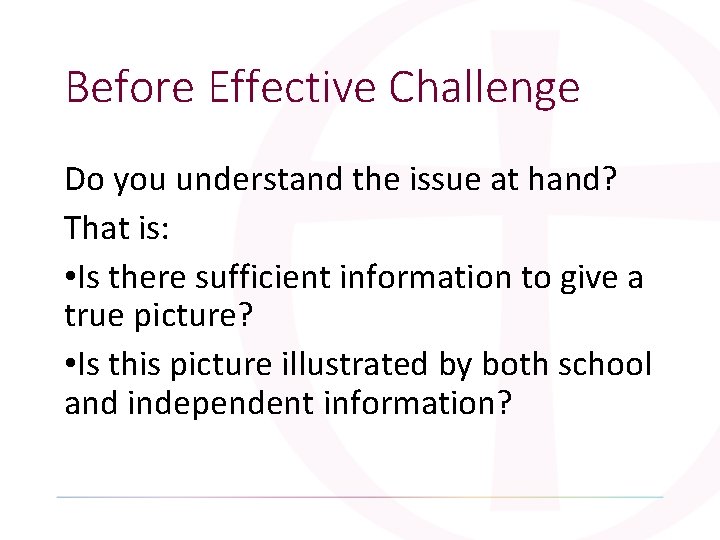
Before Effective Challenge Do you understand the issue at hand? That is: • Is there sufficient information to give a true picture? • Is this picture illustrated by both school and independent information?
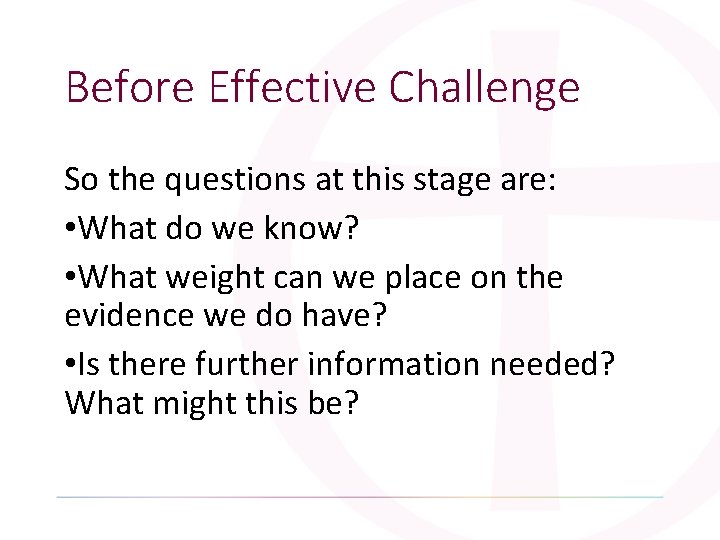
Before Effective Challenge So the questions at this stage are: • What do we know? • What weight can we place on the evidence we do have? • Is there further information needed? What might this be?
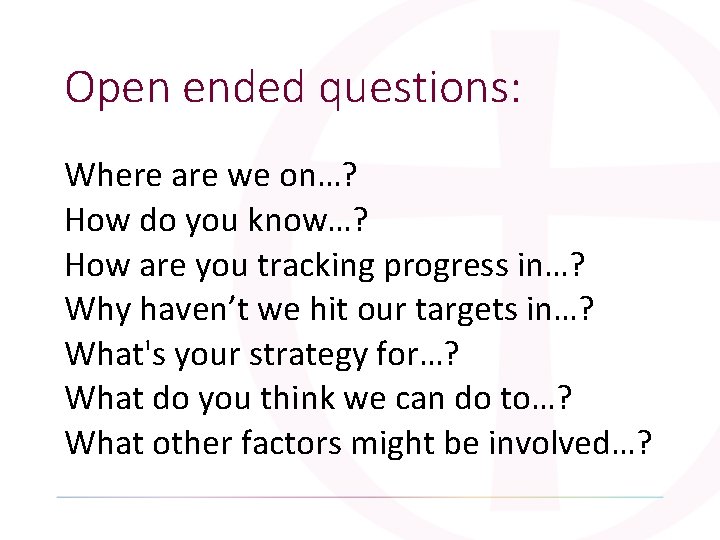
Open ended questions: Where are we on…? How do you know…? How are you tracking progress in…? Why haven’t we hit our targets in…? What's your strategy for…? What do you think we can do to…? What other factors might be involved…?
What is Effective Challenge involves asking questions, but it shouldn't feel like an interrogation. Think carefully about: • What assessment can we make now? • Does this require follow up? • What further monitoring would be needed and how do we plan this?
Getting beyond information gathering: What will the impact of … be? What are the outcomes for children as a result of …? What will have changed as a result of…? What impact will this [intervention] have?
Discussion Look at the handout being circulated. What additional information would you want from your headteacher? What questions would you ask? NB: The handout is fictional!
Holding Leaders To Account (1) Our challenge ( or questions) should be on: • Educational performance, both progress and attainment (as shown in Data, including progress and results) • Curriculum and the breadth and sequencing of this • Safeguarding/ Child protection • Behaviour (including exclusions)

Holding Leaders To Account (2) Our challenge ( or questions) should be on: • SEND provision and inclusion • Staff performance • Attendance • Finance
Ensure you ask about: • Pupil Premium children • • • (including Children Looked After and Fostered & Adopted Children) SEND children Disadvantaged/ most vulnerable Most able/ Children learning at greater depth Absence – persistent, approved, unapproved Exclusions, including fixed term
Perspectives to consider What is a day in school like for: • a Pupil Premium child? • a SEND child • a child whose native language is not English (EAL)? • a very able child?
Times of day to observe • Drop off, pick up – how are all children kept safe? How are vulnerable families supported? • Playtimes – is there something for active and reflective children? • lunchtimes • ‘Transitions’ – times when children move from one lesson/activity to another
Discussion Which part of ‘holding to account’ or ‘challenge’ do you find difficult? What support do you and your board need to be more effective?
- Slides: 13