
EFFECTIVE ASSESSMENTS 1 Session Objectives Apply concepts from
EFFECTIVE ASSESSMENTS 1
Session Objectives Apply concepts from today’s presentation in planning concrete next steps towards… • determining the purpose of assessments in monitoring student learning. • creating true value in assessing students by properly integrating them into the teaching and learning cycle. • incorporating the five elements of assessment design in creating balanced and well-designed assessment items which accurately measure what students know and can do. 2
Agenda • INTRODUCTION • DETERMINING THE PURPOSE OF AN ASSESSMENT • IMPLEMENTING VALUABLE ASSESSMENT PRACTICES • DESIGNING ACCURATE ASSESSMENTS 3
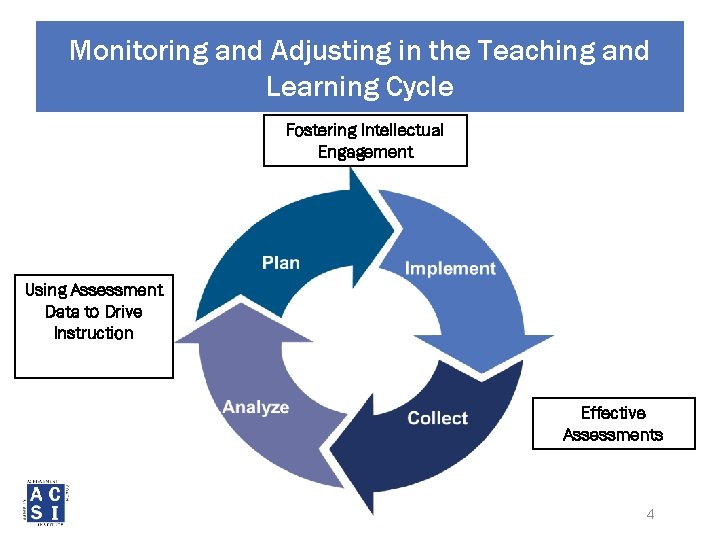
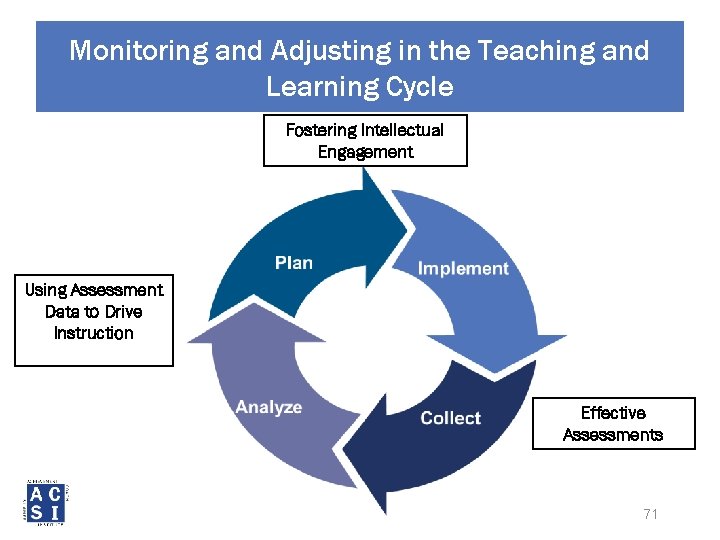
Monitoring and Adjusting in the Teaching and Learning Cycle Fostering Intellectual Engagement Using Assessment Data to Drive Instruction Effective Assessments 4
Assessments and the Learning Process Testing: Dipstick versus Learning Tool Make it Stick “There are few surer ways to raise the hackles of many students and educators than talking about testing. The growing focus over recent years on standardized assessment, in particular, has turned testing into a lightning rod for frustration over how to achieve the country's education goals. . . But if we stop thinking of testing as a dipstick to measure learning-if we think of it as practicing retrieval of learning from memory rather than “testing, ” we open ourselves to another possibility: the use of testing as a tool for learning. ” (Brown, Roediger, & Mc. Daniel, 2014) 5
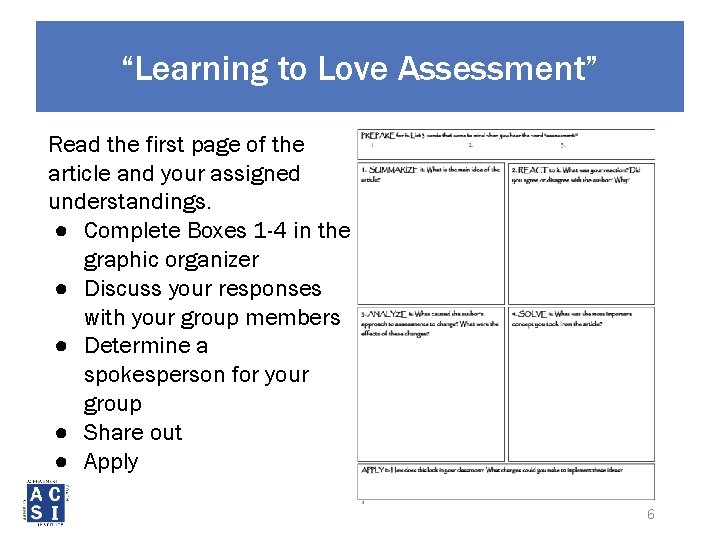
“Learning to Love Assessment” Read the first page of the article and your assigned understandings. ● Complete Boxes 1 -4 in the graphic organizer ● Discuss your responses with your group members ● Determine a spokesperson for your group ● Share out ● Apply 6
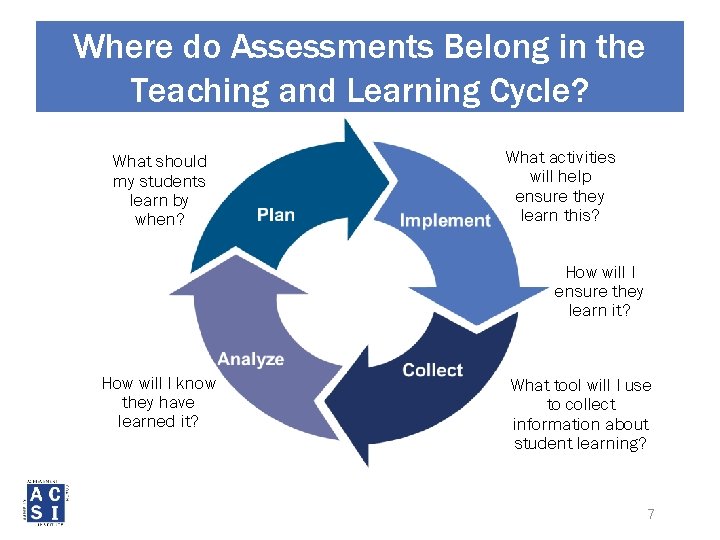
Where do Assessments Belong in the Teaching and Learning Cycle? What should my students learn by when? What activities will help ensure they learn this? How will I ensure they learn it? How will I know they have learned it? What tool will I use to collect information about student learning? 7
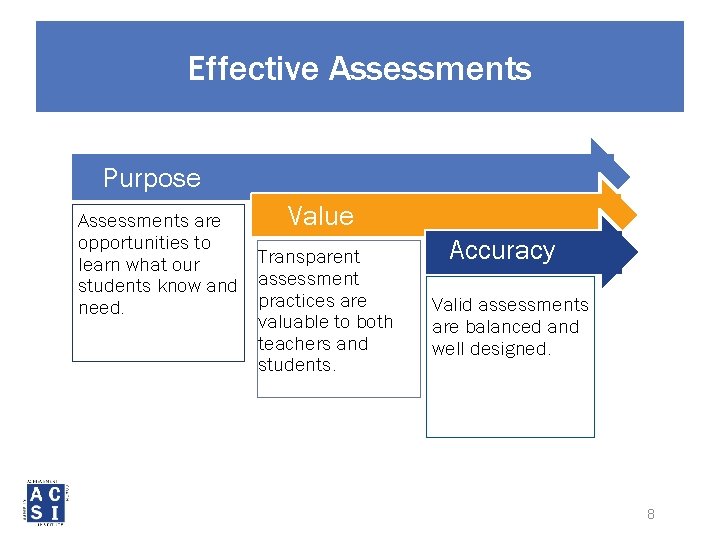
Effective Assessments Purpose Value Assessments are opportunities to Transparent learn what our students know and assessment practices are need. valuable to both teachers and students. Accuracy Valid assessments are balanced and well designed. 8
Agenda • INTRODUCTION • DETERMINING THE PURPOSE OF AN ASSESSMENT • IMPLEMENTING VALUABLE ASSESSMENT PRACTICES • DESIGNING ACCURATE ASSESSMENTS 9
The Purposes of Assessment • Think about ways you currently assess student learning throughout a unit of study. – Take one minute to write down as many as you can on separate post-its 10
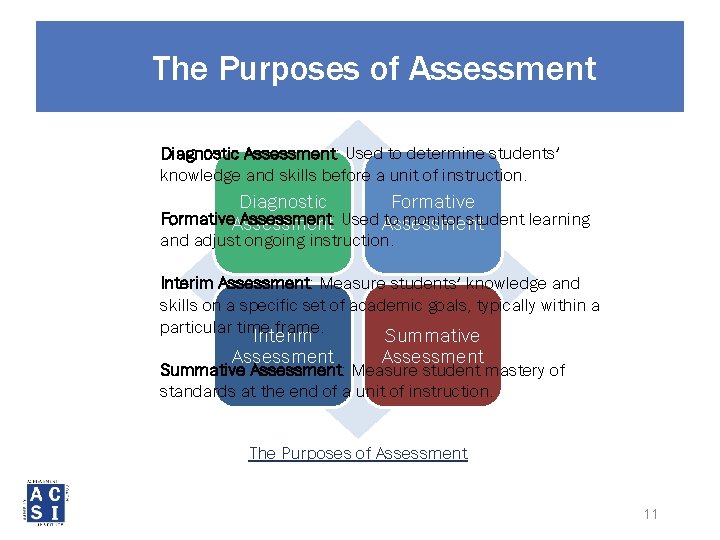
The Purposes of Assessment Diagnostic Assessment: Used to determine students’ knowledge and skills before a unit of instruction. Diagnostic Formative. Assessment: Used Assessment to monitor student learning and adjust ongoing instruction. Interim Assessment: Measure students’ knowledge and skills on a specific set of academic goals, typically within a particular time frame. Interim Assessment Summative Assessment: Measure student mastery of standards at the end of a unit of instruction. The Purposes of Assessment 11
The Purposes of Assessment Activity 1. Return to post-its. – Sort assessments into purposes 2. Reflect: – Could you have sorted them differently? How and why? 12
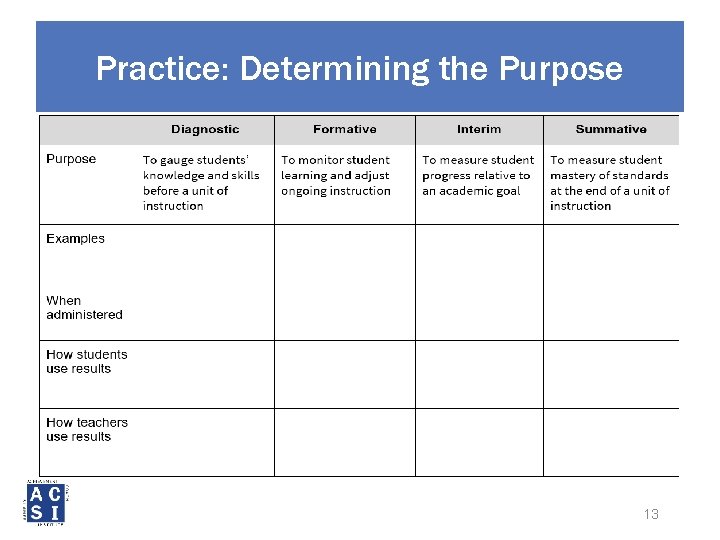
Practice: Determining the Purpose 13
Check for Understanding Using the posters around the room, and table you created, respond to this question using the handout provided: What are the purposes of assessment? 14
Key Takeaways Assessment is a tool for learning when used • to determine what students know • to determine what students need to know • to determine what students learned • to plan instruction • to help students gauge their progress 15
Agenda • INTRODUCTION • DETERMINING THE PURPOSE OF AN ASSESSMENT • IMPLEMENTING VALUABLE ASSESSMENT PRACTICES • DESIGNING ACCURATE ASSESSMENTS 16
Implementing Valuable Assessment Practices Assessment practices which create student ownership of learning include: • • Incorporating a variety of assessment approaches. Continuously providing task- involving feedback. Creating opportunities for productive struggle. Developing and utilizing common assessments when practical. 17
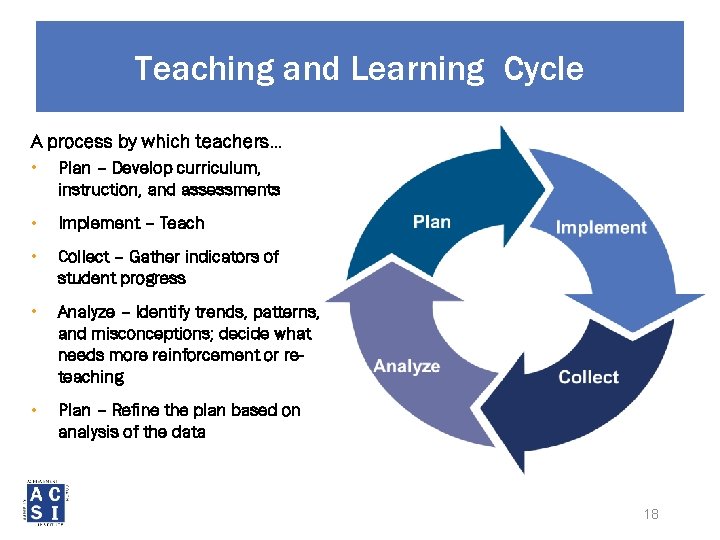
Teaching and Learning Cycle A process by which teachers… • Plan – Develop curriculum, instruction, and assessments • Implement – Teach • Collect – Gather indicators of student progress • Analyze – Identify trends, patterns, and misconceptions; decide what needs more reinforcement or reteaching • Plan – Refine the plan based on analysis of the data 18

Let’s Learn about the Olympics 19

We’re off to the Olympics! 20
What do we Know? 1. Kahoot. it 2. Type in game pin # 3. Type your first name and first letter of your last name 21
Objectives • Describe places of interest in Rio De Janeiro. • Identify current political issues and how they are impacting the games. • Identify current headlines and how they are impacting people’s interest in the games. 22
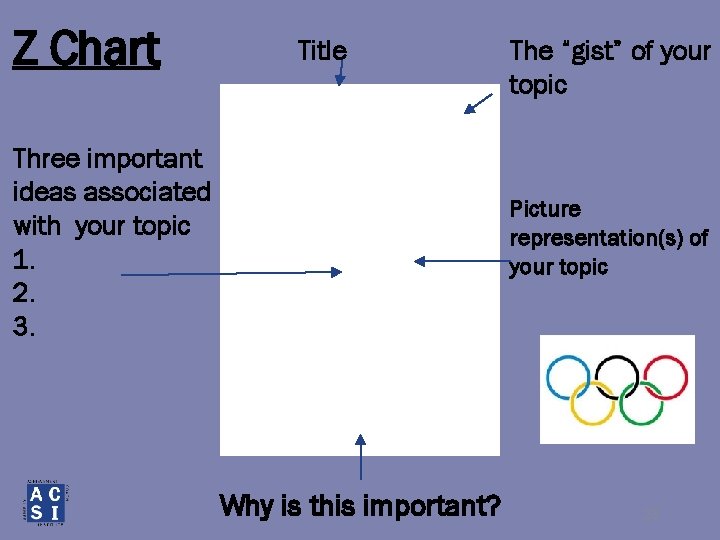
Z Chart Three important ideas associated with your topic 1. 2. 3. Title Z Why is this important? The “gist” of your topic Picture representation(s) of your topic 23
With Your Group. . . 1. Research 2. Complete “Z” Chart 3. Plan Presentation 4. Practice and Critique 5. Refine 24
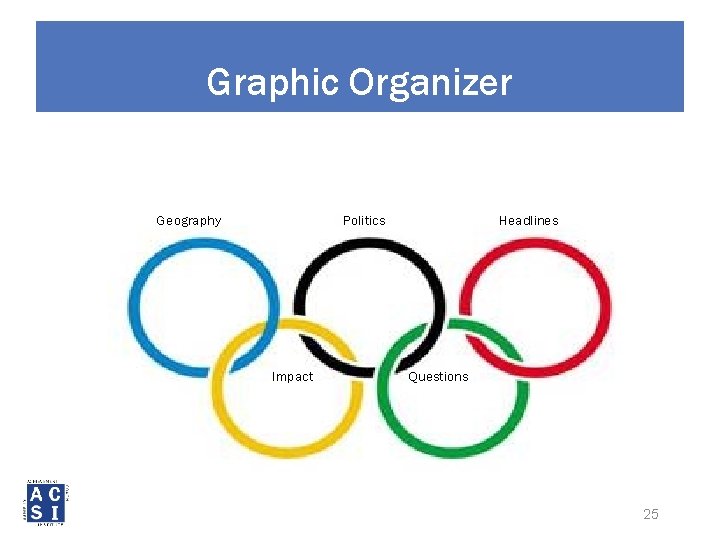
Graphic Organizer Geography Politics Impact Headlines Questions 25
Here we go! presentation gallery walk assessment 26

Show us what you know! • Write a one minute essay on what you’ve learned. Be sure to include how the politics, places of interest and headlines are impacting the games. 27
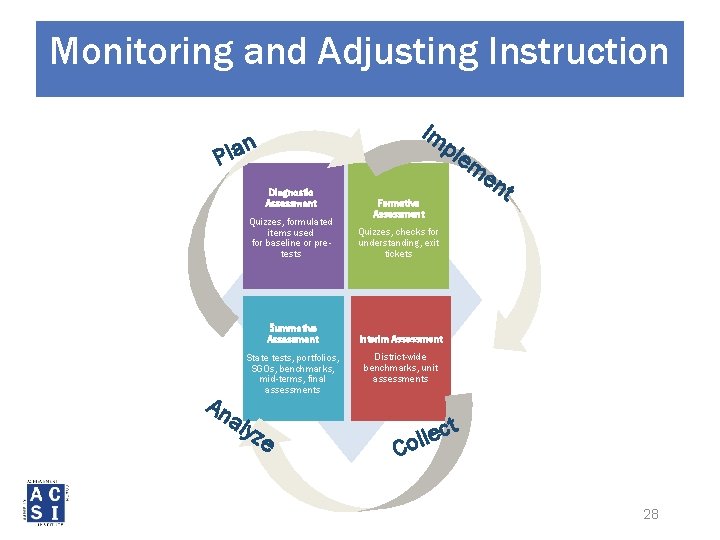
Monitoring and Adjusting Instruction Im ple lan P Diagnostic Assessment Formative Assessment Quizzes, formulated items used for baseline or pretests Quizzes, checks for understanding, exit tickets Summative Assessment Interim Assessment State tests, portfolios, SGOs, benchmarks, mid-terms, final assessments An me aly ze nt District-wide benchmarks, unit assessments t c e l l Co 28
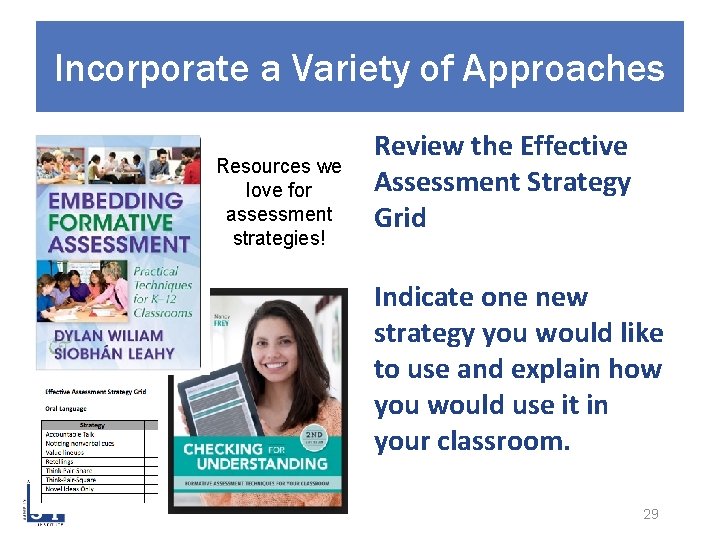
Incorporate a Variety of Approaches Resources we love for assessment strategies! Review the Effective Assessment Strategy Grid Indicate one new strategy you would like to use and explain how you would use it in your classroom. 29
Provide Valuable Feedback 30
Feedback Activity Feedback Should Be More Work For The Recipient Than The Donor – – – – Focus on the reaction of the students, not the feedback. Develop a growth mindset in your students. Design feedback as part of a system. Focus more on longer time for feedback. Concentrate on personal bests, not efforts or ranks. Make feedback into detective work. Provide comment-only grading. Use focused feedback. 31
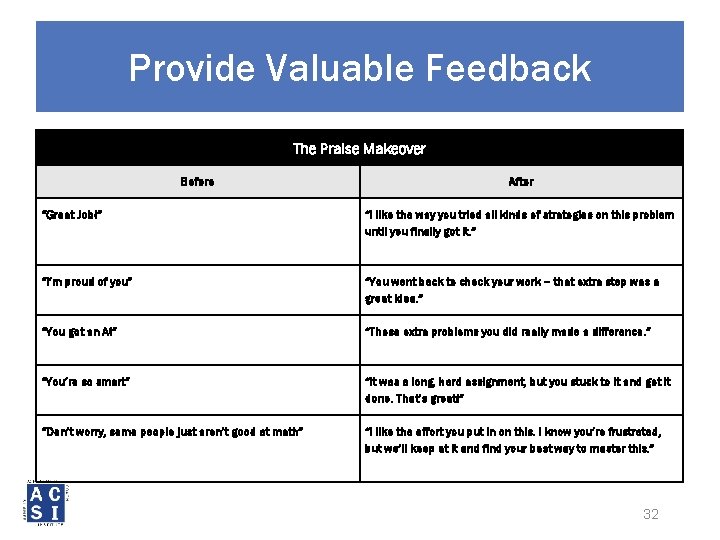
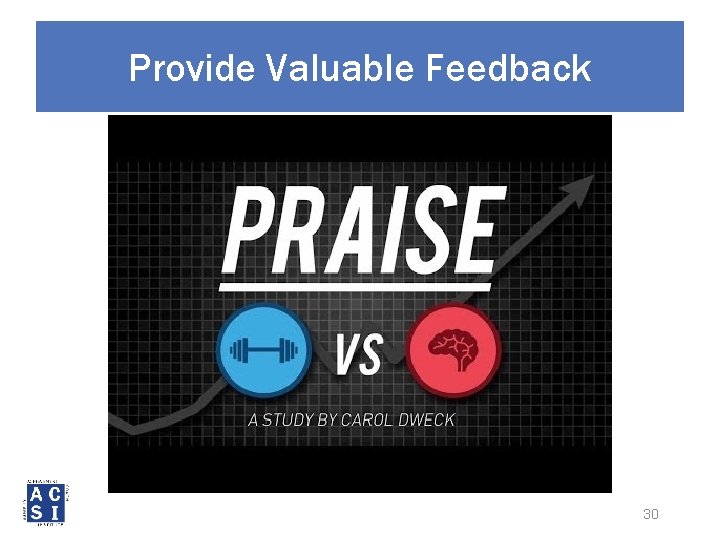
Provide Valuable Feedback The Praise Makeover Before After “Great Job!” “I like the way you tried all kinds of strategies on this problem until you finally got it. ” “I’m proud of you” “You went back to check your work – that extra step was a great idea. ” “You got an A!” “Those extra problems you did really made a difference. ” “You’re so smart” “It was a long, hard assignment, but you stuck to it and got it done. That’s great!” “Don’t worry, some people just aren’t good at math” “I like the effort you put in on this. I know you’re frustrated, but we’ll keep at it and find your best way to master this. ” 32
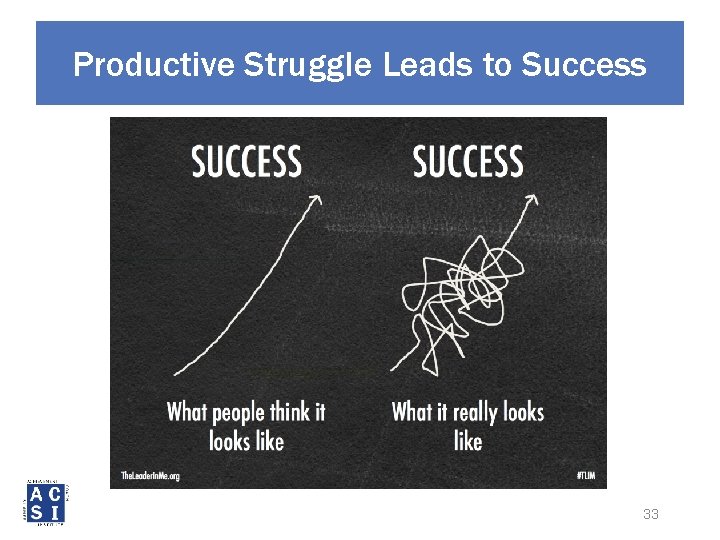
Productive Struggle Leads to Success 33
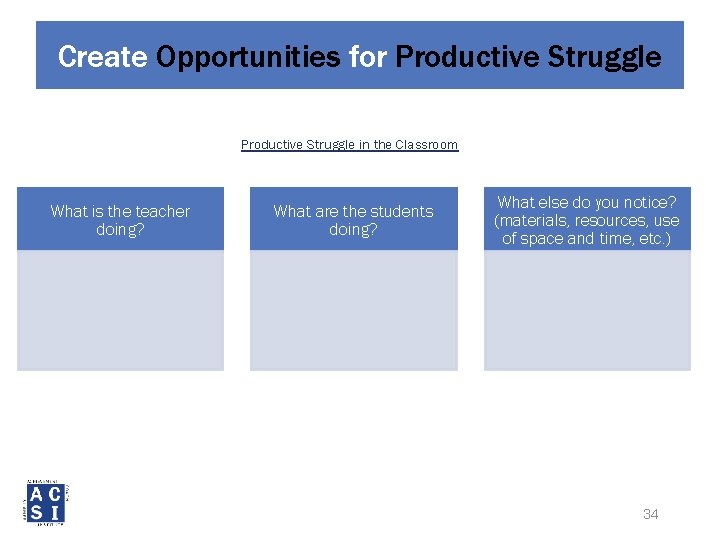
Create Opportunities for Productive Struggle in the Classroom What is the teacher doing? What are the students doing? What else do you notice? (materials, resources, use of space and time, etc. ) 34
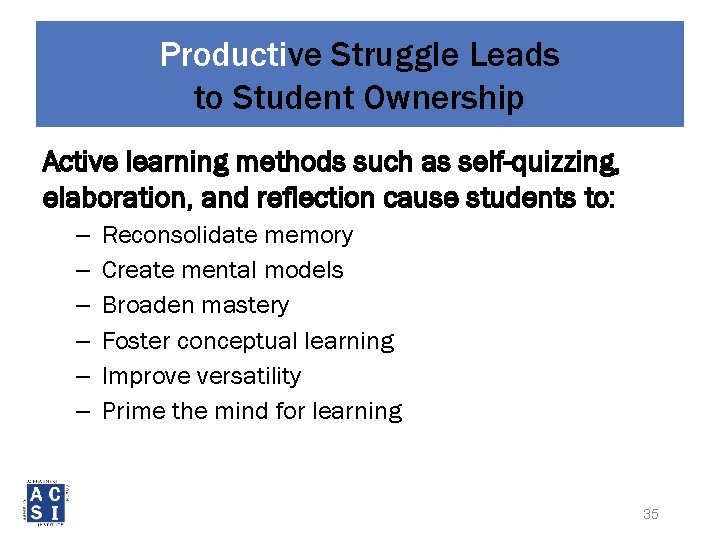
Productive Struggle Leads to Student Ownership Active learning methods such as self-quizzing, elaboration, and reflection cause students to: – – – Reconsolidate memory Create mental models Broaden mastery Foster conceptual learning Improve versatility Prime the mind for learning 35
Common Assessments Common assessments help to: – provide guidance to drive instruction in more focused way – provide consistency within departments – show students that they are being held to high expectations/standards – consolidate learning by bringing it all together 36
Check for Understanding Which assessment practice is your area of strength and which is your area for growth? Variety Feedback Productive Struggle Common Assessments 37
Key Takeaways Assessment practices which create student ownership of learning include: • • Incorporating a variety of assessment approaches. Continuously providing task-involving feedback. Creating opportunities for productive struggle. Developing and utilizing common assessments when practical. 38
Agenda • INTRODUCTION • DETERMINING THE PURPOSE OF AN ASSESSMENT • IMPLEMENTING VALUABLE ASSESSMENT PRACTICES • DESIGNING ACCURATE ASSESSMENTS 39
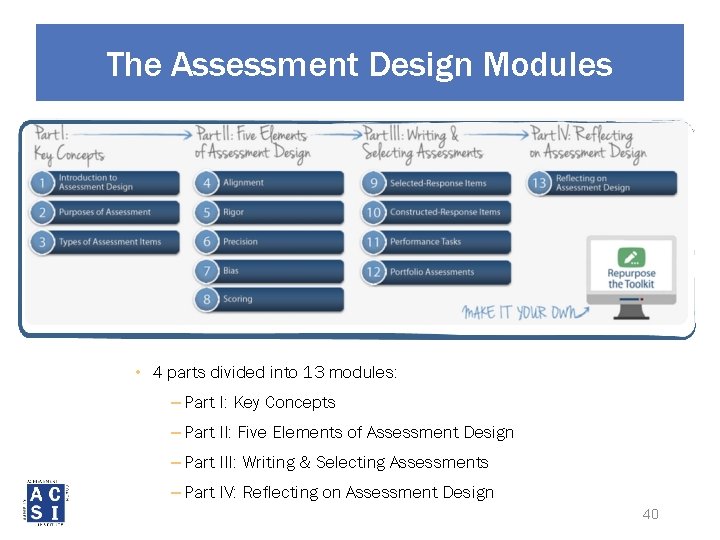
The Assessment Design Modules • 4 parts divided into 13 modules: – Part I: Key Concepts – Part II: Five Elements of Assessment Design – Part III: Writing & Selecting Assessments – Part IV: Reflecting on Assessment Design 40
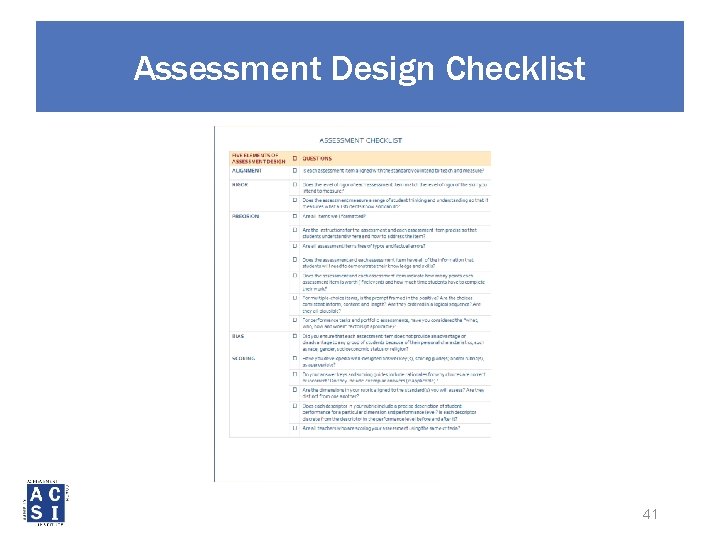
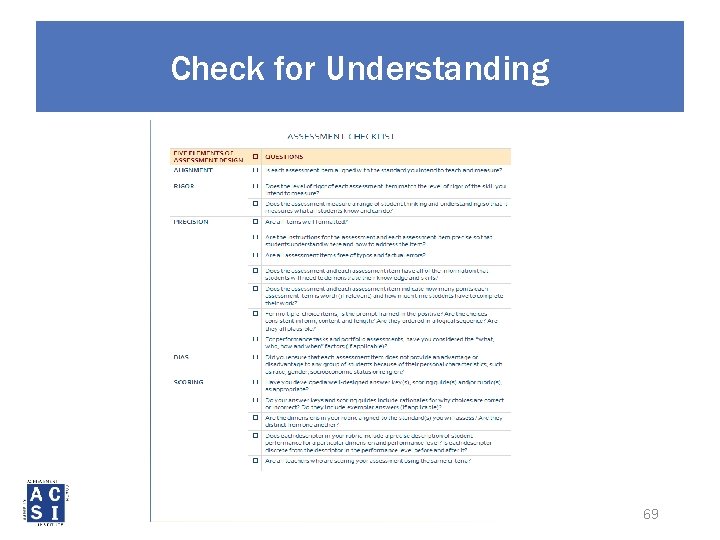
Assessment Design Checklist 41
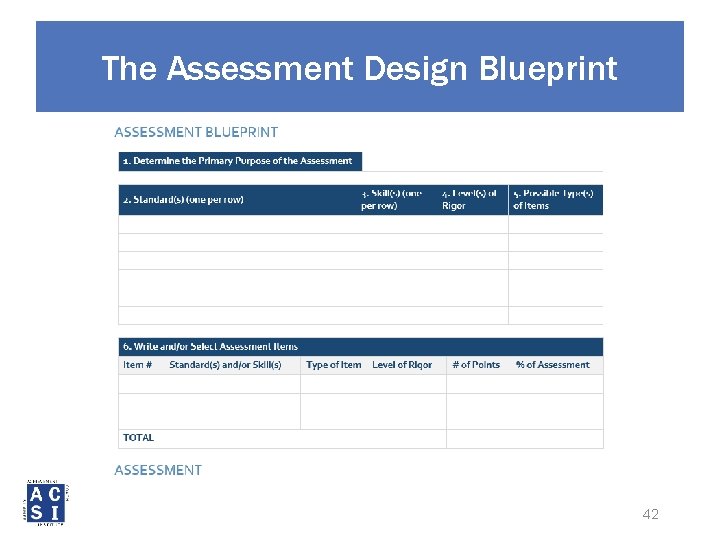
The Assessment Design Blueprint 42
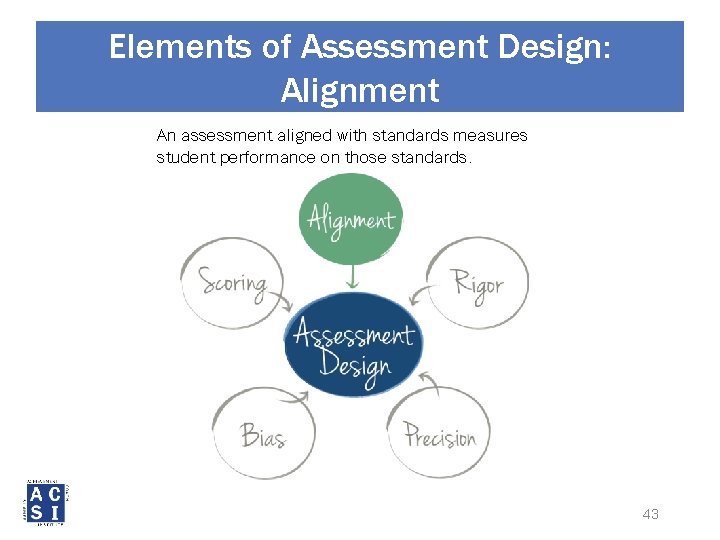
Elements of Assessment Design: Alignment An assessment aligned with standards measures student performance on those standards. 43
Alignment: Unpacking the Standard Does each assessment item align with the standard you intend to teach and measure? 1. Read the Standard. Compare and contrast treatments of the same topic, or of various perspectives, in several primary and secondary sources; analyze how they relate in terms of themes and significant historical concepts. 2. Identify and clarify meanings of terminology used within the standard. RH. 9 -10. 9: Compare and contrast treatments of the same topic, or of various perspectives, in several primary and secondary sources; analyze how they relate in terms of themes and significant historical concepts. 3. Nouns = content necessary, while verbs = what students need to do. – Verbs = compare, contrast, analyze, relate – Nouns = treatments, “same topic, ” “several sources” primary, and secondary, themes, significant historical concepts 44
Alignment: Determine the Skills and Assessment 4. Determine skills necessary for students to fully demonstrate understanding of standards. ― Summarizing articles; Compare and contrast over multiple sources; Differentiate primary and secondary sources; Recognize point of view/bias 5. Discuss rationale for each skill. 6. Identify formative, diagnostic, interim and summative assessment strategies that could be used to assess this standard. ― Non-content related articles to compare and contrast (high interest) ― Close reading activity, Station activity (analyzing documents from different sources/points of view: Abolition of Slavery, Gettysburg Address, New York Times article, Closure with question about each of the statements) ― Unit test (open ended question) ― Timed Document Based Question ― Research Paper 45
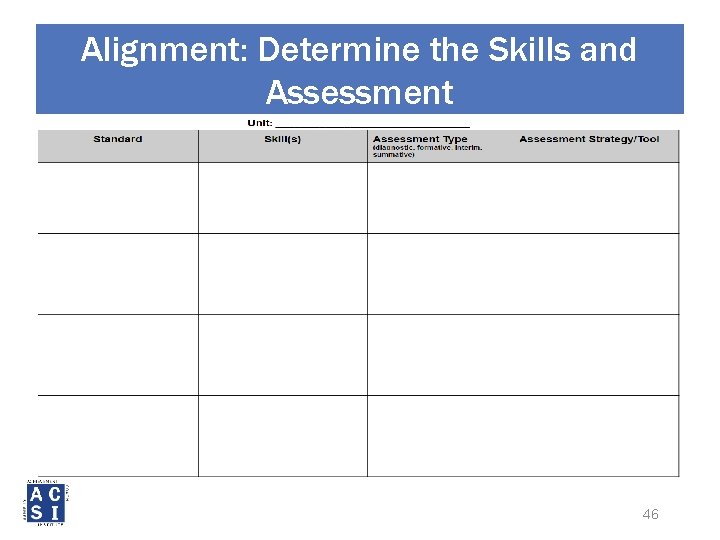
Alignment: Determine the Skills and Assessment 46
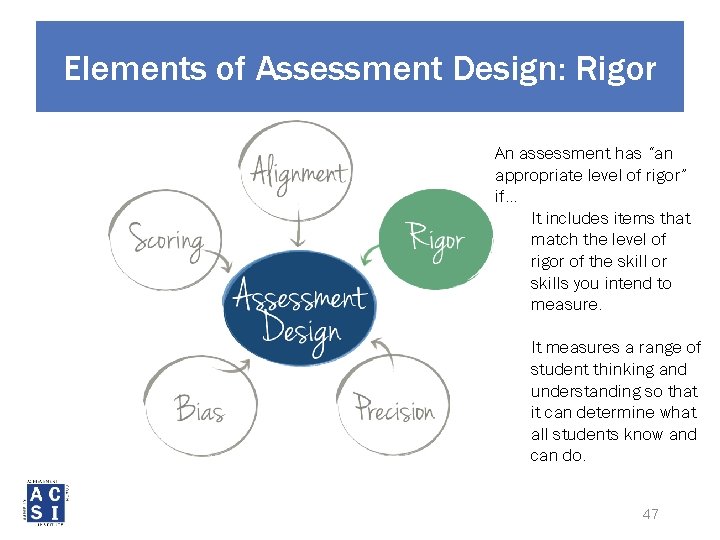
Elements of Assessment Design: Rigor An assessment has “an appropriate level of rigor” if… It includes items that match the level of rigor of the skill or skills you intend to measure. It measures a range of student thinking and understanding so that it can determine what all students know and can do. 47
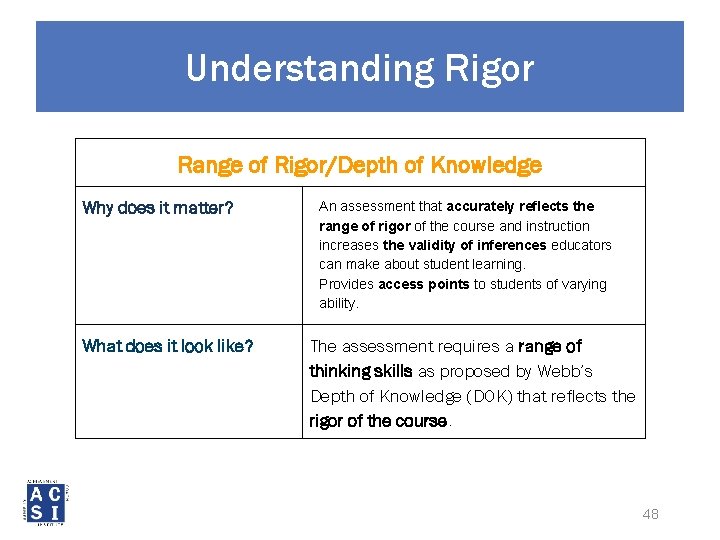
Understanding Rigor Range of Rigor/Depth of Knowledge Why does it matter? What does it look like? An assessment that accurately reflects the range of rigor of the course and instruction increases the validity of inferences educators can make about student learning. Provides access points to students of varying ability. The assessment requires a range of thinking skills as proposed by Webb’s Depth of Knowledge (DOK) that reflects the rigor of the course. 48
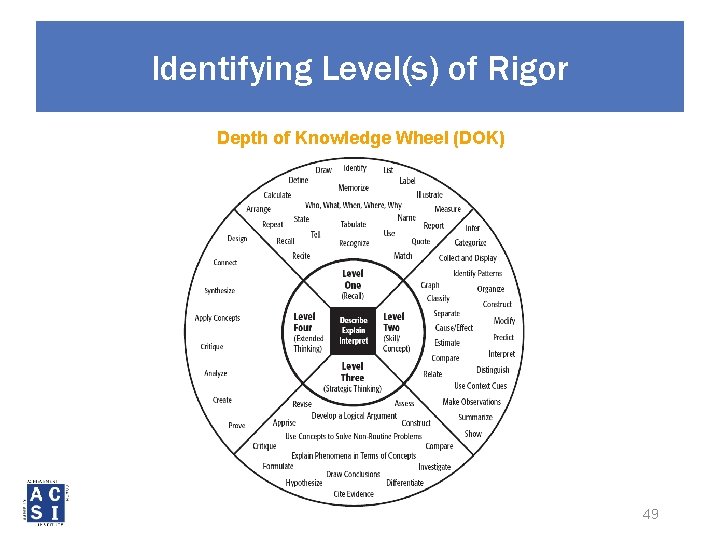
Identifying Level(s) of Rigor Depth of Knowledge Wheel (DOK) 49
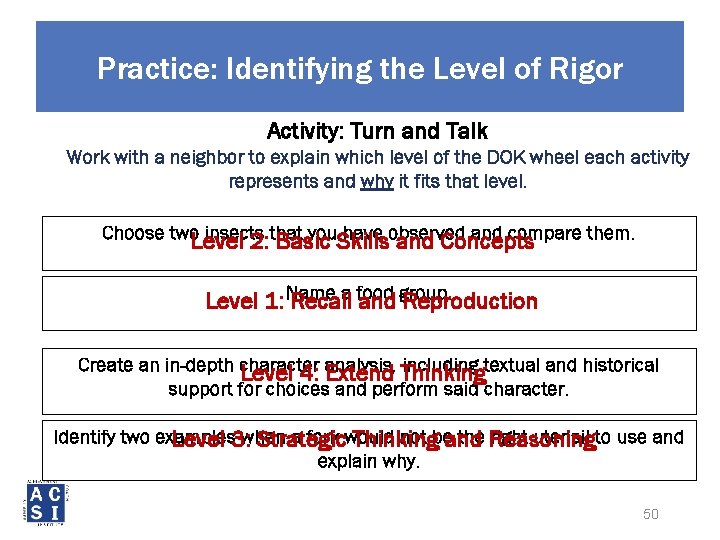
Understanding Levels of Thinking Practice: Identifying the Level of Rigor Activity: Turn and Talk Work with a neighbor to explain which level of the DOK wheel each activity represents and why it fits that level. Choose two. Level insects you. Skills have observed and compare them. 2: that Basic and Concepts Level 1: Name Recalla food and group. Reproduction Create an in-depth character including textual and historical Level 4: analysis, Extend Thinking support for choices and perform said character. Identify two examples a fork would not beand the Reasoning right utensil to use and Level 3: when Strategic Thinking explain why. 50
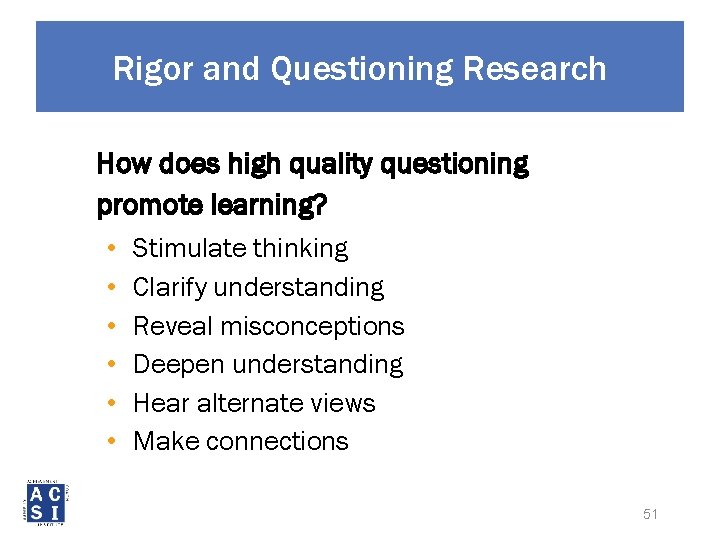
Rigor and Questioning Research How does high quality questioning promote learning? • • • Stimulate thinking Clarify understanding Reveal misconceptions Deepen understanding Hear alternate views Make connections 51
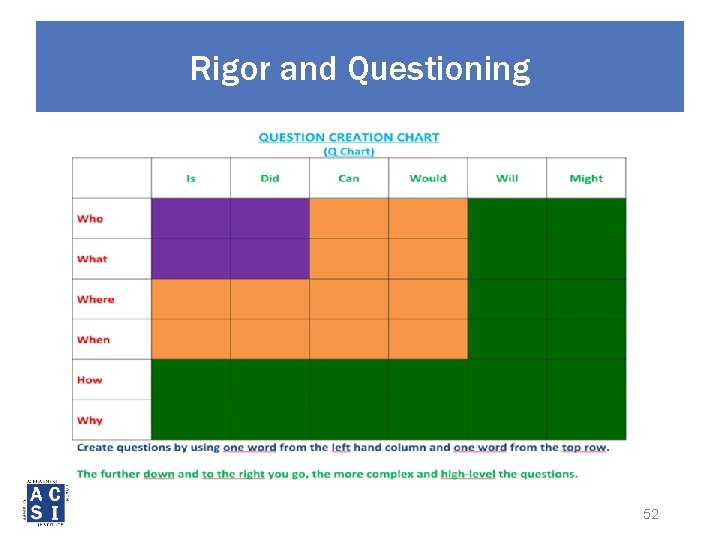
Rigor and Questioning 52
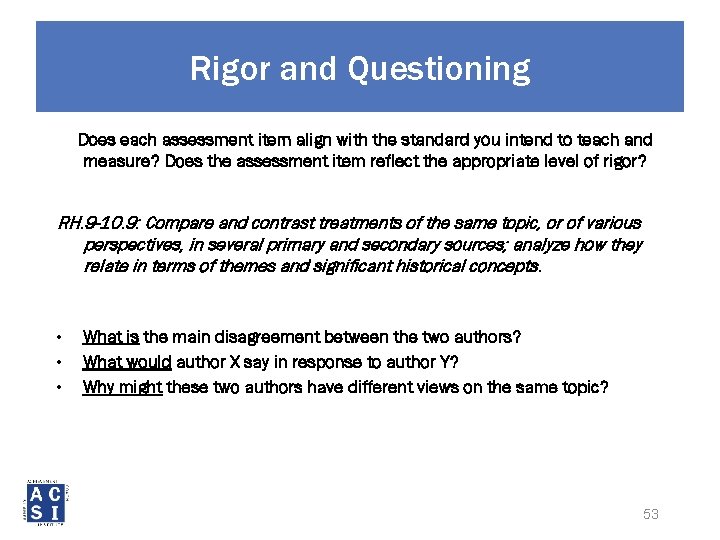
Rigor and Questioning Does each assessment item align with the standard you intend to teach and measure? Does the assessment item reflect the appropriate level of rigor? RH. 9 -10. 9: Compare and contrast treatments of the same topic, or of various perspectives, in several primary and secondary sources; analyze how they relate in terms of themes and significant historical concepts. • • • What is the main disagreement between the two authors? What would author X say in response to author Y? Why might these two authors have different views on the same topic? 53
Rigor and Questioning Activity Group Activity: Working in your small group, create 3 - 4 questions you could use to assess the standard you unpacked on the Alignment Tool. Questions should represent a range of rigor. Use the Q Chart and the Depth Knowledge Wheel to help with this. 54
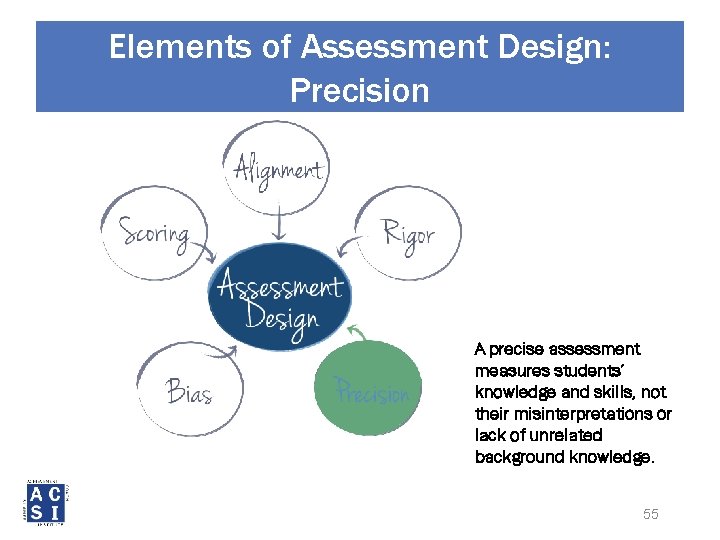
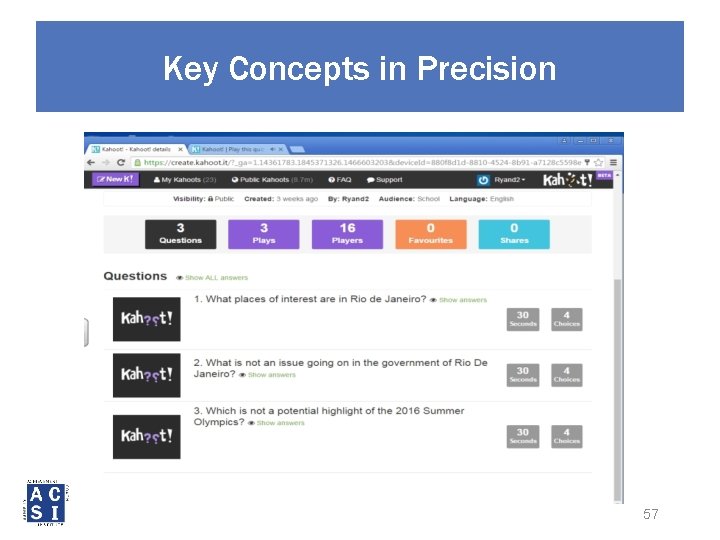
Elements of Assessment Design: Precision A precise assessment measures students’ knowledge and skills, not their misinterpretations or lack of unrelated background knowledge. 55
Key Concepts in Precision Well-designed assessments… 1. are formatted in a logical order 2. do NOT contain typos or factual errors 3. contain accurate and clear instructions 4. include all of the information students need to demonstrate their knowledge and skills 56
Key Concepts in Precision 57
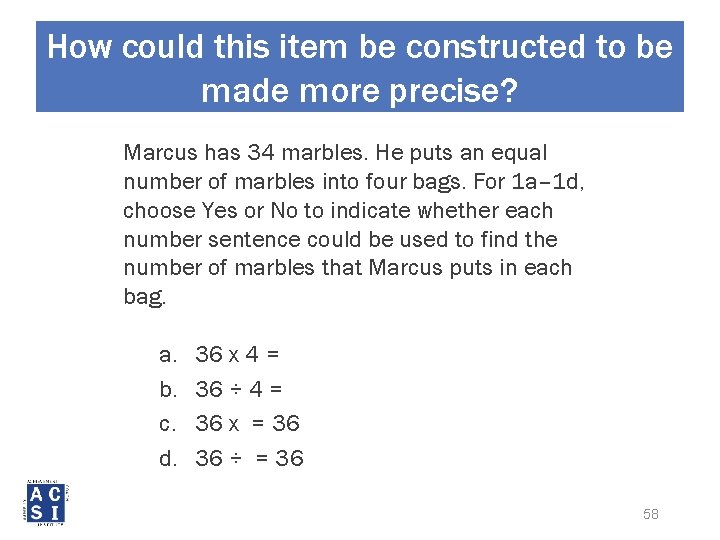
How could this item be constructed to be made more precise? Marcus has 34 marbles. He puts an equal number of marbles into four bags. For 1 a– 1 d, choose Yes or No to indicate whether each number sentence could be used to find the number of marbles that Marcus puts in each bag. a. b. c. d. 36 x 4 = 36 ÷ 4 = 36 x = 36 36 ÷ = 36 58
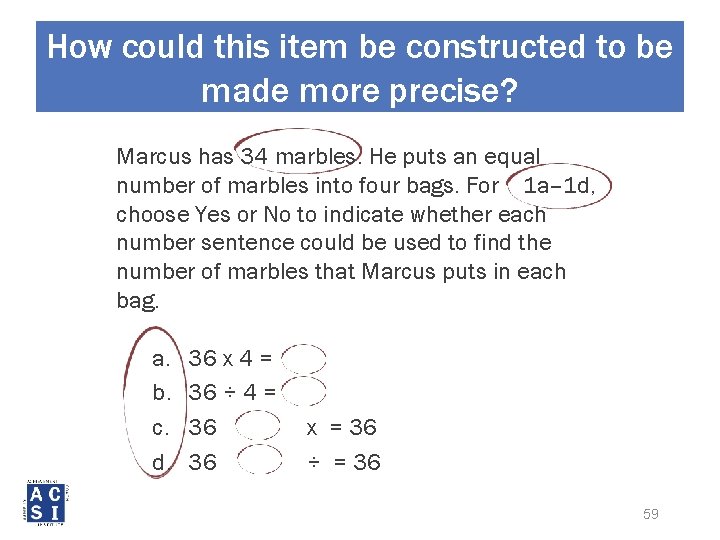
How could this item be constructed to be made more precise? Marcus has 34 marbles. He puts an equal number of marbles into four bags. For 1 a– 1 d, choose Yes or No to indicate whether each number sentence could be used to find the number of marbles that Marcus puts in each bag. a. b. c. d. 36 x 4 = 36 ÷ 4 = 36 36 x = 36 ÷ = 36 59
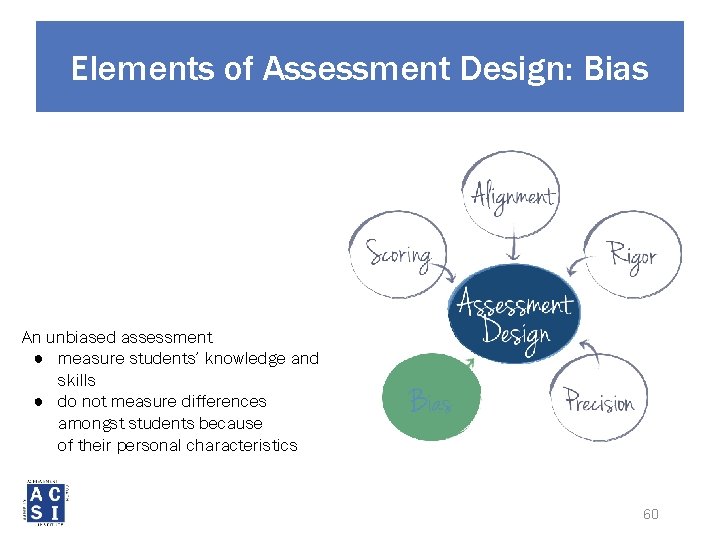
Elements of Assessment Design: Bias An unbiased assessment ● measure students’ knowledge and skills ● do not measure differences amongst students because of their personal characteristics 60
Is this an Example of Bias? Which of the following measures could be the length of a typical hole in a golf course? a. 300 inches b. 300 feet c. 300 yards d. 300 miles 61
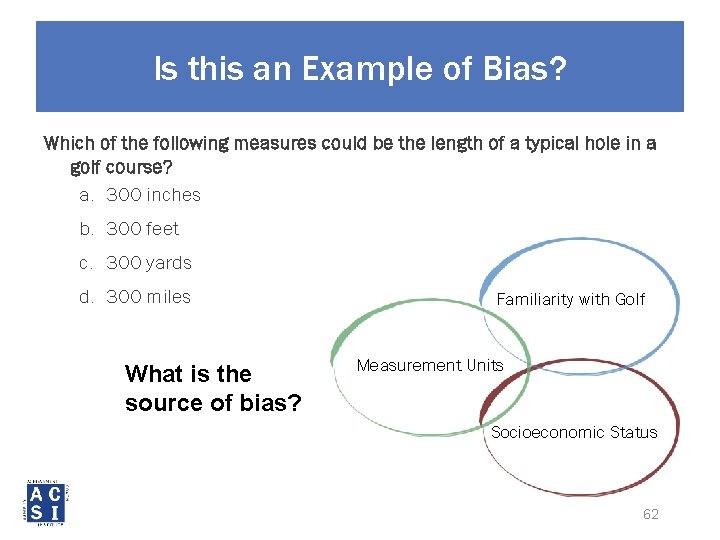
Is this an Example of Bias? Which of the following measures could be the length of a typical hole in a golf course? a. 300 inches b. 300 feet c. 300 yards d. 300 miles What is the source of bias? Familiarity with Golf Measurement Units Socioeconomic Status 62
Detecting Bias • Remember, bias does not mean that assessment items cannot include any references to topics that may interest some groups of students and not others. That would make designing assessments nearly impossible. • It’s difficult to detect your own bias. 63
Precision and Bias Activity Go back to the questions you created in the previous activity. Trade. Evaluate each question for precision and bias. Were any of the questions biased in any way? How could they be improved? 64
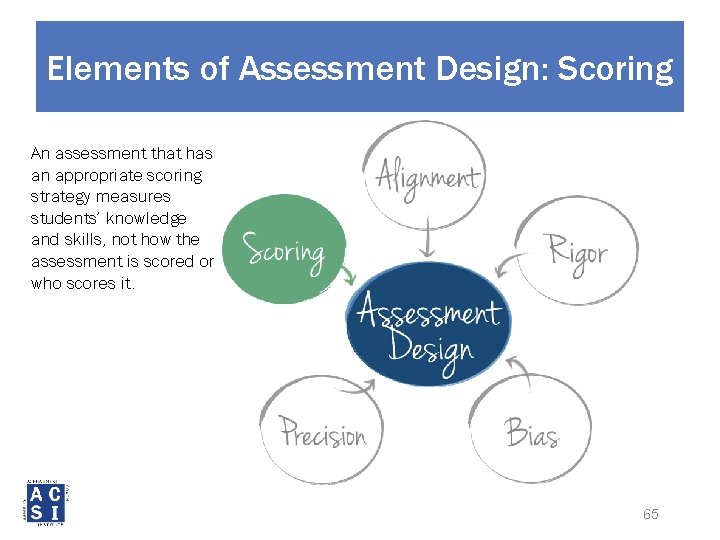
Elements of Assessment Design: Scoring An assessment that has an appropriate scoring strategy measures students’ knowledge and skills, not how the assessment is scored or who scores it. 65
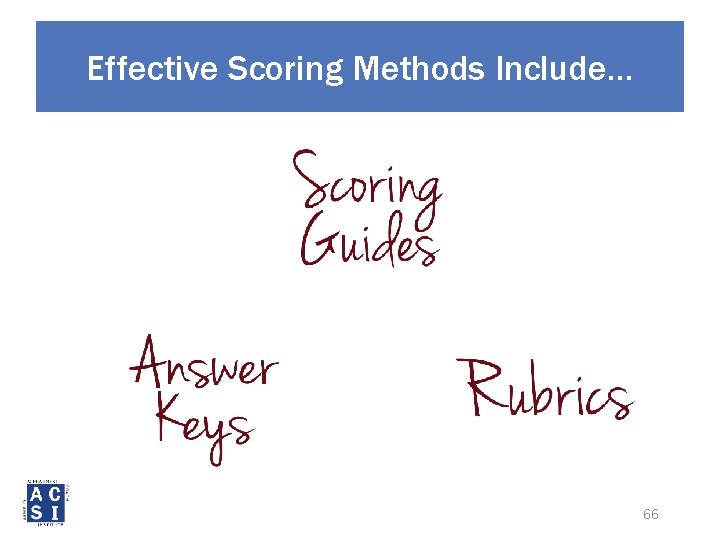
Effective Scoring Methods Include… 66
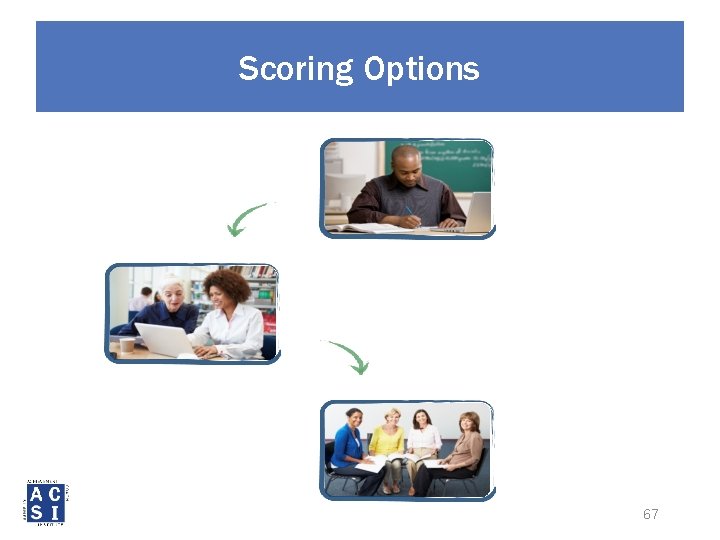
Scoring Options 67
Scoring Options Go back to the list of assessment strategies you created earlier. Choose one and decide the best possible scoring option. Be prepared to explain why you chose this scoring option. How could another scoring option change the data? 68
Check for Understanding 69
Key Takeaways Assessments should ● align to standards. ● match the level of rigor of the standard and include a range of rigor. ● be constructed with precision. ● be checked for bias. ● utilize an appropriate scoring method. 70
Monitoring and Adjusting in the Teaching and Learning Cycle Fostering Intellectual Engagement Using Assessment Data to Drive Instruction Effective Assessments 71
Tying it all Together If you were riding in an elevator with your superintendent, a parent, a student and a colleague, and they asked you about the assessment cycle, what would you say? Write your one-minute explanation. 72
Closure 5 R’s of Reflecting • Restate: What did you learn? • React: What is your opinion? • Relate: How does it relate to you? • Respond: With a question. • Realize: Why is it important? 73
Closure Set a SMART Goal for your practice Specific Measurable Action-Oriented Realistic Time-bound 74
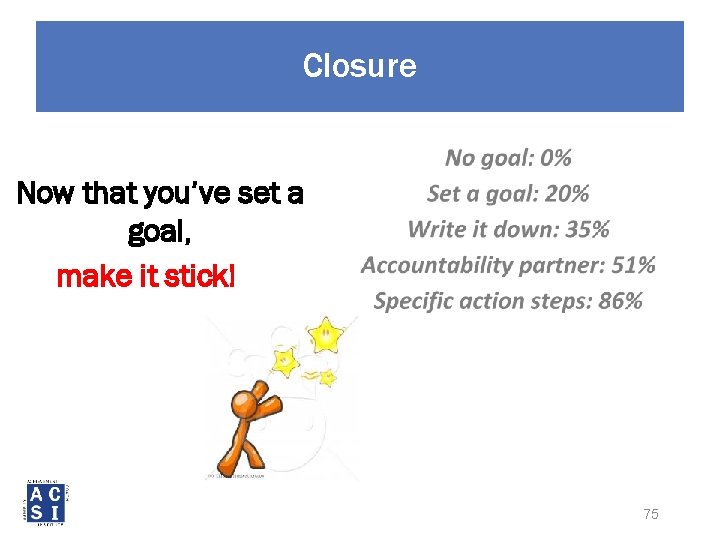
Closure Now that you’ve set a goal, make it stick! 75
- Slides: 75