
Effective Assessment Practices What Does It Look Like










- Slides: 61
Effective Assessment Practices: What Does It Look Like In The Classroom?
Old: Assessment means testing. New: Assessment is a continuous and dynamic process of communication between teachers, students, and parents regarding students’ achievement and is embedded in everything the teacher and students do all day, every day. Old: Administrators control achievement data and filter it down to teachers, parents, and students. New: Achievement data is directly available to teachers, parents, and students.
Old: Teachers set standards. Students may not know or understand grading practices. New: Teachers set standards together with students and students have a clear understanding of grading practices. Old: The target moves from grade to grade and teacher to teacher. New: Teachers work together within and across grade levels to ensure that standards are consistent.
Old: The teacher grades papers. Students get papers back with a grade, marks, and/or comments days, or weeks later (or never). New: The teacher only grades summative assessments and discusses results with students in a timely manner. Students assess their own and each other’s formative work together with the teacher. Old: Attitude, effort, late or missing assignments, group work, homework, and extra credit are all factored into a student’s grades. New: Only individual, subject-specific assessment data is used to determine grades. Other factors are reported separately.
Old: Assessment is used to sort students. New: Assessment is used to identify student strengths and weaknesses and to help students set goals for what they need to do next. Old: Year after year the same students are successful and the same students aren’t. Unsuccessful students seldom close the achievement gap that separates them from those who are performing at grade level. New: Effective assessment practices can improve grade equivalent scores by several grade levels or up
A New Vision of Assessment The expectation that every student knows his or her current level of achievement in each subject and also knows what he or she needs to do next to maintain or improve his or her level of achievement. A shift in focus from teaching to learning.
Some kids come to school to slay the dragon… some come to be slain. Rick Stiggins
Why should you believe that there is a connection between student -involved assessment practices and student achievement?
Black & Wiliam (1998) International Research Review 0. 5 to 1. 0 Standard Deviation Score Gain Largest Gain for Low Achievers Bloom (1984) Mastery Learning Research 1. 0 to 2. 0 S. D. Gain Rivals Impact of One-on-One Tutoring Rodriguez (2004) 0. 5 to 1. 8 S. D. Gain Effect of Reducing Class Size 0. 2 S. D. Gain
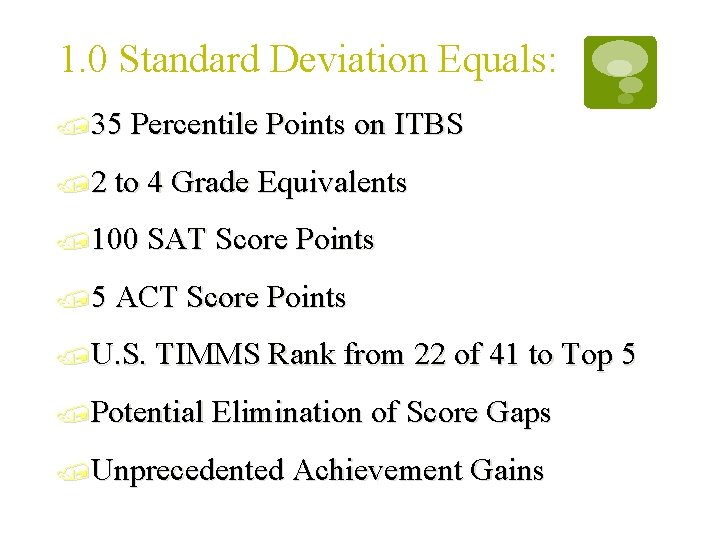
1. 0 Standard Deviation Equals: /35 Percentile Points on ITBS /2 to 4 Grade Equivalents /100 SAT Score Points /5 ACT Score Points /U. S. TIMMS Rank from 22 of 41 to Top 5 /Potential Elimination of Score Gaps /Unprecedented Achievement Gains
Student-involved assessment practices build student confidence, increase the achievement of all students and have the greatest impact on low-achieving students.
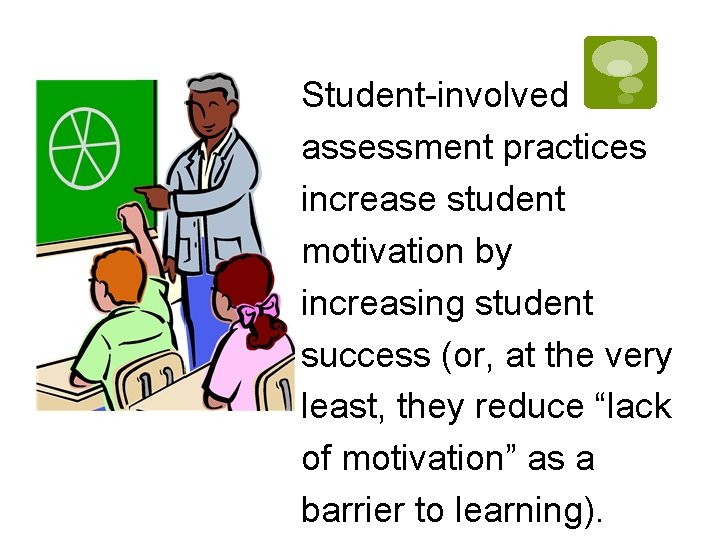
Student-involved assessment practices increase student motivation by increasing student success (or, at the very least, they reduce “lack of motivation” as a barrier to learning).
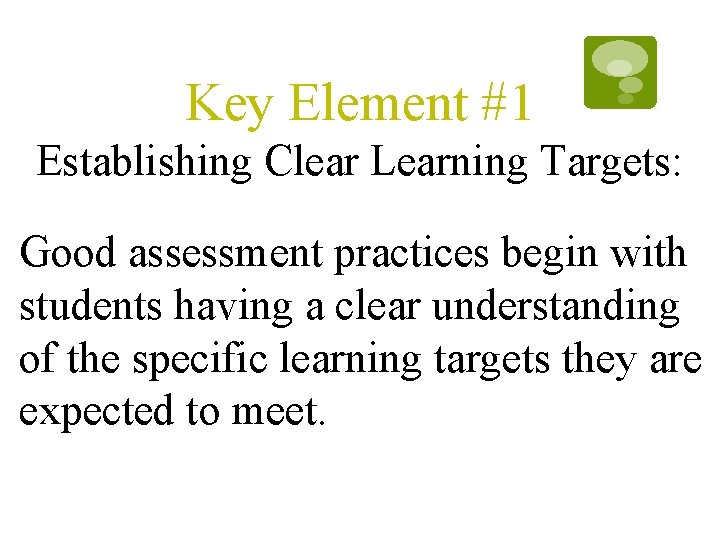
Key Element #1 Establishing Clear Learning Targets: Good assessment practices begin with students having a clear understanding of the specific learning targets they are expected to meet.
“Students can hit any target that is clear and that holds still for them. ” Rick Stiggins
The learning targets need to be clear to the teacher, students, and parents: • What do students need to know/do? • How well do they need to know/do it? • How will you know they know? • How will you get them there? • What will you do when they fail?
Procedural directions are not the same thing as learning targets.
Understanding by Design (Ub. D) is a great model for developing clearning targets. • Essential Questions • Enduring Understandings • Vocabulary • Activities • Assessments (evidence of learning) Grant Wiggins
To clarify the learning target use: • Examples and non-examples • Models • Rubrics • Scoring guides • Test specification guides
Key Element #2 Engaging Students in Formative Assessment Activities: Throughout a unit of instruction students engage in practice and risktaking activities and receive feedback that will help them move toward meeting the learning targets.
Every student needs to be able to answer the question, “What do I need to do next to improve my own work? ”
Students need to be given multiple “next” opportunities to practice, experiment, and, ultimately, show growth.
Good feedback is less like a grade and more like advice.
What the Research Says: • minimum 7% achievement gain (Lysakowski & Walberg, 1981) • maximum 41% achievement gain (Kumar, 1991) • average 35% achievement gain (nine studies, 1981 -1999)
The teacher provides opportunities for students to assess anonymous samples of work, their own work, and each other’s work.
The teacher creates an atmosphere of trust within the classroom where students feel free to take risks.
Key Element #3 Using High Quality Summative Assessments: The teacher uses a variety of high quality assessments that best measures the learning of their students.
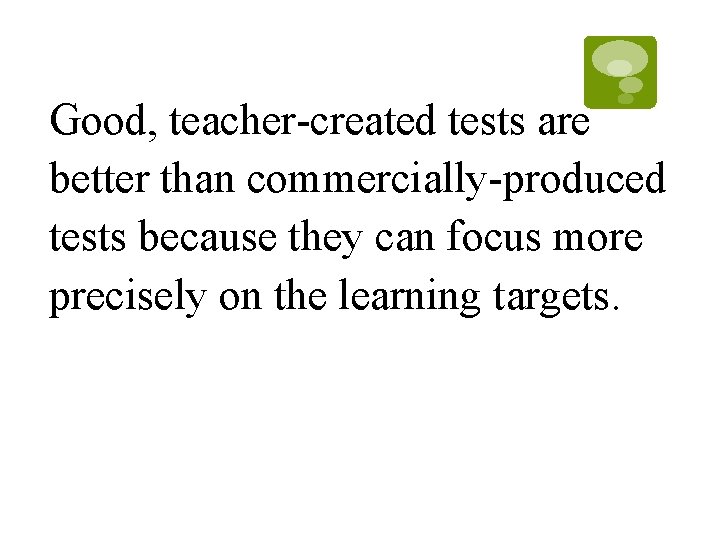
Good, teacher-created tests are better than commercially-produced tests because they can focus more precisely on the learning targets.
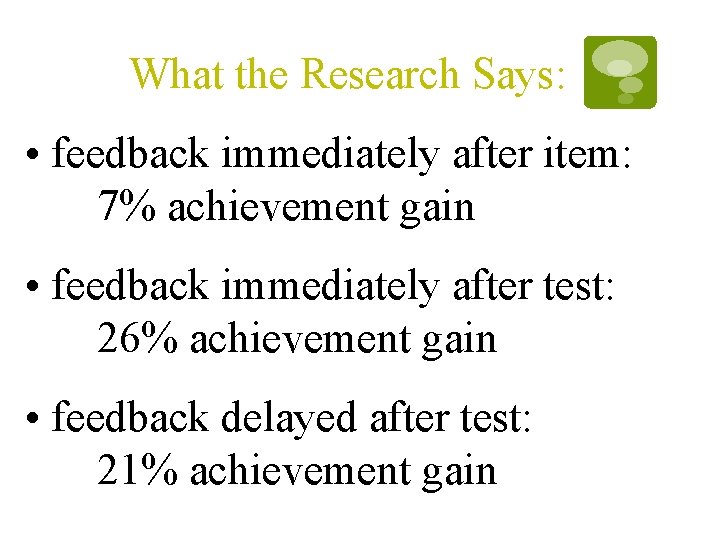
What the Research Says: • feedback immediately after item: 7% achievement gain • feedback immediately after test: 26% achievement gain • feedback delayed after test: 21% achievement gain
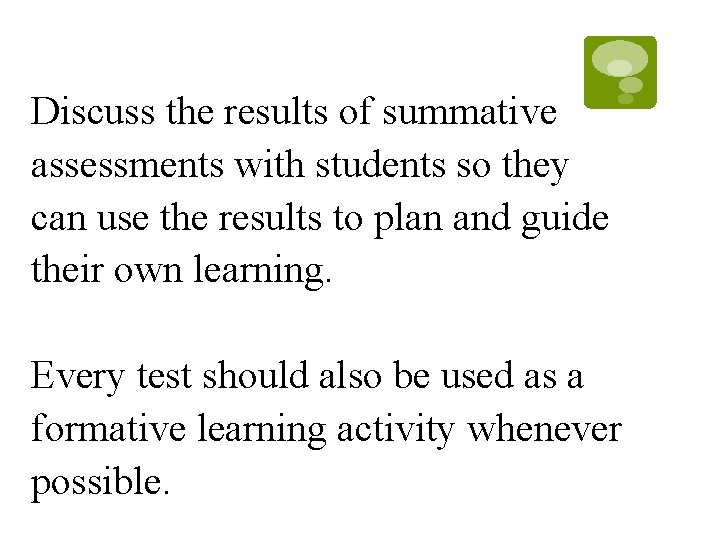
Discuss the results of summative assessments with students so they can use the results to plan and guide their own learning. Every test should also be used as a formative learning activity whenever possible.
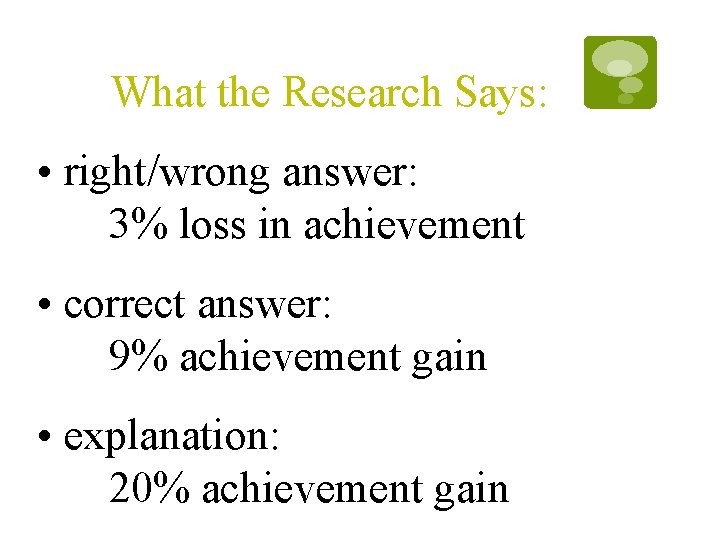
What the Research Says: • right/wrong answer: 3% loss in achievement • correct answer: 9% achievement gain • explanation: 20% achievement gain
What do you teach that you don’t want 100% of your students to learn?
Key Element #4 Involving Students in Goal. Setting and Reflection: Students set goals and reflect on their learning as it progresses and communicate their understanding to others.
“Self assessment by pupils, far from being a luxury, is in fact an essential component of formative assessment. ” Black & Wiliam, 1998
Students must be taught how to set realistic goals.
A goal without a plan is just a wish.
Students must be held accountable for making progress toward meeting their goals.
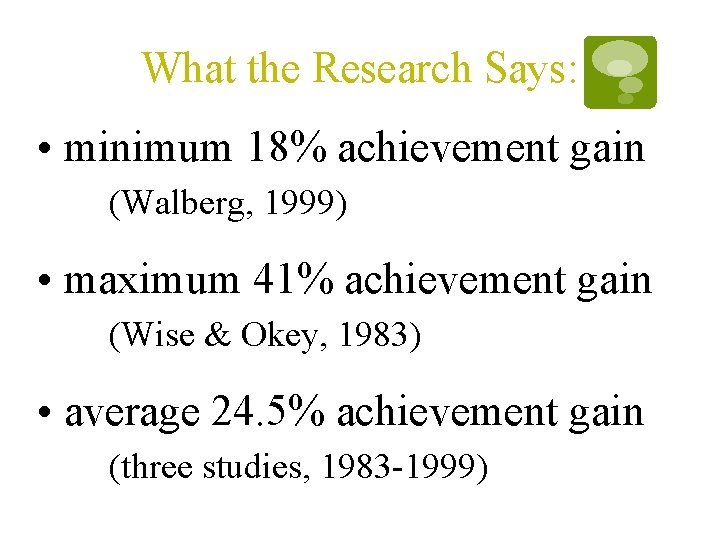
What the Research Says: • minimum 18% achievement gain (Walberg, 1999) • maximum 41% achievement gain (Wise & Okey, 1983) • average 24. 5% achievement gain (three studies, 1983 -1999)
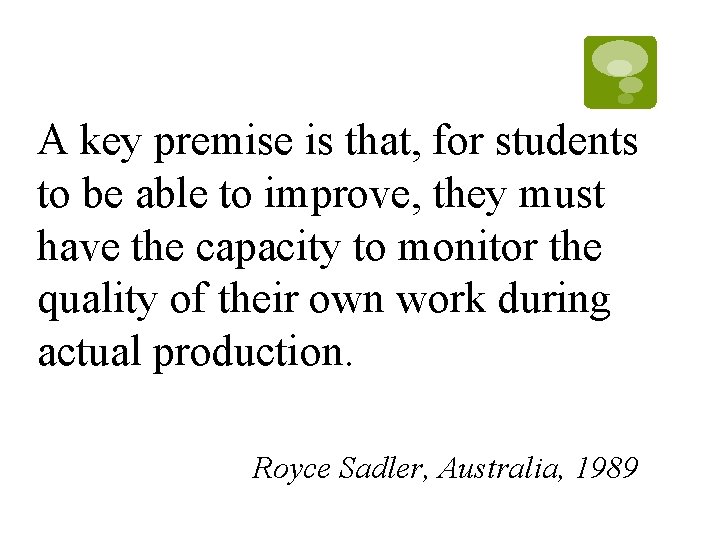
A key premise is that, for students to be able to improve, they must have the capacity to monitor the quality of their own work during actual production. Royce Sadler, Australia, 1989
A portfolio without student reflections is just a scrapbook. Ruth Sutton
Key Element #6 Communicating About Student Achievement: Students are the primary users of assessment information and, as such, they regularly communicate about their achievement.
When students keep portfolios with self reflections they can see the quality of their work change over time. Result? Success is within reach.
Key Element #5 Using Fair Grading Practices: Grades are based on ample evidence that accurately reflects a student’s level of achievement in specific subjects, performances, products, or skills.
What does a “C” mean?
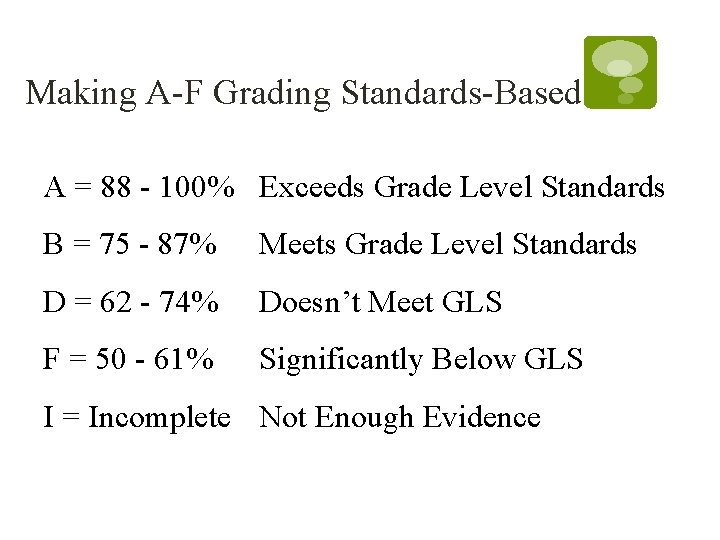
Making A-F Grading Standards-Based A = 88 - 100% Exceeds Grade Level Standards B = 75 - 87% Meets Grade Level Standards D = 62 - 74% Doesn’t Meet GLS F = 50 - 61% Significantly Below GLS I = Incomplete Not Enough Evidence
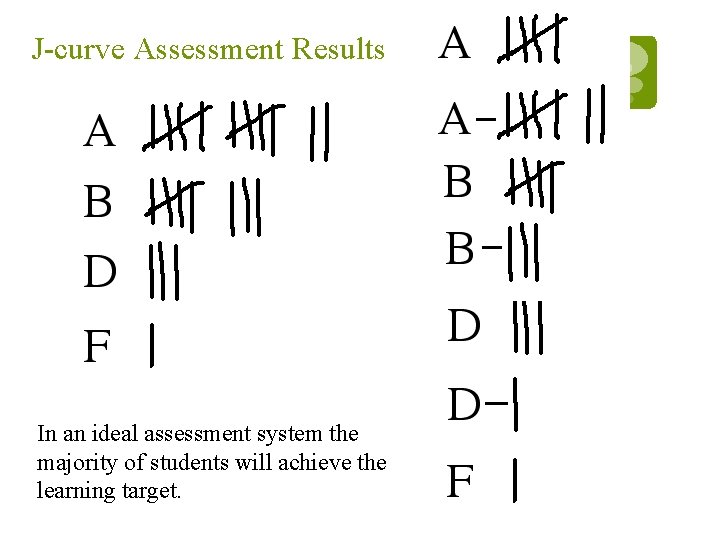
J-curve Assessment Results In an ideal assessment system the majority of students will achieve the learning target.
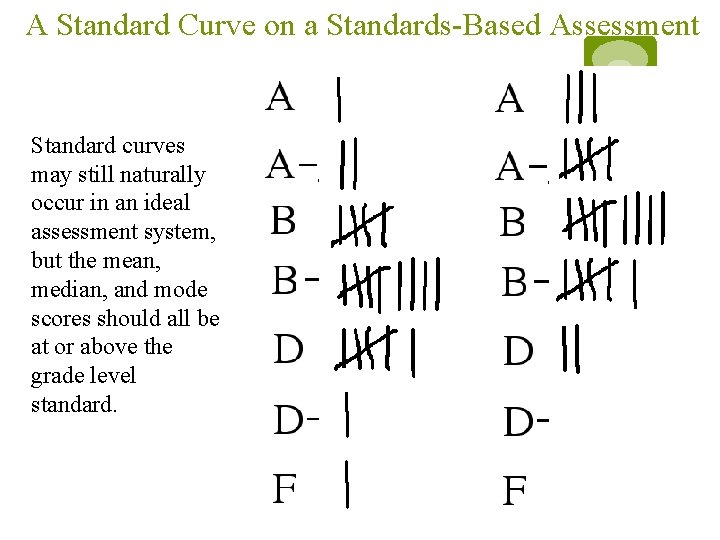
A Standard Curve on a Standards-Based Assessment Standard curves may still naturally occur in an ideal assessment system, but the mean, median, and mode scores should all be at or above the grade level standard.
In a standards based system grades are criterion referenced and not norm referenced. Student achievement is measured against a standard - students are not compared to each other.
Grades are motivating for some students.
A student’s grades belong to that student.
Students need to understand classroom grading practices.
Teach students the connection between effort and achievement.
Put grades into your gradebook in pencil - not in permanent ink.
Get rid of the zero score.
All grading is subjective.
All grades must be justifiable. (measurement theory says that you need at least 3 pieces of good evidence for triangulation)
There are no right grades - only justifiable grades
GOOD PRACTICES REGARDING GRADING • Use the most-recent evidence. • Use the most-comprehensive forms of evidence. • Use evidence that reflects the most important learning goals. • Use only selective, representative grades.
The grades a student receives can have a tremendous impact on that student’s life - especially in high school.
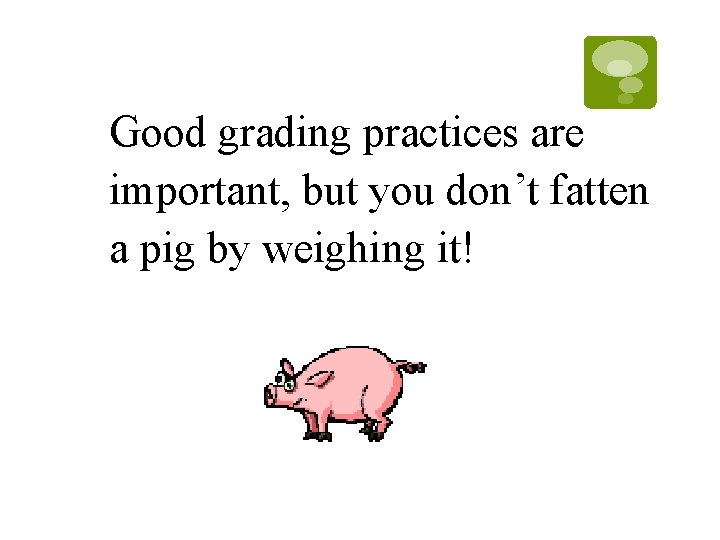
Good grading practices are important, but you don’t fatten a pig by weighing it!
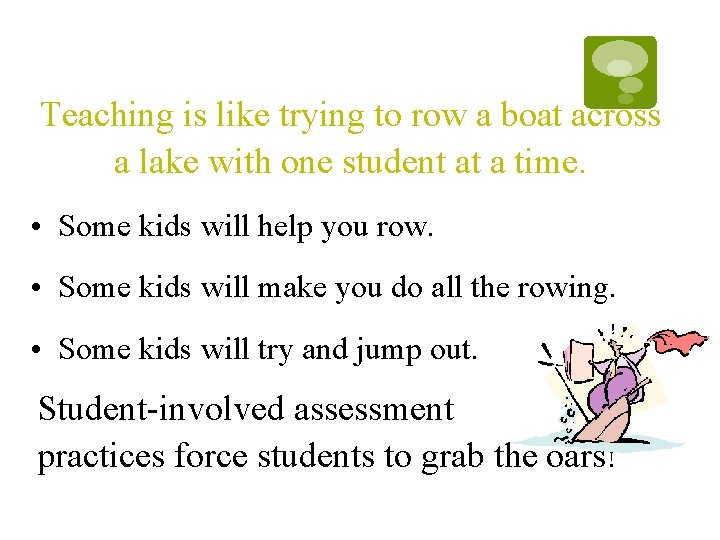
Teaching is like trying to row a boat across a lake with one student at a time. • Some kids will help you row. • Some kids will make you do all the rowing. • Some kids will try and jump out. Student-involved assessment practices force students to grab the oars!