
Effective Assessment Knowing what your students know English


- Slides: 18
Effective Assessment: Knowing what your students know English: Ella Erskine and Ruth Buckle 30 th September
Welcome and housekeeping Mobile phones to silent (there will be breakout rooms when we’ll ask you to unmute to join discussion).
Break out space 1 10 mins • How do you check for understanding in your subject area? • What are the challenging aspects? • How do you know that your staff check for understanding and have the skills and tools to know what to do next?
How do we use questioning to check for understanding in English? • Rosenshine’s third principle is questioning. In an English classroom this is one of the main ways we check for understanding. • Tom Sherrington suggests that teachers use six different questioning styles: • Cold calling: in Sherrington’s view this should be ‘absolutely routine’ • No opt-out: return to unsure students after someone else answers confidently • Say it again, better: guide students to add depth, accuracy and sophistication • Think, pair, share: cold calling and probing is more effective after rehearsal • Whole class response: try this with multiple choice questions • Probing: each student is asked several questions which probe for understanding and then add challenge.
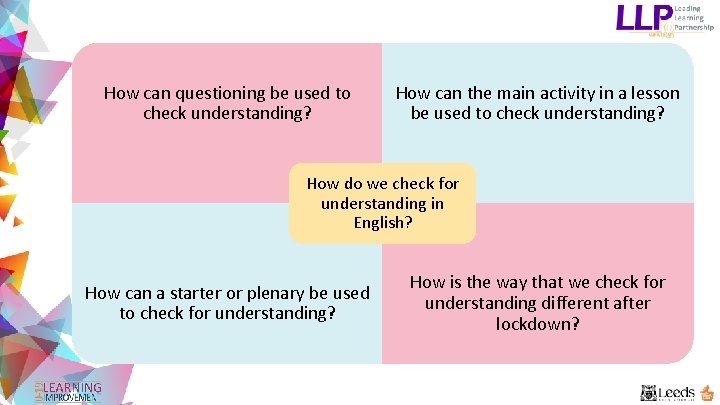
How can questioning be used to check understanding? How can the main activity in a lesson be used to check understanding? How do we check for understanding in English? How can a starter or plenary be used to check for understanding? How is the way that we check for understanding different after lockdown?
Break out space 2 20 mins • TASK: subject leaders create their own multiple choice answers for a question (pre thought common misconception about by the LTSs). • How to subject leaders ensure this happens across the team?
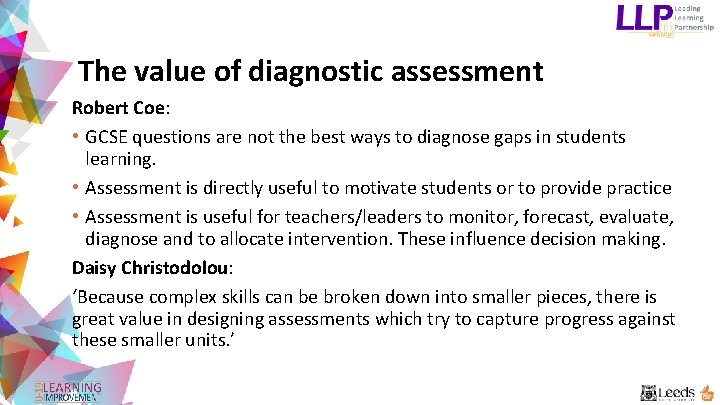
The value of diagnostic assessment Robert Coe: • GCSE questions are not the best ways to diagnose gaps in students learning. • Assessment is directly useful to motivate students or to provide practice • Assessment is useful for teachers/leaders to monitor, forecast, evaluate, diagnose and to allocate intervention. These influence decision making. Daisy Christodolou: ‘Because complex skills can be broken down into smaller pieces, there is great value in designing assessments which try to capture progress against these smaller units. ’
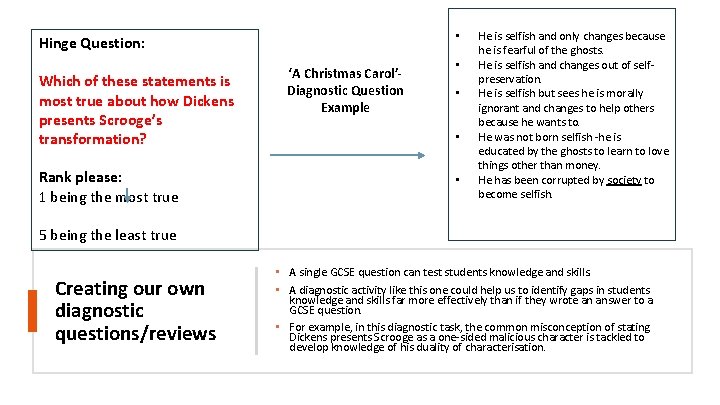
• Hinge Question: Which of these statements is most true about how Dickens presents Scrooge’s transformation? Rank please: 1 being the most true ‘A Christmas Carol’Diagnostic Question Example • • He is selfish and only changes because he is fearful of the ghosts. He is selfish and changes out of selfpreservation. He is selfish but sees he is morally ignorant and changes to help others because he wants to. He was not born selfish -he is educated by the ghosts to learn to love things other than money. He has been corrupted by society to become selfish. 5 being the least true Creating our own diagnostic questions/reviews • A single GCSE question can test students knowledge and skills. • A diagnostic activity like this one could help us to identify gaps in students knowledge and skills far more effectively than if they wrote an answer to a GCSE question. • For example, in this diagnostic task, the common misconception of stating Dickens presents Scrooge as a one-sided malicious character is tackled to develop knowledge of his duality of characterisation.
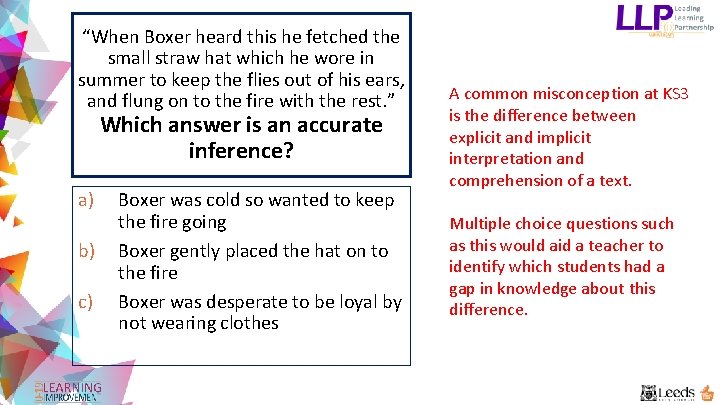
“When Boxer heard this he fetched the small straw hat which he wore in summer to keep the flies out of his ears, and flung on to the fire with the rest. ” Which answer is an accurate inference? a) b) c) Boxer was cold so wanted to keep the fire going Boxer gently placed the hat on to the fire Boxer was desperate to be loyal by not wearing clothes A common misconception at KS 3 is the difference between explicit and implicit interpretation and comprehension of a text. Multiple choice questions such as this would aid a teacher to identify which students had a gap in knowledge about this difference.
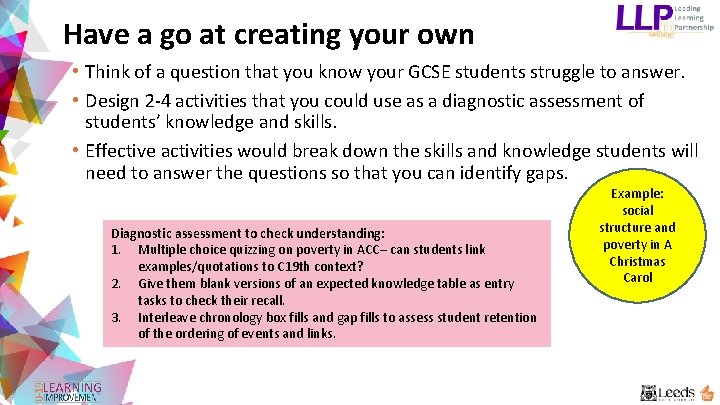
Have a go at creating your own • Think of a question that you know your GCSE students struggle to answer. • Design 2 -4 activities that you could use as a diagnostic assessment of students’ knowledge and skills. • Effective activities would break down the skills and knowledge students will need to answer the questions so that you can identify gaps. Diagnostic assessment to check understanding: 1. Multiple choice quizzing on poverty in ACC– can students link examples/quotations to C 19 th context? 2. Give them blank versions of an expected knowledge table as entry tasks to check their recall. 3. Interleave chronology box fills and gap fills to assess student retention of the ordering of events and links. Example: social structure and poverty in A Christmas Carol
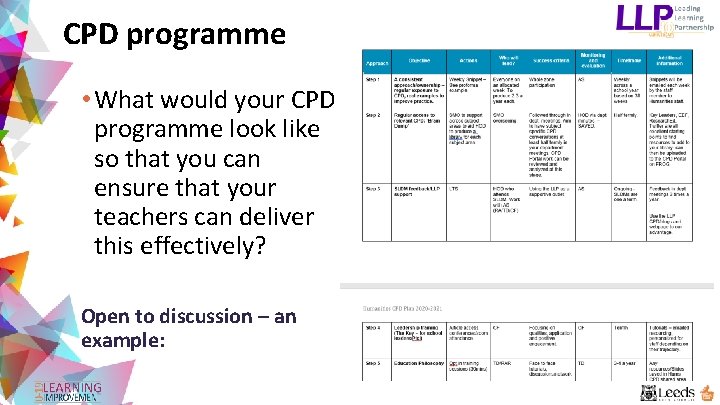
Break out space 3 15 mins • What would you do for your subject specific scenarios? • What would your CPD programme look like so that you can ensure that your teachers can deliver this effectively?
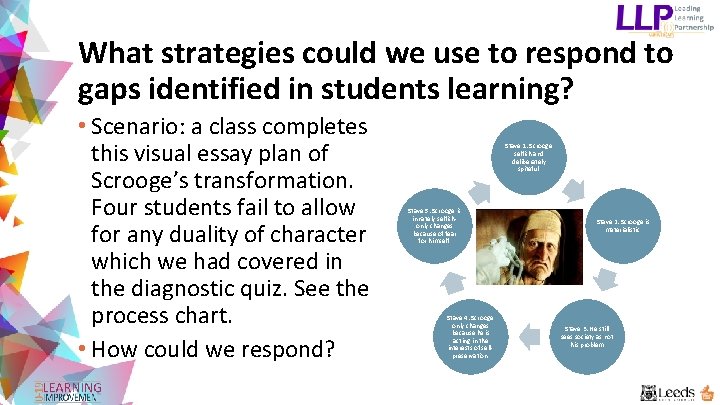
What strategies could we use to respond to gaps identified in students learning? • Scenario: a class completes this visual essay plan of Scrooge’s transformation. Four students fail to allow for any duality of character which we had covered in the diagnostic quiz. See the process chart. • How could we respond? Stave 1: Scrooge selfish and deliberately spiteful. Stave 5: Scrooge is innately selfishonly changes because of fear for himself. Stave 4: Scrooge only changes because he is acting in the interests of selfpreservation. Stave 2: Scrooge is materialistic. Stave 3: He still sees society as not his problem
What strategies could we use to respond to gaps identified in students learning? Scenario: a Year 8 class completes a set of multiple choice questions like the earlier example. Students have correctly identified the implicit answer only 60% of the time. One student only 20% of the time. • How would we respond as the class teacher? • How could we ensure our department know how to respond?
CPD programme • What would your CPD programme look like so that you can ensure that your teachers can deliver this effectively? Open to discussion – an example:
• Thinking Forward: You’re planning an hour department meeting after school on “assessment” - what three things are you going to include?
Evaluation update - Consider focussing on… • What was useful? • What could be improved? • Which elements of this session will you take back into school? • Who needs to know about this or be involved in its development? (Staff and students or is this something to discuss with leadership? )
English Conference: 13 th November 2020 This fantastic event will take place virtually and will be recorded. We have an fantastic line up of speakers. As requested we have: • Emma Smith, Professor of Shakespeare Studies at the University of Oxford, • Sarah Hubbard HMI, National Lead for English, • Jennifer Webb author of ‘How to Teach English Literature: Overcoming Cultural Poverty’ and ‘Teach like a Writer’. There a wealth of workshops including : ‘Decolonising Literature at KS 3’, ‘Exploring 19 th Century Contexts using original sources’ and ‘Discourses of Context to enrich GCSE English Literature Prose and Drama Responses’.
Booking further training or SLDM sessions? Don’t forget to use leedsforlearning. co. uk.