
Effective Assessment CLASS Day 2 CLASS Assessment Power













- Slides: 44
Effective Assessment CLASS, Day 2 CLASS Assessment Power. Point 23 May 2011 1
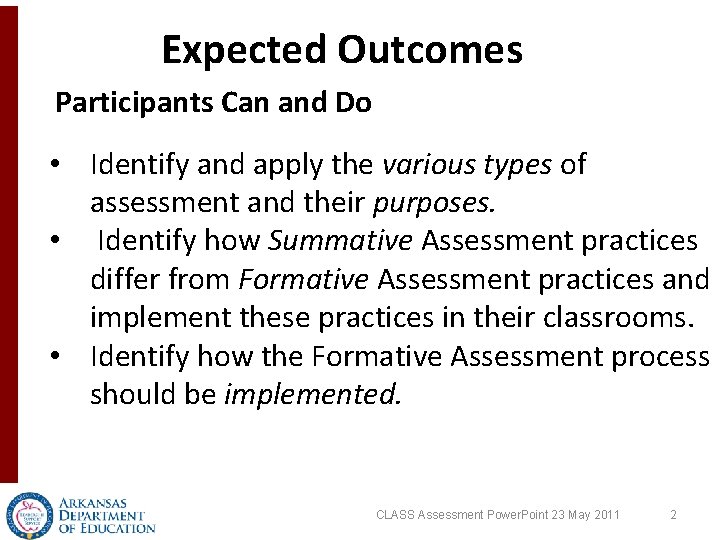
Expected Outcomes Participants Can and Do • Identify and apply the various types of assessment and their purposes. • Identify how Summative Assessment practices differ from Formative Assessment practices and implement these practices in their classrooms. • Identify how the Formative Assessment process should be implemented. CLASS Assessment Power. Point 23 May 2011 2
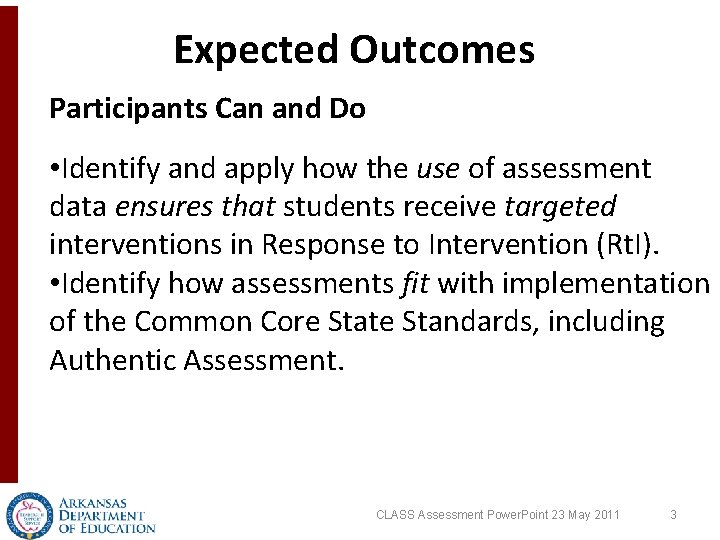
Expected Outcomes Participants Can and Do • Identify and apply how the use of assessment data ensures that students receive targeted interventions in Response to Intervention (Rt. I). • Identify how assessments fit with implementation of the Common Core State Standards, including Authentic Assessment. CLASS Assessment Power. Point 23 May 2011 3
Assessment Sorting Activity CLASS Assessment Power. Point 23 May 2011 4
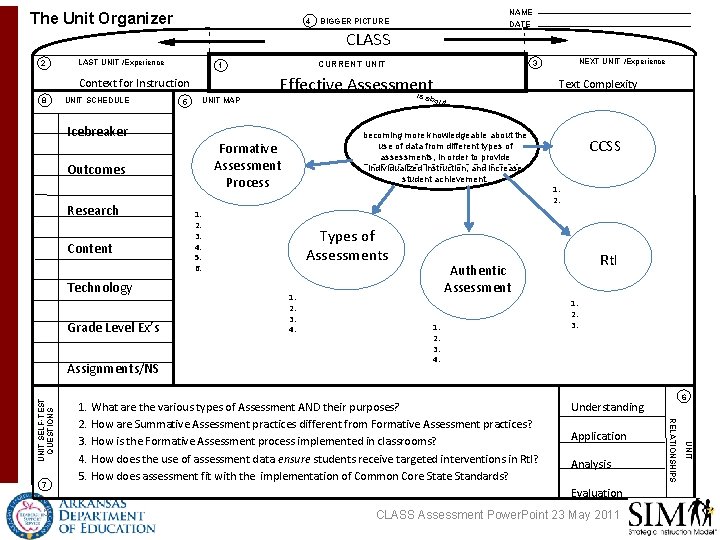
The Unit Organizer 4 NAME DATE BIGGER PICTURE CLASS 2 LAST UNIT /Experience Context for Instruction 8 UNIT SCHEDULE 5 UNIT MAP Effective Assessment is Research Content Technology Grade Level Ex’s 5 becoming more knowledgeable about the use of data from different types of assessments, in order to provide individualized instruction, and increase student achievement. Formative Assessment Process CCSS 1. 2. 1. 2. 3. 4. 5. 6. Types of Assessments 1. 2. 3. 4. Rt. I Authentic Assessment 1. 2. 3. 4. 1. What are the various types of Assessment AND their purposes? 2. How are Summative Assessment practices different from Formative Assessment practices? 3. How is the Formative Assessment process implemented in classrooms? 4. How does the use of assessment data ensure students receive targeted interventions in Rt. I? 5. How does assessment fit with the implementation of Common Core State Standards? 1. 2. 3. 6 Understanding Application Analysis Evaluation CLASS Assessment Power. Point 23 May 2011 UNIT 7 t. . . RELATIONSHIPS UNIT SELF-TEST QUESTIONS Assignments/NS Text Complexity abou Icebreaker Outcomes NEXT UNIT /Experience 3 CURRENT UNIT 1
“Marking [grading] is usually conscientious but often fails to offer guidance on how work can be improved. In a significant minority of cases, marking [grading] reinforces under-achievement and under-expectation by being too generous or unfocused. Information about pupil performance received by the teacher is insufficiently used to inform subsequent work. ” General Report on Secondary Schools, 1996 OFSTED CLASS Assessment Power. Point 23 May 2011 7
Formative Assessment Versus Summative Assessment What is the gap between current assessment practice and ideal assessment practice? CLASS Assessment Power. Point 23 May 2011 8
Formative Assessment Summative Assessment • Formative assessments describe • Summative assessments are aimed ongoing classroom-based evaluations at a final evaluation of a student’s for improving student learning and mastery or understanding of informing instruction. information, skills, concepts, or processes. • Activities may involve time spent inside or outside of the classroom such as • Some examples may include state teacher-made tests, curriculumassessments, end-of-unit or chapter embedded tests, oral questioning, and tests, end-of-term or semester tests, other cognitive performance scores that are used for school assessments. accountability (AYP), and student reports. CLASS Assessment Power. Point 23 May 2011 9
Turn and Talk… How do you know when a student gets it? What are you going to do when they don’t? CLASS Assessment Power. Point 23 May 2011 10
Emily’s Story “A Vision of the perfect Assessment System…” CLASS Assessment Power. Point 23 May 2011 11
Organizational Model For Maximizing Student Achievement Behavior, Discipline, Climate Academic Instruction & Intervention Parent and Community Outreach Curriculum, Instruction, and Assessment S P R I N T Behavioral Instruction & Intervention Professional Development, Mentoring CLASS Assessment Power. Point 23 May 2011 12
Response to Intervention Tier 1 Core Classroom Intervention ALL Students Tier 2 Supplementary Intervention Tier 3 Intensive Intervention Approx. 20 -30% Approx. 5 -10% INCREASING: Time & Intensity & Data Collection & Expertise CLASS Assessment Power. Point 23 May 2011 13
Professional Parallel TIER 1 Annual Treatment, REGULAR Physician, Screening Data TIER 2 TIER 3 Strategic, Supplemental Care, Intensive Care, SPECIALIST working TEAM of doctors, nurses, with regular physician technicians, Monitoring Data INCREASING Time & Intensity & Data Collection & Expertise CLASS Assessment Power. Point 23 May 2011 14
“Assessment without the capability and will to respond to the information it generates, is essentially a waste of time. ” Joseph Torgeson, Ph. D. CLASS Assessment Power. Point 23 May 2011 15
Rt. I and Assessment 1. 2. 3. 4. Screening Diagnostic Monitoring Evaluation CLASS Assessment Power. Point 23 May 2011 16
Benchmark/Screening Assessments Which of our students might possibly need some extra assistance in order to be successful academically? CLASS Assessment Power. Point 23 May 2011 17
Benchmark/Screening Assessments • Evaluating the instructional needs of ALL students on a regular basis, looking for students who may need some additional help. • Ensuring that no student, “Falls between the cracks”- unwilling to write-off or ignore any student. CLASS Assessment Power. Point 23 May 2011 18
Benchmark/Screening Assessments Examples: QPS (Quick Phonics Screener), TOWRE (Test of Word Reading Efficiency), Maze Assessment, DRA (Developmental Reading Assessment), Flynt-Cooter, DIBELS (Dynamic Indicators of Basic Early Literacy Skills) CLASS Assessment Power. Point 23 May 2011 19
Diagnostic Assessments What are this student’s academic strengths and instructional needs? CLASS Assessment Power. Point 23 May 2011 20
Diagnostic Assessments • Set of individually administered diagnostic assessments. • Not the same as assessments used by special educators, used to diagnose a disability. • Assists in designing instruction that builds on what the student already knows and immediately addresses any gaps. • Helps to provide specific information to plan effectively differentiated and appropriately focused instruction. CLASS Assessment Power. Point 23 May 2011 21
Diagnostic Assessments Examples: DAR (Diagnostic Assessment of Reading), Gates Mac. Ginite, QRI (Qualitative Reading Inventory), QPS, GRADE, SDRT (Stanford Diagnostic Reading Test), WRMT (Woodcock Reading Mastery Test) CLASS Assessment Power. Point 23 May 2011 22
Progress Monitoring Assessments Is learning happening? CLASS Assessment Power. Point 23 May 2011 23
Progress Monitoring Assessments • Implemented periodically throughout the year to measure instructional effectiveness • This is NOT simply watching a student move through a curriculum and appear to understand the content. • Waiting until the end of a school year or even a semester is too long a wait for information that determines what the student is actually learning. CLASS Assessment Power. Point 23 May 2011 24
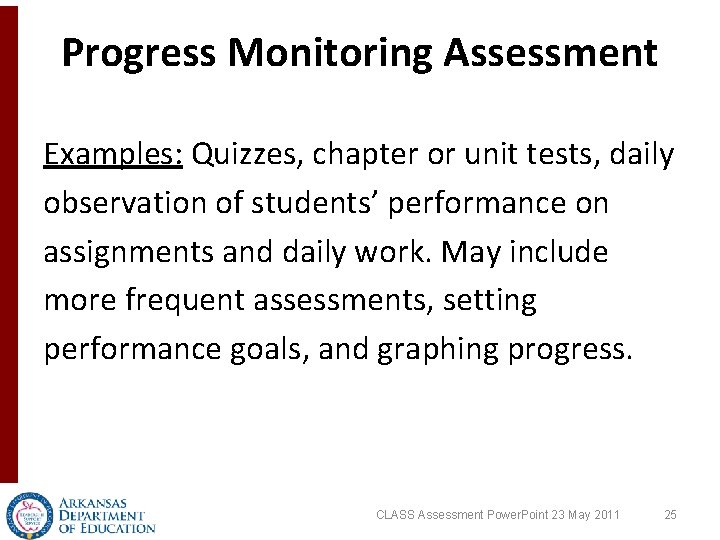
Progress Monitoring Assessment Examples: Quizzes, chapter or unit tests, daily observation of students’ performance on assignments and daily work. May include more frequent assessments, setting performance goals, and graphing progress. CLASS Assessment Power. Point 23 May 2011 25
Outcome/Evaluation Assessments Did our students make progress toward meeting the standards? CLASS Assessment Power. Point 23 May 2011 26
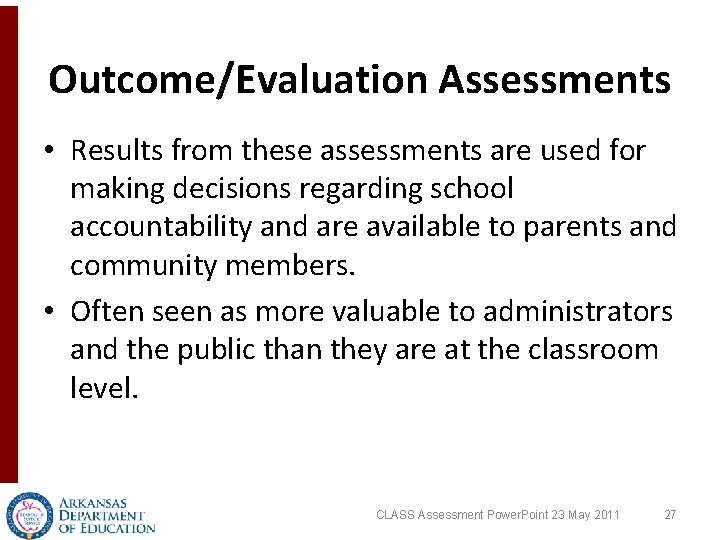
Outcome/Evaluation Assessments • Results from these assessments are used for making decisions regarding school accountability and are available to parents and community members. • Often seen as more valuable to administrators and the public than they are at the classroom level. CLASS Assessment Power. Point 23 May 2011 27
Outcome/Evaluation Assessments Examples: High-stakes assessments designed by individual states, starting in the elementary years and on into high school (ACTAPP, Benchmark assessments, EOC, ITBS, ACT and SAT. ) CLASS Assessment Power. Point 23 May 2011 28
The Unit Organizer 2 8 4 LAST UNIT /Experience 1 Context for Instruction UNIT SCHEDULE 5 Content Technology Grade Level Ex’s Effective Assessment is ab out. . . 29 becoming more knowledgeable about the use of data from different types of assessments, in order to provide individualized instruction, and increase student achievement. Formative Assessment Process CCSS 1. 2. 1. 2. 3. 4. 5. 6. Types of Assessments 1. 2. 3. 4. Rt. I Authentic Assessment 1. 2. 3. 4. 1. What are the various types of Assessment AND their purposes? 2. How are Summative Assessment practices different from Formative Assessment practices? 3. How is the Formative Assessment process implemented in classrooms? 4. How does the use of assessment data ensure students receive targeted interventions in Rt. I? 5. How does assessment fit with the implementation of Common Core State Standards? 1. 2. 3. Understanding Application Analysis Evaluation CLASS Assessment Power. Point 23 May 2011 6 UNIT 7 Text Complexity RELATIONSHIPS UNIT SELF-TEST QUESTIONS Assignments/NS NEXT UNIT /Experience 3 CURRENT UNIT Icebreaker Research CLASS UNIT MAP Outcomes NAME DATE BIGGER PICTURE
Let’s Revisit… How do you know when a student gets it? What are you going to do when they don’t? CLASS Assessment Power. Point 23 May 2011 31
“The student who is aware of how he or she learns is better able to set goals, develop a variety of learning strategies, and control and evaluate his or her own learning process. Alternatively, summative assessments, which evaluate student performance at the conclusion of the instructional period, have little or no influence on student learning. ” Assessment For Learning, Stiggins CLASS Assessment Power. Point 23 May 2011 32
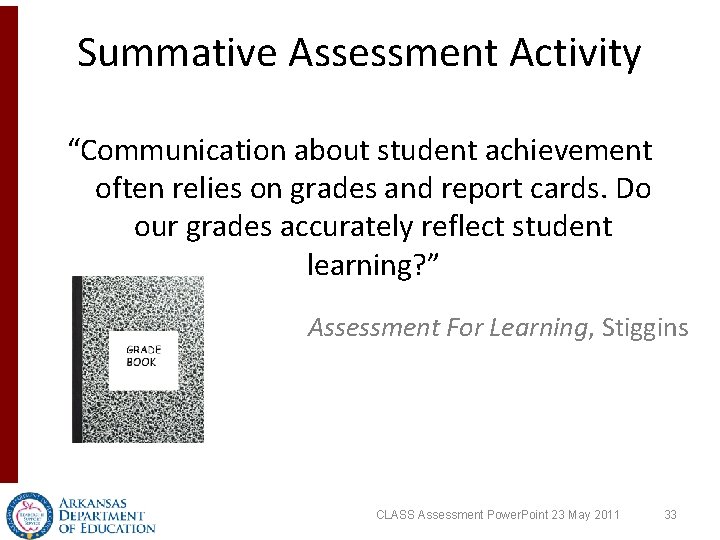
Summative Assessment Activity “Communication about student achievement often relies on grades and report cards. Do our grades accurately reflect student learning? ” Assessment For Learning, Stiggins CLASS Assessment Power. Point 23 May 2011 33
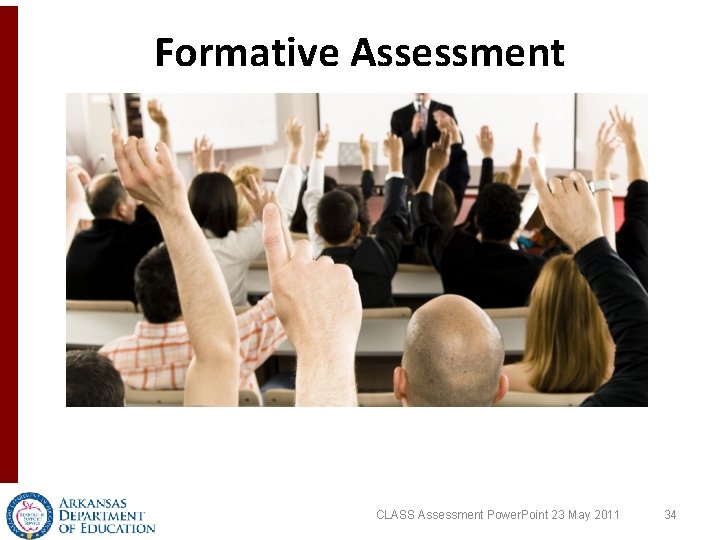
Formative Assessment CLASS Assessment Power. Point 23 May 2011 34
Three Guiding Questions in the Formative Assessment process 1. Where am I going? 2. Where am I now? 3. What strategy or strategies can help me get to where I need to go? CLASS Assessment Power. Point 23 May 2011 35
Research… “There is a firm body of evidence that formative assessment is an essential component of classroom work and that its development can raise standards of achievement. We know of no other way of raising standards for which such a strong prima facie case can be made. ” Inside the Black Box: Raising Standards Through Classroom Assessment, William & Black CLASS Assessment Power. Point 23 May 2011 36
“When teachers join forces with their students in the formative assessment process, their partnership generates powerful learning outcomes. Teachers become more effective, students become actively engaged, and they both become intentional learners. ” Advancing Formative Assessment, Moss & Brookhart CLASS Assessment Power. Point 23 May 2011 37
Six Elements of the Formative Assessment Process 1. 2. 3. 4. 5. 6. Shared learning targets and criteria for success Feedback that feeds forward Student goal setting Student self-assessment Strategic teacher questioning Student engagement in asking effective questions CLASS Assessment Power. Point 23 May 2011 38
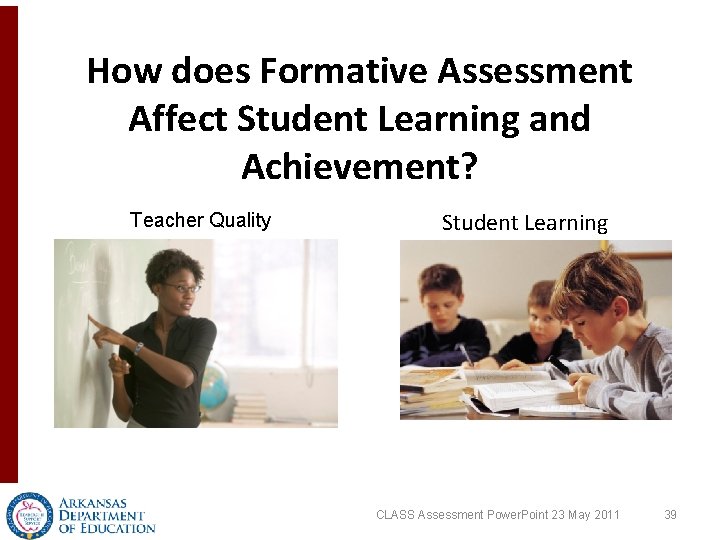
How does Formative Assessment Affect Student Learning and Achievement? Teacher Quality Student Learning CLASS Assessment Power. Point 23 May 2011 39
Self-Regulated Learners 1. Are my students motivated? 2. Are my students engaged? 3. Are my students self-regulated learners? CLASS Assessment Power. Point 23 May 2011 40
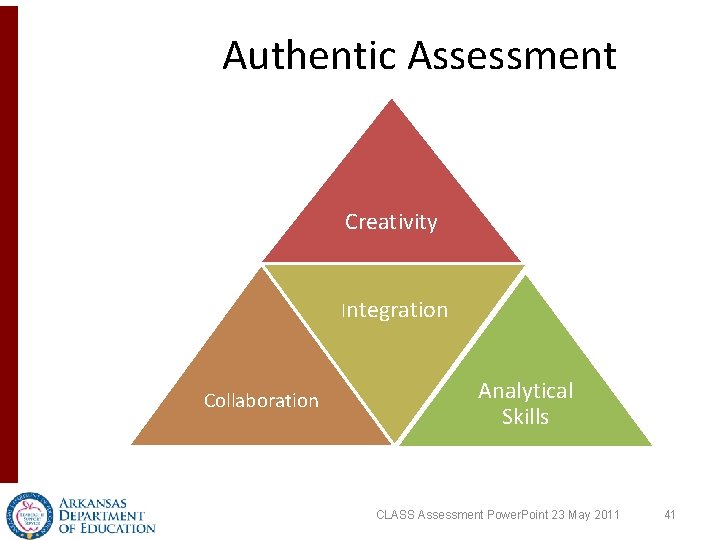
Authentic Assessment Creativity Integration Collaboration Analytical Skills CLASS Assessment Power. Point 23 May 2011 41
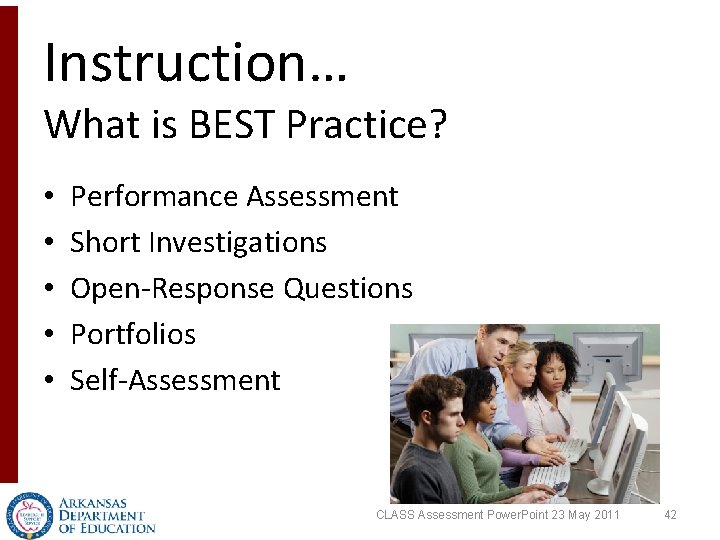
Instruction… What is BEST Practice? • • • Performance Assessment Short Investigations Open-Response Questions Portfolios Self-Assessment CLASS Assessment Power. Point 23 May 2011 42
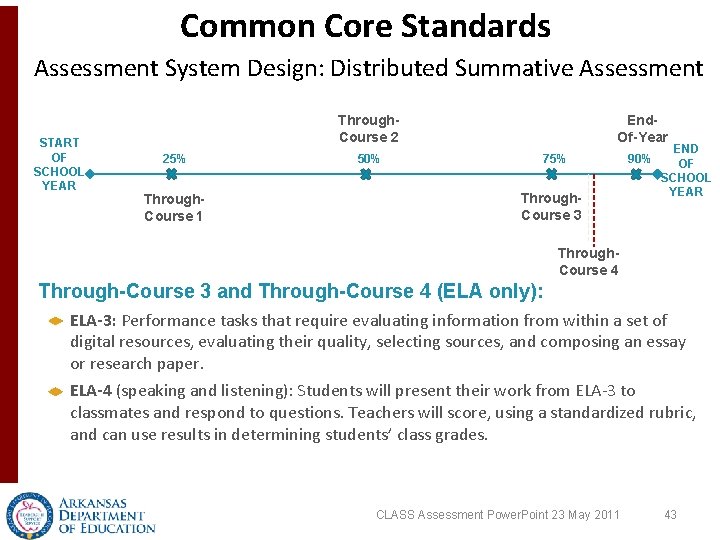
Common Core Standards Assessment System Design: Distributed Summative Assessment START OF SCHOOL YEAR Through. Course 2 25% Through. Course 1 End. Of-Year 50% 75% Through. Course 3 90% END OF SCHOOL YEAR Through. Course 4 Through-Course 3 and Through-Course 4 (ELA only): ELA-3: Performance tasks that require evaluating information from within a set of digital resources, evaluating their quality, selecting sources, and composing an essay or research paper. ELA-4 (speaking and listening): Students will present their work from ELA-3 to classmates and respond to questions. Teachers will score, using a standardized rubric, and can use results in determining students’ class grades. CLASS Assessment Power. Point 23 May 2011 43
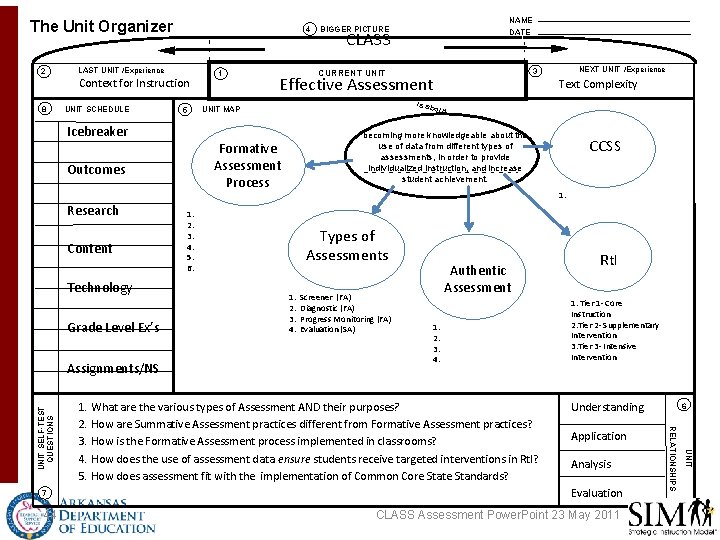
The Unit Organizer 2 8 4 LAST UNIT /Experience Context for Instruction UNIT SCHEDULE 5 1 Research Content Technology Grade Level Ex’s 44 is ab out. . . becoming more knowledgeable about the use of data from different types of assessments, in order to provide individualized instruction, and increase student achievement. CCSS 1. Types of Assessments 1. Screener (FA) 2. Diagnostic (FA) 3. Progress Monitoring (FA) 4. Evaluation (SA) Authentic Assessment 1. 2. 3. 4. 1. What are the various types of Assessment AND their purposes? 2. How are Summative Assessment practices different from Formative Assessment practices? 3. How is the Formative Assessment process implemented in classrooms? 4. How does the use of assessment data ensure students receive targeted interventions in Rt. I? 5. How does assessment fit with the implementation of Common Core State Standards? Rt. I 1. Tier 1 - Core Instruction 2. Tier 2 - Supplementary Intervention 3. Tier 3 - Intensive Intervention Understanding Application Analysis Evaluation CLASS Assessment Power. Point 23 May 2011 6 UNIT 7 Text Complexity RELATIONSHIPS UNIT SELF-TEST QUESTIONS Assignments/NS NEXT UNIT /Experience 3 CURRENT UNIT MAP Formative Assessment Process 1. 2. 3. 4. 5. 6. CLASS Effective Assessment Icebreaker Outcomes NAME DATE BIGGER PICTURE
Reflection… CLASS Assessment Power. Point 23 May 2011 46
“Far and away the best prize that life offers is the chance to work hard at work worth doing. ” - Theodore Roosevelt CLASS Assessment Power. Point 23 May 2011 47