
Effective Alignment for Better Outcomes Tonya Rutkowski M
Effective Alignment for Better Outcomes Tonya Rutkowski, M. Ed. – SSIP Coordinator: Vermont Agency of Education Meg Porcella, M. A. – SPDG Director: Vermont Agency of Education Steve Goodman, Ph. D. – Director: Michigan’s Integrated Behavior and Learning Support Initiative (MIBLSI) 2017 LEADERSHIP CONFERENCE 1

Learning Objectives: • Participants will be able to identify what it means to align key initiatives and why this is important for efficient and effective educational systems. • Participants will be able to identify steps for aligning key initiatives. • Participants understand the initiative alignment process and application to their work. 2 2017 LEADERSHIP CONFERENCE
Steve Goodman sgoodman@miblsimtss. org Acknowledgements: Rob Horner, George Sugai, Lucille Eber, Susan Barrett, Justyn Poulos, Sheree Garvey, Ashley Greenwald miblsi. org
Waves of Innovation • Focus on results / accountability • Focus on fidelity • Focus on systems for sustainability • Focus on alignment 4

Why Invest in Alignment? • Unaligned efforts are ineffective and inefficient • Doing many things, but none of them well • Assumption that New is better…. More is better • Political value of “touching” many efforts (“we have _______ in our school”) • Assumption that if we train individuals in many things THEY will do the alignment and integration on their own 5

Alignment and Integration Alignment Integration • Correct positioning for effective/efficient performance • Different parts of a system are made a functional and structural whole • Core features of practices and support of these practices are aligned across the system • Resources are leveraged to build upon each other • Integration: • Cross Content • Cross Department • Cross Agencies 6
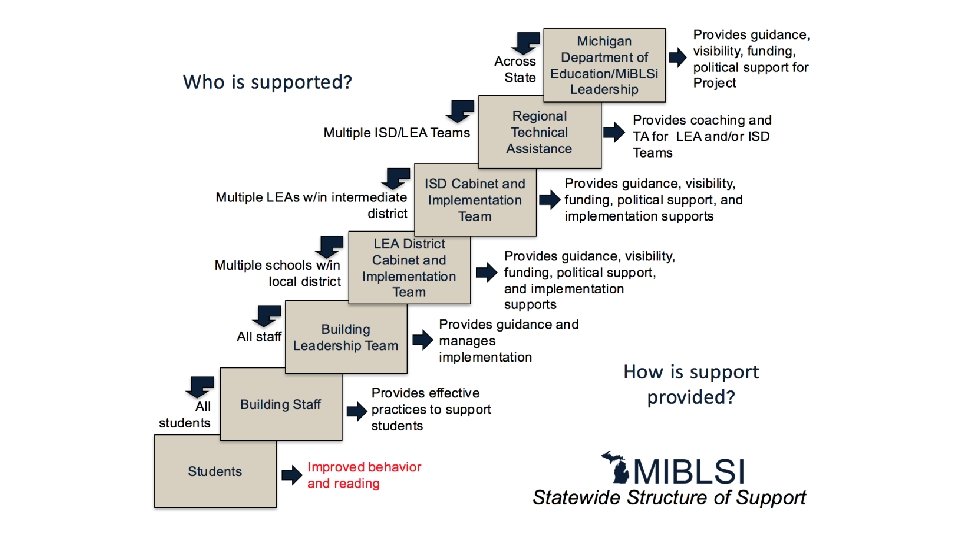

Alignment of Effort “Unit” of Implementation Contextual Focus Student Level of Analysis School Level of Implementation Local Educational Agency Level of Management and Resources Regional Agency Level of Support State Level of Coordination 8

When to Consider Alignment? • When taking on new initiative(s) • When new leadership has priority initiative(s) • When there are new mandates • When there is initiative fatigue (Project 1= Monday, Project 2 = Wed. , Project 3 =Thurs. ) • When there are changes in funding 9
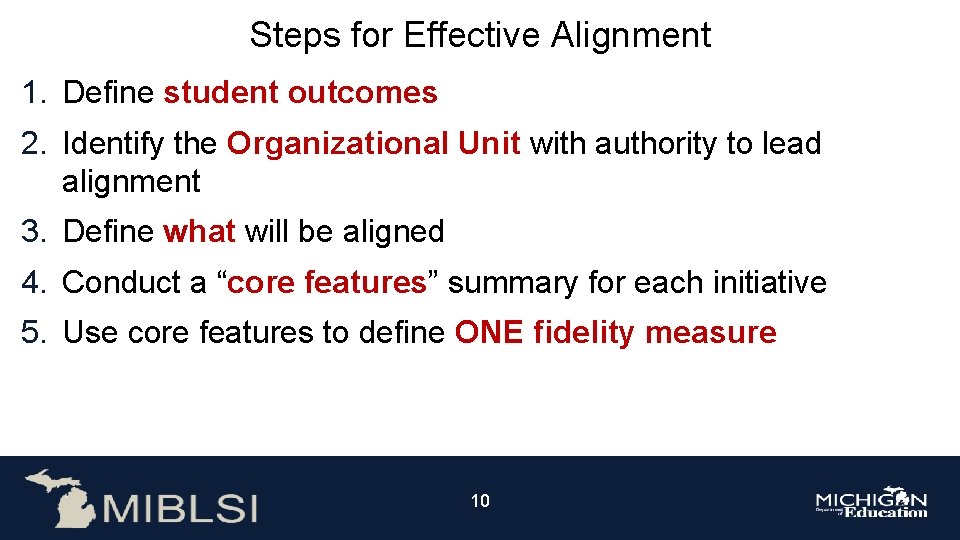
Steps for Effective Alignment 1. Define student outcomes 2. Identify the Organizational Unit with authority to lead alignment 3. Define what will be aligned 4. Conduct a “core features” summary for each initiative 5. Use core features to define ONE fidelity measure 10

Steps for Effective Alignment (cont. ) 6. Build a single model for professional 7. Resolve logic model conflicts 8. Implement, assess, adapt 11 development
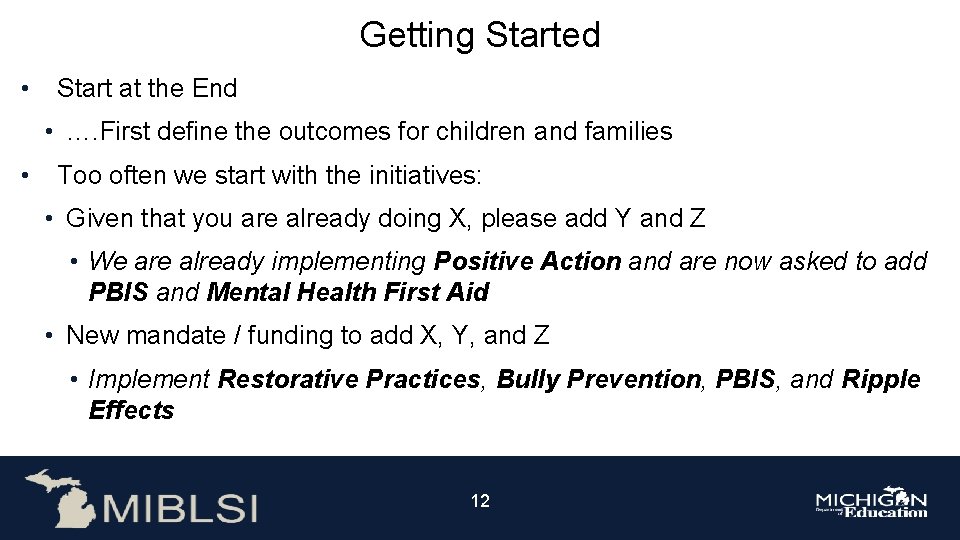
Getting Started • Start at the End • …. First define the outcomes for children and families • Too often we start with the initiatives: • Given that you are already doing X, please add Y and Z • We are already implementing Positive Action and are now asked to add PBIS and Mental Health First Aid • New mandate / funding to add X, Y, and Z • Implement Restorative Practices, Bully Prevention, PBIS, and Ripple Effects 12
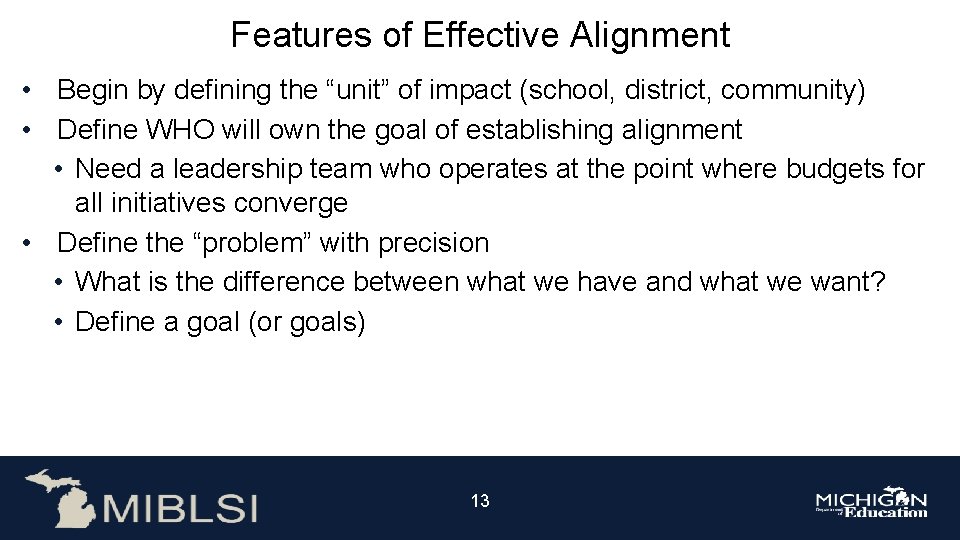
Features of Effective Alignment • Begin by defining the “unit” of impact (school, district, community) • Define WHO will own the goal of establishing alignment • Need a leadership team who operates at the point where budgets for all initiatives converge • Define the “problem” with precision • What is the difference between what we have and what we want? • Define a goal (or goals) 13
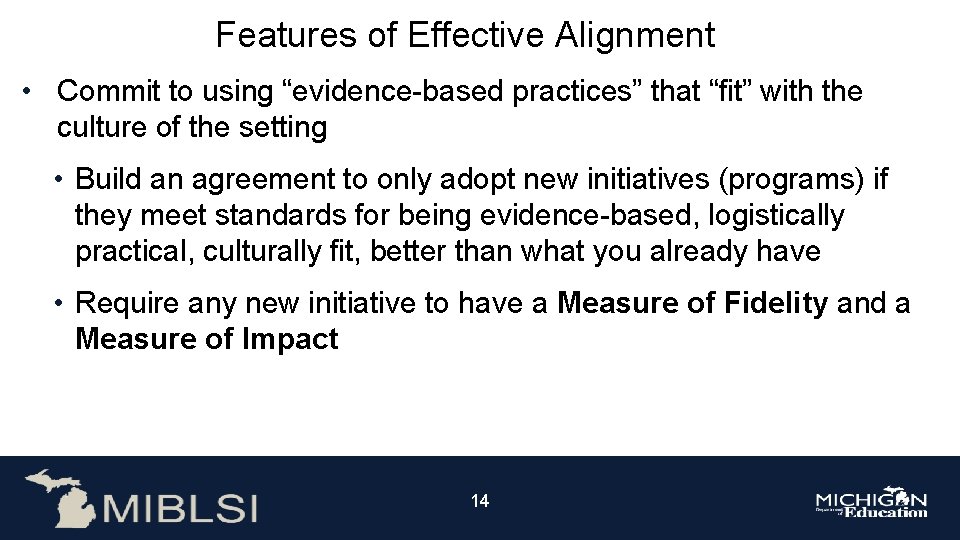
Features of Effective Alignment 2 • Commit to using “evidence-based practices” that “fit” with the culture of the setting • Build an agreement to only adopt new initiatives (programs) if they meet standards for being evidence-based, logistically practical, culturally fit, better than what you already have • Require any new initiative to have a Measure of Fidelity and a Measure of Impact 14
Features of Effective Alignment 3 • Conduct resource mapping to define what you are already are doing • Most context are already doing many initiatives as the plan to adopt something new • Organize “practices” around core features that achieve your goal • Get content experts to help define practices and core features 15

Getting Started • Start at the End • …. First define the outcomes for children and families • Too often we start with the initiatives: • Given that you are already doing X, please add Y and A • We are already implementing Positive Action and are now asked to add PBIS and Mental Health First Aid • New mandate / funding to add X, Y, and Z • Implement Restorative Practices, Bully Prevention, PBIS, and Ripple Effects 16
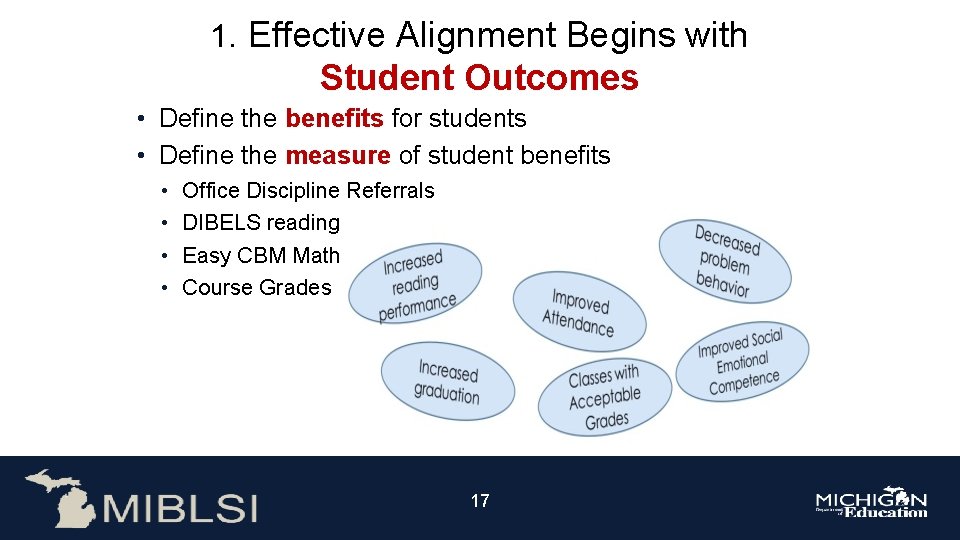
1. Effective Alignment Begins with Student Outcomes • Define the benefits for students • Define the measure of student benefits • • Office Discipline Referrals DIBELS reading Easy CBM Math Course Grades 17
2. Define What will be Aligned • Select initiatives that are supported by empirical evidence. • Evidence-based • Promising • Insufficient information • Documented as not effective or negative • If initiatives are mandated, then determine empirical support. 18
Effective Programs/Approaches/Practices 1. Practices are defined in a clear, operational manner 2. A measure of implementation fidelity is available 3. Published research (2 randomized controlled studies, or 5 single-case studies) documents the effectiveness of the approach 4. Demonstrations of application in similar contexts (e. g. high school) 5. Practices are designed to adapt across cultural contexts. 19
3. Define the Organizational Unit with the authority to lead Alignment • The person/team should have the organizational knowledge to achieve impact. • The person/team should have budget authority for ALL of the initiatives to be aligned. • The person/team has access to the “Content Knowledge” needed to guide alignment. 20
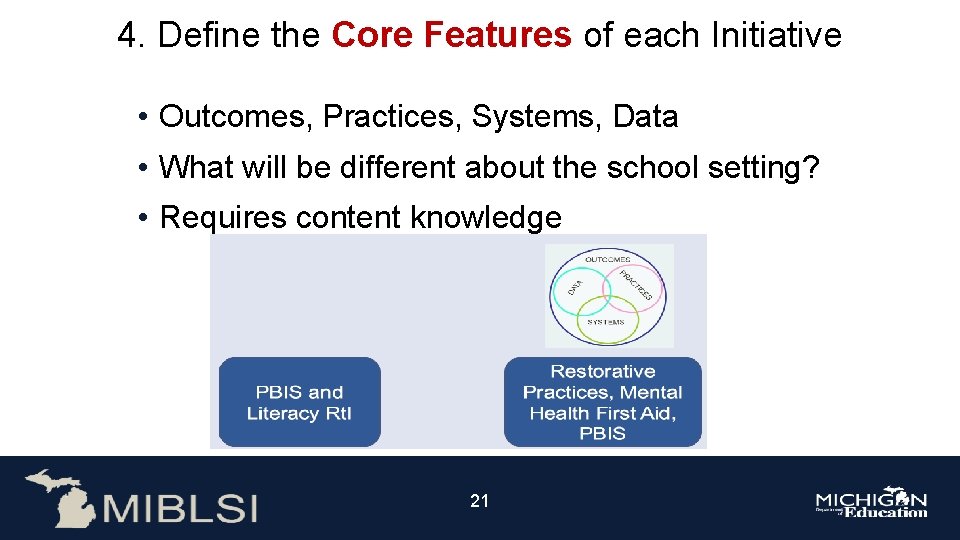
4. Define the Core Features of each Initiative • Outcomes, Practices, Systems, Data • What will be different about the school setting? • Requires content knowledge Core features including outcomes, practices, systems and data must be defined when considering the alignment of PBIS and Literacy Rt. I or Restorative Practices, Mental Health First Aid, and PBIS. 21
5. Define one Fidelity Measure • Use Core Features to guide design of one fidelity measure that can be used to assess implementation across different initiatives 22
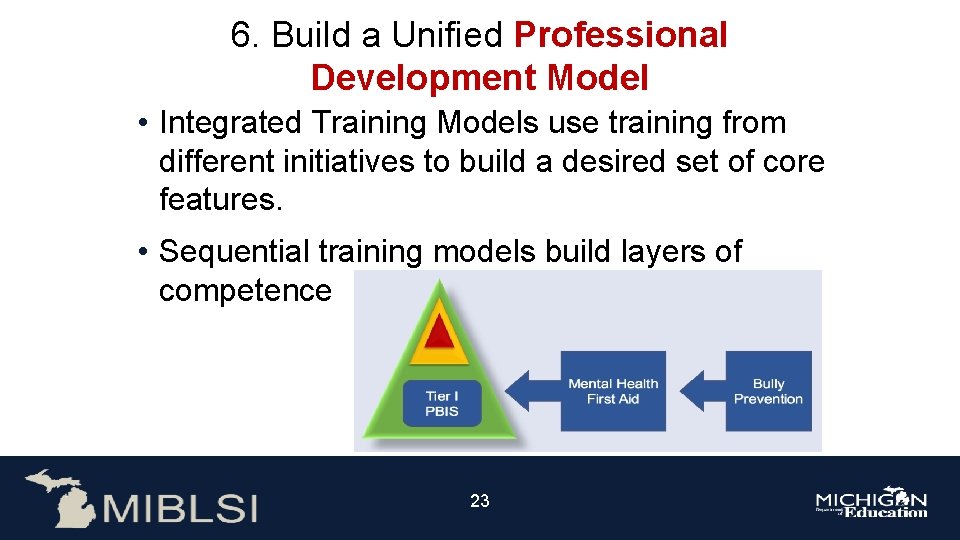
6. Build a Unified Professional Development Model • Integrated Training Models use training from different initiatives to build a desired set of core features. • Sequential training models build layers of competence 23
Align Professional Development • Define core features of effective environment • Define contributions from each initiative to the core features • Define how Professional Development will focus on core features across initiatives 24
7. Resolve Logic Model Conflicts • When logic models are in conflict…build a narrative that indicates either how these can co-exist or will be managed • Cultural standards • Use of rewards • Reading instruction 25
Logic Models Matter Resolve Logic Conflict at the Highest Level • • • Consider not only what is being recommended but the assumptions about WHY recommendations should work • Remember nearly all initiatives have a useful contribution Initiatives with conflicting logic models are more difficult to align • Discovery Learning vs. Explicit Instruction • Teach emotions to guide behavior vs. Teach the behaviors you want • Rewards damage intrinsic motivation vs. Rewards build intrinsic motivation • Facilitated Communication It is worth taking time to find common ground • Restorative justice 26
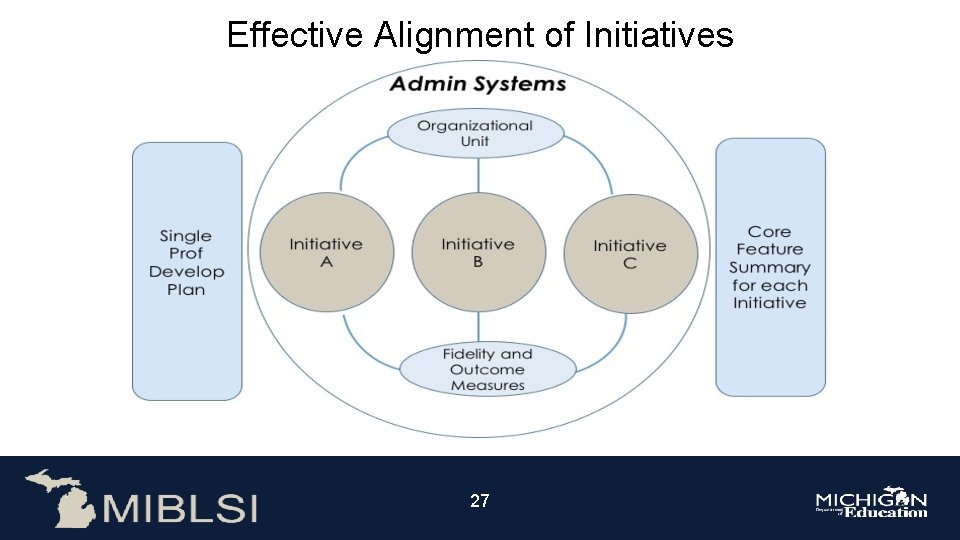
Effective Alignment of Initiatives 27
Align Initiative A and B Define and link core features for Alignment Rule: Separate “core features” from practices. Select common core features, link professional development 28
Integration of Vermont’s SSIP and SPDG Presenters: Tonya Rutkowski, M. Ed. – SSIP Coordinator tonya. rutkowski@vermont. gov Meg Porcella, M. A. – SPDG Director meg. porcella@vermont. gov Additional Members of Vermont’s Core Team: State Director of Special Education: Cindy Moran, Agency of Education Consultants: Laura Baker, Tracy Harris, Tracy Watterson, PBIS Consultants: Sherry Schoenberg, Amy Wheeler-Sutton, Evaluator: Pat Mueller, Arlene Russell, Consultants/Coaches: Sue Cano, Lisa Lovelette, Judi Maynard
State Personnel Development Grant (SPDG) The focus of the current SPDG is summarized in these three (3) goals: • Early vt. MTSS – Build capacity for providers to support early reading, numeracy and social-emotional development of infants, toddlers, and preschoolers. • School Age vt. MTSS – Enhance the capacity of general and special education teachers to provide instruction and intervention within a Multi-Tier System of Support across grade, disability, behavior and academic content. • Secondary vt. MTSS – Provide articulated professional development to develop competency in evidence based secondary transition practices that will result in an increase of IEPs with appropriate transition plans.
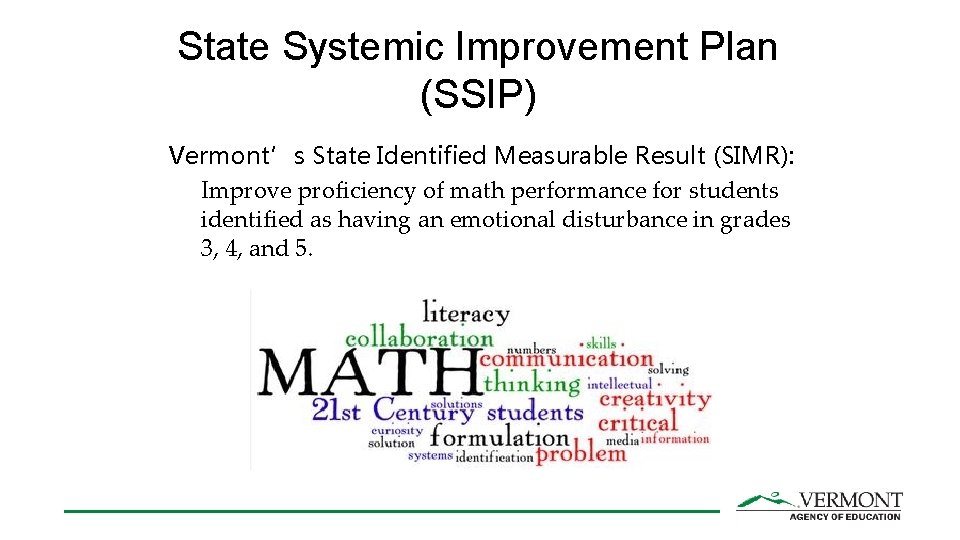
State Systemic Improvement Plan (SSIP) Vermont’s State Identified Measurable Result (SIMR): Improve proficiency of math performance for students identified as having an emotional disturbance in grades 3, 4, and 5.
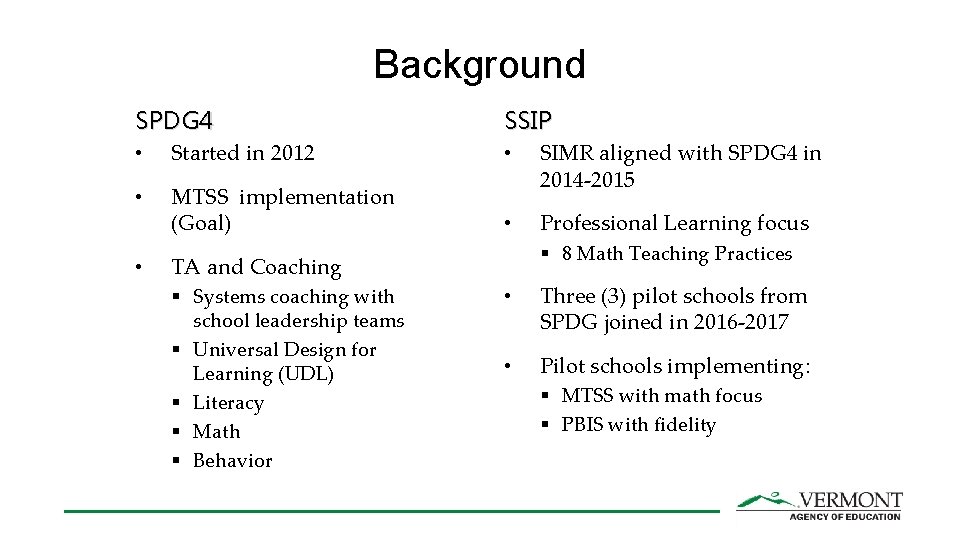
Background SPDG 4 SSIP • Started in 2012 • • MTSS implementation (Goal) SIMR aligned with SPDG 4 in 2014 -2015 • Professional Learning focus • § 8 Math Teaching Practices TA and Coaching § Systems coaching with school leadership teams § Universal Design for Learning (UDL) § Literacy § Math § Behavior • Three (3) pilot schools from SPDG joined in 2016 -2017 • Pilot schools implementing: § MTSS with math focus § PBIS with fidelity
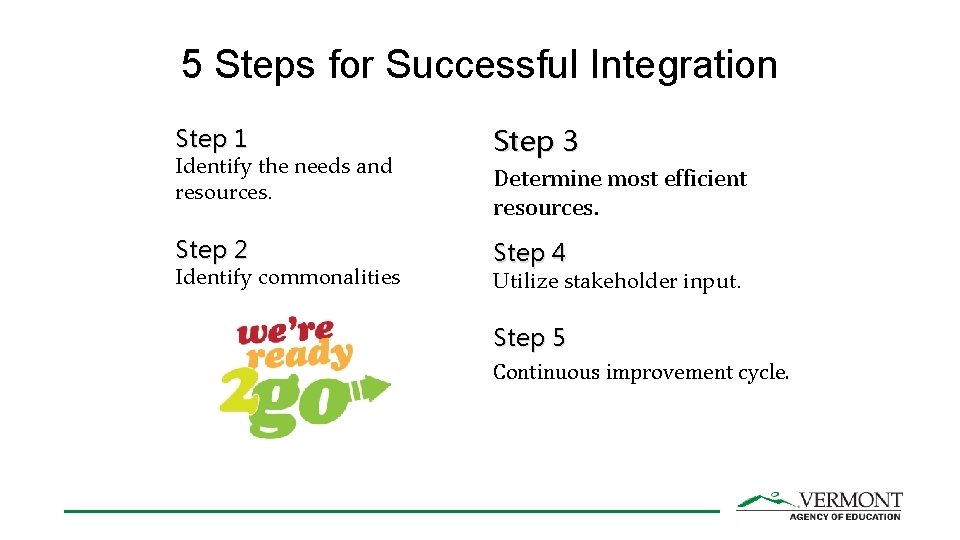
5 Steps for Successful Integration Step 1 Identify the needs and resources. Step 2 Identify commonalities Step 3 Determine most efficient resources. Step 4 Utilize stakeholder input. Step 5 Continuous improvement cycle.
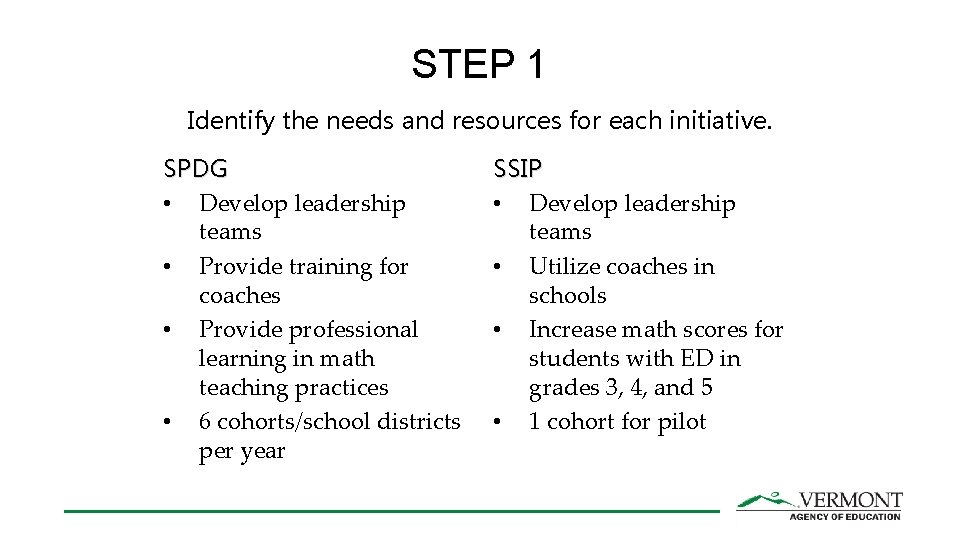
STEP 1 Identify the needs and resources for each initiative. SPDG • Develop leadership teams • Provide training for coaches • Provide professional learning in math teaching practices • 6 cohorts/school districts per year SSIP • Develop leadership teams • Utilize coaches in schools • Increase math scores for students with ED in grades 3, 4, and 5 • 1 cohort for pilot
STEP 2 Identify commonalities and examine areas where these needs and resources intersect.
STEP 3 Determine which resource most efficiently supports both initiatives. Provide a rationale for this decision. Resources 1. Trained coaches 2. Shared Cohort/district 3. Focus on leadership team development Rationale 1. Limit disruption in student/staff routines 2. Better data sharing capability 3. Reduces burden on schools
STEP 4 Utilize stakeholder input to decrease redundancies and determine the most effective methods for using available resources. • Communication • SSIP Google Site • Timing is everything!
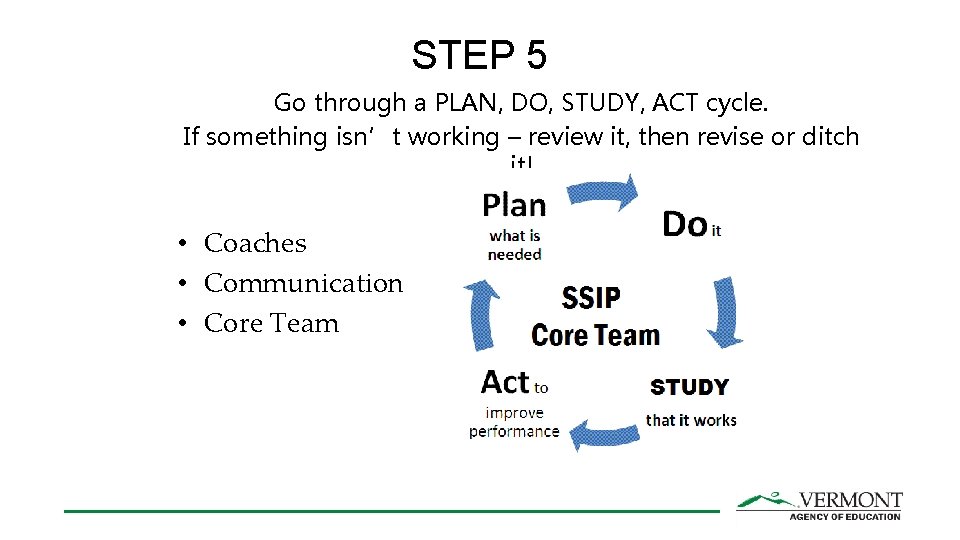
STEP 5 Go through a PLAN, DO, STUDY, ACT cycle. If something isn’t working – review it, then revise or ditch it! • Coaches • Communication • Core Team
Thoughtful Planning
Practice Makes Perfect 1. Take 2 minutes to reflect on the integration of two (2) projects and write down your thoughts on the template provided. 2. Take 3 minutes and turn to someone next to you and share what you wrote. 3. Share your ideas with a colleague back in your workplace. 4. Begin to thoughtfully make a plan to implement these ideas.
Discussion Questions 1. What benefits do you see in aligning initiatives? 2. What are risks of not aligning initiatives? 3. What have you found to be helpful in aligning key initiatives? 4. What collaboration is needed between your leadership teams and stakeholders to build capacity at state and local levels?
- Slides: 41