
Effective Academic Advising of Pacific Islander Students A

- Slides: 26
Effective Academic Advising of Pacific Islander Students: A Community College perspective Michelle Tuitupou Academic & Career Advisor, Salt Lake Community College Latu Kinikini Assistant Director for Scholastic Standards, University of Utah
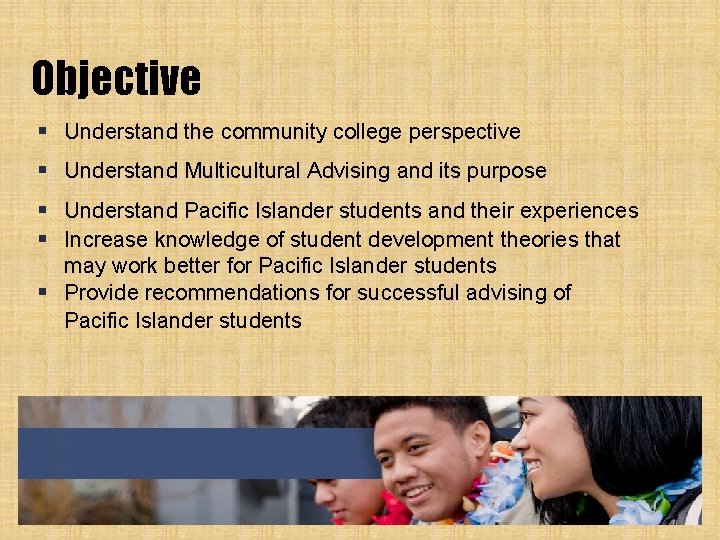
Objective § Understand the community college perspective § Understand Multicultural Advising and its purpose § Understand Pacific Islander students and their experiences § Increase knowledge of student development theories that may work better for Pacific Islander students § Provide recommendations for successful advising of Pacific Islander students
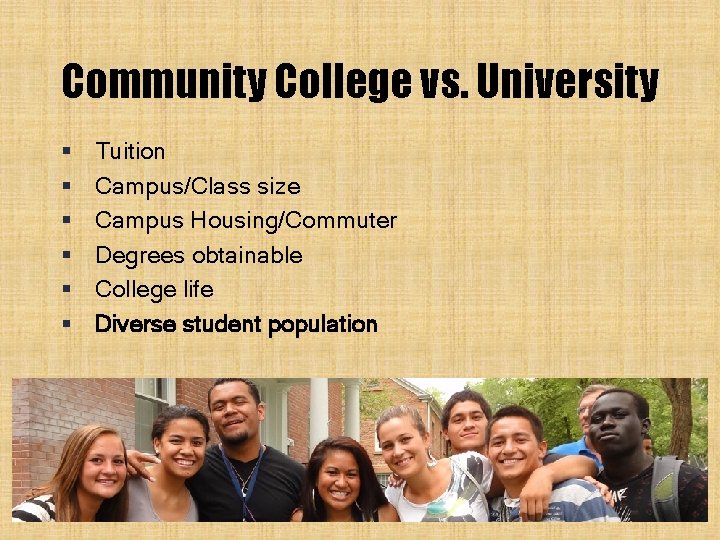
Community College vs. University § § § Tuition Campus/Class size Campus Housing/Commuter Degrees obtainable College life Diverse student population
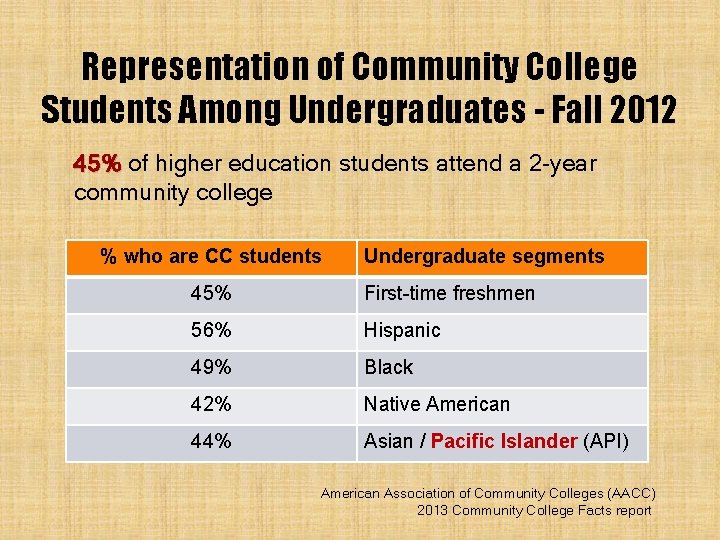
Representation of Community College Students Among Undergraduates - Fall 2012 45% of higher education students attend a 2 -year community college % who are CC students Undergraduate segments 45% First-time freshmen 56% Hispanic 49% Black 42% Native American 44% Asian / Pacific Islander (API) American Association of Community Colleges (AACC) 2013 Community College Facts report
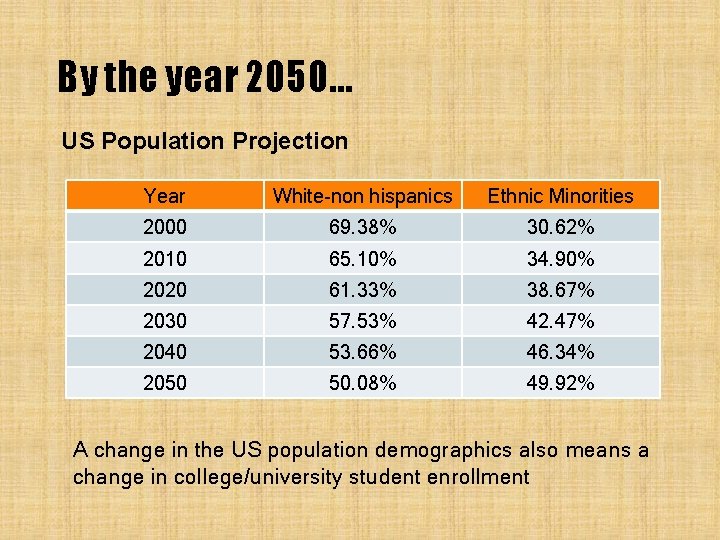
By the year 2050… US Population Projection Year White-non hispanics Ethnic Minorities 2000 69. 38% 30. 62% 2010 65. 10% 34. 90% 2020 61. 33% 38. 67% 2030 57. 53% 42. 47% 2040 53. 66% 46. 34% 2050 50. 08% 49. 92% A change in the US population demographics also means a change in college/university student enrollment
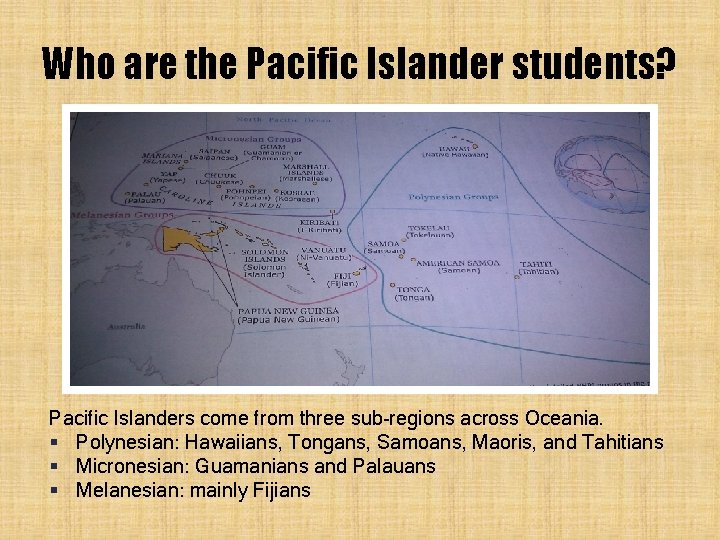
Who are the Pacific Islander students? Pacific Islanders come from three sub-regions across Oceania. § Polynesian: Hawaiians, Tongans, Samoans, Maoris, and Tahitians § Micronesian: Guamanians and Palauans § Melanesian: mainly Fijians
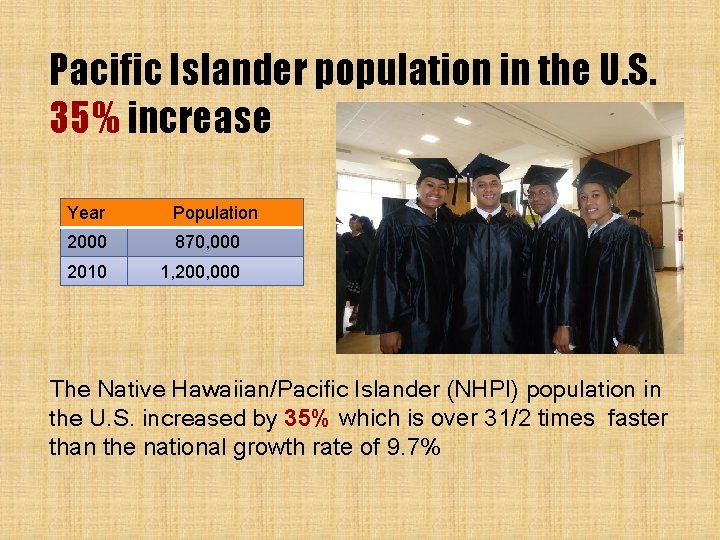
Pacific Islander population in the U. S. 35% increase Year Population 2000 870, 000 2010 1, 200, 000 The Native Hawaiian/Pacific Islander (NHPI) population in the U. S. increased by 35% which is over 31/2 times faster than the national growth rate of 9. 7%
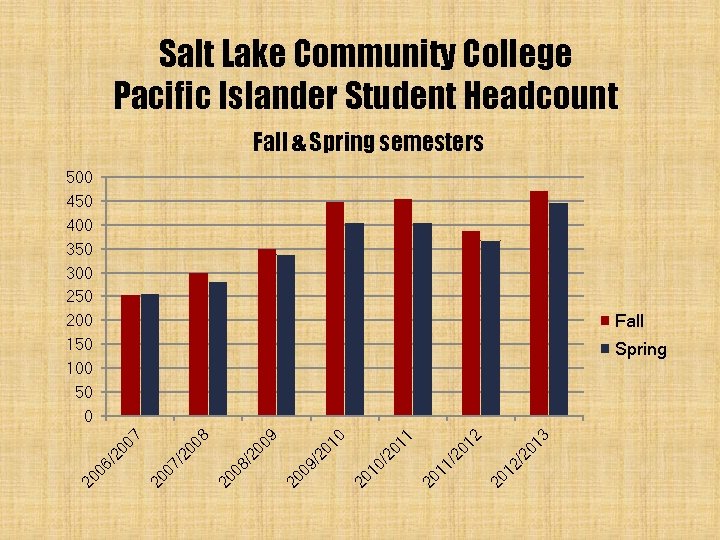
Salt Lake Community College Pacific Islander Student Headcount Fall & Spring semesters 500 450 400 350 300 250 200 150 100 50 0 Fall 01 3 /2 20 11 /2 01 20 10 01 0 /2 20 09 20 08 /2 00 9 8 /2 00 20 07 20 06 /2 00 7 Spring
Multicultural Advisors History of Salt Lake Community College Need Current Situation Hispanic/ Latino(a) African/ African American Vision Asian/ Asian American Native American Pacific Islander
Pacific Islander Advisor Job Description § Provide intrusive/proactive academic advising § Follow up advisement of PI students with the goal of increasing retention § Focus advising on PI students, particularly those on Academic Standards § Develop prevention and intervention strategies
Pacific Islander Advisor Job Description § Coordinate services § Develop recognition strategies for students in good academic standing § Identify, outreach to, and assist on-campus PI students who scored in ESL, math, reading, or writing developmental classes
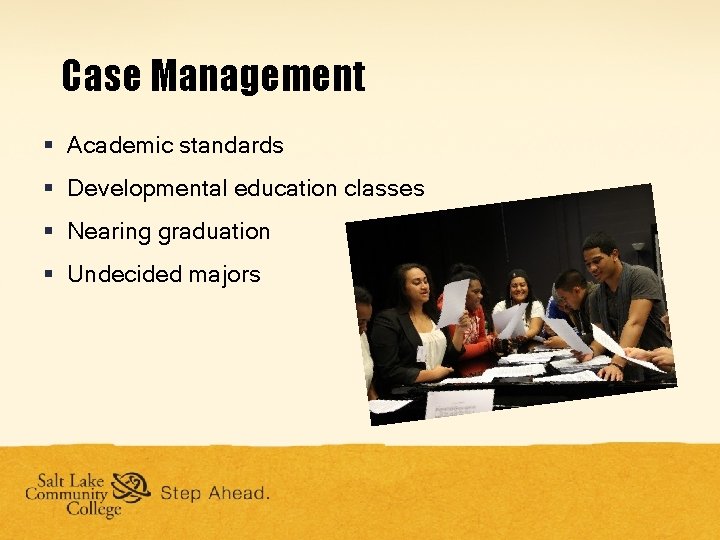
Case Management § Academic standards § Developmental education classes § Nearing graduation § Undecided majors
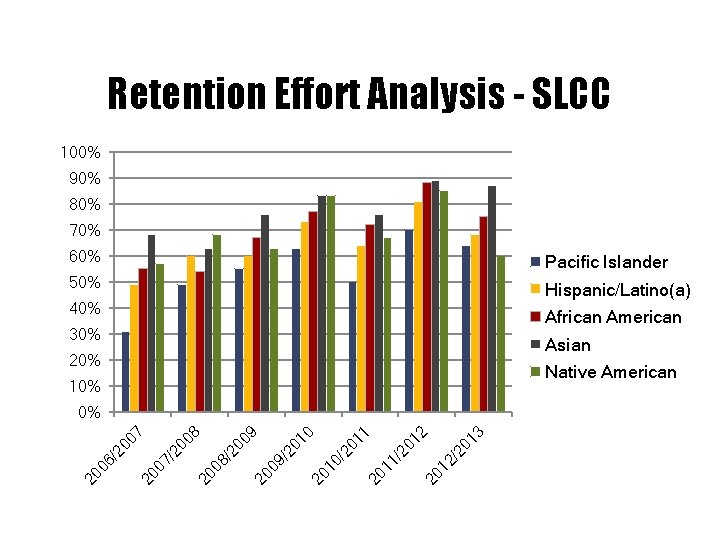
Retention Effort Analysis - SLCC 100% 90% 80% 70% 60% Pacific Islander 50% Hispanic/Latino(a) 40% African American 30% Asian 20% Native American 10% 3 /2 01 2 20 12 /2 01 1 20 11 /2 01 20 10 /2 01 0 9 20 09 /2 00 8 20 08 /2 00 20 07 20 06 /2 00 7 0%
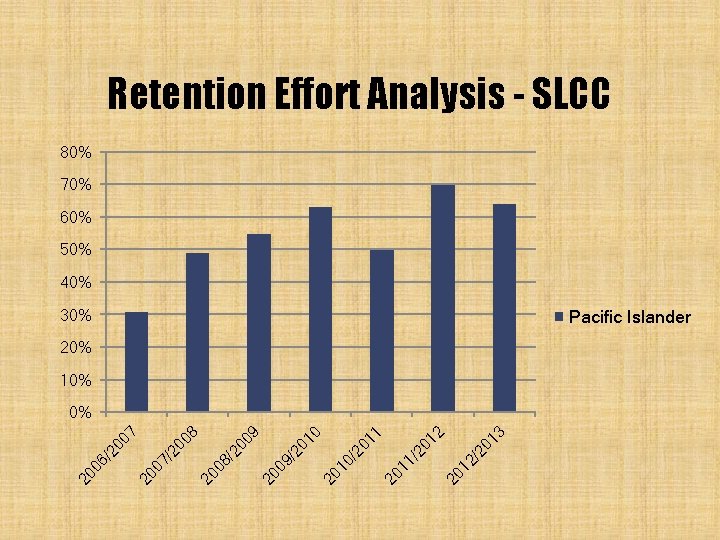
Retention Effort Analysis - SLCC 80% 70% 60% 50% 40% 30% Pacific Islander 20% 10% 3 20 12 /2 01 1 20 11 /2 01 20 10 0 /2 01 20 09 8/ 2 00 9 8 20 0 /2 00 20 07 20 06 /2 00 7 0%
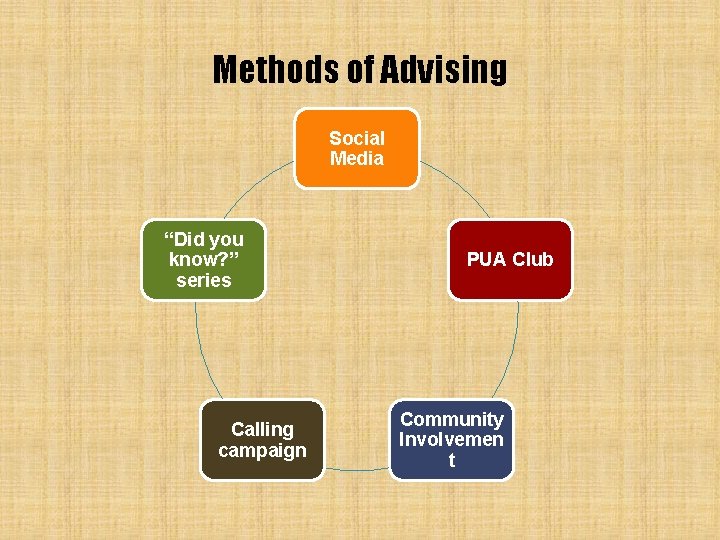
Methods of Advising Social Media “Did you know? ” series Calling campaign PUA Club Community Involvemen t
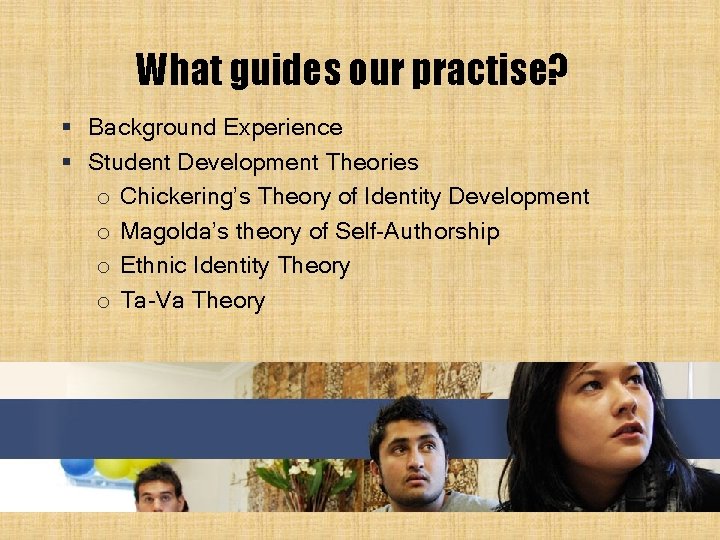
What guides our practise? § Background Experience § Student Development Theories o Chickering’s Theory of Identity Development o Magolda’s theory of Self-Authorship o Ethnic Identity Theory o Ta-Va Theory
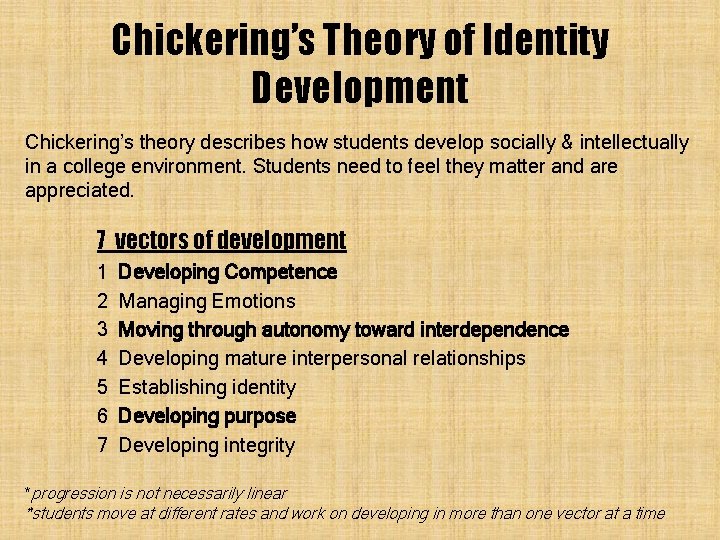
Chickering’s Theory of Identity Development Chickering’s theory describes how students develop socially & intellectually in a college environment. Students need to feel they matter and are appreciated. 7 vectors of development 1 Developing Competence 2 Managing Emotions 3 Moving through autonomy toward interdependence 4 Developing mature interpersonal relationships 5 Establishing identity 6 Developing purpose 7 Developing integrity *progression is not necessarily linear *students move at different rates and work on developing in more than one vector at a time
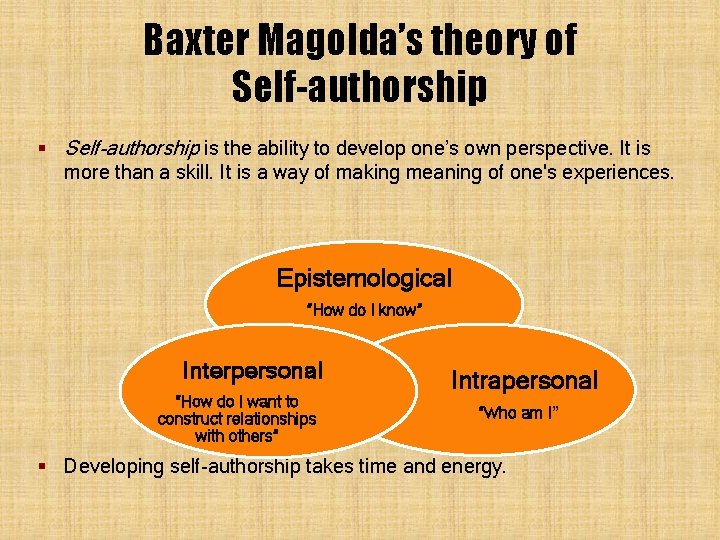
Baxter Magolda’s theory of Self-authorship § Self-authorship is the ability to develop one’s own perspective. It is more than a skill. It is a way of making meaning of one's experiences. Epistemological “How do I know” Interpersonal “How do I want to construct relationships with others” Intrapersonal “Who am I” § Developing self-authorship takes time and energy.
Ethnic Identity theory a “multitude of characteristics like nationality, religion, culture and history to which personal and social meanings of group identity are usually attached” (Cokley, 2007, p. 518). positive ethnic identity is most important in the development of “healthy, psychological functioning and self-esteem” [of PI students] (Evans, et al. 2010, p. 273).
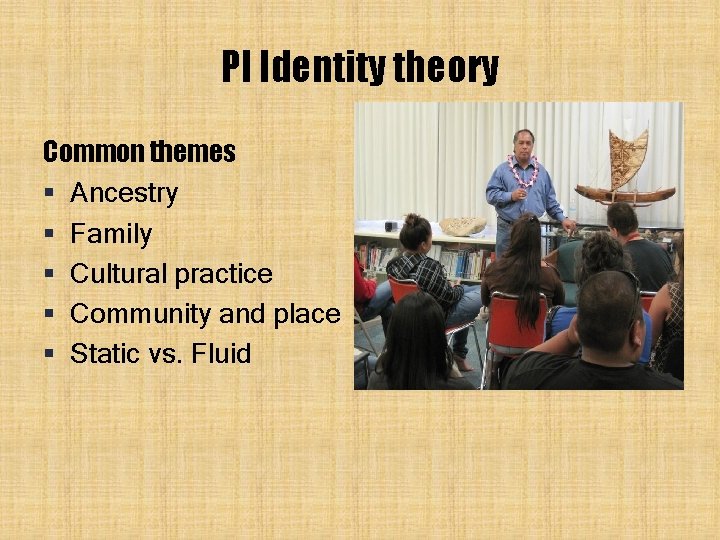
PI Identity theory Common themes § Ancestry § Family § Cultural practice § Community and place § Static vs. Fluid
Ethnic Identity theory “As a first generation PI student myself, I learned to be a “cultural straddler” where I attempted to find a balance between the knowledge and behavior I learned at home and that which I would receive outside of it. The balance I found became less of a question as to “how can I use what I learn from this space into that space? ” and more of a question as to “who do I want to be today? ” At that time, I thought that being skilled in my English and classical music abilities meant I had to disconnect myself from my identity as a Tongan. With that being said, I found myself avoiding my PI friends so I could associate with my white friends in my honors and music classes. Both my white and non-white friends began to see me as “white-washed, ” or fiepalangi” (personal conversation, December 1, 2012 ).
Ta-Va (Time-Space) Theory – Dr. Okusitino Mahina § Ta (Time) and Va (Environment/Space) is a process that requires mediation of social and intellectual spaces in order to create harmony § PI students constantly negotiate their Ta and Va § The practice of nurturing spaces (tauhi va) in higher education requires time, energy and resources. E. g. common geneaological link and shared social space are important as this has a long history with Oceania people. § “Our Moana/Pacific students are sandwiched between two largely irreconcilable worlds, that is, Western and Moana/Pacific cultures and languages - done in the West in singular, technoteleological, individualistic, analytical and linear modes in contrast to their arrangement in the Moana/Pacific in plural, cultural, collectivisitic and circular ways. ” § Examples: funeral , non-linear four year plan , balance between family & education, recite genealogies § Remedy: knowledge production and knowledge acquisition
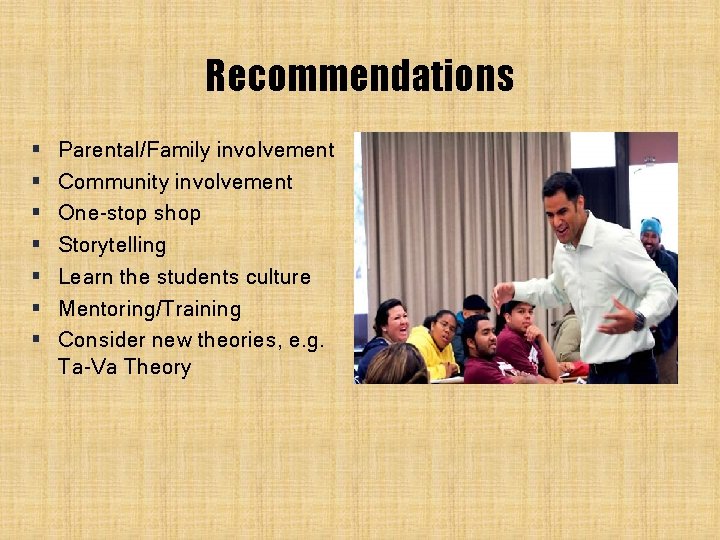
Recommendations § § § § Parental/Family involvement Community involvement One-stop shop Storytelling Learn the students culture Mentoring/Training Consider new theories, e. g. Ta-Va Theory
Recommendations § Adapt to the transitional and learning needs of students “In the past, [educational institutions] have tended to develop new student support programs implicitly assuming that the challenge is to help students adapt to the institution. In some cases, and to a certain extent, this may have been appropriate. For nontraditional and diverse students, however, the logic needs to be reversed: Institutions must seek ways in which they can change so at to accommodate the transitional and learning needs of…nontraditional students” (Teranzini et al. , 1994, p. 72)
References Chickering, A. W. (1969). Education and Identity. San Francisco: Jossey-Baas. Evans, N. J. , Forney, D. S. , Guido, F. , Patton, L. D. , & Renn, K. A. (2010). Student development in college: Theory, research, and practice. 2 nd Edition. San Francisco: Jossey-Bass. Mahina, O. (2007). Tongans at the University of Auckland: A cause for Celebration. In O. Mahina, N. Seve-Williams, A. Faaiuaso & D. Hosking (Eds. ), Atea, Moana and Vanua: Voices from the Brown Edge. Auckland: O Lagi Atea Moana Press. Terenzini, P. T. , Rendon, L. I. , Upcraft, M. L. , Millar, S. B. , Allison, K. W. , Gregg, P. L. , et al. (1994). The transition to college: Diverse students, diverse stories. Research in Higher Education, 35(1), 57 -73 U. S. Census Bureau. (2012). Profile america: Facts for features (CB 12 -FF. 09). Washington, D. C. : U. S. Department of Commerce. U. S. Census Bureau. (2012). Retrieved from http: //factfinder. census. gov/servlet/SAFFFacts. Char. Iteration? _submenu. Id=factsheet_2&_sse=on
Thank you! Michelle Tuitupou Michelle. tuitupou@slcc. edu 801. 957. 4474 Latu Kinikini lkini@uc. utah. edu 801. 581. 8429