
Effect of the Enhanced Recovery After Surgery ERAS

- Slides: 7
Effect of the Enhanced Recovery After Surgery (ERAS) Perioperative Protocol on Short Term Outcomes of Joint Replacement Surgery Safa Fassihi M. D. 1, Melissa Soderquist M. D. 1, Sean Kraekel M. D. 1, Anthony Unger M. D. 2 1 The George Washington University Department of Orthopaedic Surgery, Washington DC 2 The Johns Hopkins University, Department of Orthopaedic Surgery, Baltimore MD
DISCLOSURES • There are no conflicts or relationships related to the content of this presentation. • I have no disclosures – Royalties and stock options: None – Consulting income: None – Research and educational support: None – Other support: None
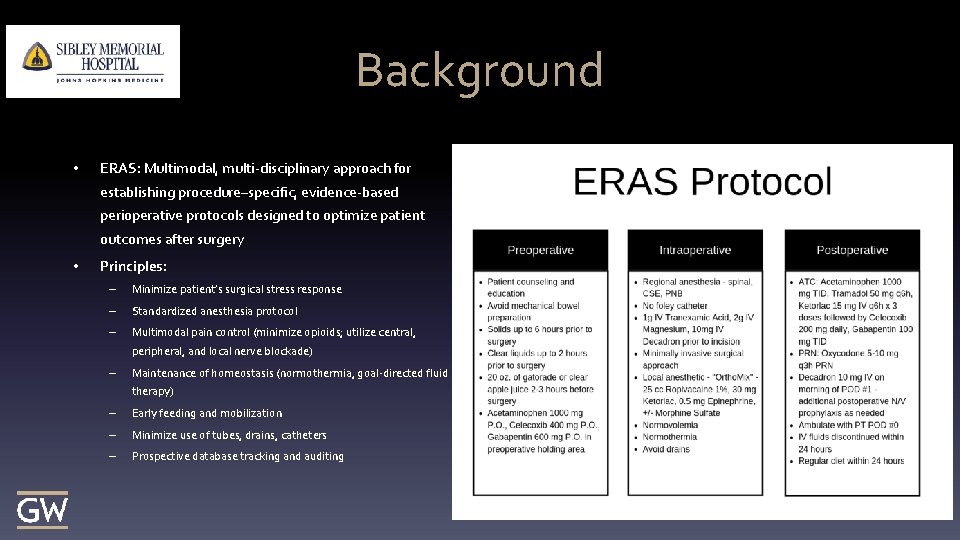
Background • ERAS: Multimodal, multi-disciplinary approach for establishing procedure–specific, evidence-based perioperative protocols designed to optimize patient outcomes after surgery • Principles: – Minimize patient’s surgical stress response – Standardized anesthesia protocol – Multimodal pain control (minimize opioids; utilize central, peripheral, and local nerve blockade) – Maintenance of homeostasis (normothermia, goal-directed fluid therapy) – Early feeding and mobilization – Minimize use of tubes, drains, catheters – Prospective database tracking and auditing
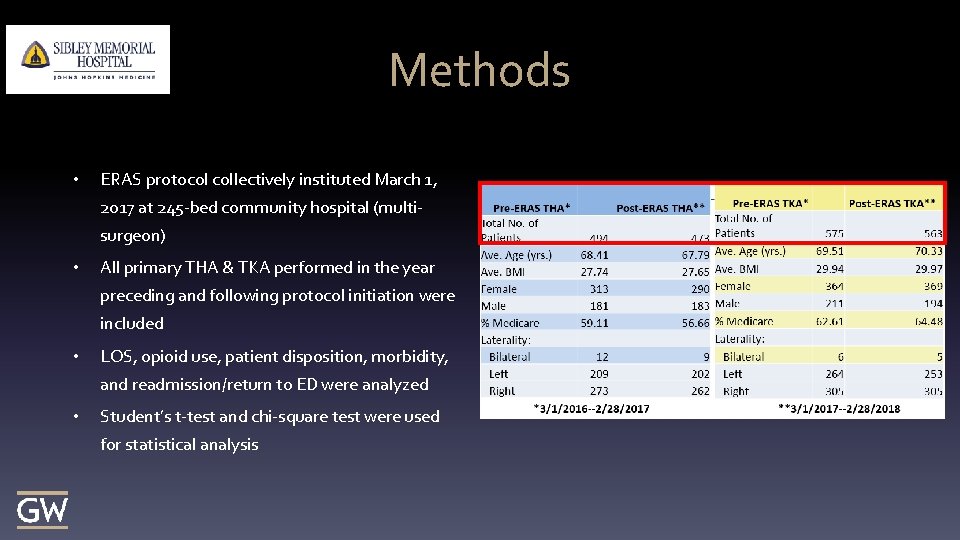
Methods • ERAS protocol collectively instituted March 1, 2017 at 245 -bed community hospital (multisurgeon) • All primary THA & TKA performed in the year preceding and following protocol initiation were included • LOS, opioid use, patient disposition, morbidity, and readmission/return to ED were analyzed • Student’s t-test and chi-square test were used for statistical analysis
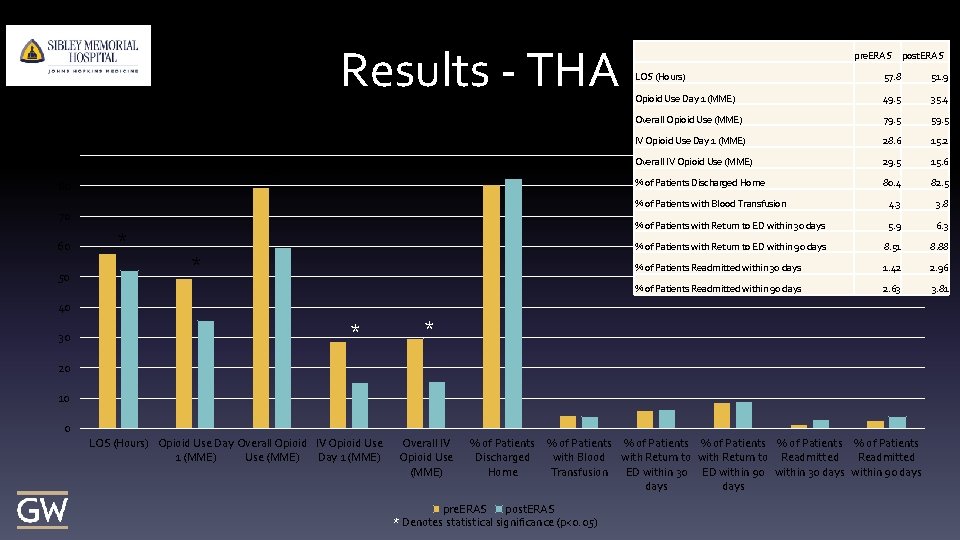
Results - THA Outcomes for THA 90 * * 80 50 * * post. ERAS LOS (Hours) 57. 8 51. 9 Opioid Use Day 1 (MME) 49. 5 35. 4 Overall Opioid Use (MME) 79. 5 59. 5 IV Opioid Use Day 1 (MME) 28. 6 15. 2 Overall IV Opioid Use (MME) 29. 5 15. 6 % of Patients Discharged Home 80. 4 82. 5 4. 3 3. 8 % of Patients with Return to ED within 30 days 5. 9 6. 3 % of Patients with Return to ED within 90 days 8. 51 8. 88 % of Patients Readmitted within 30 days 1. 42 2. 96 % of Patients Readmitted within 90 days 2. 63 3. 81 % of Patients with Blood Transfusion 70 60 pre. ERAS * 40 30 * * 20 10 0 LOS (Hours) Opioid Use Day Overall Opioid IV Opioid Use 1 (MME) Use (MME) Day 1 (MME) Overall IV Opioid Use (MME) % of Patients % of Patients Discharged with Blood with Return to Readmitted Home Transfusion ED within 30 ED within 90 within 30 days within 90 days pre. ERAS post. ERAS * Denotes statistical significance (p<0. 05)
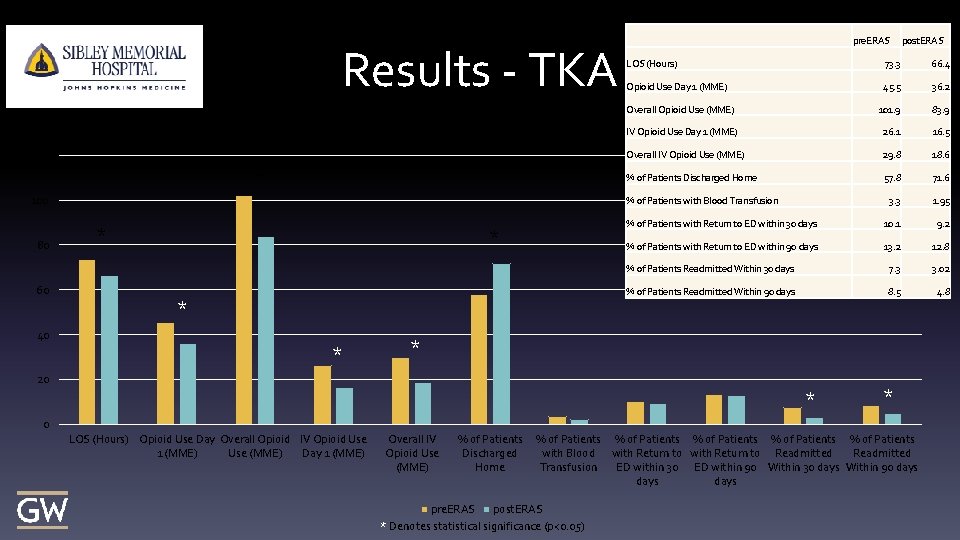
Results - TKA Outcomes for TKA 120 * 100 80 60 40 pre. ERAS LOS (Hours) 73. 3 66. 4 Opioid Use Day 1 (MME) 45. 5 36. 2 Overall Opioid Use (MME) 101. 9 83. 9 IV Opioid Use Day 1 (MME) 26. 1 16. 5 Overall IV Opioid Use (MME) 29. 8 18. 6 % of Patients Discharged Home 57. 8 71. 6 3. 3 1. 95 % of Patients with Return to ED within 30 days 10. 1 9. 2 % of Patients with Return to ED within 90 days 13. 2 12. 8 % of Patients Readmitted Within 30 days 7. 3 3. 02 % of Patients Readmitted Within 90 days 8. 5 4. 8 % of Patients with Blood Transfusion * * post. ERAS * 20 * * 0 LOS (Hours) Opioid Use Day Overall Opioid IV Opioid Use 1 (MME) Use (MME) Day 1 (MME) Overall IV Opioid Use (MME) % of Patients Discharged Home % of Patients % of Patients with Blood with Return to Readmitted Transfusion ED within 30 ED within 90 Within 30 days Within 90 days pre. ERAS post. ERAS * Denotes statistical significance (p<0. 05)
Conclusion • In primary THA & TKA, the ERAS protocol significantly reduces LOS, increases patient disposition to home, reduces overall and IV opioid consumption, and trends towards decreasing blood transfusion rates. • For THA, this is achieved without a statistically significant difference in early readmission rates or return to the ED. • For TKA, the ERAS protocol significantly reduces overall readmission rates in the 30 - and 90 -day postoperative periods. • Further research is underway to determine if the ERAS protocol affects functional outcomes scores following primary THA & TKA.