
Effect of substrate temperature on morphology and resistivity
Effect of substrate temperature on morphology and resistivity of inkjet printed Dr. Thiago Martins Amaral INM-g. Gmb. H- Leibniz - Institute für Neue Materialien Saarbrücken ICCG 11 - 2016

Outline • • • Introduction Motivation Objective Experimental Results Conclusions 2
Inkjet printing • Ejecting drops directly into a substrate • “Drop on demand” – Position on the substrate – Amount of material deposited – Material economy and versatility of shapes 3
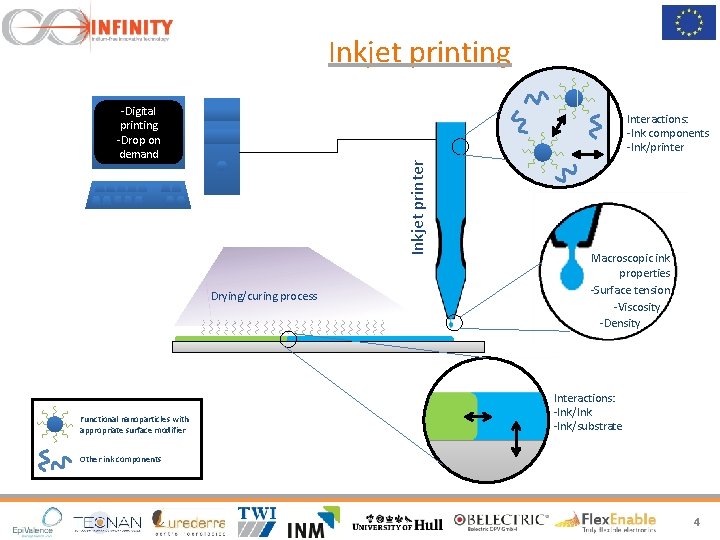
Inkjet printing -Digital printing -Drop on demand Inkjet printer Interactions: -Ink components -Ink/printer Drying/curing process Functional nanoparticles with appropriate surface modifier Macroscopic ink properties -Surface tension -Viscosity -Density Interactions: -Ink/Ink -Ink/substrate Other ink components 4
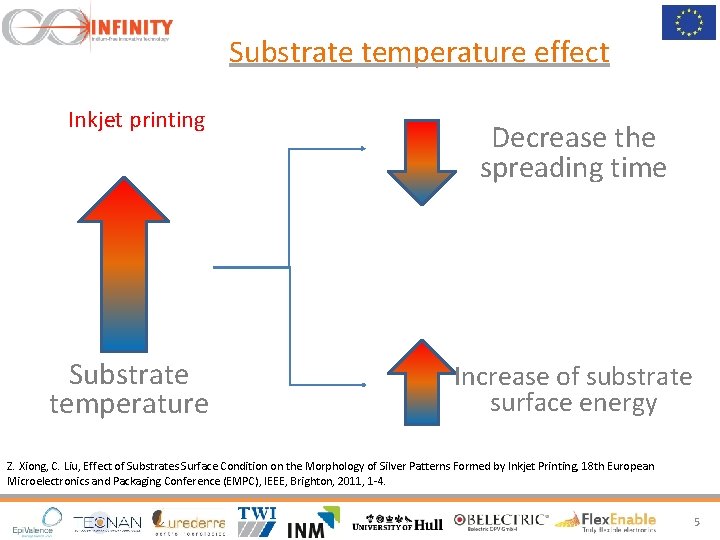
Substrate temperature effect Inkjet printing Substrate temperature Decrease the spreading time Increase of substrate surface energy Z. Xiong, C. Liu, Effect of Substrates Surface Condition on the Morphology of Silver Patterns Formed by Inkjet Printing, 18 th European Microelectronics and Packaging Conference (EMPC), IEEE, Brighton, 2011, 1 -4. 5
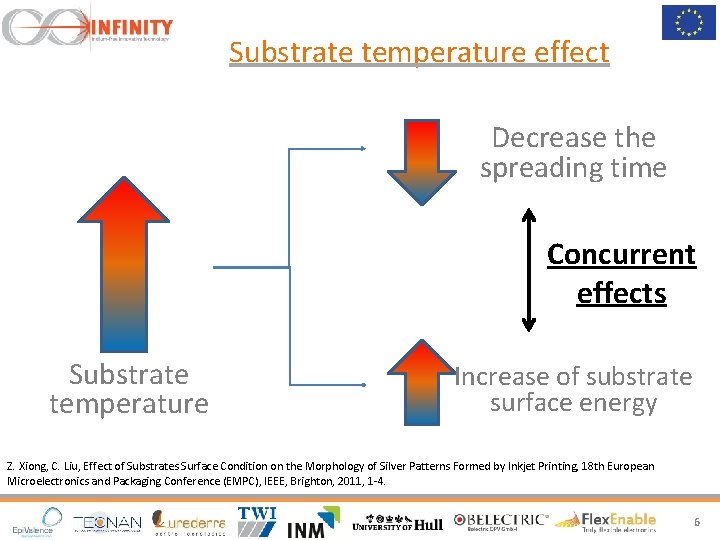
Substrate temperature effect Decrease the spreading time Concurrent effects Substrate temperature Increase of substrate surface energy Z. Xiong, C. Liu, Effect of Substrates Surface Condition on the Morphology of Silver Patterns Formed by Inkjet Printing, 18 th European Microelectronics and Packaging Conference (EMPC), IEEE, Brighton, 2011, 1 -4. 6
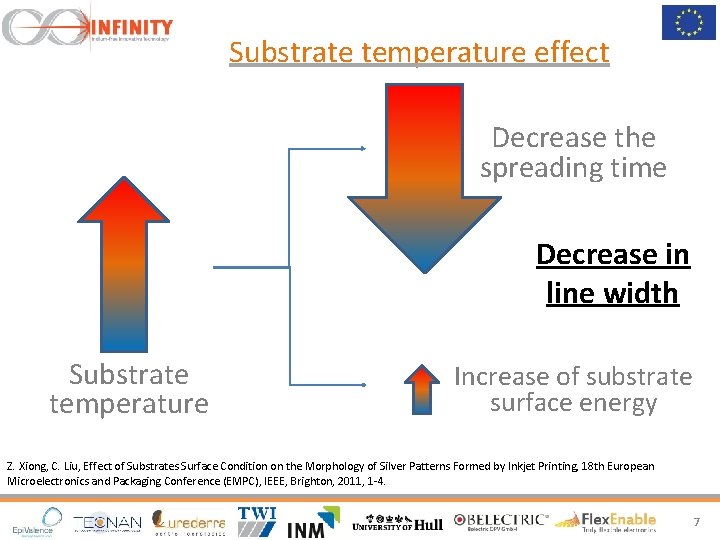
Substrate temperature effect Decrease the spreading time Decrease in line width Substrate temperature Increase of substrate surface energy Z. Xiong, C. Liu, Effect of Substrates Surface Condition on the Morphology of Silver Patterns Formed by Inkjet Printing, 18 th European Microelectronics and Packaging Conference (EMPC), IEEE, Brighton, 2011, 1 -4. 7
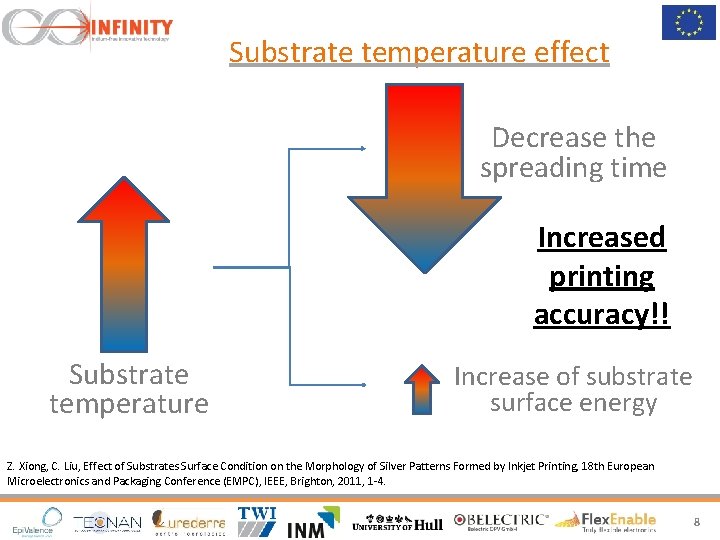
Substrate temperature effect Decrease the spreading time Increased printing accuracy!! Substrate temperature Increase of substrate surface energy Z. Xiong, C. Liu, Effect of Substrates Surface Condition on the Morphology of Silver Patterns Formed by Inkjet Printing, 18 th European Microelectronics and Packaging Conference (EMPC), IEEE, Brighton, 2011, 1 -4. 8
ITO • In 2 O 3: Sn - Transparent conducting oxide -> Display industry Generally processed under vacuum Waste Inkjet-> drop-on-demand 9
Substrate temperature effect • Objective - Investigate substrate temperature effects on morphology and resistivity of Inkjet printed ITO - ITO ink: Isopropoxyethanol+H 2 O+TODS+ITO nanoparticles+MPTS 10
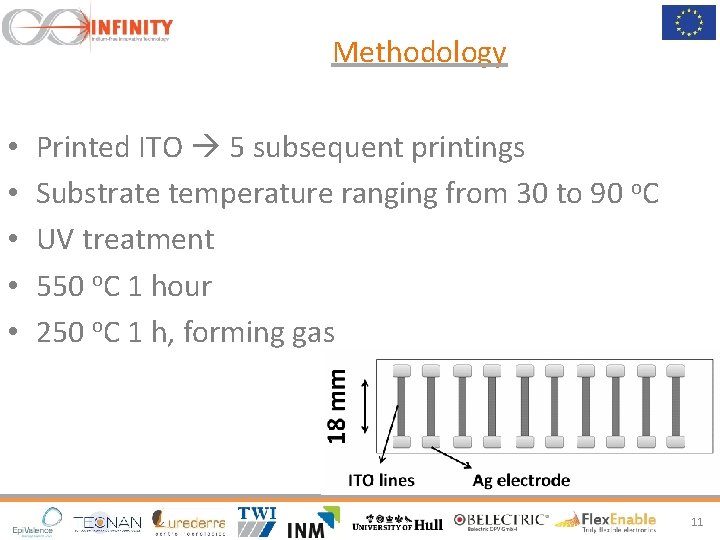
Methodology • • • Printed ITO 5 subsequent printings Substrate temperature ranging from 30 to 90 o. C UV treatment 550 o. C 1 hour 250 o. C 1 h, forming gas 11
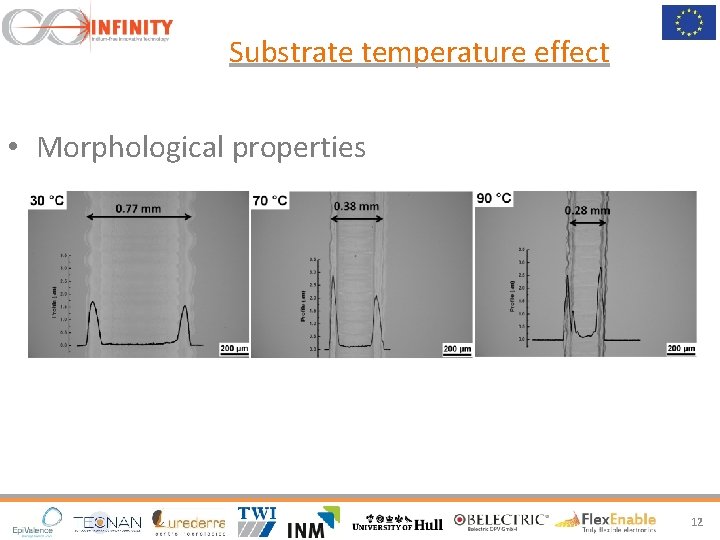
Substrate temperature effect • Morphological properties 12
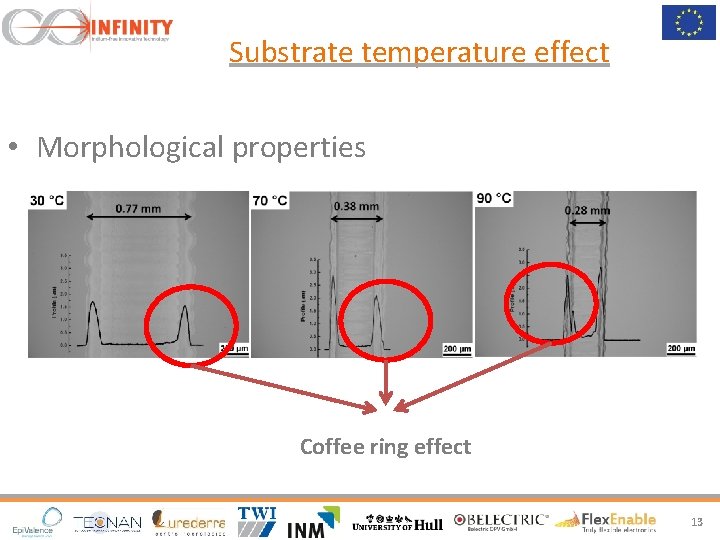
Substrate temperature effect • Morphological properties Coffee ring effect 13
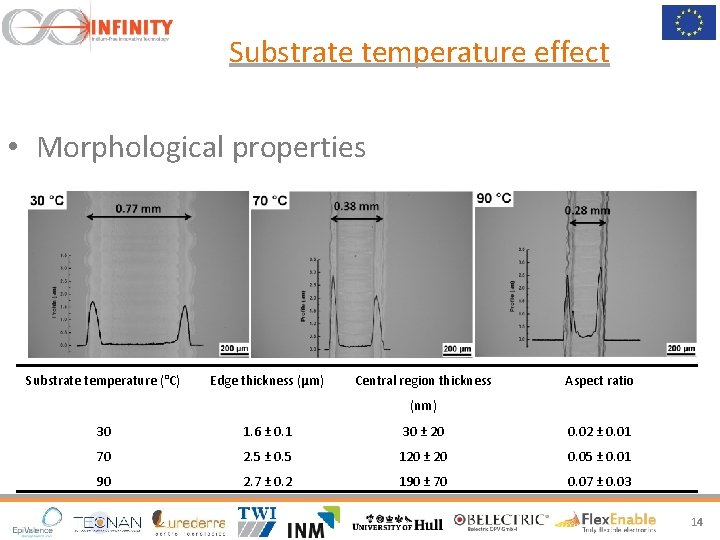
Substrate temperature effect • Morphological properties Substrate temperature (°C) Edge thickness (μm) Central region thickness Aspect ratio (nm) 30 1. 6 ± 0. 1 30 ± 20 0. 02 ± 0. 01 70 2. 5 ± 0. 5 120 ± 20 0. 05 ± 0. 01 90 2. 7 ± 0. 2 190 ± 70 0. 07 ± 0. 03 14
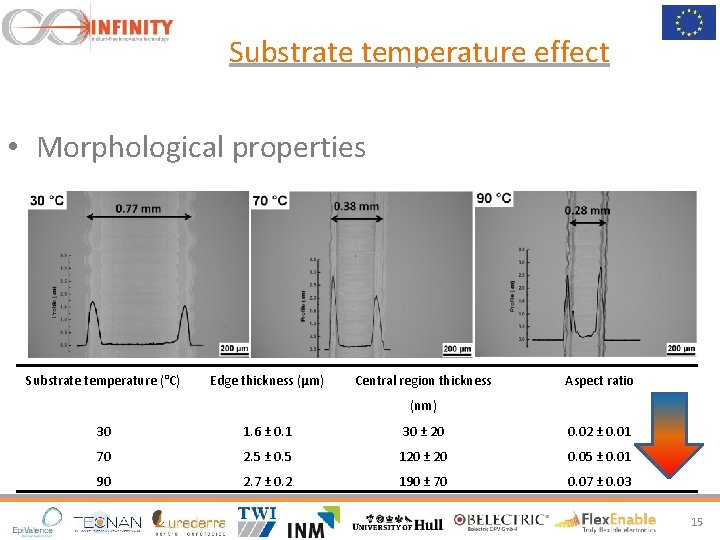
Substrate temperature effect • Morphological properties Substrate temperature (°C) Edge thickness (μm) Central region thickness Aspect ratio (nm) 30 1. 6 ± 0. 1 30 ± 20 0. 02 ± 0. 01 70 2. 5 ± 0. 5 120 ± 20 0. 05 ± 0. 01 90 2. 7 ± 0. 2 190 ± 70 0. 07 ± 0. 03 15
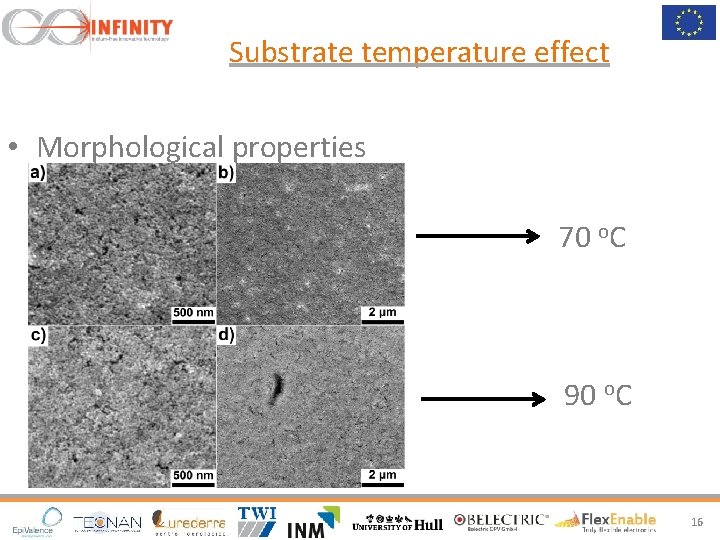
Substrate temperature effect • Morphological properties 70 o. C 90 o. C 16
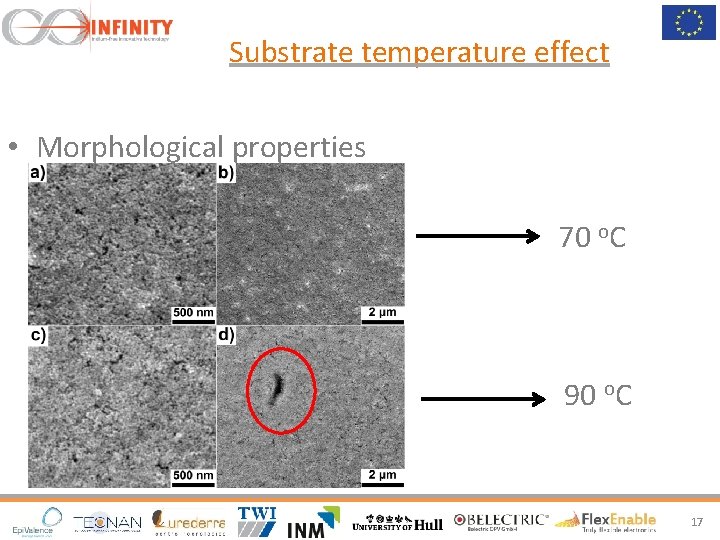
Substrate temperature effect • Morphological properties 70 o. C 90 o. C 17
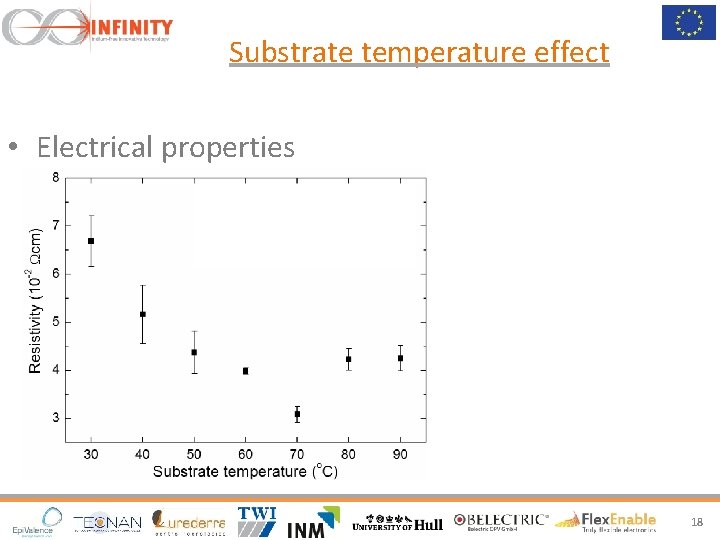
Substrate temperature effect • Electrical properties 18
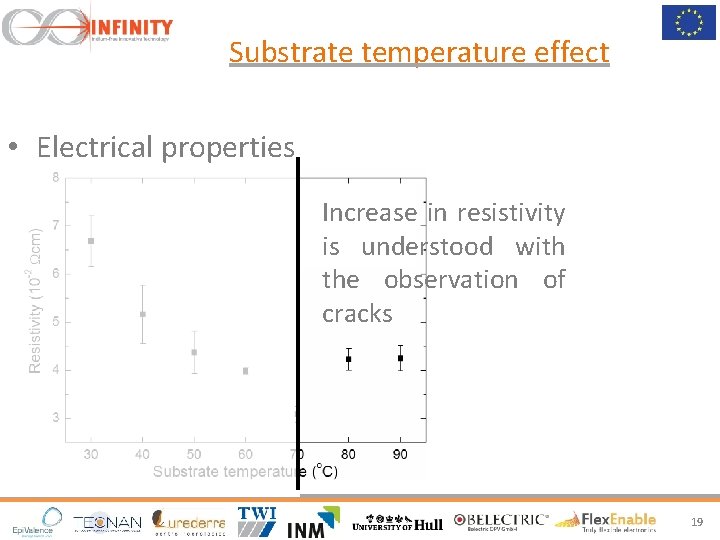
Substrate temperature effect • Electrical properties Increase in resistivity is understood with the observation of cracks 19
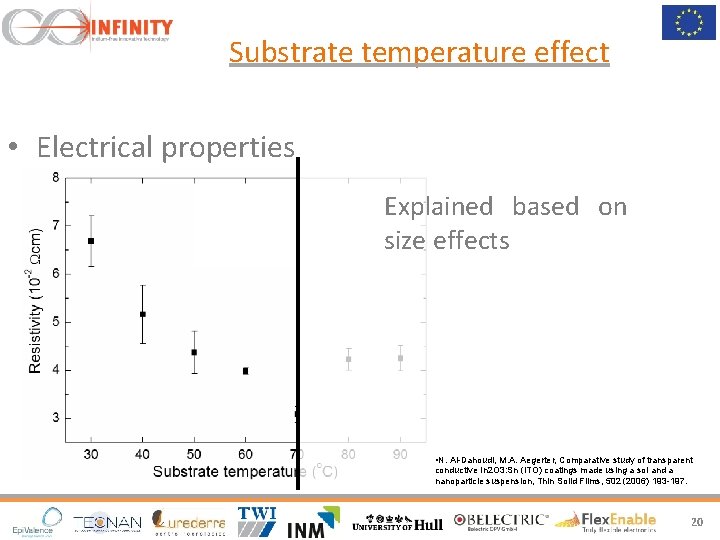
Substrate temperature effect • Electrical properties Explained based on size effects • N. Al-Dahoudi, M. A. Aegerter, Comparative study of transparent conductive In 2 O 3: Sn (ITO) coatings made using a sol and a nanoparticle suspension, Thin Solid Films, 502 (2006) 193 -197. 20
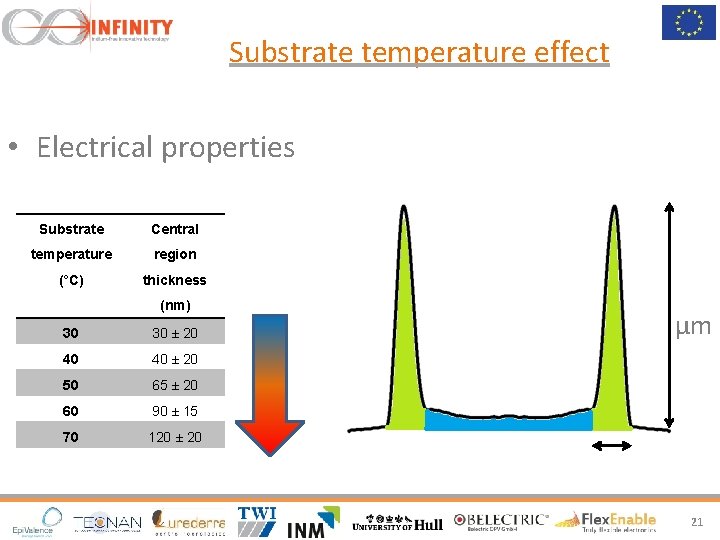
Substrate temperature effect • Electrical properties Substrate Central temperature region (°C) thickness (nm) 30 30 ± 20 40 40 ± 20 50 65 ± 20 60 90 ± 15 70 120 ± 20 µm 21
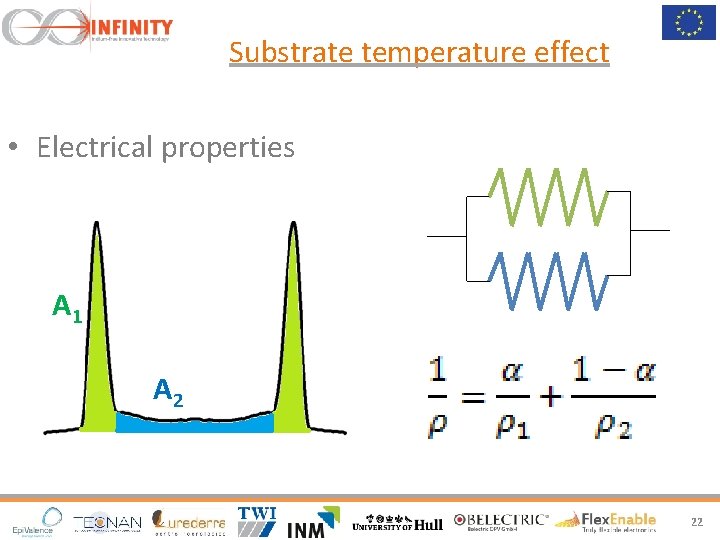
Substrate temperature effect • Electrical properties A 1 A 2 22
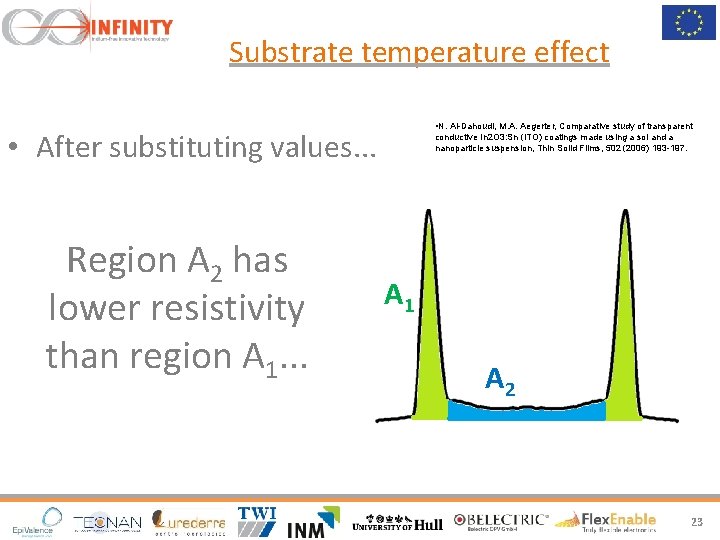
Substrate temperature effect • N. Al-Dahoudi, M. A. Aegerter, Comparative study of transparent • After substituting values. . . Region A 2 has lower resistivity than region A 1. . . conductive In 2 O 3: Sn (ITO) coatings made using a sol and a nanoparticle suspension, Thin Solid Films, 502 (2006) 193 -197. A 1 A 2 23
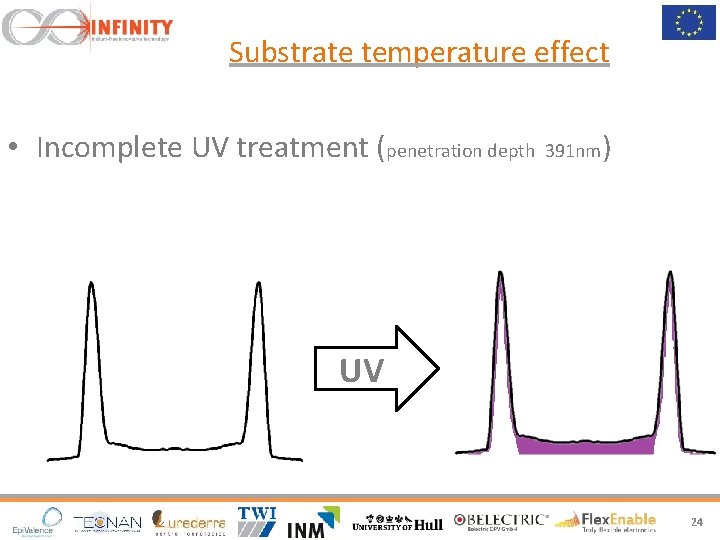
Substrate temperature effect • Incomplete UV treatment (penetration depth 391 nm) UV 24
Conclusions • Temperature of the substrate indirect affect the lines resistivity by changing their morphology • The temperature can be tuned in order to optimize electrical resistivity as a trade off between increase of the line thickness and speed of solvent evaporation • Coffee ring effect must be avoided in ITO-UV curable inks 25
Thank you Acknowledgments Dr. Sabine Heusing Dr. Peter König Dr. Peter Williams de Oliveira Contact: Dr. Thiago Martins Amaral Thiago. Martins. Amaral@leibniz-inm. de INM-Leibniz Institut für Neue Materialien g. Gmb. H Saarbrücken, Germany This project has received funding from the European Union’s Horizon 2020 research and innovation programme under grant agreement No 641927 26
- Slides: 26