
Effect of solar proton events and medium energy
- Slides: 1
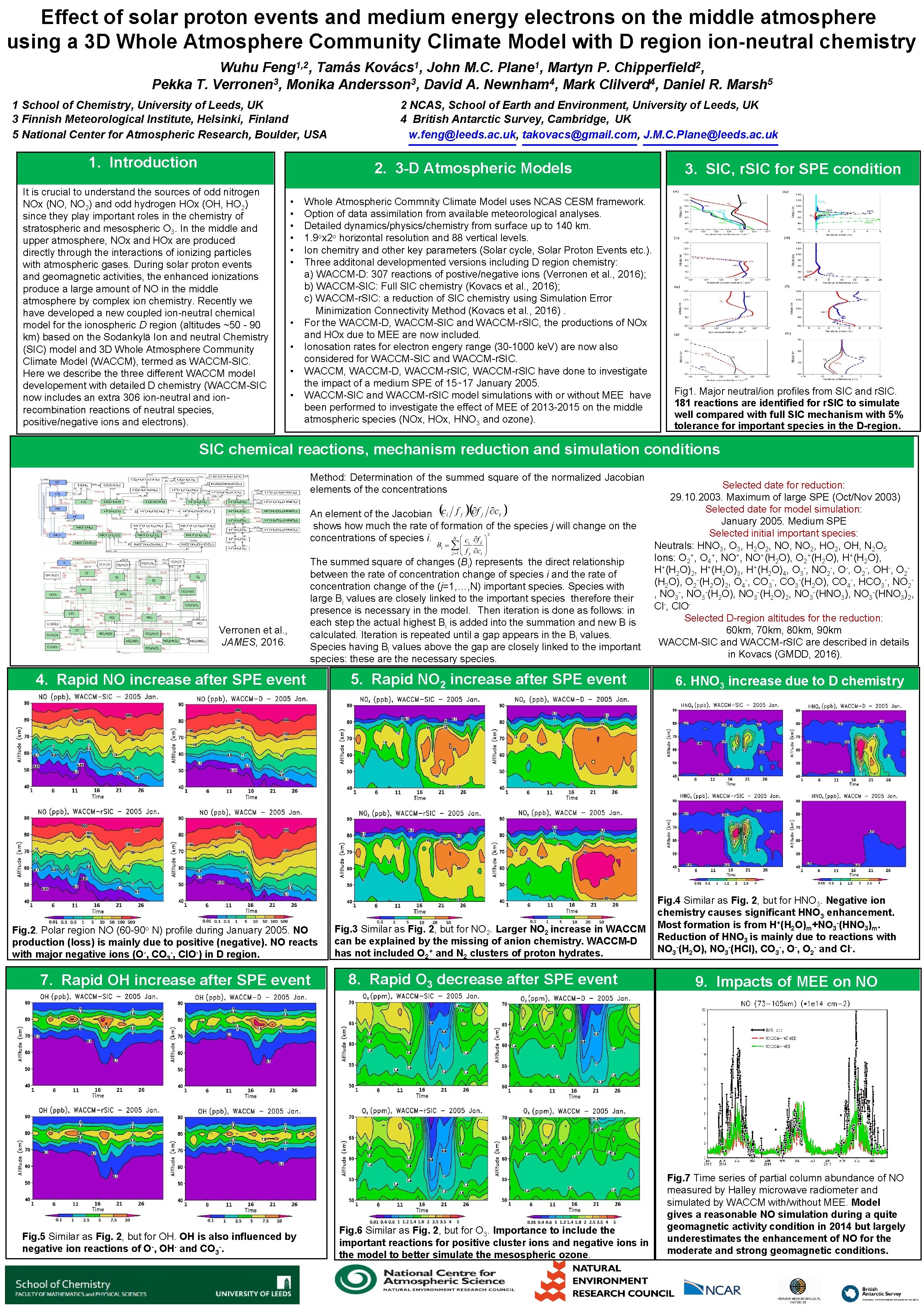
Effect of solar proton events and medium energy electrons on the middle atmosphere using a 3 D Whole Atmosphere Community Climate Model with D region ion-neutral chemistry Wuhu Feng 1, 2, Tamás Kovács 1, John M. C. Plane 1, Martyn P. Chipperfield 2, Pekka T. Verronen 3, Monika Andersson 3, David A. Newnham 4, Mark Clilverd 4, Daniel R. Marsh 5 1 School of Chemistry, University of Leeds, UK 3 Finnish Meteorological Institute, Helsinki, Finland 5 National Center for Atmospheric Research, Boulder, USA 1. Introduction 2 NCAS, School of Earth and Environment, University of Leeds, UK 4 British Antarctic Survey, Cambridge, UK w. feng@leeds. ac. uk, takovacs@gmail. com, J. M. C. Plane@leeds. ac. uk 2. 3 -D Atmospheric Models It is crucial to understand the sources of odd nitrogen NOx (NO, NO 2) and odd hydrogen HOx (OH, HO 2) since they play important roles in the chemistry of stratospheric and mesospheric O 3. In the middle and upper atmosphere, NOx and HOx are produced directly through the interactions of ionizing particles with atmospheric gases. During solar proton events and geomagnetic activities, the enhanced ionizations produce a large amount of NO in the middle atmosphere by complex ion chemistry. Recently we have developed a new coupled ion-neutral chemical model for the ionospheric D region (altitudes ~50 - 90 km) based on the Sodankylä Ion and neutral Chemistry (SIC) model and 3 D Whole Atmosphere Community Climate Model (WACCM), termed as WACCM-SIC. Here we describe three different WACCM model developement with detailed D chemistry (WACCM-SIC now includes an extra 306 ion-neutral and ionrecombination reactions of neutral species, positive/negative ions and electrons). • • • Whole Atmospheric Commnity Climate Model uses NCAS CESM framework. Option of data assimilation from available meteorological analyses. Detailed dynamics/physics/chemistry from surface up to 140 km. 1. 9 ox 2 o horizontal resolution and 88 vertical levels. Ion chemitry and other key parameters (Solar cycle, Solar Proton Events etc. ). Three additonal developmented versions including D region chemistry: a) WACCM-D: 307 reactions of postive/negative ions (Verronen et al. , 2016); b) WACCM-SIC: Full SIC chemistry (Kovacs et al. , 2016); c) WACCM-r. SIC: a reduction of SIC chemistry using Simulation Error Minimization Connectivity Method (Kovacs et al. , 2016). For the WACCM-D, WACCM-SIC and WACCM-r. SIC, the productions of NOx and HOx due to MEE are now included. Ionosation rates for electron engery range (30 -1000 ke. V) are now also considered for WACCM-SIC and WACCM-r. SIC. WACCM, WACCM-D, WACCM-r. SIC have done to investigate the impact of a medium SPE of 15‑ 17 January 2005. WACCM-SIC and WACCM-r. SIC model simulations with or without MEE have been performed to investigate the effect of MEE of 2013 -2015 on the middle atmospheric species (NOx, HNO 3 and ozone). 3. SIC, r. SIC for SPE condition Fig 1. Major neutral/ion profiles from SIC and r. SIC. 181 reactions are identified for r. SIC to simulate well compared with full SIC mechanism with 5% tolerance for important species in the D-region. SIC chemical reactions, mechanism reduction and simulation conditions Method: Determination of the summed square of the normalized Jacobian elements of the concentrations An element of the Jacobian shows how much the rate of formation of the species j will change on the concentrations of species i. Verronen et al. , JAMES, 2016. The summed square of changes (Bi) represents the direct relationship between the rate of concentration change of species i and the rate of concentration change of the (j=1, …, N) important species. Species with large Bi values are closely linked to the important species therefore their presence is necessary in the model. Then iteration is done as follows: in each step the actual highest Bi is added into the summation and new B is calculated. Iteration is repeated until a gap appears in the Bi values. Species having Bi values above the gap are closely linked to the important species: these are the necessary species. 4. Rapid NO increase after SPE event 5. Rapid NO 2 increase after SPE event 8. Solar cycle impact Fig. 2. Polar region NO (60 -90 o N) profile during January 2005. NO production (loss) is mainly due to positive (negative). NO reacts with major negative ions (O-, CO 3 -, Cl. O-) in D region. 7. Rapid OH increase after SPE event Fig. 5 Similar as Fig. 2, but for OH. OH is also influenced by negative ion reactions of O-, OH- and CO 3 -. Fig. 3 Similar as Fig. 2, but for NO 2. Larger NO 2 increase in WACCM can be explained by the missing of anion chemistry. WACCM-D has not included O 2+ and N 2 clusters of proton hydrates. 8. Rapid O 3 decrease after SPE event Fig. 6 Similar as Fig. 2, but for O 3. Importance to include the important reactions for positive cluster ions and negative ions in the model to better simulate the mesospheric ozone. Selected date for reduction: 29. 10. 2003. Maximum of large SPE (Oct/Nov 2003) Selected date for model simulation: January 2005. Medium SPE Selected initial important species: Neutrals: HNO 3, H 2 O 2, NO 2, HO 2, OH, N 2 O 5 Ions: O 2+, O 4+, NO+(H 2 O), O 2+(H 2 O), H+(H 2 O)2, H+(H 2 O)3, H+(H 2 O)4, O 3 -, NO 2 -, OH-, O 2(H 2 O), O 2 -(H 2 O)2, O 4 -, CO 3 -(H 2 O), CO 4 -, HCO 3 -, NO 2, NO 3 -(H 2 O), NO 3 -(H 2 O)2, NO 3 -(HNO 3)2, Cl-, Cl. OSelected D-region altitudes for the reduction: 60 km, 70 km, 80 km, 90 km WACCM-SIC and WACCM-r. SIC are described in details in Kovacs (GMDD, 2016). 6. HNO 3 increase due to D chemistry 9. Summary and conclusion Fig. 4 Similar as Fig. 2, but for HNO 3. Negative ion chemistry causes significant HNO 3 enhancement. Most formation is from H+(H 2 O)m+NO 3 -(HNO 3)m. Reduction of HNO 3 is mainly due to reactions with NO 3 -(H 2 O), NO 3 -(HCl), CO 3 -, O 2 - and Cl-. 9. Impacts of MEE on NO Fig. 7 Time series of partial column abundance of NO measured by Halley microwave radiometer and simulated by WACCM with/without MEE. Model gives a reasonable NO simulation during a quite geomagnetic activity condition in 2014 but largely underestimates the enhancement of NO for the moderate and strong geomagnetic conditions.