
Effect of Social Positive Reinforcement on Hand Raising
- Slides: 22
Effect of Social Positive Reinforcement on Hand Raising ABA II Allison Kracker
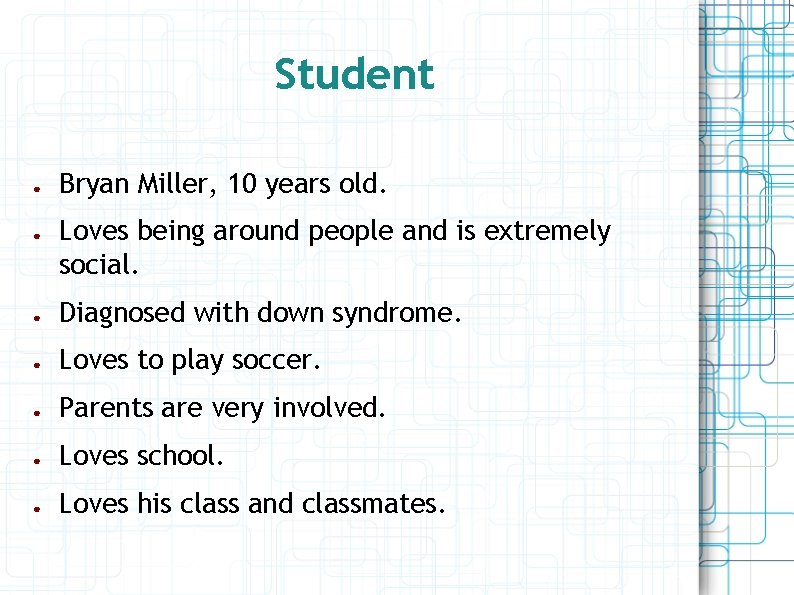
Student ● ● Bryan Miller, 10 years old. Loves being around people and is extremely social. ● Diagnosed with down syndrome. ● Loves to play soccer. ● Parents are very involved. ● Loves school. ● Loves his class and classmates.
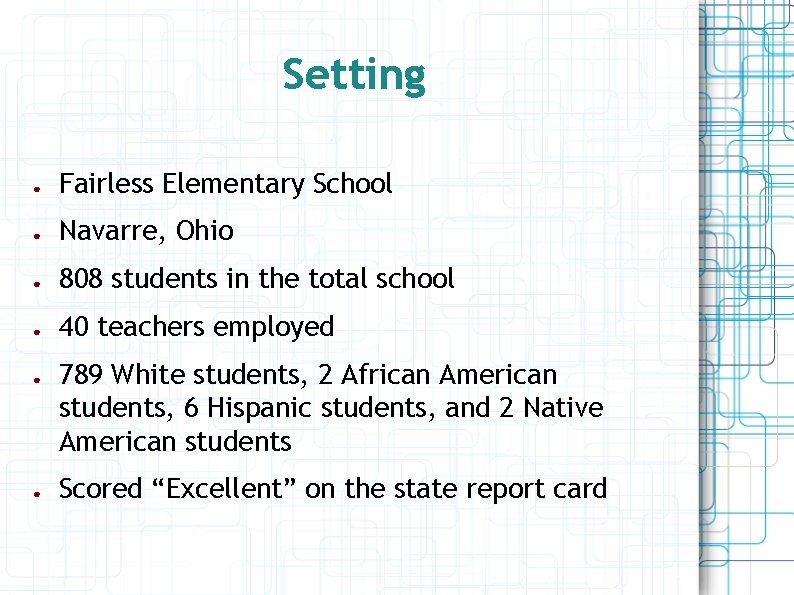
Setting ● Fairless Elementary School ● Navarre, Ohio ● 808 students in the total school ● 40 teachers employed ● ● 789 White students, 2 African American students, 6 Hispanic students, and 2 Native American students Scored “Excellent” on the state report card
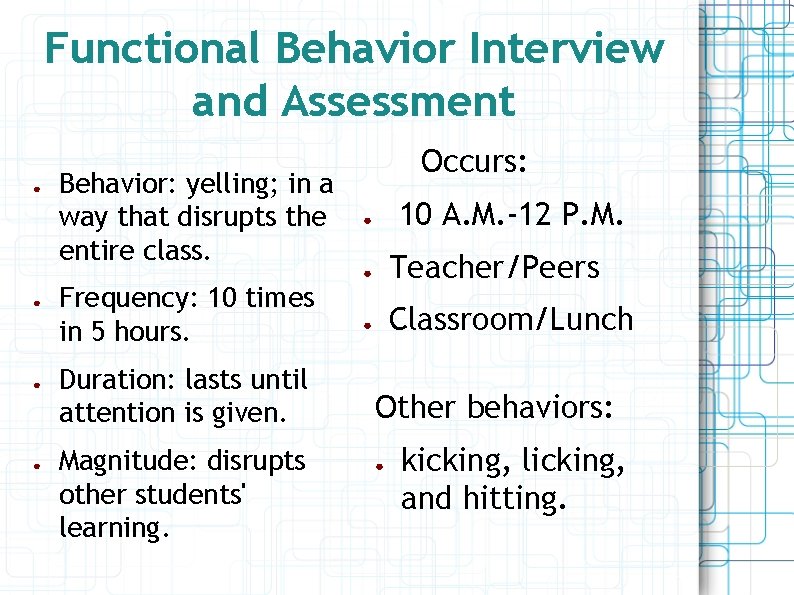
Functional Behavior Interview and Assessment ● ● Behavior: yelling; in a way that disrupts the entire class. Frequency: 10 times in 5 hours. Duration: lasts until attention is given. Magnitude: disrupts other students' learning. Occurs: 10 A. M. -12 P. M. ● ● Teacher/Peers ● Classroom/Lunch Other behaviors: ● kicking, licking, and hitting.
The types of situations that trigger this behavior are when peers/teachers are touching the student or when the teachers attention is not on him.
Target Behavior Definition ● (The student) will raise one of his hands up above his head making zero noises.
Behavioral Objective ● (The student) will raise his hand in an independent work classroom setting given one verbal redirection 3/5 days in the week by the first nine weeks of school as measured by observations given a positive reinforcement such as, “good job”, immediately after target behavior is detected.
What does the student get out of the behavior? ● ● ● Attention. The function of the behavior is a positive reinforcement function. The student is gaining attention from the teacher and/or peer when performing the behavior.
Replacement Behaviors ● A behavior that could serve the same function as yelling is raising his hand being immediately reinforced by a verbal cue. ● In raising his hand he gains attention with a verbal praise, but does not disrupt the class.
Intervention Procedures Before class begins put a piece of clear tape on your left and right leg, and put a pen in your pocket. Your left leg will be the number of times he displays the target behavior, and the right will be the total amount of opportunities he has to raise his hand.
Intervention Procedures: Task Analysis 1. Student raises his hand, with his mouth closed. 2. Immediately after noticing his hand is raised, point at Student. 3. While pointing state an encouraging message of praise such as, “Great job raising your hand. ” (Other positive phrases listed on next slide) 4. Go over to student and see what he needs. (Mark a tally on your left and right pant legs where the tape is. )
Intervention Procedure ● Phrases to be utilized in implementation of intervention: “Thank you for raising your hand, (student name)!” “Great job raising your hand, (student name)!” “I really like how you raised your hand, (student name)!” “Great choice raising your hand, (student name)!”
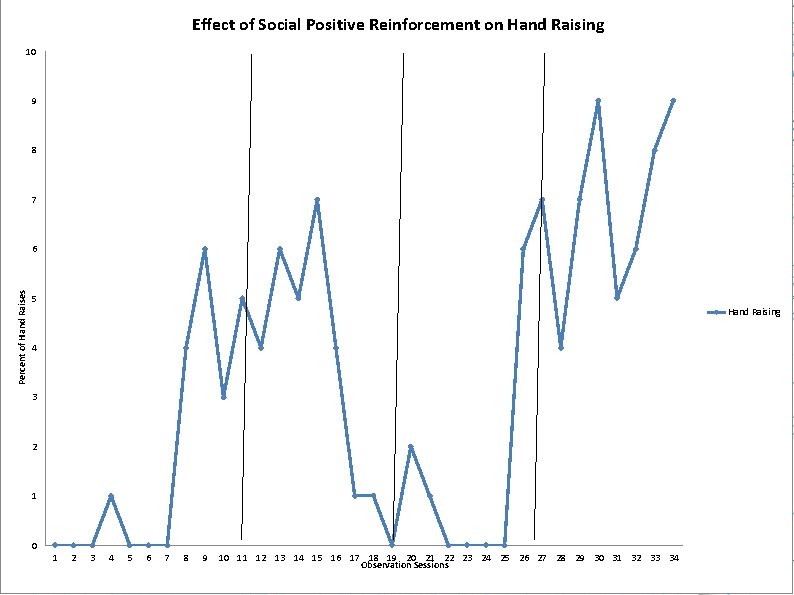
Effect of Social Positive Reinforcement on Hand Raising 10 9 8 7 Percent of Hand Raises 6 5 Hand Raising 4 3 2 1 0 1 2 3 4 5 6 7 8 9 10 11 12 13 14 15 16 17 18 19 20 21 22 23 24 25 26 27 28 29 30 31 32 33 34 Observation Sessions
Data collecting Procedures and Reporting Method ● ● I used event recording to report the behaviors observed in unison with the tally marks on the tape. I chose event because I was recording the number of times Bryan raised his hand. I reported the data by using percent, since I collected data using event.
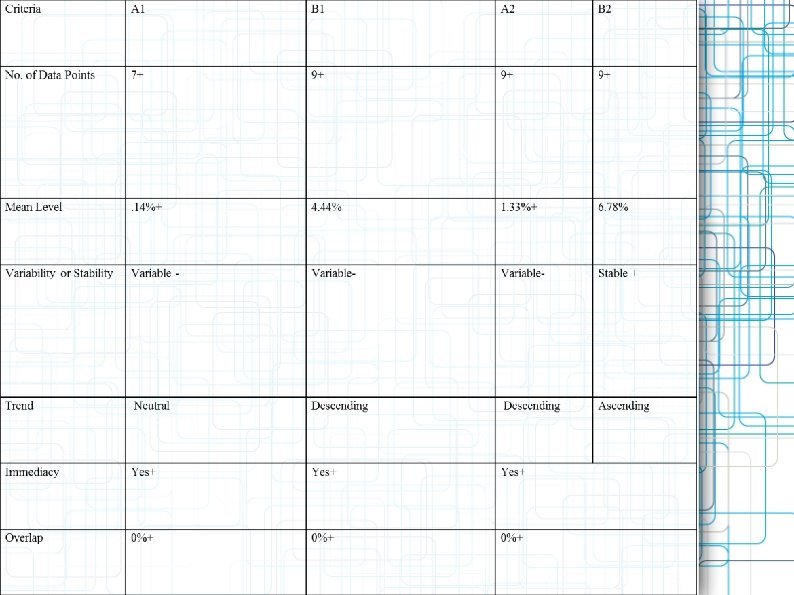
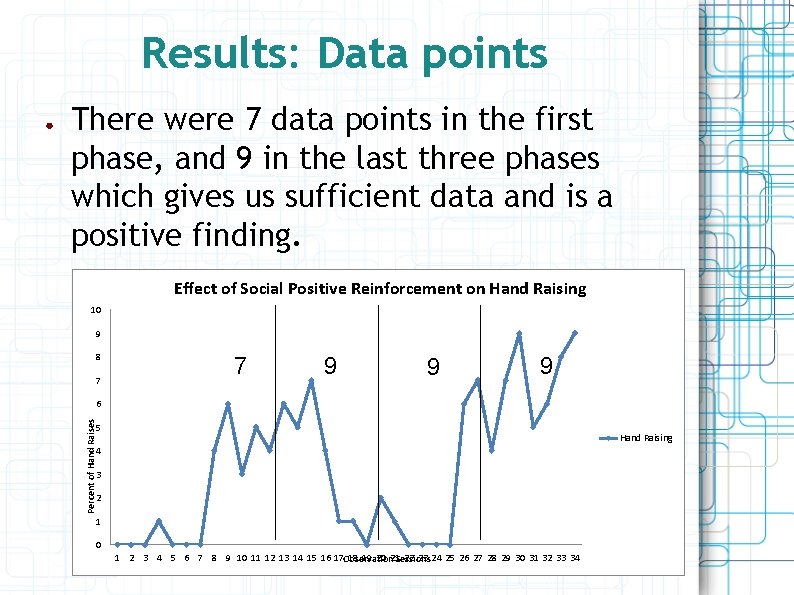
Results: Data points There were 7 data points in the first phase, and 9 in the last three phases which gives us sufficient data and is a positive finding. Effect of Social Positive Reinforcement on Hand Raising 10 9 8 7 7 9 9 9 6 Percent of Hand Raises ● 5 Hand Raising 4 3 2 1 0 1 2 3 4 5 6 7 8 9 10 11 12 13 14 15 16 17 Observation 18 19 20 21 Sessions 22 23 24 25 26 27 28 29 30 31 32 33 34
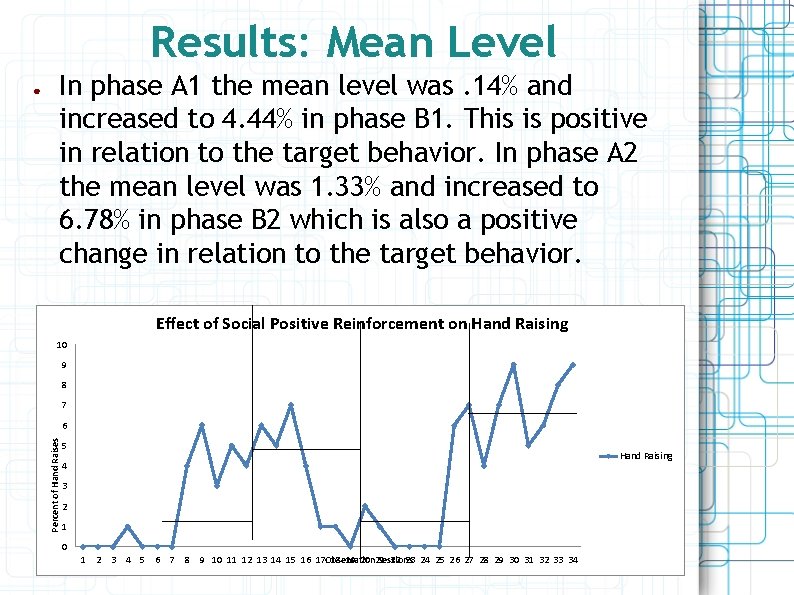
Results: Mean Level In phase A 1 the mean level was. 14% and increased to 4. 44% in phase B 1. This is positive in relation to the target behavior. In phase A 2 the mean level was 1. 33% and increased to 6. 78% in phase B 2 which is also a positive change in relation to the target behavior. Effect of Social Positive Reinforcement on Hand Raising 10 9 8 7 6 Percent of Hand Raises ● 5 Hand Raising 4 3 2 1 0 1 2 3 4 5 6 7 8 9 10 11 12 13 14 15 16 17 Observation 18 19 20 21 22 23 24 25 26 27 28 29 30 31 32 33 34 Sessions
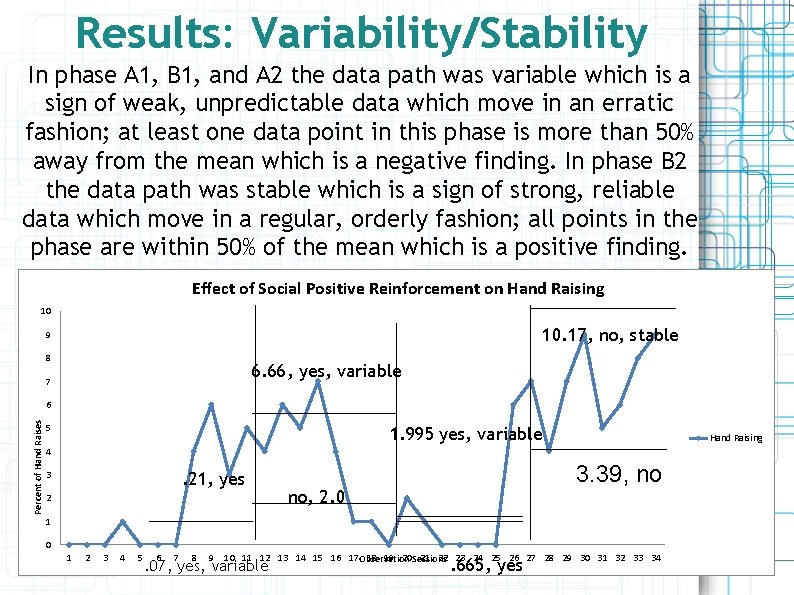
Results: Variability/Stability In phase A 1, B 1, and A 2 the data path was variable which is a sign of weak, unpredictable data which move in an erratic fashion; at least one data point in this phase is more than 50% away from the mean which is a negative finding. In phase B 2 the data path was stable which is a sign of strong, reliable data which move in a regular, orderly fashion; all points in the phase are within 50% of the mean which is a positive finding. Effect of Social Positive Reinforcement on Hand Raising 10 10. 17, no, stable 9 8 6. 66, yes, variable 7 Percent of Hand Raises 6 5 1. 995 yes, variable Hand Raising 4 . 21, yes 3 2 3. 39, no no, 2. 0 1 2 3 4 5 6 7 8 9 10 11 12 13 14 15 16 17 Observation 18 19 20 Sessions 21 22 23 24 25 26 27 28 29 30 31 32 33 34 . 07, yes, variable . 665, yes
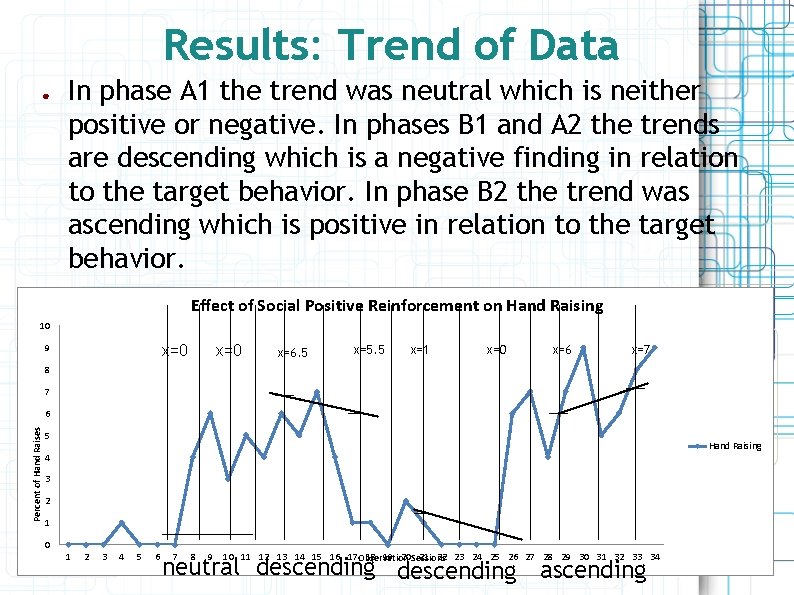
Results: Trend of Data ● In phase A 1 the trend was neutral which is neither positive or negative. In phases B 1 and A 2 the trends are descending which is a negative finding in relation to the target behavior. In phase B 2 the trend was ascending which is positive in relation to the target behavior. Effect of Social Positive Reinforcement on Hand Raising 10 x=0 9 x=0 x=6. 5 x=5. 5 x=1 x=0 x=6 x=7 8 7 Percent of Hand Raises 6 5 Hand Raising 4 3 2 1 0 1 2 3 4 5 6 7 8 9 10 11 12 13 14 15 16 17 Observation 18 19 20 Sessions 21 22 23 24 25 26 27 28 29 30 31 32 33 34 neutral descending ascending
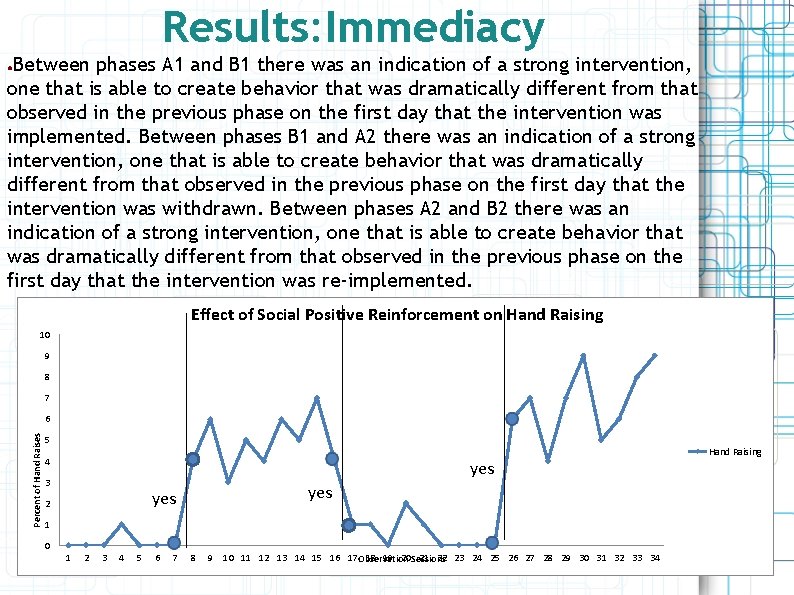
Results: Immediacy Between phases A 1 and B 1 there was an indication of a strong intervention, one that is able to create behavior that was dramatically different from that observed in the previous phase on the first day that the intervention was implemented. Between phases B 1 and A 2 there was an indication of a strong intervention, one that is able to create behavior that was dramatically different from that observed in the previous phase on the first day that the intervention was withdrawn. Between phases A 2 and B 2 there was an indication of a strong intervention, one that is able to create behavior that was dramatically different from that observed in the previous phase on the first day that the intervention was re-implemented. ● Effect of Social Positive Reinforcement on Hand Raising 10 9 8 7 Percent of Hand Raises 6 5 4 yes 3 yes 2 1 0 1 2 3 4 5 6 7 8 9 10 11 12 13 14 15 16 17 Observation 18 19 20 Sessions 21 22 23 24 25 26 27 28 29 30 31 32 33 34 Hand Raising
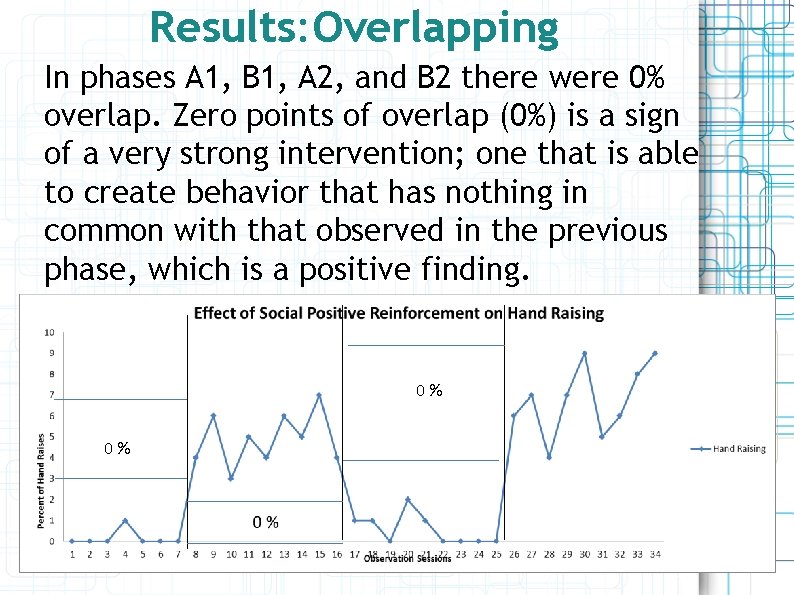
Results: Overlapping In phases A 1, B 1, A 2, and B 2 there were 0% overlap. Zero points of overlap (0%) is a sign of a very strong intervention; one that is able to create behavior that has nothing in common with that observed in the previous phase, which is a positive finding. 0% 0%
Results: Functional Relationship Overall 63% of the criteria were positive. Therefore, a positive relationship was demonstrated in this intervention.