
Effect of shear stress on endothelial cells under
- Slides: 1
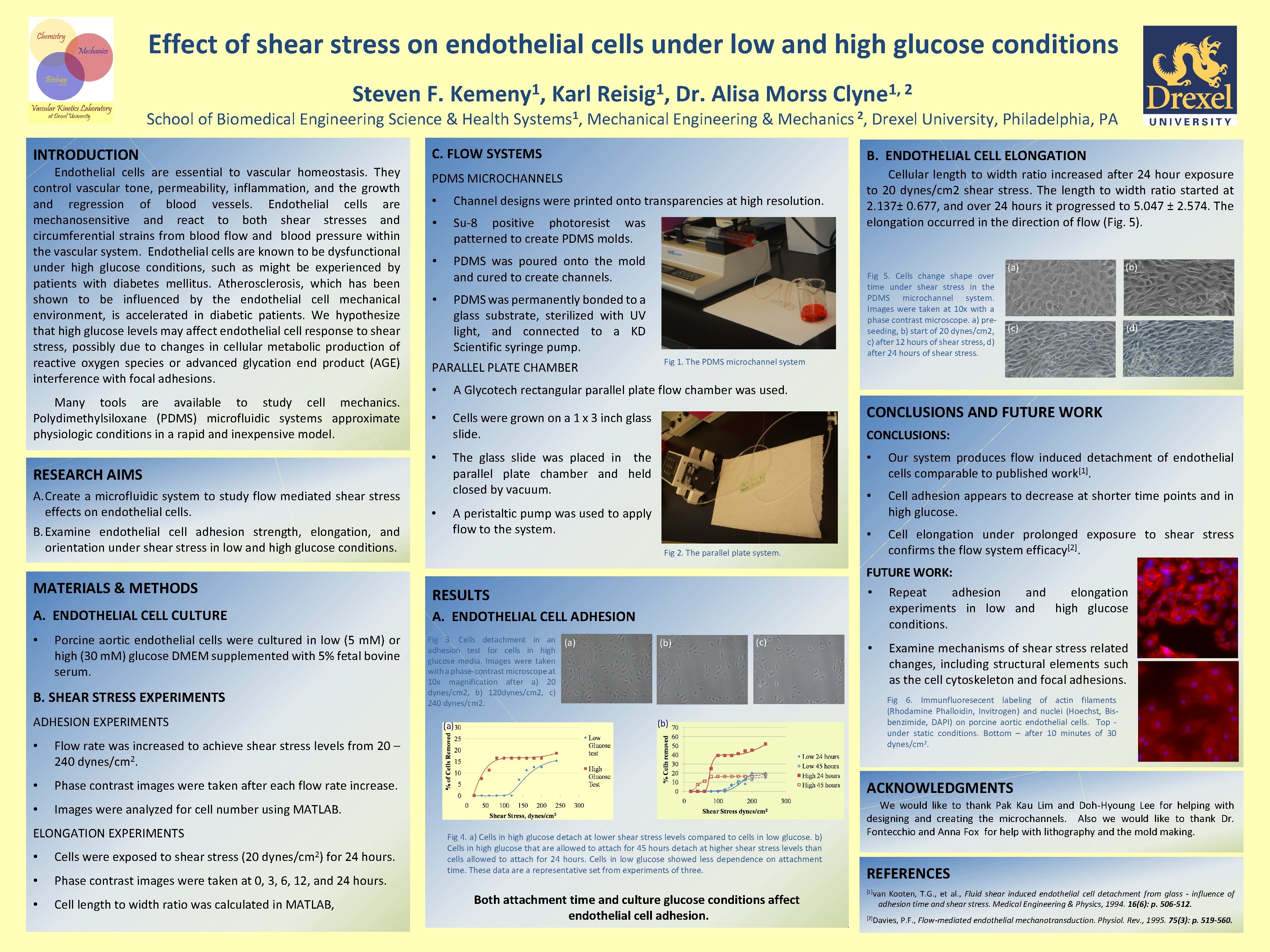
Effect of shear stress on endothelial cells under low and high glucose conditions Steven F. 1 Kemeny , Karl 1 Reisig , Dr. Alisa Morss 1, 2 Clyne School of Biomedical Engineering Science & Health Systems 1, Mechanical Engineering & Mechanics 2, Drexel University, Philadelphia, PA INTRODUCTION Endothelial cells are essential to vascular homeostasis. They control vascular tone, permeability, inflammation, and the growth and regression of blood vessels. Endothelial cells are mechanosensitive and react to both shear stresses and circumferential strains from blood flow and blood pressure within the vascular system. Endothelial cells are known to be dysfunctional under high glucose conditions, such as might be experienced by patients with diabetes mellitus. Atherosclerosis, which has been shown to be influenced by the endothelial cell mechanical environment, is accelerated in diabetic patients. We hypothesize that high glucose levels may affect endothelial cell response to shear stress, possibly due to changes in cellular metabolic production of reactive oxygen species or advanced glycation end product (AGE) interference with focal adhesions. Many tools are available to study cell mechanics. Polydimethylsiloxane (PDMS) microfluidic systems approximate physiologic conditions in a rapid and inexpensive model. RESEARCH AIMS A. Create a microfluidic system to study flow mediated shear stress effects on endothelial cells. B. Examine endothelial cell adhesion strength, elongation, and orientation under shear stress in low and high glucose conditions. C. FLOW SYSTEMS B. ENDOTHELIAL CELL ELONGATION PDMS MICROCHANNELS Cellular length to width ratio increased after 24 hour exposure to 20 dynes/cm 2 shear stress. The length to width ratio started at 2. 137± 0. 677, and over 24 hours it progressed to 5. 047 ± 2. 574. The elongation occurred in the direction of flow (Fig. 5). • Channel designs were printed onto transparencies at high resolution. • Su-8 positive photoresist was patterned to create PDMS molds. • PDMS was poured onto the mold and cured to create channels. • PDMS was permanently bonded to a glass substrate, sterilized with UV light, and connected to a KD Scientific syringe pump. PARALLEL PLATE CHAMBER • A Glycotech rectangular parallel plate flow chamber was used. • Cells were grown on a 1 x 3 inch glass slide. • • A. ENDOTHELIAL CELL ADHESION Porcine aortic endothelial cells were cultured in low (5 m. M) or high (30 m. M) glucose DMEM supplemented with 5% fetal bovine serum. B. SHEAR STRESS EXPERIMENTS ADHESION EXPERIMENTS Fig 3. Cells detachment in an (a) adhesion test for cells in high glucose media. Images were taken with a phase-contrast microscope at 10 x magnification after a) 20 dynes/cm 2, b) 120 dynes/cm 2, c) 240 dynes/cm 2. (a) (d) • Our system produces flow induced detachment of endothelial cells comparable to published work[1]. • Cell adhesion appears to decrease at shorter time points and in high glucose. • Cell elongation under prolonged exposure to shear stress confirms the flow system efficacy[2]. Fig 2. The parallel plate system. A. ENDOTHELIAL CELL CULTURE (c) CONCLUSIONS: A peristaltic pump was used to apply flow to the system. RESULTS (b) CONCLUSIONS AND FUTURE WORK The glass slide was placed in the parallel plate chamber and held closed by vacuum. MATERIALS & METHODS • Fig 1. The PDMS microchannel system Fig 5. Cells change shape over time under shear stress in the PDMS microchannel system. Images were taken at 10 x with a phase contrast microscope. a) preseeding, b) start of 20 dynes/cm 2, c) after 12 hours of shear stress, d) after 24 hours of shear stress. (a) FUTURE WORK: • Repeat adhesion and elongation experiments in low and high glucose conditions. (b) (c) Examine mechanisms of shear stress related changes, including structural elements such as the cell cytoskeleton and focal adhesions. • Fig 6. Immunfluoresecent labeling of actin filaments (Rhodamine Phalloidin, Invitrogen) and nuclei (Hoechst, Bisbenzimide, DAPI) on porcine aortic endothelial cells. Top under static conditions. Bottom – after 10 minutes of 30 dynes/cm 2. (b) • Flow rate was increased to achieve shear stress levels from 20 – 240 dynes/cm 2. • Phase contrast images were taken after each flow rate increase. ACKNOWLEDGMENTS • Images were analyzed for cell number using MATLAB. We would like to thank Pak Kau Lim and Doh-Hyoung Lee for helping with designing and creating the microchannels. Also we would like to thank Dr. Fontecchio and Anna Fox for help with lithography and the mold making. ELONGATION EXPERIMENTS • Cells were exposed to shear stress (20 dynes/cm 2) for 24 hours. • Phase contrast images were taken at 0, 3, 6, 12, and 24 hours. • Cell length to width ratio was calculated in MATLAB, Fig 4. a) Cells in high glucose detach at lower shear stress levels compared to cells in low glucose. b) Cells in high glucose that are allowed to attach for 45 hours detach at higher shear stress levels than cells allowed to attach for 24 hours. Cells in low glucose showed less dependence on attachment time. These data are a representative set from experiments of three. Both attachment time and culture glucose conditions affect endothelial cell adhesion. REFERENCES [1]van Kooten, T. G. , et al. , Fluid shear induced endothelial cell detachment from glass - influence of adhesion time and shear stress. Medical Engineering & Physics, 1994. 16(6): p. 506 -512. [2]Davies, P. F. , Flow-mediated endothelial mechanotransduction. Physiol. Rev. , 1995. 75(3): p. 519 -560.