
Effect of retained trees on growth and structure

- Slides: 19
Effect of retained trees on growth and structure of young Scots pine stands Juha Ruuska, Sauli Valkonen and Jouni Siipilehto Finnish Forest Research Institute, Vantaa, Finland
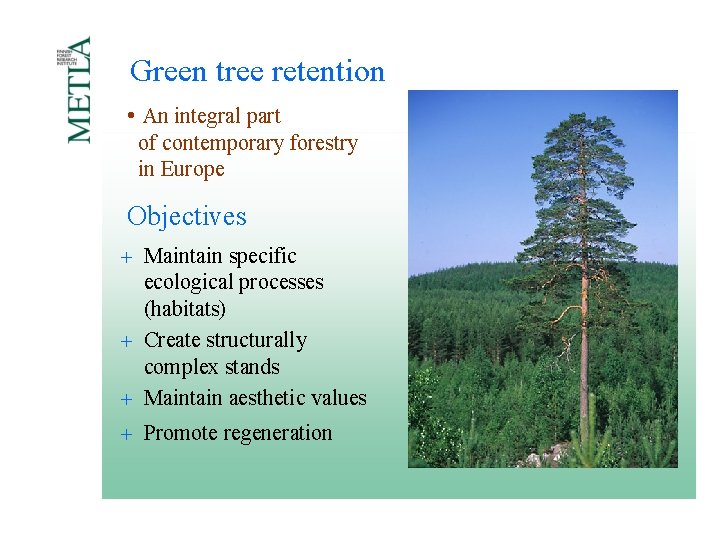
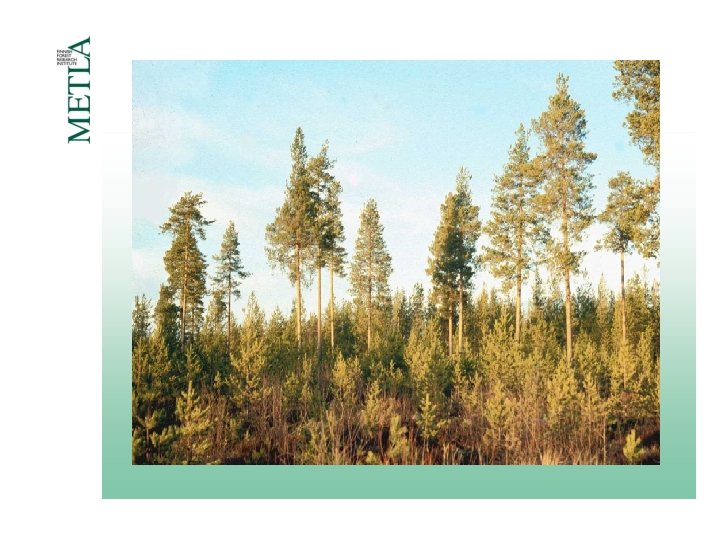
Green tree retention • An integral part of contemporary forestry in Europe Objectives + Maintain specific ecological processes (habitats) + Create structurally complex stands + Maintain aesthetic values + Promote regeneration
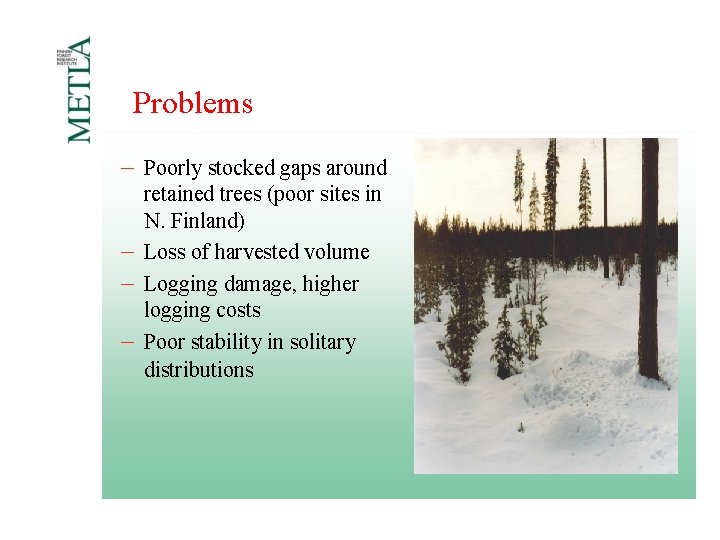
Problems - Poorly stocked gaps around - retained trees (poor sites in N. Finland) Loss of harvested volume Logging damage, higher logging costs Poor stability in solitary distributions
Hypotheses In the vicinity of Retained Trees (RT), • Seedling stand density is lower • Seedling height and diameter growth is slower • Influence on diameter growth is greater than on height growth, and seedlings are slimmer (height-diameter ratio) • Seedlings have smaller and less branches and • An aggregated RT distribution is less harmful than a dispersed distribution
Study stands • A sample of planted or naturally generated Scots pine seedling stands with RT – 9 stands in Southern Finland – Most Scots pine upland sites covered – Seedling stand dominant height of 2 -7 m – Scots pines retained for 8 -18 years – Variable RT densities (32 - 117 ha-1) – Variable but mostly scattered spatial distributions – No significant tree removals or mortality
Sampling • All RT mapped, measured for dbh, h • 10 sample RT per stand – measured for trunk and crown variables, t, dbh growth • 8 seedling sample plots per RT sample tree – Plots systematically at 1, 3, 6 and 10 m distance from RT – Seedlings measured for h, dbh, coordinates – One sample seedling per plot per species selected among main crop seedlings (h, dbh, cr, cw, h growth, d growth, branch diameters etc. ) – One additional sample seedling per species to represent nonmain crop seedlings
Approach • Growth models – For pine seedlings, RT – Individual tree, spatially explicit • Models for branching – Max branch diameter and branch cross sectional area of 3 whorls; for pine only • Simulation – Seedling diameter and height growth – Branching variables – Subject to site, density of the seedling stand, number and diameter of RT, and RT spatial distribution
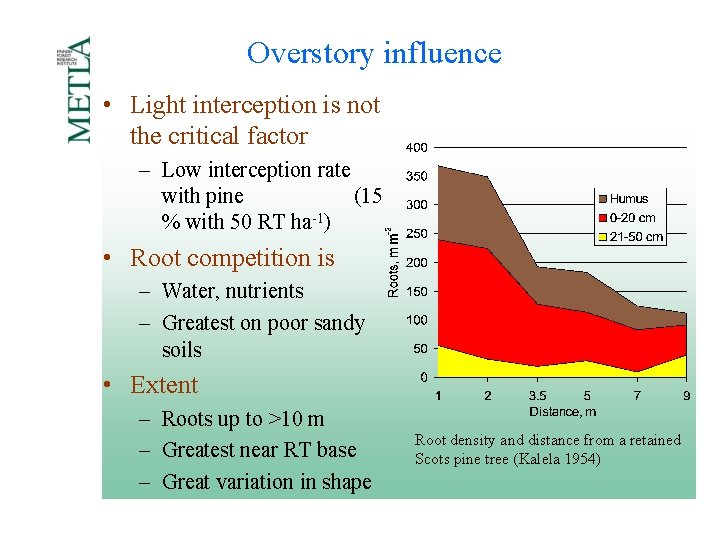
Overstory influence • Light interception is not the critical factor – Low interception rate with pine (15 % with 50 RT ha-1) • Root competition is – Water, nutrients – Greatest on poor sandy soils • Extent – Roots up to >10 m – Greatest near RT base – Great variation in shape Root density and distance from a retained Scots pine tree (Kalela 1954)
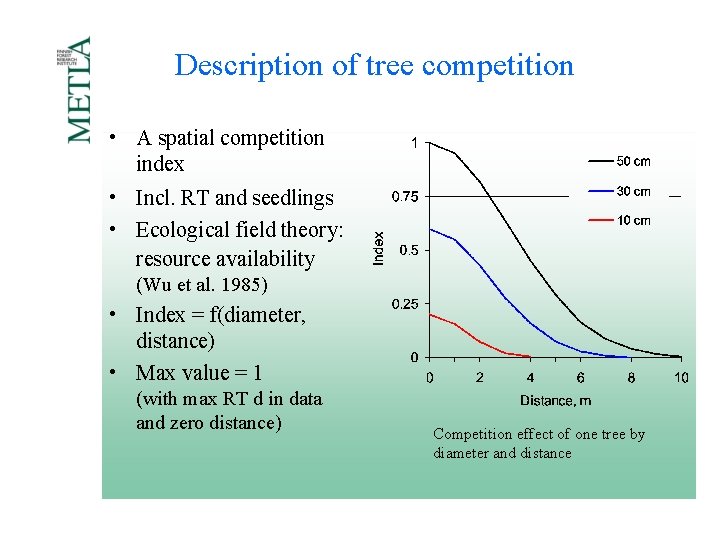
Description of tree competition • A spatial competition index • Incl. RT and seedlings • Ecological field theory: resource availability (Wu et al. 1985) • Index = f(diameter, distance) • Max value = 1 (with max RT d in data and zero distance) Competition effect of one tree by diameter and distance
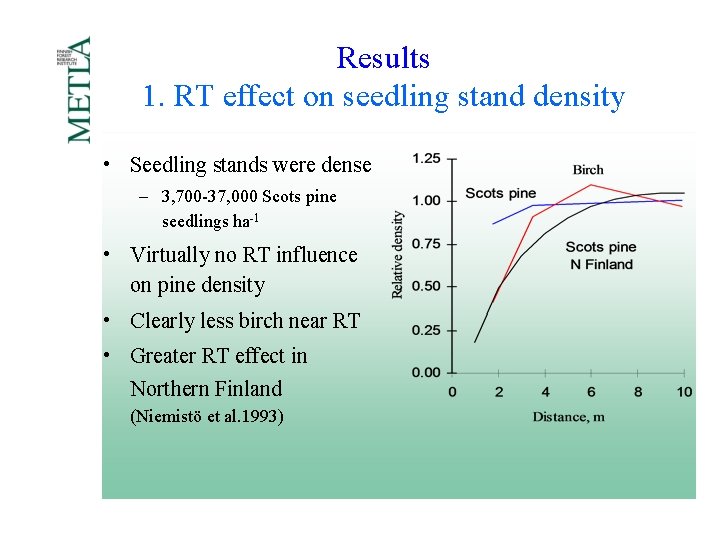
Results 1. RT effect on seedling stand density • Seedling stands were dense – 3, 700 -37, 000 Scots pine seedlings ha-1 • Virtually no RT influence on pine density • Clearly less birch near RT • Greater RT effect in Northern Finland (Niemistö et al. 1993)
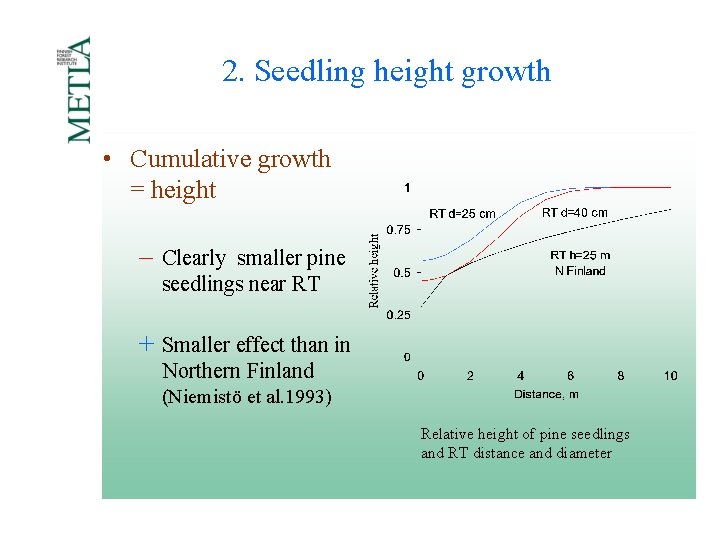
2. Seedling height growth • Cumulative growth = height – Clearly smaller pine seedlings near RT + Smaller effect than in Northern Finland (Niemistö et al. 1993) Relative height of pine seedlings and RT distance and diameter
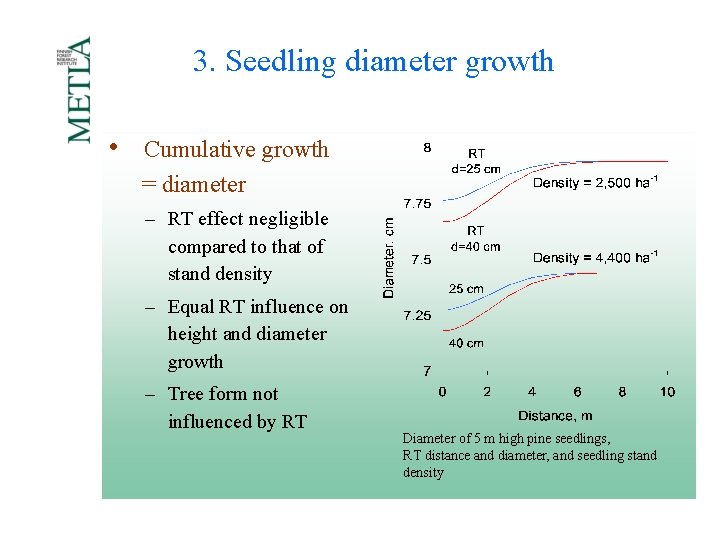
3. Seedling diameter growth • Cumulative growth = diameter – RT effect negligible compared to that of stand density – Equal RT influence on height and diameter growth – Tree form not influenced by RT Diameter of 5 m high pine seedlings, RT distance and diameter, and seedling stand density
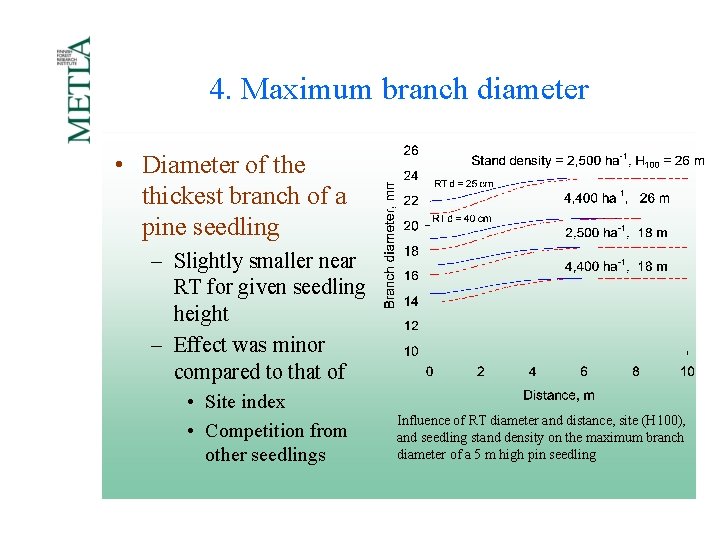
4. Maximum branch diameter • Diameter of the thickest branch of a pine seedling – Slightly smaller near RT for given seedling height – Effect was minor compared to that of • Site index • Competition from other seedlings Influence of RT diameter and distance, site (H 100), and seedling stand density on the maximum branch diameter of a 5 m high pin seedling
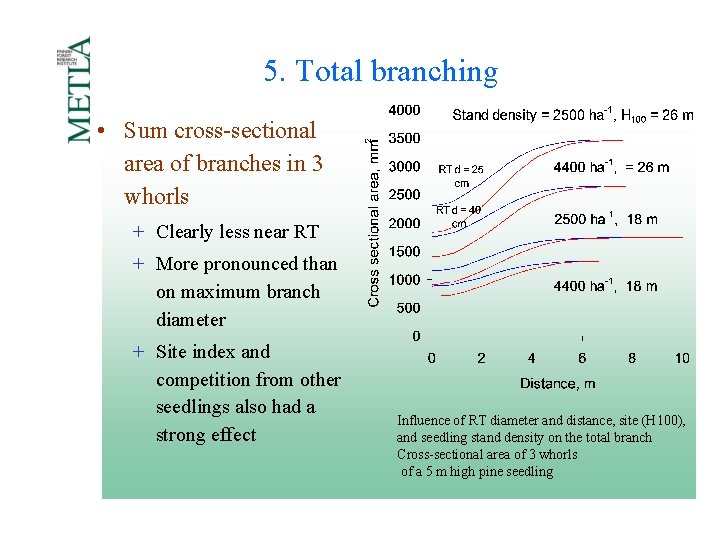
5. Total branching • Sum cross-sectional area of branches in 3 whorls + Clearly less near RT + More pronounced than on maximum branch diameter + Site index and competition from other seedlings also had a strong effect Influence of RT diameter and distance, site (H 100), and seedling stand density on the total branch Cross-sectional area of 3 whorls of a 5 m high pine seedling
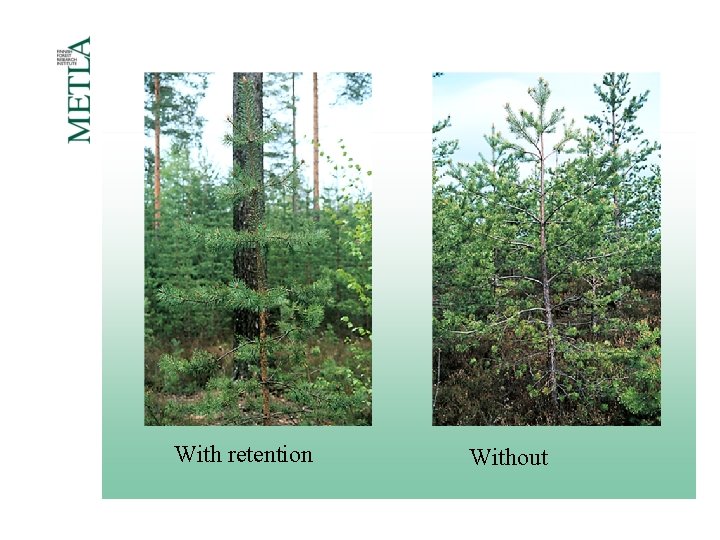
With retention Without
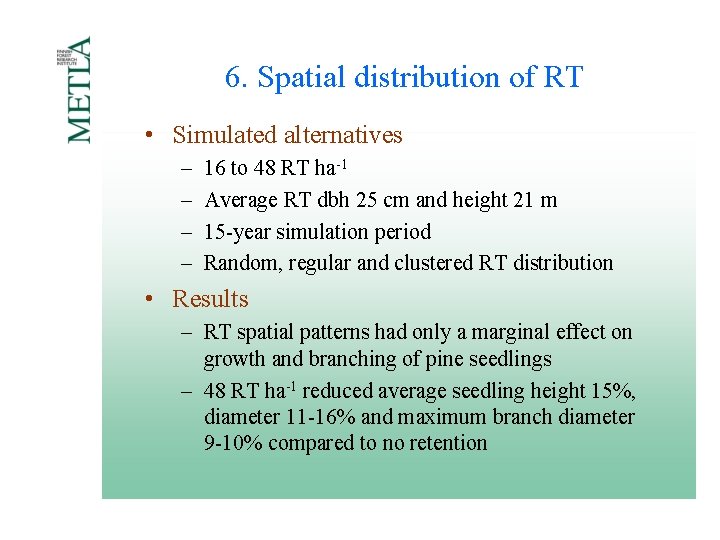
6. Spatial distribution of RT • Simulated alternatives – – 16 to 48 RT ha-1 Average RT dbh 25 cm and height 21 m 15 -year simulation period Random, regular and clustered RT distribution • Results – RT spatial patterns had only a marginal effect on growth and branching of pine seedlings – 48 RT ha-1 reduced average seedling height 15%, diameter 11 -16% and maximum branch diameter 9 -10% compared to no retention
Conclusions (I) • RT do not reduce seedling stand density in S Finland as much as in N Finland • Can help control birch on problem sites • Influence on diameter growth is not greater than on height growth, and height-diameter ratio is not affected much • Seedlings have smaller and less branches, but the maximum branch diameter is not reduced much • Reduction in branching is small compared to that achieved by higher density, site-species match • An aggregated RT distribution is only little less harmful than a dispersed distribution
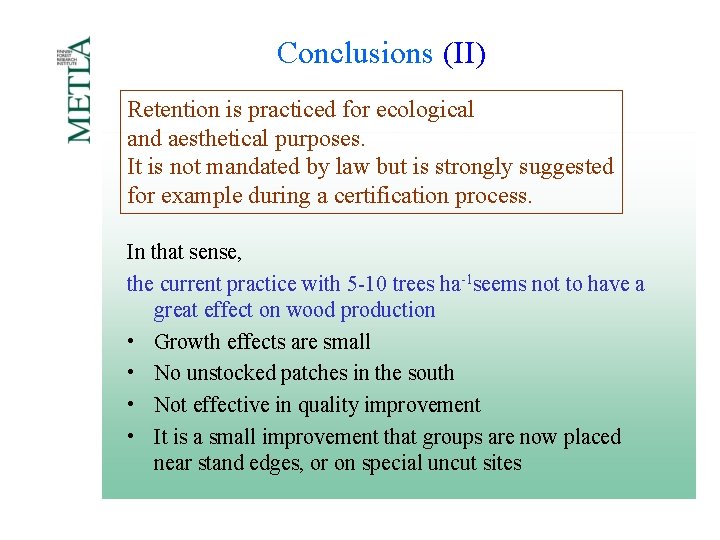
Conclusions (II) Retention is practiced for ecological and aesthetical purposes. It is not mandated by law but is strongly suggested for example during a certification process. In that sense, the current practice with 5 -10 trees ha-1 seems not to have a great effect on wood production • Growth effects are small • No unstocked patches in the south • Not effective in quality improvement • It is a small improvement that groups are now placed near stand edges, or on special uncut sites