
Effect of pressure on magnetic properties of mixed
- Slides: 1
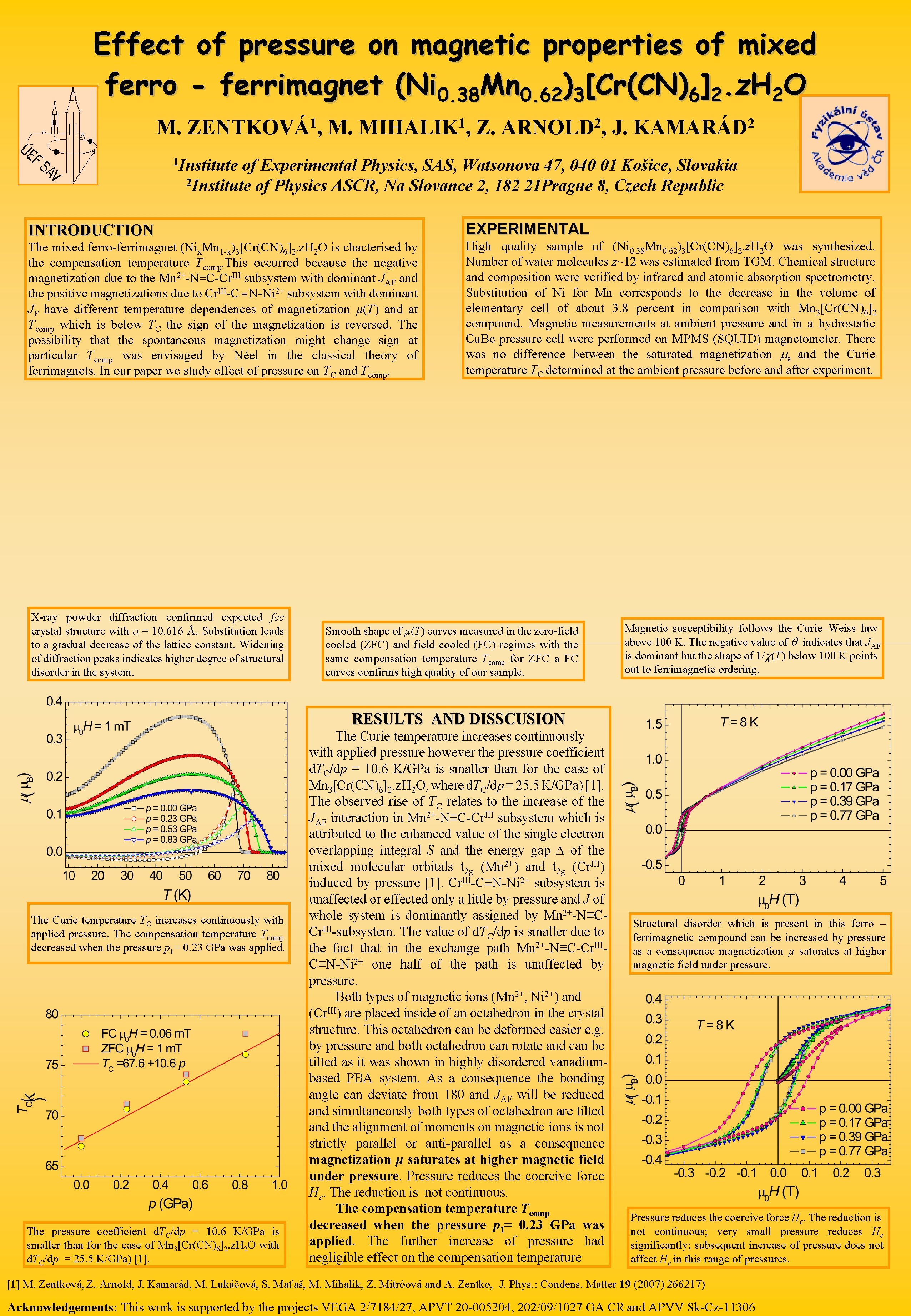
Effect of pressure on magnetic properties of mixed ferro - ferrimagnet (Ni 0. 38 Mn 0. 62)3[Cr(CN)6]2. z. H 2 O M. 1 ZENTKOVÁ , M. 1 MIHALIK , Z. 2 ARNOLD , J. 2 KAMARÁD 1 Institute of Experimental Physics, SAS, Watsonova 47, 040 01 Košice, Slovakia 2 Institute of Physics ASCR, Na Slovance 2, 182 21 Prague 8, Czech Republic EXPERIMENTAL INTRODUCTION The mixed ferro-ferrimagnet (Nix. Mn 1 -x)3[Cr(CN)6]2. z. H 2 O is chacterised by the compensation temperature Tcomp. This occurred because the negative magnetization due to the Mn 2+-N≡C-Cr. III subsystem with dominant JAF and the positive magnetizations due to Cr. III-C ≡ N-Ni 2+ subsystem with dominant JF have different temperature dependences of magnetization µ(T) and at Tcomp which is below TC the sign of the magnetization is reversed. The possibility that the spontaneous magnetization might change sign at particular Tcomp was envisaged by Néel in the classical theory of ferrimagnets. In our paper we study effect of pressure on TC and Tcomp. X-ray powder diffraction confirmed expected fcc crystal structure with a = 10. 616 Å. Substitution leads to a gradual decrease of the lattice constant. Widening of diffraction peaks indicates higher degree of structural disorder in the system. High quality sample of (Ni 0. 38 Mn 0. 62)3[Cr(CN)6]2. z. H 2 O was synthesized. Number of water molecules z~12 was estimated from TGM. Chemical structure and composition were verified by infrared and atomic absorption spectrometry. Substitution of Ni for Mn corresponds to the decrease in the volume of elementary cell of about 3. 8 percent in comparison with Mn 3[Cr(CN)6]2 compound. Magnetic measurements at ambient pressure and in a hydrostatic Cu. Be pressure cell were performed on MPMS (SQUID) magnetometer. There was no difference between the saturated magnetization ms and the Curie temperature TC determined at the ambient pressure before and after experiment. Smooth shape of µ(T) curves measured in the zero-field cooled (ZFC) and field cooled (FC) regimes with the same compensation temperature Tcomp for ZFC a FC curves confirms high quality of our sample. Magnetic susceptibility follows the Curie–Weiss law above 100 K. The negative value of indicates that JAF is dominant but the shape of 1/ (T) below 100 K points out to ferrimagnetic ordering. RESULTS AND DISSCUSION The Curie temperature TC increases continuously with applied pressure. The compensation temperature Tcomp decreased when the pressure p 1= 0. 23 GPa was applied. The pressure coefficient d. TC/dp = 10. 6 K/GPa is smaller than for the case of Mn 3[Cr(CN)6]2. z. H 2 O with d. TC/dp = 25. 5 K/GPa) [1]. The Curie temperature increases continuously with applied pressure however the pressure coefficient d. TC/dp = 10. 6 K/GPa is smaller than for the case of Mn 3[Cr(CN)6]2. z. H 2 O, where d. TC/dp = 25. 5 K/GPa) [1]. The observed rise of TC relates to the increase of the JAF interaction in Mn 2+-N≡C-Cr. III subsystem which is attributed to the enhanced value of the single electron overlapping integral S and the energy gap ∆ of the mixed molecular orbitals t 2 g (Mn 2+) and t 2 g (Cr. III) induced by pressure [1]. Cr. III-C≡N-Ni 2+ subsystem is unaffected or effected only a little by pressure and J of whole system is dominantly assigned by Mn 2+-N≡CCr. III-subsystem. The value of d. TC/dp is smaller due to the fact that in the exchange path Mn 2+-N≡C-Cr. IIIC≡N-Ni 2+ one half of the path is unaffected by pressure. Both types of magnetic ions (Mn 2+, Ni 2+) and (Cr. III) are placed inside of an octahedron in the crystal structure. This octahedron can be deformed easier e. g. by pressure and both octahedron can rotate and can be tilted as it was shown in highly disordered vanadiumbased PBA system. As a consequence the bonding angle can deviate from 180 and JAF will be reduced and simultaneously both types of octahedron are tilted and the alignment of moments on magnetic ions is not strictly parallel or anti-parallel as a consequence magnetization µ saturates at higher magnetic field under pressure. Pressure reduces the coercive force Hc. The reduction is not continuous. The compensation temperature Tcomp decreased when the pressure p 1= 0. 23 GPa was applied. The further increase of pressure had negligible effect on the compensation temperature Structural disorder which is present in this ferro – ferrimagnetic compound can be increased by pressure as a consequence magnetization µ saturates at higher magnetic field under pressure. Pressure reduces the coercive force Hc. The reduction is not continuous; very small pressure reduces Hc significantly; subsequent increase of pressure does not affect Hc in this range of pressures. [1] M. Zentková, Z. Arnold, J. Kamarád, M. Lukáčová, S. Maťaš, M. Mihalik, Z. Mitróová and A. Zentko, J. Phys. : Condens. Matter 19 (2007) 266217) Acknowledgements: This work is supported by the projects VEGA 2/7184/27, APVT 20 -005204, 202/09/1027 GA CR and APVV Sk-Cz-11306