
EFFECT OF PRESSURE AND ELECTRODE SEPARATION ON PLASMA
![Ar PLASMA IN SINGLE FREQUENCY CCP · [e] · 10 m. Torr, Max =](https://slidetodoc.com/presentation_image/59fb68b4dca2802c2eed487929585c06/image-10.jpg "Ar PLASMA IN SINGLE FREQUENCY CCP · [e] · 10 m. Torr, Max =")

- Slides: 24
EFFECT OF PRESSURE AND ELECTRODE SEPARATION ON PLASMA UNIFORMITY IN DUAL FREQUENCY CAPACITIVELY COUPLED PLASMA TOOLS * Yanga) and Mark J. Kushnerb) a)Department of Electrical and Computer Engineering Iowa State University, Ames, IA 50011, USA yangying@eecs. umich. edu b)Department of Electrical Engineering and Computer Science University of Michigan, Ann Arbor, MI 48109, USA mjkush@umich. edu http: //uigelz. eecs. umich. edu June 2009 * Work supported by Semiconductor Research Corp. , Applied Materials and Tokyo Electron Ltd. YY_MJK_ICOPS 2009_01
AGENDA · Optimization of multiple frequency plasma etching reactors · Description of the model · Scaling with: · Pressure · Electrode separation · Concluding remarks YY_MJK_ICOPS 2009_02 University of Michigan Institute for Plasma Science & Engr.
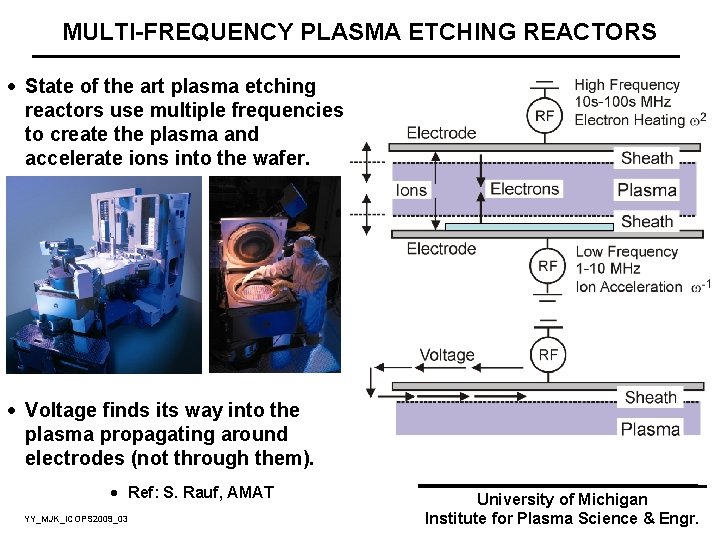
MULTI-FREQUENCY PLASMA ETCHING REACTORS · State of the art plasma etching reactors use multiple frequencies to create the plasma and accelerate ions into the wafer. · Voltage finds its way into the plasma propagating around electrodes (not through them). · Ref: S. Rauf, AMAT YY_MJK_ICOPS 2009_03 University of Michigan Institute for Plasma Science & Engr.
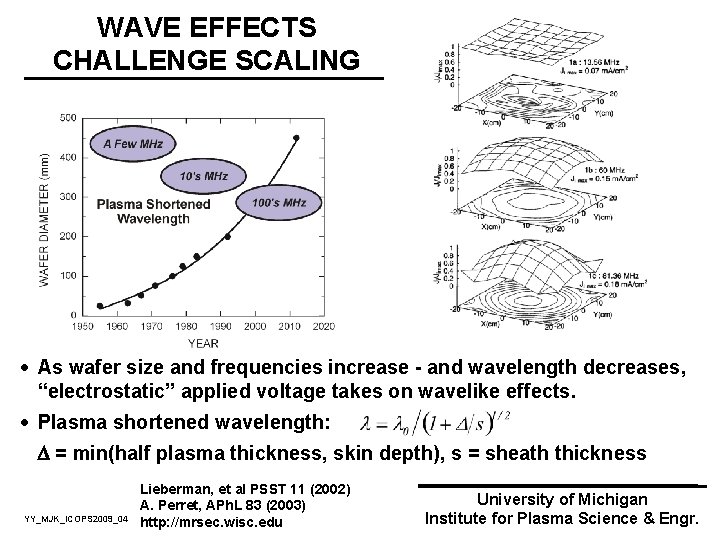
WAVE EFFECTS CHALLENGE SCALING · As wafer size and frequencies increase - and wavelength decreases, “electrostatic” applied voltage takes on wavelike effects. · Plasma shortened wavelength: = min(half plasma thickness, skin depth), s = sheath thickness YY_MJK_ICOPS 2009_04 Lieberman, et al PSST 11 (2002) A. Perret, APh. L 83 (2003) http: //mrsec. wisc. edu University of Michigan Institute for Plasma Science & Engr.
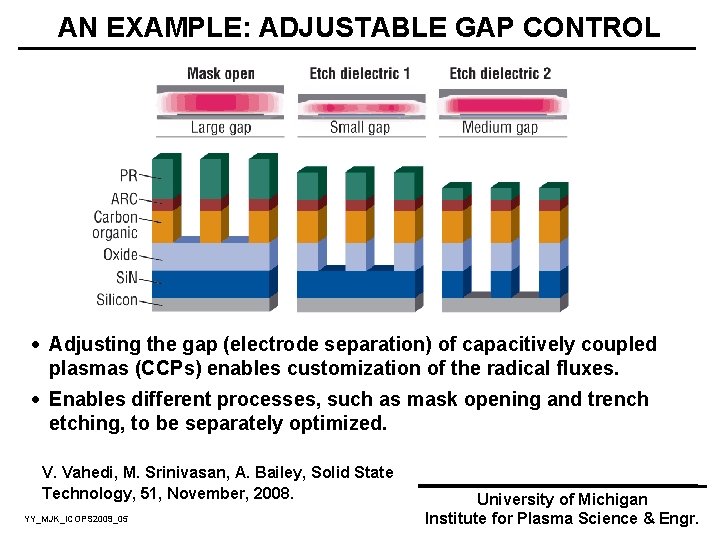
AN EXAMPLE: ADJUSTABLE GAP CONTROL · Adjusting the gap (electrode separation) of capacitively coupled plasmas (CCPs) enables customization of the radical fluxes. · Enables different processes, such as mask opening and trench etching, to be separately optimized. V. Vahedi, M. Srinivasan, A. Bailey, Solid State Technology, 51, November, 2008. YY_MJK_ICOPS 2009_05 University of Michigan Institute for Plasma Science & Engr.
COUPLED EFFECTS IN HIGH FREQUENCY CCPs · Electromagnetic wave effects impact processing uniformity in high frequency CCPs. · When coupled with changing gap and pressure, controlling the plasma uniformity could be more difficult. · Results from a computational investigation of impacts of pressure and gap on plasma uniformity in dual frequency CCPs (DF-CCPs) will be discussed. YY_MJK_ICOPS 2009_06 University of Michigan Institute for Plasma Science & Engr.
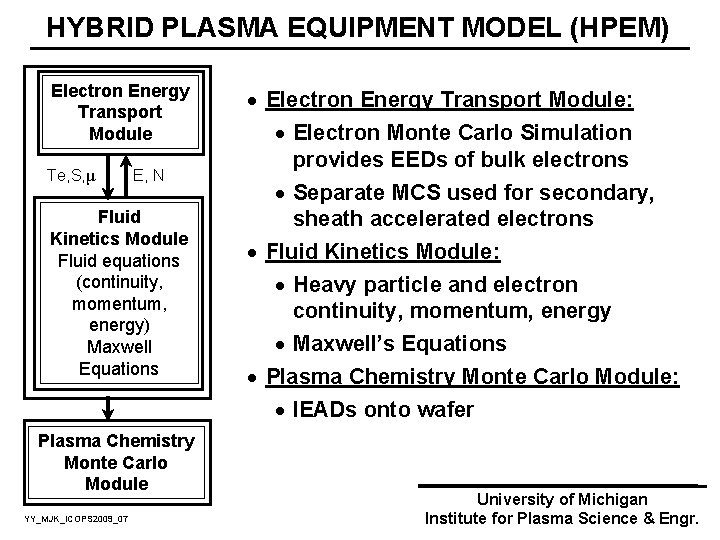
HYBRID PLASMA EQUIPMENT MODEL (HPEM) Electron Energy Transport Module Te, S, μ E, N Fluid Kinetics Module Fluid equations (continuity, momentum, energy) Maxwell Equations Plasma Chemistry Monte Carlo Module YY_MJK_ICOPS 2009_07 · Electron Energy Transport Module: · Electron Monte Carlo Simulation provides EEDs of bulk electrons · Separate MCS used for secondary, sheath accelerated electrons · Fluid Kinetics Module: · Heavy particle and electron continuity, momentum, energy · Maxwell’s Equations · Plasma Chemistry Monte Carlo Module: · IEADs onto wafer University of Michigan Institute for Plasma Science & Engr.
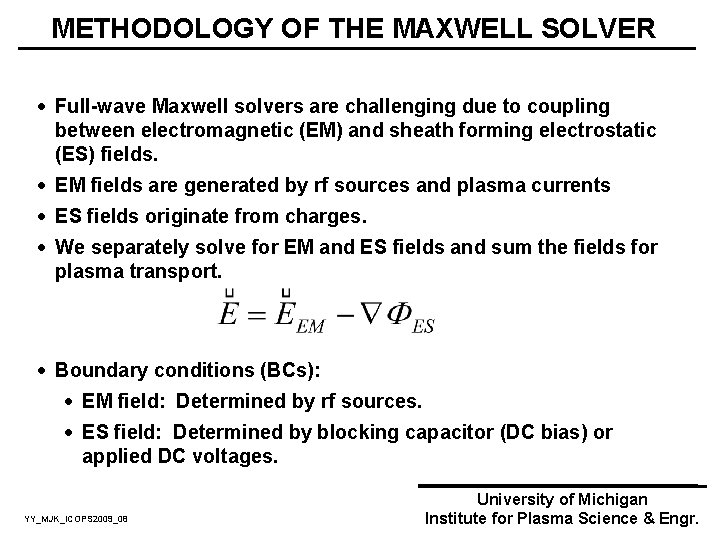
METHODOLOGY OF THE MAXWELL SOLVER · Full-wave Maxwell solvers are challenging due to coupling between electromagnetic (EM) and sheath forming electrostatic (ES) fields. · EM fields are generated by rf sources and plasma currents · ES fields originate from charges. · We separately solve for EM and ES fields and sum the fields for plasma transport. · Boundary conditions (BCs): · EM field: Determined by rf sources. · ES field: Determined by blocking capacitor (DC bias) or applied DC voltages. YY_MJK_ICOPS 2009_08 University of Michigan Institute for Plasma Science & Engr.
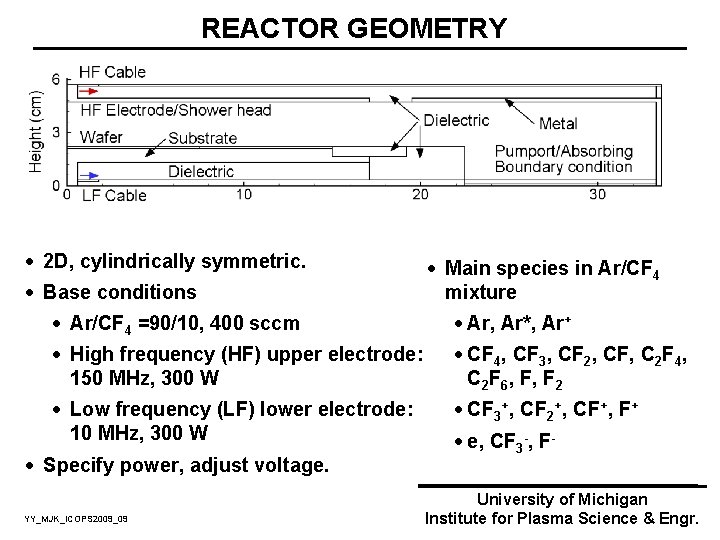
REACTOR GEOMETRY · 2 D, cylindrically symmetric. · Base conditions · Main species in Ar/CF 4 mixture · Ar/CF 4 =90/10, 400 sccm · Ar, Ar*, Ar+ · High frequency (HF) upper electrode: 150 MHz, 300 W · CF 4, CF 3, CF 2, CF, C 2 F 4, C 2 F 6, F, F 2 · Low frequency (LF) lower electrode: 10 MHz, 300 W · CF 3+, CF 2+, CF+, F+ · Specify power, adjust voltage. YY_MJK_ICOPS 2009_09 · e, CF 3 -, FUniversity of Michigan Institute for Plasma Science & Engr.
Ar PLASMA IN SINGLE FREQUENCY CCP · [e] · 10 m. Torr, Max = 9. 6 x 109 cm-3 · 50 m. Torr, Max = 4. 3 x 1010 cm-3 · With increasing Ar pressure, electron density transitions from center high to edge high. · 80 m. Torr, Max = 1. 5 x 1011 cm-3 · Agrees with experimental trend, albeit in a different geometry. · DF-CCP at higher frequency, with electronegative gas…trends? V. N. Volynets, et al. , J. Vac. Sci. Technol. A 26, 406, 2008. YY_MJK_ICOPS 2009_10 · Ar, 100 MHz/750 W from upper electrode. University of Michigan Institute for Plasma Science & Engr.
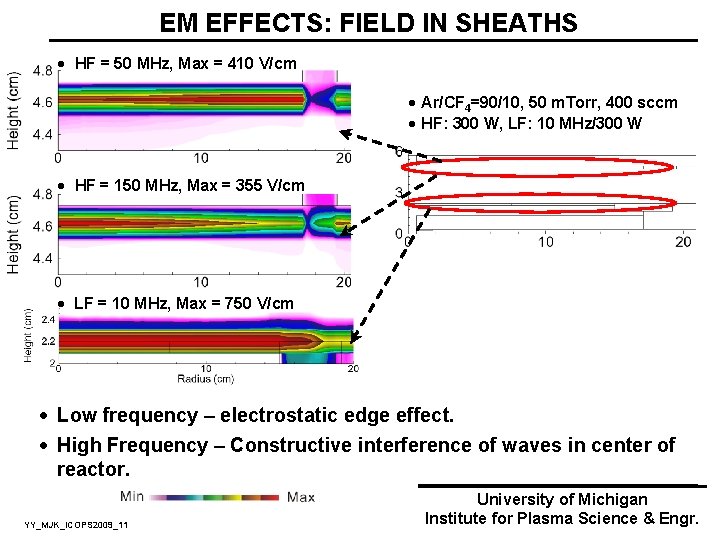
EM EFFECTS: FIELD IN SHEATHS · HF = 50 MHz, Max = 410 V/cm · Ar/CF 4=90/10, 50 m. Torr, 400 sccm · HF: 300 W, LF: 10 MHz/300 W · HF = 150 MHz, Max = 355 V/cm · LF = 10 MHz, Max = 750 V/cm · Low frequency – electrostatic edge effect. · High Frequency – Constructive interference of waves in center of reactor. YY_MJK_ICOPS 2009_11 University of Michigan Institute for Plasma Science & Engr.
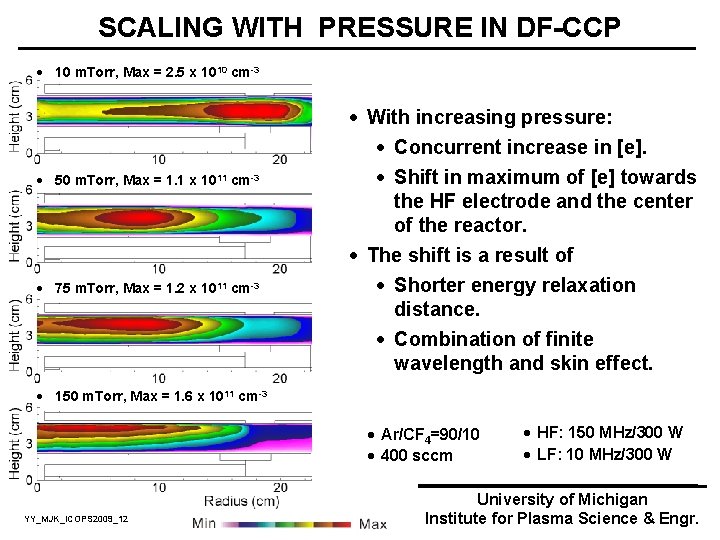
SCALING WITH PRESSURE IN DF-CCP · 10 m. Torr, Max = 2. 5 x 1010 cm-3 · 50 m. Torr, Max = 1. 1 x 1011 cm-3 · 75 m. Torr, Max = 1. 2 x 1011 cm-3 · With increasing pressure: · Concurrent increase in [e]. · Shift in maximum of [e] towards the HF electrode and the center of the reactor. · The shift is a result of · Shorter energy relaxation distance. · Combination of finite wavelength and skin effect. · 150 m. Torr, Max = 1. 6 x 1011 cm-3 · Ar/CF 4=90/10 · 400 sccm YY_MJK_ICOPS 2009_12 · HF: 150 MHz/300 W · LF: 10 MHz/300 W University of Michigan Institute for Plasma Science & Engr.
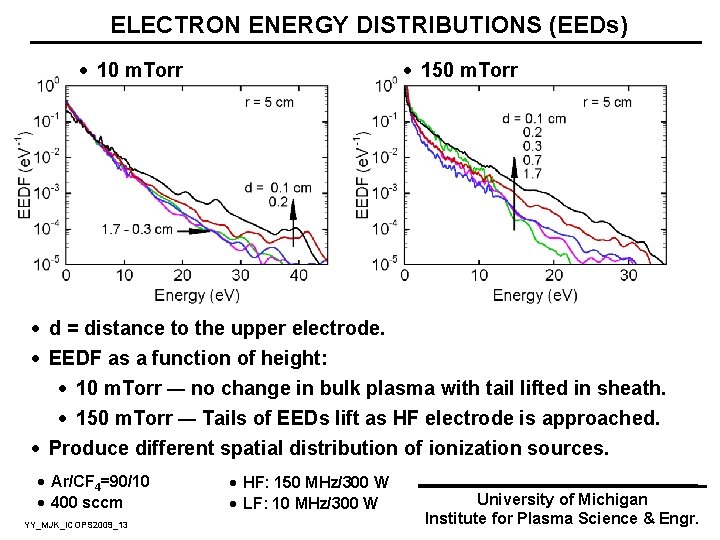
ELECTRON ENERGY DISTRIBUTIONS (EEDs) · 10 m. Torr · 150 m. Torr · d = distance to the upper electrode. · EEDF as a function of height: · 10 m. Torr — no change in bulk plasma with tail lifted in sheath. · 150 m. Torr — Tails of EEDs lift as HF electrode is approached. · Produce different spatial distribution of ionization sources. · Ar/CF 4=90/10 · 400 sccm YY_MJK_ICOPS 2009_13 · HF: 150 MHz/300 W · LF: 10 MHz/300 W University of Michigan Institute for Plasma Science & Engr.
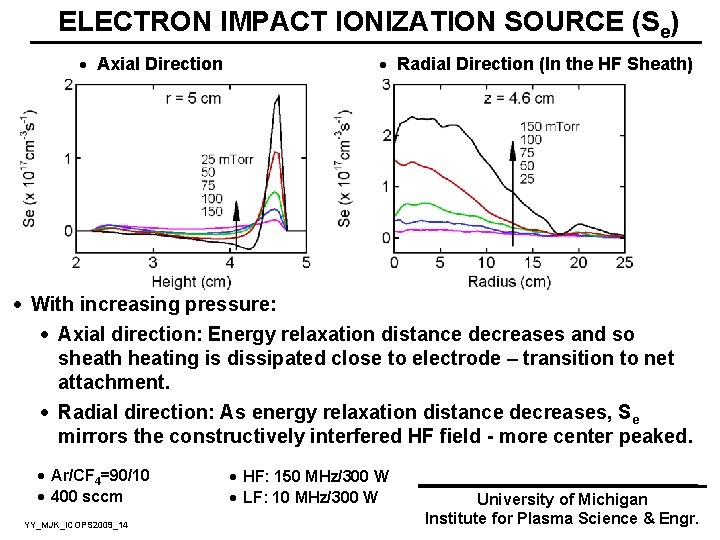
ELECTRON IMPACT IONIZATION SOURCE (Se) · Axial Direction · Radial Direction (In the HF Sheath) · With increasing pressure: · Axial direction: Energy relaxation distance decreases and so sheath heating is dissipated close to electrode – transition to net attachment. · Radial direction: As energy relaxation distance decreases, Se mirrors the constructively interfered HF field - more center peaked. · Ar/CF 4=90/10 · 400 sccm YY_MJK_ICOPS 2009_14 · HF: 150 MHz/300 W · LF: 10 MHz/300 W University of Michigan Institute for Plasma Science & Engr.
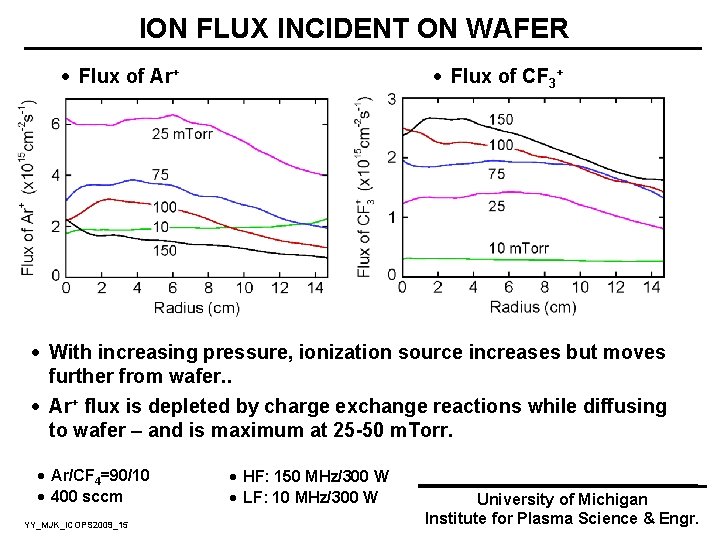
ION FLUX INCIDENT ON WAFER · Flux of Ar+ · Flux of CF 3+ · With increasing pressure, ionization source increases but moves further from wafer. . · Ar+ flux is depleted by charge exchange reactions while diffusing to wafer – and is maximum at 25 -50 m. Torr. · Ar/CF 4=90/10 · 400 sccm YY_MJK_ICOPS 2009_15 · HF: 150 MHz/300 W · LF: 10 MHz/300 W University of Michigan Institute for Plasma Science & Engr.
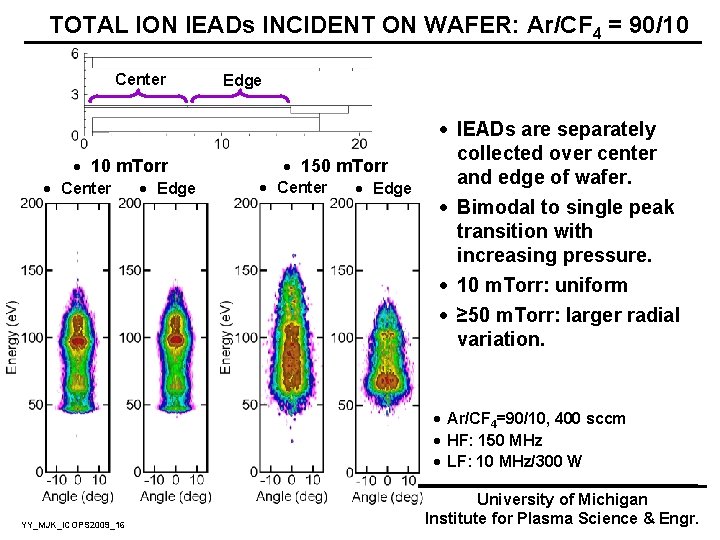
TOTAL ION IEADs INCIDENT ON WAFER: Ar/CF 4 = 90/10 Center · 10 m. Torr · Center · Edge · 150 m. Torr · Center · Edge · IEADs are separately collected over center and edge of wafer. · Bimodal to single peak transition with increasing pressure. · 10 m. Torr: uniform · ≥ 50 m. Torr: larger radial variation. · Ar/CF 4=90/10, 400 sccm · HF: 150 MHz · LF: 10 MHz/300 W YY_MJK_ICOPS 2009_16 University of Michigan Institute for Plasma Science & Engr.
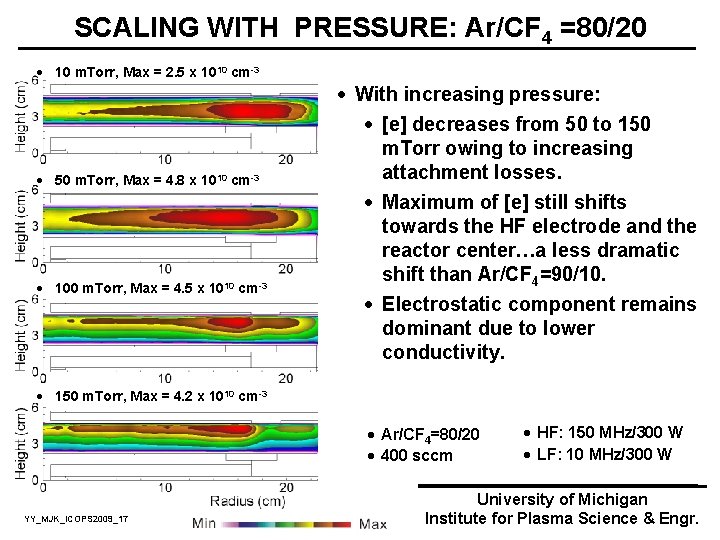
SCALING WITH PRESSURE: Ar/CF 4 =80/20 · 10 m. Torr, Max = 2. 5 x 1010 cm-3 · 50 m. Torr, Max = 4. 8 x 1010 cm-3 · 100 m. Torr, Max = 4. 5 x 1010 cm-3 · With increasing pressure: · [e] decreases from 50 to 150 m. Torr owing to increasing attachment losses. · Maximum of [e] still shifts towards the HF electrode and the reactor center…a less dramatic shift than Ar/CF 4=90/10. · Electrostatic component remains dominant due to lower conductivity. · 150 m. Torr, Max = 4. 2 x 1010 cm-3 · Ar/CF 4=80/20 · 400 sccm YY_MJK_ICOPS 2009_17 · HF: 150 MHz/300 W · LF: 10 MHz/300 W University of Michigan Institute for Plasma Science & Engr.
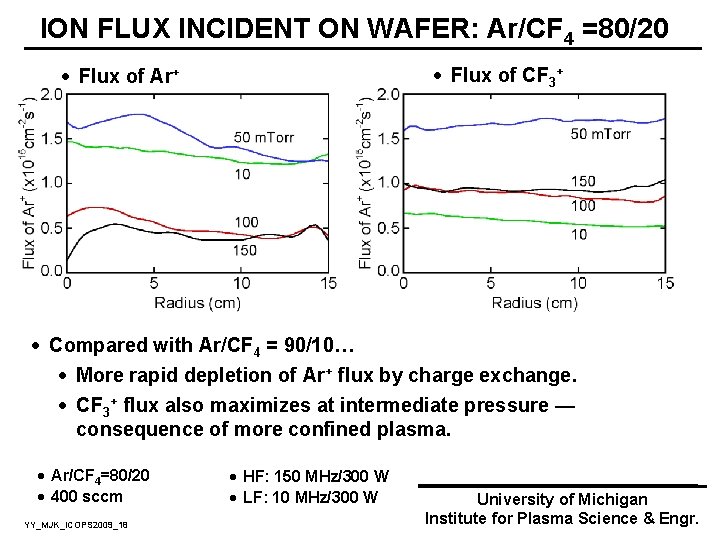
ION FLUX INCIDENT ON WAFER: Ar/CF 4 =80/20 · Flux of CF 3+ · Flux of Ar+ · Compared with Ar/CF 4 = 90/10… · More rapid depletion of Ar+ flux by charge exchange. · CF 3+ flux also maximizes at intermediate pressure — consequence of more confined plasma. · Ar/CF 4=80/20 · 400 sccm YY_MJK_ICOPS 2009_18 · HF: 150 MHz/300 W · LF: 10 MHz/300 W University of Michigan Institute for Plasma Science & Engr.
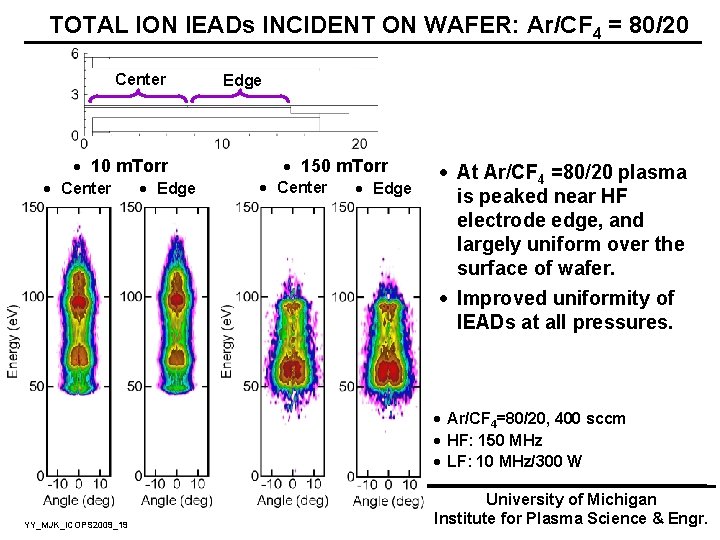
TOTAL ION IEADs INCIDENT ON WAFER: Ar/CF 4 = 80/20 Center · 10 m. Torr · Center · Edge · 150 m. Torr · Center · Edge · At Ar/CF 4 =80/20 plasma is peaked near HF electrode edge, and largely uniform over the surface of wafer. · Improved uniformity of IEADs at all pressures. · Ar/CF 4=80/20, 400 sccm · HF: 150 MHz · LF: 10 MHz/300 W YY_MJK_ICOPS 2009_19 University of Michigan Institute for Plasma Science & Engr.
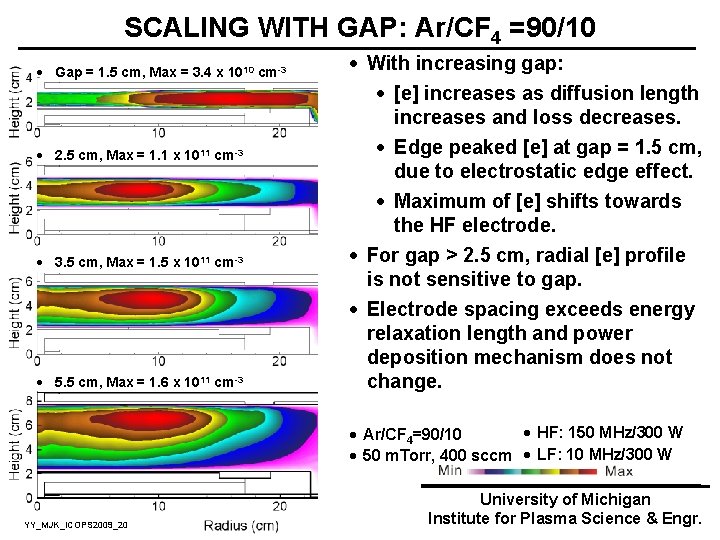
SCALING WITH GAP: Ar/CF 4 =90/10 · Gap = 1. 5 cm, Max = 3. 4 x 1010 cm-3 · 2. 5 cm, Max = 1. 1 x 1011 cm-3 · 3. 5 cm, Max = 1. 5 x 1011 cm-3 · 5. 5 cm, Max = 1. 6 x 1011 cm-3 · With increasing gap: · [e] increases as diffusion length increases and loss decreases. · Edge peaked [e] at gap = 1. 5 cm, due to electrostatic edge effect. · Maximum of [e] shifts towards the HF electrode. · For gap > 2. 5 cm, radial [e] profile is not sensitive to gap. · Electrode spacing exceeds energy relaxation length and power deposition mechanism does not change. · HF: 150 MHz/300 W · Ar/CF 4=90/10 · 50 m. Torr, 400 sccm · LF: 10 MHz/300 W YY_MJK_ICOPS 2009_20 University of Michigan Institute for Plasma Science & Engr.
EEDs vs GAP · Gap = 1. 5 cm · · Ar/CF 4=90/10 50 m. Torr, 400 sccm HF: 150 MHz/300 W LF: 10 MHz/300 W YY_MJK_ICOPS 2009_21 · Gap = 5. 5 cm · 2. 5 cm: Little change across bulk plasma; tail in LF sheath lifted owing to HF wave penetration. · 5. 5 cm: Systematic tail enhancement towards the HF electrode — larger separation between HF and LF waves, system functions more linearly. University of Michigan Institute for Plasma Science & Engr.
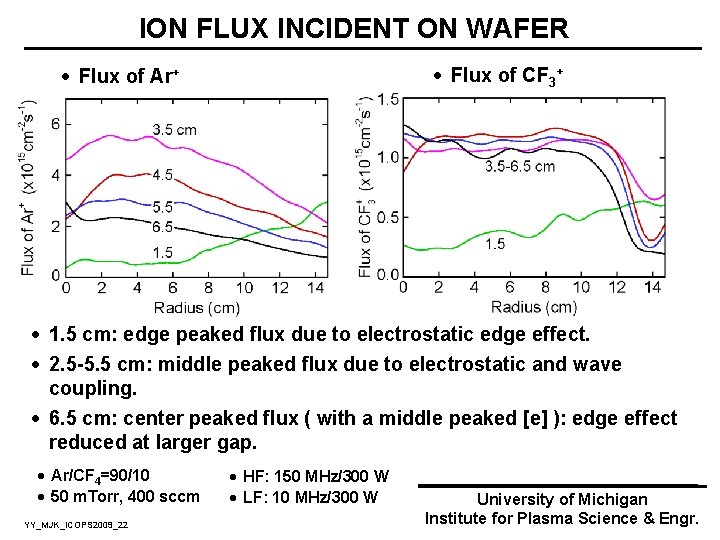
ION FLUX INCIDENT ON WAFER · Flux of CF 3+ · Flux of Ar+ · 1. 5 cm: edge peaked flux due to electrostatic edge effect. · 2. 5 -5. 5 cm: middle peaked flux due to electrostatic and wave coupling. · 6. 5 cm: center peaked flux ( with a middle peaked [e] ): edge effect reduced at larger gap. · Ar/CF 4=90/10 · 50 m. Torr, 400 sccm YY_MJK_ICOPS 2009_22 · HF: 150 MHz/300 W · LF: 10 MHz/300 W University of Michigan Institute for Plasma Science & Engr.
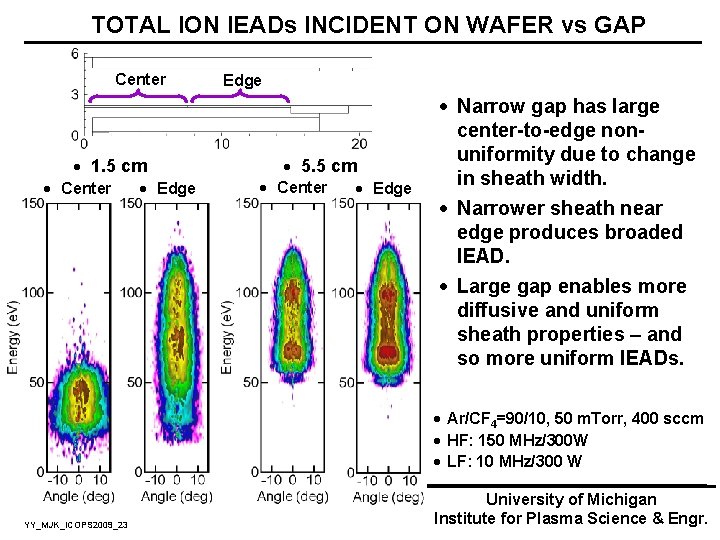
TOTAL ION IEADs INCIDENT ON WAFER vs GAP Center · 1. 5 cm · Center · Edge · 5. 5 cm · Center · Edge · Narrow gap has large center-to-edge nonuniformity due to change in sheath width. · Narrower sheath near edge produces broaded IEAD. · Large gap enables more diffusive and uniform sheath properties – and so more uniform IEADs. · Ar/CF 4=90/10, 50 m. Torr, 400 sccm · HF: 150 MHz/300 W · LF: 10 MHz/300 W YY_MJK_ICOPS 2009_23 University of Michigan Institute for Plasma Science & Engr.
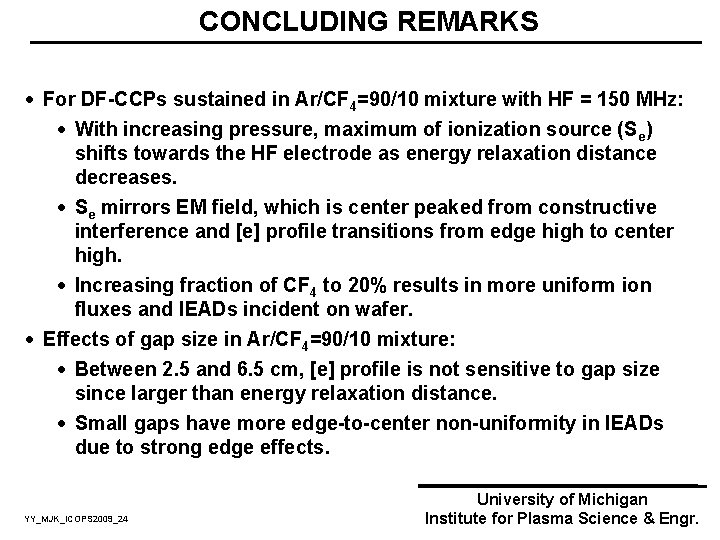
CONCLUDING REMARKS · For DF-CCPs sustained in Ar/CF 4=90/10 mixture with HF = 150 MHz: · With increasing pressure, maximum of ionization source (Se) shifts towards the HF electrode as energy relaxation distance decreases. · Se mirrors EM field, which is center peaked from constructive interference and [e] profile transitions from edge high to center high. · Increasing fraction of CF 4 to 20% results in more uniform ion fluxes and IEADs incident on wafer. · Effects of gap size in Ar/CF 4=90/10 mixture: · Between 2. 5 and 6. 5 cm, [e] profile is not sensitive to gap size since larger than energy relaxation distance. · Small gaps have more edge-to-center non-uniformity in IEADs due to strong edge effects. YY_MJK_ICOPS 2009_24 University of Michigan Institute for Plasma Science & Engr.