
Effect of Oxytocin Administration on Mirror Neuron Activation
- Slides: 2
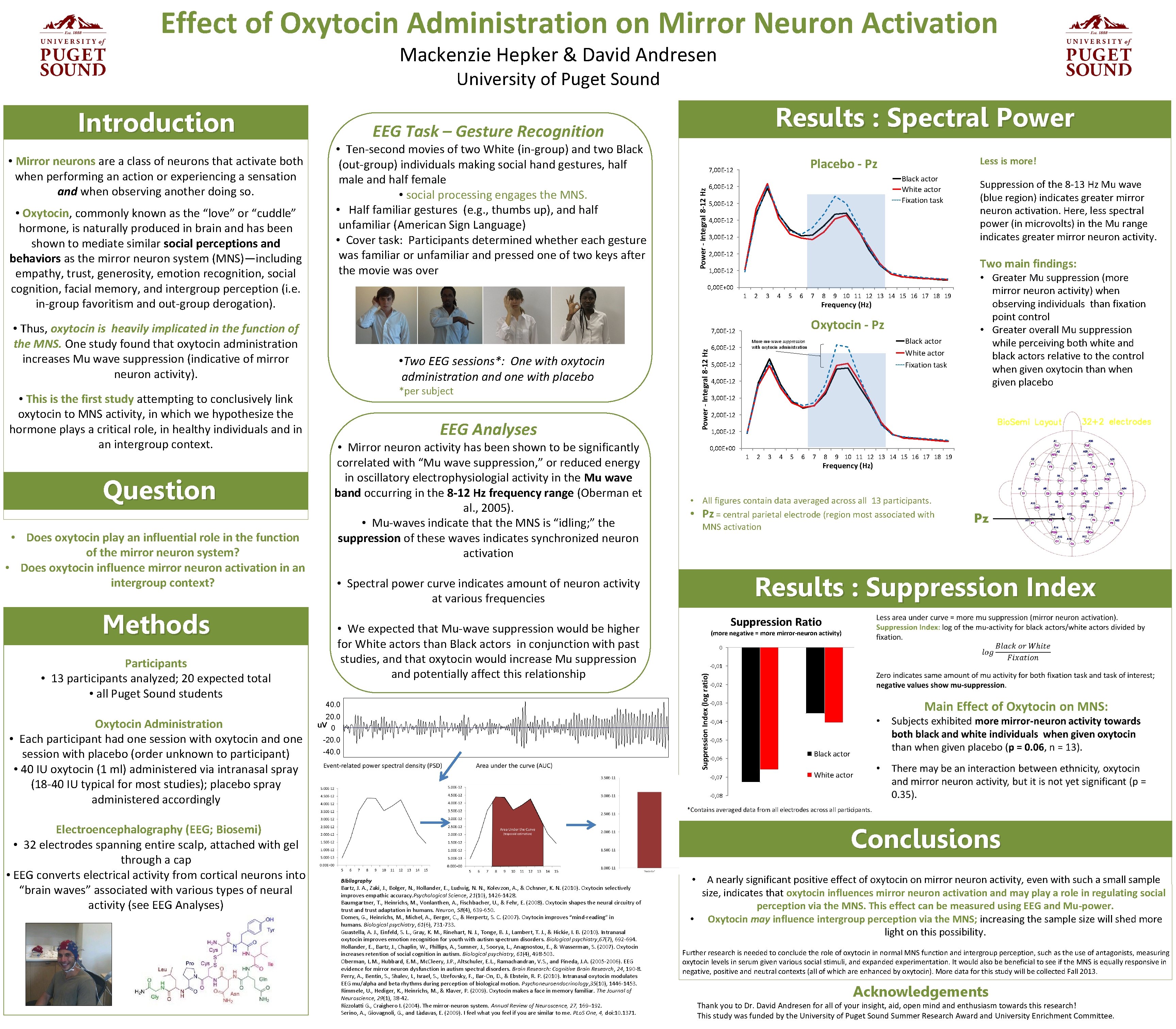
Effect of Oxytocin Administration on Mirror Neuron Activation Mackenzie Hepker & David Andresen University of Puget Sound Introduction • Ten-second movies of two White (in-group) and two Black (out-group) individuals making social hand gestures, half male and half female • social processing engages the MNS. • Half familiar gestures (e. g. , thumbs up), and half unfamiliar (American Sign Language) • Cover task: Participants determined whether each gesture was familiar or unfamiliar and pressed one of two keys after the movie was over Question • Does oxytocin play an influential role in the function of the mirror neuron system? • Does oxytocin influence mirror neuron activation in an intergroup context? Methods Participants • 13 participants analyzed; 20 expected total • all Puget Sound students Oxytocin Administration • Each participant had one session with oxytocin and one session with placebo (order unknown to participant) • 40 IU oxytocin (1 ml) administered via intranasal spray (18 -40 IU typical for most studies); placebo spray administered accordingly Electroencephalography (EEG; Biosemi) • 32 electrodes spanning entire scalp, attached with gel through a cap • EEG converts electrical activity from cortical neurons into “brain waves” associated with various types of neural activity (see EEG Analyses) Power - Integral 8 -12 Hz Black actor White actor Fixation task 6, 00 E-12 5, 00 E-12 4, 00 E-12 3, 00 E-12 2, 00 E-12 1 2 3 4 5 6 *per subject EEG Analyses • Mirror neuron activity has been shown to be significantly correlated with “Mu wave suppression, ” or reduced energy in oscillatory electrophysiologial activity in the Mu wave band occurring in the 8 -12 Hz frequency range (Oberman et al. , 2005). • Mu-waves indicate that the MNS is “idling; ” the suppression of these waves indicates synchronized neuron activation 7 8 9 10 11 12 13 14 15 16 17 18 19 Frequency (Hz) Oxytocin - Pz 7, 00 E-12 • Two EEG sessions*: One with oxytocin administration and one with placebo Suppression of the 8 -13 Hz Mu wave (blue region) indicates greater mirror neuron activation. Here, less spectral power (in microvolts) in the Mu range indicates greater mirror neuron activity. Two main findings: 0, 00 E+00 • Thus, oxytocin is heavily implicated in the function of the MNS. One study found that oxytocin administration increases Mu wave suppression (indicative of mirror neuron activity). • This is the first study attempting to conclusively link oxytocin to MNS activity, in which we hypothesize the hormone plays a critical role, in healthy individuals and in an intergroup context. Less is more! Placebo - Pz 7, 00 E-12 Power - Integral 8 -12 Hz • Oxytocin, commonly known as the “love” or “cuddle” hormone, is naturally produced in brain and has been shown to mediate similar social perceptions and behaviors as the mirror neuron system (MNS)—including empathy, trust, generosity, emotion recognition, social cognition, facial memory, and intergroup perception (i. e. in-group favoritism and out-group derogation). EEG Task – Gesture Recognition Black actor White actor Fixation task More mu-wave suppression with oxytocin administration 6, 00 E-12 5, 00 E-12 4, 00 E-12 • Greater Mu suppression (more mirror neuron activity) when observing individuals than fixation point control • Greater overall Mu suppression while perceiving both white and black actors relative to the control when given oxytocin than when given placebo 3, 00 E-12 2, 00 E-12 1, 00 E-12 0, 00 E+00 1 2 3 4 5 6 7 8 9 10 11 12 13 14 15 16 17 18 19 Frequency (Hz) • All figures contain data averaged across all 13 participants. • Pz = central parietal electrode (region most associated with MNS activation Pz Results : Suppression Index • Spectral power curve indicates amount of neuron activity at various frequencies Suppression Ratio • We expected that Mu-wave suppression would be higher for White actors than Black actors in conjunction with past studies, and that oxytocin would increase Mu suppression and potentially affect this relationship (more negative = more mirror-neuron activity) 0 -0, 01 Suppression Index (log ratio) • Mirror neurons are a class of neurons that activate both when performing an action or experiencing a sensation and when observing another doing so. Results : Spectral Power 40. 0 20. 0 u. V 0 -20. 0 -40. 0 -0, 02 -0, 03 -0, 04 -0, 05 -0, 06 -0, 07 Black actor White actor -0, 08 *Contains averaged data from all electrodes across all participants. Conclusions Bibliography Bartz, J. A. , Zaki, J. , Bolger, N. , Hollander, E. , Ludwig, N. N. , Kolevzon, A. , & Ochsner, K. N. (2010). Oxytocin selectively improves empathic accuracy. Psychological Science, 21(10), 1426 -1428. Baumgartner, T. , Heinrichs, M. , Vonlanthen, A. , Fischbacher, U. , & Fehr, E. (2008). Oxytocin shapes the neural circuitry of trust and trust adaptation in humans. Neuron, 58(4), 639 -650. Domes, G. , Heinrichs, M. , Michel, A. , Berger, C. , & Herpertz, S. C. (2007). Oxytocin improves “mind-reading” in humans. Biological psychiatry, 61(6), 731 -733. Guastella, A. J. , Einfeld, S. L. , Gray, K. M. , Rinehart, N. J. , Tonge, B. J. , Lambert, T. J. , & Hickie, I. B. (2010). Intranasal oxytocin improves emotion recognition for youth with autism spectrum disorders. Biological psychiatry, 67(7), 692 -694. Hollander, E. , Bartz, J. , Chaplin, W. , Phillips, A. , Sumner, J. , Soorya, L. , Anagnostou, E. , & Wasserman, S. (2007). Oxytocin increases retention of social cognition in autism. Biological psychiatry, 61(4), 498 -503. Oberman, L. M. , Hubbard, E. M. , Mc. Cleery, J. P. , Altschuler, E. L. , Ramachandran, V. S. , and Pineda, J. A. (2005 -2006). EEG evidence for mirror neuron dysfunction in autism spectral disorders. Brain Research: Cognitive Brain Research, 24, 190 -8. Perry, A. , Bentin, S. , Shalev, I. , Israel, S. , Uzefovsky, F. , Bar-On, D. , & Ebstein, R. P. (2010). Intranasal oxytocin modulates EEG mu/alpha and beta rhythms during perception of biological motion. Psychoneuroendocrinology, 35(10), 1446 -1453. Rimmele, U. , Hediger, K. , Heinrichs, M. , & Klaver, P. (2009). Oxytocin makes a face in memory familiar. The Journal of Neuroscience, 29(1), 38 -42. Rizzolatti G. , Craighero I. (2004). The mirror-neuron system. Annual Review of Neuroscence, 27, 169– 192. Serino, A. , Giovagnoli, G. , and Làdavas, E. (2009). I feel what you feel if you are similar to me. PLo. S One, 4, doi: 10. 1371. A nearly significant positive effect of oxytocin on mirror neuron activity, even with such a small sample size, indicates that oxytocin influences mirror neuron activation and may play a role in regulating social perception via the MNS. This effect can be measured using EEG and Mu-power. • Oxytocin may influence intergroup perception via the MNS; increasing the sample size will shed more light on this possibility. • Further research is needed to conclude the role of oxytocin in normal MNS function and intergroup perception, such as the use of antagonists, measuring oxytocin levels in serum given various social stimuli, and expanded experimentation. It would also be beneficial to see if the MNS is equally responsive in negative, positive and neutral contexts (all of which are enhanced by oxytocin). More data for this study will be collected Fall 2013. Acknowledgements Thank you to Dr. David Andresen for all of your insight, aid, open mind and enthusiasm towards this research! This study was funded by the University of Puget Sound Summer Research Award and University Enrichment Committee.
This study was funded by the Summer Science & Mathematics Award ‘ 13 and UEC Research Grants ($450). These funds were used for purchasing 40 IU oxytocin and placebo intranasal sprays ($50 total), compensation of participants ($700 total) and physical/medical screenings ($40).