
Effect of Flux Conservers on Inductive Pulsed Plasmoid
- Slides: 1
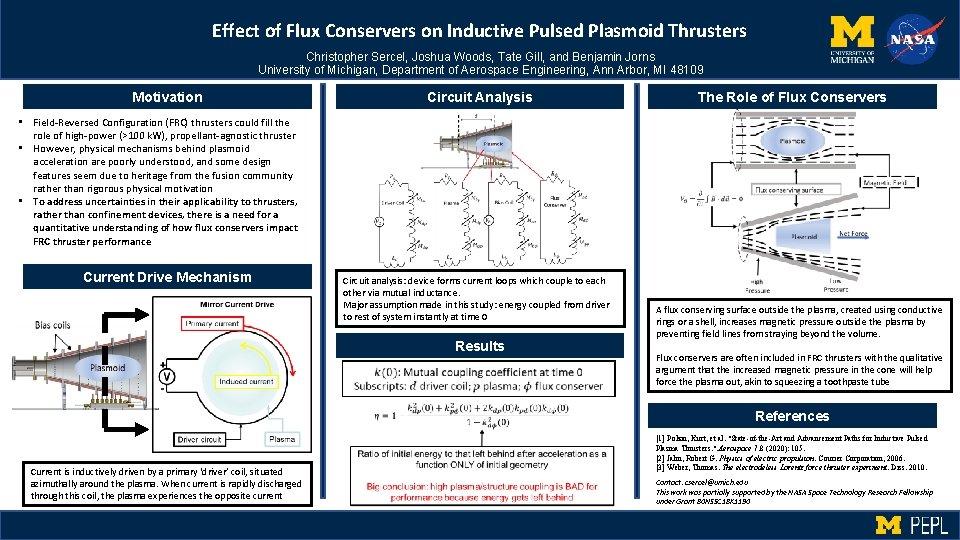
Effect of Flux Conservers on Inductive Pulsed Plasmoid Thrusters Christopher Sercel, Joshua Woods, Tate Gill, and Benjamin Jorns University of Michigan, Department of Aerospace Engineering, Ann Arbor, MI 48109 Motivation Circuit Analysis The Role of Flux Conservers • Field-Reversed Configuration (FRC) thrusters could fill the role of high-power (>100 k. W), propellant-agnostic thruster • However, physical mechanisms behind plasmoid acceleration are poorly understood, and some design features seem due to heritage from the fusion community rather than rigorous physical motivation • To address uncertainties in their applicability to thrusters, rather than confinement devices, there is a need for a quantitative understanding of how flux conservers impact FRC thruster performance Current Drive Mechanism Circuit analysis: device forms current loops which couple to each other via mutual inductance. Major assumption made in this study: energy coupled from driver to rest of system instantly at time 0 Results A flux conserving surface outside the plasma, created using conductive rings or a shell, increases magnetic pressure outside the plasma by preventing field lines from straying beyond the volume. Flux conservers are often included in FRC thrusters with the qualitative argument that the increased magnetic pressure in the cone will help force the plasma out, akin to squeezing a toothpaste tube References Current is inductively driven by a primary ‘driver’ coil, situated azimuthally around the plasma. When current is rapidly discharged through this coil, the plasma experiences the opposite current [1] Polzin, Kurt, et al. "State-of-the-Art and Advancement Paths for Inductive Pulsed Plasma Thrusters. " Aerospace 7. 8 (2020): 105. [2] Jahn, Robert G. Physics of electric propulsion. Courier Corporation, 2006. [3] Weber, Thomas. The electrodeless Lorentz force thruster experiment. Diss. 2010. Contact: csercel@umich. edu This work was partially supported by the NASA Space Technology Research Fellowship under Grant 80 NSSC 18 K 1190