
EFFECT OF ELECTROMAGNETIC FIELD INDUCED BY RADIO FREQUENCY
EFFECT OF ELECTROMAGNETIC FIELD INDUCED BY RADIO FREQUENCY WAVES AT 900 TO 1800 MHZ ON GROWTH PLATE IN GROWING RATS H. OZLEM NISBET This study has been published in “Research in Veterinary Science”. H. O. Nisbet, A. Akar, C. Nisbet, M. Y. Gulbahar, A. Ozak, C. Yardimci, S. Cömlekci. “Effects of electromagnetic field (1. 8/0. 9 GHz) exposure on growth plate in growing rats. ” Research in Veterinary Science, 104: 24 -29, 2016. DOI: 10. 1016/j. rvsc. 2015. 11. 002
EMFs have biological effects on the behavior of bone cells, increase the maturation of bone trabecula, bone volume and formation. (Rothman et al. , 1996; Tabrah et al. , 1998) Some authors have observed that an external magnetic field accelerated the healing of bone fractures. (Pickering and Scammell, 2002; Fini et al. , 2008) However, Yamada et al. (1985) did not observe any effects on bone tissue.
Although some papers have focused on the general effects of high frequency EMF on various organs and tissues, there is still no comprehensive study exploring the underlying mechanisms of the effects of high frequency EMF on bone tissue. (Koyama et al. , 2003; Diem et al. , 2005; Koyu et al. , 2005; Lixia et al. , 2006; Zhang et al. , 2006; Schwarz et al. , 2008; Aydin and Akar, 2011; Dasdag et al. , 2012, Kostoff and Lau, 2013)
The main goal: to evaluate the effects of high frequency EMF exposure on the femoral epiphyseal growth plates in growing male rats.

MATERIALS AND METHODS The animal study was approved by the Experimental Animal Studies Ethics Committee of Ondokuz Mayis University.
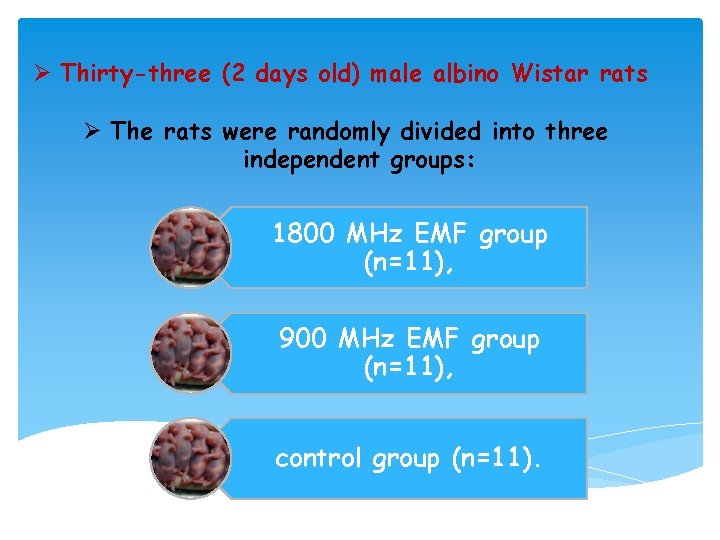
Ø Thirty-three (2 days old) male albino Wistar rats Ø The rats were randomly divided into three independent groups: 1800 MHz EMF group (n=11), 900 MHz EMF group (n=11), control group (n=11).
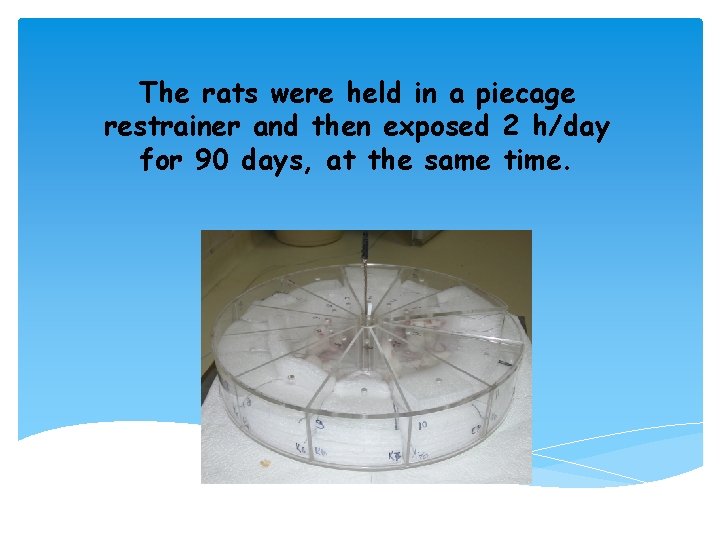
The rats were held in a piecage restrainer and then exposed 2 h/day for 90 days, at the same time.
Exposure system Øto apply 900 MHz radio frequency signal to group 2, Everest GSM Simulator (900 CW 4, Adapazarı, Türkiye) ; Øto apply 1800 MHz radio frequency signal to group 3, Everest GSM Simulator (1800 CW 2, Adapazarı, Türkiye) were used.

Ø EMF measurements were performed with Portable Field Meter (PMM 8053, Costruzioni Elettroniche Centro Misure Radioelettriche Srl. , Italy) Ø Equal distribution of electrical area was achieved by placing the dipol antenna in the middle point of restrainer. Ø Antenna length was approximately 15 cm.

The power levels antenna output power values of the RF generator exposure system were kept as value of which shows the same effect to the cellular and digital communication handsets commonly used by the general public.
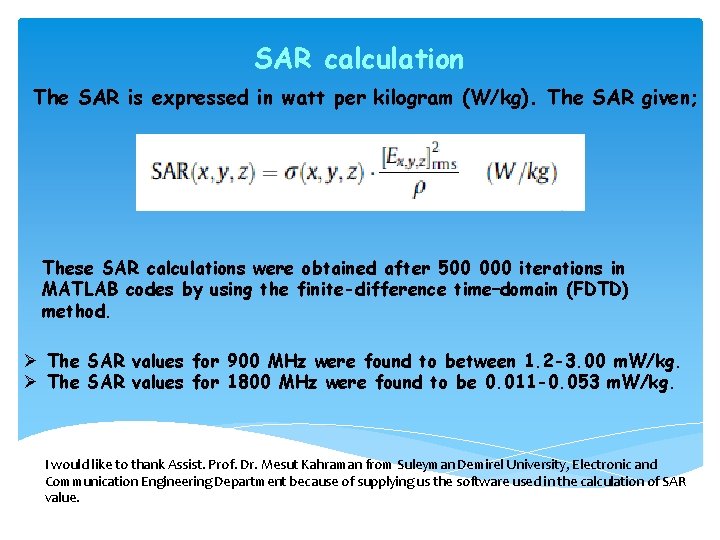
SAR calculation The SAR is expressed in watt per kilogram (W/kg). The SAR given; These SAR calculations were obtained after 500 000 iterations in MATLAB codes by using the finite-difference time–domain (FDTD) method. Ø The SAR values for 900 MHz were found to between 1. 2 -3. 00 m. W/kg. Ø The SAR values for 1800 MHz were found to be 0. 011 -0. 053 m. W/kg. I would like to thank Assist. Prof. Dr. Mesut Kahraman from Suleyman Demirel University, Electronic and Communication Engineering Department because of supplying us the software used in the calculation of SAR value.
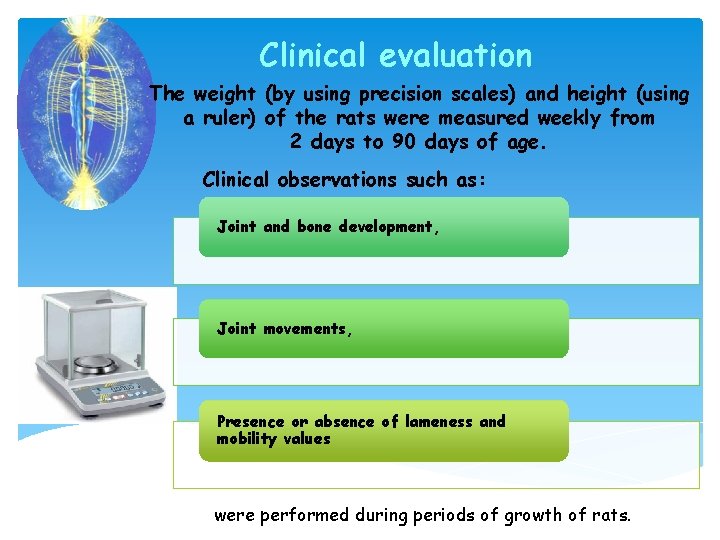
Clinical evaluation The weight (by using precision scales) and height (using a ruler) of the rats were measured weekly from 2 days to 90 days of age. Clinical observations such as: Joint and bone development, Joint movements, Presence or absence of lameness and mobility values were performed during periods of growth of rats.
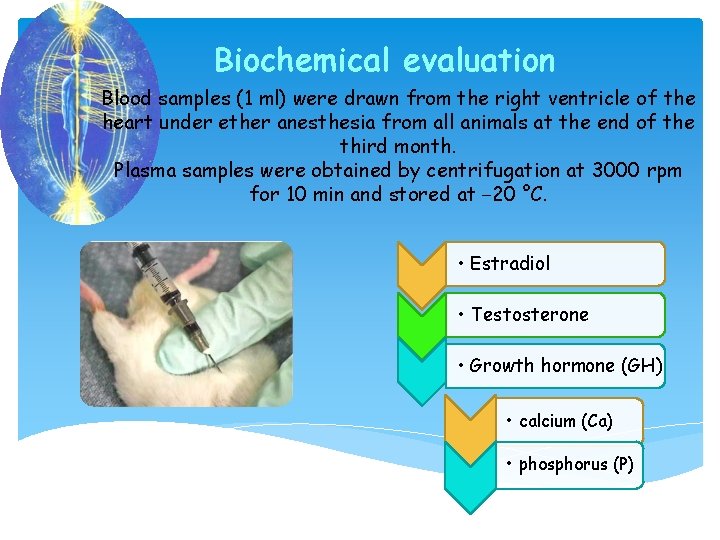
Biochemical evaluation Blood samples (1 ml) were drawn from the right ventricle of the heart under ether anesthesia from all animals at the end of the third month. Plasma samples were obtained by centrifugation at 3000 rpm for 10 min and stored at − 20 °C. • Estradiol • Testosterone • Growth hormone (GH) • calcium (Ca) • phosphorus (P)
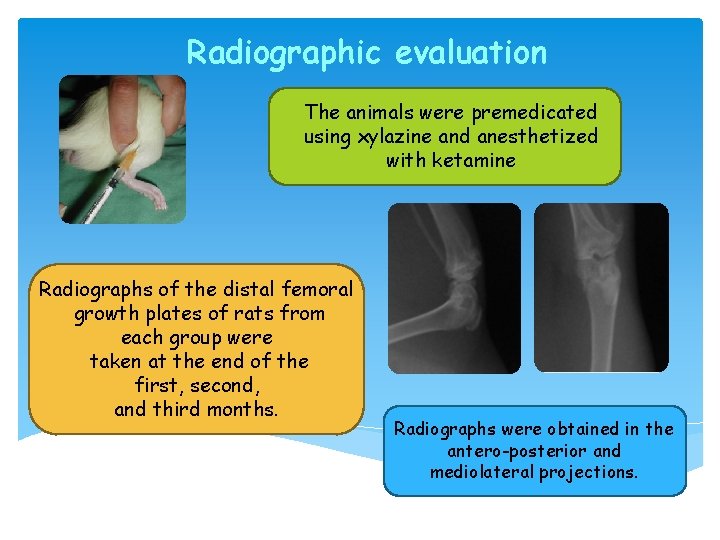
Radiographic evaluation The animals were premedicated using xylazine and anesthetized with ketamine Radiographs of the distal femoral growth plates of rats from each group were taken at the end of the first, second, and third months. Radiographs were obtained in the antero-posterior and mediolateral projections.
Histopathological evaluation • The right femurs of the rats were ablated, including epiphyseal growth plates. • The bones were kept in a formaldehyde solution of 10% buffer for 24 h, • Decalcified with formic acid-paraformaldehyde solution for 4 weeks. • The tissues were processed with alcohol and xylol series • They were blocked in paraffin • The 5 mm-cross-sections provided by microtome were stained with hematoxylin eosin, Safranin O and toluidine blue. These cross-sections were scored with Modified Mankin Method
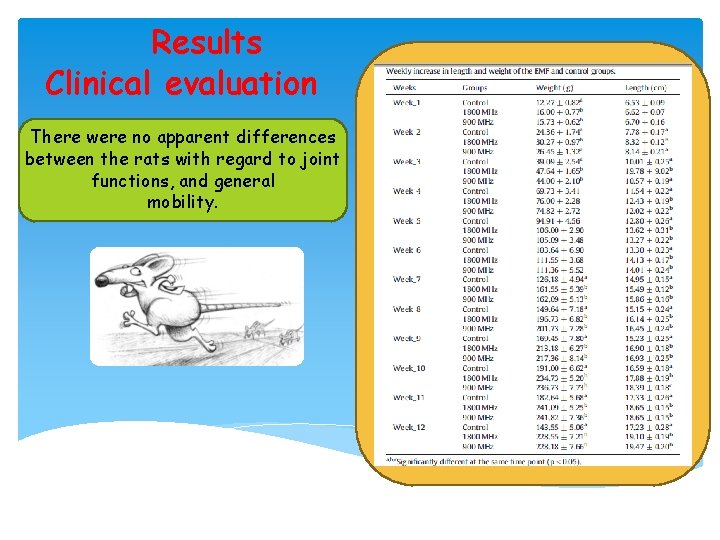
Results Clinical evaluation There were no apparent differences between the rats with regard to joint functions, and general mobility.
EMF group Rats in the EMF group experienced a faster increase in weight and length.
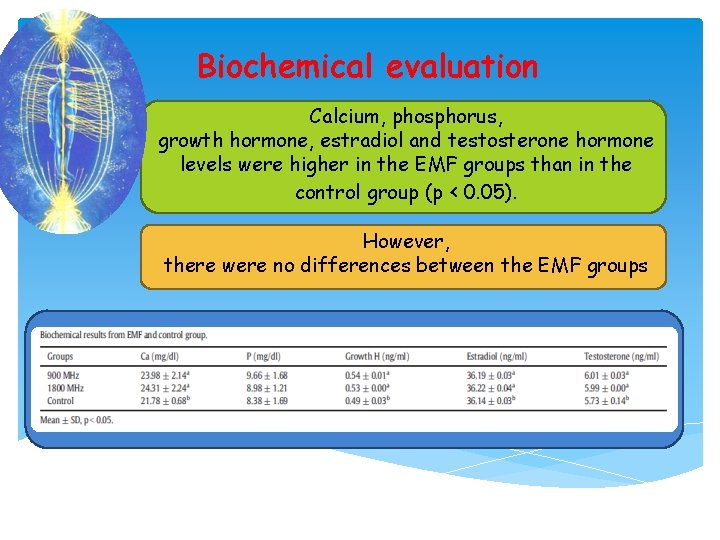
Biochemical evaluation Calcium, phosphorus, growth hormone, estradiol and testosterone hormone levels were higher in the EMF groups than in the control group (p < 0. 05). However, there were no differences between the EMF groups
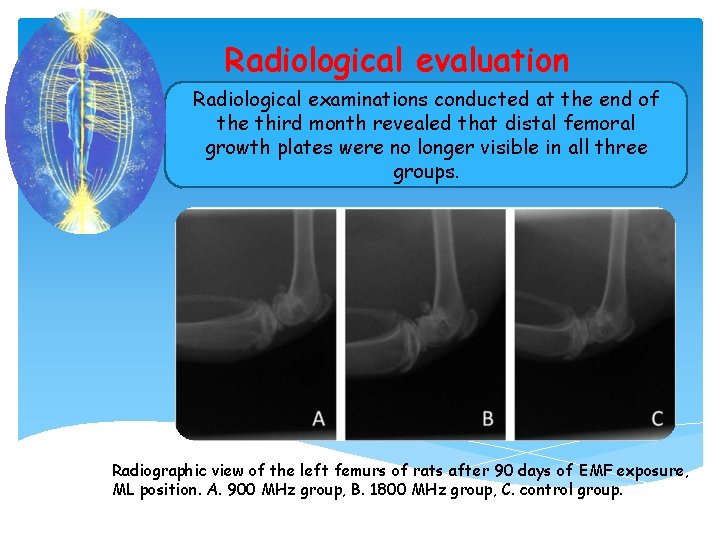
Radiological evaluation Radiological examinations conducted at the end of the third month revealed that distal femoral growth plates were no longer visible in all three groups. Radiographic view of the left femurs of rats after 90 days of EMF exposure, ML position. A. 900 MHz group, B. 1800 MHz group, C. control group.
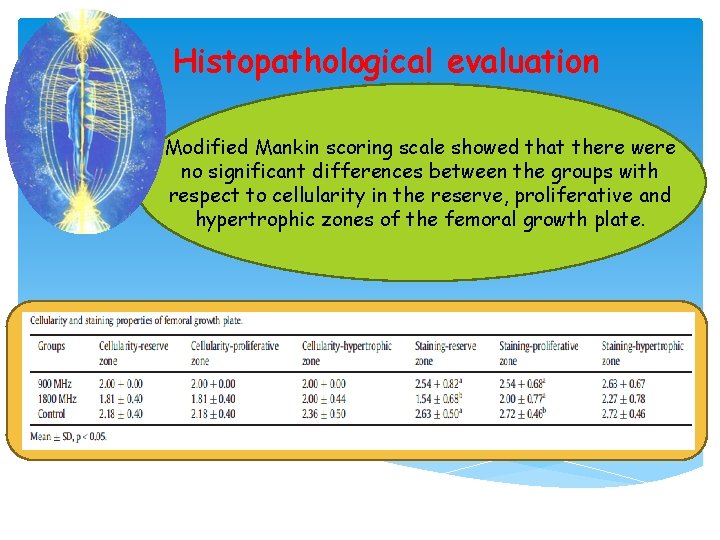
Histopathological evaluation Modified Mankin scoring scale showed that there were no significant differences between the groups with respect to cellularity in the reserve, proliferative and hypertrophic zones of the femoral growth plate.

In Safranin O staining for mature proteoglycans of growth plate, the cartilage matrix density, was lowest in the reserve zone at 1800 MHz (p < 0. 05) and was significantly increased in the proliferative zone of the control group (Fig. a).
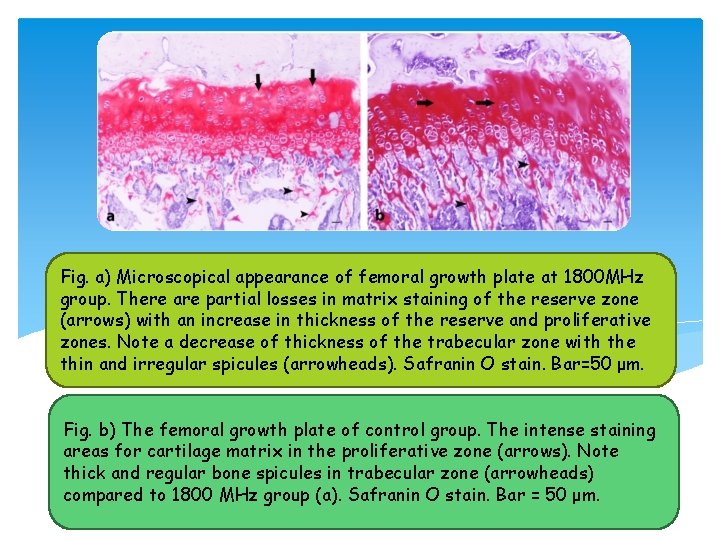
Fig. a) Microscopical appearance of femoral growth plate at 1800 MHz group. There are partial losses in matrix staining of the reserve zone (arrows) with an increase in thickness of the reserve and proliferative zones. Note a decrease of thickness of the trabecular zone with the thin and irregular spicules (arrowheads). Safranin O stain. Bar=50 μm. Fig. b) The femoral growth plate of control group. The intense staining areas for cartilage matrix in the proliferative zone (arrows). Note thick and regular bone spicules in trabecular zone (arrowheads) compared to 1800 MHz group (a). Safranin O stain. Bar = 50 μm.
Experimental studies have shown that high frequency EMF has an effect on endocrine and nervous systems (Hardell and Sage, 2008). This study evaluated the long-term effects of 1800 MHz and 900 MHz EMF on growing healthy rat bones, using clinical, radiological, histopathological and biochemical analyses.

• Clinical observations revealed no significant difference • in joint and bone growth nor in joint and • other mobilities of the rats. • However, it was found that rats in the • EMF groups • more rapidly gained weight and increased in length compared with the control group.
In light of these results, it is believed that 1800 MHz and 900 MHz EMF may cause prolong the growing process in growing rats.
Considering the results of the study, further studies by including before- and after-puberty periods at even longer time intervals are necessary to clarify the mechanisms of EMF.

This work has been supported by the grants from the Ondokuz Mayis University Scientific Projects Unit (BAP. PYO. VET. 1901. 005).

THANK YOU
- Slides: 28