
Effect of Corrosion Inhibitor Alkyl Tail Length on
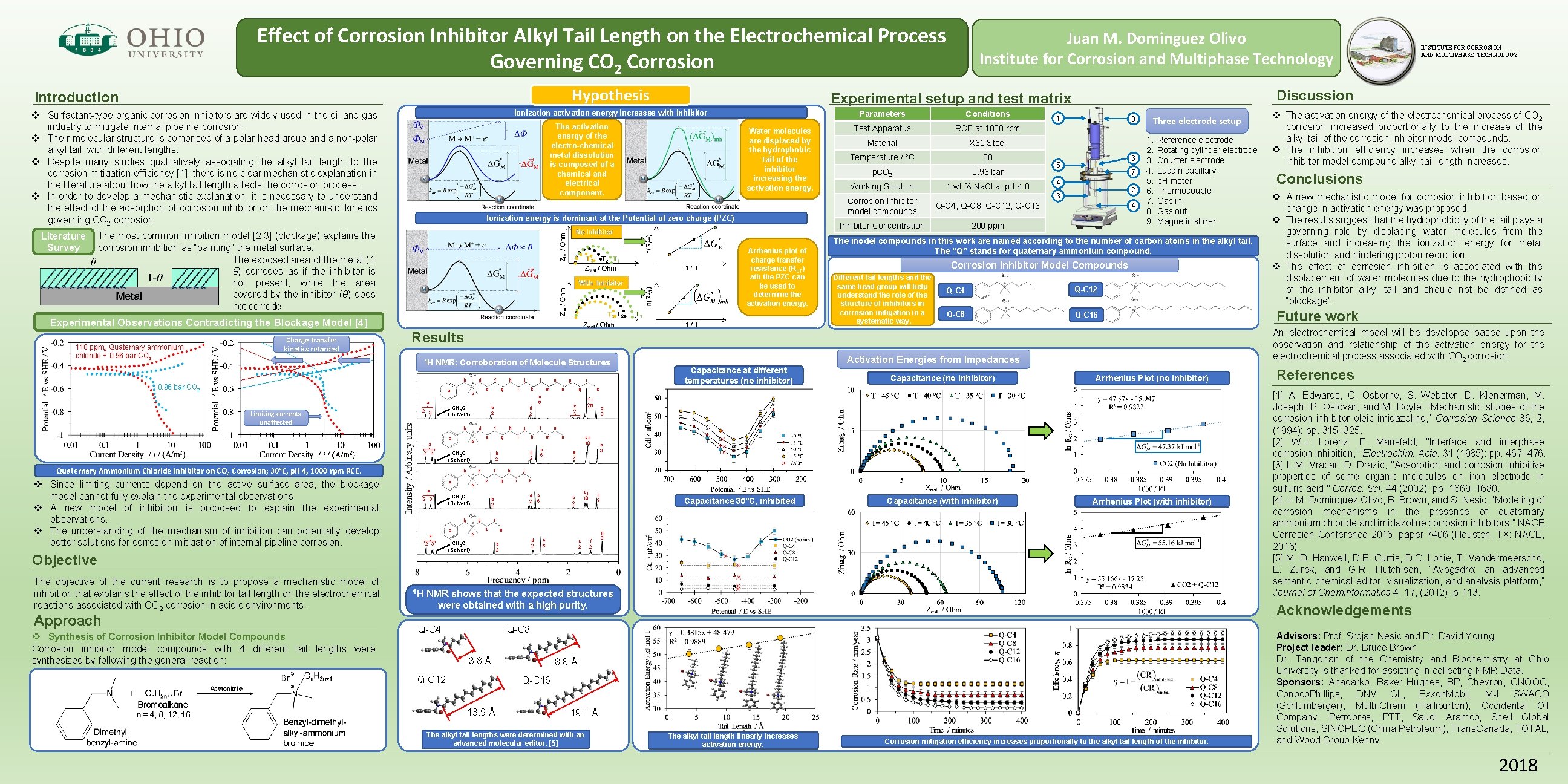
Effect of Corrosion Inhibitor Alkyl Tail Length on the Electrochemical Process Governing CO 2 Corrosion Hypothesis Introduction Literature Survey The activation energy of the electro-chemical metal dissolution is composed of a chemical and electrical component. Water molecules are displaced by the hydrophobic tail of the inhibitor increasing the activation energy. Ionization energy is dominant at the Potential of zero charge (PZC) The most common inhibition model [2, 3] (blockage) explains the corrosion inhibition as “painting” the metal surface: The exposed area of the metal (1θ) corrodes as if the inhibitor is not present, while the area covered by the inhibitor (θ) does not corrode. Arrhenius plot of charge transfer resistance (RCT) ath the PZC can be used to determine the activation energy. Experimental Observations Contradicting the Blockage Model [4] 110 ppm. V Quaternary ammonium chloride + 0. 96 bar CO 2 Charge transfer kinetics retarded NMR: Corroboration of Molecule Structures b 0. 96 bar CO 2 a 2 3 v Synthesis of Corrosion Inhibitor Model Compounds Corrosion inhibitor model compounds with 4 different tail lengths were synthesized by following the general reaction: d h a c 2 3 1 H p g r o q Test Apparatus RCE at 1000 rpm Material X 65 Steel Temperature / °C 30 p. CO 2 0. 96 bar Working Solution 1 wt. % Na. Cl at p. H 4. 0 1 8 6 5 7 4 2 3 Corrosion Inhibitor model compounds Q-C 4, Q-C 8, Q-C 12, Q-C 16 Inhibitor Concentration 200 ppm 4 Three electrode setup 1. 2. 3. 4. 5. 6. 7. 8. 9. Reference electrode Rotating cylinder electrode Counter electrode Luggin capillary p. H meter Thermocouple Gas in Gas out Magnetic stirrer The model compounds in this work are named according to the number of carbon atoms in the alkyl tail. The “Q” stands for quaternary ammonium compound. Corrosion Inhibitor Model Compounds Different tail lengths and the same head group will help understand the role of the structure of inhibitors in corrosion mitigation in a systematic way. Q-C 4 Q-C 12 Q-C 8 Q-C 16 Activation Energies from Impedances Capacitance at different temperatures (no inhibitor) Capacitance (no inhibitor) f-r 26 Arrhenius Plot (no inhibitor) s 3 n k m c 6 o f-n 18 o 3 e 2 j i k d 2 c 6 f-j 10 e 2 k 3 Capacitance 30°C, inhibited Capacitance (with inhibitor) Arrhenius Plot (with inhibitor) f e CH 3 Cl (Solvent) g d 2 b 2 c 6 e 2 f 2 g 3 NMR shows that the expected structures were obtained with a high purity. 3. 8 Å Q-C 12 8. 8 Å Q-C 16 13. 9 Å 19. 1 Å The alkyl tail lengths were determined with an advanced molecular editor. [5] Conclusions v A new mechanistic model for corrosion inhibition based on change in activation energy was proposed. v The results suggest that the hydrophobicity of the tail plays a governing role by displacing water molecules from the surface and increasing the ionization energy for metal dissolution and hindering proton reduction. v The effect of corrosion inhibition is associated with the displacement of water molecules due to the hydrophobicity of the inhibitor alkyl tail and should not be defined as “blockage”. Future work References [1] A. Edwards, C. Osborne, S. Webster, D. Klenerman, M. Joseph, P. Ostovar, and M. Doyle, “Mechanistic studies of the corrosion inhibitor oleic imidazoline, ” Corrosion Science 36, 2, (1994): pp. 315– 325. [2] W. J. Lorenz, F. Mansfeld, "Interface and interphase corrosion inhibition, " Electrochim. Acta. 31 (1985): pp. 467– 476. [3] L. M. Vracar, D. Drazic, "Adsorption and corrosion inhibitive properties of some organic molecules on iron electrode in sulfuric acid, " Corros. Sci. 44 (2002): pp. 1669– 1680. [4] J. M. Dominguez Olivo, B. Brown, and S. Nesic, “Modeling of corrosion mechanisms in the presence of quaternary ammonium chloride and imidazoline corrosion inhibitors, ” NACE Corrosion Conference 2016, paper 7406 (Houston, TX: NACE, 2016). [5] M. D. Hanwell, D. E. Curtis, D. C. Lonie, T. Vandermeerschd, E. Zurek, and G. R. Hutchison, “Avogadro: an advanced semantic chemical editor, visualization, and analysis platform, ” Journal of Cheminformatics 4, 17, (2012): p 113. Acknowledgements Q-C 8 Q-C 4 v The activation energy of the electrochemical process of CO 2 corrosion increased proportionally to the increase of the alkyl tail of the corrosion inhibitor model compounds. v The inhibition efficiency increases when the corrosion inhibitor model compound alkyl tail length increases. An electrochemical model will be developed based upon the observation and relationship of the activation energy for the electrochemical process associated with CO 2 corrosion. s e 2 l i h b 2 d m d 2 f CH 3 Cl (Solvent) a j g e c b Objective Approach f a 2 3 k b 2 b a i n d 2 e c l c 6 CH 3 Cl (Solvent) Quaternary Ammonium Chloride Inhibitor on CO 2 Corrosion; 30°C, p. H 4, 1000 rpm RCE. The objective of the current research is to propose a mechanistic model of inhibition that explains the effect of the inhibitor tail length on the electrochemical reactions associated with CO 2 corrosion in acidic environments. g d a j b 2 CH 3 Cl (Solvent) a h e c b 2 3 f d a v Since limiting currents depend on the active surface area, the blockage model cannot fully explain the experimental observations. v A new model of inhibition is proposed to explain the experimental observations. v The understanding of the mechanism of inhibition can potentially develop better solutions for corrosion mitigation of internal pipeline corrosion. Conditions Results 1 H Limiting currents unaffected Parameters INSTITUTE FOR CORROSION AND MULTIPHASE TECHNOLOGY Discussion Experimental setup and test matrix Ionization activation energy increases with inhibitor v Surfactant-type organic corrosion inhibitors are widely used in the oil and gas industry to mitigate internal pipeline corrosion. v Their molecular structure is comprised of a polar head group and a non-polar alkyl tail, with different lengths. v Despite many studies qualitatively associating the alkyl tail length to the corrosion mitigation efficiency [1], there is no clear mechanistic explanation in the literature about how the alkyl tail length affects the corrosion process. v In order to develop a mechanistic explanation, it is necessary to understand the effect of the adsorption of corrosion inhibitor on the mechanistic kinetics governing CO 2 corrosion. Juan M. Dominguez Olivo Institute for Corrosion and Multiphase Technology The alkyl tail length linearly increases activation energy. Corrosion mitigation efficiency increases proportionally to the alkyl tail length of the inhibitor. Advisors: Prof. Srdjan Nesic and Dr. David Young, Project leader: Dr. Bruce Brown Dr. Tangonan of the Chemistry and Biochemistry at Ohio University is thanked for assisting in collecting NMR Data. Sponsors: Anadarko, Baker Hughes, BP, Chevron, CNOOC, Conoco. Phillips, DNV GL, Exxon. Mobil, M-I SWACO (Schlumberger), Multi-Chem (Halliburton), Occidental Oil Company, Petrobras, PTT, Saudi Aramco, Shell Global Solutions, SINOPEC (China Petroleum), Trans. Canada, TOTAL, and Wood Group Kenny. 2018
- Slides: 1