
EFFECT OF CORE STABILITY EXERCISES ON TRUNK MUSCLES

EFFECT OF CORE STABILITY EXERCISES ON TRUNK MUSCLES' ENDURANCE AND DYNAMIC BALANCE IN HEALTHY ADULTS Neama H. Mohamed
INTRODUCTION Many models of the spine consider stability in terms of the ability of the spine to withstand compressive forces and resist buckling.
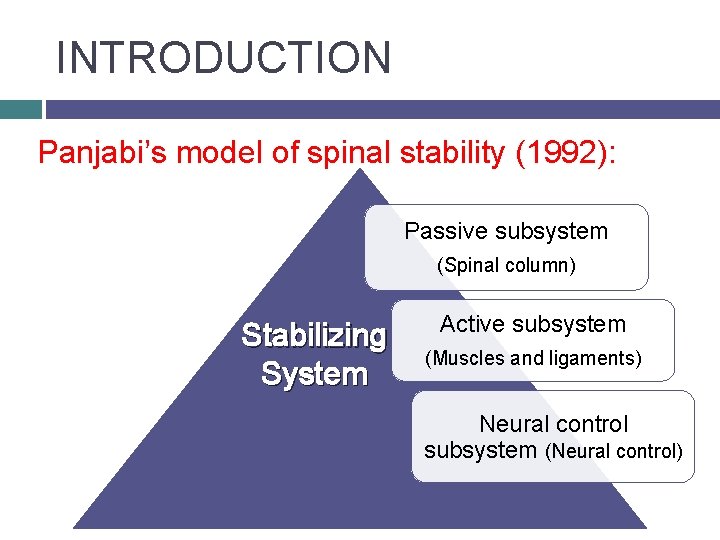
INTRODUCTION Panjabi’s model of spinal stability (1992): Passive subsystem Panjabi’s Model Of Stabilizing Spinal System Stability (Spinal column) Active subsystem (Muscles and ligaments) Neural control subsystem (Neural control)
INTRODUCTION (cont) § § The major source of spinal stability comes from the second component of Panjabi's model because the passively supported spine collapses under 90 N of load. This system must activate the correct muscles at the right time by the right amount to protect the spine from injury and also allow the desired movement (Barr et al. , 2005).
INTRODUCTION (cont) § Bergmark (1989) developed a model to summarize the role of the core muscles and their contribution to spinal stability. Global muscles § local muscles §
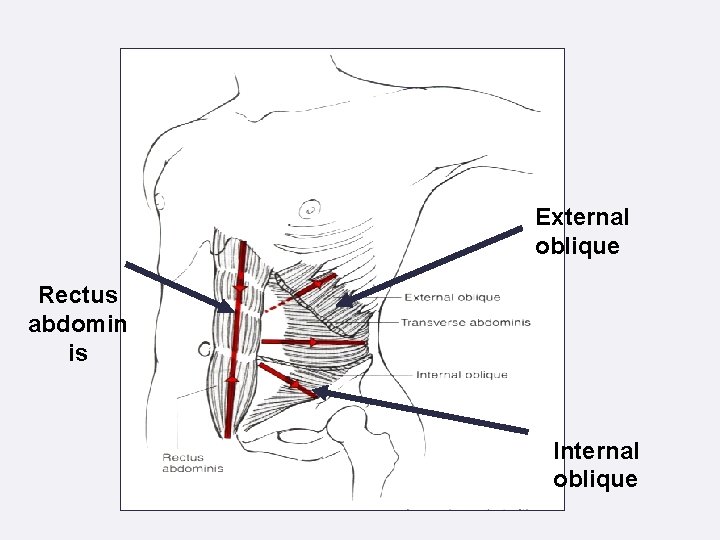
External oblique Rectus abdomin is Internal oblique
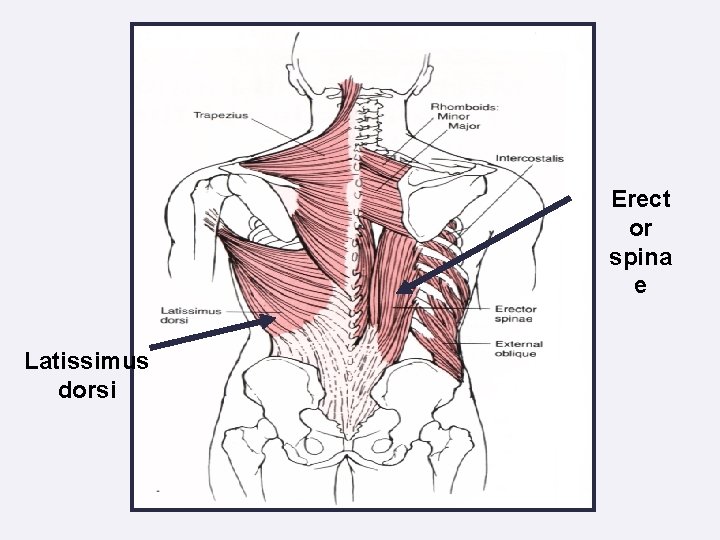
Erect or spina e Latissimus dorsi
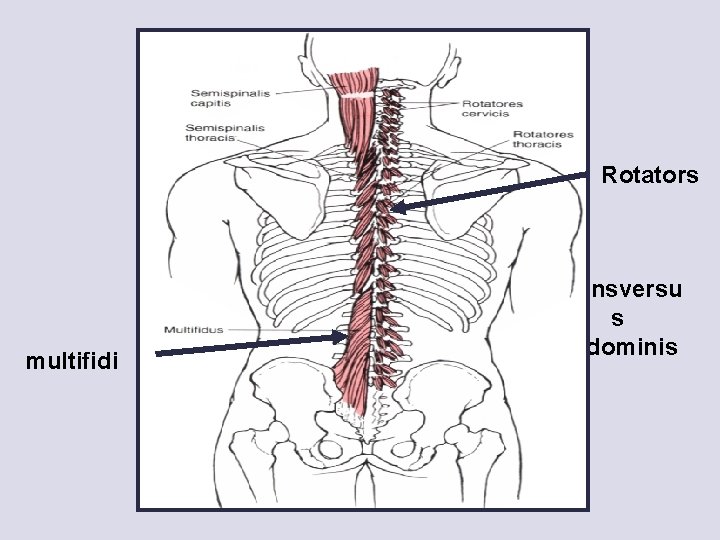
Rotators multifidi Transversu s abdominis
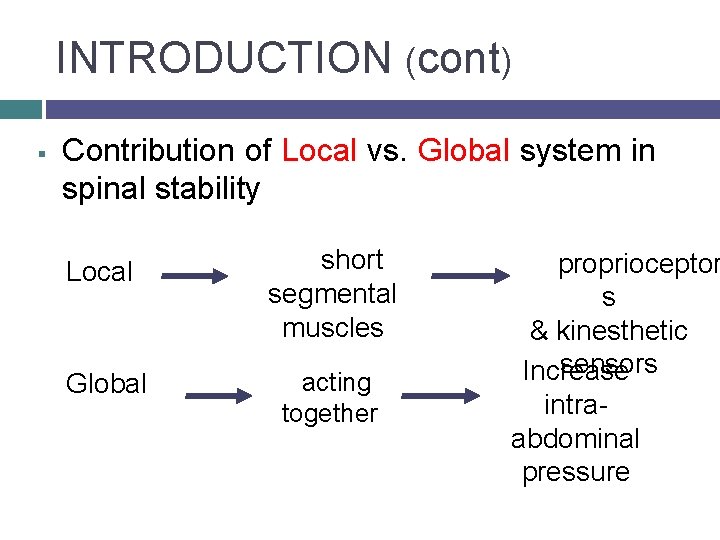
INTRODUCTION (cont) § Contribution of Local vs. Global system in spinal stability Local short segmental muscles Global acting together proprioceptor s & kinesthetic sensors Increase intraabdominal pressure

INTRODUCTION (cont) Core stability can be defined as: The ability to maintain neutral spine using the abdominal, back, and hip muscles as a stabilizers rather than prime movers.

INTRODUCTION (cont) § Components of core stability: Strength Coordinatio n Core stability Endurance Balance
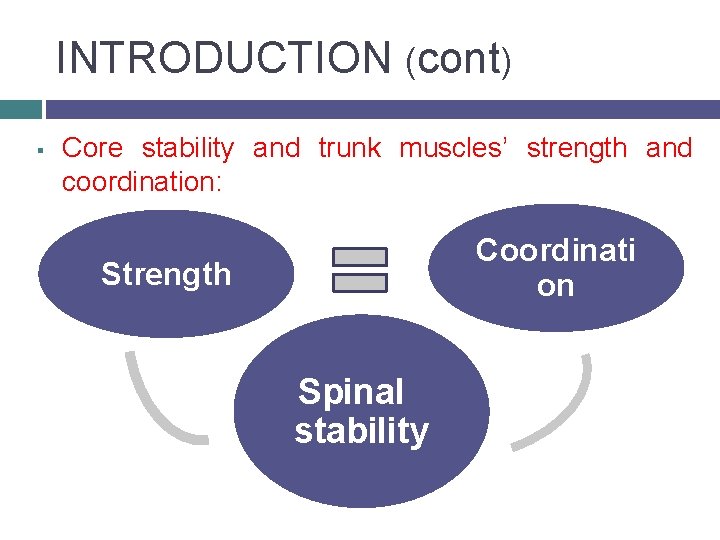
INTRODUCTION (cont) § Core stability and trunk muscles’ strength and coordination: Coordinati on Strength Spinal stability

INTRODUCTION (cont) § Core stability and trunk muscles’ strength and coordination: § sufficient stability of the lumbar spine is achieved in most persons with very modest levels of coactivation of the paraspinal and abdominal muscles. § So, maintaining stability when performing tasks of daily living is not achieved by sufficient muscle strength but rather by sufficient endurance
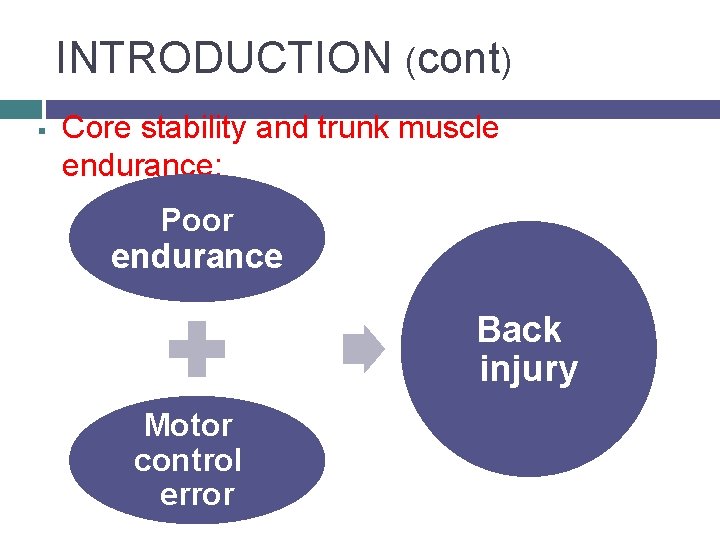
INTRODUCTION (cont) § Core stability and trunk muscle endurance: Poor endurance Back injury Motor control error

INTRODUCTION (cont) Core stability and dynamic balance: § Dynamic balance is an integral component of core stability. § The core functions to maintain dynamic balance during activities which helps avoid serious distortion patterns.

INTRODUCTION (cont) § § With the evidence supporting the importance of trunk muscle endurance and dynamic balance for improving core stability. It is important to emphasize on improving core muscle endurance and dynamic balance to improve health and reduce the risk of injury.

INTRODUCTION (cont) Purposes of the study: § § To investigate the effect of core stability exercise program on the work fatigue and total work of the trunk extensors and flexors. To investigate the effect of core stability exercise program on the antero-posterior, medio-lateral, and over all stability indices.

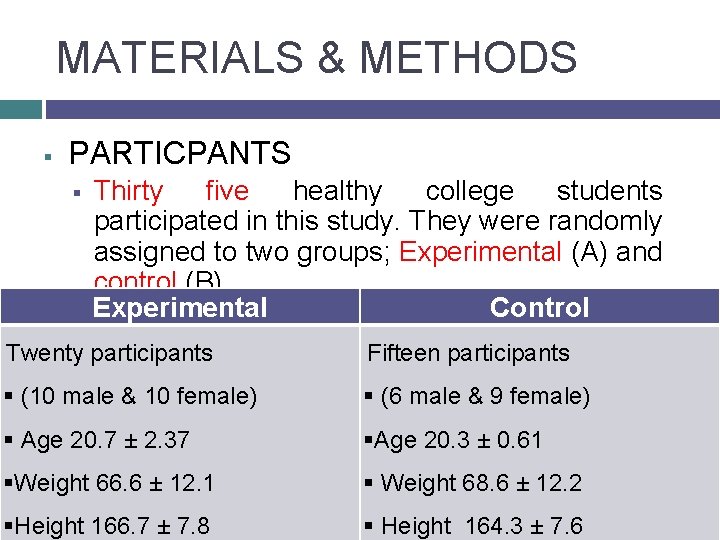
MATERIALS & METHODS § PARTICPANTS § Thirty five healthy college students participated in this study. They were randomly assigned to two groups; Experimental (A) and control (B) Experimental Control Twenty participants Fifteen participants § (10 male & 10 female) § (6 male & 9 female) § Age 20. 7 ± 2. 37 §Age 20. 3 ± 0. 61 §Weight 66. 6 ± 12. 1 § Weight 68. 6 ± 12. 2 §Height 166. 7 ± 7. 8 § Height 164. 3 ± 7. 6
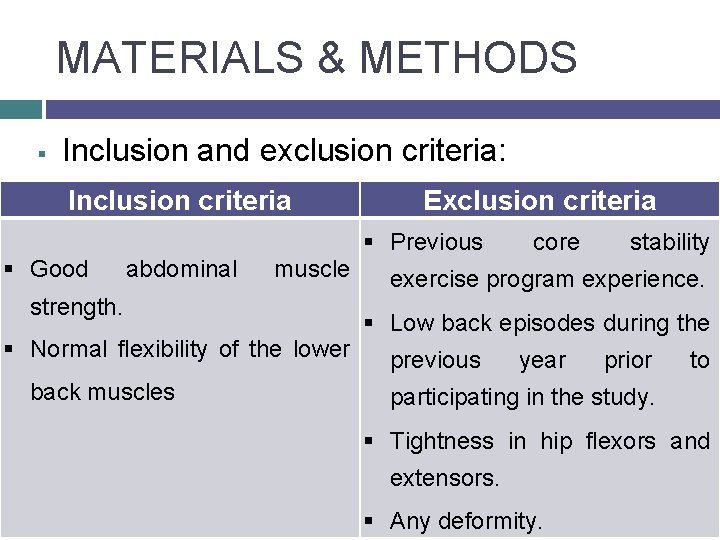
MATERIALS & METHODS § Inclusion and exclusion criteria: Inclusion criteria Exclusion criteria § Previous § Good abdominal muscle strength. § Normal flexibility of the lower back muscles core stability exercise program experience. § Low back episodes during the previous year prior to participating in the study. § Tightness in hip flexors and extensors. § Any deformity.
MATERIALS & METHODS (cont) Instrumentations: The Biodex Isokinetic Dynamometer • Assessment of the trunk muscles’ endurance
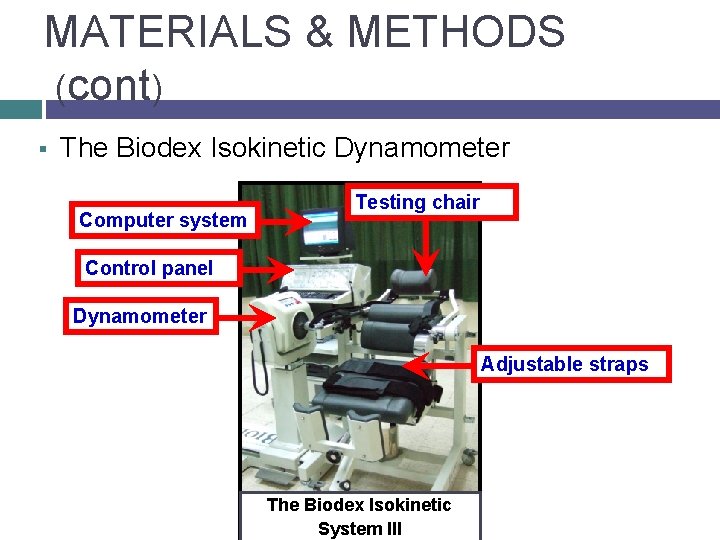
MATERIALS & METHODS (cont) § The Biodex Isokinetic Dynamometer Computer system Testing chair Control panel Dynamometer Adjustable straps The Biodex Isokinetic System III
MATERIALS & METHODS (cont) Instrumentations: The Biodex Balance system • Assessment of dynamic balance
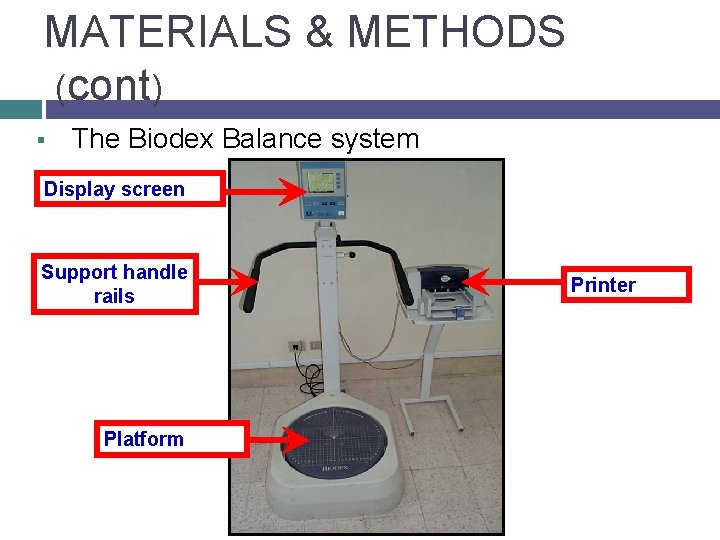
MATERIALS & METHODS (cont) § The Biodex Balance system Display screen Support handle rails Platform Printer
MATERIALS & METHODS (cont) Trunk muscles’ endurance testing Dynamic balance testing Procedur es
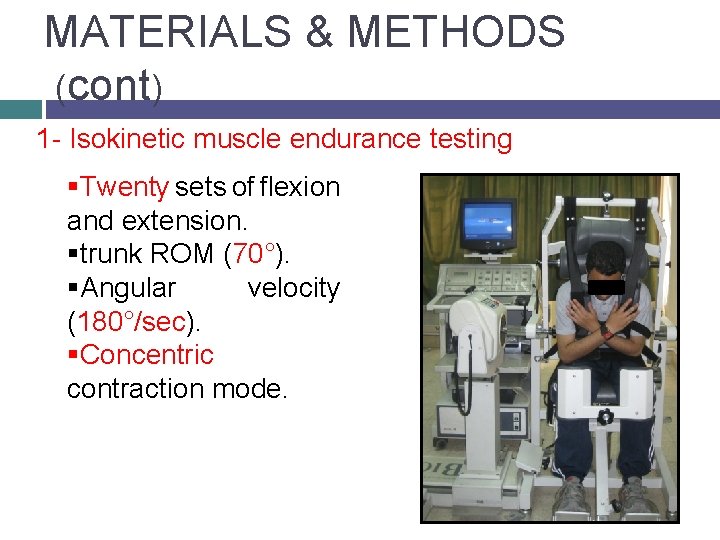
MATERIALS & METHODS (cont) 1 - Isokinetic muscle endurance testing §Twenty sets of flexion and extension. §trunk ROM (70°). §Angular velocity (180°/sec). §Concentric contraction mode.
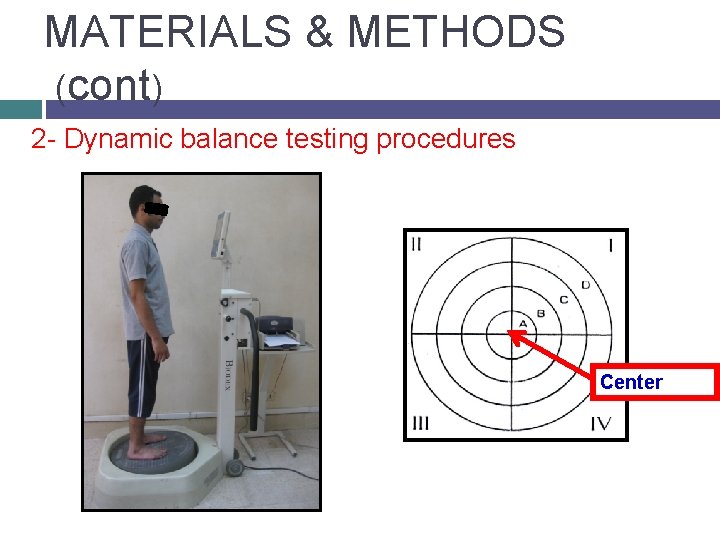
MATERIALS & METHODS (cont) 2 - Dynamic balance testing procedures Center
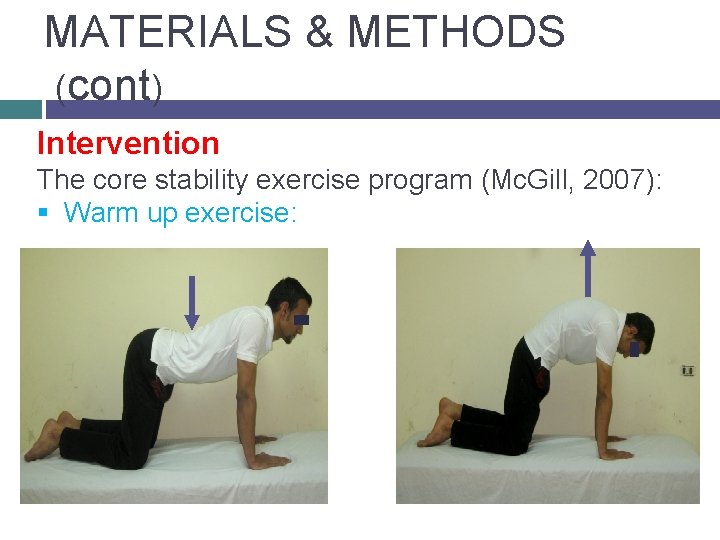
MATERIALS & METHODS (cont) Intervention The core stability exercise program (Mc. Gill, 2007): § Warm up exercise:
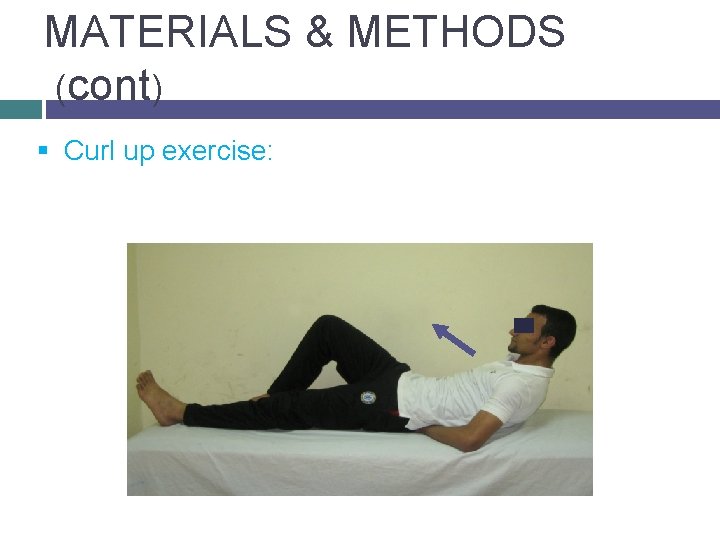
MATERIALS & METHODS (cont) § Curl up exercise:
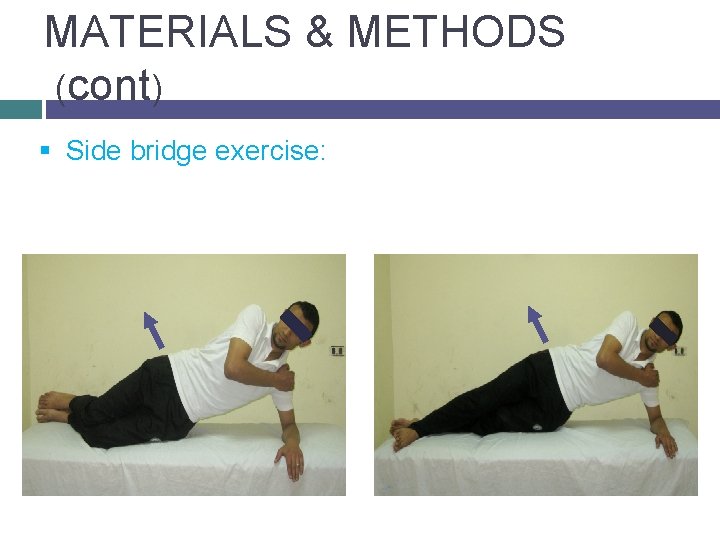
MATERIALS & METHODS (cont) § Side bridge exercise:
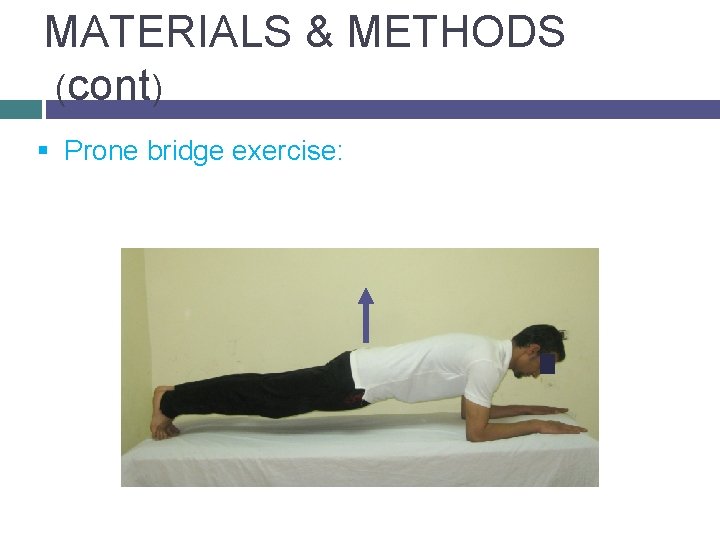
MATERIALS & METHODS (cont) § Prone bridge exercise:
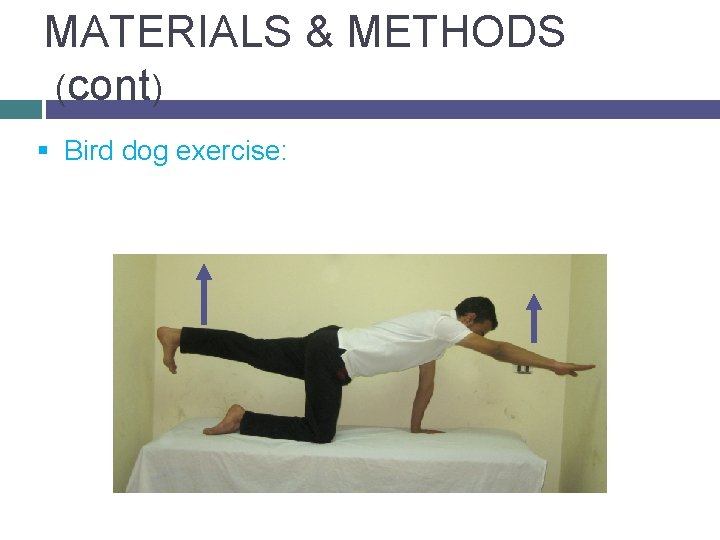
MATERIALS & METHODS (cont) § Bird dog exercise:
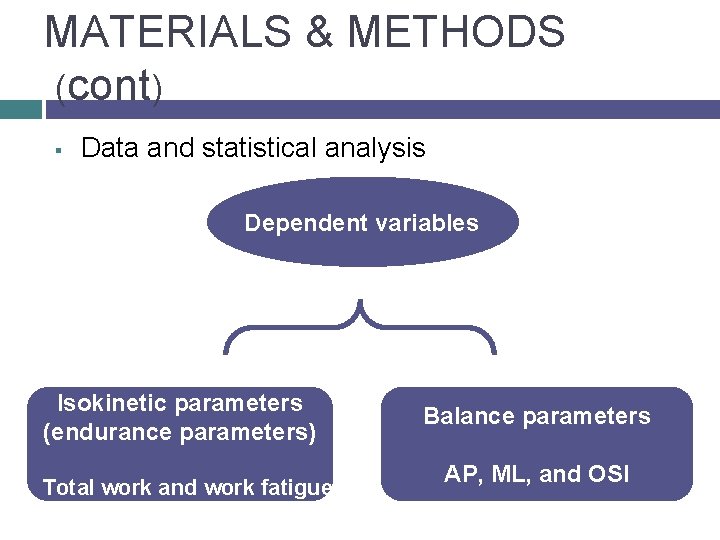
MATERIALS & METHODS (cont) § Data and statistical analysis Independent Dependent variables Isokinetic parameters Tested group (endurance parameters) Balance Timeparameters factor Experimental Pre AP, test ML, and Post OSI test Control Total work and work fatigue
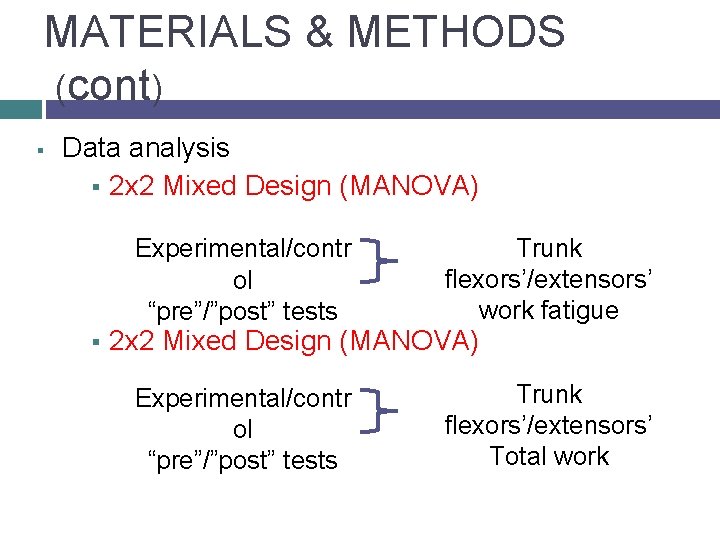
MATERIALS & METHODS (cont) § Data analysis § 2 x 2 Mixed Design (MANOVA) § Experimental/contr ol “pre”/”post” tests Trunk flexors’/extensors’ work fatigue Experimental/contr ol “pre”/”post” tests Trunk flexors’/extensors’ Total work 2 x 2 Mixed Design (MANOVA)
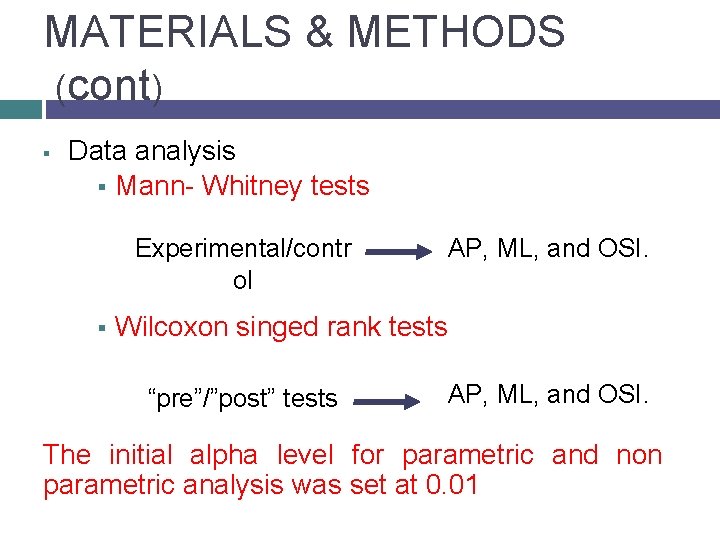
MATERIALS & METHODS (cont) § Data analysis § Mann- Whitney tests Experimental/contr ol § AP, ML, and OSI. Wilcoxon singed rank tests “pre”/”post” tests AP, ML, and OSI. The initial alpha level for parametric and non parametric analysis was set at 0. 01

Results
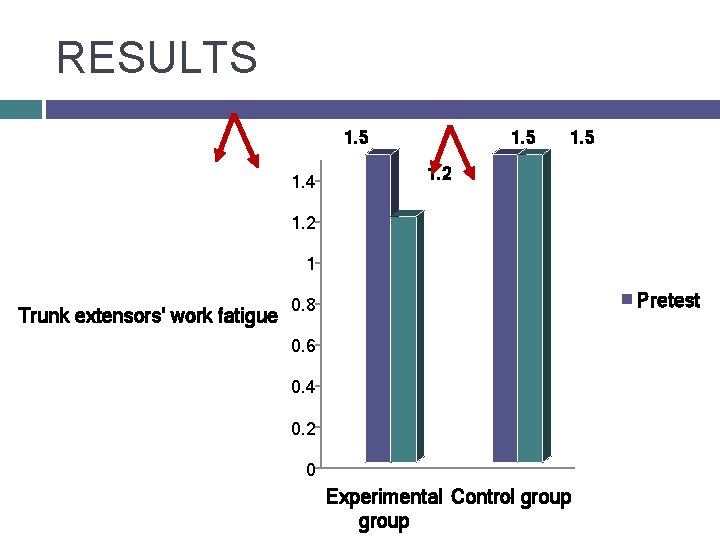
RESULTS 1. 5 1. 4 1. 5 1. 2 1 Trunk extensors' work fatigue Pretest 0. 8 0. 6 Posttes t 0. 4 0. 2 0 Experimental Control group
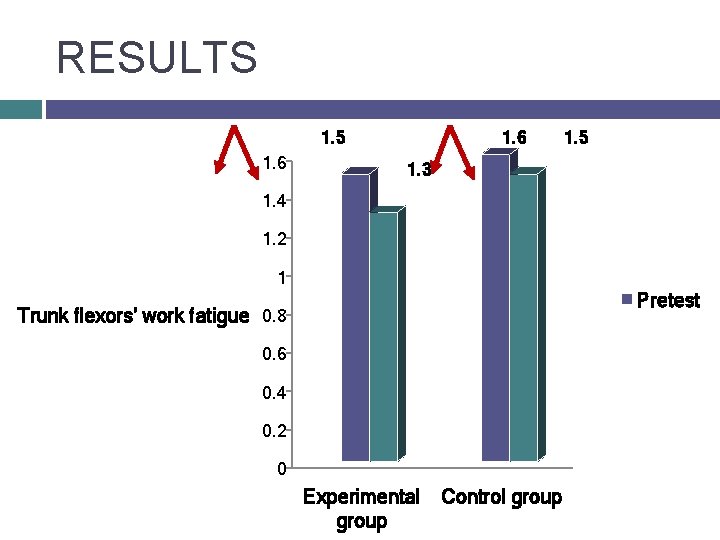
RESULTS 1. 5 1. 6 1. 5 1. 3 1. 4 1. 2 1 Pretest Trunk flexors' work fatigue 0. 8 0. 6 Posttes t 0. 4 0. 2 0 Experimental group Control group
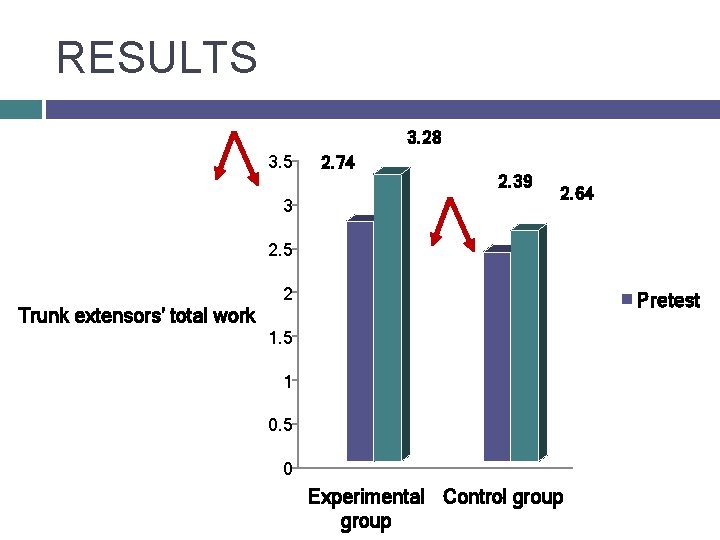
RESULTS 3. 28 3. 5 3 2. 74 2. 39 2. 64 2. 5 2 Pretest Trunk extensors' total work 1. 5 Posttes t 1 0. 5 0 Experimental Control group
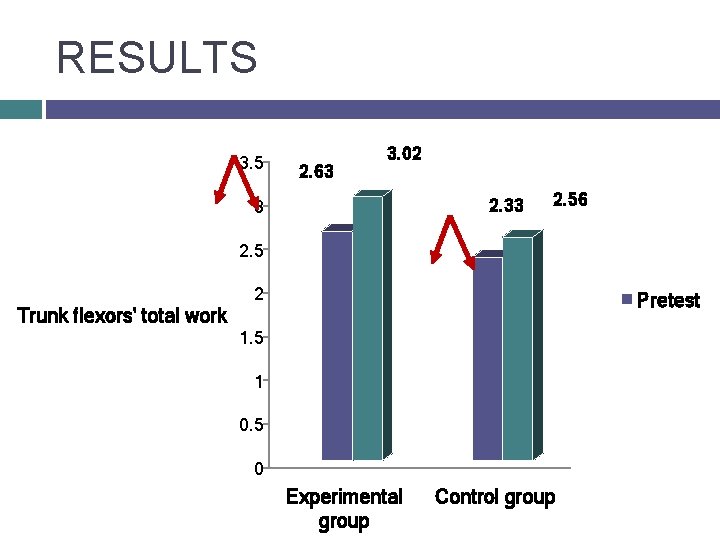
RESULTS 3. 5 2. 63 3. 02 2. 33 3 2. 56 2. 5 2 Pretest Trunk flexors' total work 1. 5 Posttes t 1 0. 5 0 Experimental group Control group
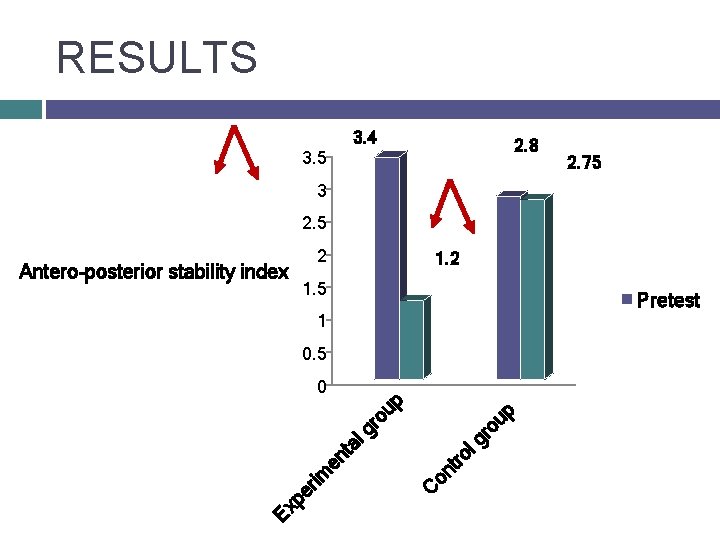
RESULTS 3. 4 3. 5 2. 8 2. 75 3 2. 5 Antero-posterior stability index 2 1. 5 Pretest 1 0. 5 Posttes t up lg ro on tro C Ex pe rim en ta l gr ou p 0
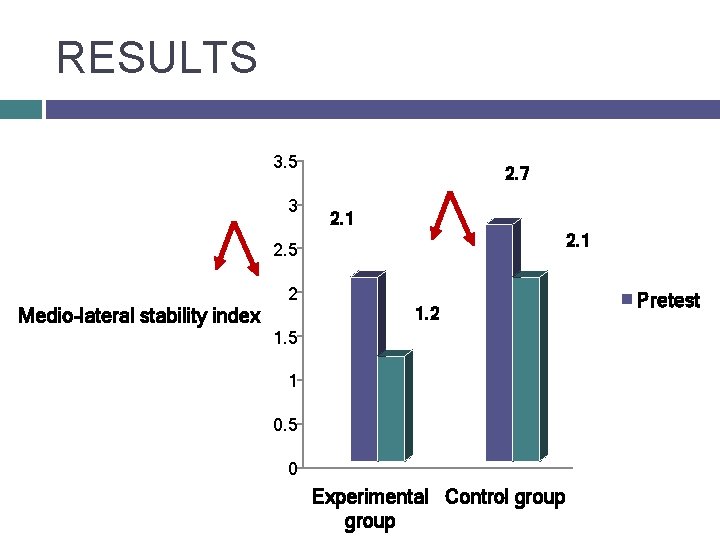
RESULTS 3. 5 3 2. 7 2. 1 2. 5 2 Medio-lateral stability index 1. 2 Pretest 1. 5 Posttes t 1 0. 5 0 Experimental Control group
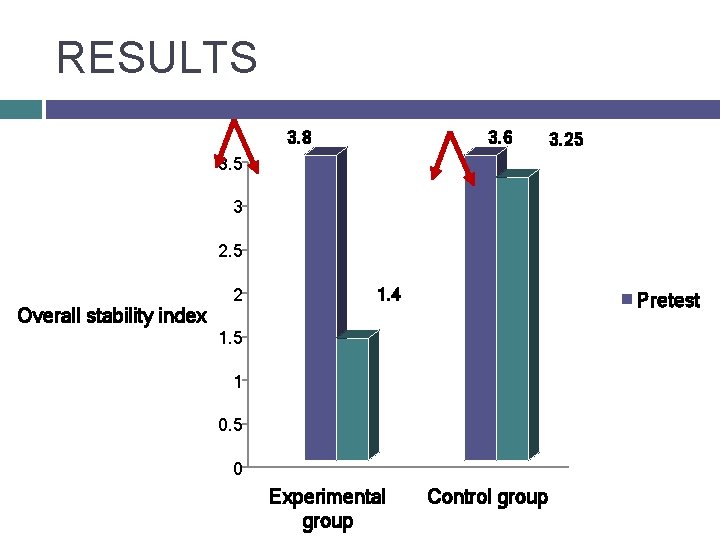
RESULTS 3. 8 3. 6 3. 25 3. 5 3 2. 5 Overall stability index 2 1. 4 Pretest 1. 5 Posttes t 1 0. 5 0 Experimental group Control group

DISCUSSION (cont) § The significant improvement in the work fatigue and total work of the trunk extensors and flexors in the “post” condition in the experimental group might be attributed to: The core stability exercise program which lasted for 6 weeks.
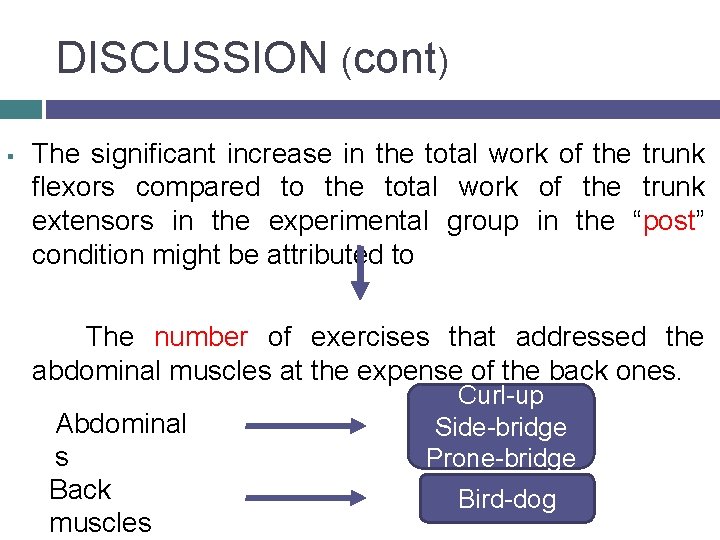
DISCUSSION (cont) § The significant increase in the total work of the trunk flexors compared to the total work of the trunk extensors in the experimental group in the “post” condition might be attributed to The number of exercises that addressed the abdominal muscles at the expense of the back ones. Abdominal s Back muscles Curl-up Side-bridge Prone-bridge Bird-dog
DISCUSSION (cont) § This improvement in the trunk muscles’ endurance in the experimental group may result From Physiological adaptations in muscles induced with training. § This adaptation can range from muscle hypertrophy to fiber type conversions. § Factors affecting the extent of these adaptations are the frequency, length and mode of training. §

DISCUSSION (cont) § § § The selected exercises in the current study were isometric to ensure sufficient activation of the deep and superficial trunk muscles. The frequency and dose of the exercises were deemed sufficient to demonstrate improvement in trunk muscles’ endurance. The core stability exercise program used in this study performed for 6 weeks. These exercises were performed thrice per week. The participant began with one set of 15 repetitions once a day for 3 days per week in the first 2 weeks. Then, 2 sets, each of 15 repetitions, were performed a day for 3 days per week in the following 2 weeks. Finally, 3 sets, each of 15 repetitions, were
DISCUSSION (cont) § The insignificant difference between the “pre” and “post” conditions for the work fatigue and the total work of the trunk extensors and flexors in the control group is because: the control group received no treatment program.
DISCUSSION (cont) § The significant decreases in the AP, ML, and OSI in the “post” condition in the experimental group might be attributed to: the core stability exercise program which lasted for 6 weeks
DISCUSSION (cont) This improvement in the AP, ML and OSI in the experimental group may result From § trunk muscle strengthening. balance is specific for every skill and is improved through repetition of static position or dynamic movement. § §
DISCUSSION (cont) § The insignificant difference between the “pre” and “post” conditions for the AP and the OSI in the control group is because: the control group received no treatment program
DISCUSSION (cont) § The slight decrease in the MLSI in the “post” condition in the control group might be attributed to: the test retest effect
Conclusion With trunk muscle endurance and dynamic balance being improved, it may be concluded that core stability exercises are effective in improving spinal stability.
Recommendations § Investigate larger sample size. § Investigate the effects of core stability exercise programs in patients with chronic low back pain.

- Slides: 56