
Effect of active antimicrobial packaging on the shelf
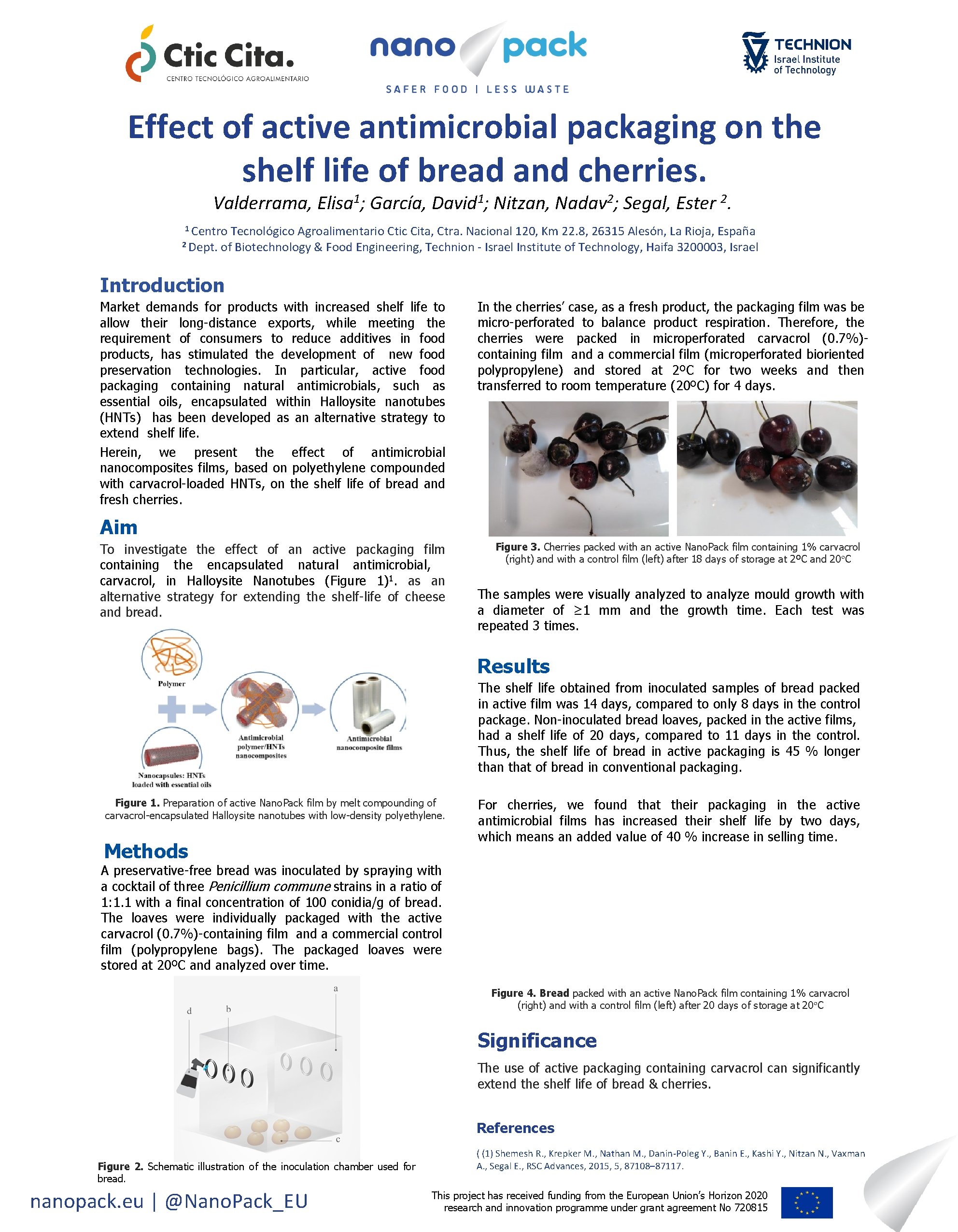
Effect of active antimicrobial packaging on the shelf life of bread and cherries. Valderrama, Elisa 1; García, David 1; Nitzan, Nadav 2; Segal, Ester 2. 1 Centro Tecnológico Agroalimentario Ctic Cita, Ctra. Nacional 120, Km 22. 8, 26315 Alesón, La Rioja, España 2 Dept. of Biotechnology & Food Engineering, Technion - Israel Institute of Technology, Haifa 3200003, Israel Introduction Market demands for products with increased shelf life to allow their long-distance exports, while meeting the requirement of consumers to reduce additives in food products, has stimulated the development of new food preservation technologies. In particular, active food packaging containing natural antimicrobials, such as essential oils, encapsulated within Halloysite nanotubes (HNTs) has been developed as an alternative strategy to extend shelf life. Herein, we present the effect of antimicrobial nanocomposites films, based on polyethylene compounded with carvacrol-loaded HNTs, on the shelf life of bread and fresh cherries. In the cherries’ case, as a fresh product, the packaging film was be micro-perforated to balance product respiration. Therefore, the cherries were packed in microperforated carvacrol (0. 7%)containing film and a commercial film (microperforated bioriented polypropylene) and stored at 2ºC for two weeks and then transferred to room temperature (20ºC) for 4 days. Aim To investigate the effect of an active packaging film containing the encapsulated natural antimicrobial, carvacrol, in Halloysite Nanotubes (Figure 1)1. as an alternative strategy for extending the shelf-life of cheese and bread. Figure 3. Cherries packed with an active Nano. Pack film containing 1% carvacrol (right) and with a control film (left) after 18 days of storage at 2ºC and 20ºC The samples were visually analyzed to analyze mould growth with a diameter of ≥ 1 mm and the growth time. Each test was repeated 3 times. Results The shelf life obtained from inoculated samples of bread packed in active film was 14 days, compared to only 8 days in the control package. Non-inoculated bread loaves, packed in the active films, had a shelf life of 20 days, compared to 11 days in the control. Thus, the shelf life of bread in active packaging is 45 % longer than that of bread in conventional packaging. Figure 1. Preparation of active Nano. Pack film by melt compounding of carvacrol-encapsulated Halloysite nanotubes with low-density polyethylene. Methods For cherries, we found that their packaging in the active antimicrobial films has increased their shelf life by two days, which means an added value of 40 % increase in selling time. A preservative-free bread was inoculated by spraying with a cocktail of three Penicillium commune strains in a ratio of 1: 1. 1 with a final concentration of 100 conidia/g of bread. The loaves were individually packaged with the active carvacrol (0. 7%)-containing film and a commercial control film (polypropylene bags). The packaged loaves were stored at 20ºC and analyzed over time. Figure 4. Bread packed with an active Nano. Pack film containing 1% carvacrol (right) and with a control film (left) after 20 days of storage at 20ºC Significance The use of active packaging containing carvacrol can significantly extend the shelf life of bread & cherries. References Figure 2. Schematic illustration of the inoculation chamber used for bread. nanopack. eu | @Nano. Pack_EU ( (1) Shemesh R. , Krepker M. , Nathan M. , Danin-Poleg Y. , Banin E. , Kashi Y. , Nitzan N. , Vaxman A. , Segal E. , RSC Advances, 2015, 5, 87108– 87117. This project has received funding from the European Union’s Horizon 2020 research and innovation programme under grant agreement No 720815
- Slides: 1