
EFFECT 4 buildings EPC PRESENTATION AND TRAINING MATERIAL
EFFECT 4 buildings EPC PRESENTATION AND TRAINING MATERIAL - New implementation model for EPC - Tools for start-up of EPC projects Liv R. Lindseth, Inland County Council EPC seminar for public building owners Hamar, May 2020
1. Aim of EPC training 2. About EPC Agenda EPC training § The EPC model § Added value compared to inhouse solutions § An EPC project example 3. Recent market status § Success factors and barriers 4. Main development needs 5. Partnership contracts 6. New implementation model for EPC 7. The tangible EPC toolbox § Guideline and presentation § Templates and model documents 8. Summary and conclusions
Agenda EPC training 1. Aim of EPC training
Aim of EPC training § Increase awareness of the benefits of EPC in public sector § Enable customers/building owners to initiate and start an EPC project § Strengthen general knowledge on EPC § EPC project process § Recent market status, § Strengths, weaknesses and development needs § Present new improved implementation model for EPC § Novelty aspects § Available tools, templates and material (toolbox)
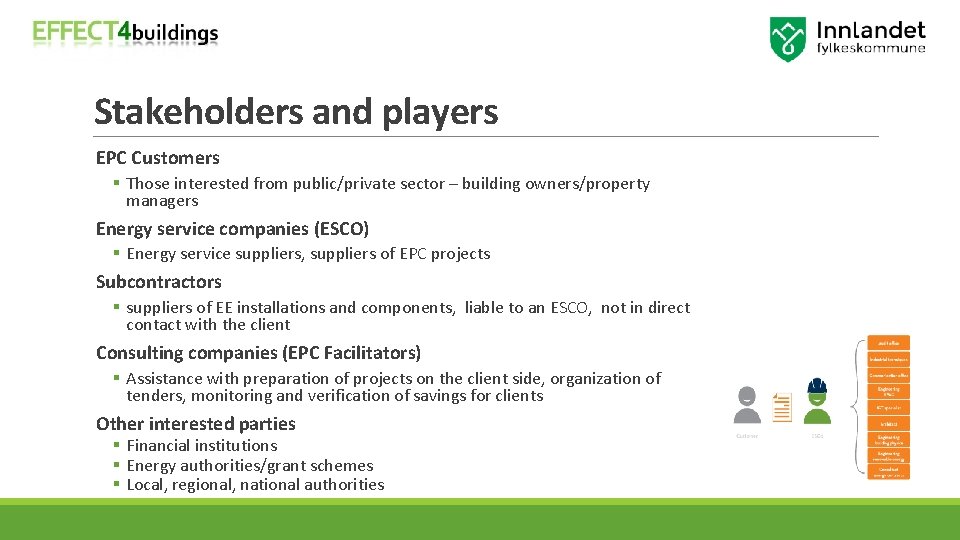
Stakeholders and players EPC Customers § Those interested from public/private sector – building owners/property managers Energy service companies (ESCO) § Energy service suppliers, suppliers of EPC projects Subcontractors § suppliers of EE installations and components, liable to an ESCO, not in direct contact with the client Consulting companies (EPC Facilitators) § Assistance with preparation of projects on the client side, organization of tenders, monitoring and verification of savings for clients Other interested parties § Financial institutions § Energy authorities/grant schemes § Local, regional, national authorities
Agenda EPC training 2. About EPC § The EPC model § Added value compared to inhouse solutions § An EPC project example
For trainers How to present EPC to customers You should address: § What is EPC? § What EPC can do for the customer/public building owner § The main benefits of EPC § How EPC works § Practical examples of EPC projects and scenarios § Main challenges and how to overcome them Ø Present solution: (new/adapted implementation model + associated toolbox) www. eesi 2020. eu
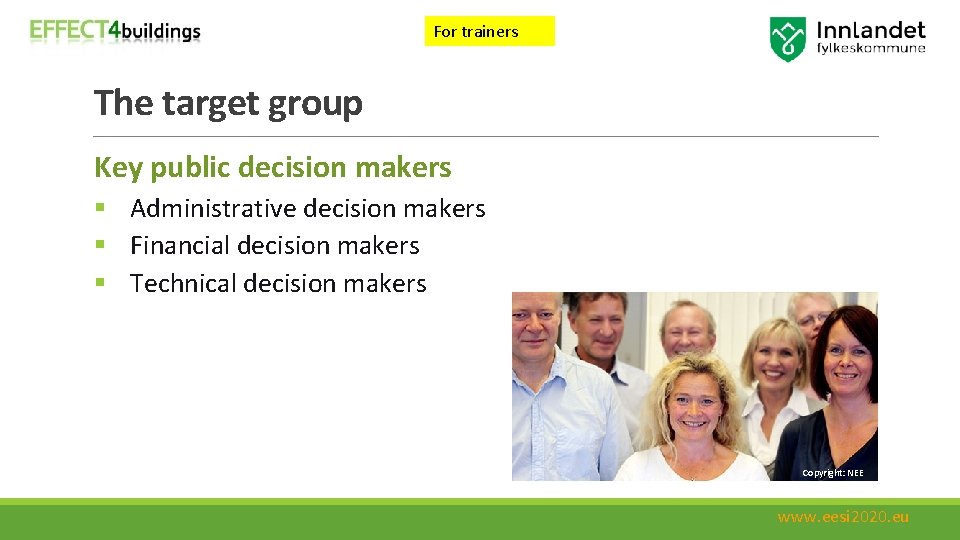
For trainers The target group Key public decision makers § Administrative decision makers § Financial decision makers § Technical decision makers Copyright: NEE www. eesi 2020. eu
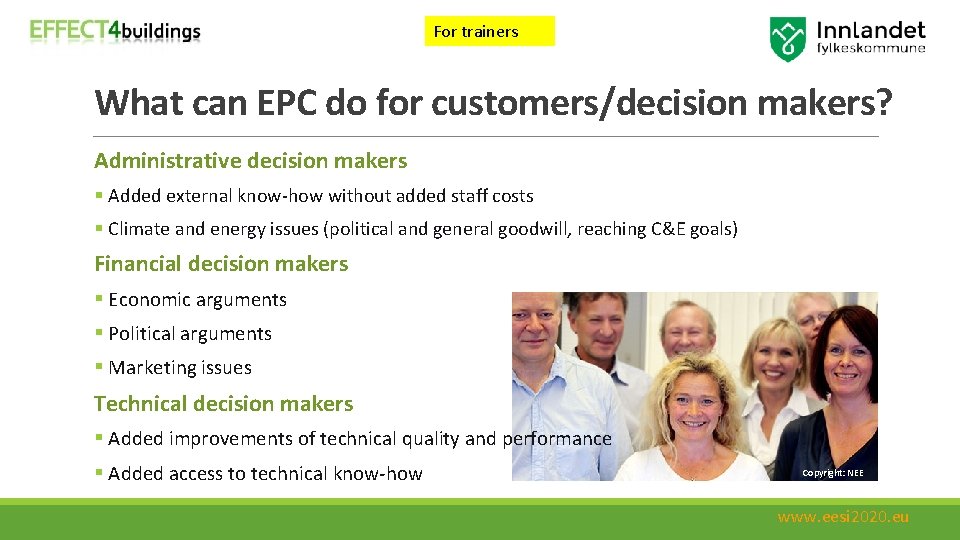
For trainers What can EPC do for customers/decision makers? Administrative decision makers § Added external know-how without added staff costs § Climate and energy issues (political and general goodwill, reaching C&E goals) Financial decision makers § Economic arguments § Political arguments § Marketing issues Technical decision makers § Added improvements of technical quality and performance § Added access to technical know-how Copyright: NEE www. eesi 2020. eu
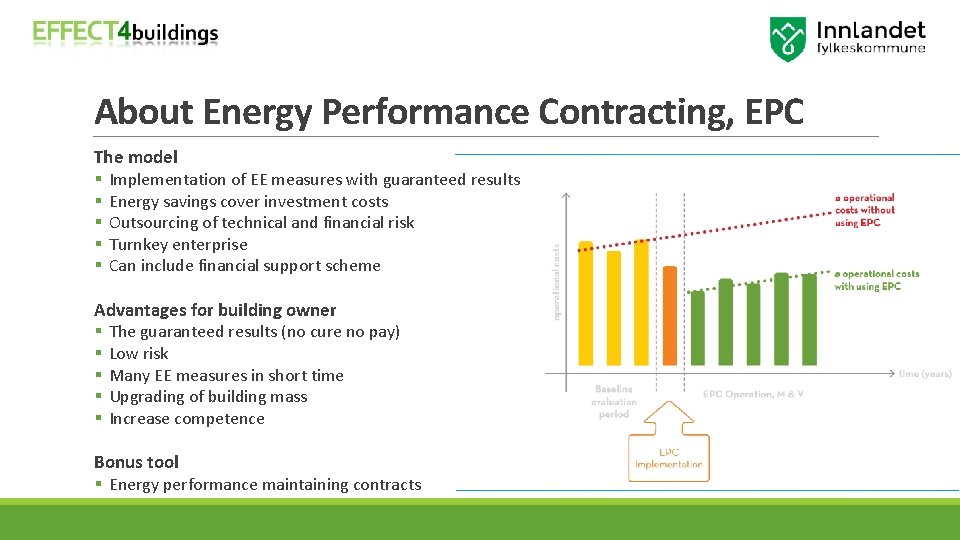
About Energy Performance Contracting, EPC The model § Implementation of EE measures with guaranteed results § Energy savings cover investment costs § Outsourcing of technical and financial risk § Turnkey enterprise § Can include financial support scheme Advantages for building owner § The guaranteed results (no cure no pay) § Low risk § Many EE measures in short time § Upgrading of building mass § Increase competence Bonus tool § Energy performance maintaining contracts
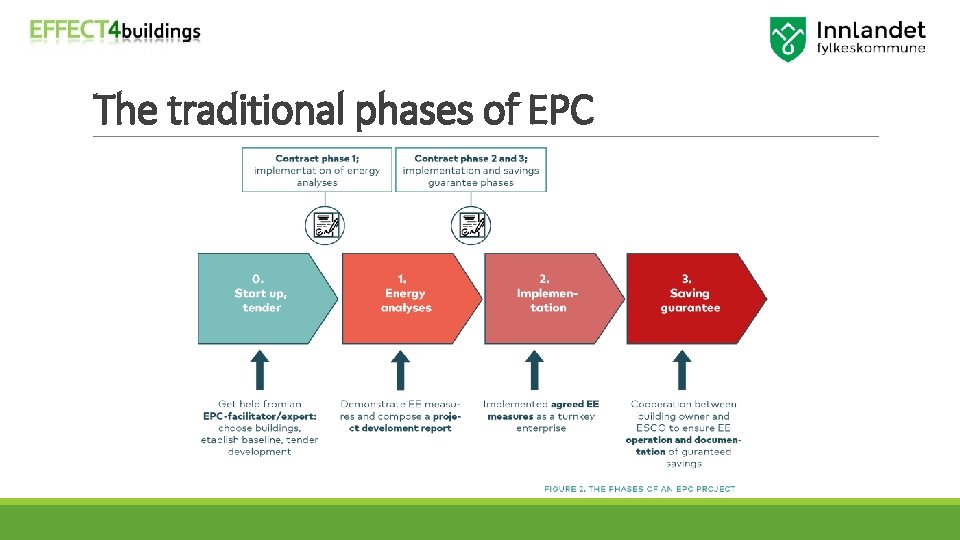
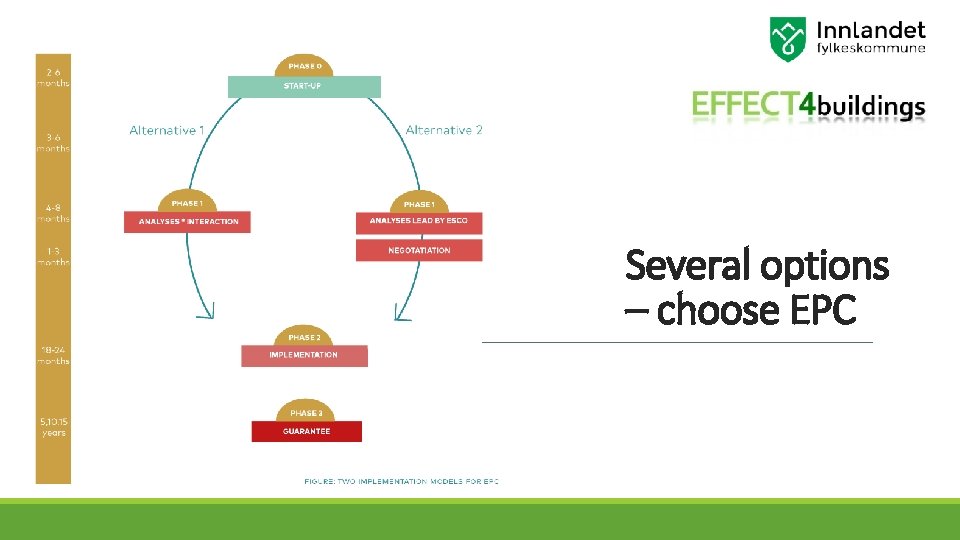
The traditional phases of EPC
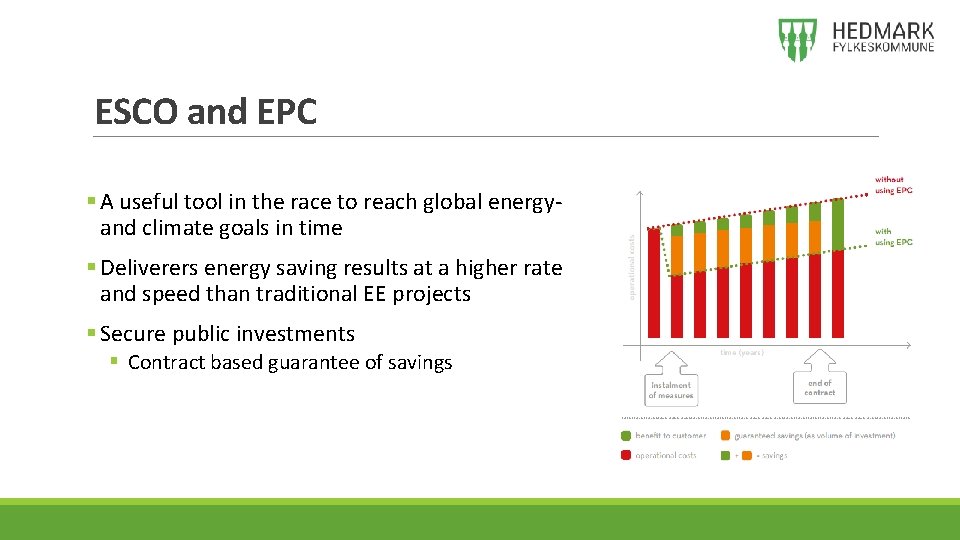
ESCO and EPC § A useful tool in the race to reach global energyand climate goals in time § Deliverers energy saving results at a higher rate and speed than traditional EE projects § Secure public investments § Contract based guarantee of savings
Main Benefits of EPC § Guaranteed implementation of EE measures within set time limit § Long-term reduction of energy consumption § A single supplier implements the project from start to finish § The supplier and the customer share the same motivation – energy saving § Option of having the project financed by the energy service supplier (if profitable) § All measures financed by the resulting savings § Significant reduction of CO 2 emissions § Outsourcing of risks § Possible outcome: Improved comfort levels and modernization of technical systems www. eesi 2020. eu
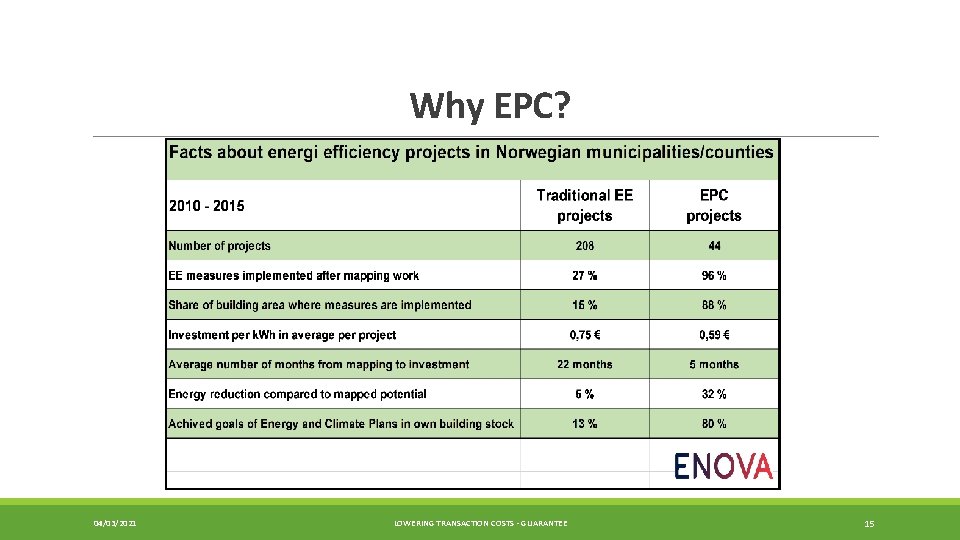
Why EPC? 04/03/2021 LOWERING TRANSACTION COSTS - GUARANTEE 15
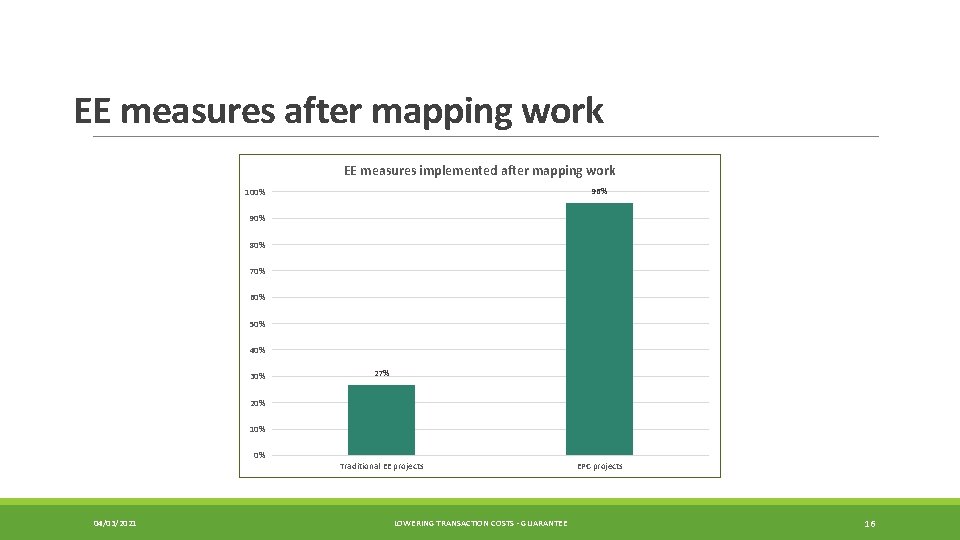
EE measures after mapping work EE measures implemented after mapping work 96% 100% 90% 80% 70% 60% 50% 40% 30% 27% 20% 10% 0% 04/03/2021 Traditional EE projects LOWERING TRANSACTION COSTS - GUARANTEE EPC projects 16
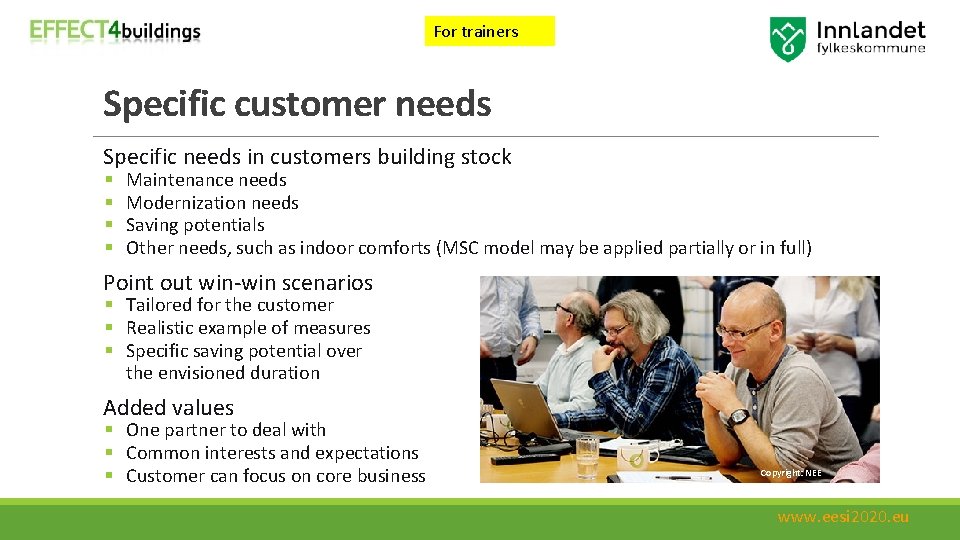
For trainers Specific customer needs Specific needs in customers building stock § § Maintenance needs Modernization needs Saving potentials Other needs, such as indoor comforts (MSC model may be applied partially or in full) Point out win-win scenarios § Tailored for the customer § Realistic example of measures § Specific saving potential over the envisioned duration Added values § One partner to deal with § Common interests and expectations § Customer can focus on core business Copyright: NEE www. eesi 2020. eu
For trainers Main Possible Challenges § Organisational § Technical § Legal § Traditional roles and responsibilities ØPresenting EPC is often presenting change management ØBe aware, prepare and overcome www. eesi 2020. eu
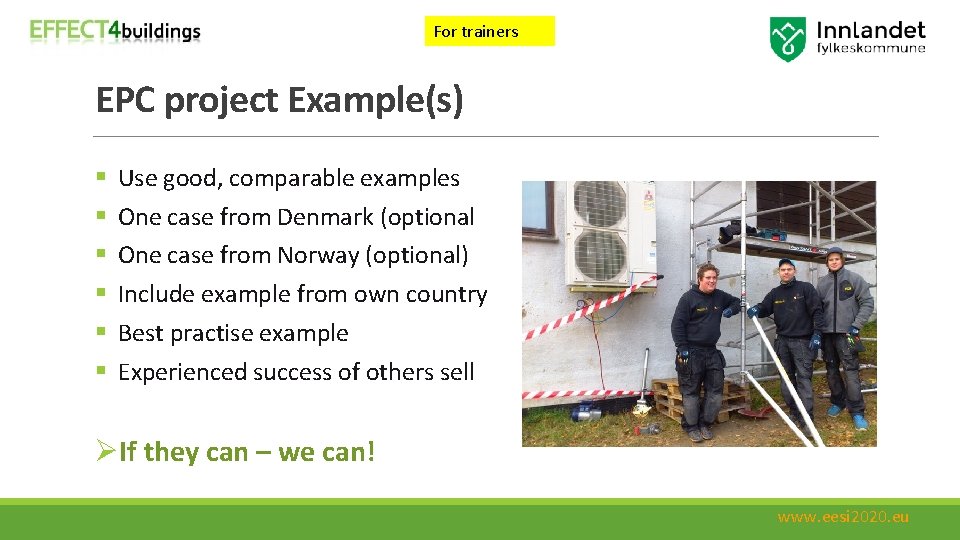
For trainers EPC project Example(s) § § § Use good, comparable examples One case from Denmark (optional One case from Norway (optional) Include example from own country Best practise example Experienced success of others sell ØIf they can – we can! Copyright: NEE www. eesi 2020. eu
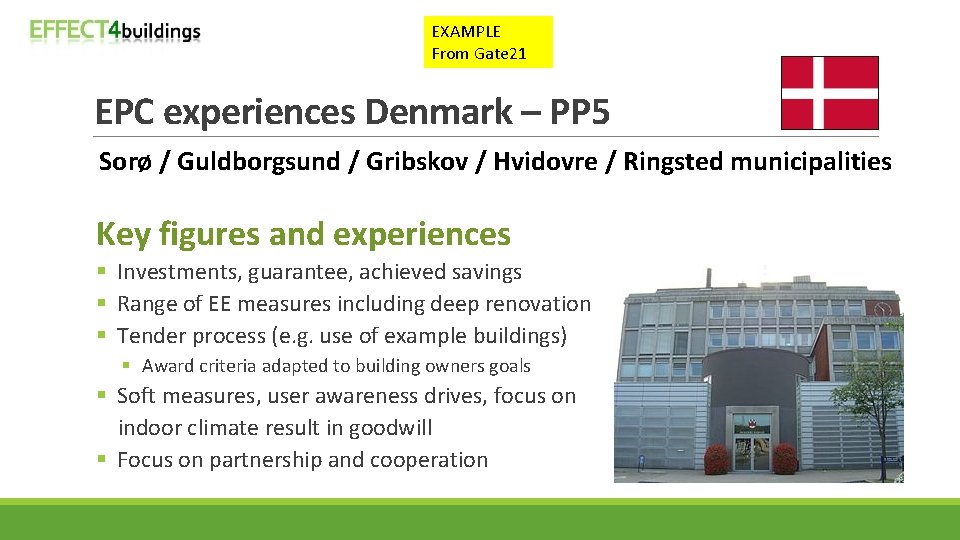
EXAMPLE From Gate 21 EPC experiences Denmark – PP 5 Sorø / Guldborgsund / Gribskov / Hvidovre / Ringsted municipalities Key figures and experiences § Investments, guarantee, achieved savings § Range of EE measures including deep renovation § Tender process (e. g. use of example buildings) § Award criteria adapted to building owners goals § Soft measures, user awareness drives, focus on indoor climate result in goodwill § Focus on partnership and cooperation
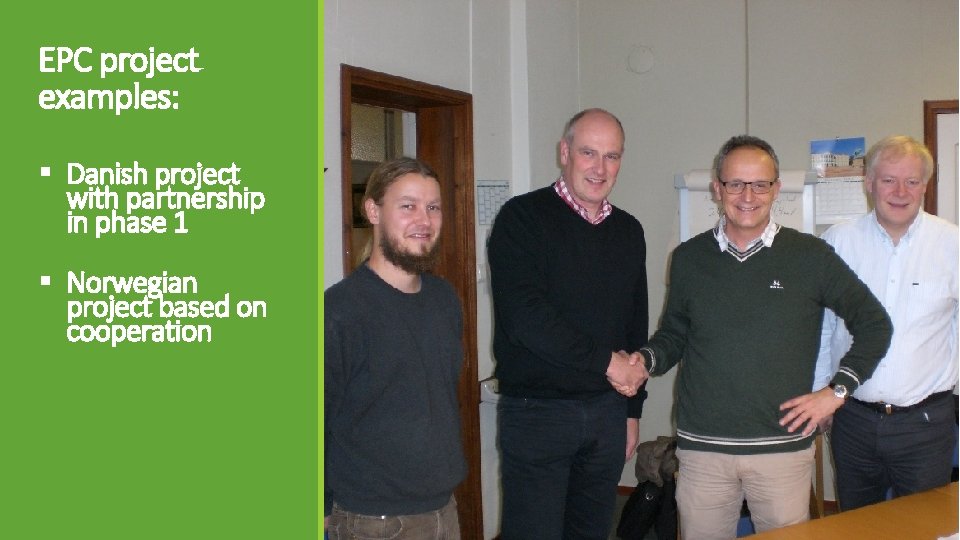
EPC project examples: § Danish project with partnership in phase 1 § Norwegian project based on cooperation
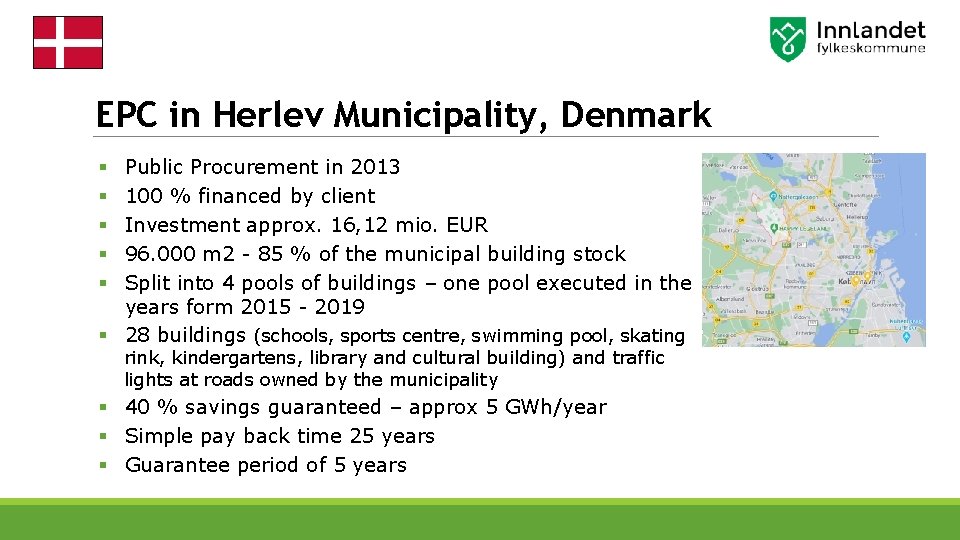
EPC in Herlev Municipality, Denmark Public Procurement in 2013 100 % financed by client Investment approx. 16, 12 mio. EUR 96. 000 m 2 - 85 % of the municipal building stock Split into 4 pools of buildings – one pool executed in the years form 2015 - 2019 § 28 buildings (schools, sports centre, swimming pool, skating § § § rink, kindergartens, library and cultural building) and traffic lights at roads owned by the municipality § 40 % savings guaranteed – approx 5 GWh/year § Simple pay back time 25 years § Guarantee period of 5 years
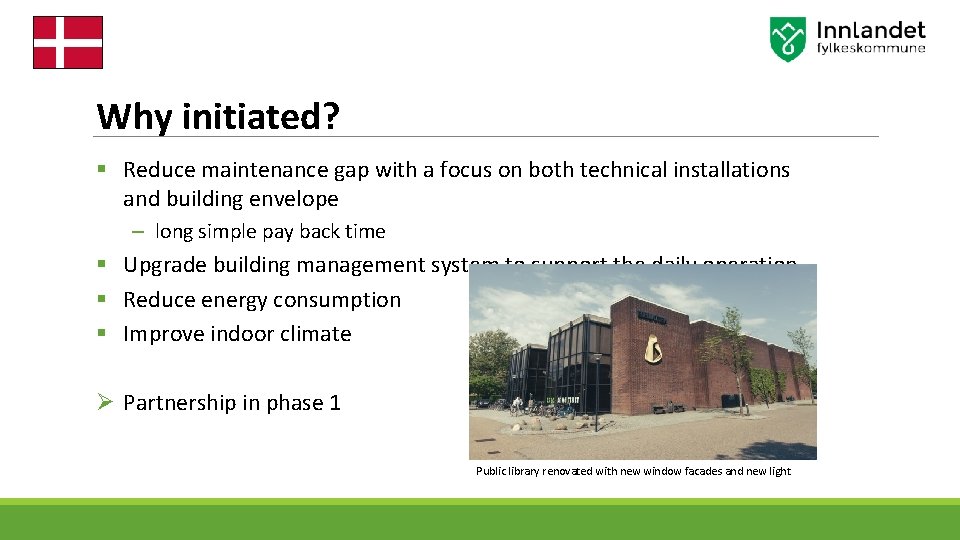
Why initiated? § Reduce maintenance gap with a focus on both technical installations and building envelope – long simple pay back time § Upgrade building management system to support the daily operation § Reduce energy consumption § Improve indoor climate Ø Partnership in phase 1 Public library renovated with new window facades and new light
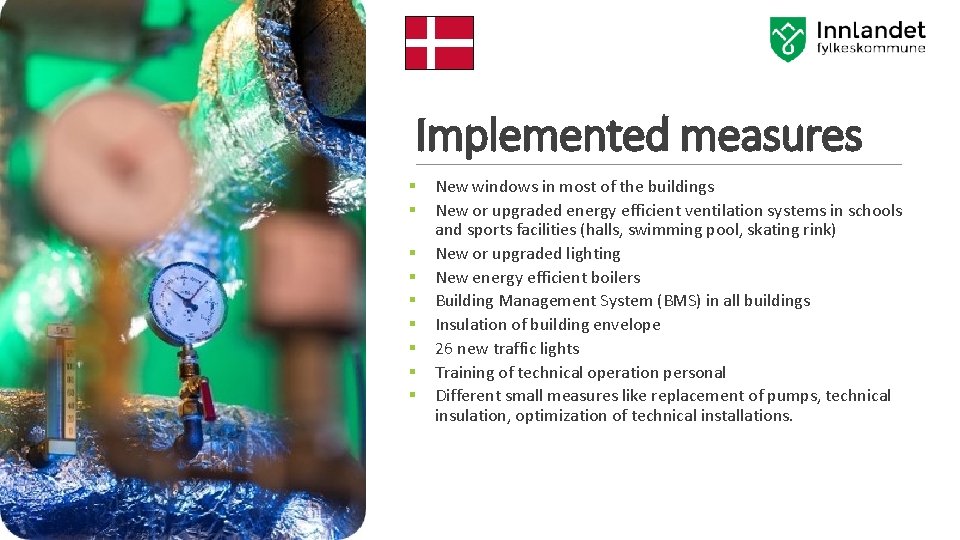
Implemented measures § § § § § New windows in most of the buildings New or upgraded energy efficient ventilation systems in schools and sports facilities (halls, swimming pool, skating rink) New or upgraded lighting New energy efficient boilers Building Management System (BMS) in all buildings Insulation of building envelope 26 new traffic lights Training of technical operation personal Different small measures like replacement of pumps, technical insulation, optimization of technical installations.
Experiences - municipal viewpoint When the going gets tough. . . § Delayed implementation § Finding of environmentally hazardous § Interfaces to other renovation projects in same building which delayed the project § Changes in project manager both on Client side and at the ESCO § Loss of knowledge and decisions taken prior in the project – means a lot of revisiting the measures and changes and time to re-establish the partnership § The documentation from the first years were not good enough – focus in the last part on improved documentation and more structure § The existing energy management system had monthly energy data and many not valid energy data. This is not sufficient in an EPC project § The calculated savings were lower than savings in the first years – mostly because of many mistakes in the energy data going back to the beginning and a lot of changes in the use of buildings
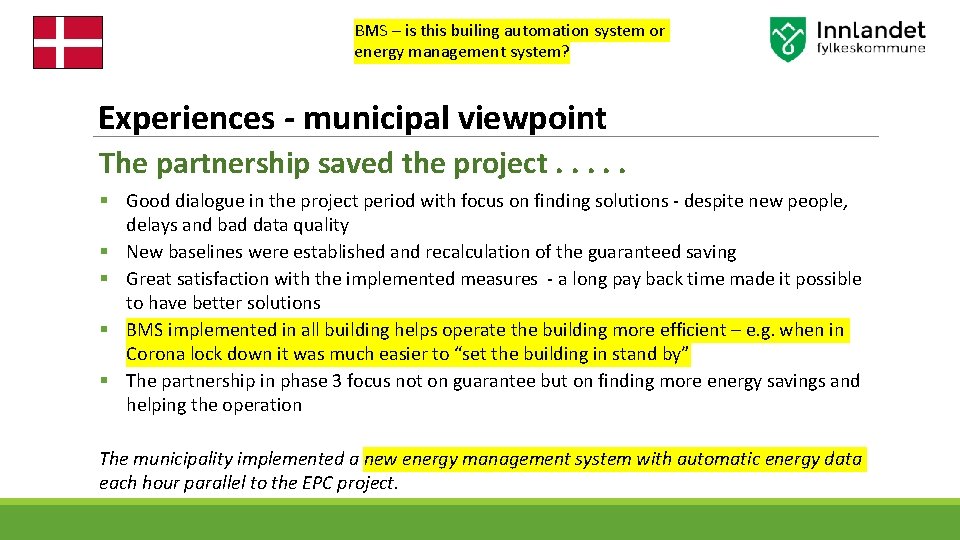
BMS – is this builing automation system or energy management system? Experiences - municipal viewpoint The partnership saved the project. . . § Good dialogue in the project period with focus on finding solutions - despite new people, delays and bad data quality § New baselines were established and recalculation of the guaranteed saving § Great satisfaction with the implemented measures - a long pay back time made it possible to have better solutions § BMS implemented in all building helps operate the building more efficient – e. g. when in Corona lock down it was much easier to “set the building in stand by” § The partnership in phase 3 focus not on guarantee but on finding more energy savings and helping the operation The municipality implemented a new energy management system with automatic energy data each hour parallel to the EPC project.
Agenda EPC training 3. Recent market status §Success factors and barriers
Status of the EPC market § EPC is a well-documented and tested EE model in Europe § In use for the last 10 -15 years in the Nordic Countries § Polish EPC market is emerging § The EPC model is still not well known in Estonia, Latvia and Lithuania § § The EPC models is beneficial for the public owner Large saving potential and possibilities for growth Stagnating or strained EPC market situation in the public sector A potential for further development
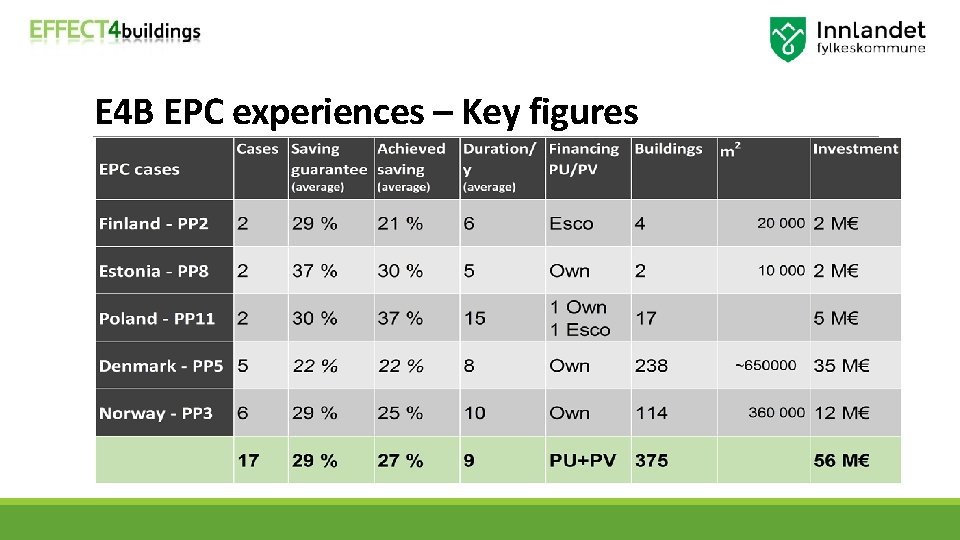
E 4 B EPC experiences – Key figures
References and supporting documentation §Six Norwegian EPC municipalities and their experiences, EFFECT 4 buildings/Hedmark County Council, 2019 (https: //docs. wixstatic. com/ugd/ca 1352_e 4964578726044 beade 7 b 9459 eaf 3 f 98. pdf) §Ny gjennomføringsmodell for EPC, WSP/Caverion/Lin. Kon, financed by the Norwegian energy agency, Enova SF, 2019 (https: //www. wsp. com/nb-NO/prosjekter/ny-gjennomforingsmodell-for-epc-prosjekter) §Granskning av EPC-avtal, Sverige 2017 (https: //byggdialogdalarna. se/wp-content/uploads/2017/07/Rapport_EPC_aug_2017_. pdf) §Kartläggning av barriärer som bromsar EPC-marknadens utveckling, Sverige 2018 (https: //eef. se/wpcontent/uploads/2018/03/Jennifer_Palen_TRITA_ITM_EX_2018_24. pdf) §EPC Summit in Finland for the Nordic and Baltic countries, February 2018 – Motiva (https: //www. motiva. fi/ajankohtaista/tapahtumat/tapahtumaaineistot/energiatehokkuus/capacity_building_workshop_on_energy_services_and_epc_14. 2. 2018) §Market report on EPC in the Nordic Countries, Nordisk Ministerråd – 2016 (http: //norden. divaportal. org/smash/record. jsf? pid=diva 2%3 A 900555&dswid=8807) §Market report on EPC in Europe, guarant. EE – 2016 (https: //guarantee-project. eu/wpcontent/uploads/2016/12/guarant. EE_EU_EPC_Market_Report. pdf) §Market report on EPC in Norway, guarant. EE – 2017 (https: //guarantee-project. eu/no/wp-content/uploads/sites/11/2016/11/D 2. 2 guarant. EE-Market-Report-NORWAY-25. 11. 2016. pdf) §ESCO I Danske kommuner, Denmark 2013 §ESCO & OPP, Denmark 2013
Common sucess factors § § § § Large documented saving potential Savings of 18 – 50 % in public buildings (Nordic Countries 2015) Reduce maintenance budgets Secures investments The guarantee important for municipalities with limited budgets Economy of scale - bundling Helps reach ambitious energy and climate targets fast ØWhy is EPC not implemented all over public sector?
Common Barriers § § § § § No designated legal framework for EPC in partner countries EE and EPC not set as clear goals in local/regional climate and energy plans Lack of knowledge and knowledge asymmetries building owner/ESCO Lack of good practice examples Lack of trust in the model and/or the ESCO (Too good to be true? ) Lack of cooperation in start up and planning phases (Phase 0 and 1) Lack of facilitators (EPC experts' phase 0, 1) Complexity of the model/concept Complexity of public procurement laws Seen as competition to inhouse solutions § § Attitudes (job pride and trust) Competent BOs want to keep control over own building mass and technical solutions
EPC experiences Denmark Some already mentioned barriers are not equally common in Denmark § § § Soft measures more common User awareness Focus on indoor climate result in goodwill Teamwork and teambuilding Contract based partnership and cooperation
Agenda EPC training 4. Main development needs
Main development needs § Allocation of more time to develop and follow up the EPC project § Better cooperation and/or partnership between building owner and ESCO § Focusing on cooperation, interaction and building trust § Equalize differences in expertise between customer and supplier § Use of skilled EPC facilitator / EPC expert § Openness and cooperation § Open book, agreed mark-up/profit margins, etc. § Consider options to lower transaction costs § Equally important both for customer and supplier
Main development needs (cont. ) § Improvement of templates for tender and contract documents § Award criteria reflecting overall goal of the building owner § Improvement of quality requirements - technical, process, cooperation skills, project management § Risk assessment analyses (e. g. bank guarantee)
Pitfalls and possible solution - tender phase 1. Profitability weighs high Solution: New award criteria to ensure the interests of the building owner 2. Guarantee on savings of buildings that are not inspected/analysed Solution: Guaranteed savings of selected examples buildings in the offer
Pitfalls and possible solutions – cont. 3. Requirements in the tender that cannot be met Solution: Award criteria and goals of the building owner coordinated 4. Performance requirements that will limit cooperation in Phase 1 Solution : Partnership contract for the whole duration of Phase 1 5. Wrong choice of EPC facilitator/consultant
Tender content - novelty aspects § Prequalification - liquidity and competence requirements § All ESCOs performs bid analysis on selected buildings, following a given template § The measures described in the tender analyzes form the basis for the measures to be prepared for the remaining building stock in the phase 1 portfolio § Described qualities in the offer are passed on to measures in the same category for remaining buildings in the portfolio. § This also applies to the cost level of measures and savings § Following the conclusion of a contract for phase 1, the tenderer shall present calculations for all measures stated in the tender analyzes.
Assessment of experiences and results § Most suggestions for improvement focus on phase 0 (tender) and phase 1 (analyses) § Critical choices and decision are made early § Decisions and actions in phase 0 and 1 form the basis for failure and/or success in phase 2 (implementation) and 3 (guarantee) There is a need for : ØImprovement of tender preparation and content in phase 0 ØImprovement of cooperation/partnership in phase 1
Agenda EPC training 5. Partnership contracts
Partnership contract § The partnership model is based on a phase divided contract § The partnership has a common development phase before the turnkey contract for implementation is entered into Phase 1 shall be utilized to: § Agree on the partners' goals and prioritising § Reduce insecurity § Achieve mutual understanding for the deliveries § Agreements on concrete solutions and technical product choices
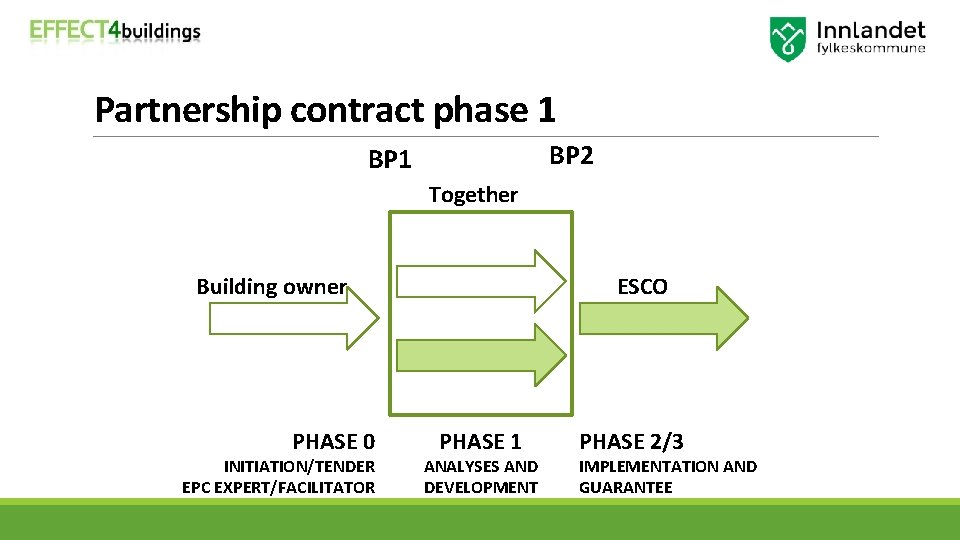
Partnership contract phase 1 BP 2 BP 1 Together Building owner PHASE 0 INITIATION/TENDER EPC EXPERT/FACILITATOR ESCO PHASE 1 ANALYSES AND DEVELOPMENT PHASE 2/3 IMPLEMENTATION AND GUARANTEE
Official turnkey standard Ø An official turnkey enterprise standard is an important tool, but if you exclude the initial chapter, most of the standard is about how to solve conflicts that might arise. Ø A partnership contract is about avoiding getting into conflicts.
What is the partnership about? Contract based cooperation (new template) § EE measures in all buildings § Quality of measures, products and technical solutions § Economy – open book – no secrets § All documents available for both parties § ESCO provide analyses with agreed mark-up § Project development report (new template)
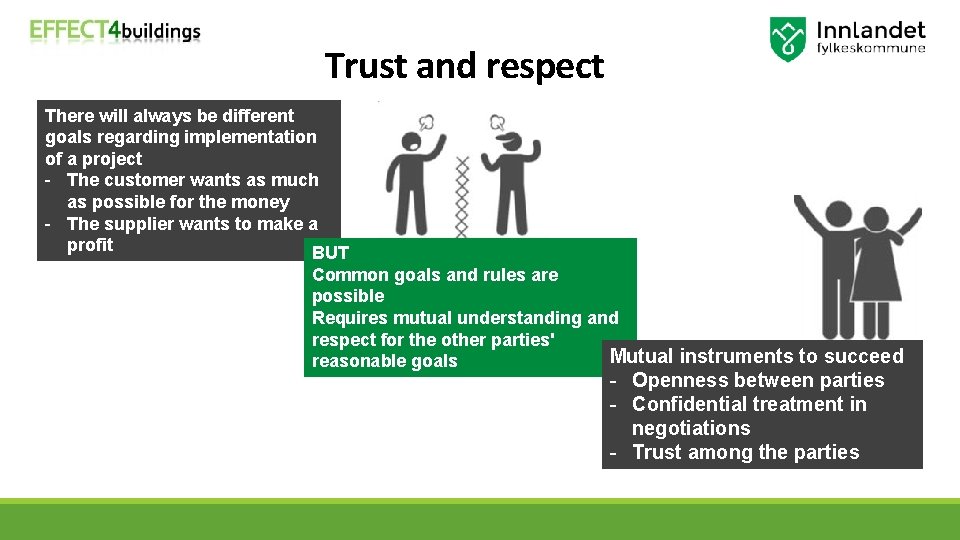
Trust and respect There will always be different goals regarding implementation of a project - The customer wants as much as possible for the money - The supplier wants to make a profit BUT Common goals and rules are possible Requires mutual understanding and respect for the other parties' Mutual instruments to succeed reasonable goals - Openness between parties - Confidential treatment in negotiations - Trust among the parties

The speed of trust
Agenda EPC training 6. New implementation model for EPC
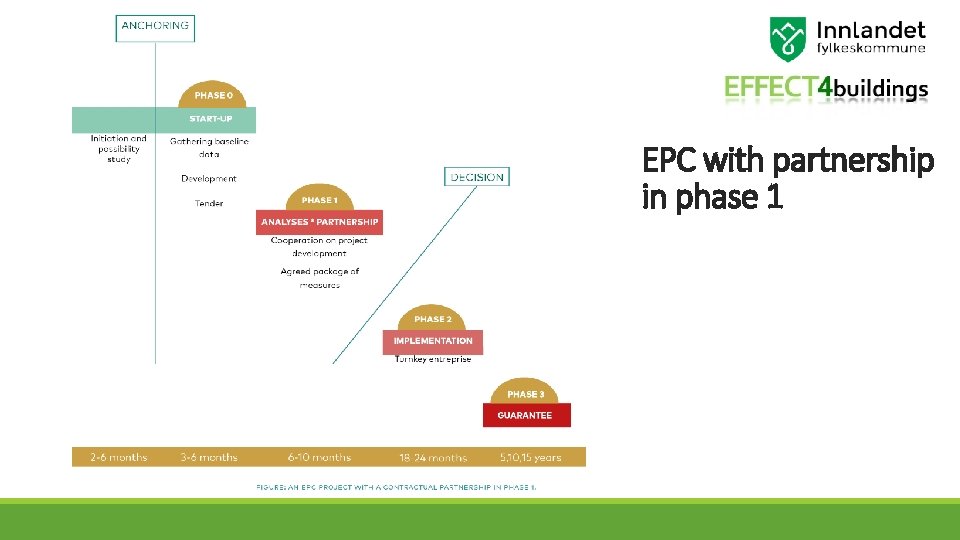
EPC with partnership in phase 1
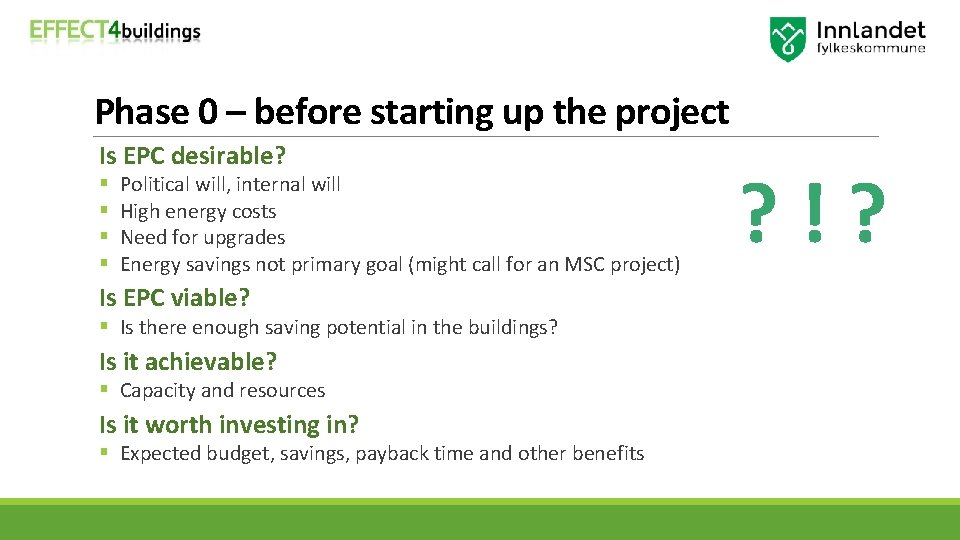
Phase 0 – before starting up the project Is EPC desirable? § § Political will, internal will High energy costs Need for upgrades Energy savings not primary goal (might call for an MSC project) Is EPC viable? § Is there enough saving potential in the buildings? Is it achievable? § Capacity and resources Is it worth investing in? § Expected budget, savings, payback time and other benefits ? ! ?
Tender preparation 1. Knowledge of EPC and implementation models § Ownership in own organization § EPC presentation by neutral advisor? 2. Get assistance from EPC faciliator (EPC expert) § National register of qualified EPC facilitators?
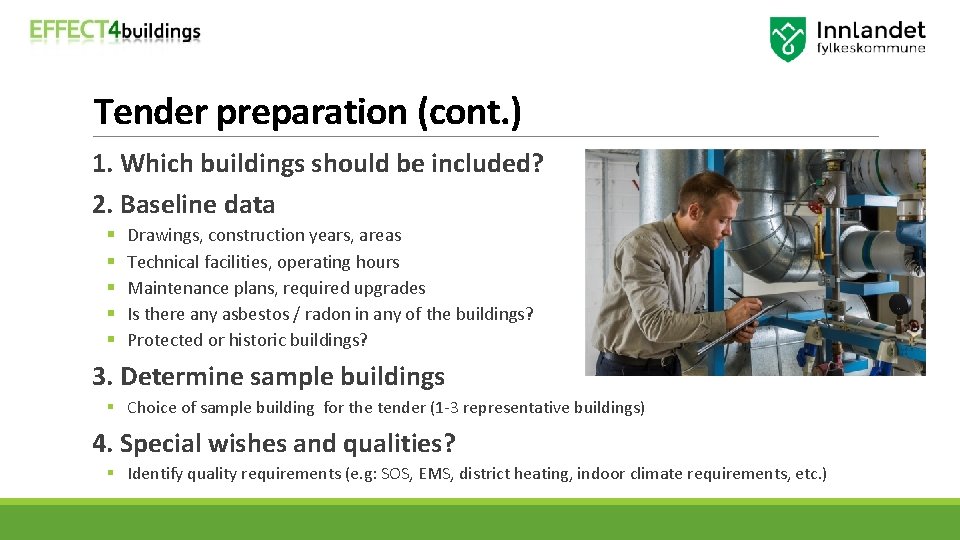
Tender preparation (cont. ) 1. Which buildings should be included? 2. Baseline data § § § Drawings, construction years, areas Technical facilities, operating hours Maintenance plans, required upgrades Is there any asbestos / radon in any of the buildings? Protected or historic buildings? 3. Determine sample buildings § Choice of sample building for the tender (1 -3 representative buildings) 4. Special wishes and qualities? § Identify quality requirements (e. g: SOS, EMS, district heating, indoor climate requirements, etc. )
The Tender New templates: The following are examples adapted to the new implementation model § Tender document for procurement of EPC supplier (example) § Novelty aspects as described; new award criteria, example buildings etc. § Contract terms for Phase 1 the analyses phase with contract-based partnership § Appendixes to contracts § Contract terms for Phase 3 the guarantee phase
Phase 1: Parntership § Contract based partnership agreement § "Open book" - no "secrets" § The measures are found and described together § End up with a unified project development report § Both parties own the documentation § Everyone happy and want to move on § The energy ESCO is still responsible for the design at all stages
Phase 2: Implementation Phase 3: Saving guarantee Based on contract terms in national standards for turnkey enterprises § Agreement on all measures - both price, function and quality § Leads to little additions and changes § Implement measures determined in Phase 1 § The duration of Phase 3 is determined in Phase 1 § The contractor guarantees the energy savings
Agenda EPC training 7. The tangible EPC toolbox §Guide and Guideline §EPC presentation and training material §Templates and model documents
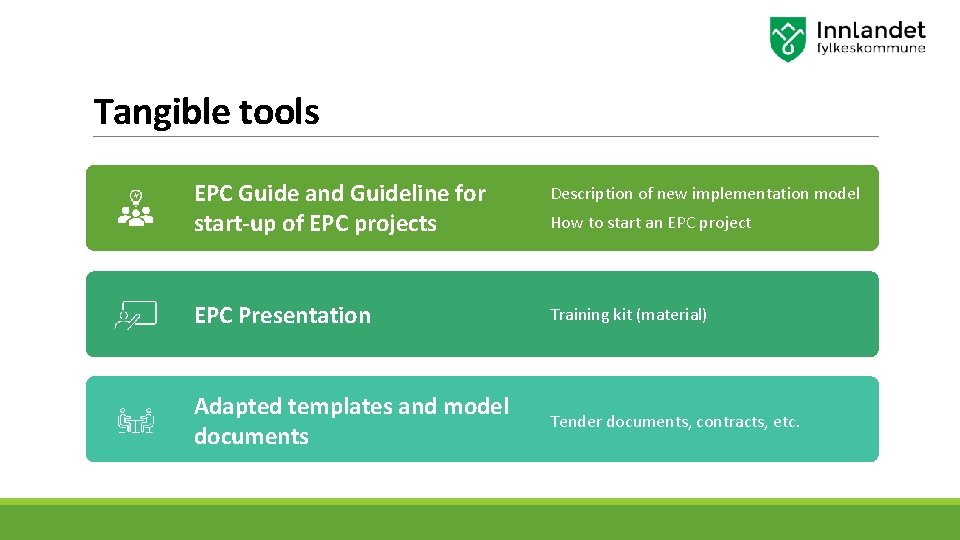
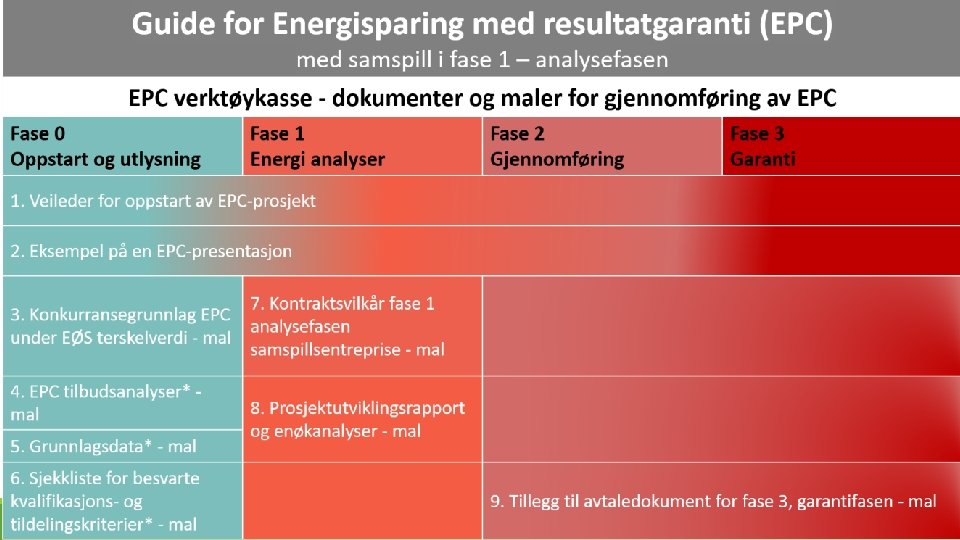
Tangible tools EPC Guide and Guideline for start-up of EPC projects Description of new implementation model EPC Presentation Training kit (material) Adapted templates and model documents Tender documents, contracts, etc. How to start an EPC project
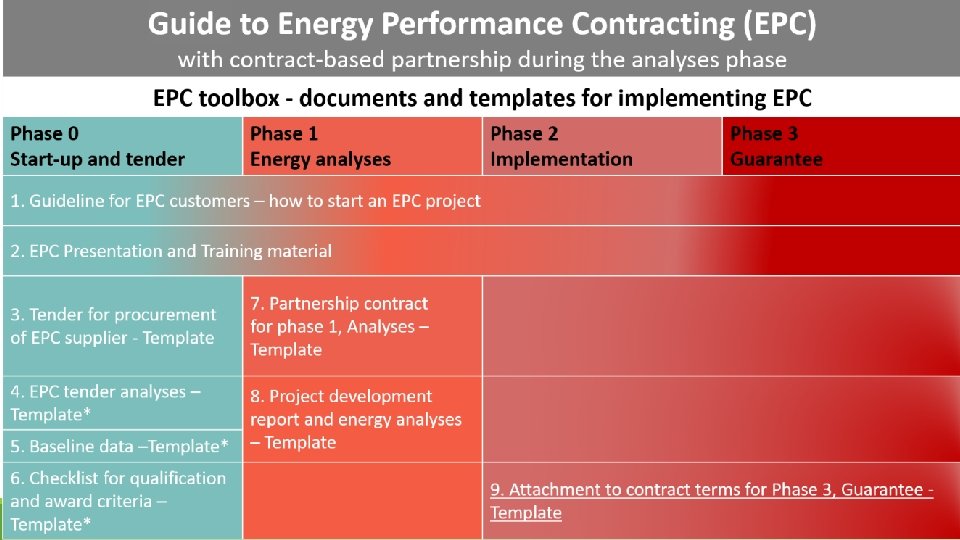
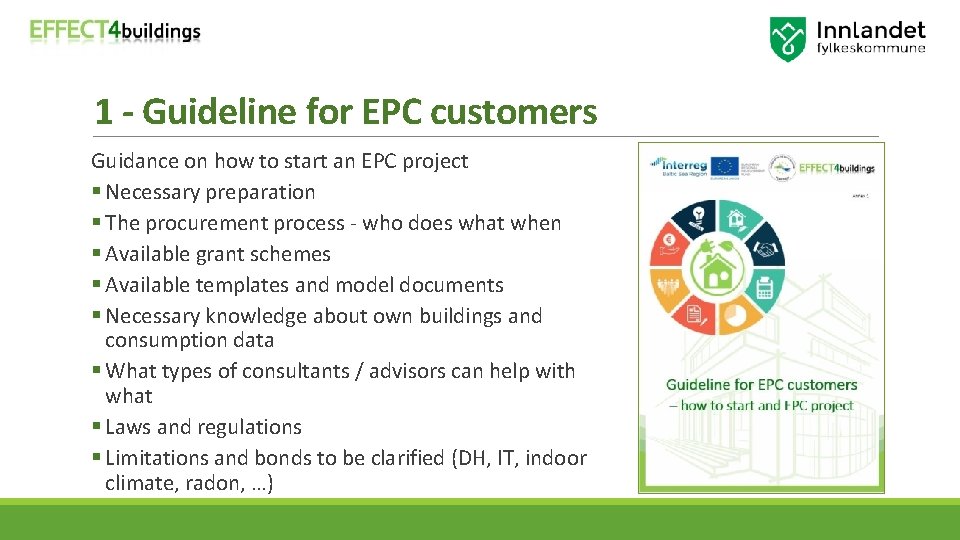
1 - Guideline for EPC customers Guidance on how to start an EPC project § Necessary preparation § The procurement process - who does what when § Available grant schemes § Available templates and model documents § Necessary knowledge about own buildings and consumption data § What types of consultants / advisors can help with what § Laws and regulations § Limitations and bonds to be clarified (DH, IT, indoor climate, radon, …)
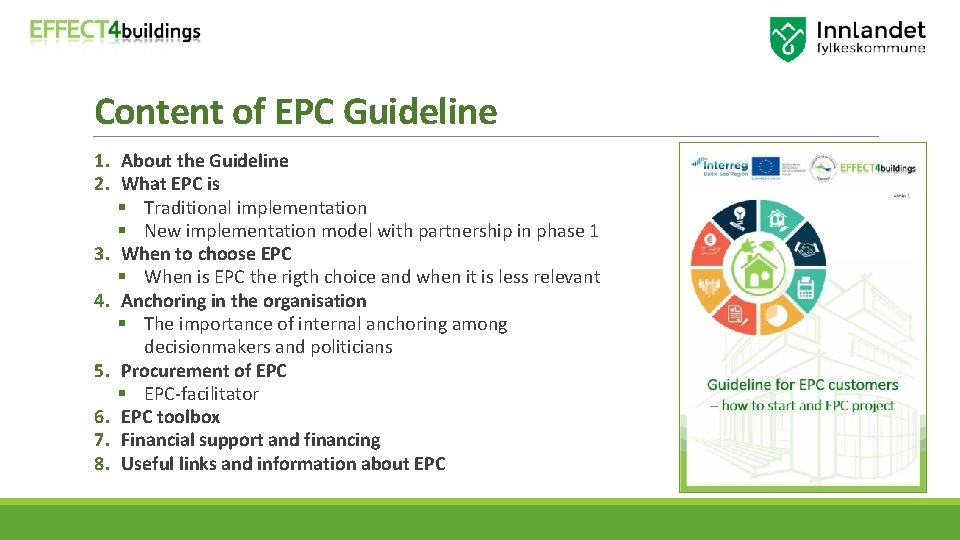
Content of EPC Guideline 1. About the Guideline 2. What EPC is § Traditional implementation § New implementation model with partnership in phase 1 3. When to choose EPC § When is EPC the rigth choice and when it is less relevant 4. Anchoring in the organisation § The importance of internal anchoring among decisionmakers and politicians 5. Procurement of EPC § EPC-facilitator 6. EPC toolbox 7. Financial support and financing 8. Useful links and information about EPC
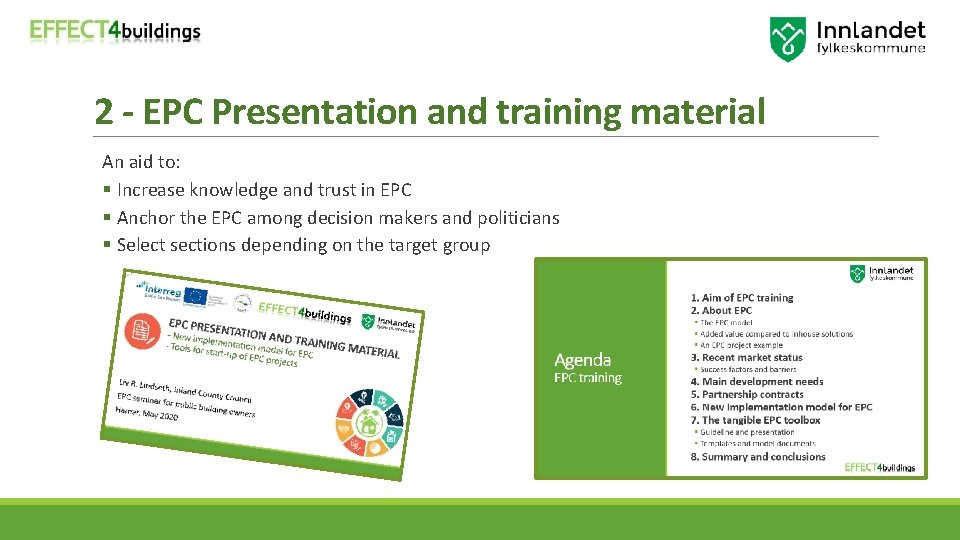
2 - EPC Presentation and training material An aid to: § Increase knowledge and trust in EPC § Anchor the EPC among decision makers and politicians § Select sections depending on the target group
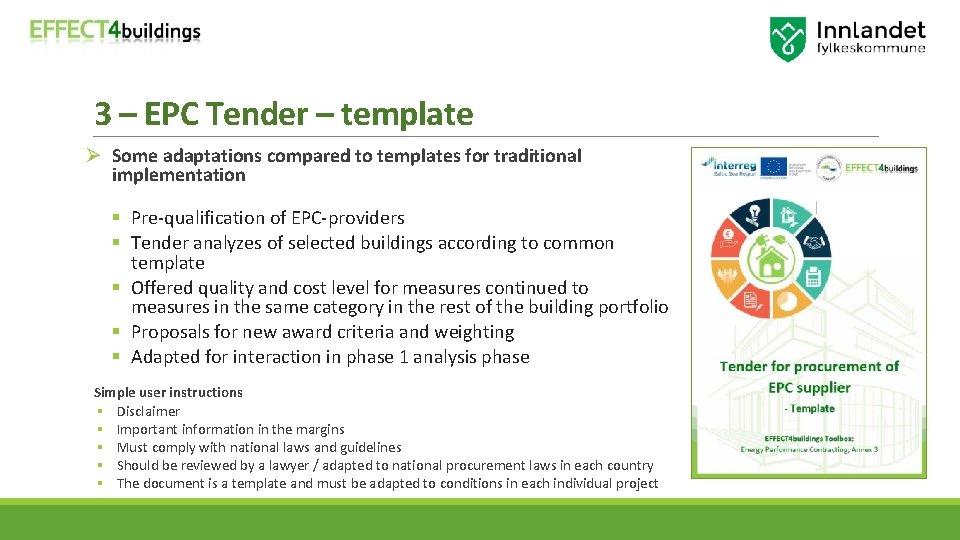
3 – EPC Tender – template Ø Some adaptations compared to templates for traditional implementation § Pre-qualification of EPC-providers § Tender analyzes of selected buildings according to common template § Offered quality and cost level for measures continued to measures in the same category in the rest of the building portfolio § Proposals for new award criteria and weighting § Adapted for interaction in phase 1 analysis phase Simple user instructions § Disclaimer § Important information in the margins § Must comply with national laws and guidelines § Should be reviewed by a lawyer / adapted to national procurement laws in each country § The document is a template and must be adapted to conditions in each individual project
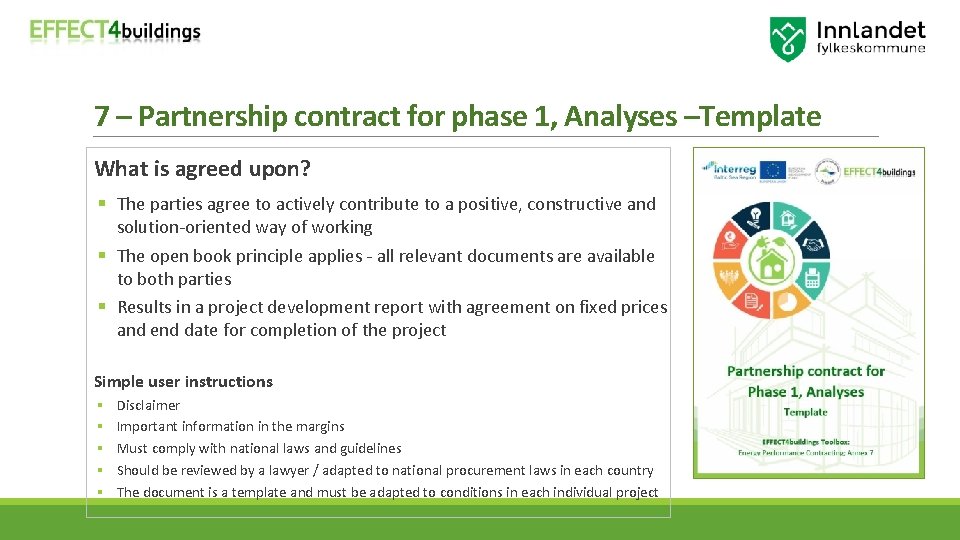
7 – Partnership contract for phase 1, Analyses –Template What is agreed upon? § The parties agree to actively contribute to a positive, constructive and solution-oriented way of working § The open book principle applies - all relevant documents are available to both parties § Results in a project development report with agreement on fixed prices and end date for completion of the project Simple user instructions § § § Disclaimer Important information in the margins Must comply with national laws and guidelines Should be reviewed by a lawyer / adapted to national procurement laws in each country The document is a template and must be adapted to conditions in each individual project
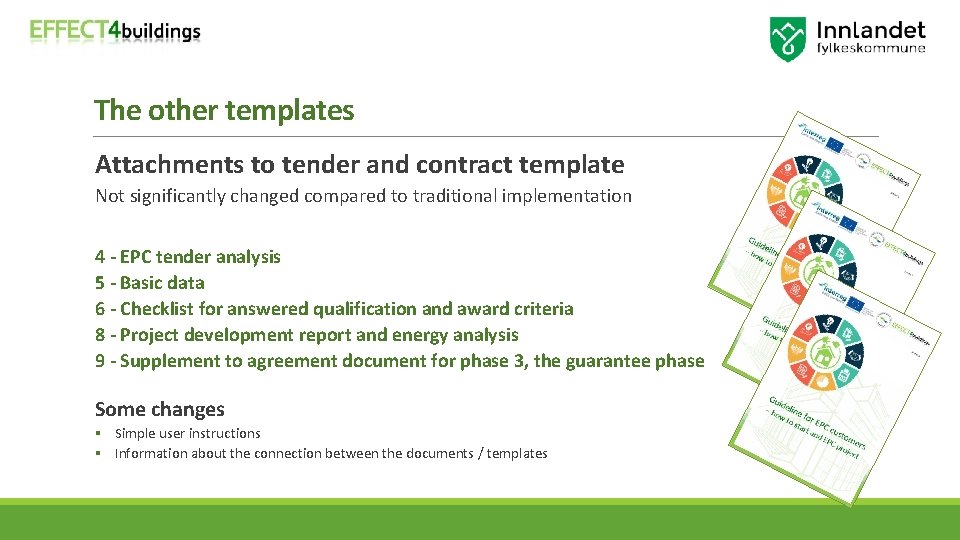
The other templates Attachments to tender and contract template Not significantly changed compared to traditional implementation 4 - EPC tender analysis 5 - Basic data 6 - Checklist for answered qualification and award criteria 8 - Project development report and energy analysis 9 - Supplement to agreement document for phase 3, the guarantee phase Some changes § Simple user instructions § Information about the connection between the documents / templates
Agenda EPC training 8. Summary and conclusions
Summary Problem § Too complicated § Lack of knowledge § Even less knowledge of different ways of implementation § Lack of EPC facilitators § Little access to customized templates and tender documents § Need for increased balance and flexible contract models § Lack of documented results and success stories § Lack of knowledge on how to start the EPC process
Reccomendations What leads to increased use of EPC? § Increased knowledge of EPC § Ownership to the project in own administration § Increased knowledge of possible models for implementation § Knowledge of own savings potential § Easy access to customized templates and tender documents § Increased balance and flexible contract models § Documented results and success stories § Knowledge on how to start the EPC process Recommendations § More information and knowledge dissemination
Several options – choose EPC
EFFECT 4 buildings Contact Liv R. Lindseth Contracted by Inland County Council innlandetfylke. no/E 4 B effect 4 buildings. se liv@linkon. no +47 95 22 04 82
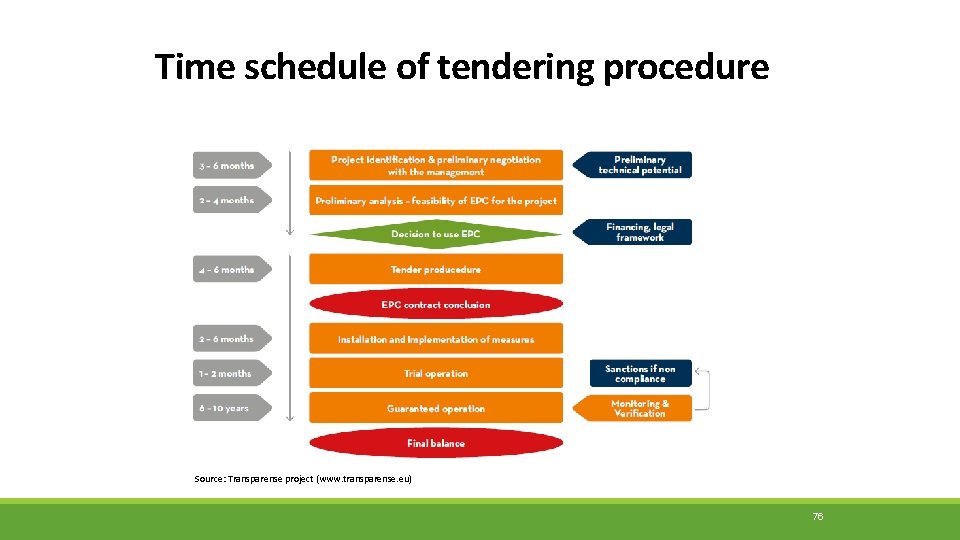
Time schedule of tendering procedure Source: Transparense project (www. transparense. eu) 76
- Slides: 70