
EFactor Environmental Impact Factor History The Royal Society


- Slides: 15
E-Factor Environmental Impact Factor
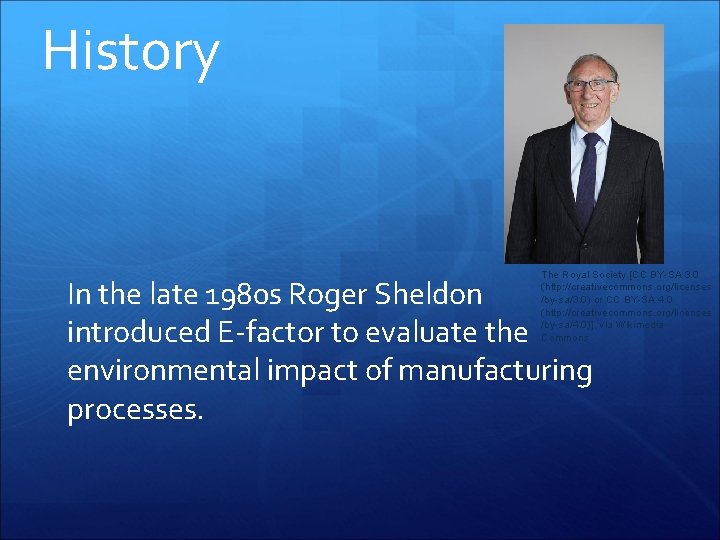
History The Royal Society [CC BY-SA 3. 0 (http: //creativecommons. org/licenses /by-sa/3. 0) or CC BY-SA 4. 0 (http: //creativecommons. org/licenses /by-sa/4. 0)], via Wikimedia Commons In the late 1980 s Roger Sheldon introduced E-factor to evaluate the environmental impact of manufacturing processes.
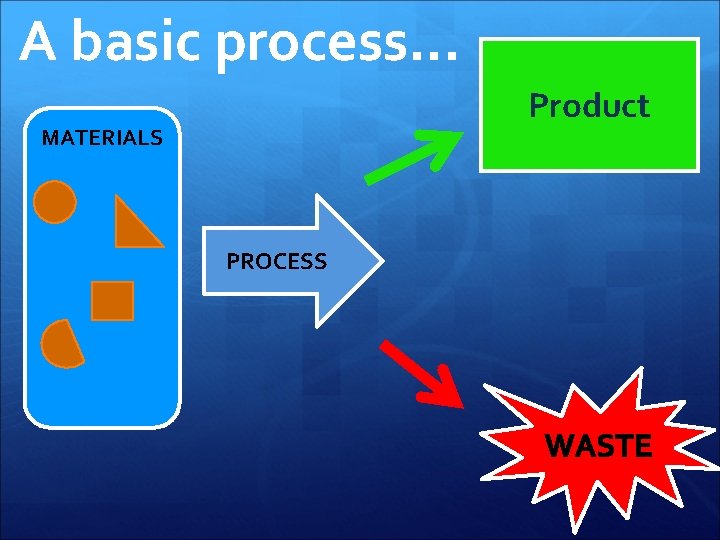
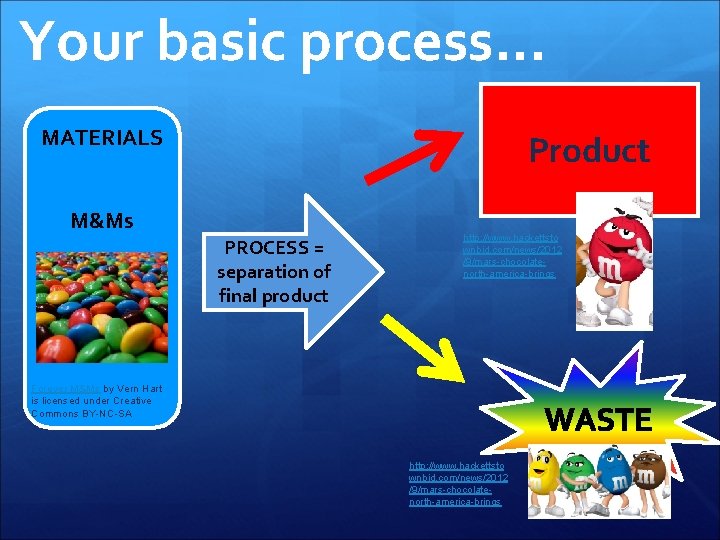
A basic process… Product MATERIALS PROCESS WASTE
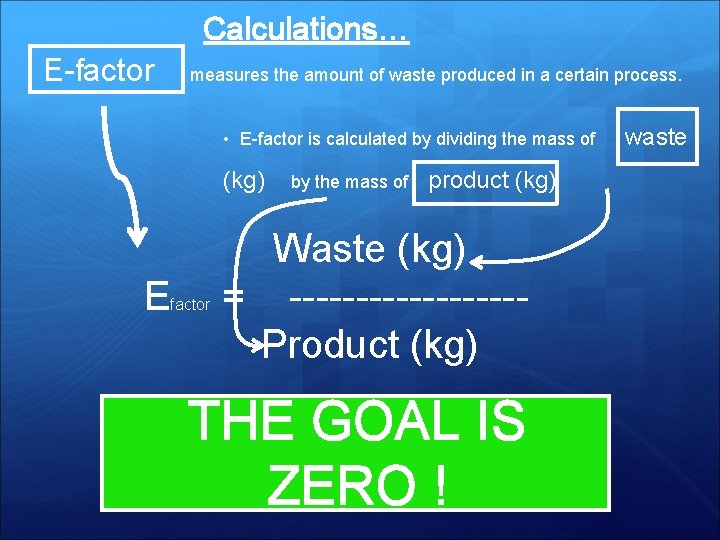
Calculations… E-factor measures the amount of waste produced in a certain process. • E-factor is calculated by dividing the mass of waste (kg) by the mass of product (kg) E factor Waste (kg) = ---------Product (kg) THE GOAL IS ZERO !
Your basic process… MATERIALS Product M&Ms PROCESS = separation of final product http: //www. hackettsto wnbid. com/news/2012 /9/mars-chocolatenorth-america-brings Forever M&Ms by Vern Hart is licensed under Creative Commons BY-NC-SA WASTE http: //www. hackettsto wnbid. com/news/2012 /9/mars-chocolatenorth-america-brings
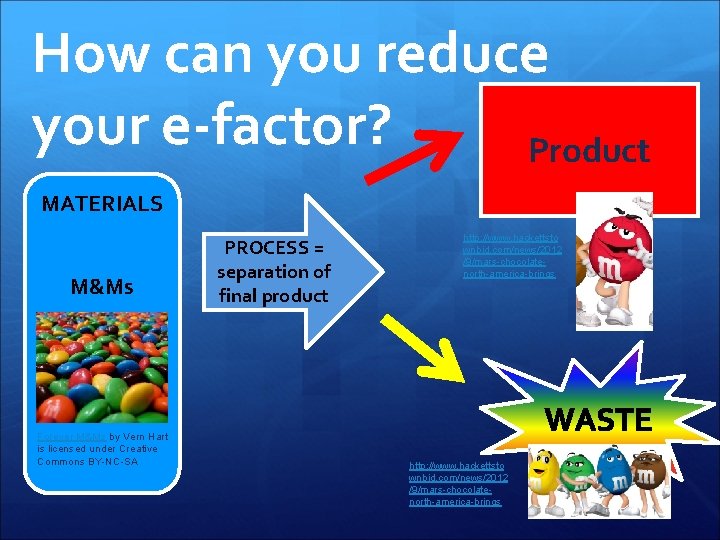
How can you reduce your e-factor? Product MATERIALS M&Ms Forever M&Ms by Vern Hart is licensed under Creative Commons BY-NC-SA PROCESS = separation of final product http: //www. hackettsto wnbid. com/news/2012 /9/mars-chocolatenorth-america-brings WASTE http: //www. hackettsto wnbid. com/news/2012 /9/mars-chocolatenorth-america-brings
Your mission: • Refer back to the 12 Principles • Write down strategies you can use to reduce the amount of waste • Come up with as many strategies as possible! THE GOAL IS ZERO WASTE !
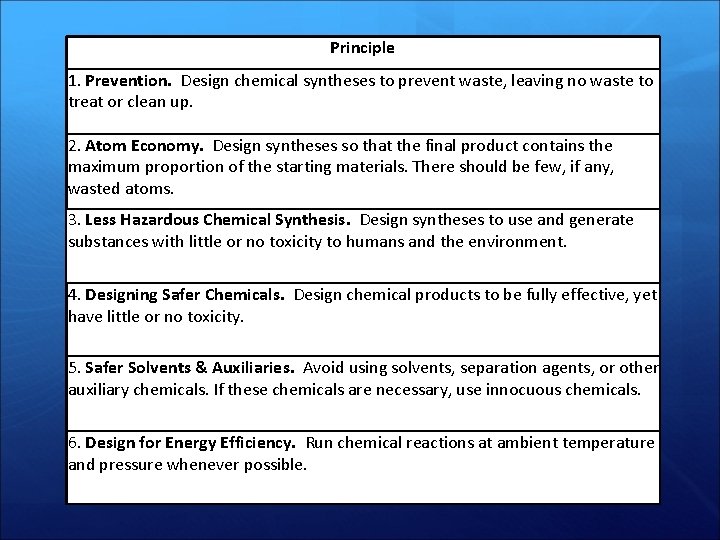
Principle 1. Prevention. Design chemical syntheses to prevent waste, leaving no waste to treat or clean up. 2. Atom Economy. Design syntheses so that the final product contains the maximum proportion of the starting materials. There should be few, if any, wasted atoms. 3. Less Hazardous Chemical Synthesis. Design syntheses to use and generate substances with little or no toxicity to humans and the environment. 4. Designing Safer Chemicals. Design chemical products to be fully effective, yet have little or no toxicity. 5. Safer Solvents & Auxiliaries. Avoid using solvents, separation agents, or other auxiliary chemicals. If these chemicals are necessary, use innocuous chemicals. 6. Design for Energy Efficiency. Run chemical reactions at ambient temperature and pressure whenever possible.
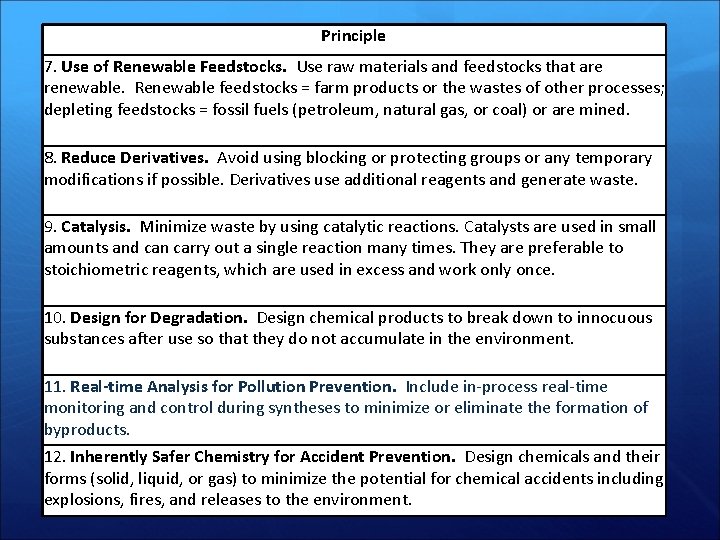
Principle 7. Use of Renewable Feedstocks. Use raw materials and feedstocks that are renewable. Renewable feedstocks = farm products or the wastes of other processes; depleting feedstocks = fossil fuels (petroleum, natural gas, or coal) or are mined. 8. Reduce Derivatives. Avoid using blocking or protecting groups or any temporary modifications if possible. Derivatives use additional reagents and generate waste. 9. Catalysis. Minimize waste by using catalytic reactions. Catalysts are used in small amounts and can carry out a single reaction many times. They are preferable to stoichiometric reagents, which are used in excess and work only once. 10. Design for Degradation. Design chemical products to break down to innocuous substances after use so that they do not accumulate in the environment. 11. Real-time Analysis for Pollution Prevention. Include in-process real-time monitoring and control during syntheses to minimize or eliminate the formation of byproducts. 12. Inherently Safer Chemistry for Accident Prevention. Design chemicals and their forms (solid, liquid, or gas) to minimize the potential for chemical accidents including explosions, fires, and releases to the environment.
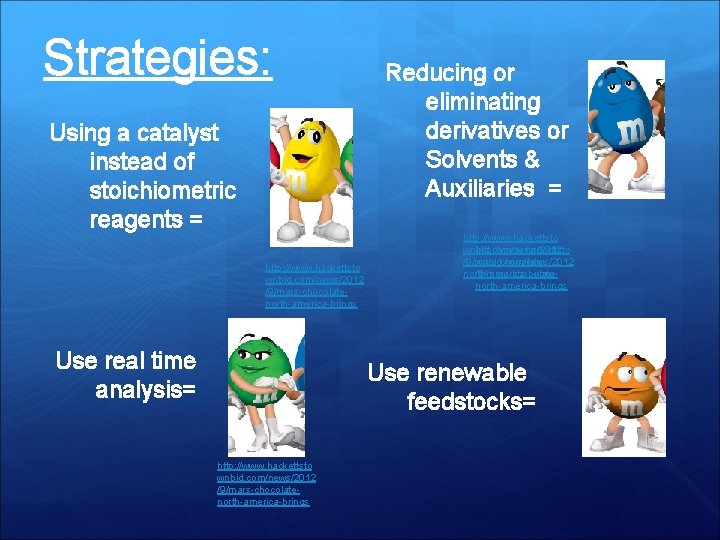
Strategies: Using a catalyst instead of stoichiometric reagents = http: //www. hackettsto wnbid. com/news/2012 /9/mars-chocolatenorth-america-brings Use real time analysis= Reducing or eliminating derivatives or Solvents & Auxiliaries = http: //www. hackettsto wnbid. com/news/2012 http: //www. hackettsto /9/mars-chocolatewnbid. com/news/2012 north-america-brings /9/mars-chocolatenorth-america-brings Use renewable feedstocks= http: //www. hackettsto wnbid. com/news/2012 /9/mars-chocolatenorth-america-brings
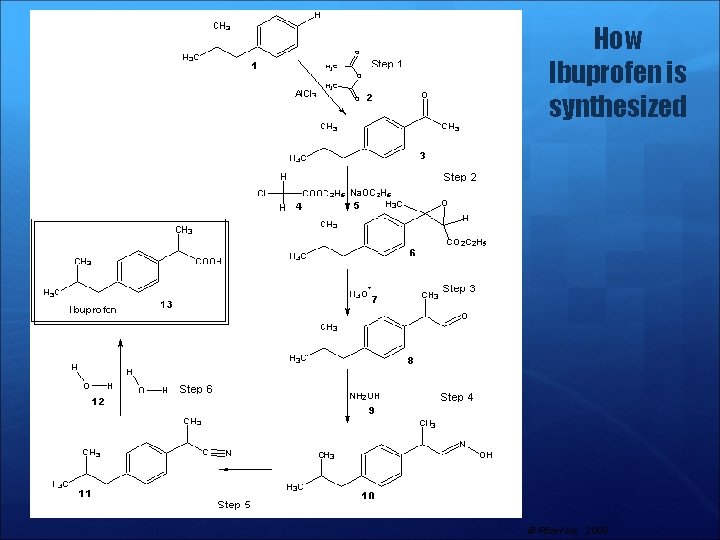
How Ibuprofen is synthesized Pfizer Inc. 2008
Pfizer Inc. 2008
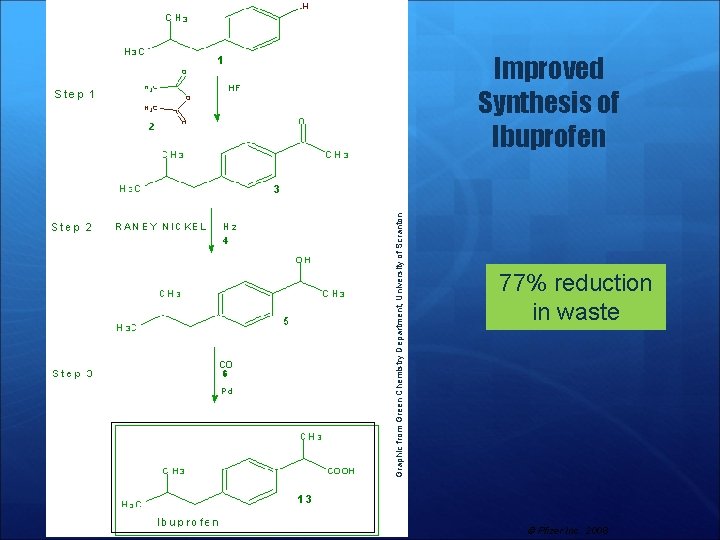
Graphic from Green Chemistry Department, University of Scranton Improved Synthesis of Ibuprofen 77% reduction in waste Pfizer Inc. 2008
Pfizer Inc. 2008
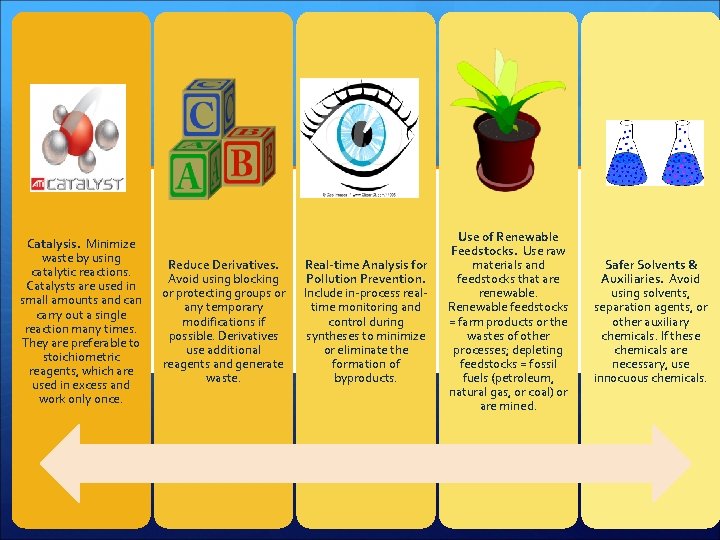
Catalysis. Minimize waste by using catalytic reactions. Catalysts are used in small amounts and can carry out a single reaction many times. They are preferable to stoichiometric reagents, which are used in excess and work only once. Reduce Derivatives. Avoid using blocking or protecting groups or any temporary modifications if possible. Derivatives use additional reagents and generate waste. • Real-time Analysis for Pollution Prevention. Include in-process realtime monitoring and control during syntheses to minimize or eliminate the formation of byproducts. Use of Renewable Feedstocks. Use raw materials and feedstocks that are renewable. Renewable feedstocks = farm products or the wastes of other processes; depleting feedstocks = fossil fuels (petroleum, natural gas, or coal) or are mined. Safer Solvents & Auxiliaries. Avoid using solvents, separation agents, or other auxiliary chemicals. If these chemicals are necessary, use innocuous chemicals.