
eEVN science in 2006 2007 Zsolt Paragi JIVE
- Slides: 21
e-EVN science in 2006 -2007 Zsolt Paragi (JIVE), for the EXPRe. S project
What will e-VLBI offer for us one day? Several Gbps data rates/telescope, two orders of magnitude better sensitivity, “full” uv-coverage, flexibility… What the e-EVN can offer today: • Limited sensitivity and resolution compared to EVN, but… • Some flexibility for rapid response science • Rapid feedback, you know if it works, you know what you observe… • … enables quick decision about more observations (VLBI or other) • Easy access, easy use – high level of PI support 2008 Jan 29 EXPRe. S Progress meeting, Utrecht 2
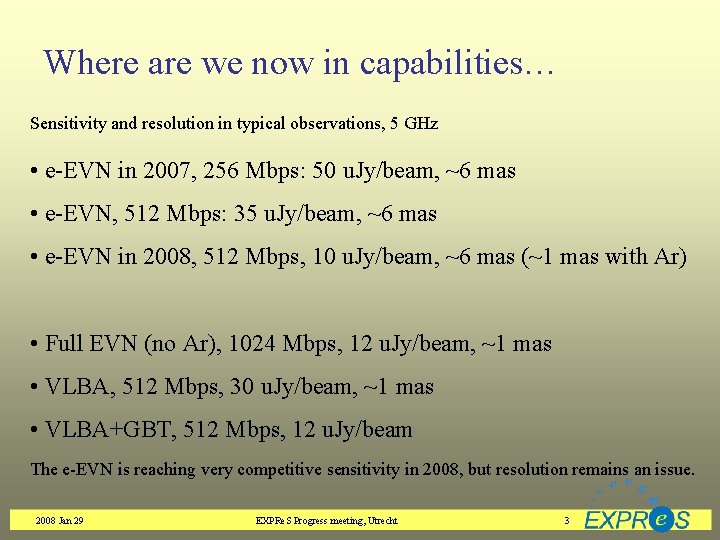
Where are we now in capabilities… Sensitivity and resolution in typical observations, 5 GHz • e-EVN in 2007, 256 Mbps: 50 u. Jy/beam, ~6 mas • e-EVN, 512 Mbps: 35 u. Jy/beam, ~6 mas • e-EVN in 2008, 512 Mbps, 10 u. Jy/beam, ~6 mas (~1 mas with Ar) • Full EVN (no Ar), 1024 Mbps, 12 u. Jy/beam, ~1 mas • VLBA, 512 Mbps, 30 u. Jy/beam, ~1 mas • VLBA+GBT, 512 Mbps, 12 u. Jy/beam The e-EVN is reaching very competitive sensitivity in 2008, but resolution remains an issue. 2008 Jan 29 EXPRe. S Progress meeting, Utrecht 3
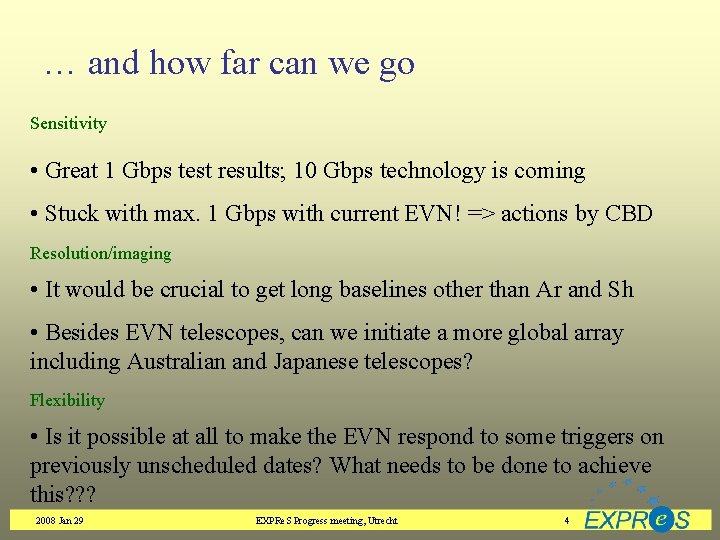
… and how far can we go Sensitivity • Great 1 Gbps test results; 10 Gbps technology is coming • Stuck with max. 1 Gbps with current EVN! => actions by CBD Resolution/imaging • It would be crucial to get long baselines other than Ar and Sh • Besides EVN telescopes, can we initiate a more global array including Australian and Japanese telescopes? Flexibility • Is it possible at all to make the EVN respond to some triggers on previously unscheduled dates? What needs to be done to achieve this? ? ? 2008 Jan 29 EXPRe. S Progress meeting, Utrecht 4
e-VLBI activities in 2007 • Regular e-VLBI test observations in every six week (on average) • 24 h time is pre-allocated for science observation during tests • Observing proposals now must be sent to normal EVN deadlines; a new type of triggered proposal class, normal and spectral projects supported • Science operations at 1. 6 and 5 GHz, up to 256 Mbps (Cm, Jb 2, Mc, On, Tr, Wb) • First 22 GHz test with Metsahovi in March 2007 • Australia and Shanghai demos, great success!; 512 Mbps in Australia science demo observations, with small number of tels. • Most recently: robust 512 Mbps operations, and 1 Gbps fringes!!! 2008 Jan 29 EXPRe. S Progress meeting, Utrecht 5
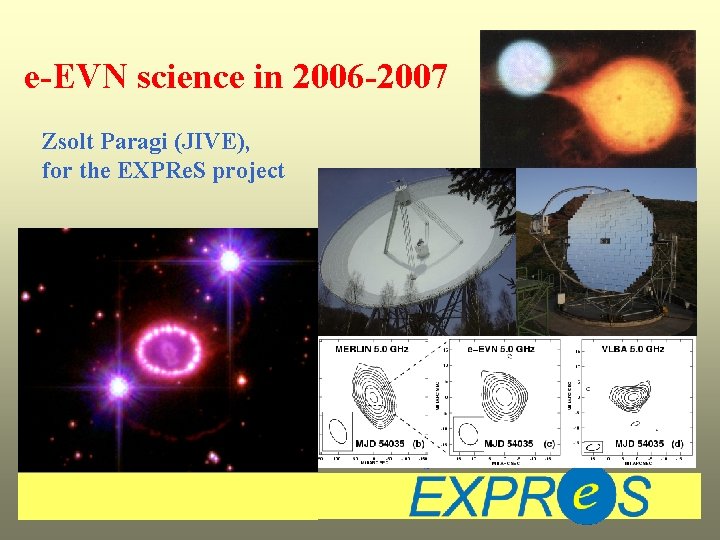
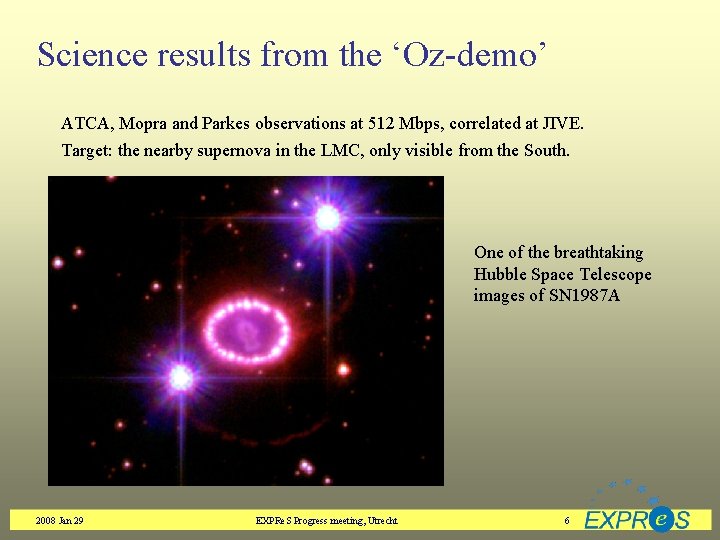
Science results from the ‘Oz-demo’ ATCA, Mopra and Parkes observations at 512 Mbps, correlated at JIVE. Target: the nearby supernova in the LMC, only visible from the South. One of the breathtaking Hubble Space Telescope images of SN 1987 A 2008 Jan 29 EXPRe. S Progress meeting, Utrecht 6
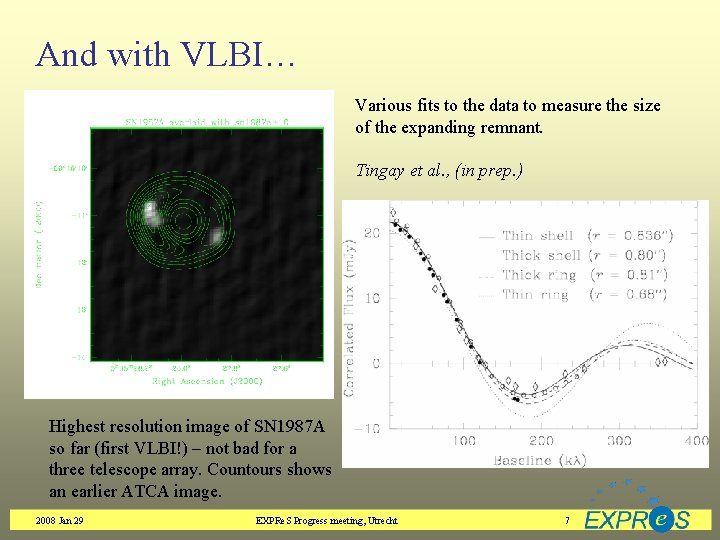
And with VLBI… Various fits to the data to measure the size of the expanding remnant. Tingay et al. , (in prep. ) Highest resolution image of SN 1987 A so far (first VLBI!) – not bad for a three telescope array. Countours shows an earlier ATCA image. 2008 Jan 29 EXPRe. S Progress meeting, Utrecht 7
e-EVN science projects in 2006/2007 • Cyg X-3, 20 Apr/18 May 2006, 128 Mbps, Tudose et al. • GRS 1915+105, 20 Apr 2006, 128 Mbps, Rushton et al. • LSI +61. 303, 256 Mbps, 26 Oct 2006, Perez-Torres et al. • Algol, 26 Oct/14 Dec 2006, 256 Mbps, Paragi et al. • Calibrators near M 81, 14 Dec 2006, 256 Mbps, Brunthaler et al. • INTEGRAL microquasar candidates, 14 Dec 2006, Pandey et al. • “double header” run, 15 XRBs, 29 Jan 2007, Rushton & Spencer • Calibrators, 21 Feb 2007, 256 Mbps, Tudose et al. • J 2020+3631 microquasar candidate, 28 Mar 2007, 256 Mbps, Martí et al. • Cyg X-3, 12 -13 Jun 2007, 256 Mbps, Tudose et al. • Stellar maser search, 22 -23 Aug 2007, 32 Mbps, Langevelde et al. • INTEGRAL source redo, 6 -7 Sep 2007, 256 Mbps, Pandey et al. • Type Ib/c SN 2007 gr, 6 -7 Sep 2007, 256 Mbps, Paragi et al. 2008 Jan 29 EXPRe. S Progress meeting, Utrecht 8
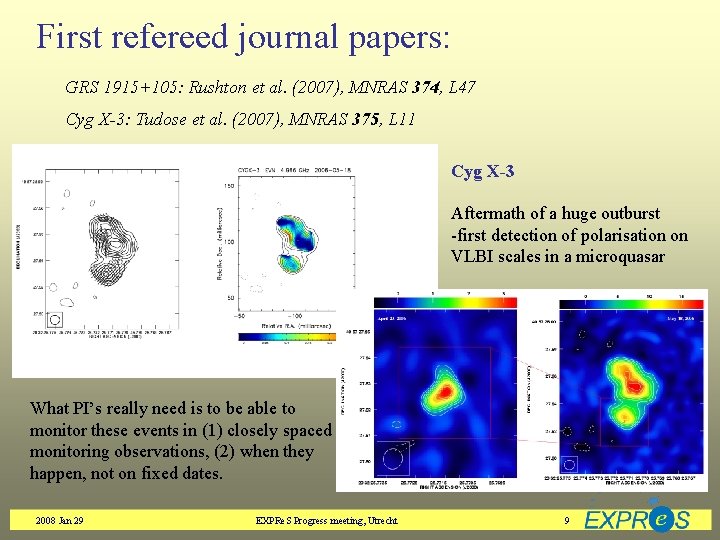
First refereed journal papers: GRS 1915+105: Rushton et al. (2007), MNRAS 374, L 47 Cyg X-3: Tudose et al. (2007), MNRAS 375, L 11 Cyg X-3 Aftermath of a huge outburst -first detection of polarisation on VLBI scales in a microquasar What PI’s really need is to be able to monitor these events in (1) closely spaced monitoring observations, (2) when they happen, not on fixed dates. 2008 Jan 29 EXPRe. S Progress meeting, Utrecht 9
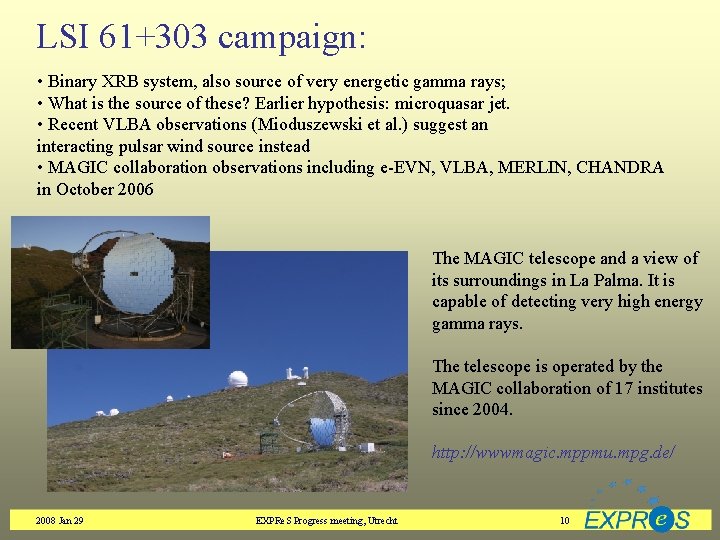
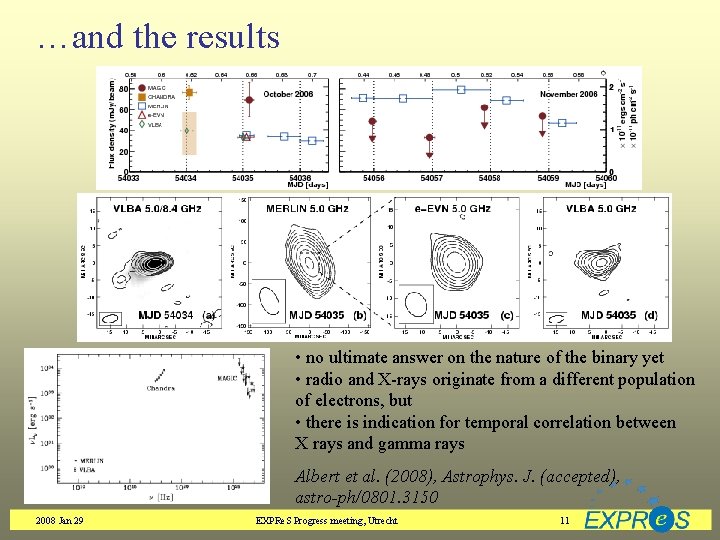
LSI 61+303 campaign: • Binary XRB system, also source of very energetic gamma rays; • What is the source of these? Earlier hypothesis: microquasar jet. • Recent VLBA observations (Mioduszewski et al. ) suggest an interacting pulsar wind source instead • MAGIC collaboration observations including e-EVN, VLBA, MERLIN, CHANDRA in October 2006 The MAGIC telescope and a view of its surroundings in La Palma. It is capable of detecting very high energy gamma rays. The telescope is operated by the MAGIC collaboration of 17 institutes since 2004. http: //wwwmagic. mppmu. mpg. de/ 2008 Jan 29 EXPRe. S Progress meeting, Utrecht 10
…and the results • no ultimate answer on the nature of the binary yet • radio and X-rays originate from a different population of electrons, but • there is indication for temporal correlation between X rays and gamma rays Albert et al. (2008), Astrophys. J. (accepted), astro-ph/0801. 3150 2008 Jan 29 EXPRe. S Progress meeting, Utrecht 11
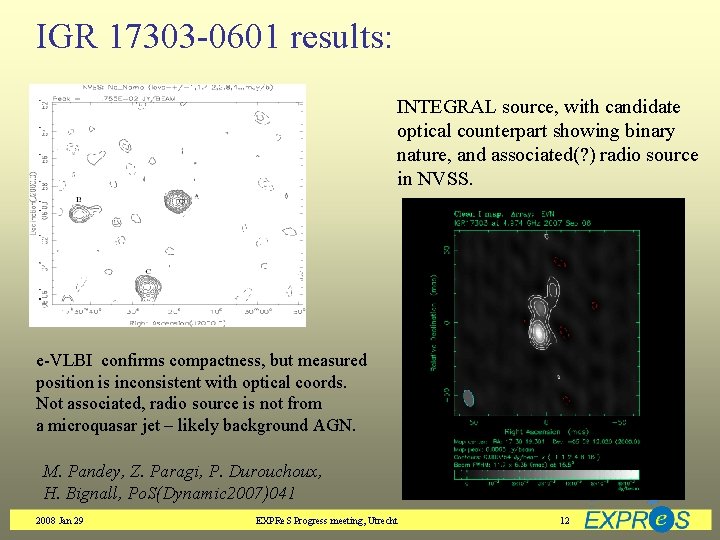
IGR 17303 -0601 results: INTEGRAL source, with candidate optical counterpart showing binary nature, and associated(? ) radio source in NVSS. e-VLBI confirms compactness, but measured position is inconsistent with optical coords. Not associated, radio source is not from a microquasar jet – likely background AGN. M. Pandey, Z. Paragi, P. Durouchoux, H. Bignall, Po. S(Dynamic 2007)041 2008 Jan 29 EXPRe. S Progress meeting, Utrecht 12
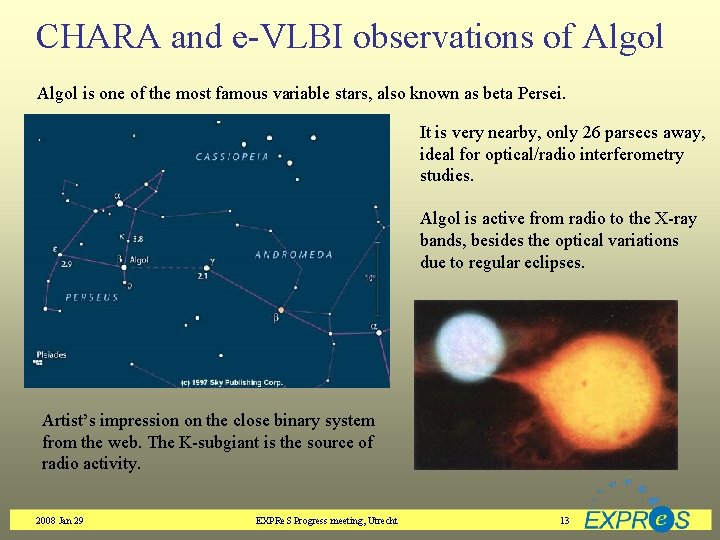
CHARA and e-VLBI observations of Algol is one of the most famous variable stars, also known as beta Persei. It is very nearby, only 26 parsecs away, ideal for optical/radio interferometry studies. Algol is active from radio to the X-ray bands, besides the optical variations due to regular eclipses. Artist’s impression on the close binary system from the web. The K-subgiant is the source of radio activity. 2008 Jan 29 EXPRe. S Progress meeting, Utrecht 13
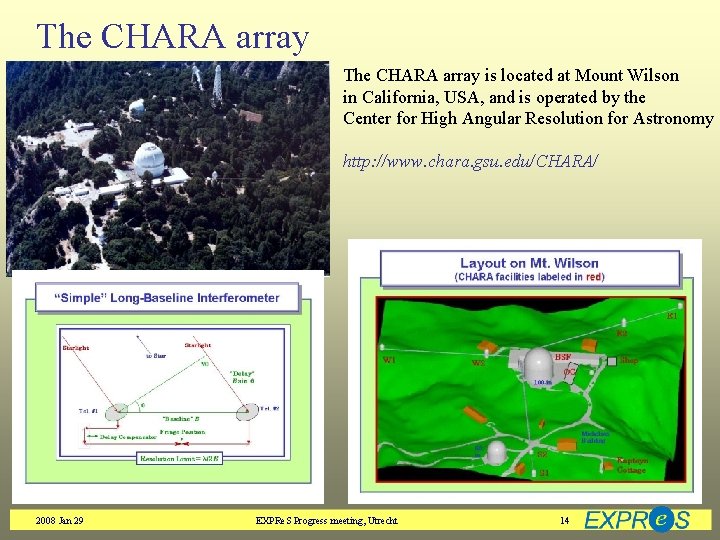
The CHARA array is located at Mount Wilson in California, USA, and is operated by the Center for High Angular Resolution for Astronomy http: //www. chara. gsu. edu/CHARA/ 2008 Jan 29 EXPRe. S Progress meeting, Utrecht 14
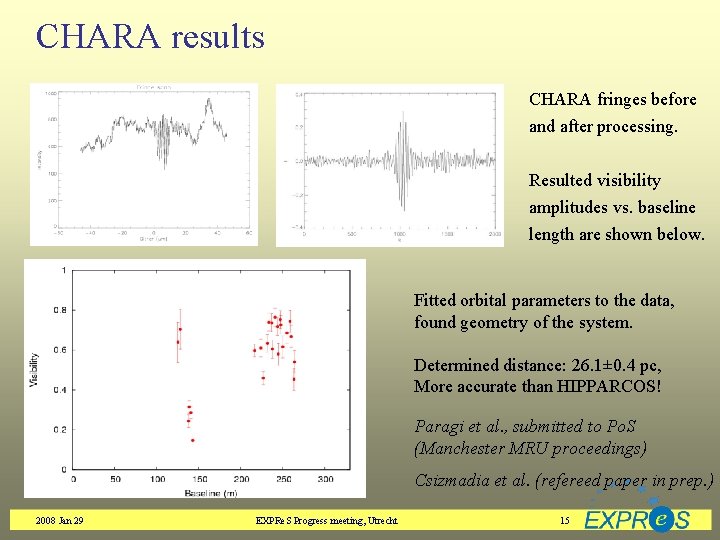
CHARA results CHARA fringes before and after processing. Resulted visibility amplitudes vs. baseline length are shown below. Fitted orbital parameters to the data, found geometry of the system. Determined distance: 26. 1± 0. 4 pc, More accurate than HIPPARCOS! Paragi et al. , submitted to Po. S (Manchester MRU proceedings) Csizmadia et al. (refereed paper in prep. ) 2008 Jan 29 EXPRe. S Progress meeting, Utrecht 15
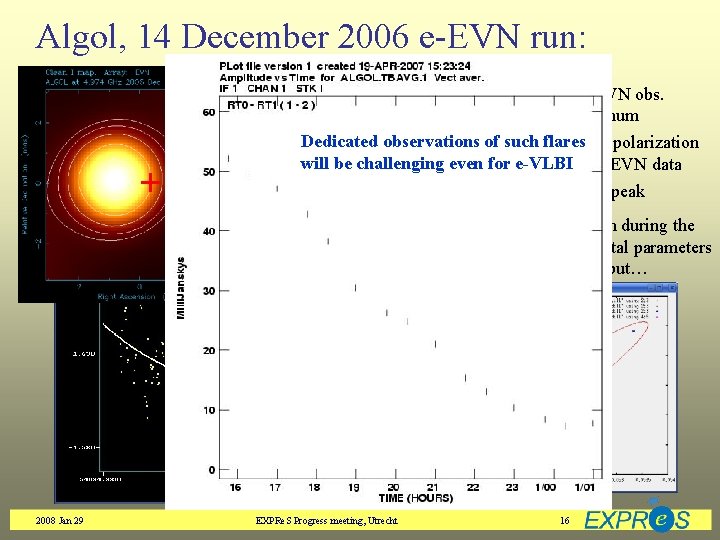
Algol, 14 December 2006 e-EVN run: + • Simultaneous optical photometry and e-EVN obs. (5 GHz, 256 Mbps) during secondary minimum observations of such • Dedicated Source flared – total intensity andflares circular polarization will be challenging even for. WSRT e-VLBIand e-EVN data variations consistent between • Flare emission ~2 mas offset from the CP peak • Detected proper motion during the 10 hours run –fitted orbital parameters of the AB close binary, but… 2008 Jan 29 EXPRe. S Progress meeting, Utrecht 16
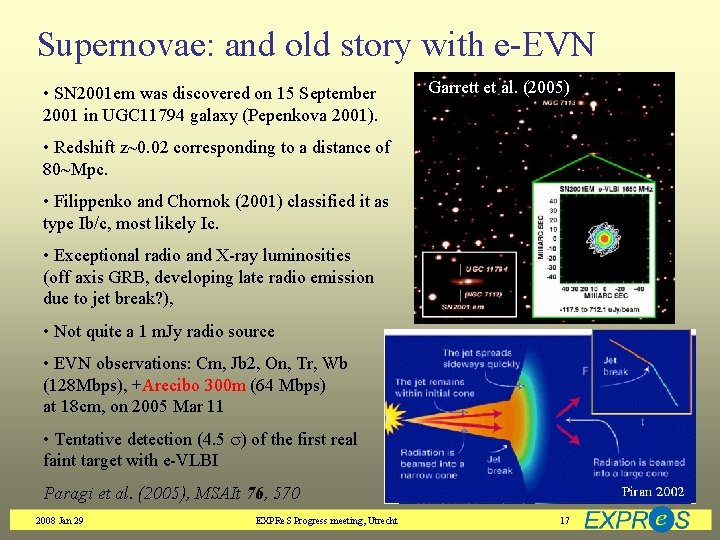
Supernovae: and old story with e-EVN • SN 2001 em was discovered on 15 September 2001 in UGC 11794 galaxy (Pepenkova 2001). Garrett et al. (2005) • Redshift z~0. 02 corresponding to a distance of 80~Mpc. • Filippenko and Chornok (2001) classified it as type Ib/c, most likely Ic. • Exceptional radio and X-ray luminosities (off axis GRB, developing late radio emission due to jet break? ), • Not quite a 1 m. Jy radio source • EVN observations: Cm, Jb 2, On, Tr, Wb (128 Mbps), +Arecibo 300 m (64 Mbps) at 18 cm, on 2005 Mar 11 • Tentative detection (4. 5 ) of the first real faint target with e-VLBI Paragi et al. (2005), MSAIt 76, 570 2008 Jan 29 EXPRe. S Progress meeting, Utrecht 17
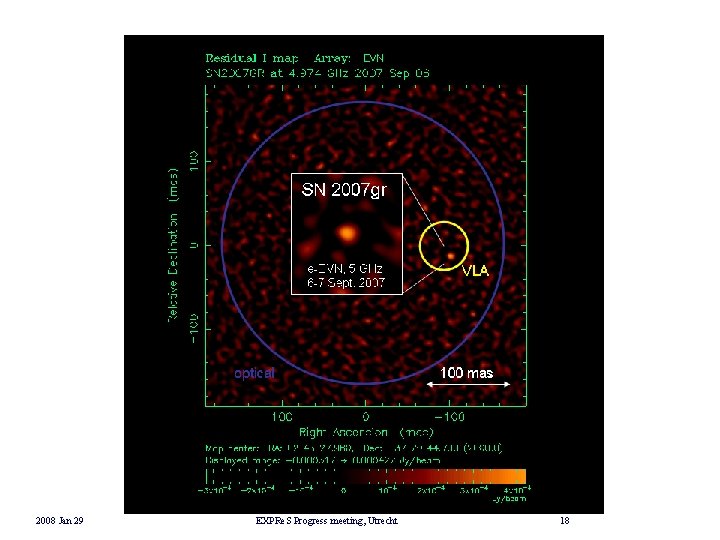
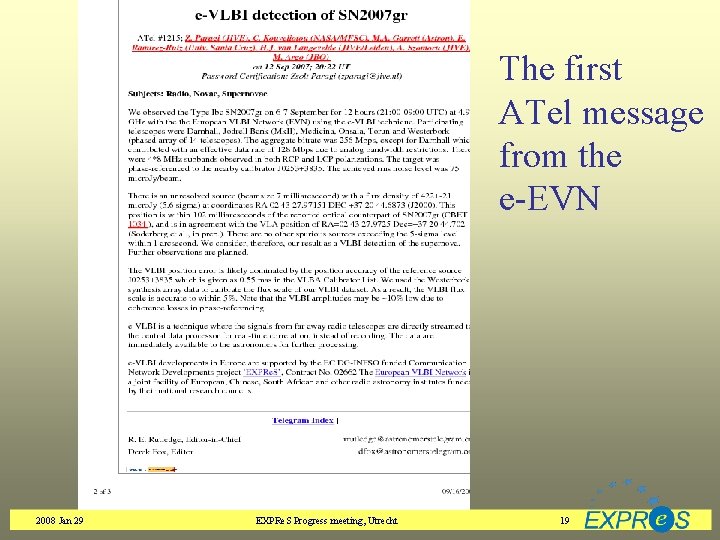
SN 2007 gr To. O observations • SN 2007 gr was discovered on 15 Aug 2007 with KAIT (CBET 1034); identified as Type Ib/c. • Distance is about 7. 3 Mpc, 10 x closer than SN 2001 em was. • VLA discovers 610 micro. Jy radio source (Soderberg 2007) • e-EVN observations: Da, Jb 2, On, Tr, Wb (256 Mbps), at 6 cm, on 2007 Sep 6 -7 • Firm detection (5. 6 ) of the supernova within the VLA error box Paragi et al. (2007), ATel #1215 2008 Jan 29 EXPRe. S Progress meeting, Utrecht 18
The first ATel message from the e-EVN 2008 Jan 29 EXPRe. S Progress meeting, Utrecht 19
Conclusion • The e-EVN has participated in a variety of science observations, contributed to results carried out in ambitious multi-waveband projects. • We ‘used’ the e-VLBI developments to stir a bit of noise around the EVN, and attract new users. • But more is needed to make e-EVN a very competitive, unique instrument. 2008 Jan 29 EXPRe. S Progress meeting, Utrecht 20
What else astronomers want? • Better sensitivity and *resolution* • Will happen with new radio telescopes being connected soon: Arecibo 300 m — 256 Mbps spring 2008 Shanghai +2 new — 1 Gpbs available (not operationally yet) Effelsberg 100 m — expected spring 2008 Yebes 40 m — expected in 2008 • Better flexibility, not fixed dates, allow multiple epochs to follow up transients!!! è in 2008 will get close to disk-recording VLBI resolution and sensitivity, and will be more flexible for To. Os è will be challenging for telescopes as well as the correlator 2008 Jan 29 EXPRe. S Progress meeting, Utrecht 21