
EEOC v Morgan Stanley U S District Court
- Slides: 18
EEOC v. Morgan Stanley U. S. District Court, SDNY(2004) Judge Ellis
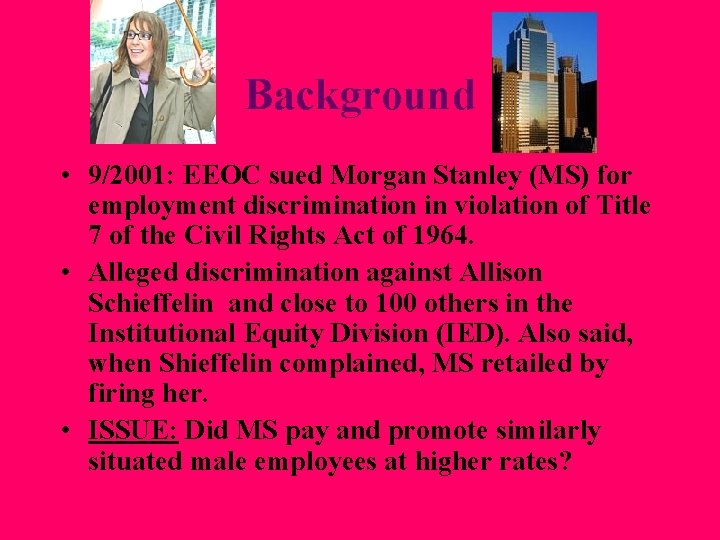
Background • 9/2001: EEOC sued Morgan Stanley (MS) for employment discrimination in violation of Title 7 of the Civil Rights Act of 1964. • Alleged discrimination against Allison Schieffelin and close to 100 others in the Institutional Equity Division (IED). Also said, when Shieffelin complained, MS retailed by firing her. • ISSUE: Did MS pay and promote similarly situated male employees at higher rates?
Spoiler! • Case ended up settling right before opening statements. • DETAILED consent decree – MS maintained it didn’t violate Title 7 – Names kept confidential – Stipulated to everything: attorneys’ fees, policies, etc. • MS settled for $54 million – $12 mil for Allison – $2 mil spent by MS for diversity initiatives – $40 mil to be distributed amongst class of 67 women
FRE 702 Brush up – Gate-keeping function of court. – Admits only reliable and relevant evidence – Daubert factors – Any expert knowledge, not just scientific – Focus on methods, not conclusion – Rejection is the exception, not the rule
FRE 702 Motions • Motions from three parties (Allison, MS, and EEOC) • Three types of evidence: Statistics, Social Science, & Miscellaneous (i. e. damages) • Court separated by evidence type and then analyzed each expert
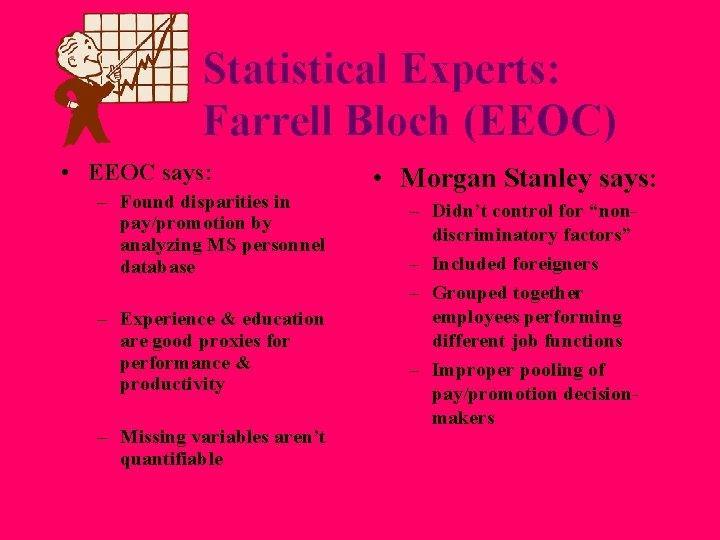
Statistical Experts: Farrell Bloch (EEOC) • EEOC says: – Found disparities in pay/promotion by analyzing MS personnel database – Experience & education are good proxies for performance & productivity – Missing variables aren’t quantifiable • Morgan Stanley says: – Didn’t control for “nondiscriminatory factors” – Included foreigners – Grouped together employees performing different job functions – Improper pooling of pay/promotion decisionmakers
Judge says: In • Jury can analyze how probative, whether Bloch’s objective variables are reasonable substitutes • Raise criticisms on cross-examination • No comprehensive, common database of personnel decisions • The variables identified by Wecker are subjective, so no quantification is possible.
Wecker (MS) to counter Bloch • Morgan Stanley says: – Bloch made wrong inference (disparity due to gender) from data • Failed to consider job function & performance • Failed to find meaningful substitute measures • EEOC says: – He didn’t do own full analysis—easier to poke holes – Used two small sample groups within IED. No weight because size too small and info given during interview with MS managing director.
Wilde (MS) to counter Bloch • Morgan Stanley says: • EEOC says: – Shows Bloch’s statistical methods to estimate damages were unreliable & irrelevant – Analyzes Bloch’s data to say women were paid equal to or more than men – He didn’t do his own empirical studies – Criticisms are merely speculatory – Improper opinion on legal issue
Judge says: In • Wecker and Wilde’s analysis of insufficiencies are significant, own statistical analysis is not necessary • EEOC’s issues impact probative weight, not admissibility • Not legal conclusions
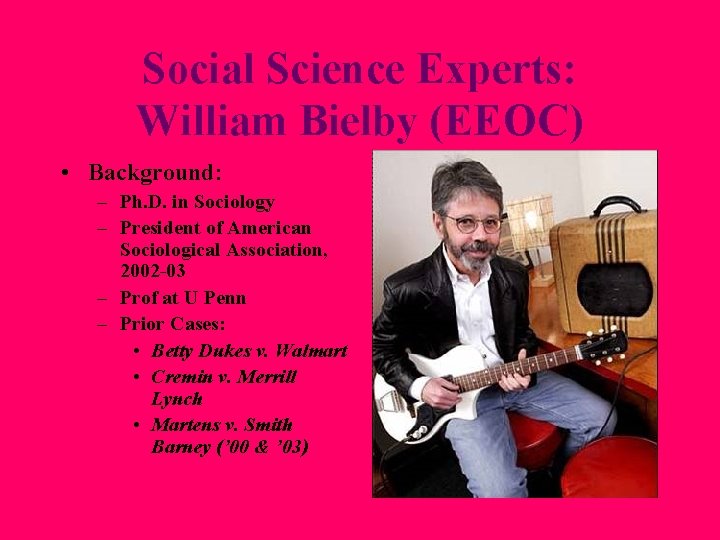
Social Science Experts: William Bielby (EEOC) • Background: – Ph. D. in Sociology – President of American Sociological Association, 2002 -03 – Prof at U Penn – Prior Cases: • Betty Dukes v. Walmart • Cremin v. Merrill Lynch • Martens v. Smith Barney (’ 00 & ’ 03)
Bielby’s Testimony: • Explains “factors that create and minimize workplace gender bias, including how gender stereotypes affect personnel decisions, organizational policies & practices that create barriers to career advancement of women, and the kind of policies and procedures that effectively minimize gender bias, particularly in male-dominated work environments. ” • Summarizes social science research • Applies to this case through “social framework analysis” • Finds male-dominated environment at IED, policies that don’t detect & minimize gender discrimination, & arbitrary/subjective procedures for pay/promotion
Morgan Stanley’s Objections • Lacks first-hand knowledge b/c testimony based on depositions • No background in social psychology, human resources, or personnel policies • No studies of IED • Unreliable methodology – No science – Omits inconsistent literature – “Social framework analysis” isn’t accepted • Male-dominated culture is irrelevant b/c can’t prove intentional discrimination • Misapplies burden of proof by saying that gender discrimination is inevitable in IED without appropriate safeguards (which aren’t there)
Judge Says: Yes & No • Acceptable methodology • Critiques go towards weight • Can say testify to gender stereotypes, how they may have affected decisions at MS, and whether policies/practices relating to gender bias might affect employees’ utilization of an equal opportunity program • Can’t say male-dominated environment – Too theoretical to say male-dominated environment results in discrimination – Jury would expect discrimination think MS would have to prove otherwise
MS Experts to Counter Bielby • Barbara Gutek (accepted): – Bielby’s opinions are unscientific – No consensus in social science research regarding best policies/practices to handle discrimination – Inappropriately relies on her work • Ira T. Kay (denied): – Compensation consultant with Ph. D. in Labor Economics – Tries to challenge Bielby’s “arbitrary” designation • Doesn’t use the qualitative factors – Says that pay/promotion system is the same in MS as in other wall street firms and why they adopt such policies
MORE MS Social Science Experts • June O’Neill (Accepted & Denied): – Not all pay discrepancies between men & women = gender discrimination – Presents study regarding compensation based on IED in North America showing no statistically significant differences in HIRING based on gender – Ct says hiring part is irrelevant, but choice testimony if fine • Christopher Winship (Accepted & Denied): – “Social Science methodologist” – Bielby’s invalid scientific methodology • Use of social science literature • Flaws in analysis of IED and Schieffelin – Court says he is qualified but has to leave out his conclusions about pay/promotion procedures b/c not a human resource specialist
Major Problem with Bielby: the Causal Story • How can he prove discrimination? – Difficulty in finding link between environment and the actual decisions being made • Difficulty of getting into someone’s head – How to remove other factors (i. e. not promoting b/c afraid of mommy track, male clients don’t trust women) • Which factors to remove? mommy track reasonable? – Subjective nature of evaluation—hard to quantify things like leadership, teamwork, management ability, integrity, product knowledge, & contribution to profitability
The Big Picture • Gender discrimination exists whether a study can prove it or not • Justice requires that the legal system right this wrong – Not doing so perpetuates discrimination • How can we prove this discrimination type? • Don’t want to get rid of causal link • Some alternatives: – Potential outcome analysis v. regression – A control—perhaps businesses outside industry known for being progressive model, i. e. Costco. • But how comparable? Same issues facing management in different industry?