
EEIC Standards Process Draft Feb 2006 Howard Mason
EEIC Standards Process Draft Feb 2006 Howard Mason / Tom Warner
The Path to AIA e. Business Interoperability • Many e. Business scenarios can be identified • Many standards and initiatives have the potential to satisfy part of the overall industry requirement for interoperability • Between companies and business partners • Between functions in an organisation • Between application systems • Challenge: • reduce overall cost and complexity by identifying the most appropriate solution components • provide concrete guidance on how to satisfy specific business requirements using an appropriate selection of those components
Standards strategy Path to AIA e. Business Standards In order of preference 1. AIA adopts existing standards for use in the aerospace industry 2. AIA influences standards organizations through participation to meet its requirements 3. AIA develops its own standards when none exists from standards organizations • AIA may then submit a proposal to the applicable standards organization for international adoption In each case • The AIA may supplement existing standards with aerospace-agreed implementation conventions (subset), models/examples, and guidelines The old real estate axiom for accumulating wealth also applies for “accumulating standards”. Use OPM (Other People’s Money) for attaining wealth quickly. Use OPSF (Other People’s Standards Forums) for attaining a standards base quickly. Use Leverage!
The role of the EEIC Overall concept of operations of the EEIC is to: • Solicit, identify and rationalize specific business requirements for interoperability • Specific scenarios • Identify and assess key standards and initiatives, as framework components within an overall framework for e. Business • Develop AIA position statements on relevant standards/initiatives • Undertake projects to ensure that appropriate standards are available to industry in a timely manner, together with suitable guidance material if required • Develop guidelines for deployment of such components to meet specific business scenarios • Seek industry endorsement of the resulting standards and solutions
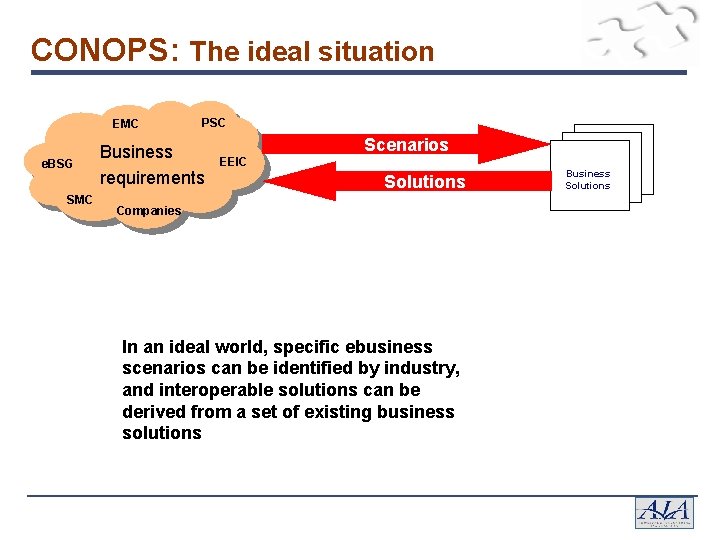
CONOPS: The ideal situation EMC e. BSG SMC PSC Business requirements Scenarios EEIC Solutions Companies In an ideal world, specific ebusiness scenarios can be identified by industry, and interoperable solutions can be derived from a set of existing business solutions Business Solutions
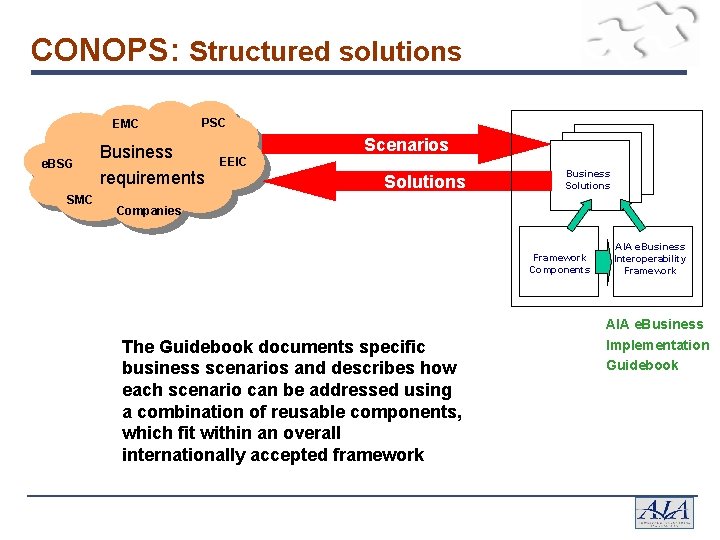
CONOPS: Structured solutions EMC e. BSG SMC PSC Business requirements Scenarios EEIC Solutions Business Solutions Companies Framework Components The Guidebook documents specific business scenarios and describes how each scenario can be addressed using a combination of reusable components, which fit within an overall internationally accepted framework AIA e. Business Interoperability Framework AIA e. Business Implementation Guidebook

CONOPS: Meeting new needs PSC EMC e. BSG SMC Business requirements Scenarios EEIC Solutions Business Solutions Companies Framework Components New Interoperability Requirements AIA e. Business Interoperability Framework AIA e. Business Implementation Guidebook As new business requirements are defined, the EEIC identifies any need for additional components
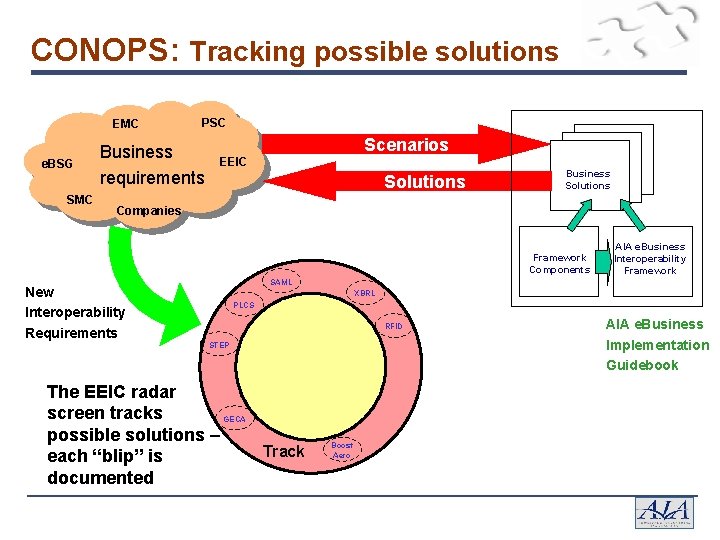
CONOPS: Tracking possible solutions EMC e. BSG SMC PSC Business requirements Scenarios EEIC Solutions Business Solutions Companies Framework Components New Interoperability Requirements AIA e. Business Interoperability Framework SAML XBRL PLCS RFID STEP The EEIC radar screen tracks GECA possible solutions – Track each “blip” is documented Boost Aero AIA e. Business Implementation Guidebook
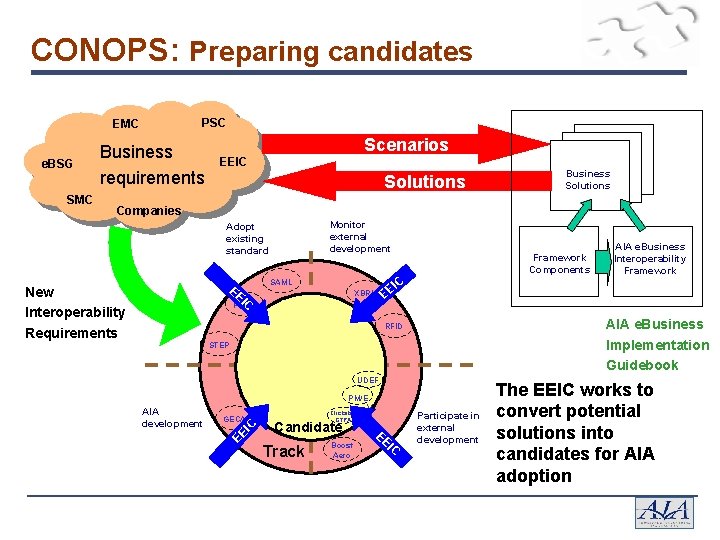
CONOPS: Preparing candidates PSC EMC e. BSG SMC Business requirements Scenarios EEIC Solutions Business Solutions Companies Monitor external development Adopt existing standard EE New Interoperability Requirements SAML XBRL IC PLCS Framework Components IC EE AIA e. Business Implementation Guidebook RFID STEP UDEF C GECA Candidate Track Boost Aero IC EE EE I AIA development PM/E V Clickable M GTPA AIA e. Business Interoperability Framework Participate in external development The EEIC works to convert potential solutions into candidates for AIA adoption
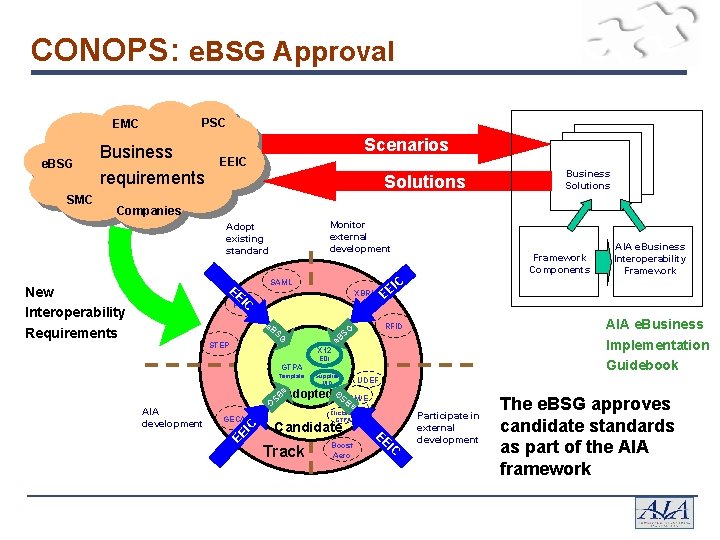
CONOPS: e. BSG Approval PSC EMC Scenarios EEIC Solutions Business Solutions Companies Monitor external development Adopt existing standard EE New Interoperability Requirements SAML XBRL IC PLCS e. B STEP X 12 S e. B EDI GTPA Template S e. B G PM/E V M Clickable GTPA Candidate Track Boost Aero IC EE EE I C GECA Adopted UDEF e AIA development Supplier UID AIA e. Business Interoperability Framework AIA e. Business Implementation Guidebook RFID G SG Framework Components IC EE BS G e. BSG Business requirements Participate in external development The e. BSG approves candidate standards as part of the AIA framework
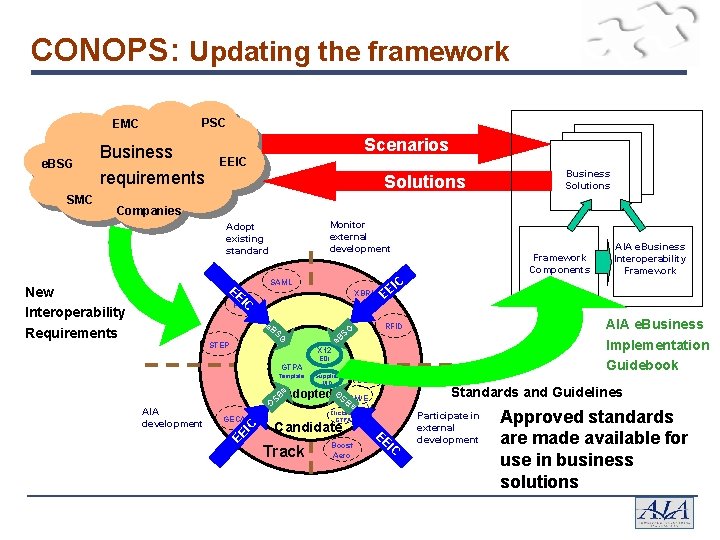
CONOPS: Updating the framework PSC EMC Scenarios EEIC Solutions Business Solutions Companies Monitor external development Adopt existing standard EE New Interoperability Requirements SAML XBRL IC PLCS e. B STEP X 12 S e. B EDI GTPA Template S e. B G Standards and Guidelines PM/E V Clickable M GTPA Candidate Track Boost Aero IC EE EE I C GECA Adopted UDEF e AIA development Supplier UID AIA e. Business Interoperability Framework AIA e. Business Implementation Guidebook RFID G SG Framework Components IC EE BS G e. BSG Business requirements Participate in external development Approved standards are made available for use in business solutions
The tools
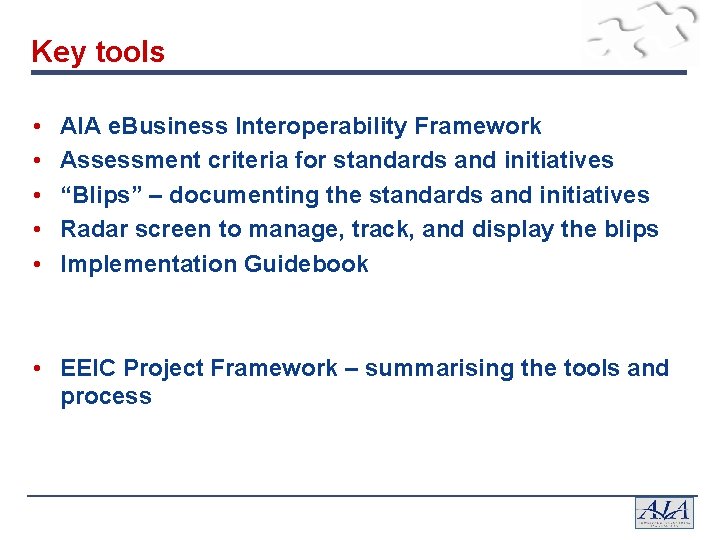
Key tools • • • AIA e. Business Interoperability Framework Assessment criteria for standards and initiatives “Blips” – documenting the standards and initiatives Radar screen to manage, track, and display the blips Implementation Guidebook • EEIC Project Framework – summarising the tools and process
AIA e. Business Interoperability Framework • Need to show complete landscape for interoperable e. Business • • • Assessment of initiatives Guidance for deploying solutions Must support cross-sectoral coherence Opportunity for multiple levels of detail Needs to be recognisable from IT viewpoint • Based on industry best practice • Developed based on NIST e. BSC and international Mo. U/MG work • Builds on many other models
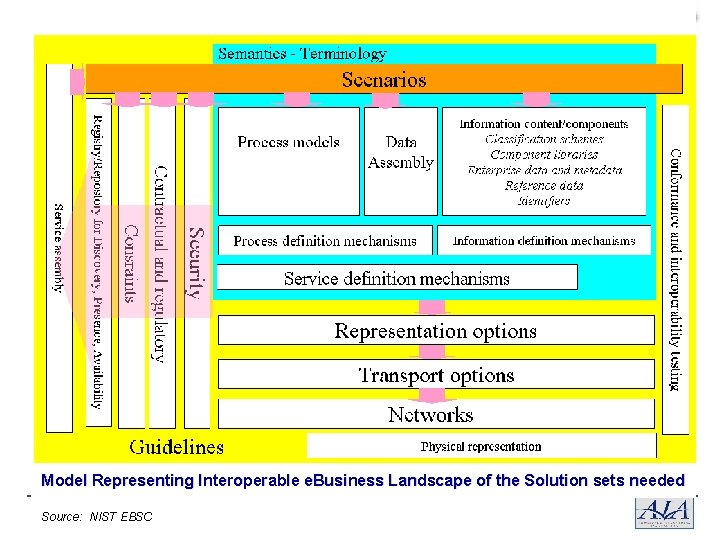
Model Representing Interoperable e. Business Landscape of the Solution sets needed Source: NIST EBSC
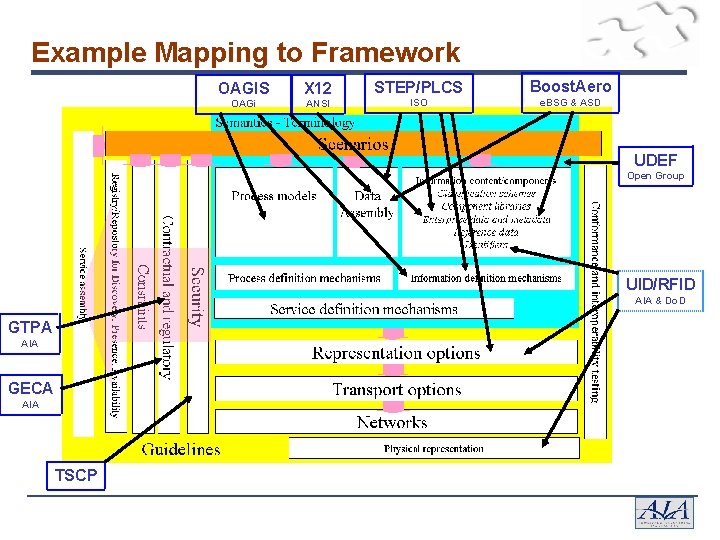
Example Mapping to Framework OAGIS X 12 STEP/PLCS Boost. Aero OAGi ANSI ISO e. BSG & ASD UDEF Open Group UID/RFID AIA & Do. D GTPA AIA GECA AIA TSCP
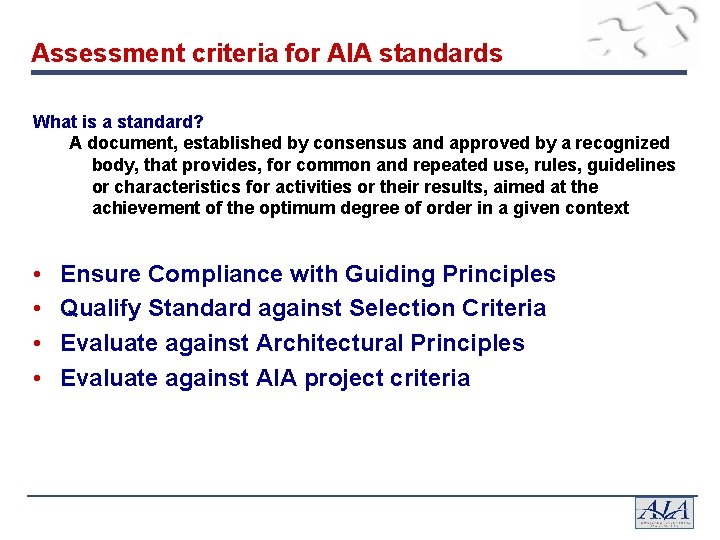
Assessment criteria for AIA standards What is a standard? A document, established by consensus and approved by a recognized body, that provides, for common and repeated use, rules, guidelines or characteristics for activities or their results, aimed at the achievement of the optimum degree of order in a given context • • Ensure Compliance with Guiding Principles Qualify Standard against Selection Criteria Evaluate against Architectural Principles Evaluate against AIA project criteria

Guiding Principles • Standards should be based on the consolidated results of science, technology and experience, and aimed at the promotion of optimum community benefits • Only recommend a standard for AIA adoption where it provides clear business value and supports the industry business strategy and requirements • Recommended standards must be within context of an overall architecture strategy that is driven by the business • Standards must be understood, supported, and planned for use by AIA membership • Leverage available standards and technologies, first within aerospace, then in the broader market • Partner with aero-related groups to increase adoption and lower workload: ATA, ASD, other AIA Councils etc • Avoid a standards war. Better to have a standard in production and replace it in five years than to have no standard. Quick wins.

Selection Criteria Indicators that might qualify a standard for AIA consideration: 1. 2. 3. 4. 5. 6. 7. 8. Current or potential basis for one or more Framework Components Web / Internet-based architecture / infrastructure standards Reach of the standards organization - preferably global “Open” host organization committed to collaboration with other groups to ensure interoperability Software / hardware vendor participation in the process and commitment to use the results in their products Critical mass for adoption Interoperability with the standards used by our customers and suppliers Adjacent Industry such as Auto, Ship, Electronics industries are using the same or similar
Architecture Principles govern and represent the criteria against which architectural decisions are made. These principles address the importance of investment and cost effective operations and should be tightly coupled with the criteria for Standards selection. 1. Business Must Drive Information Technology Architecture Decisions: The enterprise architecture and standards will be designed to (1) 2. 3. 4. 5. support and optimize operations, (2) be highly flexible to accommodate future business changes and (3) help ensure the overall success of the business. Use Industry Proven Approaches: Technology decisions must be based on industry proven and supported components, methods, and standards consistent with industry technological and market direction and as defined by the architecture. Open and/or Vendor Neutral Standards: Standards and technology choices will be based on open and/or vendor neutral standards that can be realistically implemented. Security and Access to Information: The Architecture must enable secure communications and appropriate protection of information and technology. Reduce Integration Complexity: Keep it simple. Standards, designs, and methods will be selected to reduce integration and infrastructure complexity.
AIA project criteria The project proposal needs to satisfy the criteria established by the AIA for all new projects • Within EEIC charter and scope • An issue the AIA can effectively address • A clearly defined and measurable outcome • Clearly defined sunset provisions • Senior-level commitment from multiple AIA member companies • Contributes to AIA meeting its goals and objectives • A clearly defined "customer pull" or "company push"
Radar blip • Used on radar screen to indicate status and maturity of standard • Expands to provide AIA position statement on a standard or initiative • Created as basic document to introduce standard or initiative • Updated to track progress • Records final disposition • Provides visibility to members

Information behind the “Radar blip” • • Abstract Full Title of Standard or Initiative (Acronym) • • Lead Organization within AIA • • • Responsible organisation Other stakeholders – by function/organisation Business justification Description of activity/deliverables Business benefits Location in EEIC Framework EEIC Action Plan – Monitor/Participate/Develop/Adopt – Guidelines? EEIC Status (updated) Adoption plan e. BSG adoption statement (final disposition) AIA recommendation (final disposition) Link to a standards host site Link to supporting material • Used for new tasks and updates • Word template – stored in PDF form

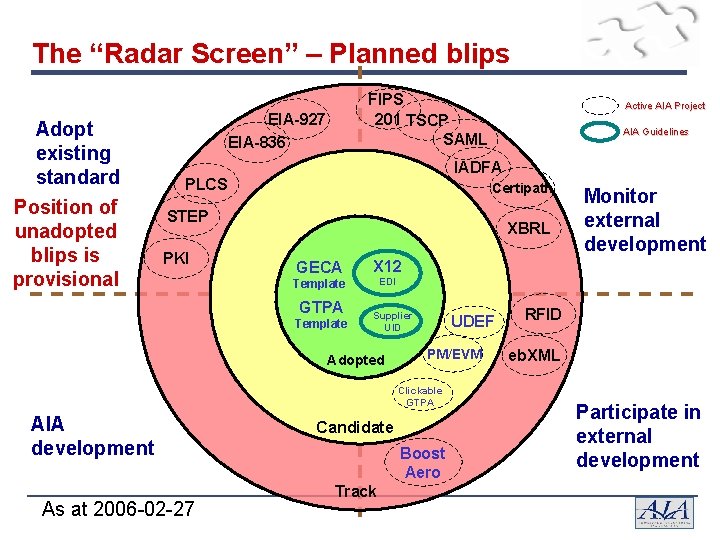
The “Radar Screen” • Simple view of AIA e. Business work programme • Illustrates • Items that may be of relevance to AIA • Candidate standards for adoption • Adopted standards that form part of the Interoperability Framework • Shows strategy for delivery of the candidate standards • Click on blip to get more information
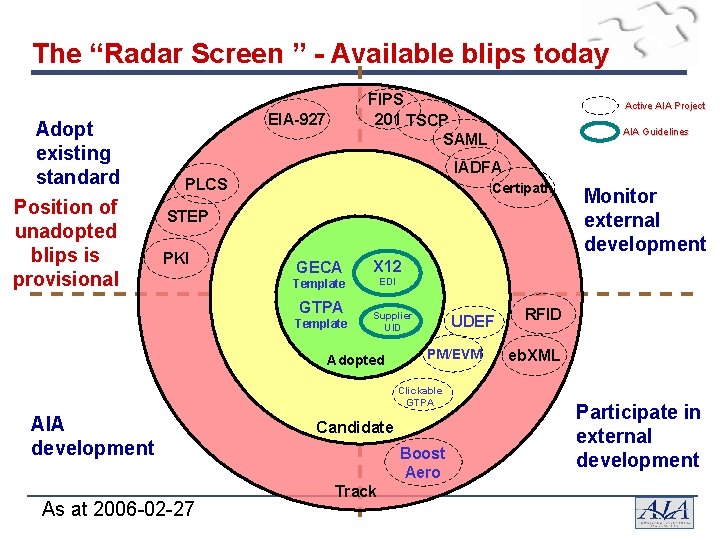
The “Radar Screen ” - Available blips today Adopt existing standard Position of unadopted blips is provisional FIPS 201 TSCP SAML EIA-927 Active AIA Project AIA Guidelines IADFA PLCS Certipath STEP PKI GECA • X 12 Supplier EDI Template • UID GTPA Template Supplier UID Adopted As at 2006 -02 -27 Candidate Boost Aero Track UDEF PM/EVM Clickable GTPA AIA development Monitor external development RFID eb. XML Participate in external development
The “Radar Screen” – Planned blips Adopt existing standard Position of unadopted blips is provisional FIPS 201 TSCP SAML EIA-927 EIA-836 Active AIA Project AIA Guidelines IADFA PLCS Certipath STEP PKI XBRL GECA • X 12 Supplier EDI Template • UID GTPA Template Supplier UID Adopted As at 2006 -02 -27 Candidate Boost Aero Track UDEF PM/EVM Clickable GTPA AIA development Monitor external development RFID eb. XML Participate in external development
AIA e. Business Implementation Guidebook • • • Concept of operations EEIC standards selection process e. Business Interoperability Framework Extensible taxonomy of framework components Extensible set of scenarios and corresponding solutions • • • Scenarios Components required Architectural guidance – design time Implementation guidance – build time Operational guidance – run time • Core still under development, based on available material
The Process
EEIC process: Identify the need Business need Need for new Framework Component Opportunity
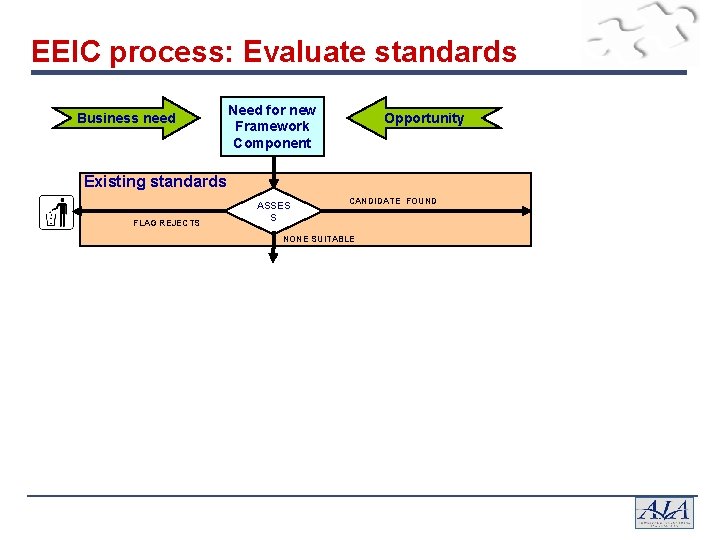
EEIC process: Evaluate standards Business need Need for new Framework Component Opportunity Existing standards FLAG REJECTS ASSES S CANDIDATE FOUND NONE SUITABLE

EEIC process: Define project Business need Need for new Framework Component Opportunity BLIP NONE SUITABLE Guidelines if needed CANDIDATE FOUND Adoption plan FLAG REJECTS ASSES S Strategy for component Existing standards
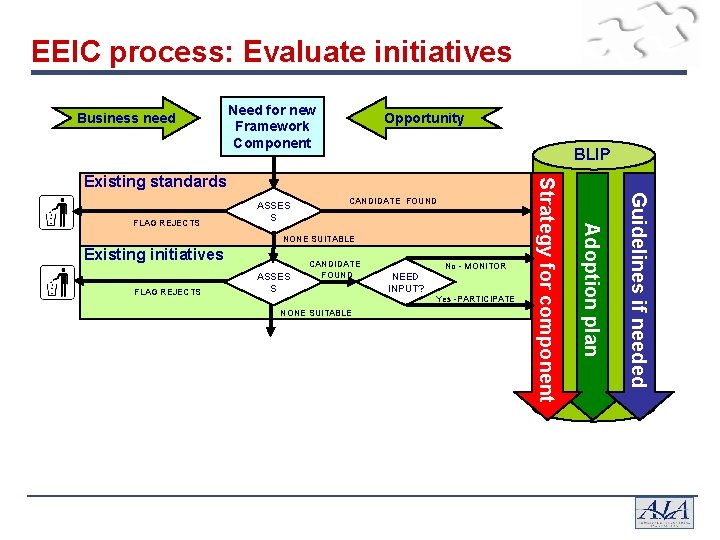
EEIC process: Evaluate initiatives Business need Need for new Framework Component Opportunity BLIP NONE SUITABLE Existing initiatives FLAG REJECTS ASSES S CANDIDATE FOUND NONE SUITABLE NEED INPUT? No - MONITOR Yes -PARTICIPATE Guidelines if needed CANDIDATE FOUND Adoption plan FLAG REJECTS ASSES S Strategy for component Existing standards
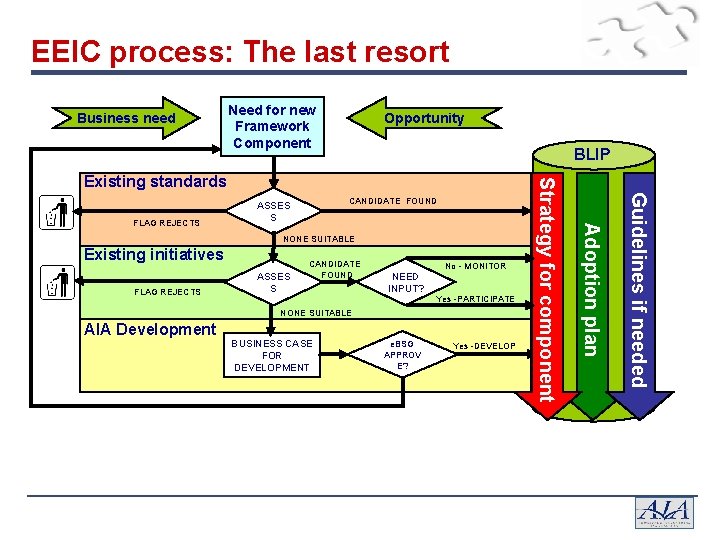
EEIC process: The last resort Business need Need for new Framework Component Opportunity BLIP Existing initiatives FLAG REJECTS ASSES S CANDIDATE FOUND NEED INPUT? No - MONITOR Yes -PARTICIPATE NONE SUITABLE AIA Development BUSINESS CASE FOR DEVELOPMENT e. BSG APPROV E? Yes -DEVELOP Guidelines if needed NONE SUITABLE Adoption plan FLAG REJECTS CANDIDATE FOUND ASSES S Strategy for component Existing standards
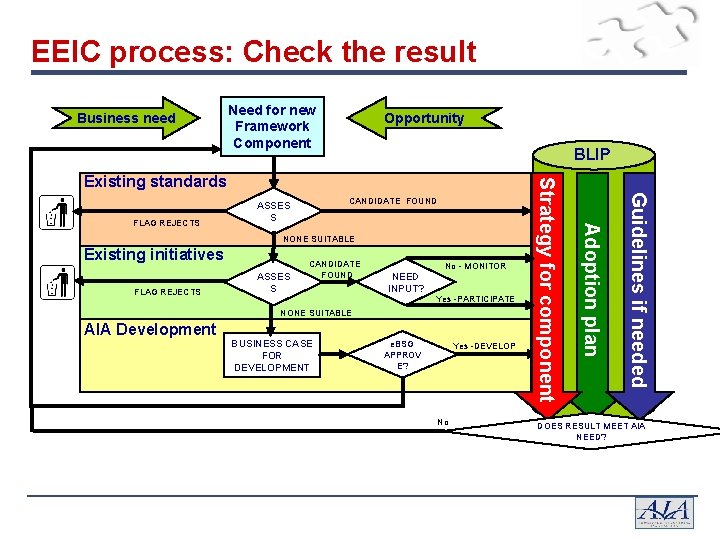
EEIC process: Check the result Business need Need for new Framework Component Opportunity BLIP Existing initiatives FLAG REJECTS ASSES S CANDIDATE FOUND NEED INPUT? No - MONITOR Yes -PARTICIPATE NONE SUITABLE AIA Development BUSINESS CASE FOR DEVELOPMENT e. BSG APPROV E? Yes -DEVELOP No Guidelines if needed NONE SUITABLE Adoption plan FLAG REJECTS CANDIDATE FOUND ASSES S Strategy for component Existing standards DOES RESULT MEET AIA NEED?
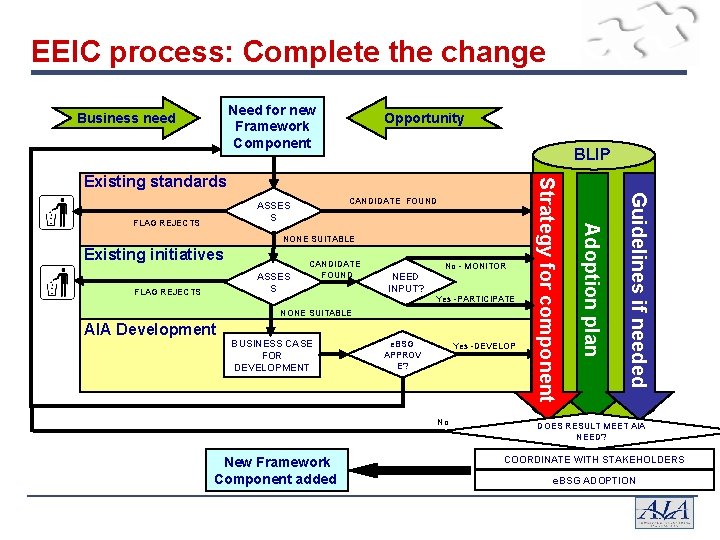
EEIC process: Complete the change Need for new Framework Component Business need Opportunity BLIP NONE SUITABLE Existing initiatives ASSES S FLAG REJECTS CANDIDATE FOUND NEED INPUT? No - MONITOR Yes -PARTICIPATE NONE SUITABLE AIA Development BUSINESS CASE FOR DEVELOPMENT e. BSG APPROV E? Yes -DEVELOP No New Framework Component added Adoption plan FLAG REJECTS Guidelines if needed CANDIDATE FOUND ASSES S Strategy for component Existing standards DOES RESULT MEET AIA NEED? COORDINATE WITH STAKEHOLDERS e. BSG ADOPTION
- Slides: 35