
EEG Investigation of MirrorNeuron Activity Before and After
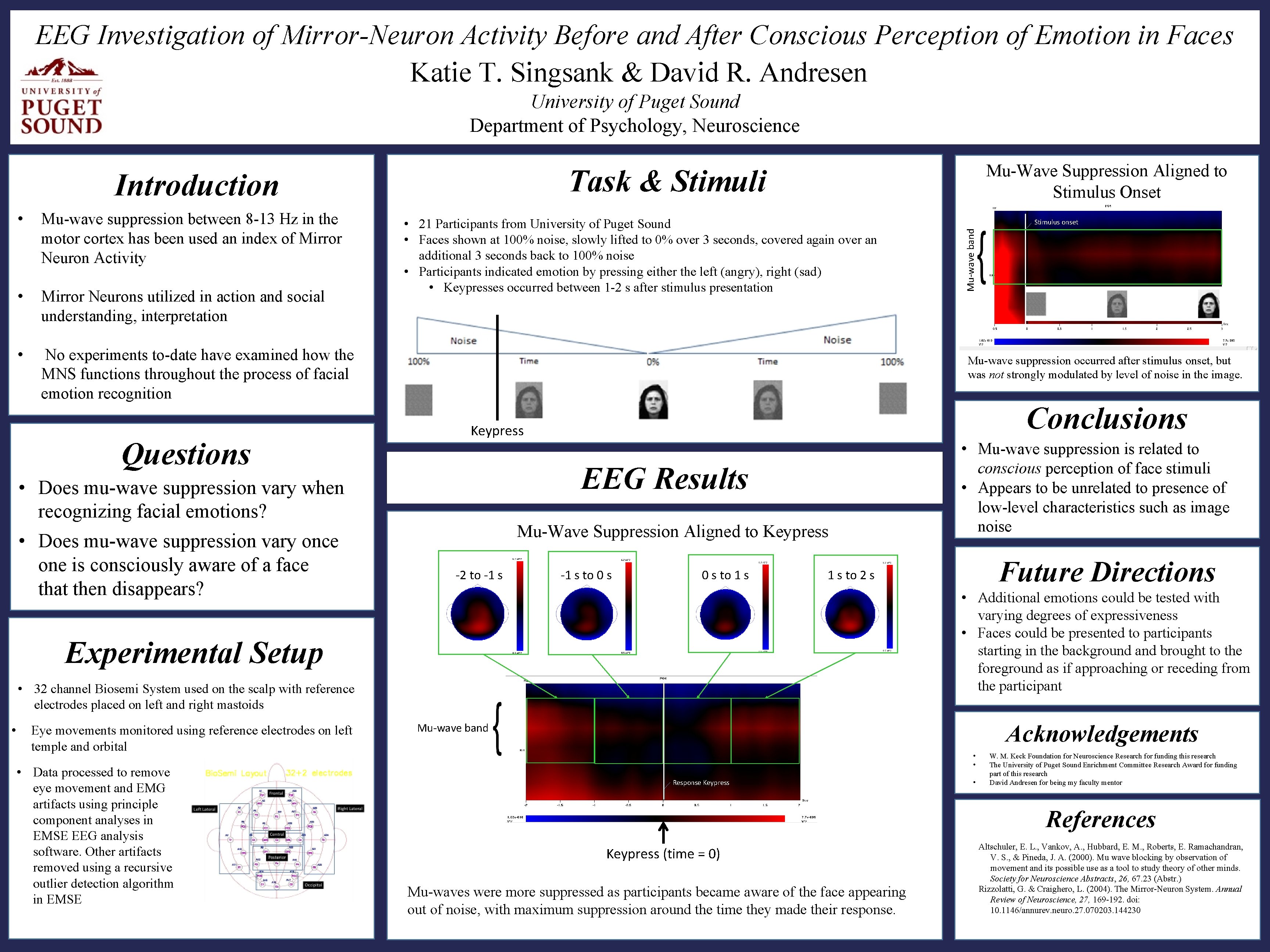
EEG Investigation of Mirror-Neuron Activity Before and After Conscious Perception of Emotion in Faces Katie T. Singsank & David R. Andresen University of Puget Sound Department of Psychology, Neuroscience Task & Stimuli Mu-wave suppression between 8 -13 Hz in the motor cortex has been used an index of Mirror Neuron Activity • Mirror Neurons utilized in action and social understanding, interpretation • No experiments to-date have examined how the MNS functions throughout the process of facial emotion recognition Questions • Does mu-wave suppression vary when recognizing facial emotions? • Does mu-wave suppression vary once one is consciously aware of a face that then disappears? • 21 Participants from University of Puget Sound • Faces shown at 100% noise, slowly lifted to 0% over 3 seconds, covered again over an additional 3 seconds back to 100% noise • Participants indicated emotion by pressing either the left (angry), right (sad) • Keypresses occurred between 1 -2 s after stimulus presentation Mu-wave suppression occurred after stimulus onset, but was not strongly modulated by level of noise in the image. Conclusions Keypress EEG Results Mu-Wave Suppression Aligned to Keypress -2 to -1 s to 0 s to 1 s • Data processed to remove eye movement and EMG artifacts using principle component analyses in EMSE EEG analysis software. Other artifacts removed using a recursive outlier detection algorithm in EMSE Future Directions • Additional emotions could be tested with varying degrees of expressiveness • Faces could be presented to participants starting in the background and brought to the foreground as if approaching or receding from the participant • 32 channel Biosemi System used on the scalp with reference electrodes placed on left and right mastoids Eye movements monitored using reference electrodes on left temple and orbital • Mu-wave suppression is related to conscious perception of face stimuli • Appears to be unrelated to presence of low-level characteristics such as image noise 1 s to 2 s Experimental Setup • Stimulus onset Mu-wave band Introduction • Mu-Wave Suppression Aligned to Stimulus Onset Acknowledgements Mu-wave band • • Response Keypress • W. M. Keck Foundation for Neuroscience Research for funding this research The University of Puget Sound Enrichment Committee Research Award for funding part of this research David Andresen for being my faculty mentor References Keypress (time = 0) Mu-waves were more suppressed as participants became aware of the face appearing out of noise, with maximum suppression around the time they made their response. Altschuler, E. L. , Vankov, A. , Hubbard, E. M. , Roberts, E. Ramachandran, V. S. , & Pineda, J. A. (2000). Mu wave blocking by observation of movement and its possible use as a tool to study theory of other minds. Society for Neuroscience Abstracts, 26, 67. 23 (Abstr. ) Rizzolatti, G. & Craighero, L. (2004). The Mirror-Neuron System. Annual Review of Neuroscience, 27, 169 -192. doi: 10. 1146/annurev. neuro. 27. 070203. 144230
- Slides: 1