
EEG Event Classification Using Deep Learning Vinit Shah
- Slides: 14
EEG Event Classification Using Deep Learning Vinit Shah and Joseph Picone Neural Engineering Data Consortium Temple University
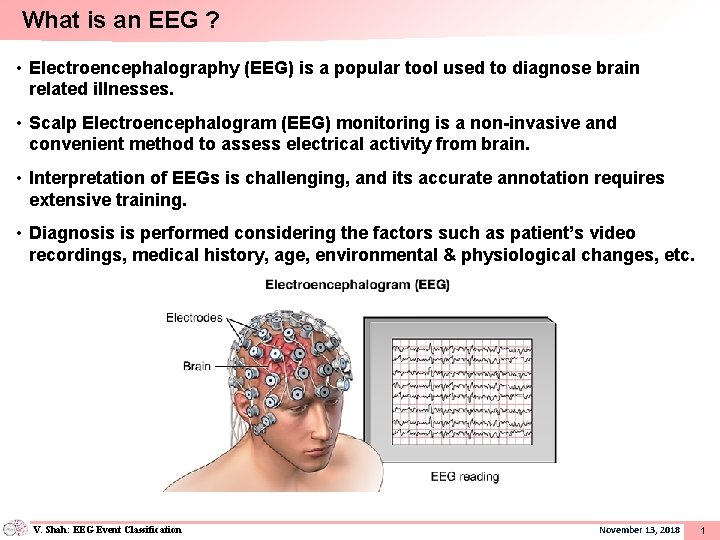
What is an EEG ? • Electroencephalography (EEG) is a popular tool used to diagnose brain related illnesses. • Scalp Electroencephalogram (EEG) monitoring is a non-invasive and convenient method to assess electrical activity from brain. • Interpretation of EEGs is challenging, and its accurate annotation requires extensive training. • Diagnosis is performed considering the factors such as patient’s video recordings, medical history, age, environmental & physiological changes, etc. V. Shah: EEG Event Classification November 13, 2018 1
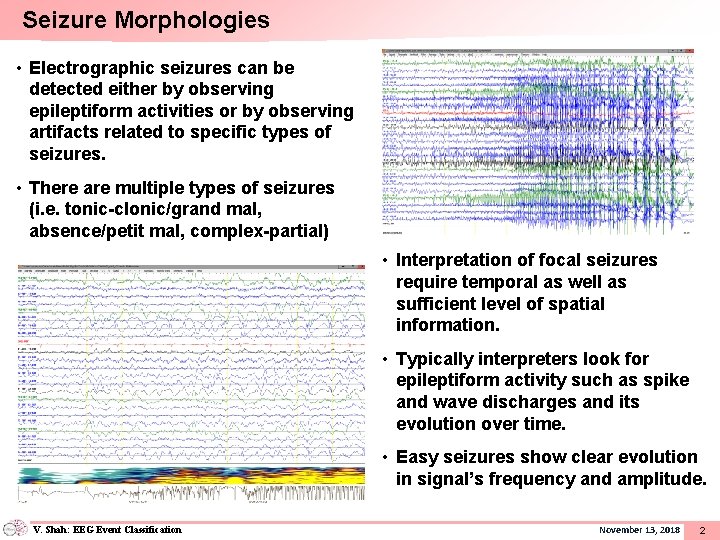
Seizure Morphologies • Electrographic seizures can be detected either by observing epileptiform activities or by observing artifacts related to specific types of seizures. • There are multiple types of seizures (i. e. tonic-clonic/grand mal, absence/petit mal, complex-partial) • Interpretation of focal seizures require temporal as well as sufficient level of spatial information. • Typically interpreters look for epileptiform activity such as spike and wave discharges and its evolution over time. • Easy seizures show clear evolution in signal’s frequency and amplitude. V. Shah: EEG Event Classification November 13, 2018 2
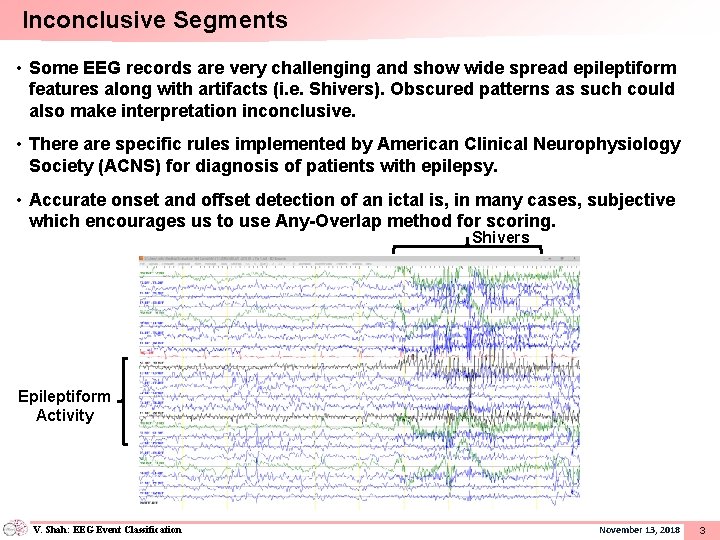
Inconclusive Segments • Some EEG records are very challenging and show wide spread epileptiform features along with artifacts (i. e. Shivers). Obscured patterns as such could also make interpretation inconclusive. • There are specific rules implemented by American Clinical Neurophysiology Society (ACNS) for diagnosis of patients with epilepsy. • Accurate onset and offset detection of an ictal is, in many cases, subjective which encourages us to use Any-Overlap method for scoring. Shivers Epileptiform Activity V. Shah: EEG Event Classification November 13, 2018 3
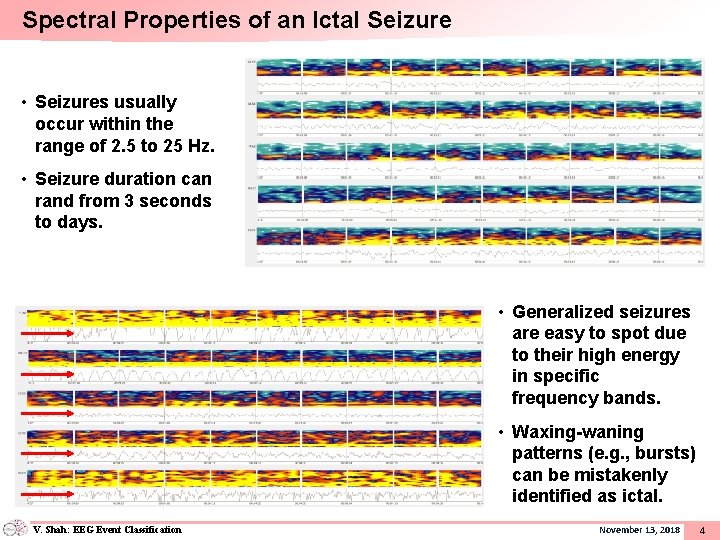
Spectral Properties of an Ictal Seizure • Seizures usually occur within the range of 2. 5 to 25 Hz. • Seizure duration can rand from 3 seconds to days. • Generalized seizures are easy to spot due to their high energy in specific frequency bands. • Waxing-waning patterns (e. g. , bursts) can be mistakenly identified as ictal. V. Shah: EEG Event Classification November 13, 2018 4
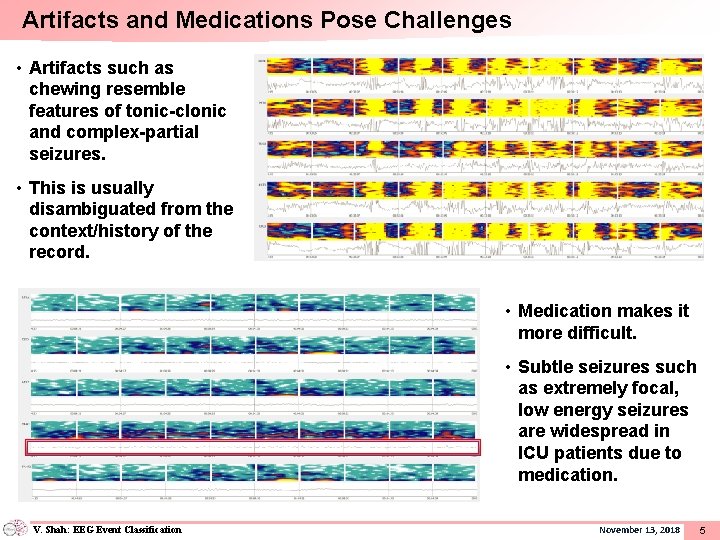
Artifacts and Medications Pose Challenges • Artifacts such as chewing resemble features of tonic-clonic and complex-partial seizures. • This is usually disambiguated from the context/history of the record. • Medication makes it more difficult. • Subtle seizures such as extremely focal, low energy seizures are widespread in ICU patients due to medication. V. Shah: EEG Event Classification November 13, 2018 5
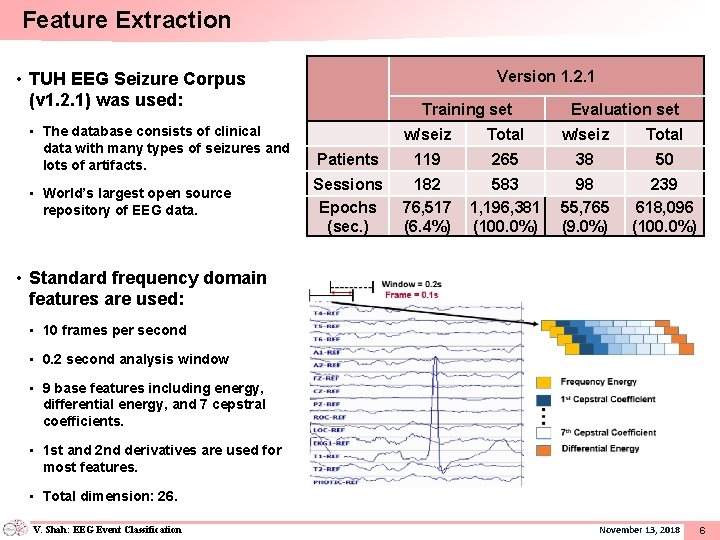
Feature Extraction Version 1. 2. 1 • TUH EEG Seizure Corpus (v 1. 2. 1) was used: • The database consists of clinical data with many types of seizures and lots of artifacts. • World’s largest open source repository of EEG data. Training set Evaluation set w/seiz Total Patients 119 265 38 50 Sessions Epochs (sec. ) 182 76, 517 (6. 4%) 583 1, 196, 381 (100. 0%) 98 55, 765 (9. 0%) 239 618, 096 (100. 0%) • Standard frequency domain features are used: • 10 frames per second • 0. 2 second analysis window • 9 base features including energy, differential energy, and 7 cepstral coefficients. • 1 st and 2 nd derivatives are used for most features. • Total dimension: 26. V. Shah: EEG Event Classification November 13, 2018 6
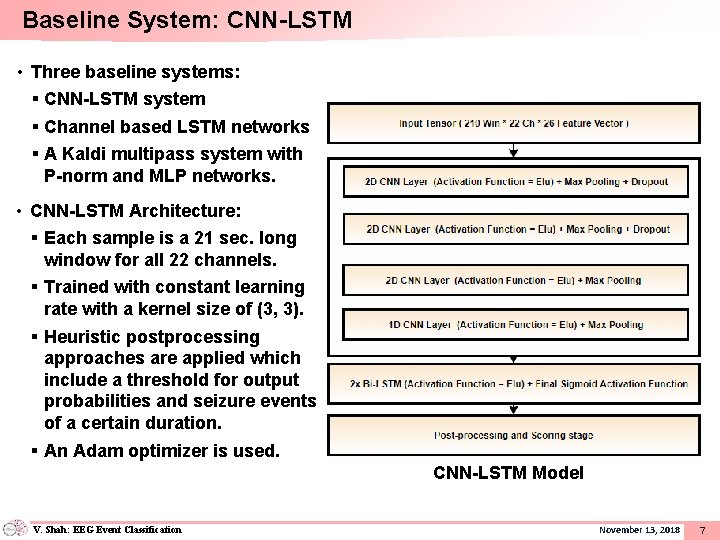
Baseline System: CNN-LSTM • Three baseline systems: § CNN-LSTM system § Channel based LSTM networks § A Kaldi multipass system with P-norm and MLP networks. • CNN-LSTM Architecture: § Each sample is a 21 sec. long window for all 22 channels. § Trained with constant learning rate with a kernel size of (3, 3). § Heuristic postprocessing approaches are applied which include a threshold for output probabilities and seizure events of a certain duration. § An Adam optimizer is used. CNN-LSTM Model V. Shah: EEG Event Classification November 13, 2018 7
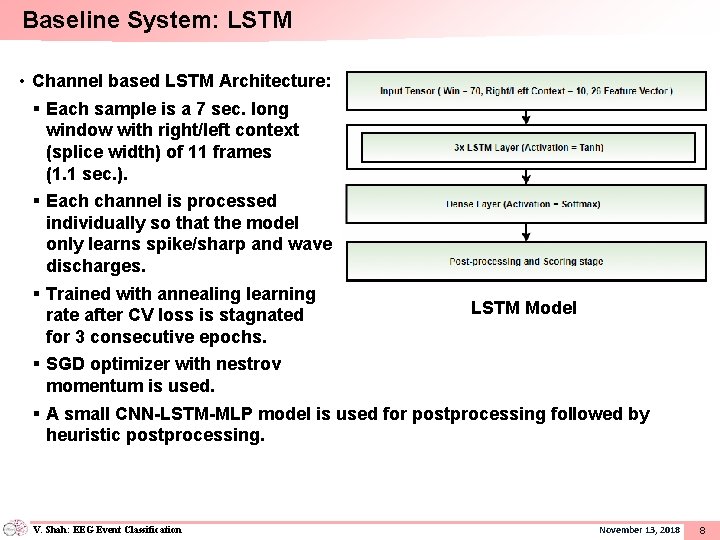
Baseline System: LSTM • Channel based LSTM Architecture: § Each sample is a 7 sec. long window with right/left context (splice width) of 11 frames (1. 1 sec. ). § Each channel is processed individually so that the model only learns spike/sharp and wave discharges. § Trained with annealing learning LSTM Model rate after CV loss is stagnated for 3 consecutive epochs. § SGD optimizer with nestrov momentum is used. § A small CNN-LSTM-MLP model is used for postprocessing followed by heuristic postprocessing. V. Shah: EEG Event Classification November 13, 2018 8
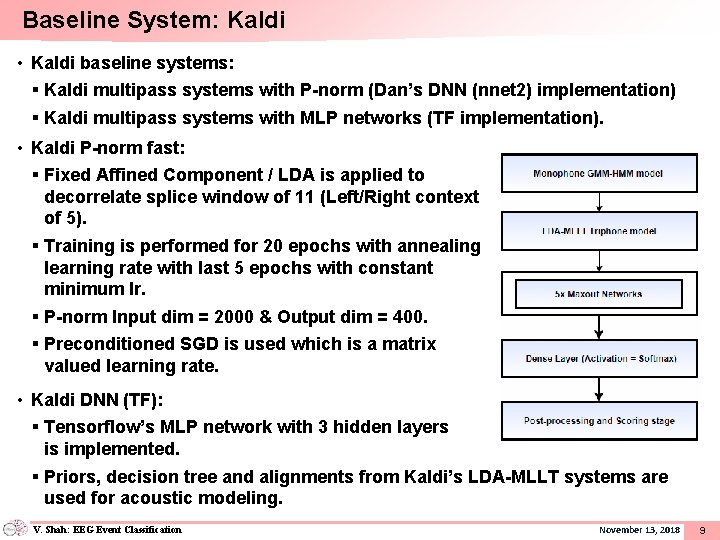
Baseline System: Kaldi • Kaldi baseline systems: § Kaldi multipass systems with P-norm (Dan’s DNN (nnet 2) implementation) § Kaldi multipass systems with MLP networks (TF implementation). • Kaldi P-norm fast: § Fixed Affined Component / LDA is applied to decorrelate splice window of 11 (Left/Right context of 5). § Training is performed for 20 epochs with annealing learning rate with last 5 epochs with constant minimum lr. § P-norm Input dim = 2000 & Output dim = 400. § Preconditioned SGD is used which is a matrix valued learning rate. • Kaldi DNN (TF): § Tensorflow’s MLP network with 3 hidden layers is implemented. § Priors, decision tree and alignments from Kaldi’s LDA-MLLT systems are used for acoustic modeling. V. Shah: EEG Event Classification November 13, 2018 9
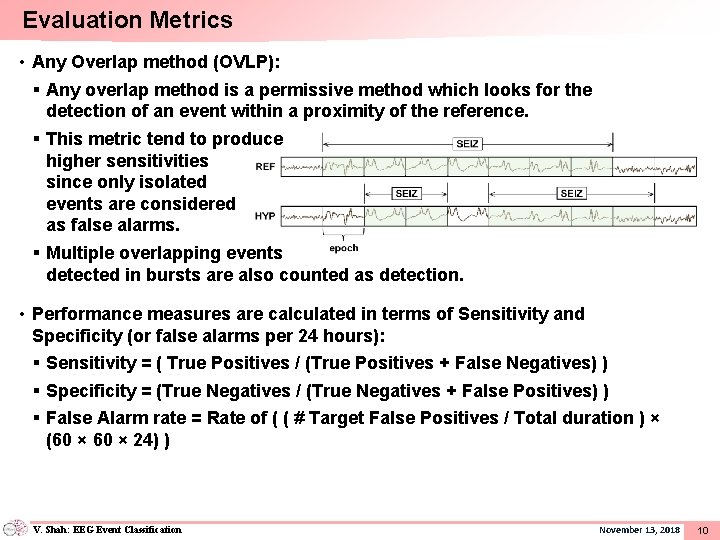
Evaluation Metrics • Any Overlap method (OVLP): § Any overlap method is a permissive method which looks for the detection of an event within a proximity of the reference. § This metric tend to produce higher sensitivities since only isolated events are considered as false alarms. § Multiple overlapping events detected in bursts are also counted as detection. • Performance measures are calculated in terms of Sensitivity and Specificity (or false alarms per 24 hours): § Sensitivity = ( True Positives / (True Positives + False Negatives) ) § Specificity = (True Negatives / (True Negatives + False Positives) ) § False Alarm rate = Rate of ( ( # Target False Positives / Total duration ) × (60 × 24) ) V. Shah: EEG Event Classification November 13, 2018 10
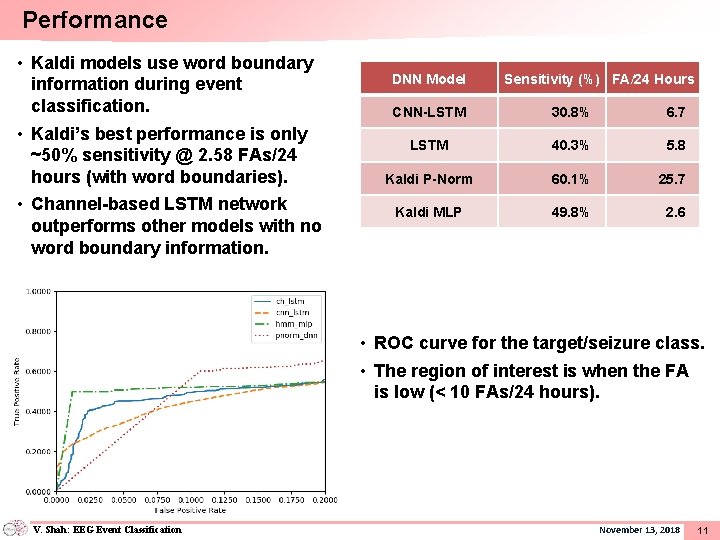
Performance • Kaldi models use word boundary information during event classification. • Kaldi’s best performance is only ~50% sensitivity @ 2. 58 FAs/24 hours (with word boundaries). • Channel-based LSTM network outperforms other models with no word boundary information. DNN Model Sensitivity (%) FA/24 Hours CNN-LSTM 30. 8% 6. 7 LSTM 40. 3% 5. 8 Kaldi P-Norm 60. 1% 25. 7 Kaldi MLP 49. 8% 2. 6 • ROC curve for the target/seizure class. • The region of interest is when the FA is low (< 10 FAs/24 hours). V. Shah: EEG Event Classification November 13, 2018 11
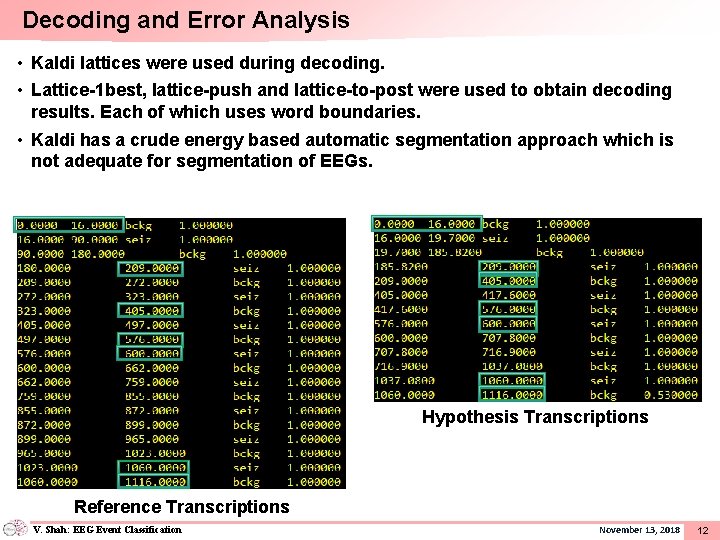
Decoding and Error Analysis • Kaldi lattices were used during decoding. • Lattice-1 best, lattice-push and lattice-to-post were used to obtain decoding results. Each of which uses word boundaries. • Kaldi has a crude energy based automatic segmentation approach which is not adequate for segmentation of EEGs. Hypothesis Transcriptions Reference Transcriptions V. Shah: EEG Event Classification November 13, 2018 12
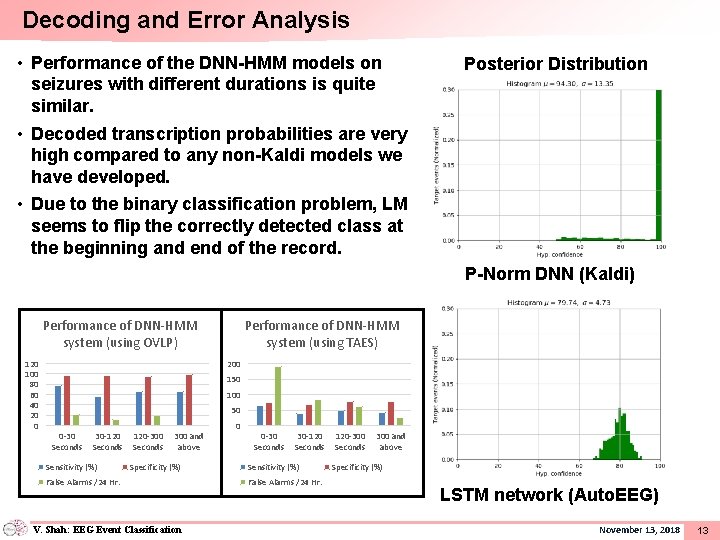
Decoding and Error Analysis • Performance of the DNN-HMM models on seizures with different durations is quite similar. • Decoded transcription probabilities are very high compared to any non-Kaldi models we have developed. • Due to the binary classification problem, LM seems to flip the correctly detected class at the beginning and end of the record. Posterior Distribution P-Norm DNN (Kaldi) Performance of DNN-HMM system (using OVLP) 120 100 80 60 40 20 0 Performance of DNN-HMM system (using TAES) 200 150 100 50 0 -30 Seconds 30 -120 Seconds Sensitivity (%) 120 -300 Seconds 300 and above Specificity (%) False Alarms /24 Hr. V. Shah: EEG Event Classification 0 0 -30 Seconds 30 -120 Seconds Sensitivity (%) False Alarms /24 Hr. 120 -300 Seconds 300 and above Specificity (%) LSTM network (Auto. EEG) November 13, 2018 13