
EEENanuk A modular cosmic ray scintillator detector from
- Slides: 5
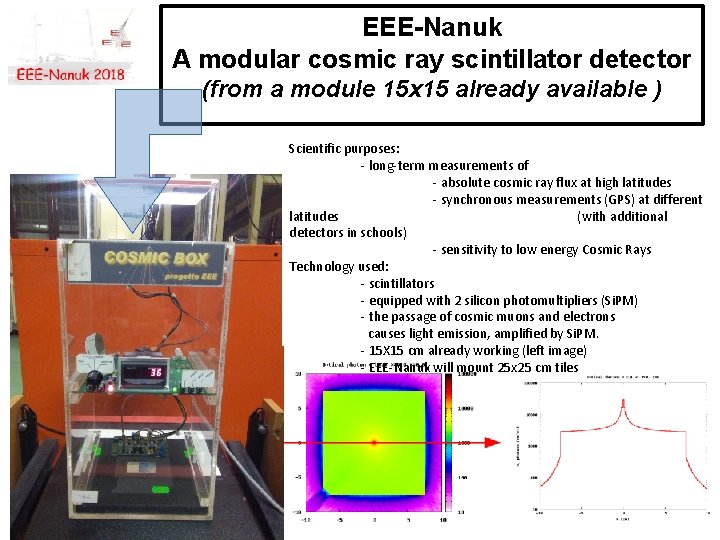
EEE-Nanuk A modular cosmic ray scintillator detector (from a module 15 x 15 already available ) Scientific purposes: - long-term measurements of - absolute cosmic ray flux at high latitudes - 15 x 15 cm scintillator - synchronous measurements (GPS) at different - read out: pair of Si. PM (Advansid) latitudes (with additional directly coupled to the scintillator without fiber detectors in schools) - sensitivity to low energy Cosmic Rays Technology used: - scintillators - equipped with 2 silicon photomultipliers (Si. PM) - the passage of cosmic muons and electrons causes light emission, amplified by Si. PM. - 15 X 15 cm already working (left image) - EEE-Nanuk will mount 25 x 25 cm tiles
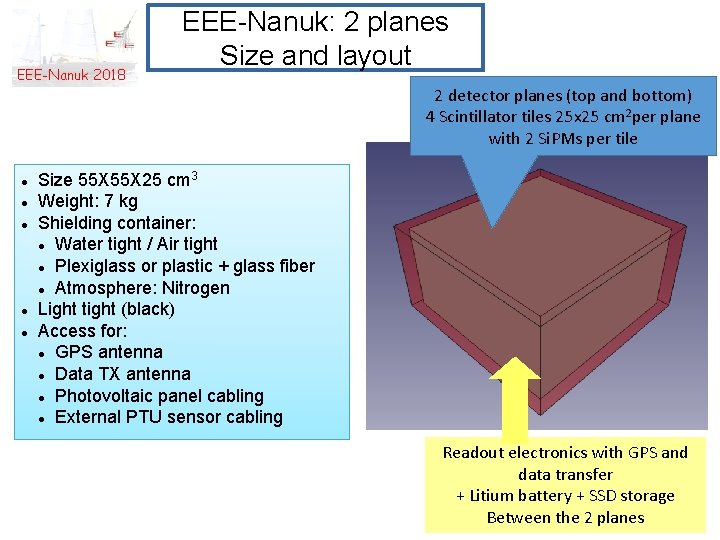
EEE-Nanuk 2018 EEE-Nanuk: 2 planes Size and layout 2 detector planes (top and bottom) 4 Scintillator tiles 25 x 25 cm 2 per plane with 2 Si. PMs per tile Size 55 X 25 cm 3 Weight: 7 kg Shielding container: Water tight / Air tight Plexiglass or plastic + glass fiber Atmosphere: Nitrogen Light tight (black) Access for: GPS antenna Data TX antenna Photovoltaic panel cabling External PTU sensor cabling Readout electronics with GPS and data transfer + Litium battery + SSD storage Between the 2 planes
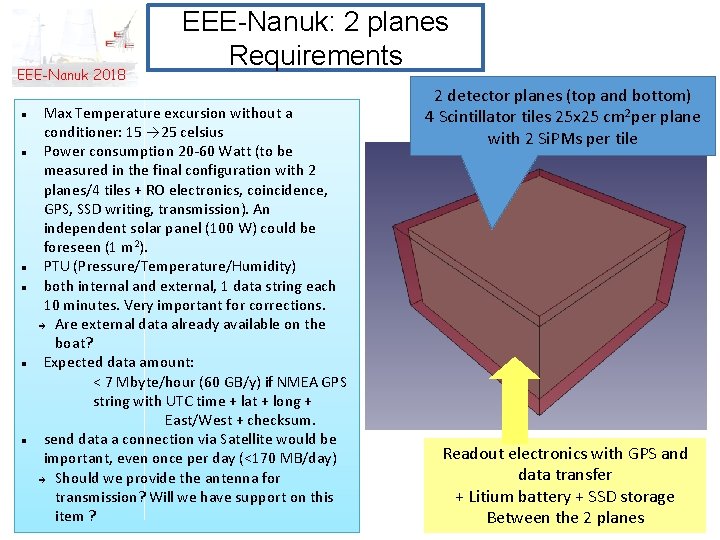
EEE-Nanuk 2018 EEE-Nanuk: 2 planes Requirements Max Temperature excursion without a conditioner: 15 → 25 celsius Power consumption 20 -60 Watt (to be measured in the final configuration with 2 planes/4 tiles + RO electronics, coincidence, GPS, SSD writing, transmission). An independent solar panel (100 W) could be foreseen (1 m 2). PTU (Pressure/Temperature/Humidity) both internal and external, 1 data string each 10 minutes. Very important for corrections. Are external data already available on the boat? Expected data amount: < 7 Mbyte/hour (60 GB/y) if NMEA GPS string with UTC time + lat + long + East/West + checksum. send data a connection via Satellite would be important, even once per day (<170 MB/day) Should we provide the antenna for transmission? Will we have support on this item ? 2 detector planes (top and bottom) 4 Scintillator tiles 25 x 25 cm 2 per plane with 2 Si. PMs per tile Readout electronics with GPS and data transfer + Litium battery + SSD storage Between the 2 planes
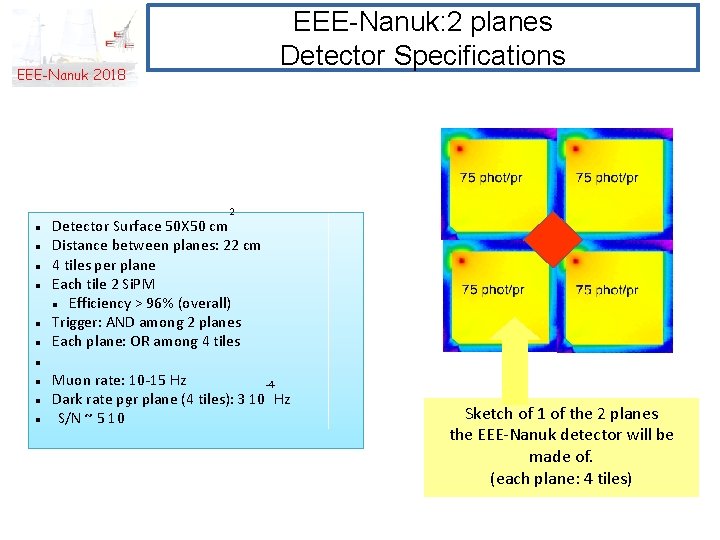
EEE-Nanuk: 2 planes Detector Specifications EEE-Nanuk 2018 2 Detector Surface 50 X 50 cm Distance between planes: 22 cm 4 tiles per plane Each tile 2 Si. PM Efficiency > 96% (overall) Trigger: AND among 2 planes Each plane: OR among 4 tiles Muon rate: 10 -15 Hz -4 Dark rate per 3 plane (4 tiles): 3 10 Hz S/N ~ 5 10 Sketch of 1 of the 2 planes the EEE-Nanuk detector will be made of. (each plane: 4 tiles)
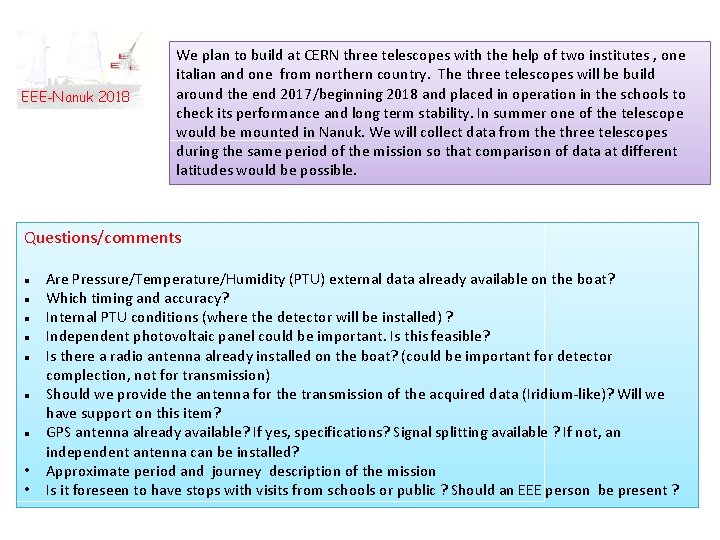
EEE-Nanuk 2018 We plan to build at CERN three telescopes with the help of two institutes , one italian and one from northern country. The three telescopes will be build around the end 2017/beginning 2018 and placed in operation in the schools to check its performance and long term stability. In summer one of the telescope would be mounted in Nanuk. We will collect data from the three telescopes during the same period of the mission so that comparison of data at different latitudes would be possible. Questions/comments • • Are Pressure/Temperature/Humidity (PTU) external data already available on the boat? Which timing and accuracy? Internal PTU conditions (where the detector will be installed) ? Independent photovoltaic panel could be important. Is this feasible? Is there a radio antenna already installed on the boat? (could be important for detector complection, not for transmission) Should we provide the antenna for the transmission of the acquired data (Iridium-like)? Will we have support on this item? GPS antenna already available? If yes, specifications? Signal splitting available ? If not, an independent antenna can be installed? Approximate period and journey description of the mission Is it foreseen to have stops with visits from schools or public ? Should an EEE person be present ?