
EEE 440 Modern Communication Systems Wireless and Mobile
EEE 440 Modern Communication Systems Wireless and Mobile Communications
Introduction • What is wireless communication? • What is mobile communication? • Different types of mobile wireless systems – Cellular – Wireless LAN – Wireless MAN – Wireless PAN – Mobile Ad-hoc network (MANET)
Characteristics of Mobile Wireless radio propagation 6 common effects • Propagation loss • Fading – Large Scale (Shadow fading) – Small scale (multipath fading) • Doppler shift • Frequency-selective fading • Time-selective fading
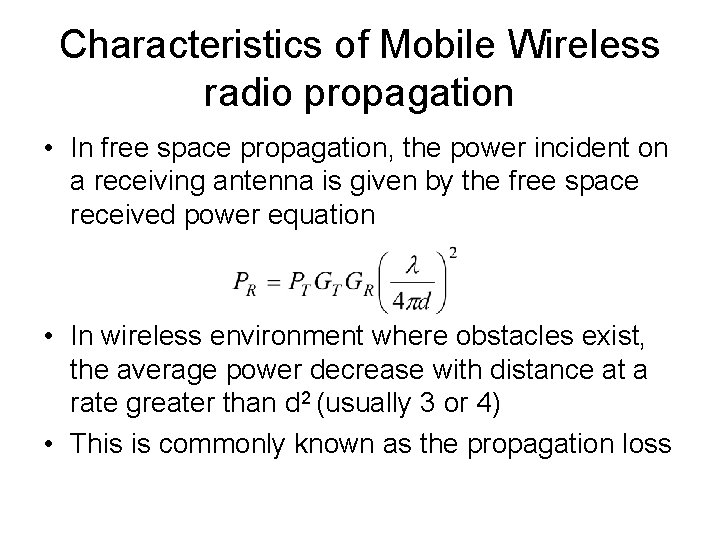
Characteristics of Mobile Wireless radio propagation • In free space propagation, the power incident on a receiving antenna is given by the free space received power equation • In wireless environment where obstacles exist, the average power decrease with distance at a rate greater than d 2 (usually 3 or 4) • This is commonly known as the propagation loss
Characteristics of Mobile Wireless radio propagation • The actual power received over a relatively long distance will vary randomly about the average power – A good approximation reveals that the power measured in decibel follows a gaussian or normal distribution centred about its average value with some standard deviation ranging typically from 6 to 10 d. B. – The power probability distribution is commonly called a log-normal distribution – This is commonly referred to as shadow fading
Characteristics of Mobile Wireless radio propagation • The actual power received over a much smaller distance also vary considerably due to the destructive/constructive interference of multiple signals that follow multiple paths – This is commonly referred to as multipath fading
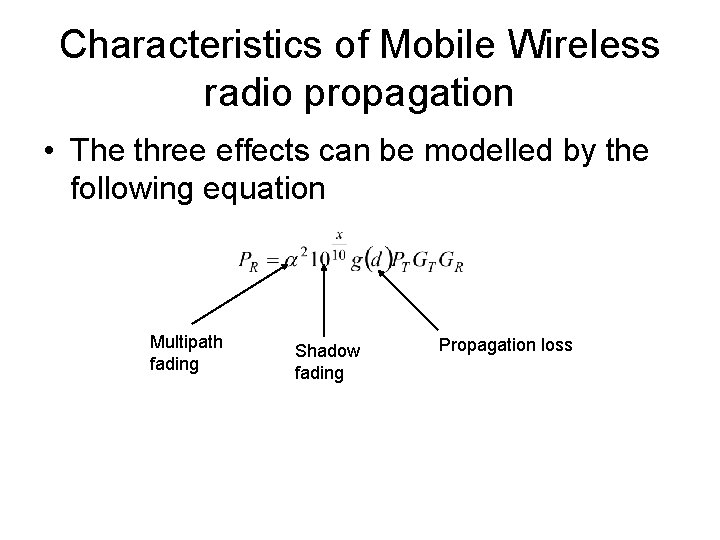
Characteristics of Mobile Wireless radio propagation • The three effects can be modelled by the following equation Multipath fading Shadow fading Propagation loss
Characteristics of Mobile Wireless radio propagation • Terminal mobility with respective to the incoming wave introduces a frequency shift called Doppler shift • Signal fades due to the movement of the terminal
Characteristics of Mobile Wireless radio propagation • The effect of multipath fading depends of the signal bandwidth • For a relatively large bandwidth, different frequency components of the signal being handled differently over the propagation path leading to signal distortion called frequency selective fading • This is manifested in inter-symbol interference (ISI) due to successive digital symbols overlap into adjacent symbol intervals • For narrower signal bandwidth, non-selective of flat fading occur
Characteristics of Mobile Wireless radio propagation • Time selective fading occurs when the channel changes its characteristics during the transmission of the signal • The change in the channel characteristics is proportional to the receiver mobility
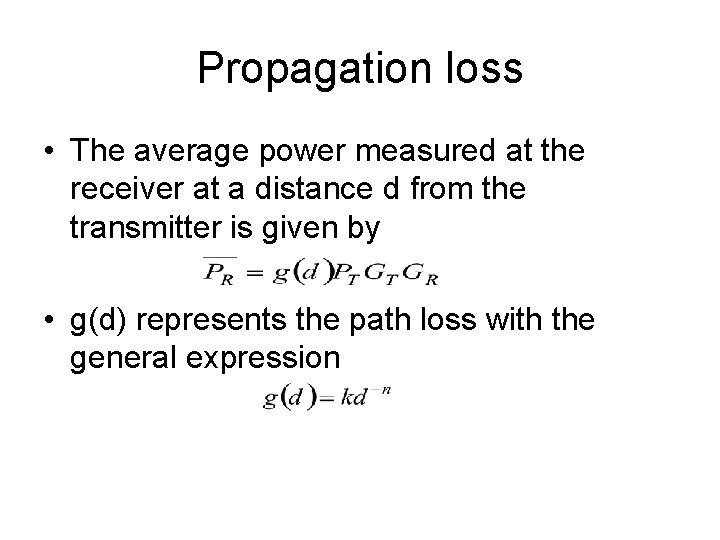
Propagation loss • The average power measured at the receiver at a distance d from the transmitter is given by • g(d) represents the path loss with the general expression
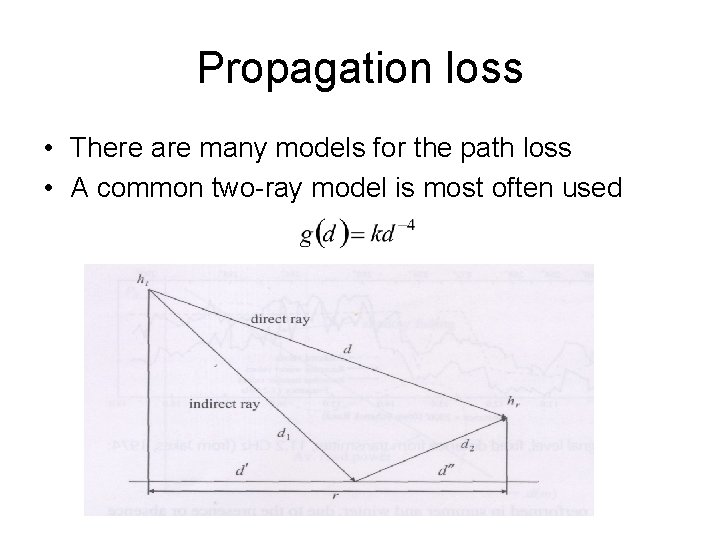
Propagation loss • There are many models for the path loss • A common two-ray model is most often used
Propagation loss: Two-ray model • The two-ray model is the simplest representation that models the effect on the average received power of multiple rays due to reflection, diffraction and scattering • It treats the case of a single reflected ray • Provides reasonably accurate results in macrocellular environment with relatively high BS antenna and/or L. O. S conditions • Assumes that the signal arrives directly through a L. O. S path and indirectly through perfect relfection from a flat ground surface
Propagation loss: Two-ray model
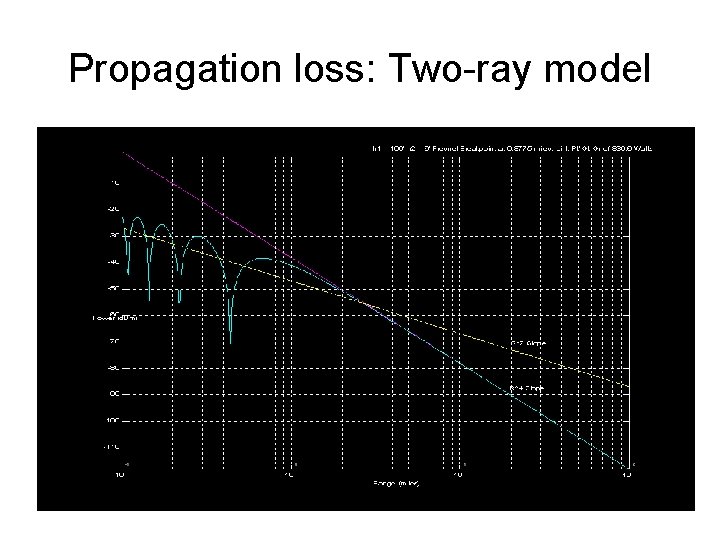
Propagation loss: Two-ray model • The reflected signal shows up with a delay relative to the direct path signal and as a consequence, may add constructively (in phase) or destructively (out of phase) • Propagation starts out with an R 2 falloff rate and then transitions to a R 4 falloff rate at greater ranges. • The "point" where this transition occurs is often called the Fresnel breakpoint. • The nulls are representative of points where direct and reflected signals cancel while the humps show points where signals add. • In practice, ground reflections are usually somewhat diffuse (rough mirror instead of polished) and so the sharp nulls get filled in. • In macrocellular communications systems, operating distances are usually large enough so that signal strength can be thought of as falling off at an R 4 rate.
Propagation loss: Other models • Various measurement based empirical laws have been developed to estimate median path loss for moderate to large macrocells based on frequency, building environment, and antenna heights; most notably the Okumura & Hata models • Generally describes median path loss as Median Path Loss (d. B) = A + B log 10( R ) where: A is median path loss in d. B at 1 km B is the rate at which median signal strength falls off (10 times ) R is range in km
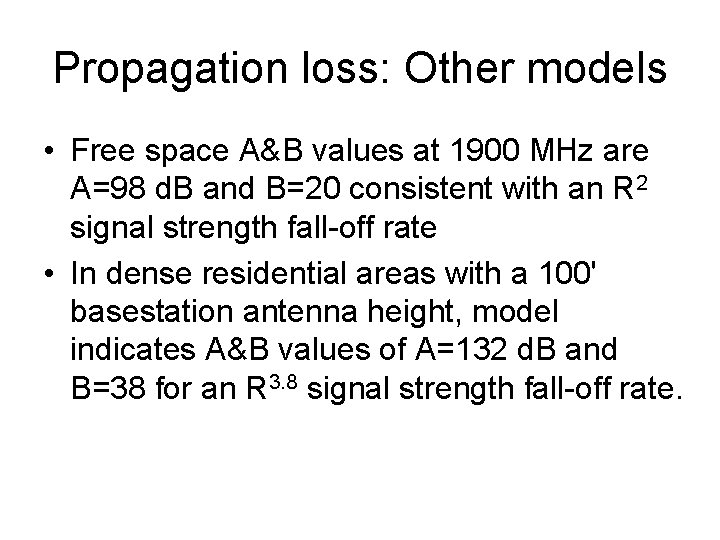
Propagation loss: Other models • Free space A&B values at 1900 MHz are A=98 d. B and B=20 consistent with an R 2 signal strength fall-off rate • In dense residential areas with a 100' basestation antenna height, model indicates A&B values of A=132 d. B and B=38 for an R 3. 8 signal strength fall-off rate.
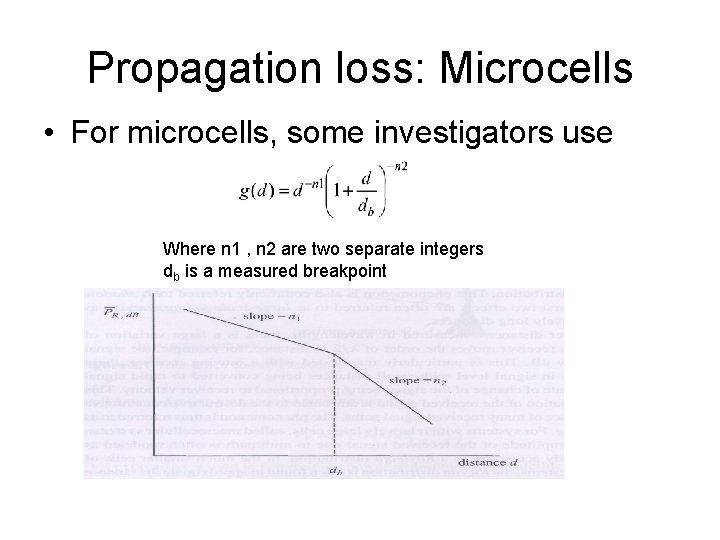
Propagation loss: Microcells • For microcells, some investigators use Where n 1 , n 2 are two separate integers db is a measured breakpoint
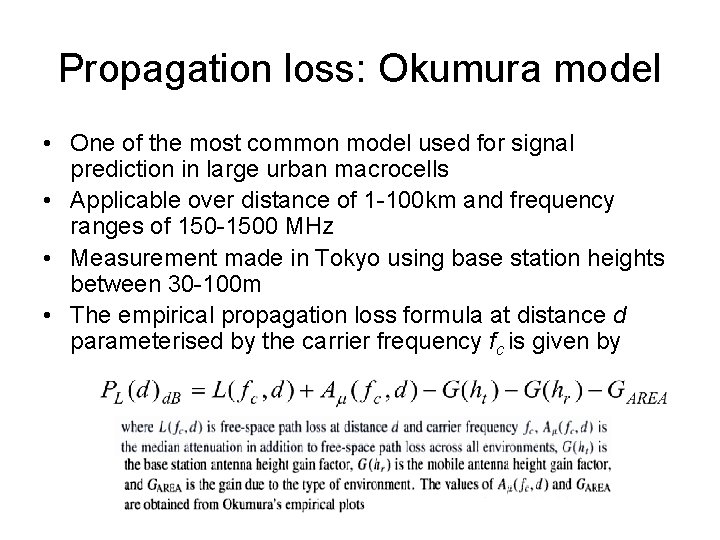
Propagation loss: Okumura model • One of the most common model used for signal prediction in large urban macrocells • Applicable over distance of 1 -100 km and frequency ranges of 150 -1500 MHz • Measurement made in Tokyo using base station heights between 30 -100 m • The empirical propagation loss formula at distance d parameterised by the carrier frequency fc is given by
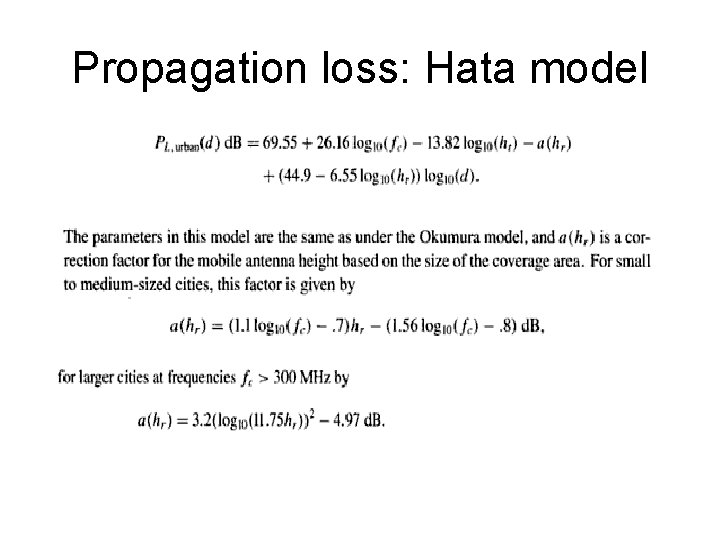
Propagation loss: Hata model
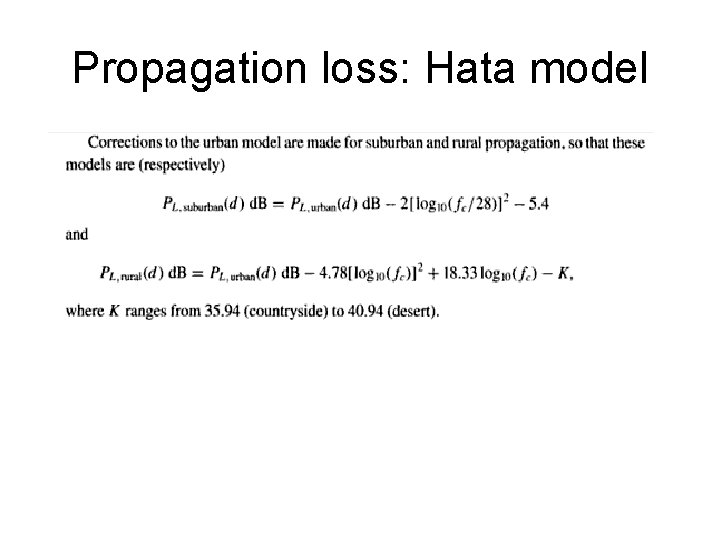
Propagation loss: Hata model
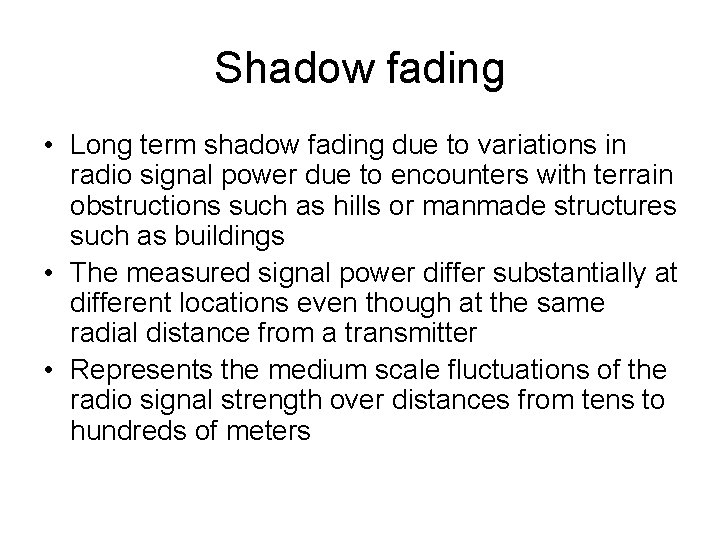
Shadow fading • Long term shadow fading due to variations in radio signal power due to encounters with terrain obstructions such as hills or manmade structures such as buildings • The measured signal power differ substantially at different locations even though at the same radial distance from a transmitter • Represents the medium scale fluctuations of the radio signal strength over distances from tens to hundreds of meters
Shadow Fading • Many empirical studies demonstrate that the received mean power fluctuates about the average power with a log-normal distribution • Can be well-approximated by a gaussian random variable with standard deviation, δ
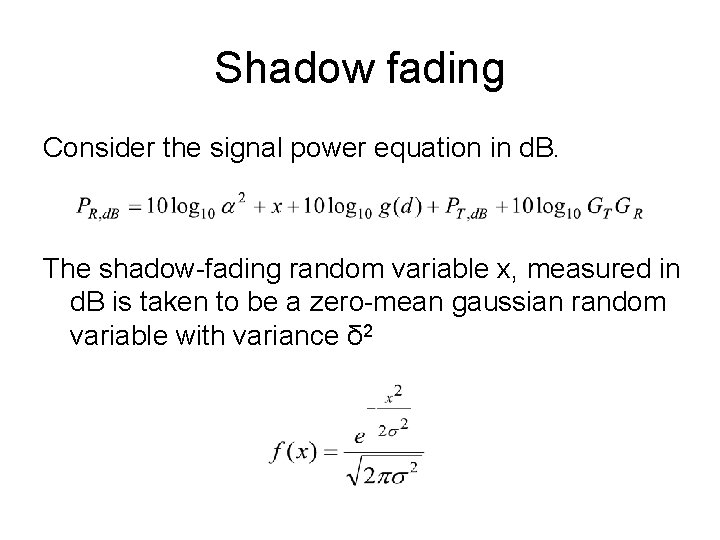
Shadow fading Consider the signal power equation in d. B. The shadow-fading random variable x, measured in d. B is taken to be a zero-mean gaussian random variable with variance δ 2
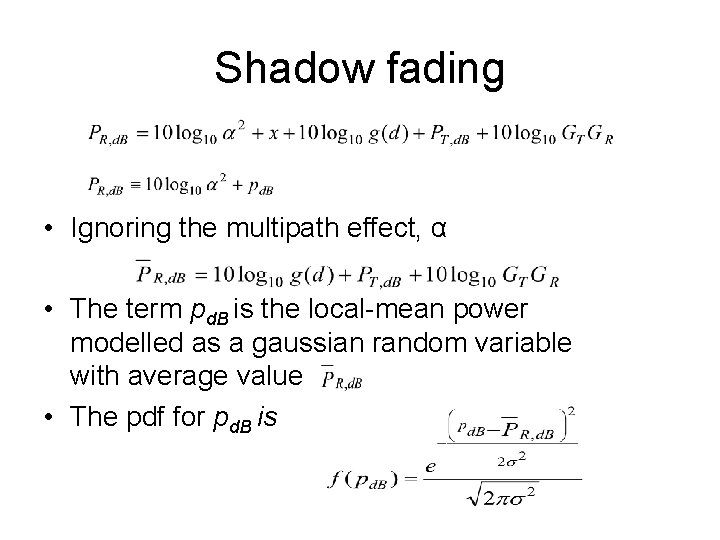
Shadow fading • Ignoring the multipath effect, α • The term pd. B is the local-mean power modelled as a gaussian random variable with average value • The pdf for pd. B is
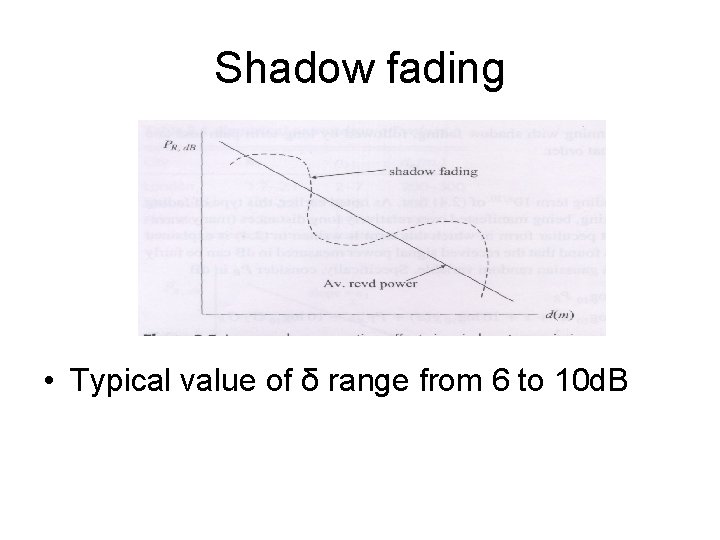
Shadow fading • Typical value of δ range from 6 to 10 d. B
Multipath fading • The actual power received over a much smaller distance vary considerably due to the destructive/constructive interference of multiple signals that follow multiple paths to the receiver • The direct ray is actually made up of many rays due to scattering multiple times by obstructions along its path, all travelling about the same distance • Each of these rays appearing at the receiver will differ randomly in amplitude and phase due to the scattering

Multipath fading
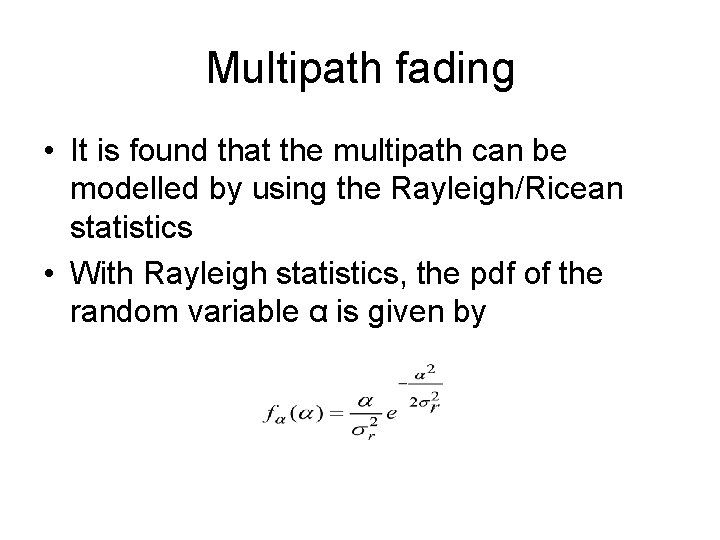
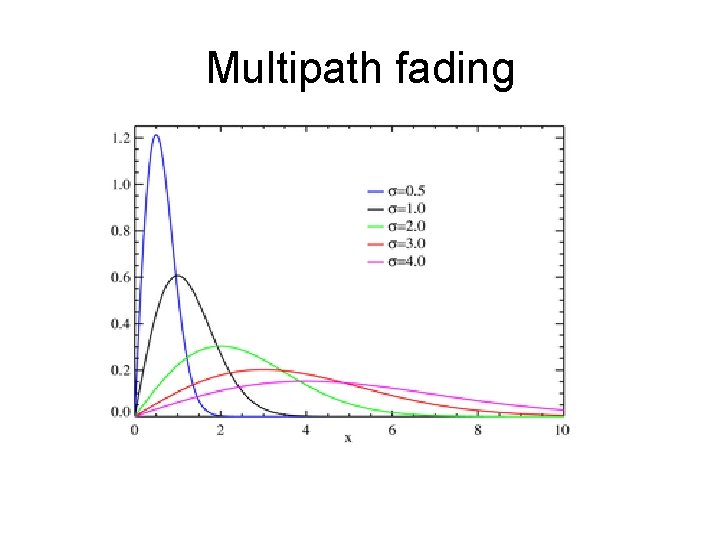
Multipath fading • It is found that the multipath can be modelled by using the Rayleigh/Ricean statistics • With Rayleigh statistics, the pdf of the random variable α is given by

Multipath fading
Multipath fading • Rayleigh fading is viewed as a reasonable model for urban environments where there are many objects in the environment that scatter the radio signal before it arrives at the receiver • there is no dominant propagation along a LOS between the transmitter and receiver. • The central limit theorem holds that, if there is sufficiently much scatter, the channel impulse response will be wellmodelled as a Gaussian process irrespective of the distribution of the individual components • such a process will have zero mean and phase evenly distributted between 0 and 2π radians. • The envelope of the channel response will therefore be Rayleigh distributed
Multipath fading
Multipath fading • If the environment is such that, in addition to the scattering, there is a strongly dominant signal seen at the receiver, usually caused by a LOS, then the mean of the random process will no longer be zero, varying instead around the powerlevel of the dominant path. • Such a situation may be better modelled as Rician fading.

Multipath fading
Doppler shift • How rapidly the channel fades will be affected by how fast the receiver and/or transmitter are moving • Motion causes Doppler shift in the received signal components • the change in frequency of a wave for a receiver moving relative to the transmitter
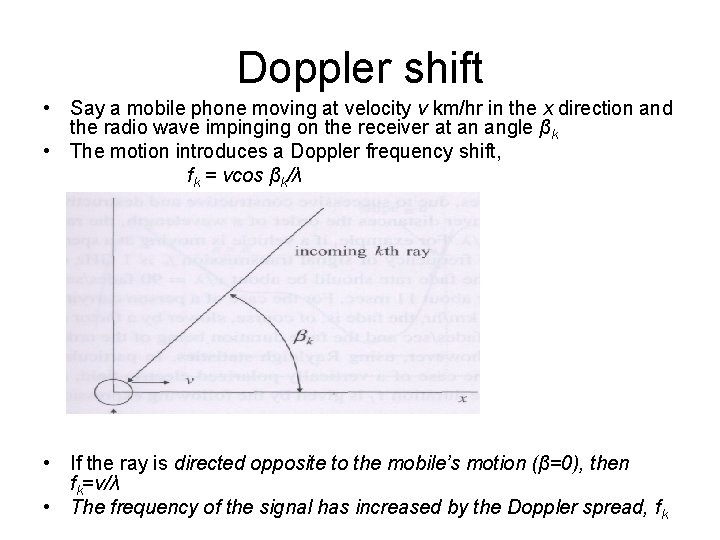
Doppler shift • Say a mobile phone moving at velocity v km/hr in the x direction and the radio wave impinging on the receiver at an angle βk • The motion introduces a Doppler frequency shift, fk = vcos βk/λ • If the ray is directed opposite to the mobile’s motion (β=0), then fk=v/λ • The frequency of the signal has increased by the Doppler spread, fk
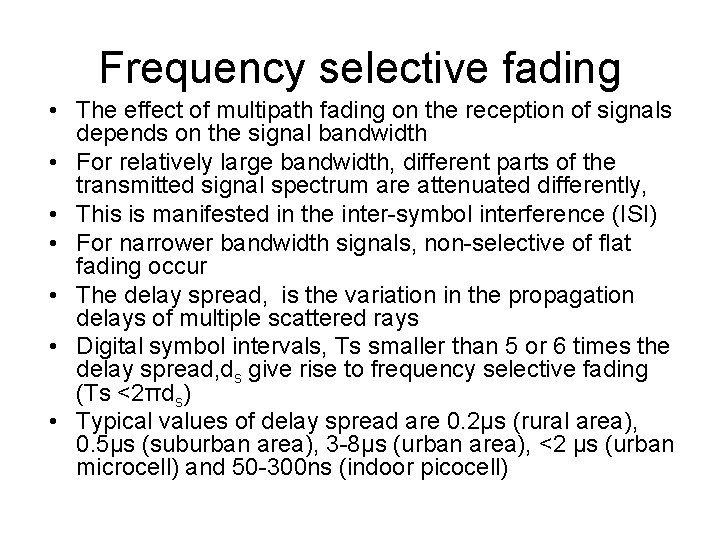
Frequency selective fading • The effect of multipath fading on the reception of signals depends on the signal bandwidth • For relatively large bandwidth, different parts of the transmitted signal spectrum are attenuated differently, • This is manifested in the inter-symbol interference (ISI) • For narrower bandwidth signals, non-selective of flat fading occur • The delay spread, is the variation in the propagation delays of multiple scattered rays • Digital symbol intervals, Ts smaller than 5 or 6 times the delay spread, ds give rise to frequency selective fading (Ts <2πds) • Typical values of delay spread are 0. 2µs (rural area), 0. 5µs (suburban area), 3 -8µs (urban area), <2 µs (urban microcell) and 50 -300 ns (indoor picocell)
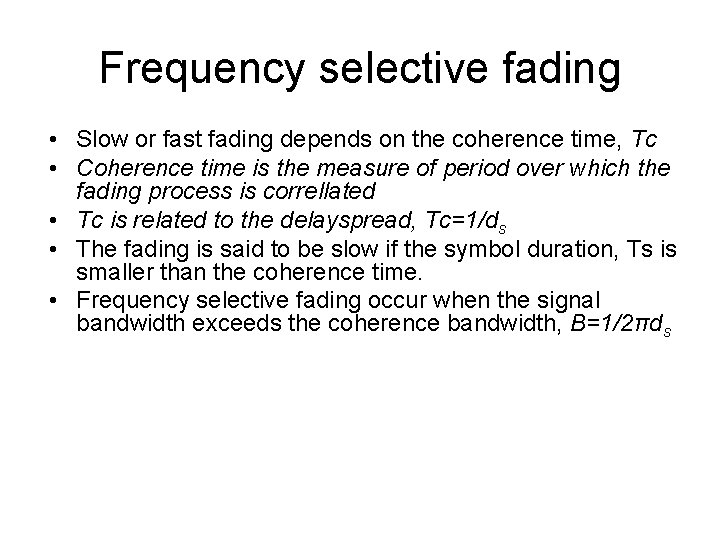
Frequency selective fading • Slow or fast fading depends on the coherence time, Tc • Coherence time is the measure of period over which the fading process is correllated • Tc is related to the delayspread, Tc=1/ds • The fading is said to be slow if the symbol duration, Ts is smaller than the coherence time. • Frequency selective fading occur when the signal bandwidth exceeds the coherence bandwidth, B=1/2πds
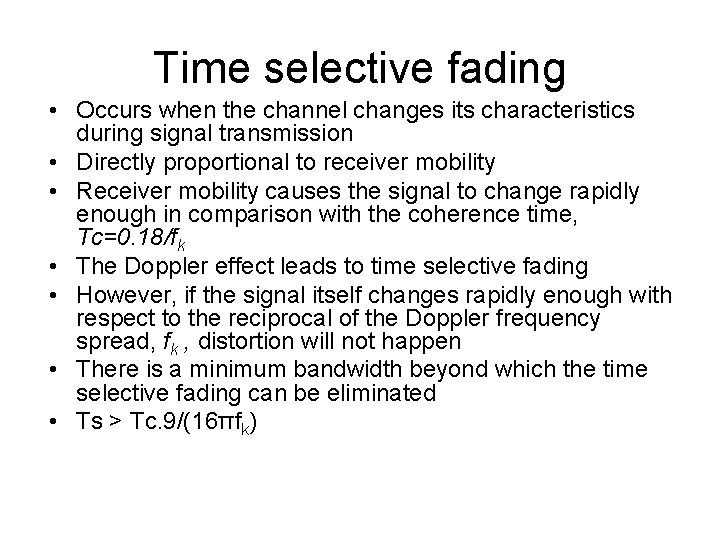
Time selective fading • Occurs when the channel changes its characteristics during signal transmission • Directly proportional to receiver mobility • Receiver mobility causes the signal to change rapidly enough in comparison with the coherence time, Tc=0. 18/fk • The Doppler effect leads to time selective fading • However, if the signal itself changes rapidly enough with respect to the reciprocal of the Doppler frequency spread, fk , distortion will not happen • There is a minimum bandwidth beyond which the time selective fading can be eliminated • Ts > Tc. 9/(16πfk)
- Slides: 39