
EEE 333 Power System Analysis Unsymmetrical Fault Analysis

- Slides: 21
EEE 333 Power System Analysis Unsymmetrical Fault Analysis Prepared by Dr. Md. Rezwanul Ahsan Assistant Professor, Dept. of EEE
Lecture Contents § Unsymmetrical Faults § Different Types of Faults (S-L-G, L-L and L-G) Analysis @Rezwan
Learning Outcomes The students will be able to… § Understand different types of unsymmetrical faults § Analyze single line-to-ground fault, line-to-line fault and double line-to-ground fault @Rezwan
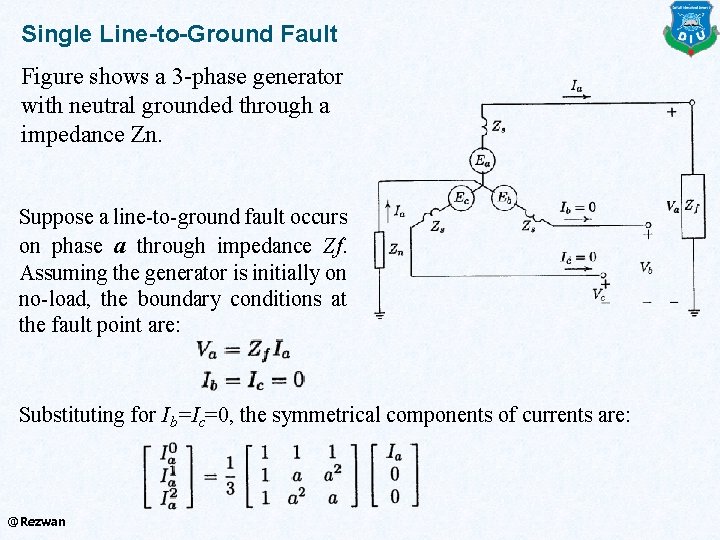
Single Line-to-Ground Fault Figure shows a 3 -phase generator with neutral grounded through a impedance Zn. Suppose a line-to-ground fault occurs on phase a through impedance Zf. Assuming the generator is initially on no-load, the boundary conditions at the fault point are: Substituting for Ib=Ic=0, the symmetrical components of currents are: @Rezwan
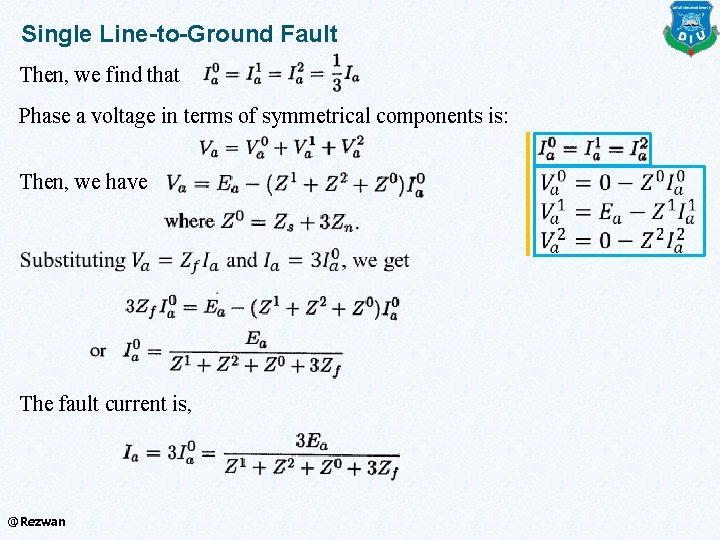
Single Line-to-Ground Fault Then, we find that Phase a voltage in terms of symmetrical components is: Then, we have The fault current is, @Rezwan
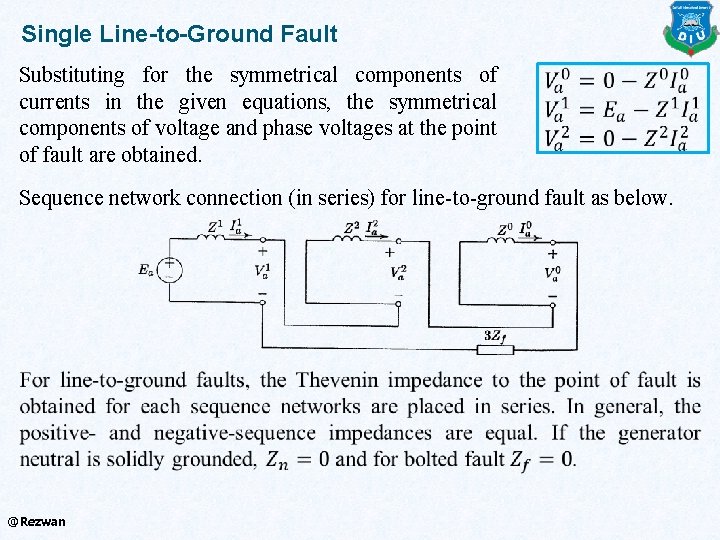
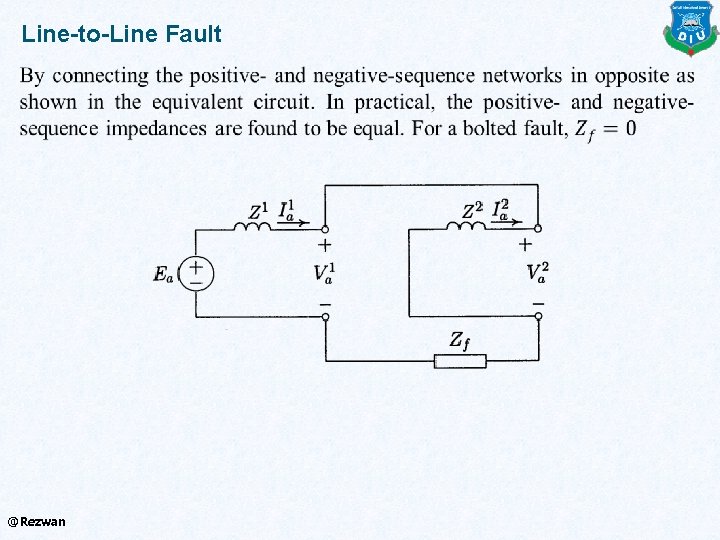
Single Line-to-Ground Fault Substituting for the symmetrical components of currents in the given equations, the symmetrical components of voltage and phase voltages at the point of fault are obtained. Sequence network connection (in series) for line-to-ground fault as below. @Rezwan
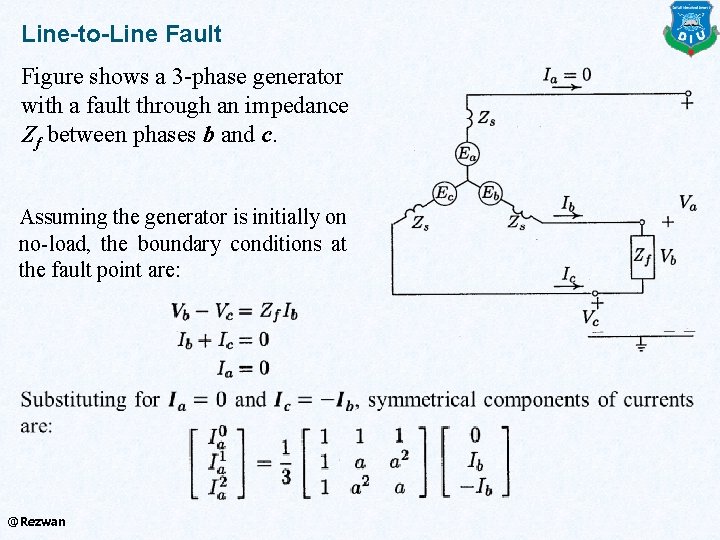
Line-to-Line Fault Figure shows a 3 -phase generator with a fault through an impedance Zf between phases b and c. Assuming the generator is initially on no-load, the boundary conditions at the fault point are: @Rezwan
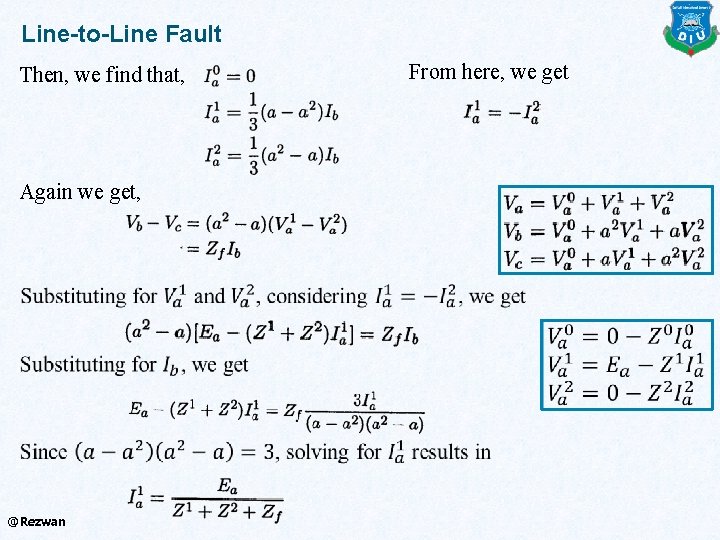
Line-to-Line Fault Then, we find that, Again we get, @Rezwan From here, we get
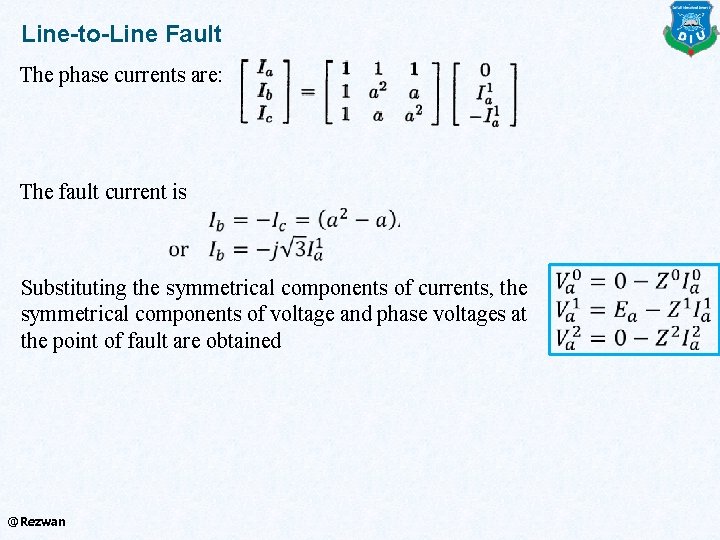
Line-to-Line Fault The phase currents are: The fault current is Substituting the symmetrical components of currents, the symmetrical components of voltage and phase voltages at the point of fault are obtained @Rezwan
Line-to-Line Fault @Rezwan
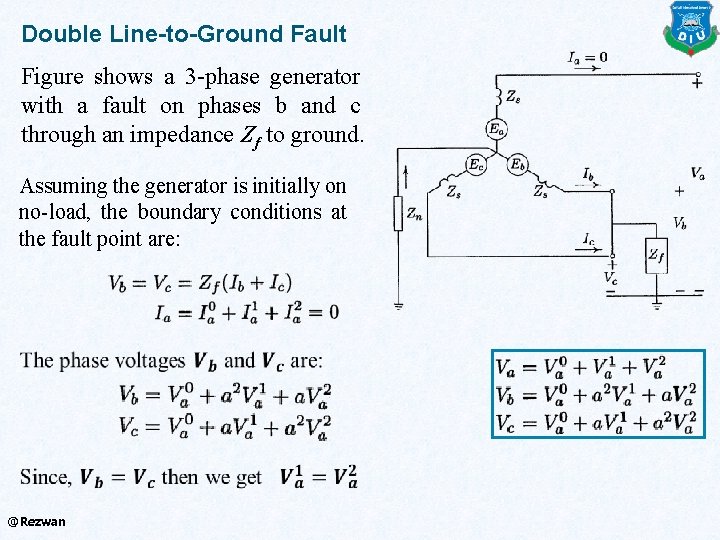
Double Line-to-Ground Fault Figure shows a 3 -phase generator with a fault on phases b and c through an impedance Zf to ground. Assuming the generator is initially on no-load, the boundary conditions at the fault point are: @Rezwan
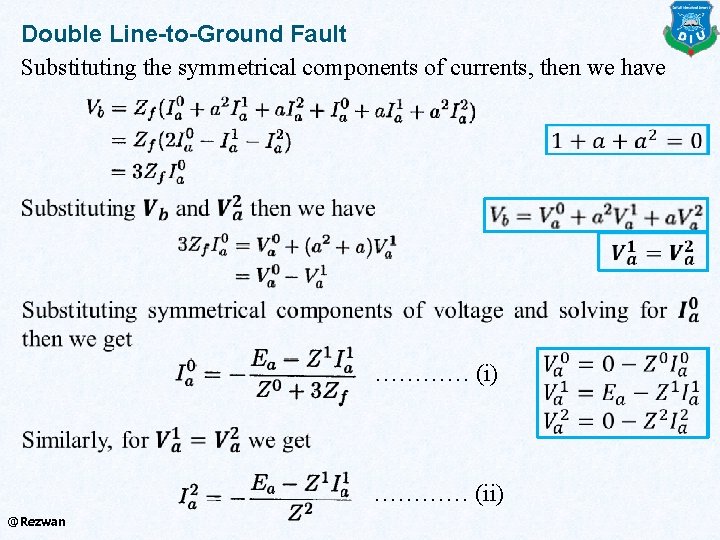
Double Line-to-Ground Fault Substituting the symmetrical components of currents, then we have ………… (i) ………… (ii) @Rezwan
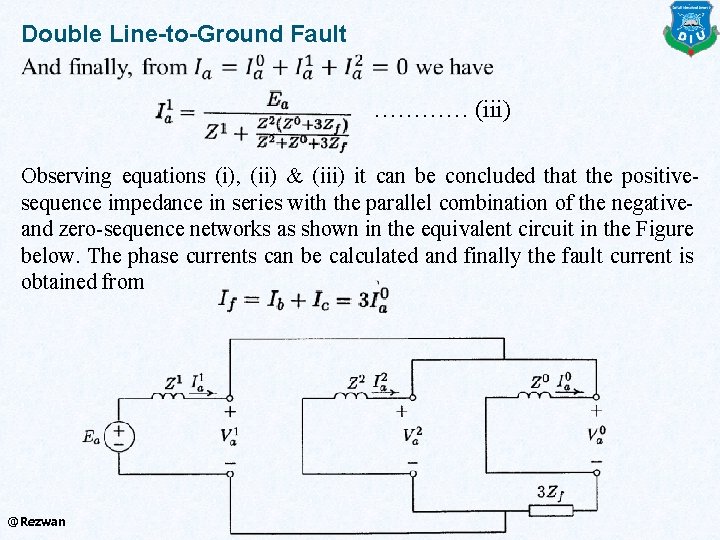
Double Line-to-Ground Fault ………… (iii) Observing equations (i), (ii) & (iii) it can be concluded that the positivesequence impedance in series with the parallel combination of the negativeand zero-sequence networks as shown in the equivalent circuit in the Figure below. The phase currents can be calculated and finally the fault current is obtained from @Rezwan
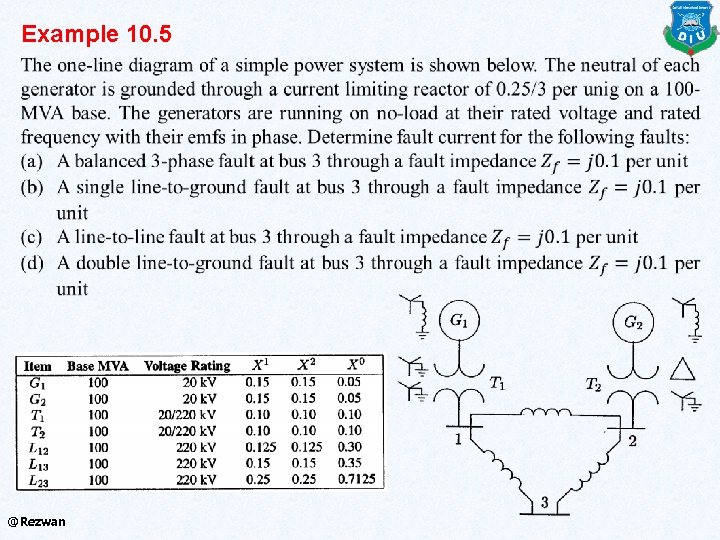
Example 10. 5 @Rezwan
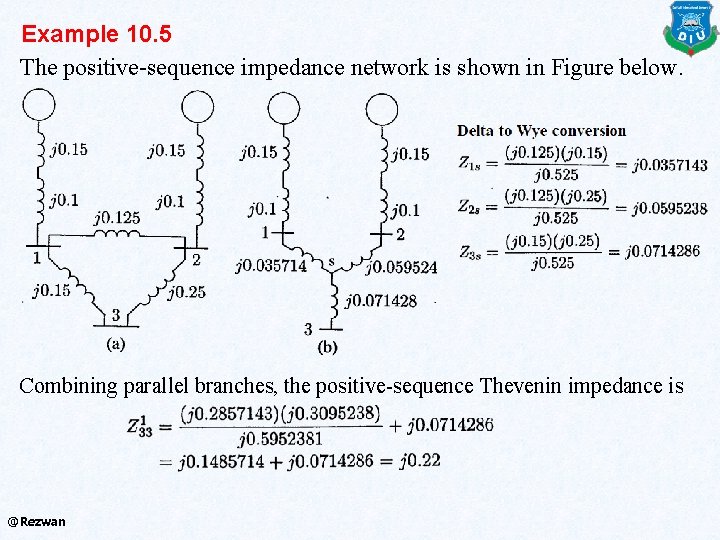
Example 10. 5 The positive-sequence impedance network is shown in Figure below. Combining parallel branches, the positive-sequence Thevenin impedance is @Rezwan
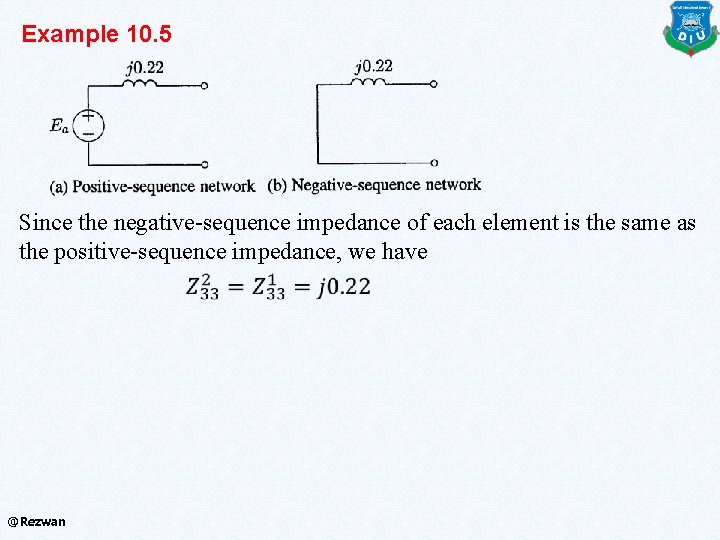
Example 10. 5 Since the negative-sequence impedance of each element is the same as the positive-sequence impedance, we have @Rezwan
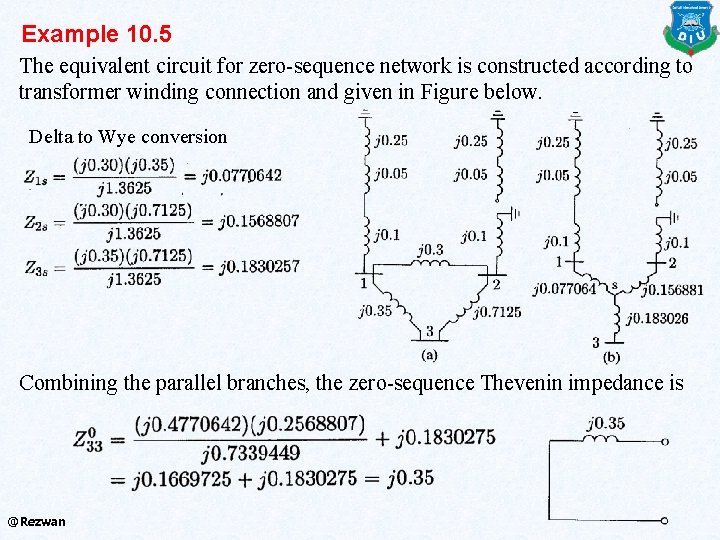
Example 10. 5 The equivalent circuit for zero-sequence network is constructed according to transformer winding connection and given in Figure below. Delta to Wye conversion Combining the parallel branches, the zero-sequence Thevenin impedance is @Rezwan
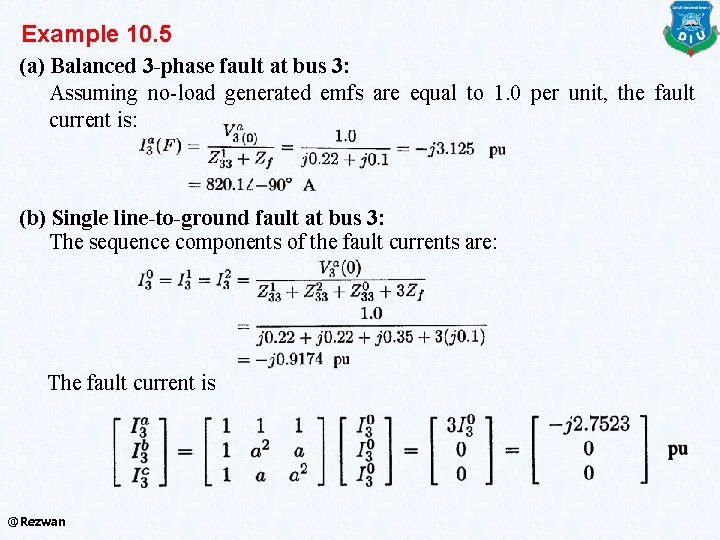
Example 10. 5 (a) Balanced 3 -phase fault at bus 3: Assuming no-load generated emfs are equal to 1. 0 per unit, the fault current is: (b) Single line-to-ground fault at bus 3: The sequence components of the fault currents are: The fault current is @Rezwan
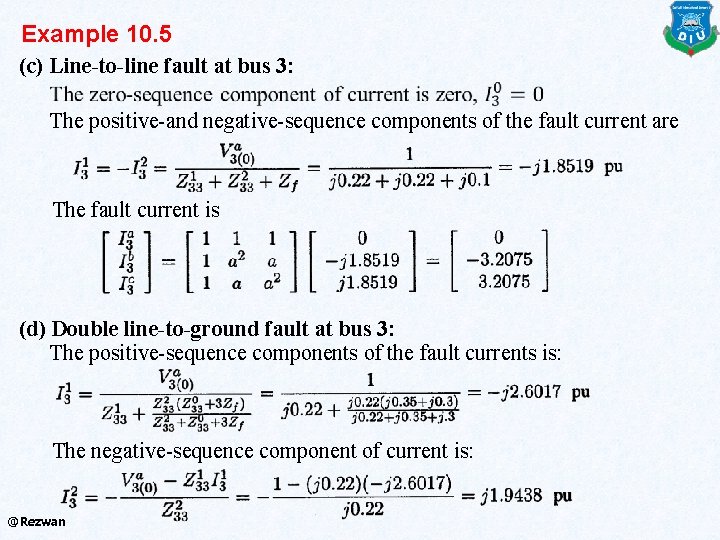
Example 10. 5 (c) Line-to-line fault at bus 3: The positive-and negative-sequence components of the fault current are The fault current is (d) Double line-to-ground fault at bus 3: The positive-sequence components of the fault currents is: The negative-sequence component of current is: @Rezwan
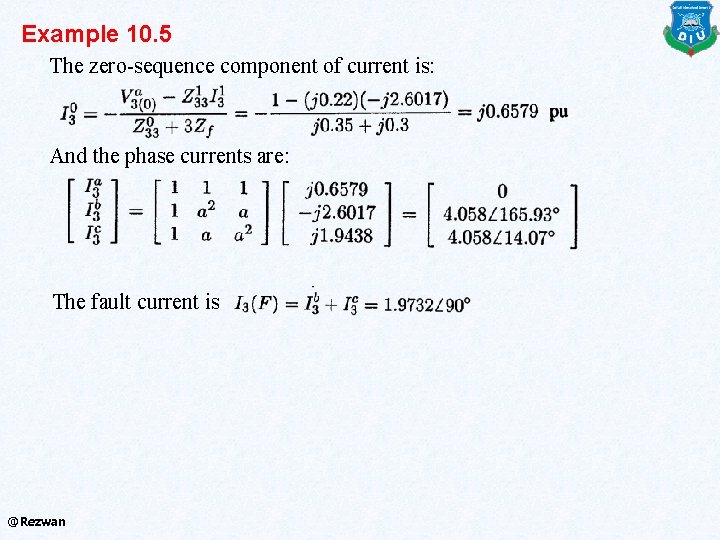
Example 10. 5 The zero-sequence component of current is: And the phase currents are: The fault current is @Rezwan