
EEE 243 Applied Computer Programming Data Structures Outline
![Ordered LL with multiple ordering criteria typedef struct STUDENT_TAG { char first_name[15]; char last_name[25];](https://slidetodoc.com/presentation_image_h/04d124736e53b30ebde663cda2edcfe3/image-17.jpg "Ordered LL with multiple ordering criteria typedef struct STUDENT_TAG { char first_name[15]; char last_name[25];")
![Doubly Linked List typedef struct STUDENT_TAG { char first_name[15]; char last_name[25]; unsigned long college_number;](https://slidetodoc.com/presentation_image_h/04d124736e53b30ebde663cda2edcfe3/image-20.jpg "Doubly Linked List typedef struct STUDENT_TAG { char first_name[15]; char last_name[25]; unsigned long college_number;")


- Slides: 29
EEE 243 – Applied Computer Programming Data Structures
Outline 1. 2. 3. 4. 5. Review Ordered and unordered LL Ordered and unordered arrays Examples Other data structures
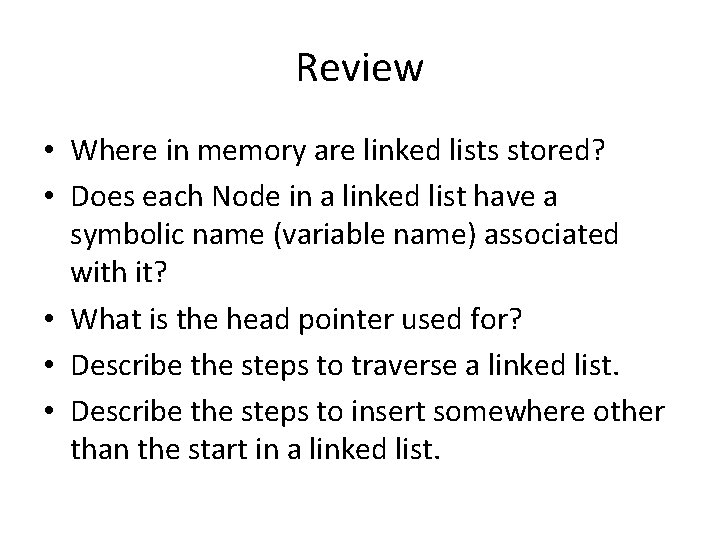
Review • Where in memory are linked lists stored? • Does each Node in a linked list have a symbolic name (variable name) associated with it? • What is the head pointer used for? • Describe the steps to traverse a linked list. • Describe the steps to insert somewhere other than the start in a linked list.
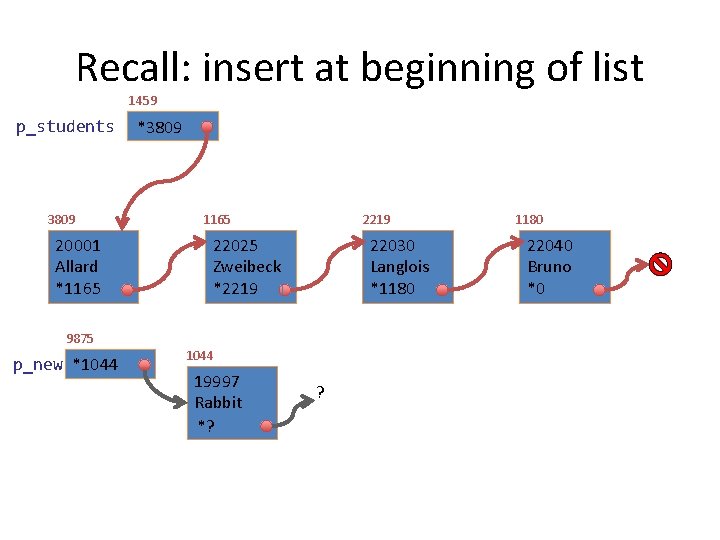
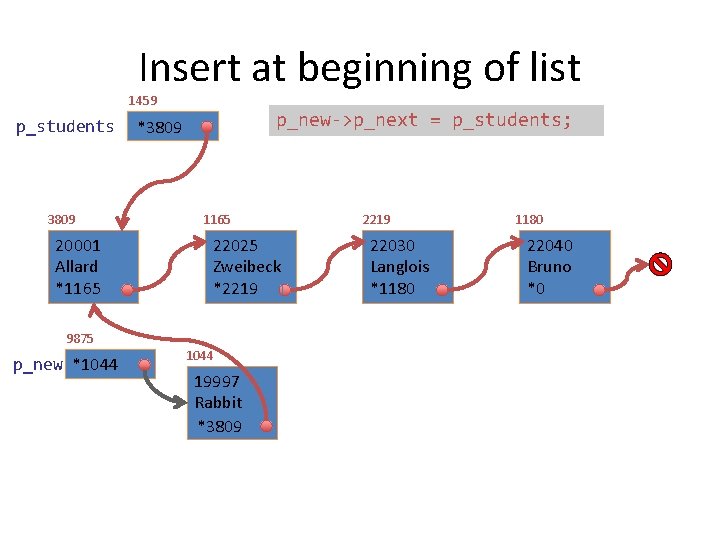
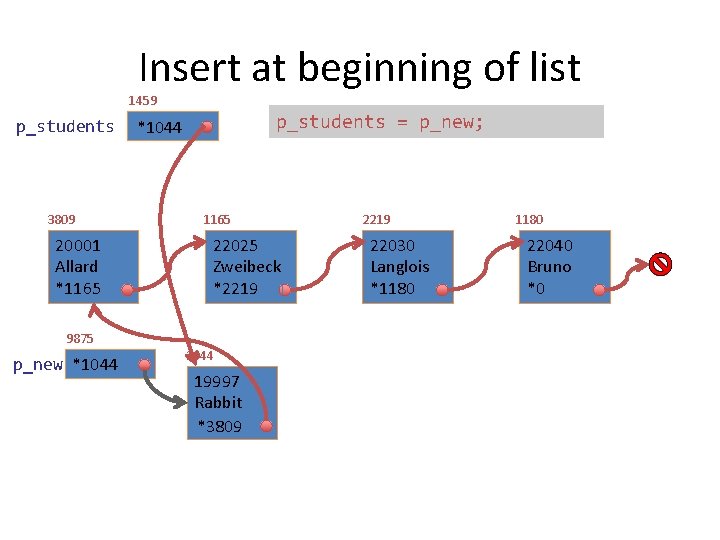
Recall: insert at beginning of list 1459 p_students 3809 20001 Allard *1165 9875 p_new *1044 *3809 1165 2219 22025 Zweibeck *2219 22030 Langlois *1180 1044 19997 Rabbit *? *? ? 1180 22040 Bruno *0
Insert at beginning of list 1459 p_students 3809 20001 Allard *1165 9875 p_new *1044 p_new->p_next = p_students; *3809 1165 22025 Zweibeck *2219 1044 19997 Rabbit *? *3809 2219 22030 Langlois *1180 22040 Bruno *0
Insert at beginning of list 1459 p_students 3809 20001 Allard *1165 9875 p_new *1044 p_students = p_new; *3809 *1044 1165 22025 Zweibeck *2219 1044 19997 Rabbit *? *3809 2219 22030 Langlois *1180 22040 Bruno *0
Ordered and unordered data structures • When you use data structures such as arrays or LL you must be aware of execution time tradeoffs • When dealing with a sequence of struct, you will have to make two main design decisions based on these tradeoffs – Selection of a data structure (array or LL) and – Selection of an ordered or an unordered sequence
Ordered and unordered data structures • Elements inside arrays and LL can be ordered using some sorting key in the structure • A key can be any of the fields in your structure: – – – Last name, College number, Height, Weight, SN, … • The sorting can also be done with a combination of two keys: – By last_name (primary key) and then by first_name (secondary key).
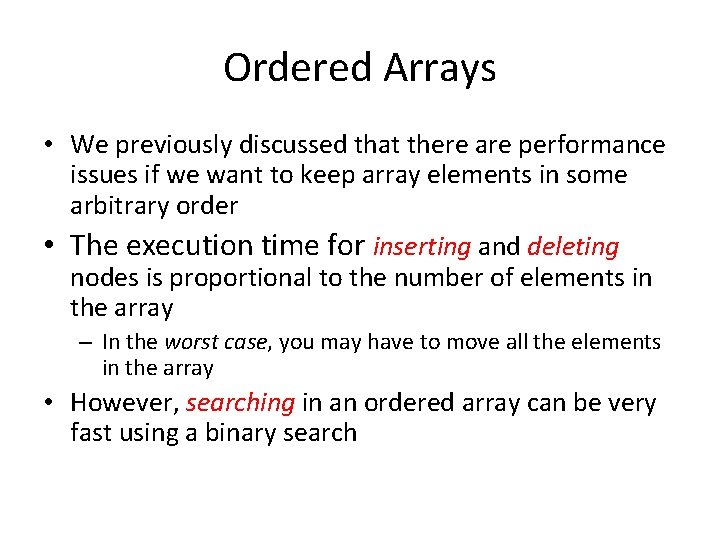
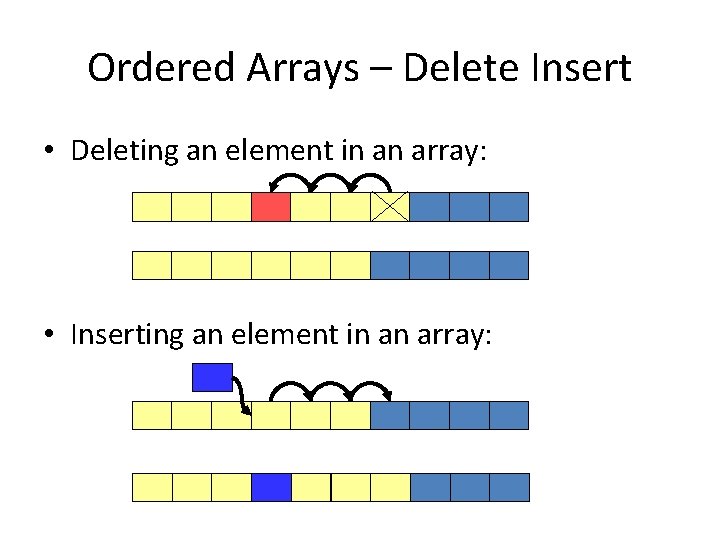
Ordered Arrays • We previously discussed that there are performance issues if we want to keep array elements in some arbitrary order • The execution time for inserting and deleting nodes is proportional to the number of elements in the array – In the worst case, you may have to move all the elements in the array • However, searching in an ordered array can be very fast using a binary search
Ordered Arrays – Delete Insert • Deleting an element in an array: • Inserting an element in an array:
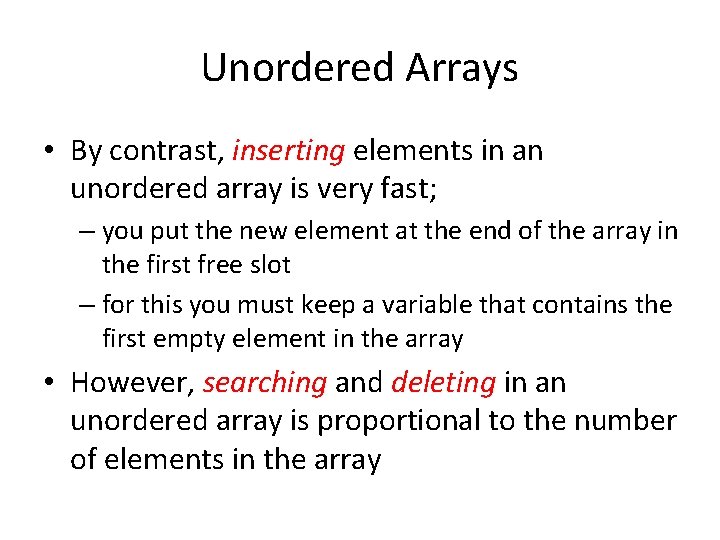
Unordered Arrays • By contrast, inserting elements in an unordered array is very fast; – you put the new element at the end of the array in the first free slot – for this you must keep a variable that contains the first empty element in the array • However, searching and deleting in an unordered array is proportional to the number of elements in the array
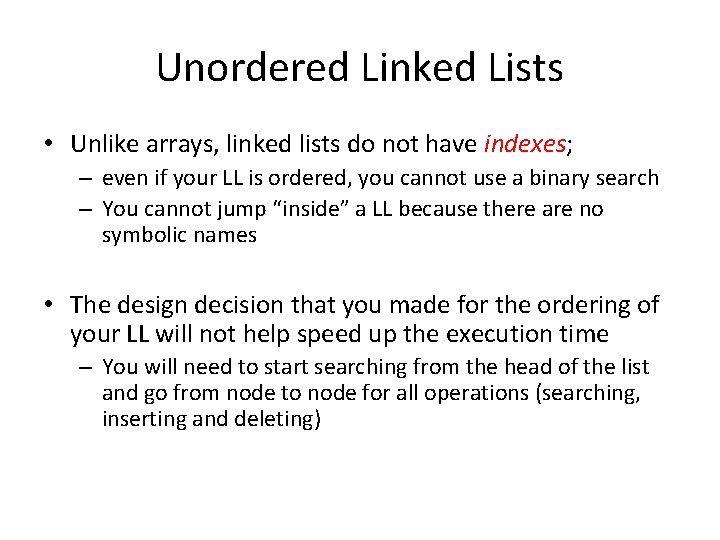
Unordered Linked Lists • Unlike arrays, linked lists do not have indexes; – even if your LL is ordered, you cannot use a binary search – You cannot jump “inside” a LL because there are no symbolic names • The design decision that you made for the ordering of your LL will not help speed up the execution time – You will need to start searching from the head of the list and go from node to node for all operations (searching, inserting and deleting)
Unordered Linked Lists • It is obvious that an unordered list will have a search time proportional to the number of elements in the list. • Deleting a node in a LL is also proportional to the number of elements, because we must find the right node to delete • Inserting in an unordered LL is however quite fast – you either insert at the head or tail – the size of the list does not affect this operation
Ordered Linked Lists • If the list is ordered, you can stop searching: – As soon as you find your structure(s) – When you pass the point where the structure would be • you then know it is not in the list • If you intend to search relatively often (in comparison inserting/deleting elements), the ordered LL is a slight improvement over the unordered LL , • Still in the worst case, you may have to go through the entire LL – The execution time is proportional to the number of elements
Choosing the right Data Structure • If you intend to insert and remove a lot of information on a regular basis and perform relatively fewer searches; then use an unordered LL • If you intend few changes in your sequence and perform relatively many searches; it is better to use an ordered array. – As long as the array size can be specified so that it doesn't have to change (a max size of elements is known) – Better yet, use an implementation based on hash tables.
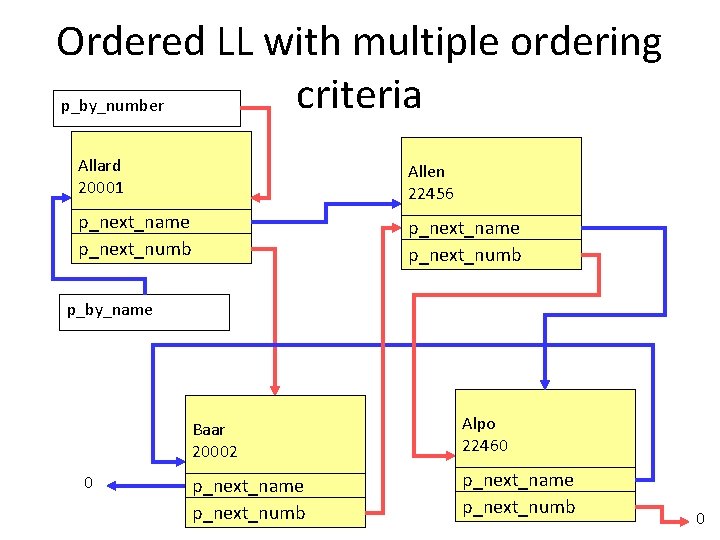
Ordered LL with multiple ordering criteria • One of the powers of LL, is that the same LL can be ordered in two different ways by using two different pointers inside each node – In fact you could use N pointers inside each node to order your nodes in N different ways; – You would need N arrays or N sorting operations to accomplish the same without a linked list • e. g. , if I want to be able to print an ordered RMC student list by last names or college numbers, I could use an ordered LL with two pointers inside each Student and keep these relations
Ordered LL with multiple ordering criteria typedef struct STUDENT_TAG { char first_name[15]; char last_name[25]; unsigned long college_number; float average; struct STUDENT_TAG *p_next_name; struct STUDENT_TAG *p_next_numb; } Student; //name of the type Student *p_by_name = NULL; Student *p_by_number = NULL;
Ordered LL with multiple ordering criteria p_by_number Allard 20001 Allen 22456 p_next_name p_next_numb p_by_name 0 Baar 20002 Alpo 22460 p_next_name p_next_numb 0
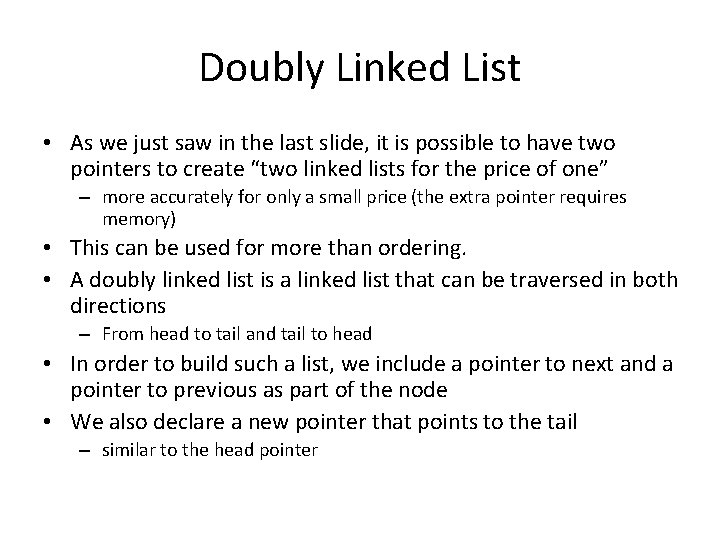
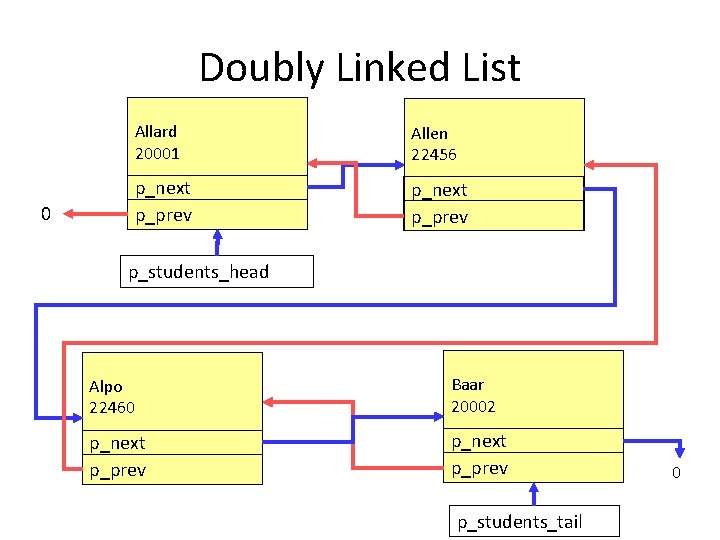
Doubly Linked List • As we just saw in the last slide, it is possible to have two pointers to create “two linked lists for the price of one” – more accurately for only a small price (the extra pointer requires memory) • This can be used for more than ordering. • A doubly linked list is a linked list that can be traversed in both directions – From head to tail and tail to head • In order to build such a list, we include a pointer to next and a pointer to previous as part of the node • We also declare a new pointer that points to the tail – similar to the head pointer
Doubly Linked List typedef struct STUDENT_TAG { char first_name[15]; char last_name[25]; unsigned long college_number; float average; struct STUDENT_TAG *p_next; struct STUDENT_TAG *p_prev; } Student; //name of the type Student *p_students_head = NULL; Student *p_students_tail = NULL;
Doubly Linked List 0 Allard 20001 Allen 22456 p_next p_prev p_students_head Alpo 22460 Baar 20002 p_next p_prev p_students_tail 0
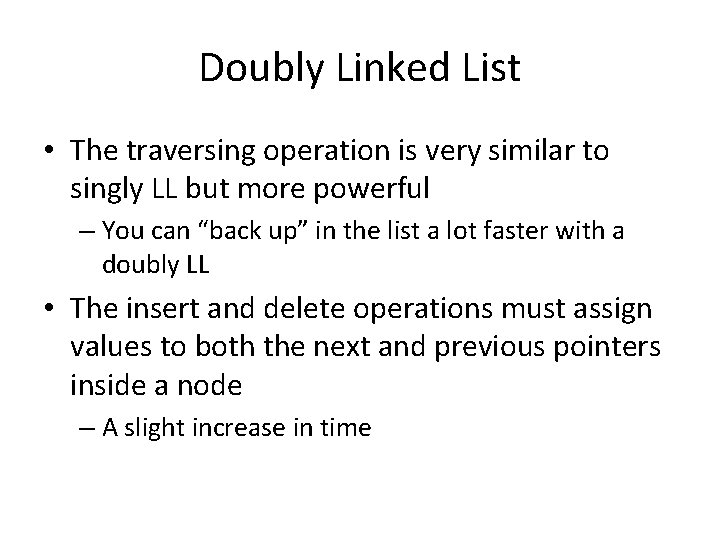
Doubly Linked List • The traversing operation is very similar to singly LL but more powerful – You can “back up” in the list a lot faster with a doubly LL • The insert and delete operations must assign values to both the next and previous pointers inside a node – A slight increase in time
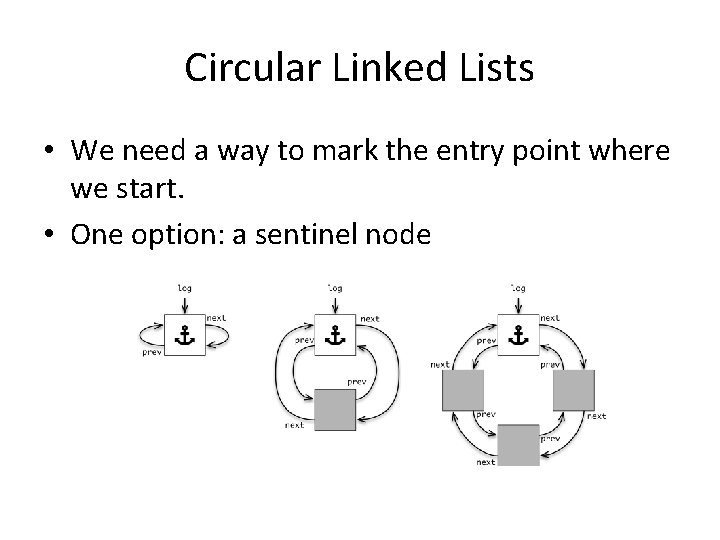
Circular Linked Lists • We need a way to mark the entry point where we start. • One option: a sentinel node
Real World Examples of LL • • • Browser history Queues Undo-Redo functionality Stacks Representations for the corner of a polygon
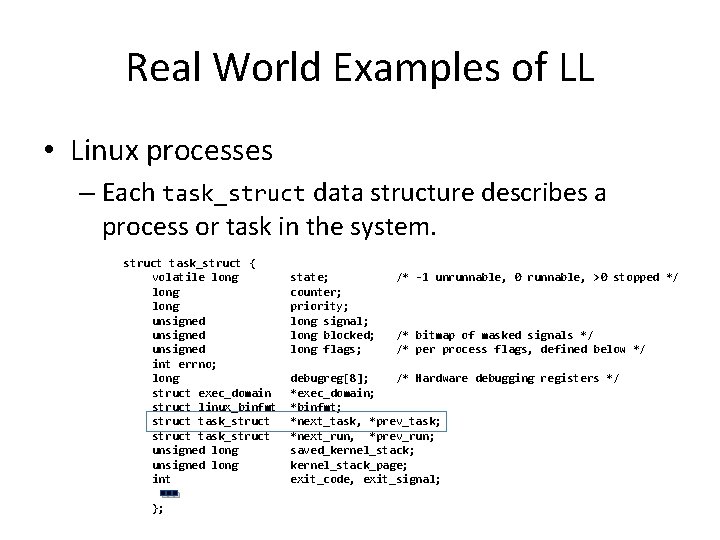
Real World Examples of LL • Linux processes – Each task_struct data structure describes a process or task in the system. struct task_struct { volatile long unsigned int errno; long struct exec_domain struct linux_binfmt struct task_struct unsigned long int … }; state; counter; priority; long signal; long blocked; long flags; /* -1 unrunnable, 0 runnable, >0 stopped */ /* bitmap of masked signals */ /* per process flags, defined below */ debugreg[8]; /* Hardware debugging registers */ *exec_domain; *binfmt; *next_task, *prev_task; *next_run, *prev_run; saved_kernel_stack; kernel_stack_page; exit_code, exit_signal;
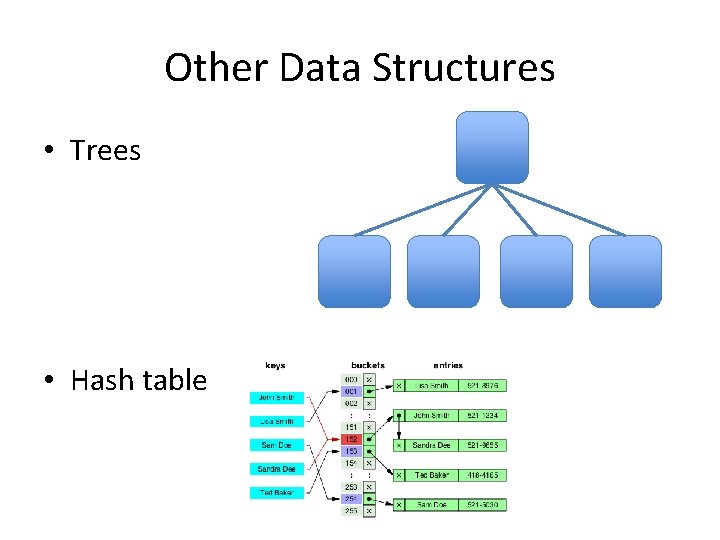
Other Data Structures • Trees • Hash table
Questions • What kind of data structure should I use if I want to enter the member of parliament after an election and be able to search for information relatively often? Ordered? • What kind of data structure should I use if I want to keep track of letters read by my robot if I do not know how many letters to read? Ordered?
Exercise • Create a doubly linked list of Students that is sorted by college number; include 5 students with college numbers 10, 20, 30, 40, and 50. • Add a new student in the sorted list with college number 25. • Delete the Node (the Student) with college number 40. • Submit to Dropbox for feedback.
Questions?