
EEE 1012 Introduction to Electrical Electronics Engineering Chapter
![Mesh Analysis Example: [Boylestad 10 th Ed. E. g. 8. 11 - modified] R](https://slidetodoc.com/presentation_image_h/1537dc7491c9ecf4ff606c77273a8167/image-7.jpg "Mesh Analysis Example: [Boylestad 10 th Ed. E. g. 8. 11 - modified] R")
![Nodal Analysis Example: [Boylestad 10 th Ed. E. g. 8. 21 - modified] a](https://slidetodoc.com/presentation_image_h/1537dc7491c9ecf4ff606c77273a8167/image-11.jpg "Nodal Analysis Example: [Boylestad 10 th Ed. E. g. 8. 21 - modified] a")

![Superposition Theorem Example: [Boylestad 10 th Ed. E. g. 9. 5 - modified] I](https://slidetodoc.com/presentation_image_h/1537dc7491c9ecf4ff606c77273a8167/image-19.jpg "Superposition Theorem Example: [Boylestad 10 th Ed. E. g. 9. 5 - modified] I")
![Superposition Theorem Example: [Boylestad 10 th Ed. E. g. 9. 5 - modified] Consider](https://slidetodoc.com/presentation_image_h/1537dc7491c9ecf4ff606c77273a8167/image-20.jpg "Superposition Theorem Example: [Boylestad 10 th Ed. E. g. 9. 5 - modified] Consider")
![Superposition Theorem Example: [Boylestad 10 th Ed. E. g. 9. 5 - modified] Consider](https://slidetodoc.com/presentation_image_h/1537dc7491c9ecf4ff606c77273a8167/image-21.jpg "Superposition Theorem Example: [Boylestad 10 th Ed. E. g. 9. 5 - modified] Consider")
![Superposition Theorem Example: [Boylestad 10 th Ed. E. g. 9. 5 - modified] Consider](https://slidetodoc.com/presentation_image_h/1537dc7491c9ecf4ff606c77273a8167/image-22.jpg "Superposition Theorem Example: [Boylestad 10 th Ed. E. g. 9. 5 - modified] Consider")
![Superposition Theorem Example: [Boylestad 10 th Ed. E. g. 9. 5 - modified] Hence:](https://slidetodoc.com/presentation_image_h/1537dc7491c9ecf4ff606c77273a8167/image-23.jpg "Superposition Theorem Example: [Boylestad 10 th Ed. E. g. 9. 5 - modified] Hence:")
![Thevenin’s Theorem Example: [Boylestad 10 th Ed. E. g. 9. 6 - modified] Convert](https://slidetodoc.com/presentation_image_h/1537dc7491c9ecf4ff606c77273a8167/image-27.jpg "Thevenin’s Theorem Example: [Boylestad 10 th Ed. E. g. 9. 6 - modified] Convert")
![Thevenin’s Theorem Example: [Boylestad 10 th Ed. E. g. 9. 6 - modified] RTh](https://slidetodoc.com/presentation_image_h/1537dc7491c9ecf4ff606c77273a8167/image-28.jpg "Thevenin’s Theorem Example: [Boylestad 10 th Ed. E. g. 9. 6 - modified] RTh")
![Thevenin’s Theorem Example: [Boylestad 10 th Ed. E. g. 9. 6 - modified] VTh](https://slidetodoc.com/presentation_image_h/1537dc7491c9ecf4ff606c77273a8167/image-29.jpg "Thevenin’s Theorem Example: [Boylestad 10 th Ed. E. g. 9. 6 - modified] VTh")
![Thevenin’s Theorem Example: [Boylestad 10 th Ed. E. g. 9. 6 - modified] Thevenin’s](https://slidetodoc.com/presentation_image_h/1537dc7491c9ecf4ff606c77273a8167/image-30.jpg "Thevenin’s Theorem Example: [Boylestad 10 th Ed. E. g. 9. 6 - modified] Thevenin’s")
![Norton’s Theorem Example: [Boylestad 10 th Ed. E. g. 9. 6 - modified] Convert](https://slidetodoc.com/presentation_image_h/1537dc7491c9ecf4ff606c77273a8167/image-34.jpg "Norton’s Theorem Example: [Boylestad 10 th Ed. E. g. 9. 6 - modified] Convert")
![Norton’s Theorem Example: [Boylestad 10 th Ed. E. g. 9. 6 - modified] RN](https://slidetodoc.com/presentation_image_h/1537dc7491c9ecf4ff606c77273a8167/image-35.jpg "Norton’s Theorem Example: [Boylestad 10 th Ed. E. g. 9. 6 - modified] RN")
![Norton’s Theorem Example: [Boylestad 10 th Ed. E. g. 9. 6 - modified] IN](https://slidetodoc.com/presentation_image_h/1537dc7491c9ecf4ff606c77273a8167/image-36.jpg "Norton’s Theorem Example: [Boylestad 10 th Ed. E. g. 9. 6 - modified] IN")
![Norton’s Theorem Example: [Boylestad 10 th Ed. E. g. 9. 6 - modified] Norton’s](https://slidetodoc.com/presentation_image_h/1537dc7491c9ecf4ff606c77273a8167/image-37.jpg "Norton’s Theorem Example: [Boylestad 10 th Ed. E. g. 9. 6 - modified] Norton’s")
- Slides: 39
EEE 1012 Introduction to Electrical & Electronics Engineering Chapter 2: Circuit Analysis Techniques by Muhazam Mustapha, July 2010
Learning Outcome By the end of this chapter students are expected to: • Understand perform calculation on circuits with mesh and nodal analysis techniques and superposition • Be able to transform circuits based on Thevenin’s or Norton’s Theorem as necessary
Chapter Content • • • Mesh Analysis Nodal Analysis Linearity and Superposition Source Conversion Thevenin’s Theorem Norton’s Theorem
Mesh Mash Analysis
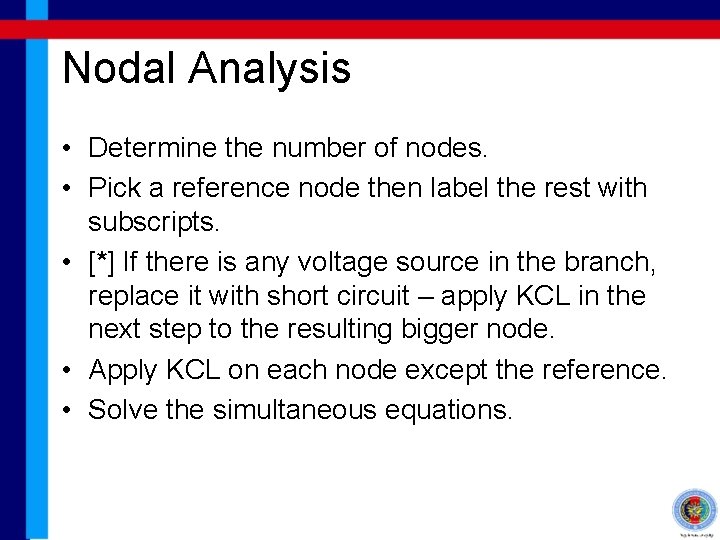
Mesh Analysis Steps: • Assign a distinct current in clockwise direction to each independent closed loop of network. • Indicate the polarities of the resistors depending on individual loop. • [*] If there is any current source in the loop path, replace it with open circuit – apply KVL in the next step to the resulting bigger loop. Use back the current source when solving for current.
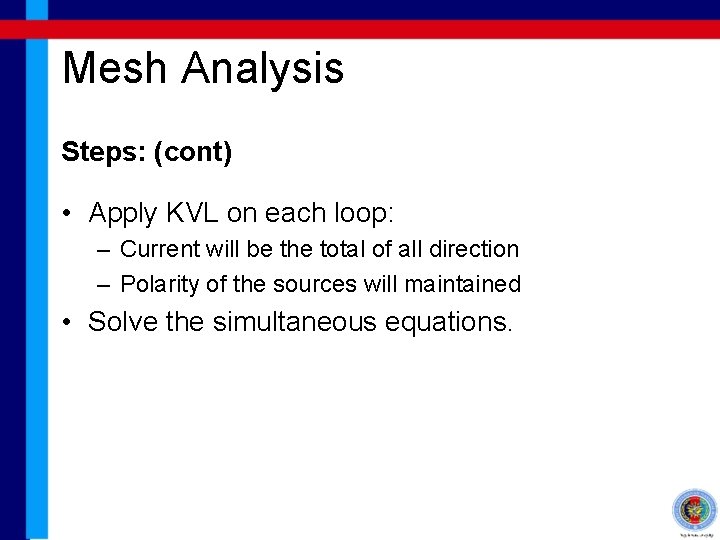
Mesh Analysis Steps: (cont) • Apply KVL on each loop: – Current will be the total of all direction – Polarity of the sources will maintained • Solve the simultaneous equations.
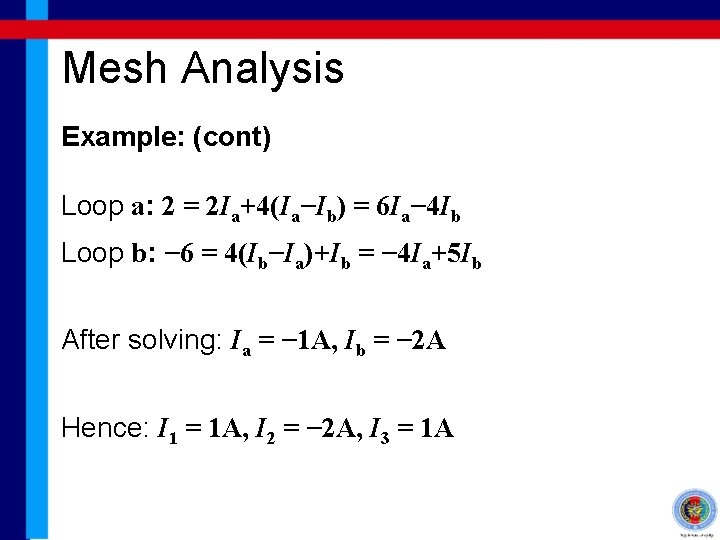
Mesh Analysis Example: [Boylestad 10 th Ed. E. g. 8. 11 - modified] R 2 R 1 R 3 4Ω 2Ω I 1 2 V a Ia I 3 1Ω b I 2 Ib 6 V
Mesh Analysis Example: (cont) Loop a: 2 = 2 Ia+4(Ia−Ib) = 6 Ia− 4 Ib Loop b: − 6 = 4(Ib−Ia)+Ib = − 4 Ia+5 Ib After solving: Ia = − 1 A, Ib = − 2 A Hence: I 1 = 1 A, I 2 = − 2 A, I 3 = 1 A
Nodal Noodle Analysis
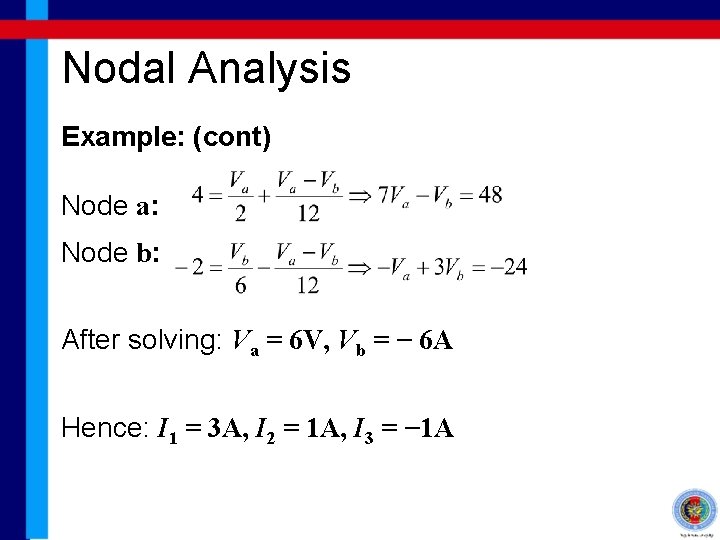
Nodal Analysis • Determine the number of nodes. • Pick a reference node then label the rest with subscripts. • [*] If there is any voltage source in the branch, replace it with short circuit – apply KCL in the next step to the resulting bigger node. • Apply KCL on each node except the reference. • Solve the simultaneous equations.
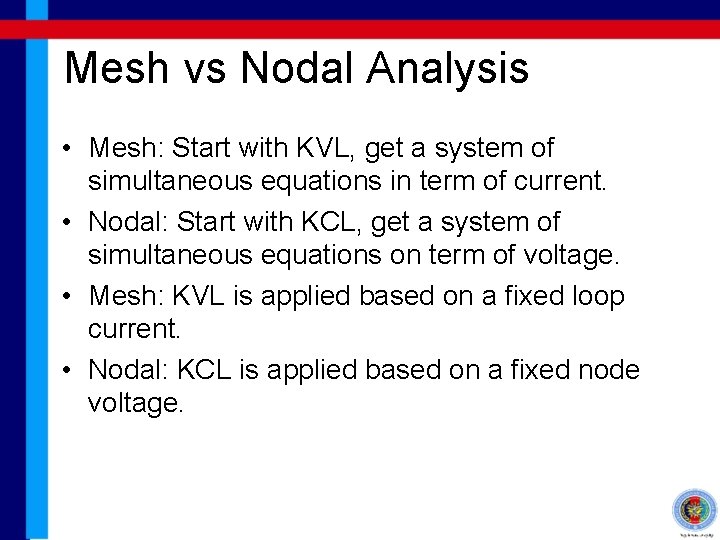
Nodal Analysis Example: [Boylestad 10 th Ed. E. g. 8. 21 - modified] a I 2 R 2 b 12Ω I 3 I 1 4 A R 1 2Ω 6Ω R 3 2 A
Nodal Analysis Example: (cont) Node a: Node b: After solving: Va = 6 V, Vb = − 6 A Hence: I 1 = 3 A, I 2 = 1 A, I 3 = − 1 A
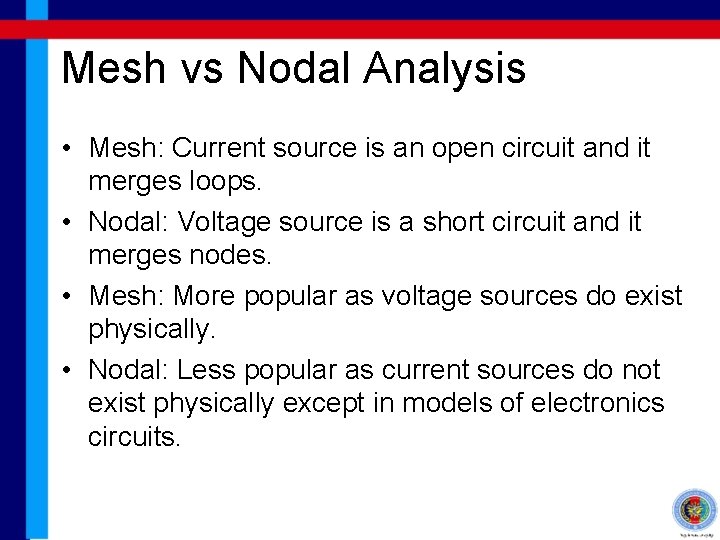
Mesh vs Nodal Analysis • Mesh: Start with KVL, get a system of simultaneous equations in term of current. • Nodal: Start with KCL, get a system of simultaneous equations on term of voltage. • Mesh: KVL is applied based on a fixed loop current. • Nodal: KCL is applied based on a fixed node voltage.
Mesh vs Nodal Analysis • Mesh: Current source is an open circuit and it merges loops. • Nodal: Voltage source is a short circuit and it merges nodes. • Mesh: More popular as voltage sources do exist physically. • Nodal: Less popular as current sources do not exist physically except in models of electronics circuits.
Linearity and Superposition
Linearity Concept of Circuit Elements • Due to Ohm’s Law, the effect of voltage across a circuit element is linear. – Can be added linearly depending on how much potential is applied to each of them. • This is true for the effect of current too.
Superposition Theorem Statement: The current through, or voltage across, an element is equal to the algebraic sum of the currents or the voltages produced independently by each source
Superposition Theorem • Choose one power source to consider, then switch off other sources: – Voltage source: remove it and replace with short circuit – Current source: remove it and replace with open circuit • Calculate the voltages and currents in the elements of concern based on the resulting circuit. • Do the above for all sources, then sum the respective voltages or currents by considering the polarities.
Superposition Theorem Example: [Boylestad 10 th Ed. E. g. 9. 5 - modified] I 2 I 1 R 1 4Ω 3 A 2Ω 12 V 6 V R 2
Superposition Theorem Example: [Boylestad 10 th Ed. E. g. 9. 5 - modified] Consider only the 12 V source: I 2 a I 1 a R 1 4Ω 2Ω 12 V R 2
Superposition Theorem Example: [Boylestad 10 th Ed. E. g. 9. 5 - modified] Consider only the 6 V source: I 2 b I 1 b R 1 4Ω 2Ω 6 V R 2
Superposition Theorem Example: [Boylestad 10 th Ed. E. g. 9. 5 - modified] Consider only the current source: I 2 c I 1 c R 1 4Ω 2Ω 3 A R 2
Superposition Theorem Example: [Boylestad 10 th Ed. E. g. 9. 5 - modified] Hence: I 1 = I 1 a + I 1 b + I 1 c = 1 A I 2 = I 2 a + I 2 b + I 2 c = 2 A
Thevenin’s Theorem
Thevenin’s Theorem Statement: Network behind any two terminals of linear DC circuit can be replaced by an equivalent voltage source and an equivalent series resistor • Can be used to reduce a complicated network to a combination of voltage source and a series resistor
Thevenin’s Theorem • Calculate the Thevenin’s resistance, RTh, by switching off all power sources and finding the resulting resistance through the two terminals: – Voltage source: remove it and replace with short circuit – Current source: remove it and replace with open circuit • Calculate the Thevenin’s voltage, VTh, by switching back on all powers and calculate the open circuit voltage between the terminals.
Thevenin’s Theorem Example: [Boylestad 10 th Ed. E. g. 9. 6 - modified] Convert the following network into its Thevenin’s equivalent: 3Ω 6Ω 9 V
Thevenin’s Theorem Example: [Boylestad 10 th Ed. E. g. 9. 6 - modified] RTh calculation: 3Ω 6Ω
Thevenin’s Theorem Example: [Boylestad 10 th Ed. E. g. 9. 6 - modified] VTh calculation: 3Ω 6Ω 9 V
Thevenin’s Theorem Example: [Boylestad 10 th Ed. E. g. 9. 6 - modified] Thevenin’s equivalence: 2Ω 6 V
Norton’s Theorem
Norton’s Theorem Statement: Network behind any two terminals of linear DC circuit can be replaced by an equivalent current source and an equivalent parallel resistor • Can be used to reduce a complicated network to a combination of current source and a parallel resistor
Norton’s Theorem • Calculate the Norton’s resistance, RN, by switching off all power sources and finding the resulting resistance through the two terminals: – Voltage source: remove it and replace with short circuit – Current source: remove it and replace with open circuit • Calculate the Norton’s voltage, IN, by switching back on all powers and calculate the short circuit current between the terminals.
Norton’s Theorem Example: [Boylestad 10 th Ed. E. g. 9. 6 - modified] Convert the following network into its Norton’s equivalent: 3Ω 6Ω 9 V
Norton’s Theorem Example: [Boylestad 10 th Ed. E. g. 9. 6 - modified] RN calculation: 3Ω 6Ω
Norton’s Theorem Example: [Boylestad 10 th Ed. E. g. 9. 6 - modified] IN calculation: 3Ω 6Ω 9 V
Norton’s Theorem Example: [Boylestad 10 th Ed. E. g. 9. 6 - modified] Norton’s equivalence: OR, 3 A 2Ω We can just take the Thevenin’s equivalent and calculate the short circuit current.
Maximum Power Consumption An element is consuming the maximum power out of a network if its resistance is equal to the Thevenin’s or Norton’s resistance.
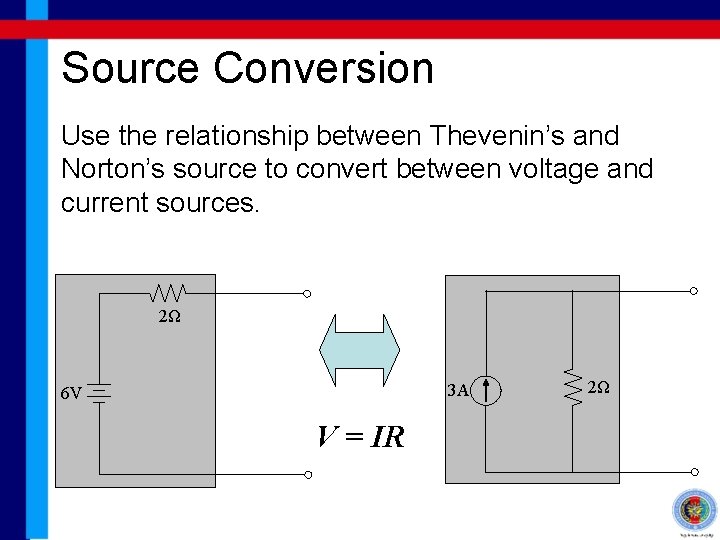
Source Conversion Use the relationship between Thevenin’s and Norton’s source to convert between voltage and current sources. 2Ω 3 A 6 V V = IR 2Ω