
EECS 322 Computer Architecture Language of the Machine
![Review: Design Abstractions temp = v[k]; High Level Language Program (e. g. , C)](https://slidetodoc.com/presentation_image_h2/909927e631a655cf9ae8549ad052a2a7/image-2.jpg "Review: Design Abstractions temp = v[k]; High Level Language Program (e. g. , C)")

![lw example 0 A[0] A[8] s 1 s 2 s 3 0 x. FFFF](https://slidetodoc.com/presentation_image_h2/909927e631a655cf9ae8549ad052a2a7/image-14.jpg "lw example 0 A[0] A[8] s 1 s 2 s 3 0 x. FFFF")
![Compile Array Example C code fragment: register int g, h, i; int A[66]; /*](https://slidetodoc.com/presentation_image_h2/909927e631a655cf9ae8549ad052a2a7/image-16.jpg "Compile Array Example C code fragment: register int g, h, i; int A[66]; /*")
![Execution Array Example: g = h + A[i]; C variables Instruction g h A](https://slidetodoc.com/presentation_image_h2/909927e631a655cf9ae8549ad052a2a7/image-17.jpg "Execution Array Example: g = h + A[i]; C variables Instruction g h A")
- Slides: 22
EECS 322 Computer Architecture Language of the Machine Load, Store and Dense Arrays Instructor: Francis G. Wolff wolff@eecs. cwru. edu Case Western Reserve University This presentation uses powerpoint animation: please viewshow CWRU EECS 322 1
Review: Design Abstractions temp = v[k]; High Level Language Program (e. g. , C) v[k] = v[k+1]; v[k+1] = temp; Compiler lw lw sw sw Assembly Language Program (e. g. MIPS) Assembler Machine Language Program (MIPS) 0000 1010 1100 0101 1001 1111 0110 1000 $t 0, $t 1, $t 0, 1100 0101 1010 0000 0110 1000 1111 1001 0($2) 4($2) 1010 0000 0101 1100 1111 1000 0110 0101 1100 0000 1010 1000 0110 1001 1111 Machine Interpretation Control Signal Specification ALUOP[0: 3] <= Inst. Reg[9: 11] & MASK An abstraction omits unneeded detail, helps us cope with complexity CWRU EECS 322 2
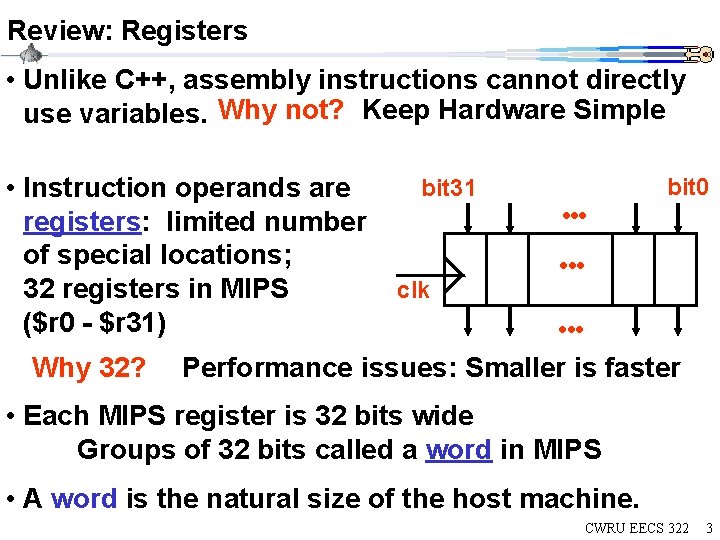
Review: Registers • Unlike C++, assembly instructions cannot directly use variables. Why not? Keep Hardware Simple • Instruction operands are registers: limited number of special locations; 32 registers in MIPS ($r 0 - $r 31) Why 32? bit 0 bit 31 • • • clk • • • Performance issues: Smaller is faster • Each MIPS register is 32 bits wide Groups of 32 bits called a word in MIPS • A word is the natural size of the host machine. CWRU EECS 322 3
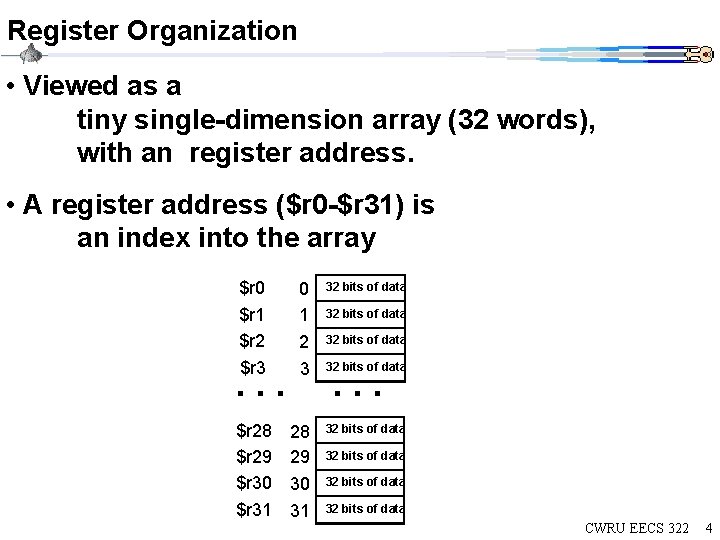
Register Organization • Viewed as a tiny single-dimension array (32 words), with an register address. • A register address ($r 0 -$r 31) is an index into the array $r 0 $r 1 $r 2 $r 3 0 1 2 3 32 bits of data $r 28 $r 29 $r 30 $r 31 28 29 30 31 32 bits of data . . . 32 bits of data 32 bits of data CWRU EECS 322 4
ANSI C integers (section A 4. 2 Basic Types) • Examples: short x; int y; long z; unsigned int f; • Plain int objects have the natural size suggested by the host machine architecture; • the other sizes are provided to meet special needs • Longer integers provide at least as much as shorter ones, • but the implementation may make plain integers equivalent to either short integers, or long integers. • The int types all represent signed values unless specified otherwise. CWRU EECS 322 5
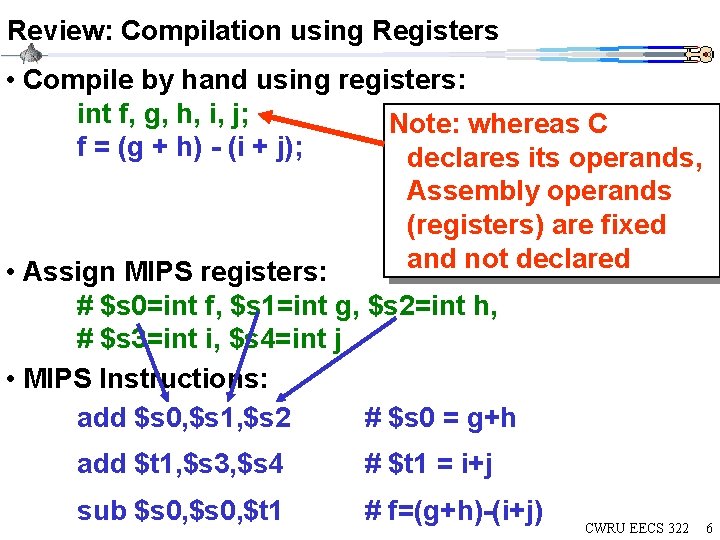
Review: Compilation using Registers • Compile by hand using registers: int f, g, h, i, j; Note: whereas C f = (g + h) - (i + j); declares its operands, Assembly operands (registers) are fixed and not declared • Assign MIPS registers: # $s 0=int f, $s 1=int g, $s 2=int h, # $s 3=int i, $s 4=int j • MIPS Instructions: add $s 0, $s 1, $s 2 # $s 0 = g+h add $t 1, $s 3, $s 4 # $t 1 = i+j sub $s 0, $t 1 # f=(g+h)-(i+j) CWRU EECS 322 6
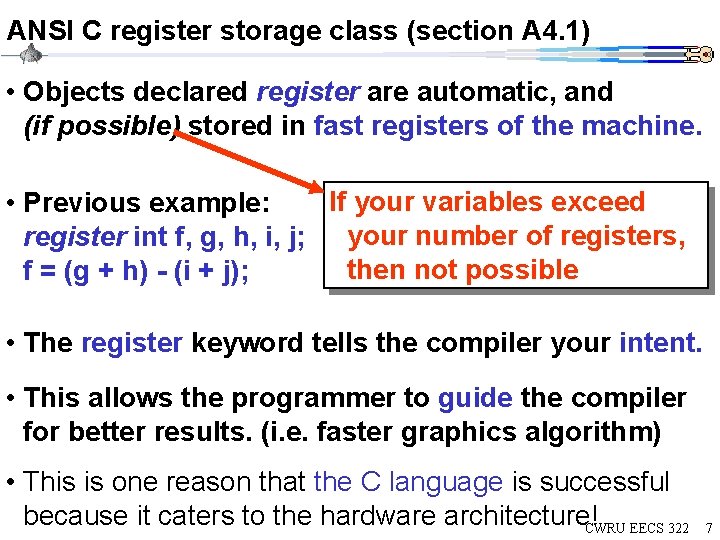
ANSI C register storage class (section A 4. 1) • Objects declared register are automatic, and (if possible) stored in fast registers of the machine. If your variables exceed • Previous example: register int f, g, h, i, j; your number of registers, then not possible f = (g + h) - (i + j); • The register keyword tells the compiler your intent. • This allows the programmer to guide the compiler for better results. (i. e. faster graphics algorithm) • This is one reason that the C language is successful because it caters to the hardware architecture!CWRU EECS 322 7
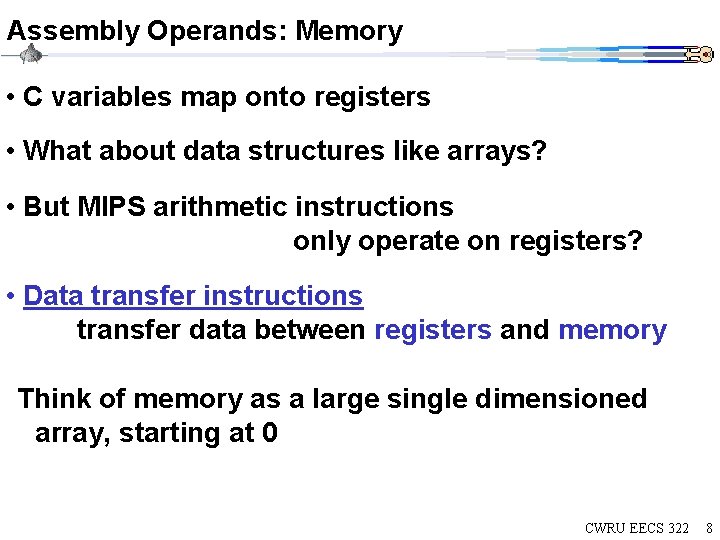
Assembly Operands: Memory • C variables map onto registers • What about data structures like arrays? • But MIPS arithmetic instructions only operate on registers? • Data transfer instructions transfer data between registers and memory Think of memory as a large single dimensioned array, starting at 0 CWRU EECS 322 8
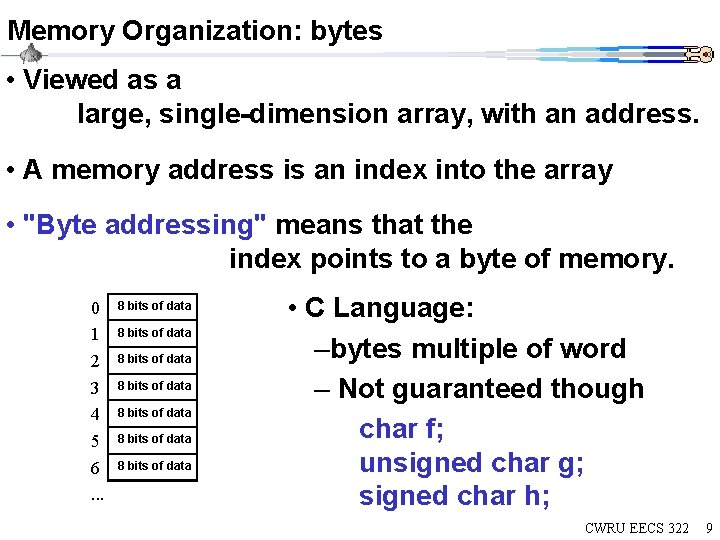
Memory Organization: bytes • Viewed as a large, single-dimension array, with an address. • A memory address is an index into the array • "Byte addressing" means that the index points to a byte of memory. 0 1 2 3 4 5 6. . . 8 bits of data 8 bits of data • C Language: –bytes multiple of word – Not guaranteed though char f; unsigned char g; signed char h; CWRU EECS 322 9
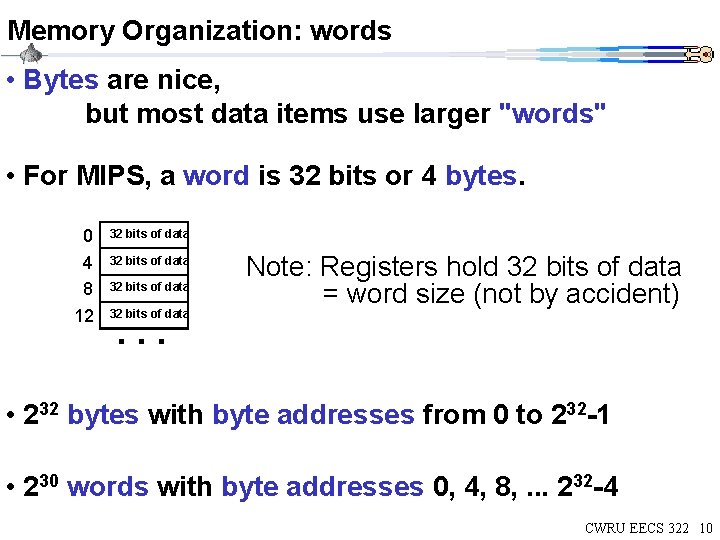
Memory Organization: words • Bytes are nice, but most data items use larger "words" • For MIPS, a word is 32 bits or 4 bytes. 0 4 8 12 32 bits of data Note: Registers hold 32 bits of data = word size (not by accident) . . . • 232 bytes with byte addresses from 0 to 232 -1 • 230 words with byte addresses 0, 4, 8, . . . 232 -4 CWRU EECS 322 10
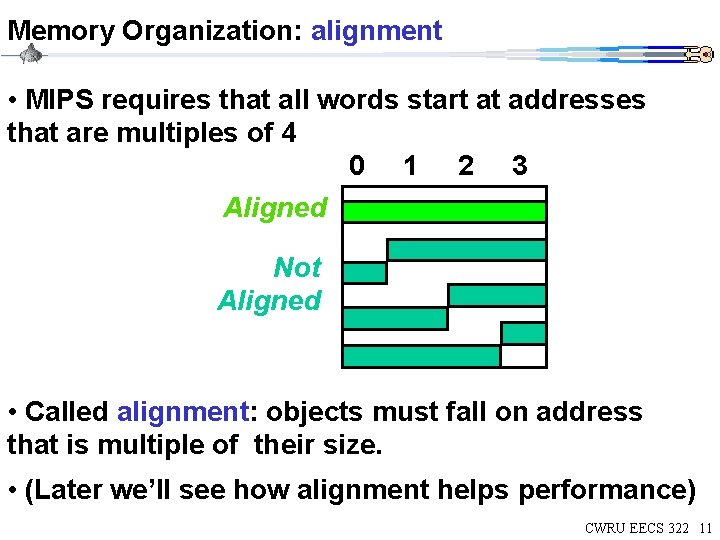
Memory Organization: alignment • MIPS requires that all words start at addresses that are multiples of 4 0 1 2 3 Aligned Not Aligned • Called alignment: objects must fall on address that is multiple of their size. • (Later we’ll see how alignment helps performance) CWRU EECS 322 11
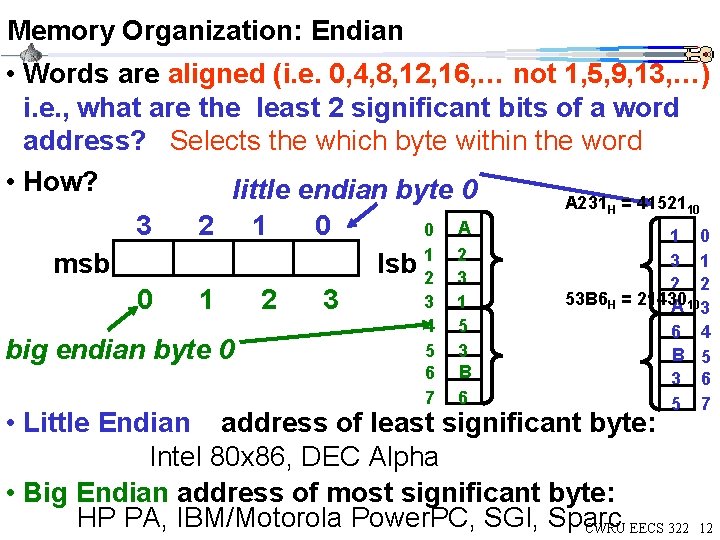
Memory Organization: Endian • Words are aligned (i. e. 0, 4, 8, 12, 16, … not 1, 5, 9, 13, …) i. e. , what are the least 2 significant bits of a word address? Selects the which byte within the word • How? little endian byte 0 3 2 1 A 231 H = 4152110 0 msb lsb 0 1 big endian byte 0 2 3 0 1 2 3 4 5 6 7 A 2 3 1 5 3 B 6 1 0 3 1 2 2 53 B 6 H = 21430 A 103 6 4 B 5 3 6 5 7 • Little Endian address of least significant byte: Intel 80 x 86, DEC Alpha • Big Endian address of most significant byte: HP PA, IBM/Motorola Power. PC, SGI, Sparc CWRU EECS 322 12
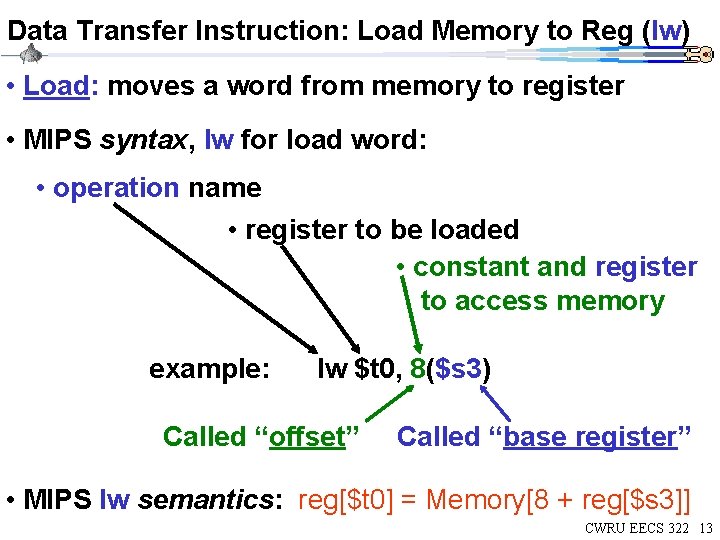
Data Transfer Instruction: Load Memory to Reg (lw) • Load: moves a word from memory to register • MIPS syntax, lw for load word: • operation name • register to be loaded • constant and register to access memory example: lw $t 0, 8($s 3) Called “offset” Called “base register” • MIPS lw semantics: reg[$t 0] = Memory[8 + reg[$s 3]] CWRU EECS 322 13
lw example 0 A[0] A[8] s 1 s 2 s 3 0 x. FFFF • The value in register $s 3 is an address • Think of it as a pointer into memory t 0 g h Suppose: Array A address = 3000 reg[$s 3]=Array A reg[$t 0]=12; mem[3008]=42; Then lw $t 0, 8($s 3) Adds offset “ 8” to $s 3 to select A[8], to put “ 42” into $t 0 reg[$t 0]=mem[8+reg[$s 3]] =mem[8+3000]=mem[3008] =42 =Hitchhikers Guide to the Galaxy CWRU EECS 322 14
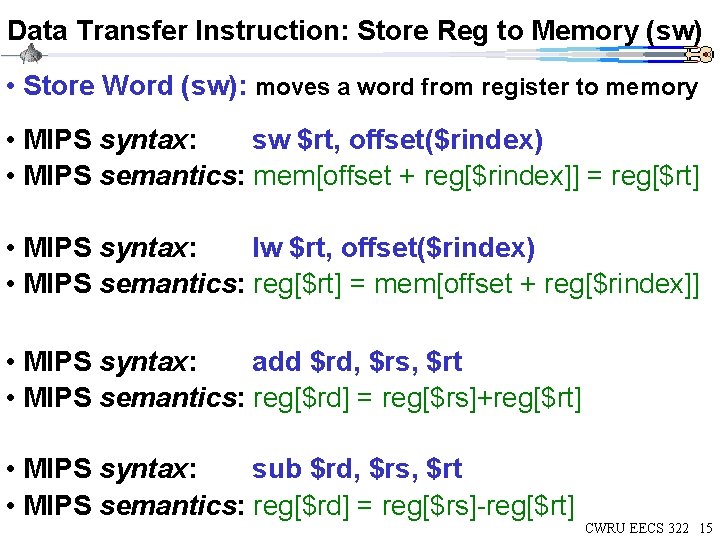
Data Transfer Instruction: Store Reg to Memory (sw) • Store Word (sw): moves a word from register to memory • MIPS syntax: sw $rt, offset($rindex) • MIPS semantics: mem[offset + reg[$rindex]] = reg[$rt] • MIPS syntax: lw $rt, offset($rindex) • MIPS semantics: reg[$rt] = mem[offset + reg[$rindex]] • MIPS syntax: add $rd, $rs, $rt • MIPS semantics: reg[$rd] = reg[$rs]+reg[$rt] • MIPS syntax: sub $rd, $rs, $rt • MIPS semantics: reg[$rd] = reg[$rs]-reg[$rt] CWRU EECS 322 15
Compile Array Example C code fragment: register int g, h, i; int A[66]; /* 66 total elements: A[0. . 65] */ g = h + A[i]; /* note: i=5 means 6 rd element */ Compiled MIPS assembly instructions: add add lw add $t 1, $s 4 $t 1, $t 1, $s 3 $t 0, 0($t 1) $s 1, $s 2, $t 0 # $t 1 = 2*i # $t 1 = 4*i #$t 1=addr A[i] # $t 0 = A[i] # g = h + A[i] CWRU EECS 322 16
Execution Array Example: g = h + A[i]; C variables Instruction g h A i $s 1 $s 2 $s 3 $s 4 $t 0 $t 1 suppose (mem[3020]=38) ? 4 3000 5 ? ? add $t 1, $s 4 ? 4 3000 5 ? ? add $t 1, $t 1 ? 4 3000 5 ? 10 add $t 1, $s 3 ? 4 3000 5 ? 20 lw ? 4 3000 5 ? 3020 add $s 1, $s 2, $t 0 ? 4 3000 5 38 20 ? ? , ? 42 4 3000 5 ? 20 $t 0, 0($t 1) CWRU EECS 322 17
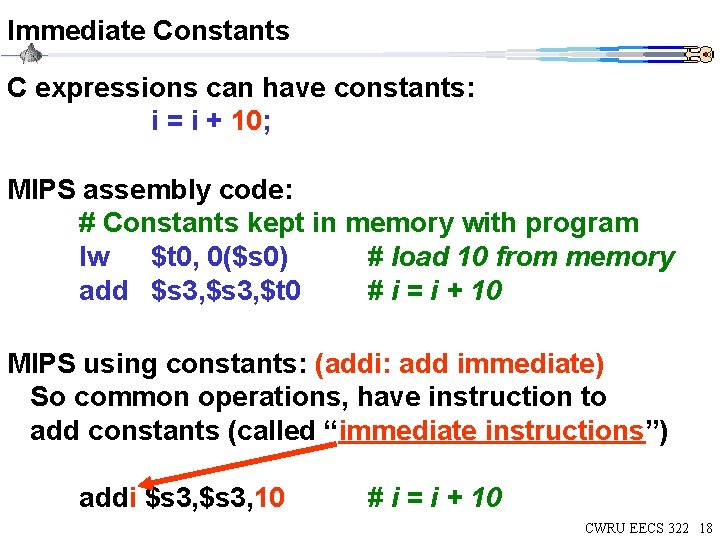
Immediate Constants C expressions can have constants: i = i + 10; MIPS assembly code: # Constants kept in memory with program lw $t 0, 0($s 0) # load 10 from memory add $s 3, $t 0 # i = i + 10 MIPS using constants: (addi: add immediate) So common operations, have instruction to add constants (called “immediate instructions”) addi $s 3, 10 # i = i + 10 CWRU EECS 322 18
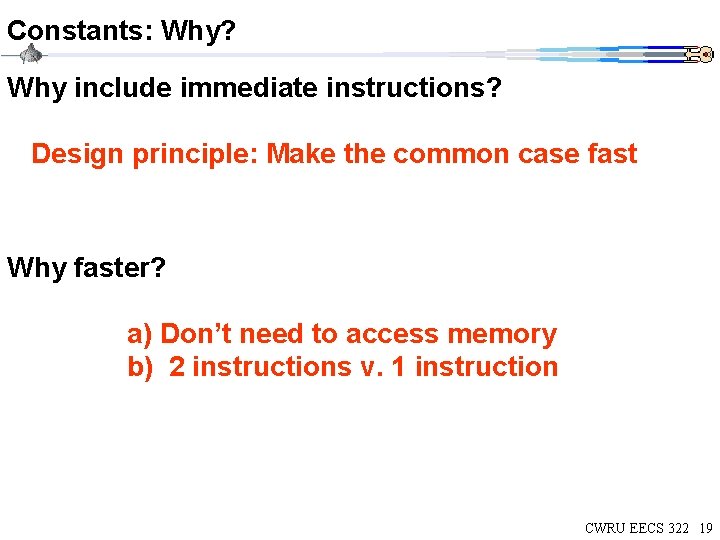
Constants: Why? Why include immediate instructions? Design principle: Make the common case fast Why faster? a) Don’t need to access memory b) 2 instructions v. 1 instruction CWRU EECS 322 19
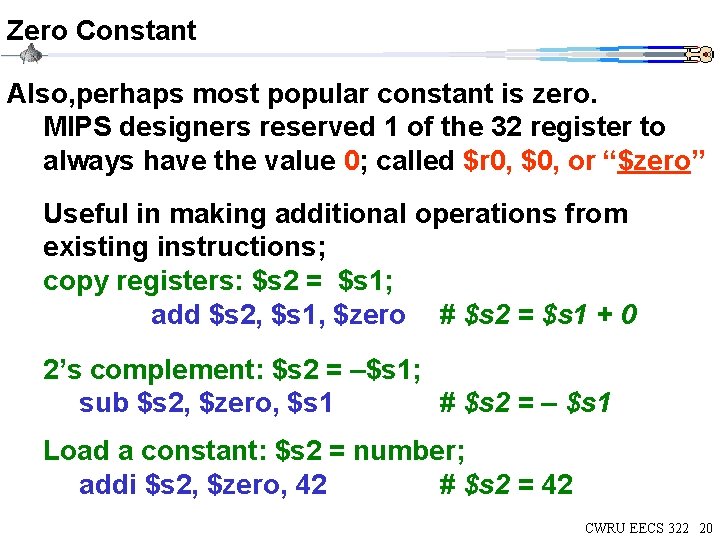
Zero Constant Also, perhaps most popular constant is zero. MIPS designers reserved 1 of the 32 register to always have the value 0; called $r 0, $0, or “$zero” Useful in making additional operations from existing instructions; copy registers: $s 2 = $s 1; add $s 2, $s 1, $zero # $s 2 = $s 1 + 0 2’s complement: $s 2 = –$s 1; sub $s 2, $zero, $s 1 # $s 2 = – $s 1 Load a constant: $s 2 = number; addi $s 2, $zero, 42 # $s 2 = 42 CWRU EECS 322 20
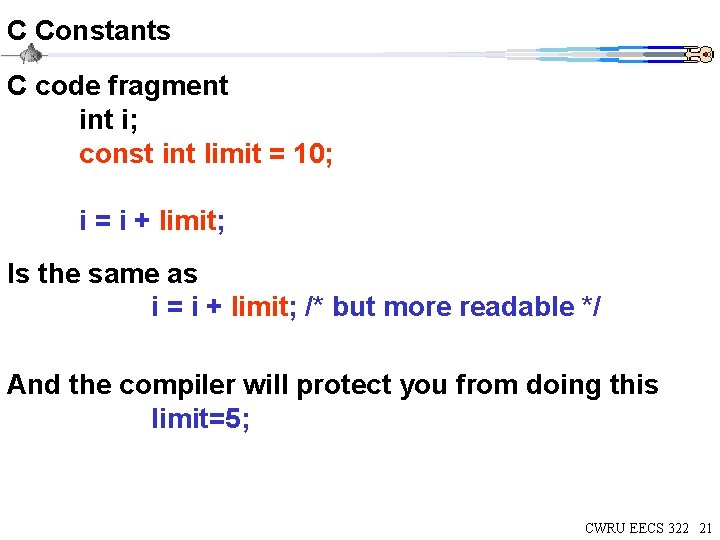
C Constants C code fragment i; const int limit = 10; i = i + limit; Is the same as i = i + limit; /* but more readable */ And the compiler will protect you from doing this limit=5; CWRU EECS 322 21
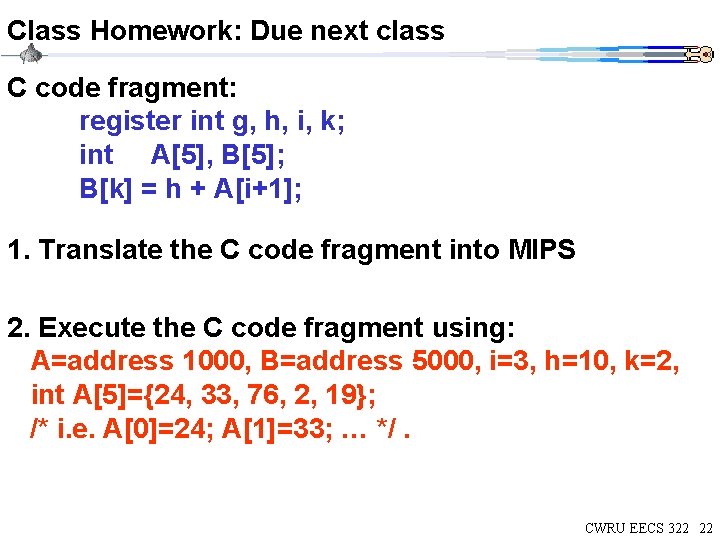
Class Homework: Due next class C code fragment: register int g, h, i, k; int A[5], B[5]; B[k] = h + A[i+1]; 1. Translate the C code fragment into MIPS 2. Execute the C code fragment using: A=address 1000, B=address 5000, i=3, h=10, k=2, int A[5]={24, 33, 76, 2, 19}; /* i. e. A[0]=24; A[1]=33; … */. CWRU EECS 322 22