
EECS 314 Computer Architecture Language of the Machine
![Compiling nested C func into MIPS [updated] int sum. Square(int x, int y) {](https://slidetodoc.com/presentation_image_h2/6254c3cf0e2311f9645a78653cb3149e/image-4.jpg "Compiling nested C func into MIPS [updated] int sum. Square(int x, int y) {")
![Review: MIPS registers and conventions Name [updated] Number Conventional usage $0 0 Constant 0](https://slidetodoc.com/presentation_image_h2/6254c3cf0e2311f9645a78653cb3149e/image-7.jpg "Review: MIPS registers and conventions Name [updated] Number Conventional usage $0 0 Constant 0")
![Alternate Static allocation (scope: public to everyone) • Static declaration int c[100]; Stack int](https://slidetodoc.com/presentation_image_h2/6254c3cf0e2311f9645a78653cb3149e/image-9.jpg "Alternate Static allocation (scope: public to everyone) • Static declaration int c[100]; Stack int")
![Review: memory allocation model int e[100]; int *sumarray(int a[], int b[]) { register int](https://slidetodoc.com/presentation_image_h2/6254c3cf0e2311f9645a78653cb3149e/image-10.jpg "Review: memory allocation model int e[100]; int *sumarray(int a[], int b[]) { register int")
- Slides: 37
EECS 314 Computer Architecture Language of the Machine Instructions Instructor: Francis G. Wolff wolff@eecs. cwru. edu Case Western Reserve University This presentation uses powerpoint animation: please viewshow CWRU EECS 314 1
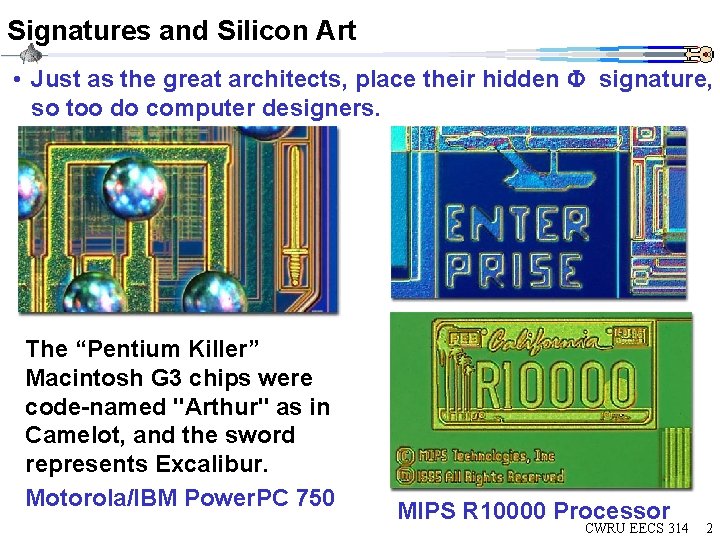
Signatures and Silicon Art • Just as the great architects, place their hidden signature, so too do computer designers. The “Pentium Killer” Macintosh G 3 chips were code-named "Arthur" as in Camelot, and the sword represents Excalibur. Motorola/IBM Power. PC 750 MIPS R 10000 Processor CWRU EECS 314 2
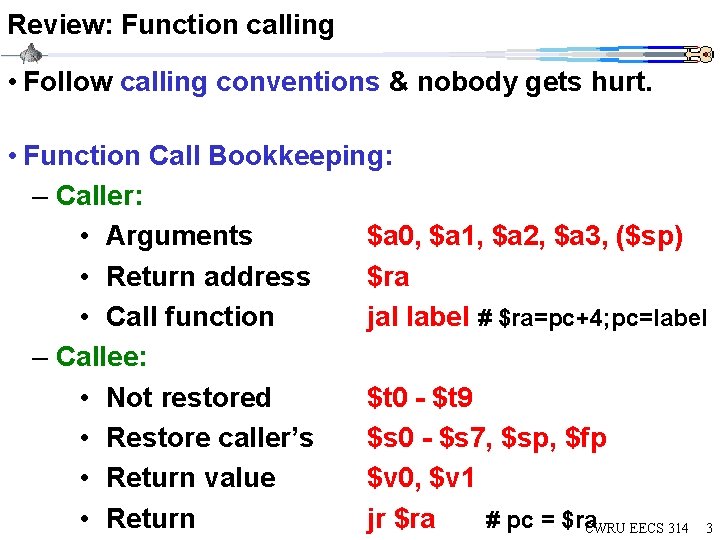
Review: Function calling • Follow calling conventions & nobody gets hurt. • Function Call Bookkeeping: – Caller: • Arguments $a 0, $a 1, $a 2, $a 3, ($sp) • Return address $ra • Call function jal label # $ra=pc+4; pc=label – Callee: • Not restored $t 0 - $t 9 • Restore caller’s $s 0 - $s 7, $sp, $fp • Return value $v 0, $v 1 • Return jr $ra # pc = $ra CWRU EECS 314 3
Compiling nested C func into MIPS [updated] int sum. Square(int x, int y) { return mult(x, x)+ y; } sum. Square: Prologue addi sw addi Body jal lw Epilogue addi lw addi add jr $sp, -4 $ra, 0($sp) $sp, -4 $a 1, 0($sp) $sp, -4 $a 0, 0($sp) $a 1, $a 0, $0 mult $a 0, 0($sp) $sp, 4 $a 1, 4($sp) $sp, 4 $ra, 8($sp) $sp, 4 $v 0, $a 1 $ra # push return address # # push argument y =$a 1 # # push argument x =$a 0 # # mult($a 0=x, $a 1=x) # call mult; $v 0=return # pop x # # pop y # # pop return address # # return=$v 0+($a 1=y) # return to caller CWRU EECS 314 4
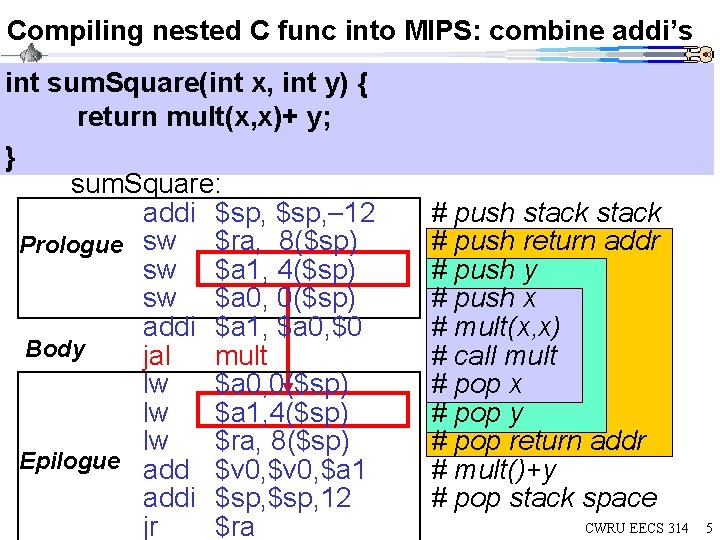
Compiling nested C func into MIPS: combine addi’s int sum. Square(int x, int y) { return mult(x, x)+ y; } sum. Square: addi $sp, 12 $ra, 8($sp) Prologue sw sw $a 1, 4($sp) sw $a 0, 0($sp) addi $a 1, $a 0, $0 Body jal mult lw $a 0, 0($sp) lw $a 1, 4($sp) lw $ra, 8($sp) Epilogue add $v 0, $a 1 addi $sp, 12 jr $ra # push stack # push return addr # push y # push x # mult(x, x) # call mult # pop x # pop y # pop return addr # mult()+y # pop stack space CWRU EECS 314 5
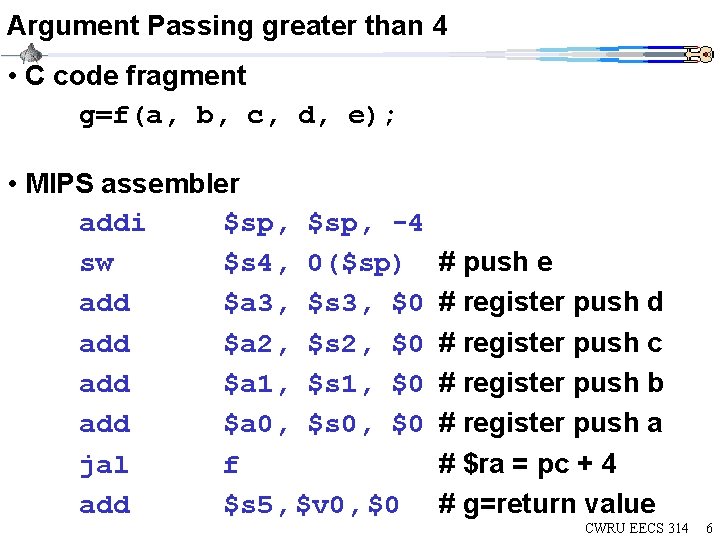
Argument Passing greater than 4 • C code fragment g=f(a, b, c, d, e); • MIPS assembler addi $sp, -4 sw $s 4, 0($sp) add $a 3, $s 3, $0 add $a 2, $s 2, $0 add $a 1, $s 1, $0 add $a 0, $s 0, $0 jal f add $s 5, $v 0, $0 # push e # register push d # register push c # register push b # register push a # $ra = pc + 4 # g=return value CWRU EECS 314 6
Review: MIPS registers and conventions Name [updated] Number Conventional usage $0 0 Constant 0 (writing $0 will not change $0) $at 1 Reserved by assembler for pseudo-instructions $v 0 -$v 1 2 -3 Function “return value; ” & temporary usage $a 0 -$a 3 4 -7 “function($a 0, $a 1, $a 2 $a 3); ” calling arguments $t 0 -$t 9 8 -15, 24, 25 Temporary (not preserved across call) $s 0 -$s 7 16 -23 Saved Temporary (preserved across call) $k 0 -$k 1 26 -27 Reserved for OS kernel $gp 28 Global pointer (global static variables) $sp 29 Stack pointer (args > 4 & local function variables) $fp 30 Frame pointer $ra 31 Function return address (see jal instruction) CWRU EECS 314 7
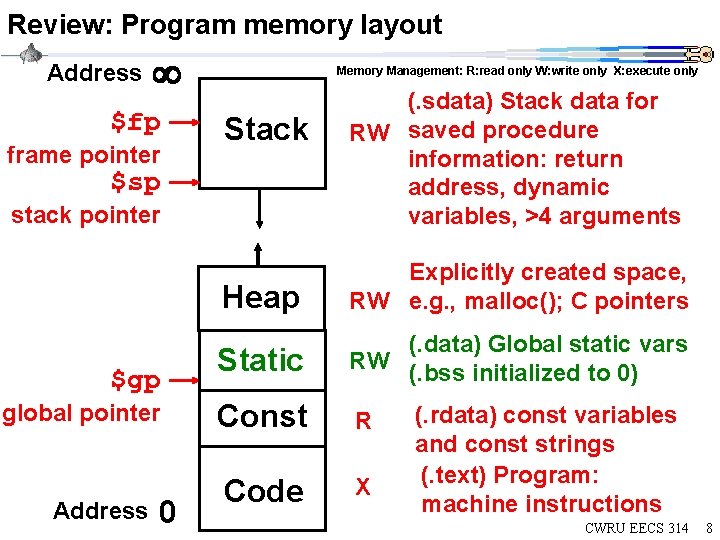
Review: Program memory layout Address ¥ $fp frame pointer Memory Management: R: read only W: write only X: execute only Stack $sp stack pointer $gp global pointer Address 0 (. sdata) Stack data for RW saved procedure information: return address, dynamic variables, >4 arguments Heap Explicitly created space, RW e. g. , malloc(); C pointers Static (. data) Global static vars RW (. bss initialized to 0) Const R Code X (. rdata) const variables and const strings (. text) Program: machine instructions CWRU EECS 314 8
Alternate Static allocation (scope: public to everyone) • Static declaration int c[100]; Stack int *sumarray(int a[], int b[]) { int i; static int c[100]; for(i=0; i<100; i=i+1) c[i] = a[i] + b[i]; return c; } • The variable scope of c is very public and is accessible to everyone outside the function Heap Static c[100] Code CWRU EECS 314 9
Review: memory allocation model int e[100]; int *sumarray(int a[], int b[]) { register int x; int i; int d[32]; int *p; static int c[100]; const int f = 3; p = (int *)malloc(sizeof(int)); . . . } • public scope: variable e • private scope: – x, i, d, p, c, f Stack Heap Static Code addi $rt, $rs, i CPU $1 -$31 CWRU EECS 314 10
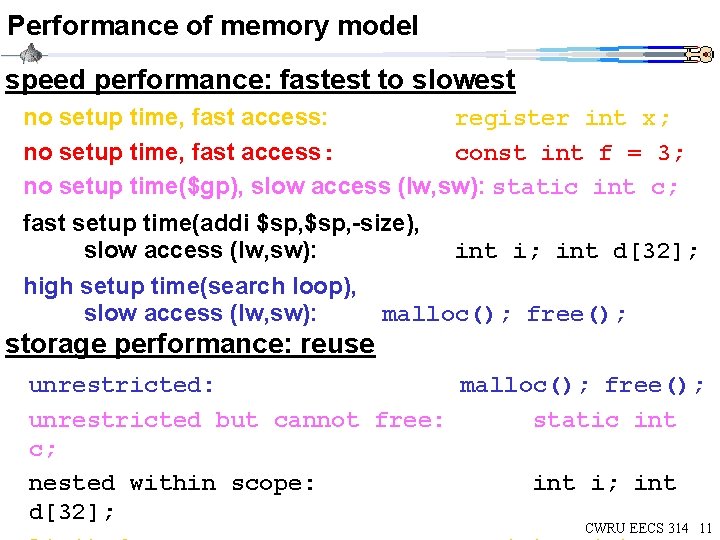
Performance of memory model speed performance: fastest to slowest no setup time, fast access: register int x; no setup time, fast access: const int f = 3; no setup time($gp), slow access (lw, sw): static int c; fast setup time(addi $sp, -size), slow access (lw, sw): high setup time(search loop), slow access (lw, sw): storage performance: reuse int i; int d[32]; malloc(); free(); unrestricted: malloc(); free(); unrestricted but cannot free: static int c; nested within scope: int i; int d[32]; CWRU EECS 314 11
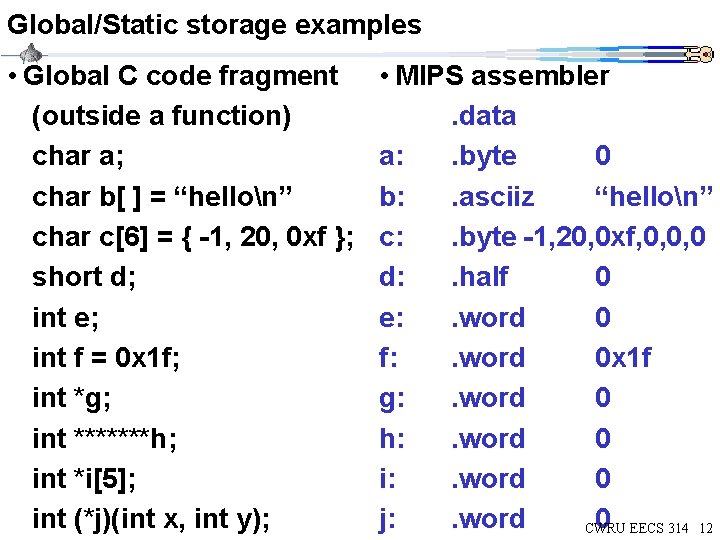
Global/Static storage examples • Global C code fragment (outside a function) char a; char b[ ] = “hellon” char c[6] = { -1, 20, 0 xf }; short d; int e; int f = 0 x 1 f; int *g; int *******h; int *i[5]; int (*j)(int x, int y); • MIPS assembler. data a: . byte 0 b: . asciiz “hellon” c: . byte -1, 20, 0 xf, 0, 0, 0 d: . half 0 e: . word 0 f: . word 0 x 1 f g: . word 0 h: . word 0 i: . word 0 j: . word 0 EECS 314 12 CWRU
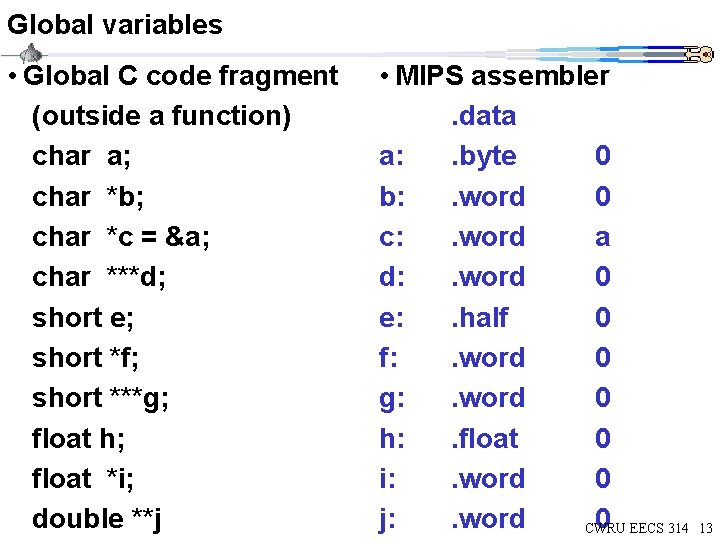
Global variables • Global C code fragment (outside a function) char a; char *b; char *c = &a; char ***d; short e; short *f; short ***g; float h; float *i; double **j • MIPS assembler. data a: . byte 0 b: . word 0 c: . word a d: . word 0 e: . half 0 f: . word 0 g: . word 0 h: . float 0 i: . word 0 j: . word 0 EECS 314 CWRU 13
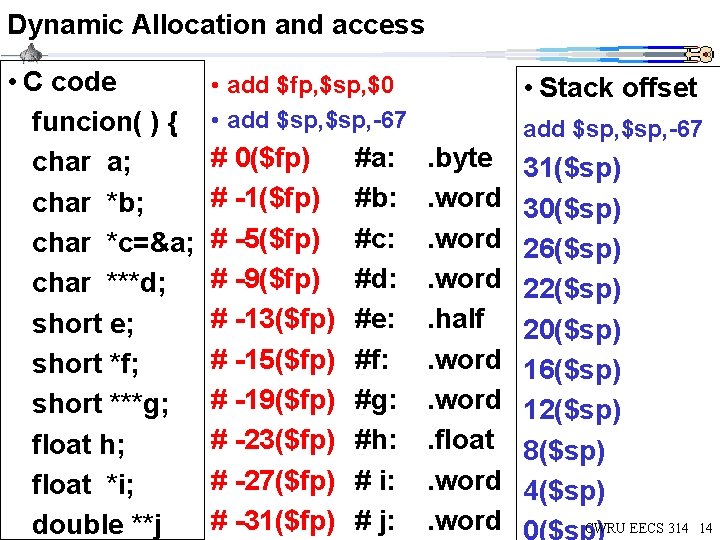
Dynamic Allocation and access • C code funcion( ) { char a; char *b; char *c=&a; char ***d; short e; short *f; short ***g; float h; float *i; double **j • add $fp, $sp, $0 • add $sp, -67 # 0($fp) # -1($fp) # -5($fp) # -9($fp) # -13($fp) # -15($fp) # -19($fp) # -23($fp) # -27($fp) # -31($fp) #a: #b: #c: #d: #e: #f: #g: #h: # i: # j: • Stack offset. byte. word. half. word. float. word add $sp, -67 31($sp) 30($sp) 26($sp) 22($sp) 20($sp) 16($sp) 12($sp) 8($sp) 4($sp) CWRU EECS 314 14
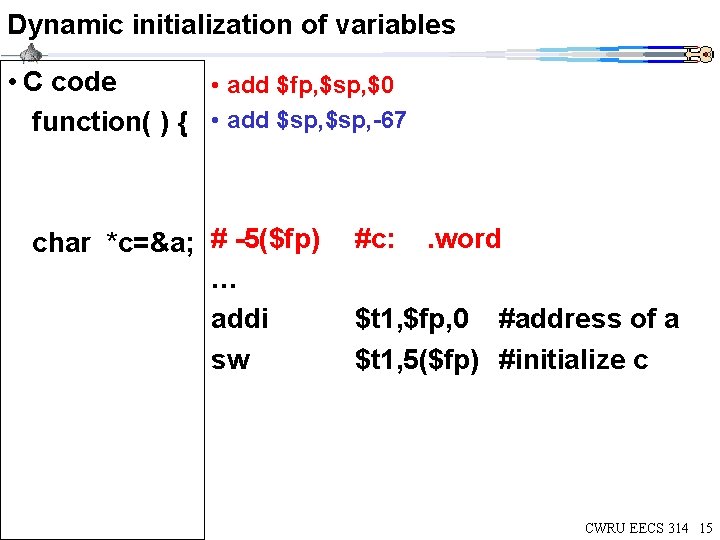
Dynamic initialization of variables • C code • add $fp, $sp, $0 function( ) { • add $sp, -67 char *c=&a; # -5($fp) … addi sw #c: . word $t 1, $fp, 0 #address of a $t 1, 5($fp) #initialize c CWRU EECS 314 15
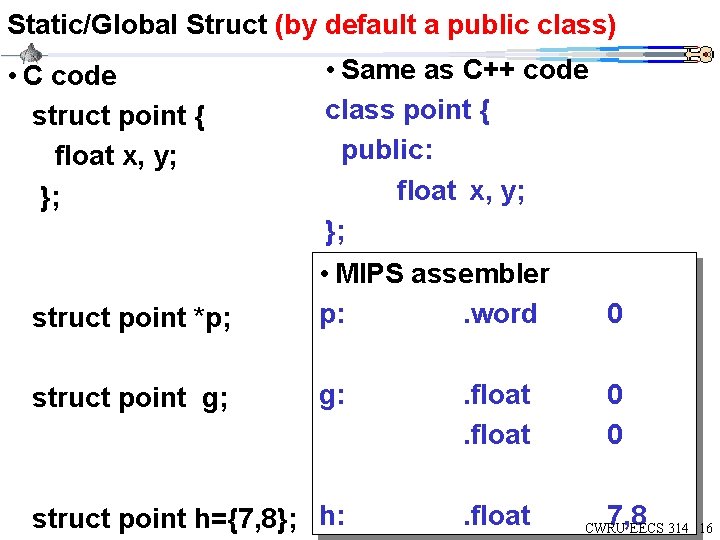
Static/Global Struct (by default a public class) struct point *p; • Same as C++ code class point { public: float x, y; }; • MIPS assembler p: . word 0 struct point g; g: . float struct point h={7, 8}; h: . float • C code struct point { float x, y; }; 0 0 7, 8 CWRU EECS 314 16
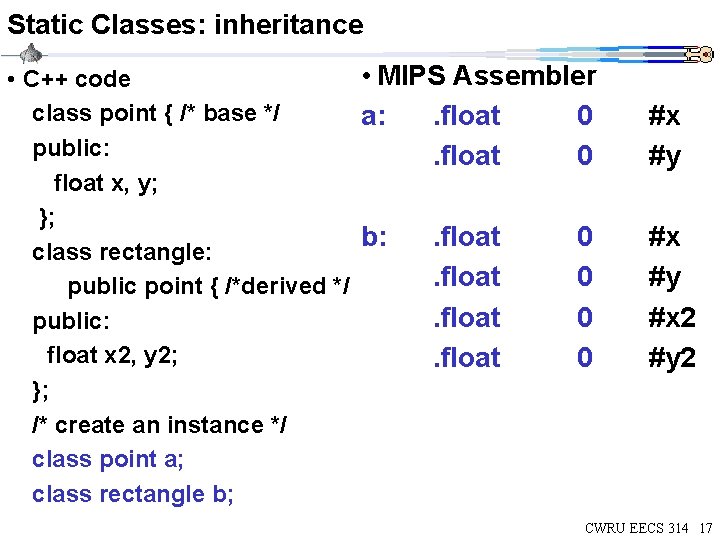
Static Classes: inheritance • MIPS Assembler • C++ code class point { /* base */ a: . float 0 public: . float 0 float x, y; }; b: . float 0 class rectangle: . float 0 public point { /*derived */. float 0 public: float x 2, y 2; . float 0 }; /* create an instance */ class point a; class rectangle b; #x #y #x 2 #y 2 CWRU EECS 314 17
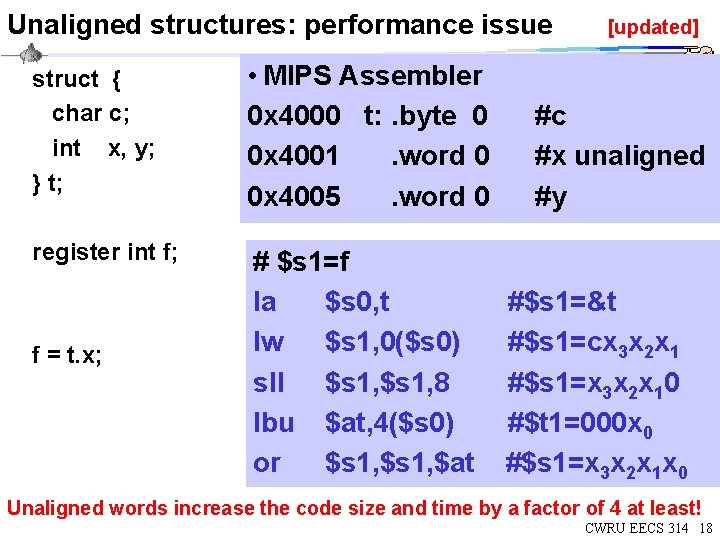
Unaligned structures: performance issue struct { char c; int x, y; } t; • MIPS Assembler 0 x 4000 t: . byte 0 0 x 4001. word 0 0 x 4005. word 0 register int f; # $s 1=f la $s 0, t lw $s 1, 0($s 0) sll $s 1, 8 lbu $at, 4($s 0) or $s 1, $at f = t. x; [updated] #c #x unaligned #y #$s 1=&t #$s 1=cx 3 x 2 x 1 #$s 1=x 3 x 2 x 10 #$t 1=000 x 0 #$s 1=x 3 x 2 x 1 x 0 Unaligned words increase the code size and time by a factor of 4 at least! CWRU EECS 314 18
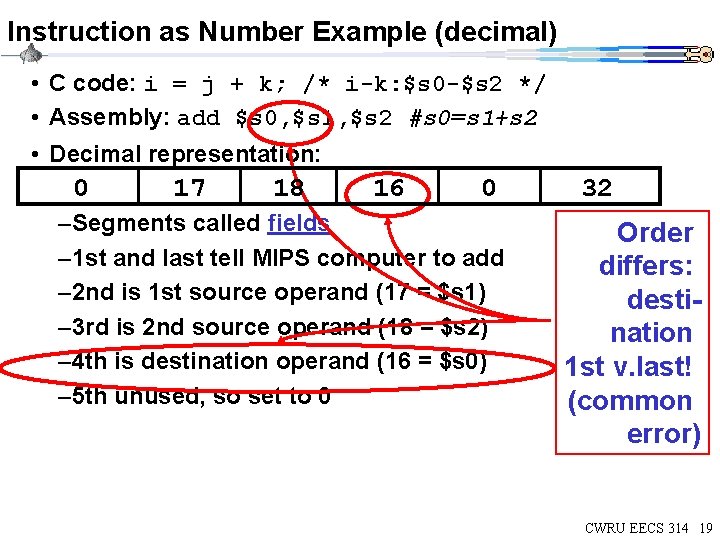
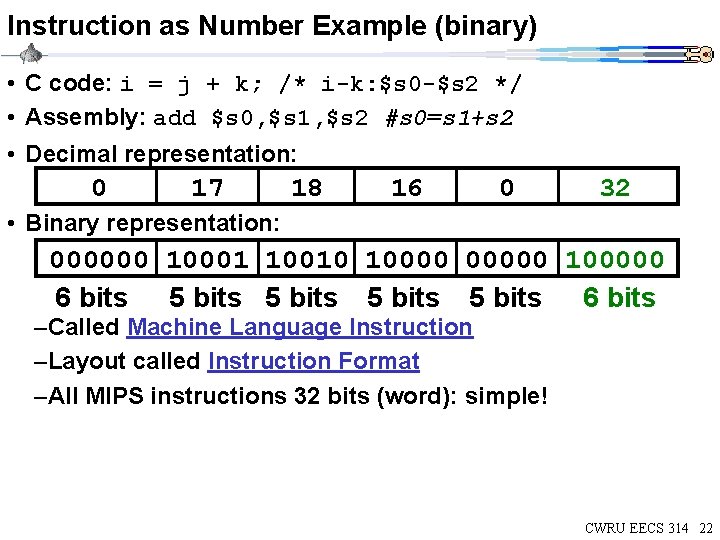
Instruction as Number Example (decimal) • C code: i = j + k; /* i-k: $s 0 -$s 2 */ • Assembly: add $s 0, $s 1, $s 2 #s 0=s 1+s 2 • Decimal representation: 0 17 18 16 0 –Segments called fields – 1 st and last tell MIPS computer to add – 2 nd is 1 st source operand (17 = $s 1) – 3 rd is 2 nd source operand (18 = $s 2) – 4 th is destination operand (16 = $s 0) – 5 th unused, so set to 0 32 Order differs: destination 1 st v. last! (common error) CWRU EECS 314 19
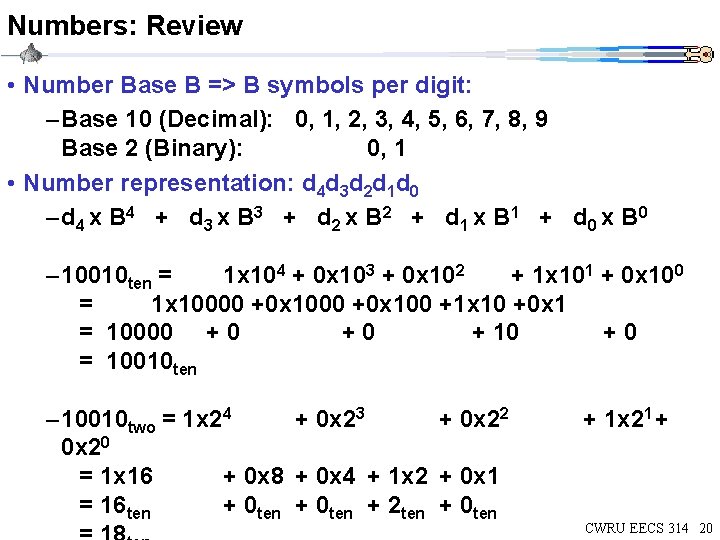
Numbers: Review • Number Base B => B symbols per digit: – Base 10 (Decimal): 0, 1, 2, 3, 4, 5, 6, 7, 8, 9 Base 2 (Binary): 0, 1 • Number representation: d 4 d 3 d 2 d 1 d 0 – d 4 x B 4 + d 3 x B 3 + d 2 x B 2 + d 1 x B 1 + d 0 x B 0 – 10010 ten = 1 x 10⁴ + 0 x 103 + 0 x 102 + 1 x 101 + 0 x 100 = 1 x 10000 +0 x 100 +1 x 10 +0 x 1 = 10000 + 0 +0 + 10 +0 = 10010 ten – 10010 two = 1 x 24 + 0 x 23 + 0 x 22 0 x 20 = 1 x 16 + 0 x 8 + 0 x 4 + 1 x 2 + 0 x 1 = 16 ten + 0 ten + 2 ten + 0 ten + 1 x 21 + CWRU EECS 314 20
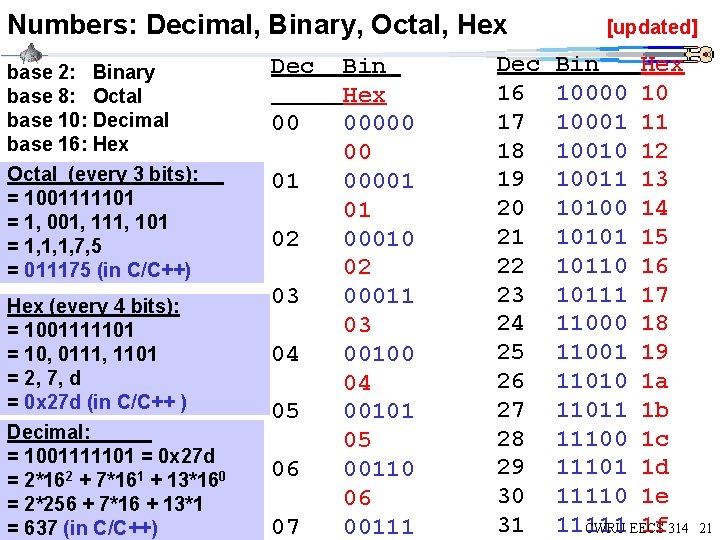
Numbers: Decimal, Binary, Octal, Hex base 2: Binary base 8: Octal base 10: Decimal base 16: Hex Dec Octal (every 3 bits): = 1001111101 = 1, 001, 111, 101 = 1, 1, 1, 7, 5 = 011175 (in C/C++) 01 Hex (every 4 bits): = 1001111101 = 10, 0111, 1101 = 2, 7, d = 0 x 27 d (in C/C++ ) Decimal: = 1001111101 = 0 x 27 d = 2*162 + 7*161 + 13*160 = 2*256 + 7*16 + 13*1 = 637 (in C/C++) 00 02 03 04 05 06 07 Bin Hex 00000 00 00001 01 00010 02 00011 03 00100 04 00101 05 00110 06 00111 Dec 16 17 18 19 20 21 22 23 24 25 26 27 28 29 30 31 [updated] Bin Hex 10000 10 10001 11 10010 12 10011 13 10100 14 10101 15 10110 16 10111 17 11000 18 11001 19 11010 1 a 11011 1 b 11100 1 c 11101 1 d 11110 1 e 11111 1 f 314 CWRU EECS 21
Instruction as Number Example (binary) • C code: i = j + k; /* i-k: $s 0 -$s 2 */ • Assembly: add $s 0, $s 1, $s 2 #s 0=s 1+s 2 • Decimal representation: 0 17 18 16 0 32 • Binary representation: 000000 10001 10010 100000 100000 6 bits 5 bits 6 bits –Called Machine Language Instruction –Layout called Instruction Format –All MIPS instructions 32 bits (word): simple! CWRU EECS 314 22
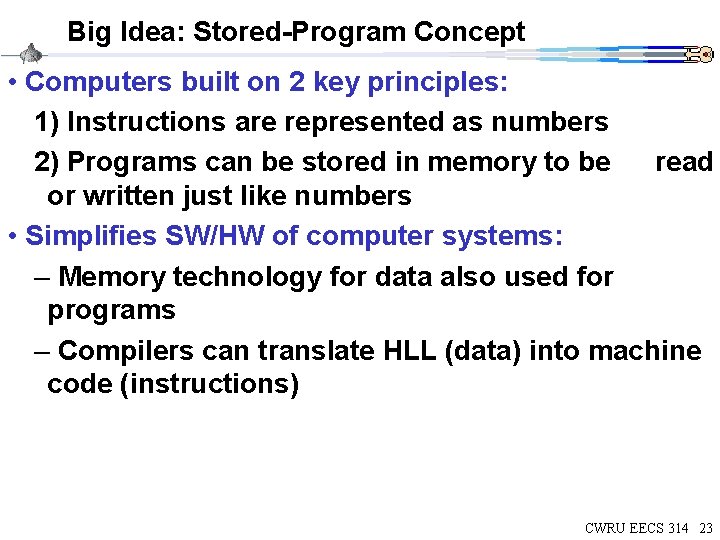
Big Idea: Stored-Program Concept • Computers built on 2 key principles: 1) Instructions are represented as numbers 2) Programs can be stored in memory to be read or written just like numbers • Simplifies SW/HW of computer systems: – Memory technology for data also used for programs – Compilers can translate HLL (data) into machine code (instructions) CWRU EECS 314 23
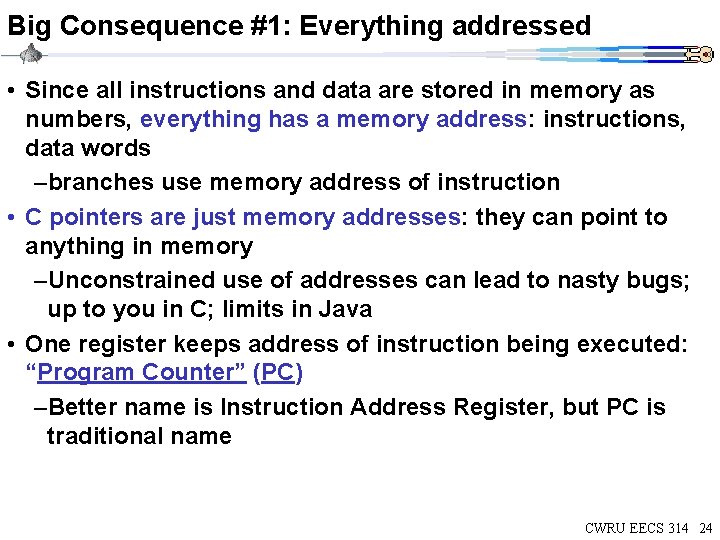
Big Consequence #1: Everything addressed • Since all instructions and data are stored in memory as numbers, everything has a memory address: instructions, data words –branches use memory address of instruction • C pointers are just memory addresses: they can point to anything in memory –Unconstrained use of addresses can lead to nasty bugs; up to you in C; limits in Java • One register keeps address of instruction being executed: “Program Counter” (PC) –Better name is Instruction Address Register, but PC is traditional name CWRU EECS 314 24
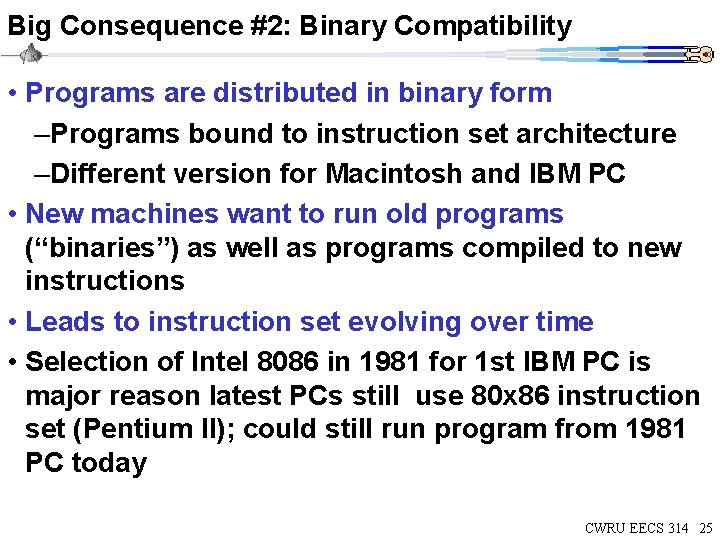
Big Consequence #2: Binary Compatibility • Programs are distributed in binary form –Programs bound to instruction set architecture –Different version for Macintosh and IBM PC • New machines want to run old programs (“binaries”) as well as programs compiled to new instructions • Leads to instruction set evolving over time • Selection of Intel 8086 in 1981 for 1 st IBM PC is major reason latest PCs still use 80 x 86 instruction set (Pentium II); could still run program from 1981 PC today CWRU EECS 314 25
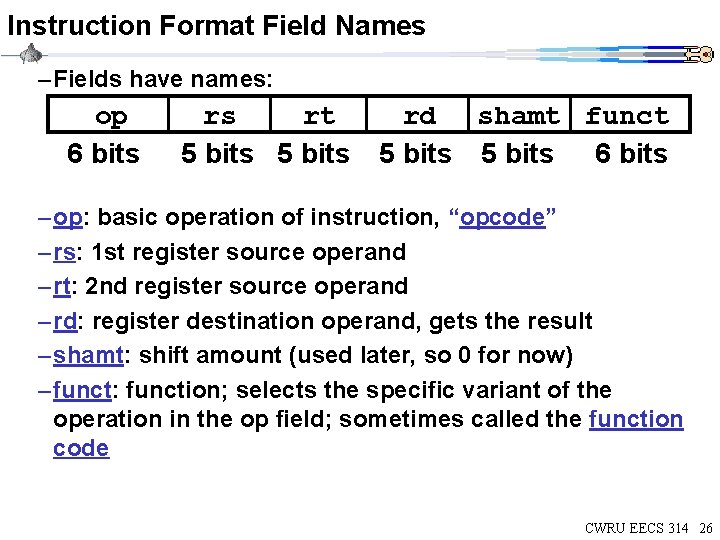
Instruction Format Field Names – Fields have names: op 6 bits rs rt 5 bits rd shamt funct 5 bits 6 bits – op: basic operation of instruction, “opcode” – rs: 1 st register source operand – rt: 2 nd register source operand – rd: register destination operand, gets the result – shamt: shift amount (used later, so 0 for now) – funct: function; selects the specific variant of the operation in the op field; sometimes called the function code CWRU EECS 314 26
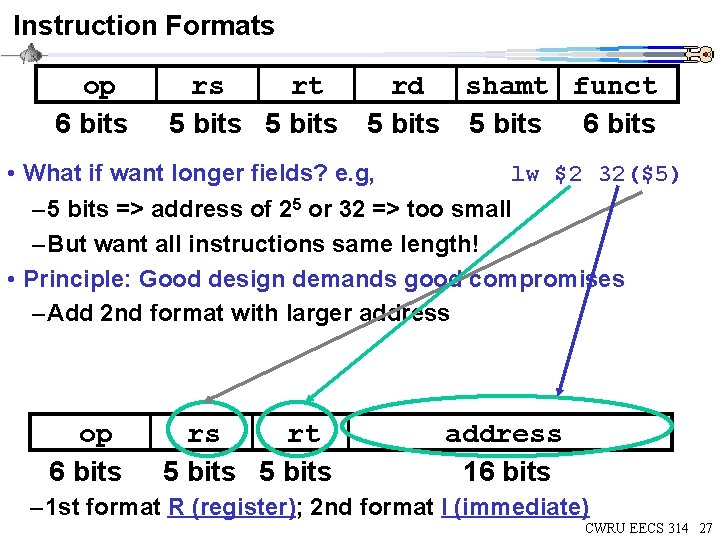
Instruction Formats op 6 bits rs rt 5 bits rd shamt funct 5 bits 6 bits • What if want longer fields? e. g, lw $2 32($5) – 5 bits => address of 25 or 32 => too small – But want all instructions same length! • Principle: Good design demands good compromises – Add 2 nd format with larger address op 6 bits rs rt 5 bits address 16 bits – 1 st format R (register); 2 nd format I (immediate) CWRU EECS 314 27
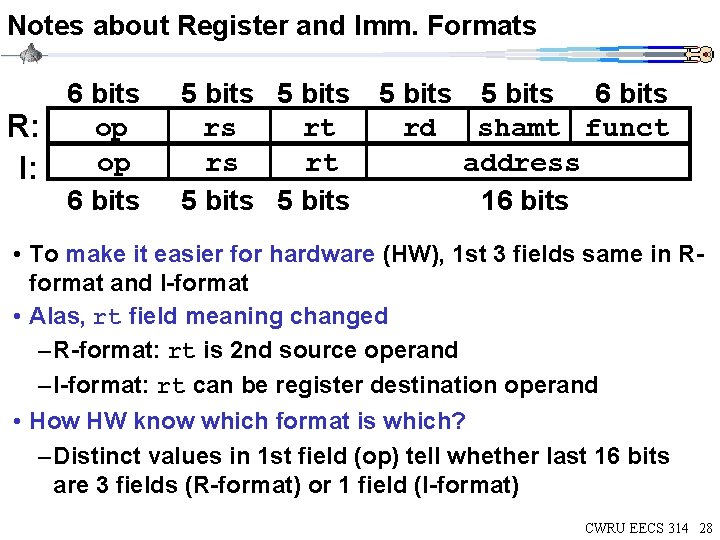
Notes about Register and Imm. Formats 6 bits op R: op I: 6 bits 5 bits rs rt 5 bits 6 bits rd shamt funct address 16 bits • To make it easier for hardware (HW), 1 st 3 fields same in Rformat and I-format • Alas, rt field meaning changed – R-format: rt is 2 nd source operand – I-format: rt can be register destination operand • How HW know which format is which? – Distinct values in 1 st field (op) tell whether last 16 bits are 3 fields (R-format) or 1 field (I-format) CWRU EECS 314 28
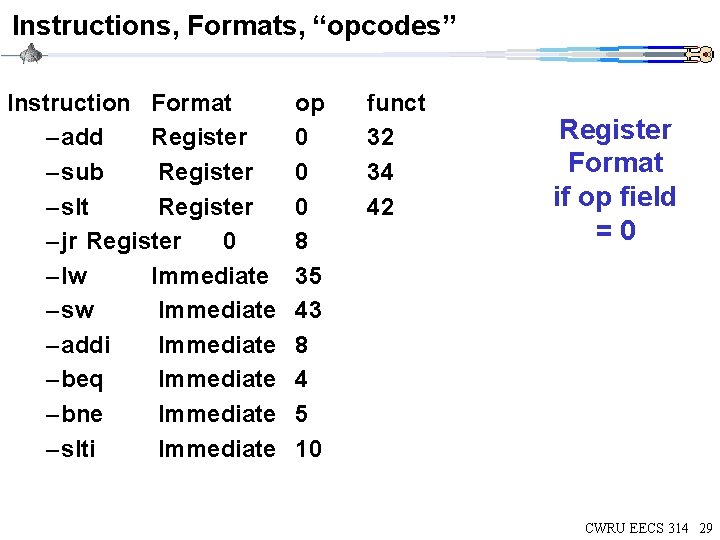
Instructions, Formats, “opcodes” Instruction Format – add Register – sub Register – slt Register – jr Register 0 – lw Immediate – sw Immediate – addi Immediate – beq Immediate – bne Immediate – slti Immediate op 0 0 0 8 35 43 8 4 5 10 funct 32 34 42 Register Format if op field =0 CWRU EECS 314 29
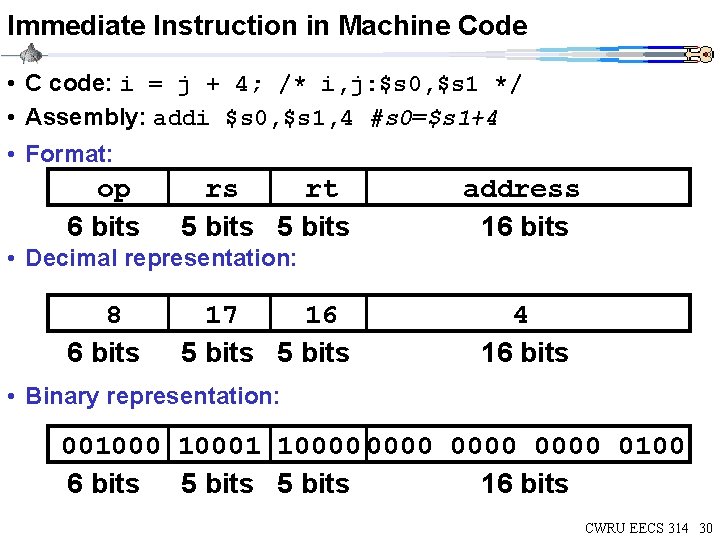
Immediate Instruction in Machine Code • C code: i = j + 4; /* i, j: $s 0, $s 1 */ • Assembly: addi $s 0, $s 1, 4 #s 0=$s 1+4 • Format: op 6 bits rs rt 5 bits address 16 bits • Decimal representation: 8 6 bits 17 16 5 bits 4 16 bits • Binary representation: 0010001 10000 0100 6 bits 5 bits 16 bits CWRU EECS 314 30
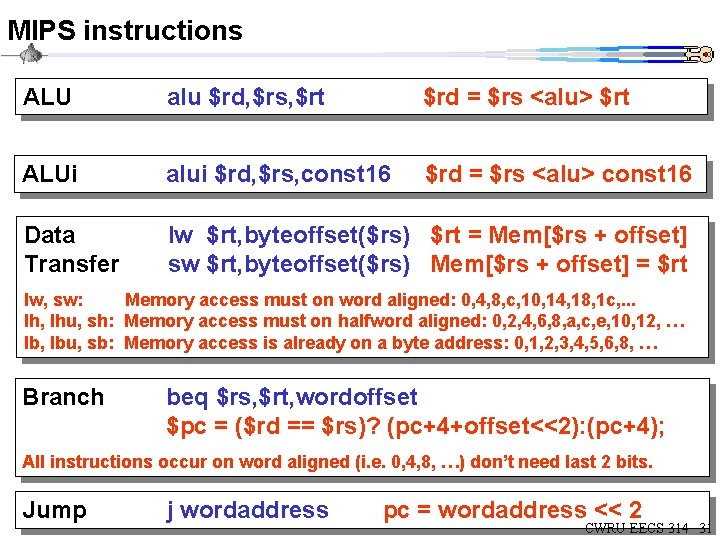
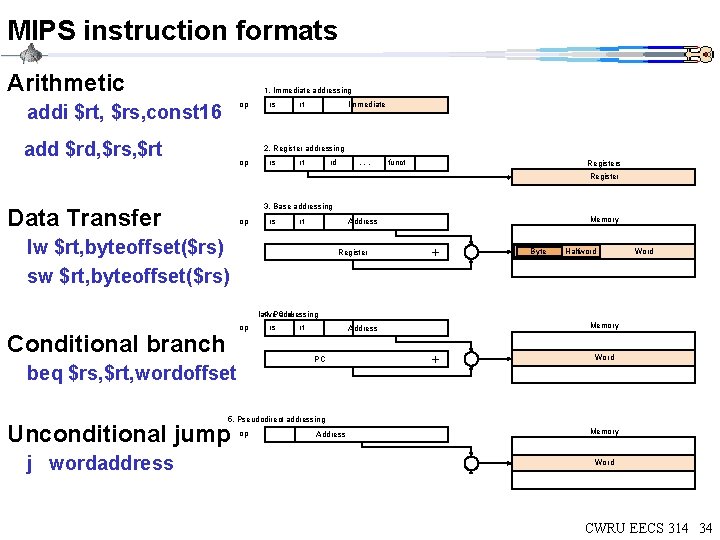
MIPS instructions ALU alu $rd, $rs, $rt $rd = $rs <alu> $rt ALUi alui $rd, $rs, const 16 $rd = $rs <alu> const 16 Data Transfer lw $rt, byteoffset($rs) $rt = Mem[$rs + offset] sw $rt, byteoffset($rs) Mem[$rs + offset] = $rt lw, sw: Memory access must on word aligned: 0, 4, 8, c, 10, 14, 18, 1 c, . . . lh, lhu, sh: Memory access must on halfword aligned: 0, 2, 4, 6, 8, a, c, e, 10, 12, … lb, lbu, sb: Memory access is already on a byte address: 0, 1, 2, 3, 4, 5, 6, 8, … Branch beq $rs, $rt, wordoffset $pc = ($rd == $rs)? (pc+4+offset<<2): (pc+4); All instructions occur on word aligned (i. e. 0, 4, 8, …) don’t need last 2 bits. Jump j wordaddress pc = wordaddress << 2 CWRU EECS 314 31
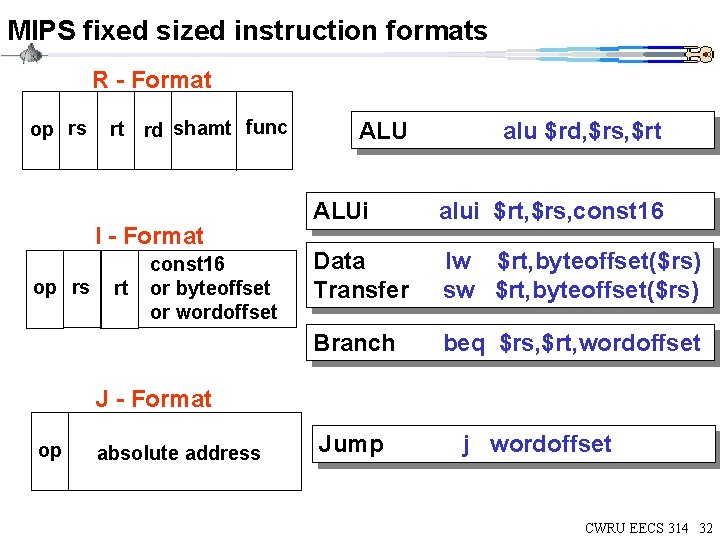
MIPS fixed sized instruction formats R - Format op rs rt rd shamt func I - Format op rs rt const 16 or byteoffset or wordoffset ALU alu $rd, $rs, $rt ALUi alui $rt, $rs, const 16 Data Transfer lw $rt, byteoffset($rs) sw $rt, byteoffset($rs) Branch beq $rs, $rt, wordoffset J - Format op absolute address Jump j wordoffset CWRU EECS 314 32
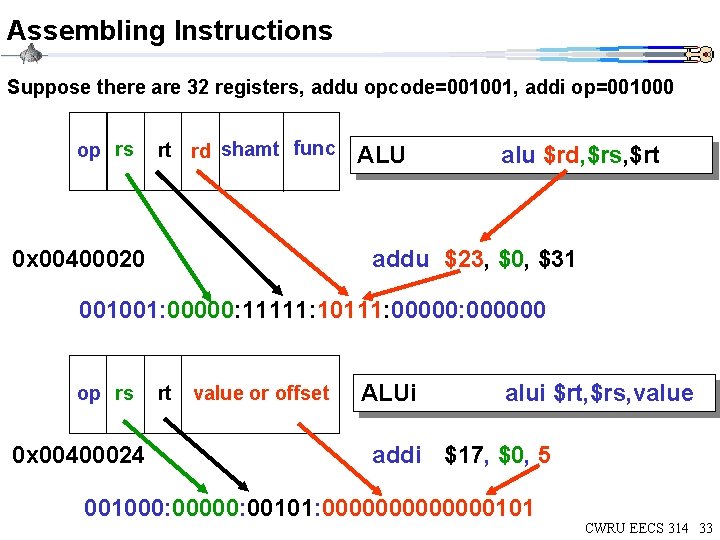
Assembling Instructions Suppose there are 32 registers, addu opcode=001001, addi op=001000 op rs rt rd shamt func 0 x 00400020 ALU alu $rd, $rs, $rt addu $23, $0, $31 001001: 00000: 11111: 10111: 000000 op rs 0 x 00400024 rt value or offset ALUi alui $rt, $rs, value addi $17, $0, 5 001000: 00101: 0000000101 CWRU EECS 314 33
MIPS instruction formats Arithmetic 1. Immediate addressing op addi $rt, $rs, const 16 add $rd, $rs, $rt rs rt Immediate 2. Register addressing op rs rt rd . . . funct Registers Register 3. Base addressing Data Transfer op rs rt Memory Address lw $rt, byteoffset($rs) sw $rt, byteoffset($rs) Register + Byte Halfword Word 4. PC-re lative addressing op Conditional branch rs rt PC beq $rs, $rt, wordoffset Memory Address + Word 5. Pseudodirect addressing Unconditional jump j wordaddress op Address Memory Word CWRU EECS 314 34
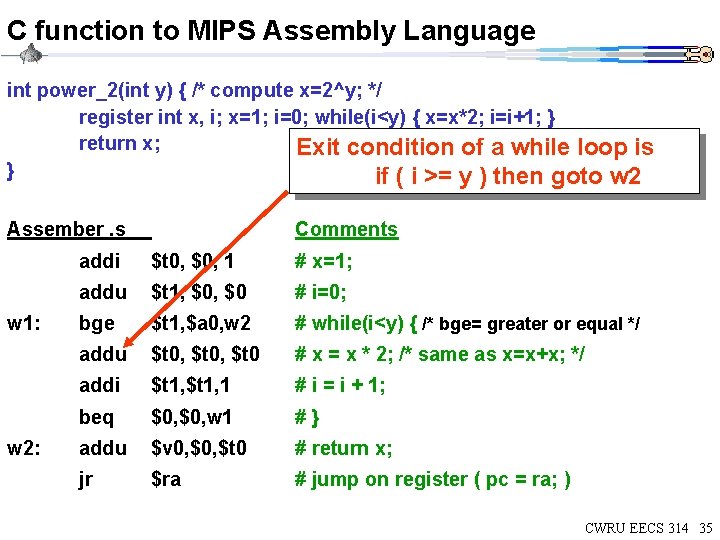
C function to MIPS Assembly Language int power_2(int y) { /* compute x=2^y; */ register int x, i; x=1; i=0; while(i<y) { x=x*2; i=i+1; } return x; Exit condition of a while loop is } if ( i >= y ) then goto w 2 Assember. s w 1: w 2: Comments addi $t 0, $0, 1 # x=1; addu $t 1, $0 # i=0; bge $t 1, $a 0, w 2 # while(i<y) { /* bge= greater or equal */ addu $t 0, $t 0 # x = x * 2; /* same as x=x+x; */ addi $t 1, 1 # i = i + 1; beq $0, w 1 #} addu $v 0, $t 0 # return x; jr $ra # jump on register ( pc = ra; ) CWRU EECS 314 35
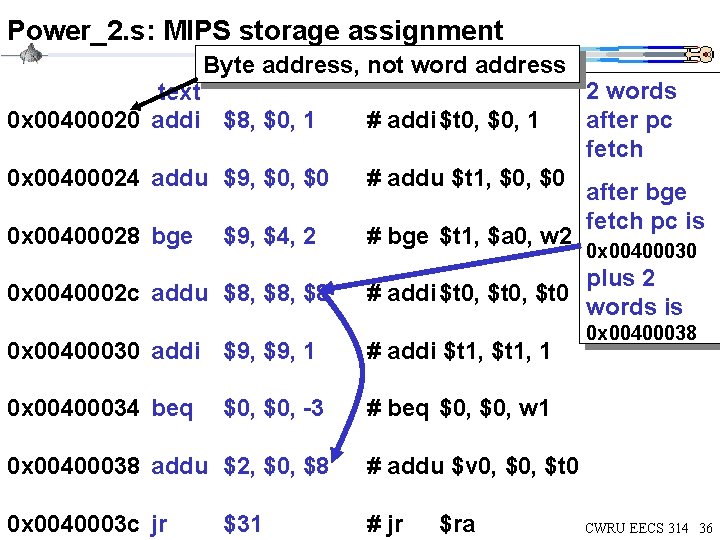
Power_2. s: MIPS storage assignment Byte address, not word address. text 0 x 00400020 addi $8, $0, 1 # addi $t 0, $0, 1 0 x 00400024 addu $9, $0 # addu $t 1, $0 0 x 00400028 bge # bge $t 1, $a 0, w 2 $9, $4, 2 0 x 0040002 c addu $8, $8 # addi $t 1, 1 0 x 00400034 beq # beq $0, w 1 0 x 00400038 addu $2, $0, $8 # addu $v 0, $t 0 0 x 0040003 c jr # jr $31 after bge fetch pc is 0 x 00400030 plus 2 # addi $t 0, $t 0 words is 0 x 00400030 addi $9, 1 $0, -3 2 words after pc fetch $ra 0 x 00400038 CWRU EECS 314 36
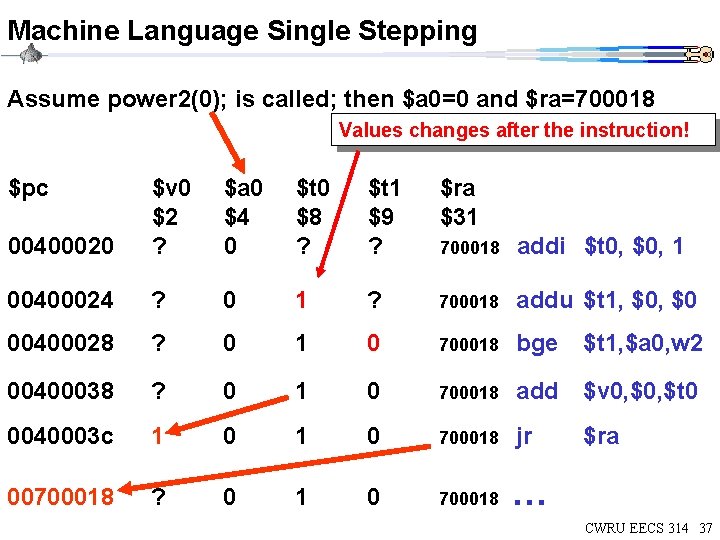
Machine Language Single Stepping Assume power 2(0); is called; then $a 0=0 and $ra=700018 Values changes after the instruction! $pc $a 0 $4 0 $t 0 $8 ? $t 1 $9 ? $ra $31 00400020 $v 0 $2 ? 700018 addi $t 0, $0, 1 00400024 ? 0 1 ? 700018 addu $t 1, $0 00400028 ? 0 1 0 700018 bge $t 1, $a 0, w 2 00400038 ? 0 1 0 700018 add $v 0, $t 0 0040003 c 1 0 700018 jr $ra 00700018 ? 0 1 0 700018 … CWRU EECS 314 37