
EECS 122 Introduction to Computer Networks Evolution of
- Slides: 29
EECS 122: Introduction to Computer Networks Evolution of the Internet Computer Science Division Department of Electrical Engineering and Computer Sciences University of California, Berkeley, CA 94720 -1776 EECS 122 - UCB Katz, Stoica F 04
R U RDY 4 WOTS NXT? Katz, Stoica F 04 2
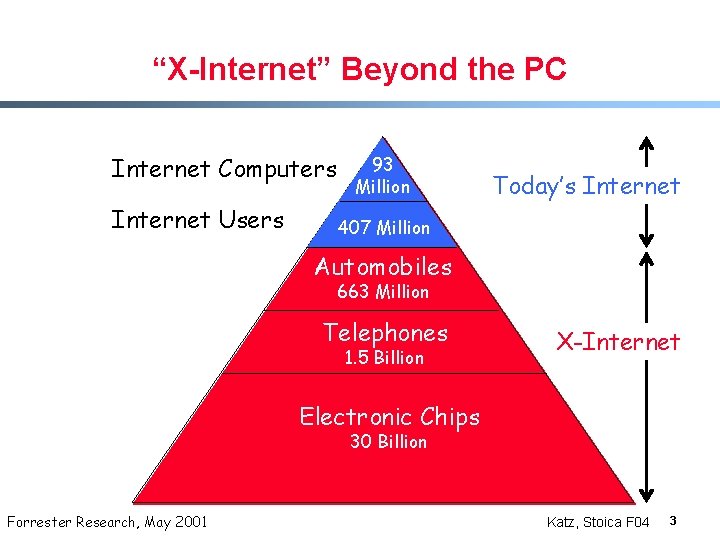
“X-Internet” Beyond the PC Internet Computers Internet Users 93 Million Today’s Internet 407 Million Automobiles 663 Million Telephones 1. 5 Billion X-Internet Electronic Chips 30 Billion Forrester Research, May 2001 Katz, Stoica F 04 3
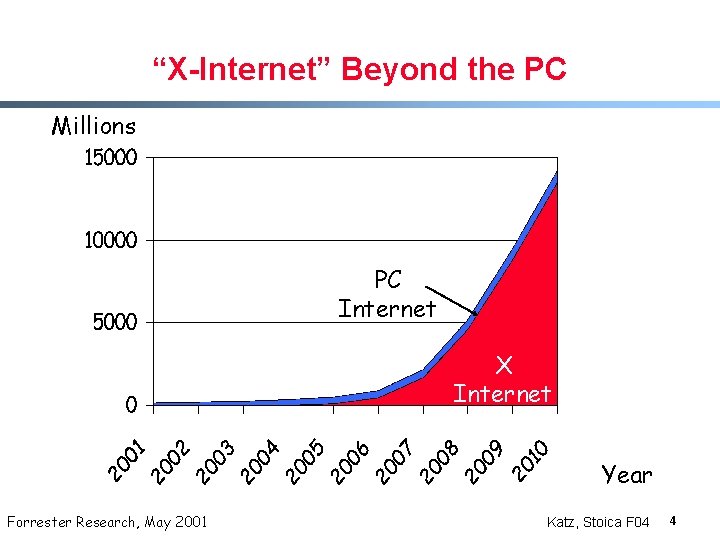
“X-Internet” Beyond the PC Millions PC Internet X Internet Year Forrester Research, May 2001 Katz, Stoica F 04 4
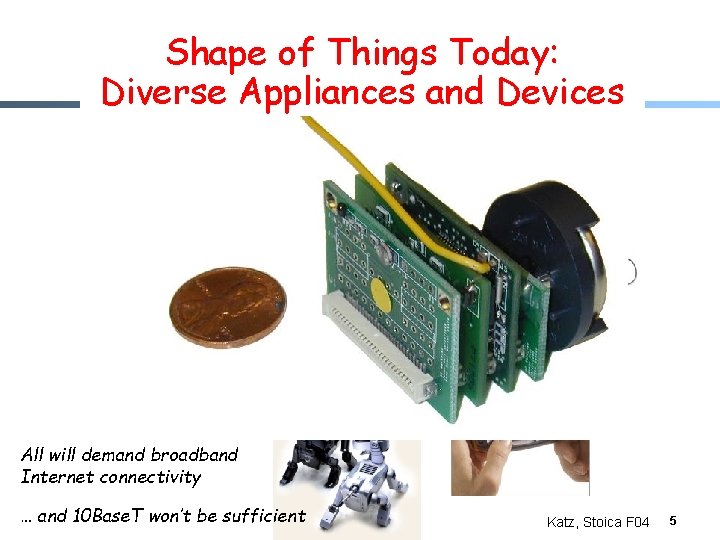
Shape. The of Old Things Days. Today: Diverse Appliances and Devices Game Consoles Personal Digital Assistants Digital VCRs Communicators Smart Telephones E-Toys All will demand broadband Internet connectivity … and 10 Base. T won’t be sufficient Katz, Stoica F 04 5
Future of the Internet § § § Mobile IP Networked Everything: Sensor Nets Internet Economics Katz, Stoica F 04 6
Why Mobile IP? § § Need a protocol that maintains network connectivity while hosts move between nets Must avoid massive changes to router software, etc. Must be compatible with large installed base of IPv 4 networks/hosts Confine changes to mobile hosts and a few support hosts that enable mobility G. G. Richard III, UNO Katz, Stoica F 04 7
Mobile IP: Basics § Proposed by IETF (Internet Engineering Task Force) - Standards development body for the Internet § § § Allows a mobile host (MH) to move about without changing its permanent IP address Each mobile host has a home agent (HA) on its home network MH establishes a care-of address when it's away from home G. G. Richard III, UNO Katz, Stoica F 04 8
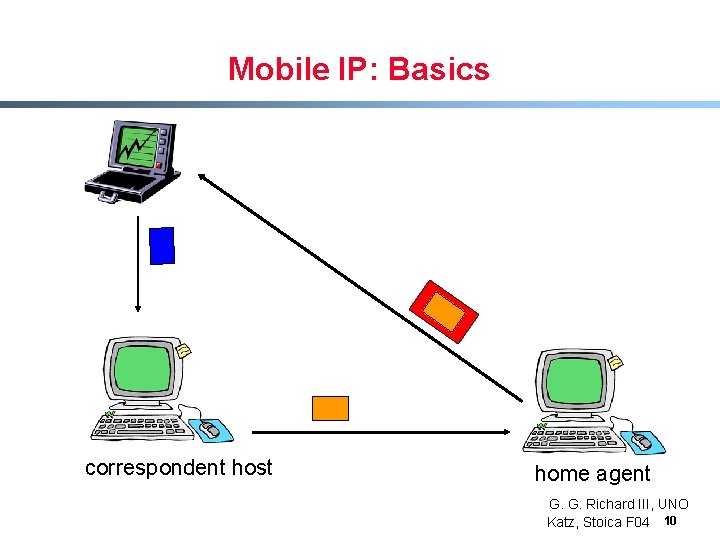
Mobile IP: Basics § § § Correspondent host (CH) is a host that wants to send packets to the MH CH sends packets to the MH’s IP permanent home address Packets routed to the MH’s home network HA forwards IP packets for MH to current care-of address MH sends packets directly to correspondent, using permanent home IP as source IP G. G. Richard III, UNO Katz, Stoica F 04 9
Mobile IP: Basics correspondent host home agent G. G. Richard III, UNO Katz, Stoica F 04 10
Mobile IP: Care-of Addresses § When MH connects to a remote network: - Care-of can be the address of a foreign agent (FA) on the remote network • FA delivers packets forwarded from HA to MA - Care-of can be a temporary, foreign IP address obtained through, e. g. , DHCP • HA tunnels packets directly to the temporary IP address § Care-of address must be registered with HA G. G. Richard III, UNO Katz, Stoica F 04 11
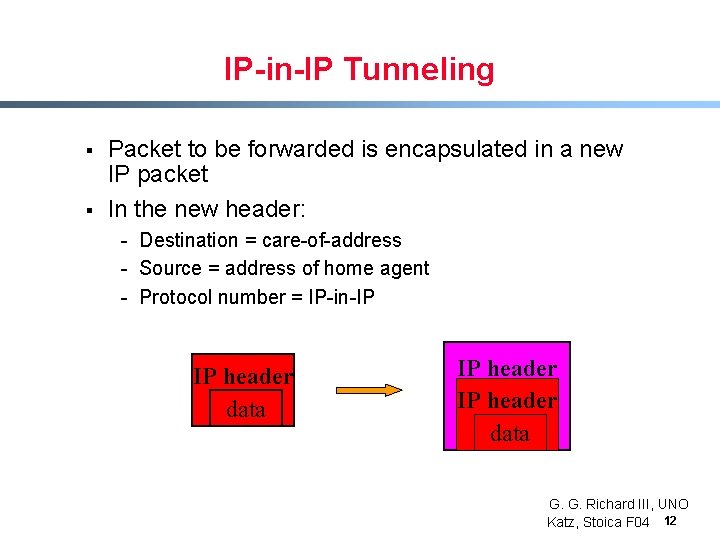
IP-in-IP Tunneling § § Packet to be forwarded is encapsulated in a new IP packet In the new header: - Destination = care-of-address - Source = address of home agent - Protocol number = IP-in-IP IP header data G. G. Richard III, UNO Katz, Stoica F 04 12
At the Other End. . . § Depending on type of care-of address: - FA or - MH § … strips outer IP header of tunneled packet, which is then fed to the MH G. G. Richard III, UNO Katz, Stoica F 04 13
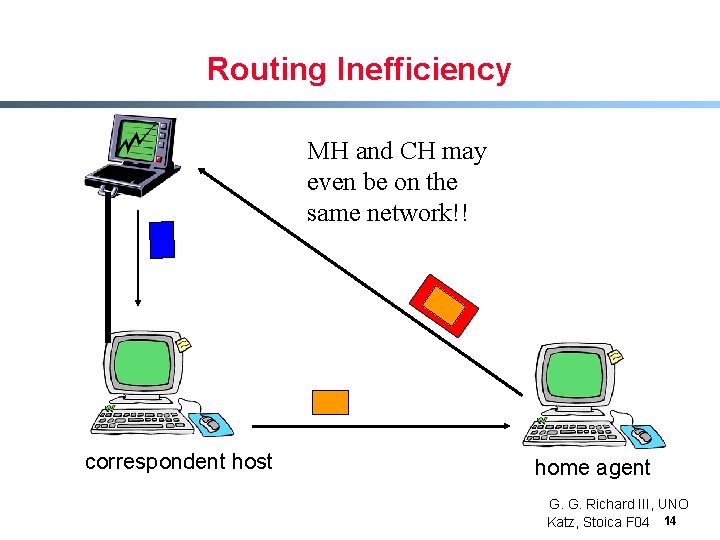
Routing Inefficiency MH and CH may even be on the same network!! correspondent host home agent G. G. Richard III, UNO Katz, Stoica F 04 14
Route Optimizations § Possible Solution: - HA sends current care-of address to CH - CH caches care-of address - Future packets tunneled directly to care-of address § But … - Cache consistency problem arises. . . - Cached care-of address becomes stale when the MH moves - Potential security issues with providing care-of address to correspondent G. G. Richard III, UNO Katz, Stoica F 04 15
Future of the Internet § § § Mobile IP Networked Everything: Sensor Nets Internet Economics Katz, Stoica F 04 36
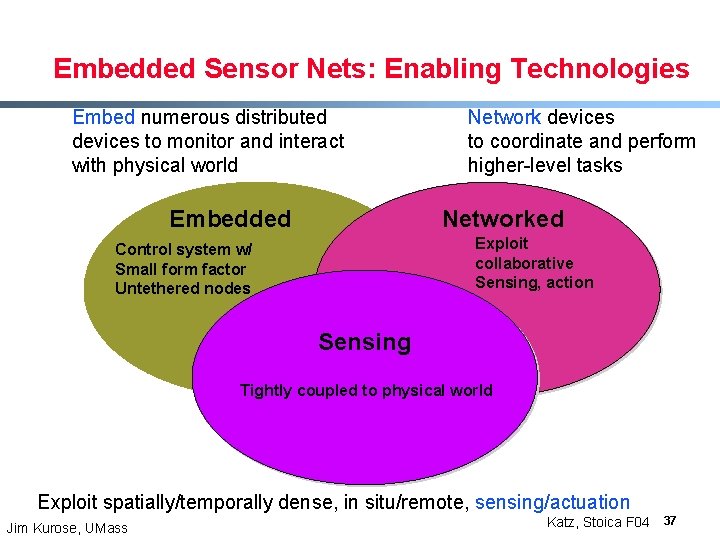
Embedded Sensor Nets: Enabling Technologies Embed numerous distributed devices to monitor and interact with physical world Embedded Network devices to coordinate and perform higher-level tasks Networked Exploit collaborative Sensing, action Control system w/ Small form factor Untethered nodes Sensing Tightly coupled to physical world Exploit spatially/temporally dense, in situ/remote, sensing/actuation Jim Kurose, UMass Katz, Stoica F 04 37
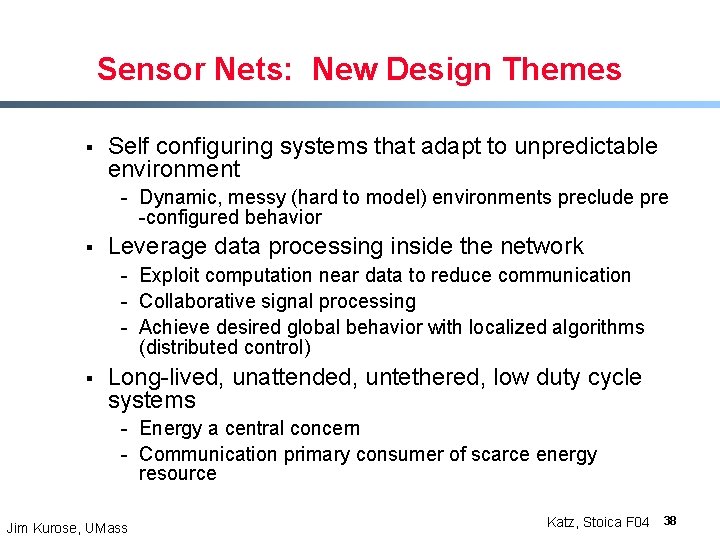
Sensor Nets: New Design Themes § Self configuring systems that adapt to unpredictable environment - Dynamic, messy (hard to model) environments preclude pre -configured behavior § Leverage data processing inside the network - Exploit computation near data to reduce communication - Collaborative signal processing - Achieve desired global behavior with localized algorithms (distributed control) § Long-lived, unattended, untethered, low duty cycle systems - Energy a central concern - Communication primary consumer of scarce energy resource Jim Kurose, UMass Katz, Stoica F 04 38
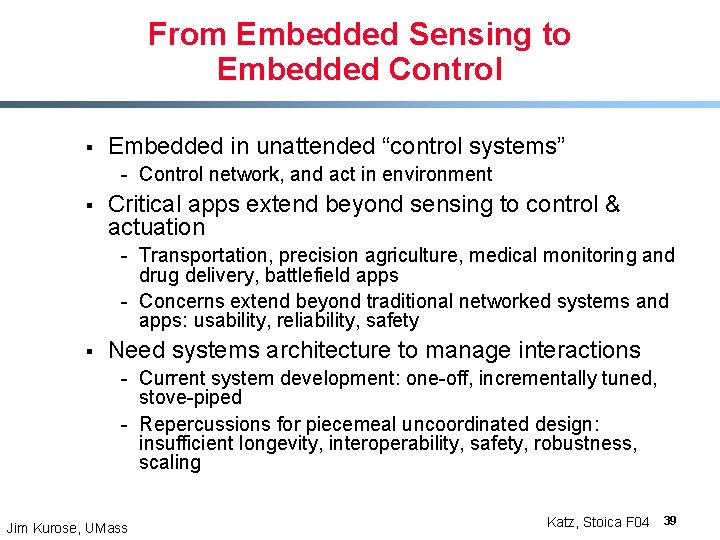
From Embedded Sensing to Embedded Control § Embedded in unattended “control systems” - Control network, and act in environment § Critical apps extend beyond sensing to control & actuation - Transportation, precision agriculture, medical monitoring and drug delivery, battlefield apps - Concerns extend beyond traditional networked systems and apps: usability, reliability, safety § Need systems architecture to manage interactions - Current system development: one-off, incrementally tuned, stove-piped - Repercussions for piecemeal uncoordinated design: insufficient longevity, interoperability, safety, robustness, scaling Jim Kurose, UMass Katz, Stoica F 04 39
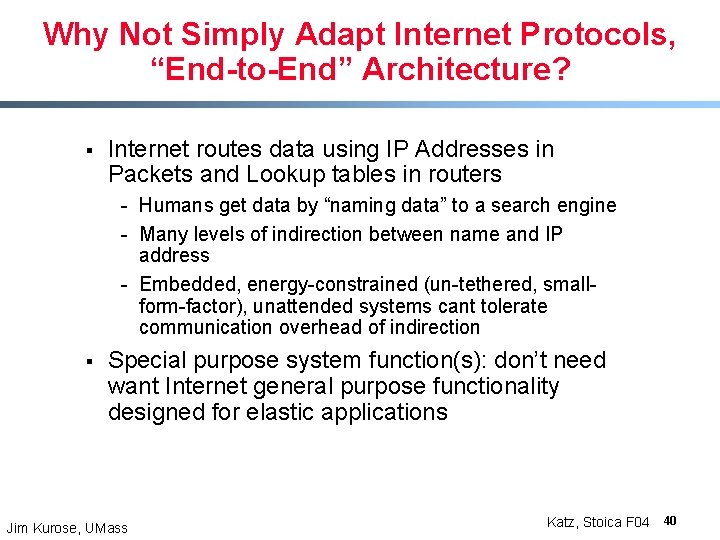
Why Not Simply Adapt Internet Protocols, “End-to-End” Architecture? § Internet routes data using IP Addresses in Packets and Lookup tables in routers - Humans get data by “naming data” to a search engine - Many levels of indirection between name and IP address - Embedded, energy-constrained (un-tethered, smallform-factor), unattended systems cant tolerate communication overhead of indirection § Special purpose system function(s): don’t need want Internet general purpose functionality designed for elastic applications Jim Kurose, UMass Katz, Stoica F 04 40
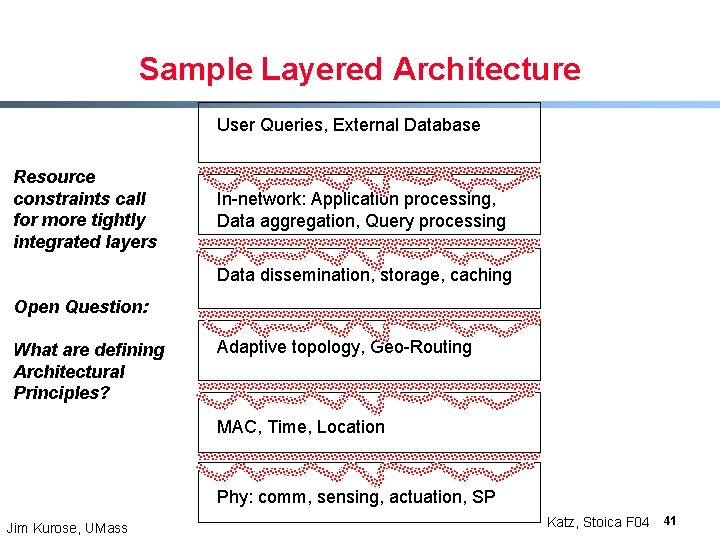
Sample Layered Architecture User Queries, External Database Resource constraints call for more tightly integrated layers In-network: Application processing, Data aggregation, Query processing Data dissemination, storage, caching Open Question: What are defining Architectural Principles? Adaptive topology, Geo-Routing MAC, Time, Location Phy: comm, sensing, actuation, SP Jim Kurose, UMass Katz, Stoica F 04 41
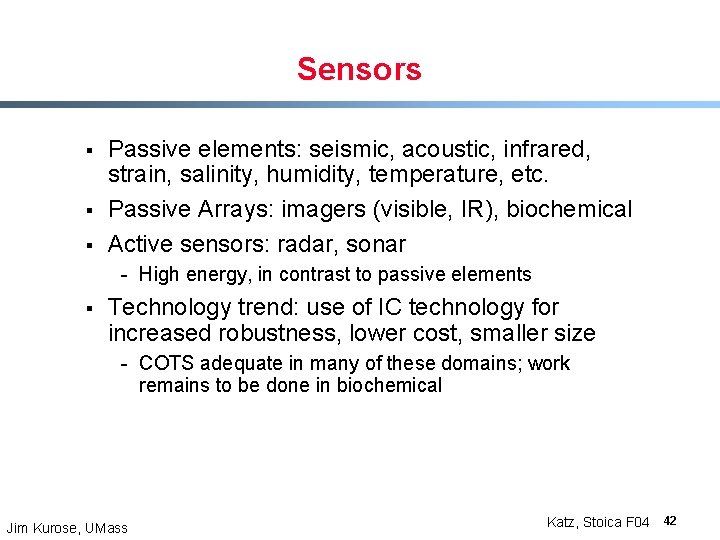
Sensors § § § Passive elements: seismic, acoustic, infrared, strain, salinity, humidity, temperature, etc. Passive Arrays: imagers (visible, IR), biochemical Active sensors: radar, sonar - High energy, in contrast to passive elements § Technology trend: use of IC technology for increased robustness, lower cost, smaller size - COTS adequate in many of these domains; work remains to be done in biochemical Jim Kurose, UMass Katz, Stoica F 04 42
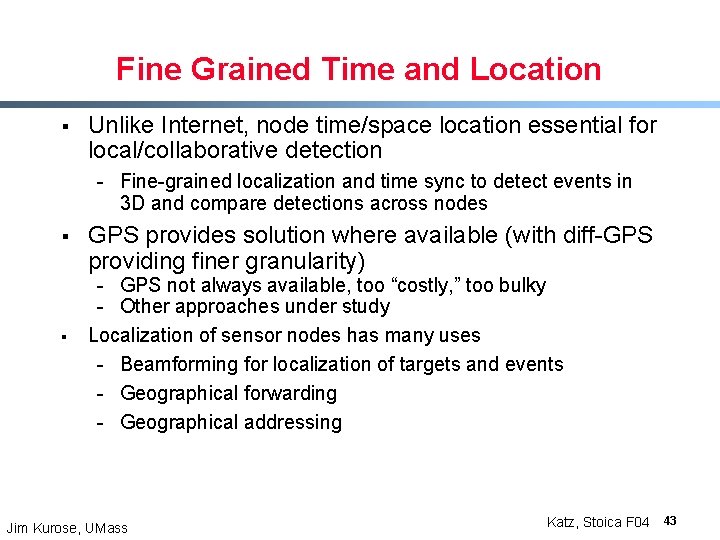
Fine Grained Time and Location § Unlike Internet, node time/space location essential for local/collaborative detection - Fine-grained localization and time sync to detect events in 3 D and compare detections across nodes § § GPS provides solution where available (with diff-GPS providing finer granularity) - GPS not always available, too “costly, ” too bulky - Other approaches under study Localization of sensor nodes has many uses - Beamforming for localization of targets and events - Geographical forwarding - Geographical addressing Jim Kurose, UMass Katz, Stoica F 04 43
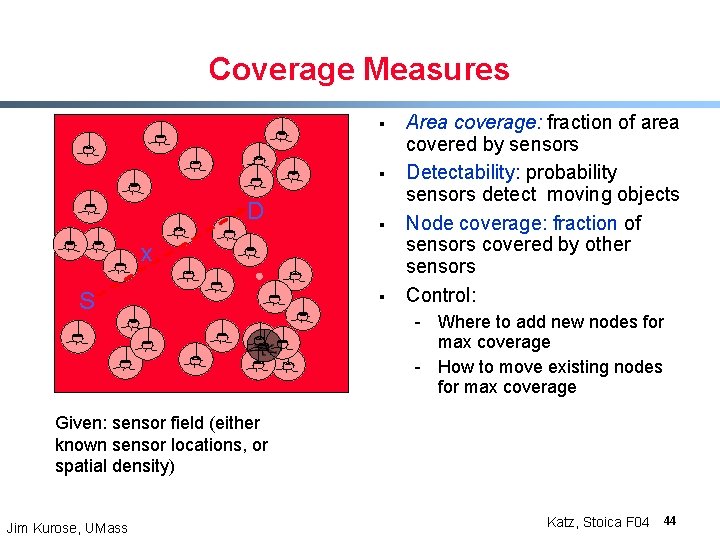
Coverage Measures § § D § x S § Area coverage: fraction of area covered by sensors Detectability: probability sensors detect moving objects Node coverage: fraction of sensors covered by other sensors Control: - Where to add new nodes for max coverage - How to move existing nodes for max coverage Given: sensor field (either known sensor locations, or spatial density) Jim Kurose, UMass Katz, Stoica F 04 44
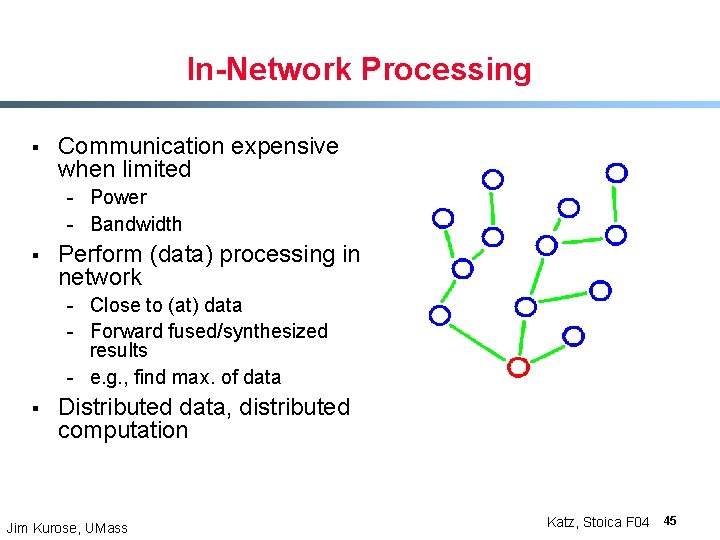
In-Network Processing § Communication expensive when limited - Power - Bandwidth § Perform (data) processing in network - Close to (at) data - Forward fused/synthesized results - e. g. , find max. of data § Distributed data, distributed computation Jim Kurose, UMass Katz, Stoica F 04 45
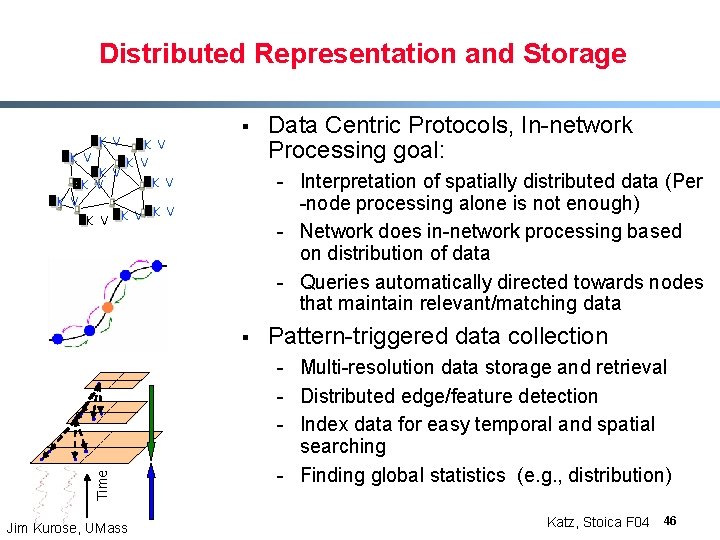
Distributed Representation and Storage K V K V § - Interpretation of spatially distributed data (Per -node processing alone is not enough) - Network does in-network processing based on distribution of data - Queries automatically directed towards nodes that maintain relevant/matching data K V K V Time § Jim Kurose, UMass Data Centric Protocols, In-network Processing goal: Pattern-triggered data collection - Multi-resolution data storage and retrieval - Distributed edge/feature detection - Index data for easy temporal and spatial searching - Finding global statistics (e. g. , distribution) Katz, Stoica F 04 46
Directed Diffusion: Data Centric Routing § Basic idea - Name data (not nodes) with externally relevant attributes: data type, time, location of node, SNR, - Diffuse requests and responses across network using application driven routing (e. g. , geo sensitive or not) - Support in-network aggregation and processing § Data sources publish data, data clients subscribe to data - However, all nodes may play both roles • Node that aggregates/combines/processes incoming sensor node data becomes a source of new data • Node that only publishes when combination of conditions arise, is client for triggering event data - True peer to peer system? Jim Kurose, UMass Katz, Stoica F 04 47
Future of the Internet § § § Mobile IP Networked Everything: Sensor Nets Internet Economics Katz, Stoica F 04 48
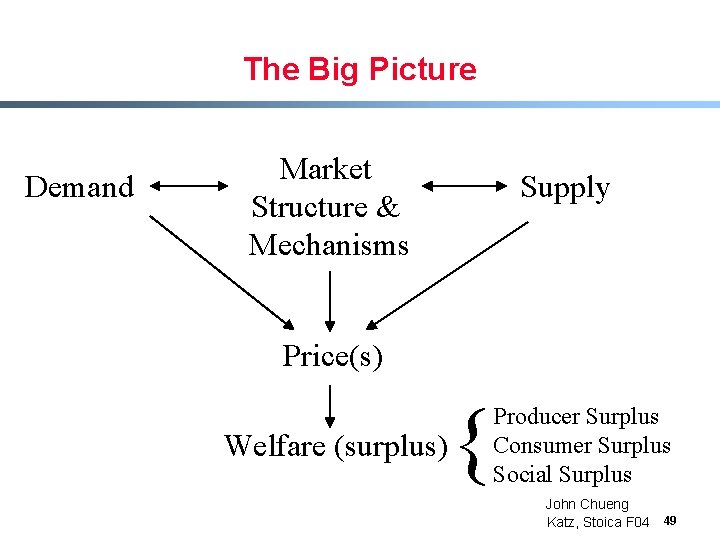
The Big Picture Demand Market Structure & Mechanisms Supply Price(s) Welfare (surplus) { Producer Surplus Consumer Surplus Social Surplus John Chueng Katz, Stoica F 04 49