
EECS 1 Introduction to Electrical Engineering And Computer


- Slides: 46
EECS 1 Introduction to Electrical Engineering And Computer Science UCIrvin. E The Henry Samueli School of Engineering
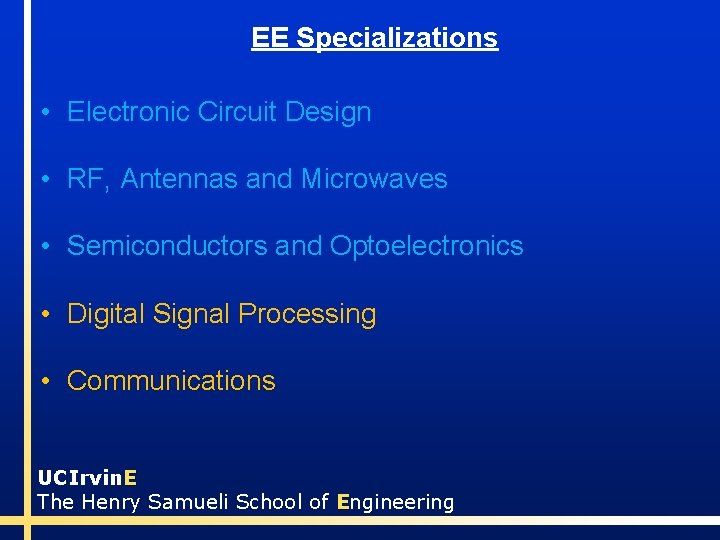
EE Specializations • Electronic Circuit Design • RF, Antennas and Microwaves • Semiconductors and Optoelectronics • Digital Signal Processing • Communications UCIrvin. E The Henry Samueli School of Engineering
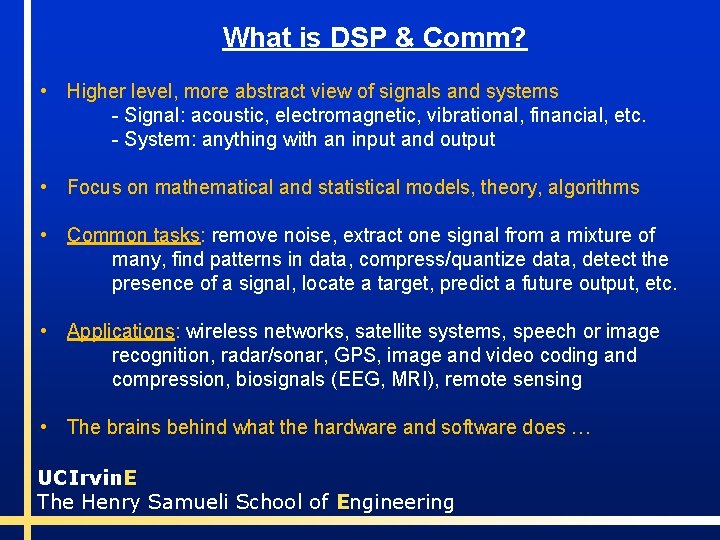
What is DSP & Comm? • Higher level, more abstract view of signals and systems - Signal: acoustic, electromagnetic, vibrational, financial, etc. - System: anything with an input and output • Focus on mathematical and statistical models, theory, algorithms • Common tasks: remove noise, extract one signal from a mixture of many, find patterns in data, compress/quantize data, detect the presence of a signal, locate a target, predict a future output, etc. • Applications: wireless networks, satellite systems, speech or image recognition, radar/sonar, GPS, image and video coding and compression, biosignals (EEG, MRI), remote sensing • The brains behind what the hardware and software does … UCIrvin. E The Henry Samueli School of Engineering
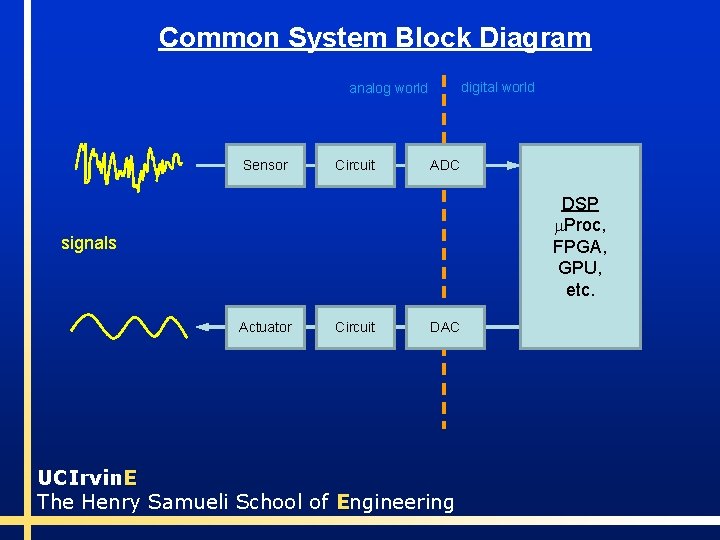
Common System Block Diagram digital world analog world Sensor Circuit ADC DSP m. Proc, FPGA, GPU, etc. signals Actuator Circuit DAC UCIrvin. E The Henry Samueli School of Engineering
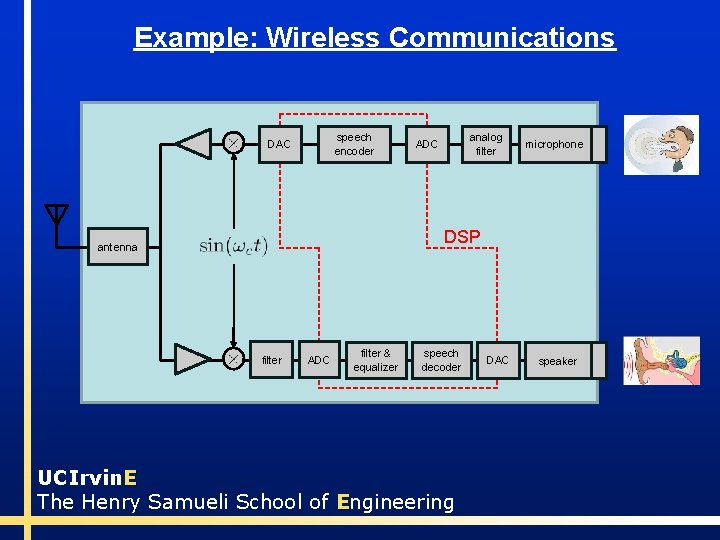
Example: Wireless Communications speech encoder DAC analog filter ADC microphone DSP antenna filter ADC filter & equalizer speech decoder UCIrvin. E The Henry Samueli School of Engineering DAC speaker
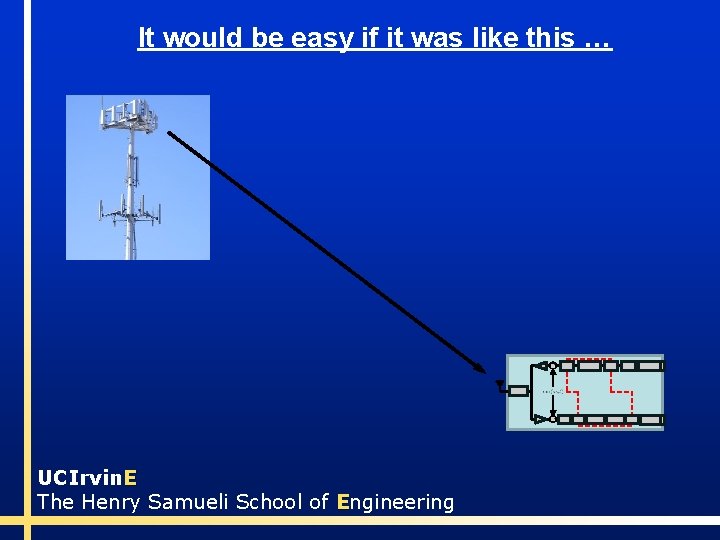
It would be easy if it was like this … UCIrvin. E The Henry Samueli School of Engineering
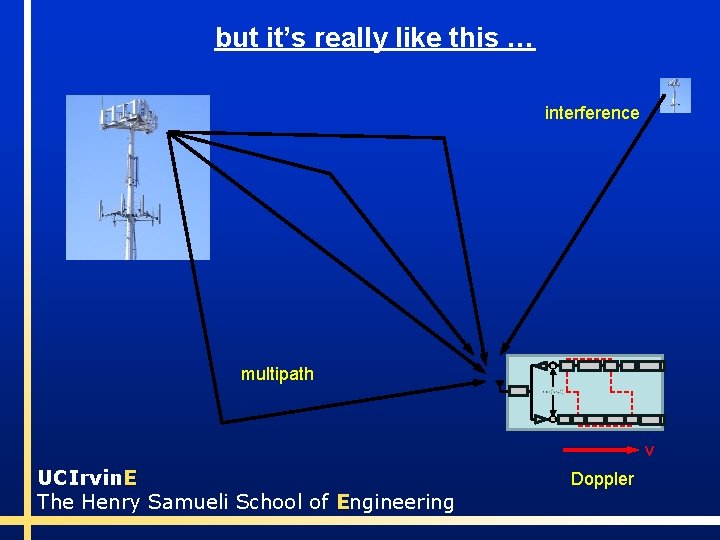
but it’s really like this … interference multipath v UCIrvin. E The Henry Samueli School of Engineering Doppler
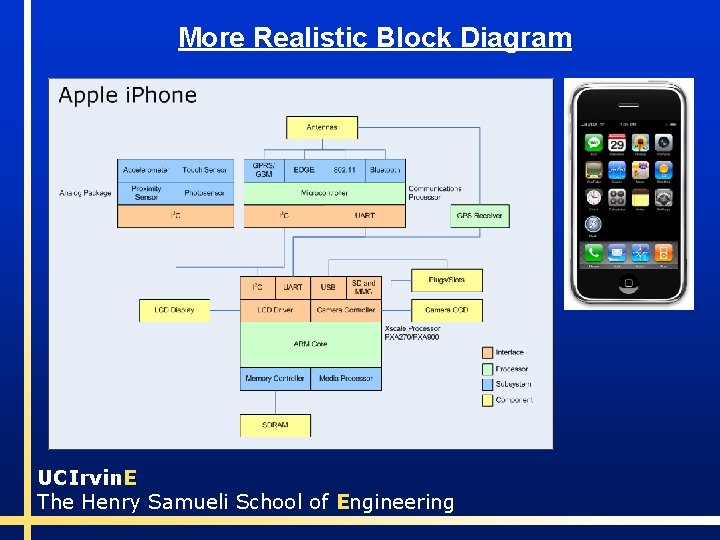
More Realistic Block Diagram UCIrvin. E The Henry Samueli School of Engineering
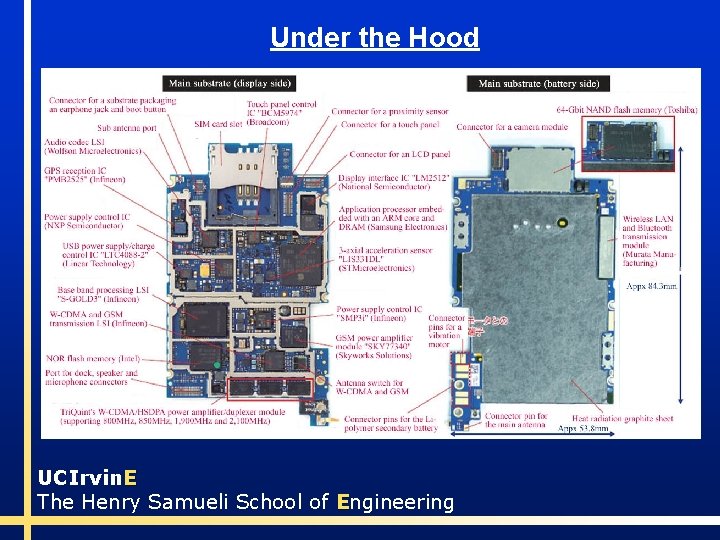
Under the Hood UCIrvin. E The Henry Samueli School of Engineering
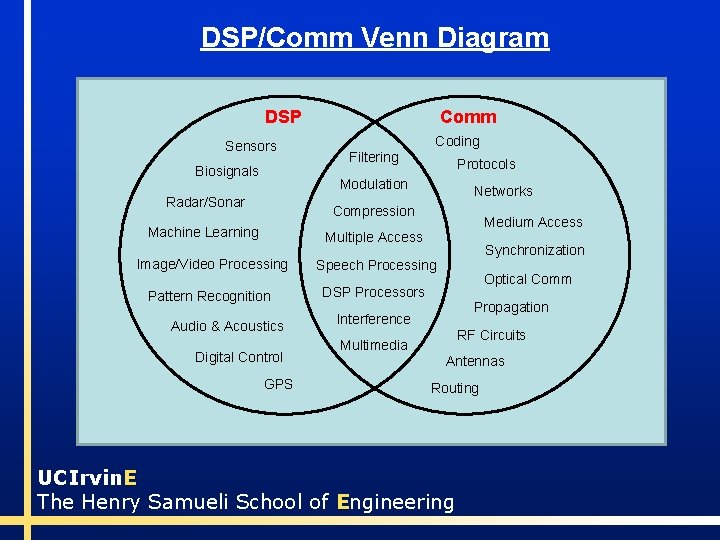
DSP/Comm Venn Diagram DSP Sensors Biosignals Comm Coding Filtering Protocols Modulation Radar/Sonar Networks Compression Machine Learning Medium Access Multiple Access Image/Video Processing Speech Processing Pattern Recognition DSP Processors Audio & Acoustics Digital Control GPS Synchronization Optical Comm Propagation Interference RF Circuits Multimedia Antennas Routing UCIrvin. E The Henry Samueli School of Engineering
Samples of My Research • • Diversity coding 56 K modems Wavelength division multiplexing Wireless packet transmission MIMO beamforming Energy efficiency for wireless cellular Modulation techniques for 5 G cellular UCIrvin. E The Henry Samueli School of Engineering
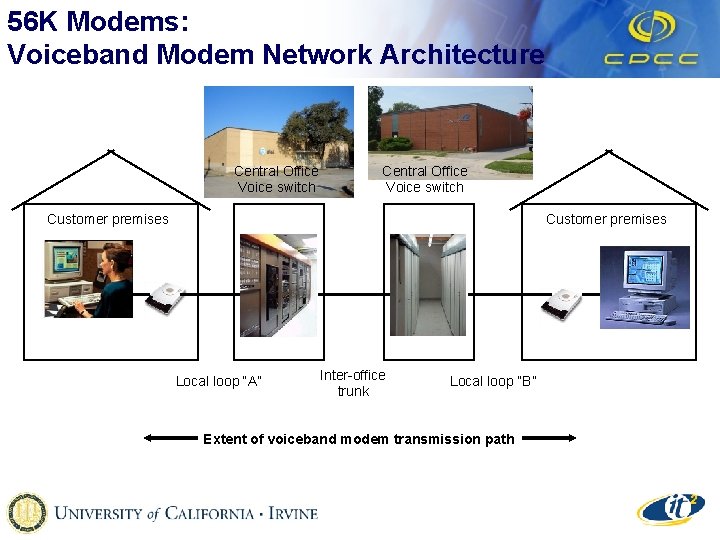
56 K Modems: Voiceband Modem Network Architecture Central Office Voice switch Customer premises Local loop “A” Inter-office trunk Local loop “B” Extent of voiceband modem transmission path
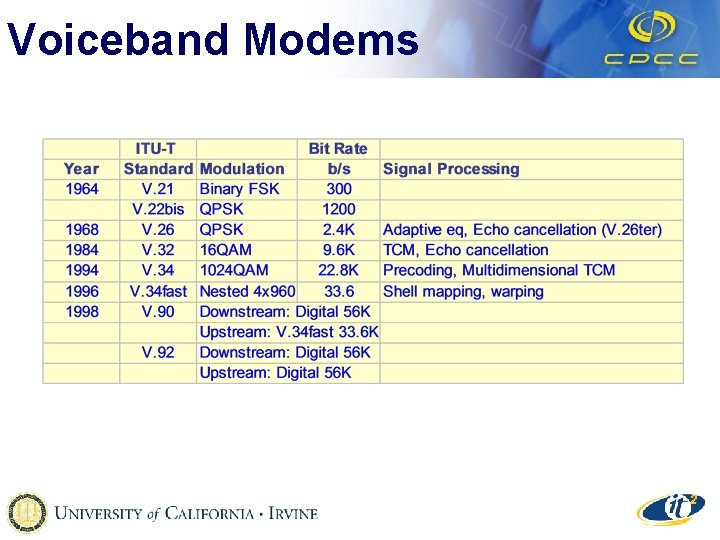
Voiceband Modems
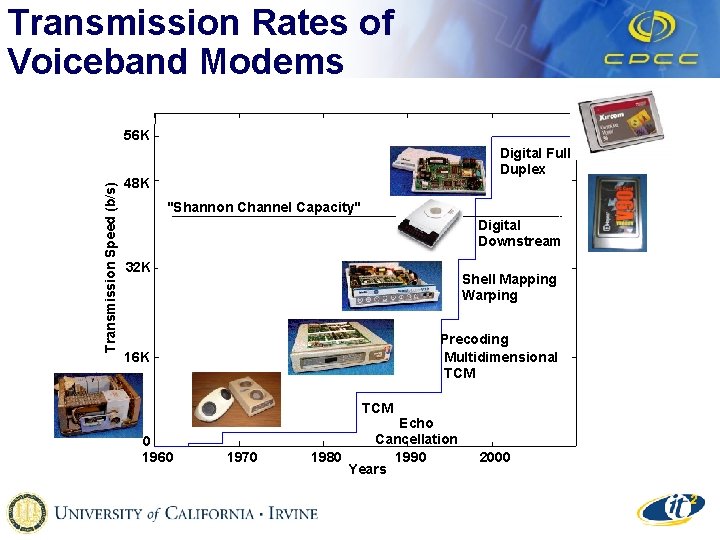
Transmission Rates of Voiceband Modems Transmission Speed (b/s) 56 K Digital Full Duplex 48 K "Shannon Channel Capacity" Digital Downstream 32 K Shell Mapping Warping Precoding Multidimensional TCM 16 K TCM 0 1960 1970 Echo Cancellation 1980 1990 Years 2000
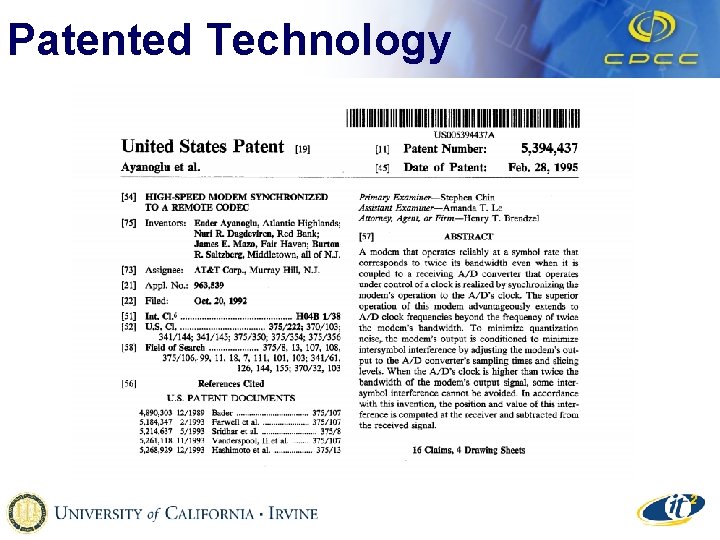
Patented Technology
State of Voiceband Modems V. 92 achieves the limit in voiceband modems!
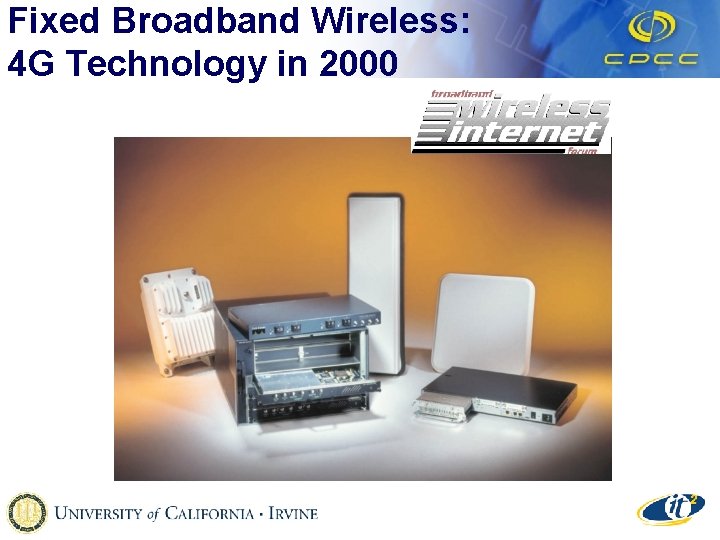
Fixed Broadband Wireless: 4 G Technology in 2000
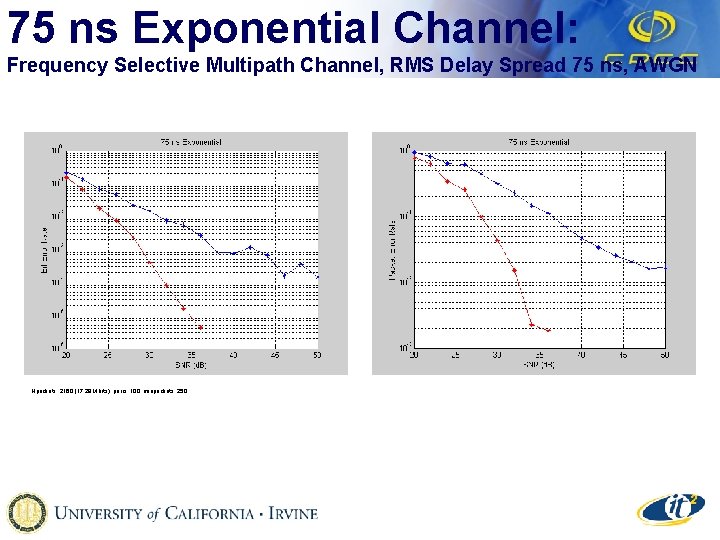
75 ns Exponential Channel: Frequency Selective Multipath Channel, RMS Delay Spread 75 ns, AWGN Npackets: 2160 (17. 28 M bits), perrs: 100, minpackets: 250
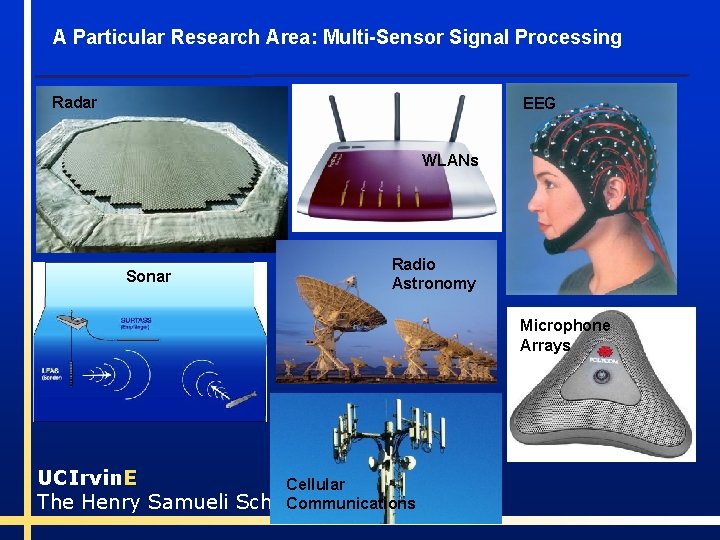
A Particular Research Area: Multi-Sensor Signal Processing Radar EEG WLANs Sonar Radio Astronomy Microphone Arrays UCIrvin. E Cellular Communications The Henry Samueli School of Engineering
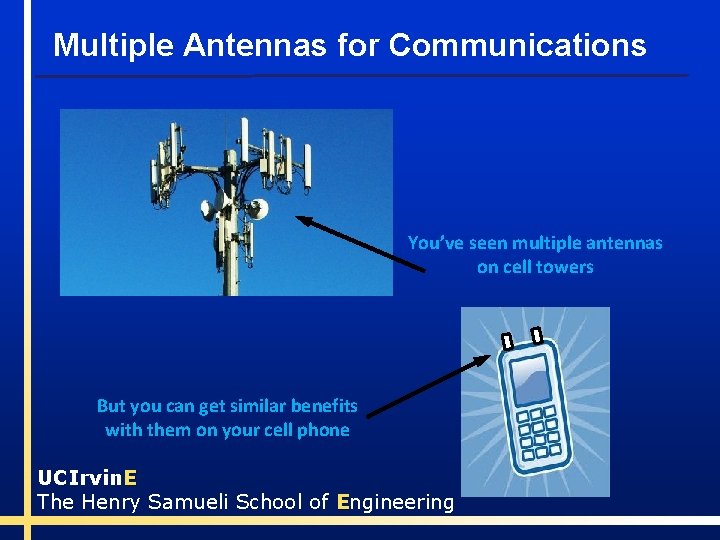
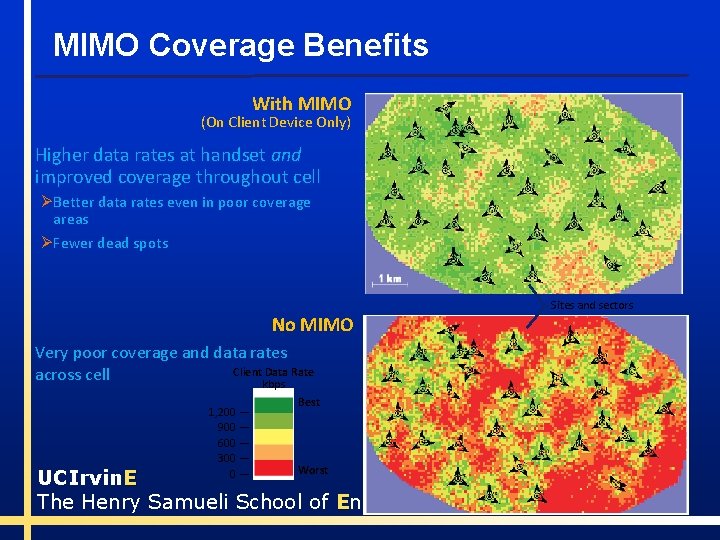
Multiple Antennas for Communications You’ve seen multiple antennas on cell towers But you can get similar benefits with them on your cell phone UCIrvin. E The Henry Samueli School of Engineering
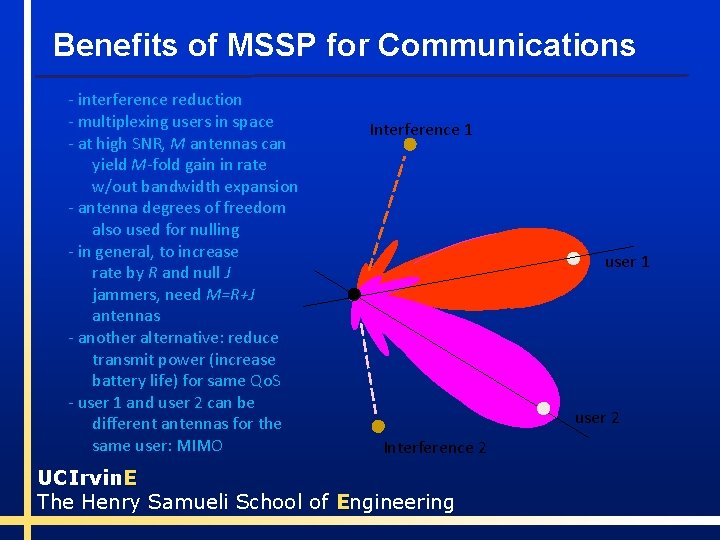
Benefits of MSSP for Communications - interference reduction - multiplexing users in space - at high SNR, M antennas can yield M-fold gain in rate w/out bandwidth expansion - antenna degrees of freedom also used for nulling - in general, to increase rate by R and null J jammers, need M=R+J antennas - another alternative: reduce transmit power (increase battery life) for same Qo. S - user 1 and user 2 can be different antennas for the same user: MIMO Interference 1 user 2 Interference 2 UCIrvin. E The Henry Samueli School of Engineering
MIMO Coverage Benefits With MIMO (On Client Device Only) Higher data rates at handset and improved coverage throughout cell ØBetter data rates even in poor coverage areas ØFewer dead spots No MIMO Very poor coverage and data rates Client Data Rate across cell kbps 1, 200 — 900 — 600 — 300 — 0— Best Worst UCIrvin. E The Henry Samueli School of Engineering Sites and sectors
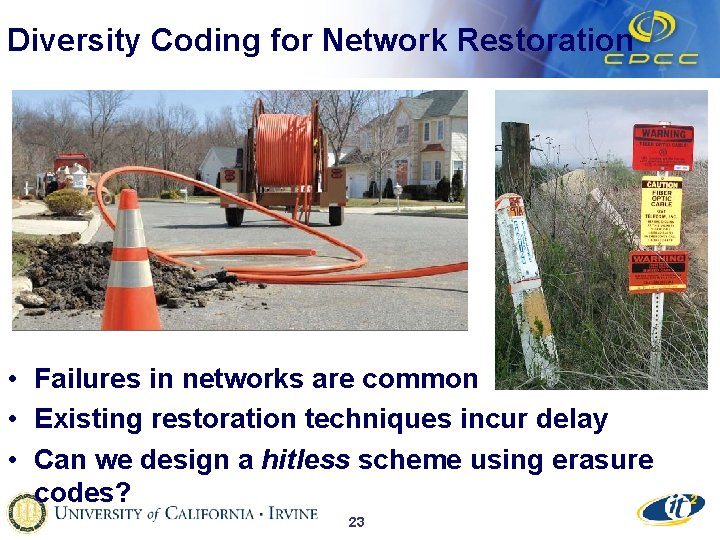
Diversity Coding for Network Restoration • Failures in networks are common • Existing restoration techniques incur delay • Can we design a hitless scheme using erasure codes? 23
Major Network Failures in 1980 s • May 8, 1988 – Fire in unmanned central office in Hinsdale, Illinois – Loss of service and isolation to 35 K residential telephones, 37 K trunks, 13. 5 K special circuits, 118 longdistance fiber optic circuits, and 50% of the cellular telephones in Chicago – 500 K residential and business customers who made 3. 5 M telephone calls per day were impacted. – Full service was not restored until June 5, 1988 • November 1988 – Construction crew accidentally severed a major fiber optic cable in New Jersey – Much of the long distance service along the East Coast was disrupted – 3. 5 M call attempts were blocked 24
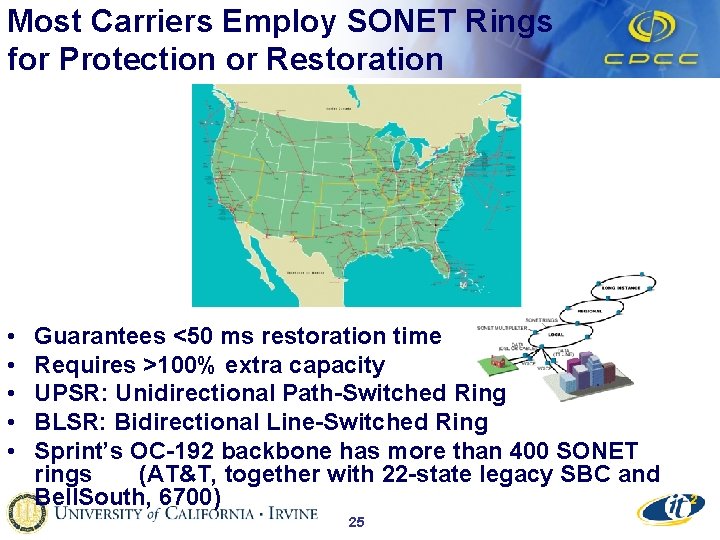
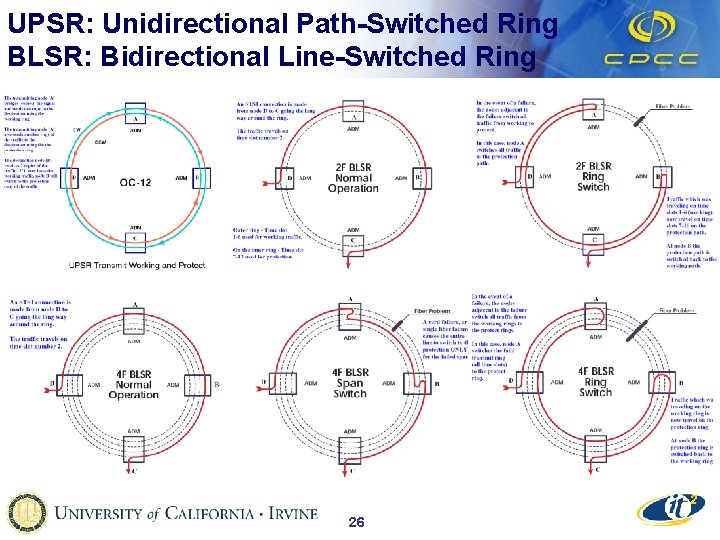
Most Carriers Employ SONET Rings for Protection or Restoration • • • Guarantees <50 ms restoration time Requires >100% extra capacity UPSR: Unidirectional Path-Switched Ring BLSR: Bidirectional Line-Switched Ring Sprint’s OC-192 backbone has more than 400 SONET rings (AT&T, together with 22 -state legacy SBC and Bell. South, 6700) 25
UPSR: Unidirectional Path-Switched Ring BLSR: Bidirectional Line-Switched Ring 26
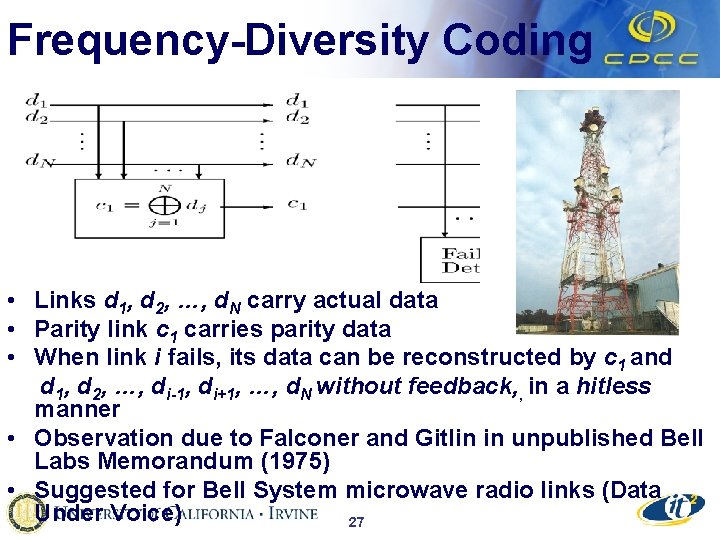
Frequency-Diversity Coding • Links d 1, d 2, …, d. N carry actual data • Parity link c 1 carries parity data • When link i fails, its data can be reconstructed by c 1 and d 1, d 2, …, di-1, di+1, …, d. N without feedback, , in a hitless manner • Observation due to Falconer and Gitlin in unpublished Bell Labs Memorandum (1975) • Suggested for Bell System microwave radio links (Data Under Voice) 27
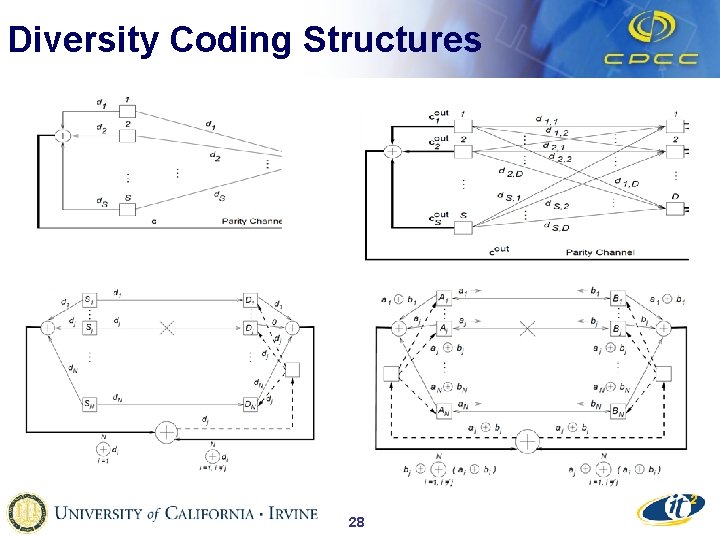
Diversity Coding Structures 28
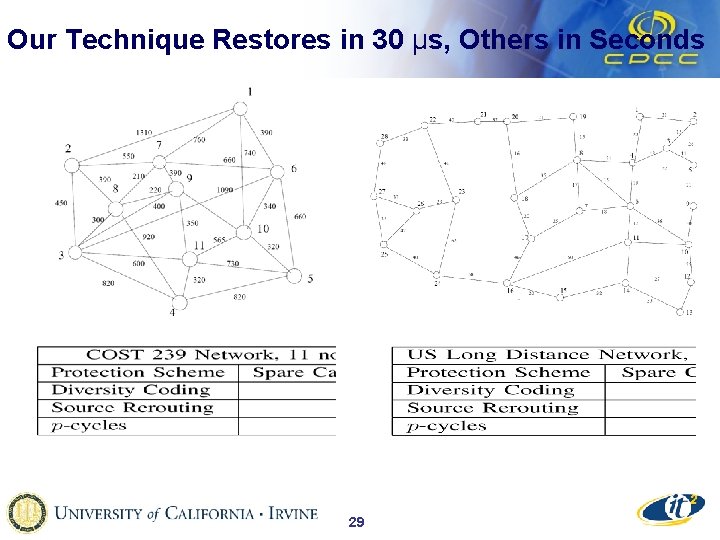
Our Technique Restores in 30 µs, Others in Seconds 29
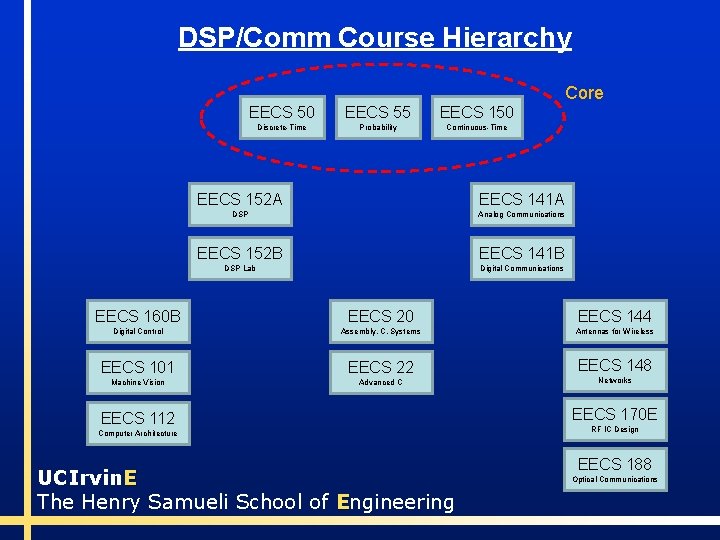
DSP/Comm Course Hierarchy Core EECS 50 EECS 55 EECS 150 Discrete-Time Probability Continuous-Time EECS 152 A EECS 141 A DSP Analog Communications EECS 152 B EECS 141 B DSP Lab Digital Communications EECS 160 B EECS 20 EECS 144 Digital Control Assembly, C, Systems Antennas for Wireless EECS 101 EECS 22 EECS 148 Machine Vision Advanced C EECS 112 Computer Architecture UCIrvin. E The Henry Samueli School of Engineering Networks EECS 170 E RF IC Design EECS 188 Optical Communications
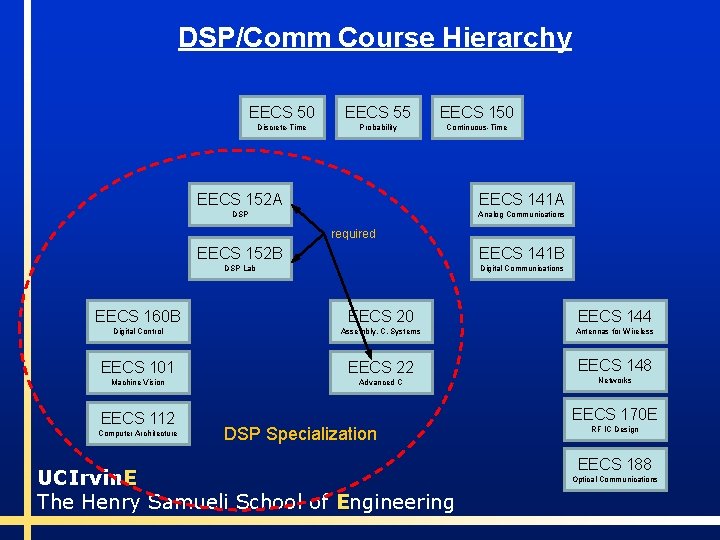
DSP/Comm Course Hierarchy EECS 50 EECS 55 EECS 150 Discrete-Time Probability Continuous-Time EECS 152 A EECS 141 A DSP Analog Communications required EECS 152 B EECS 141 B DSP Lab Digital Communications EECS 160 B EECS 20 EECS 144 Digital Control Assembly, C, Systems Antennas for Wireless EECS 101 EECS 22 EECS 148 Machine Vision Advanced C EECS 112 Computer Architecture Networks EECS 170 E DSP Specialization UCIrvin. E The Henry Samueli School of Engineering RF IC Design EECS 188 Optical Communications
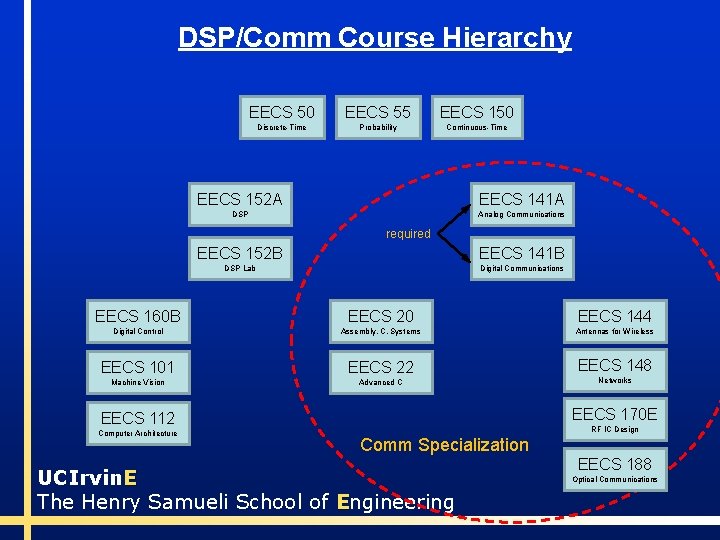
DSP/Comm Course Hierarchy EECS 50 EECS 55 EECS 150 Discrete-Time Probability Continuous-Time EECS 152 A EECS 141 A DSP Analog Communications required EECS 152 B EECS 141 B DSP Lab Digital Communications EECS 160 B EECS 20 EECS 144 Digital Control Assembly, C, Systems Antennas for Wireless EECS 101 EECS 22 EECS 148 Machine Vision Advanced C EECS 170 E EECS 112 Computer Architecture Networks RF IC Design Comm Specialization UCIrvin. E The Henry Samueli School of Engineering EECS 188 Optical Communications
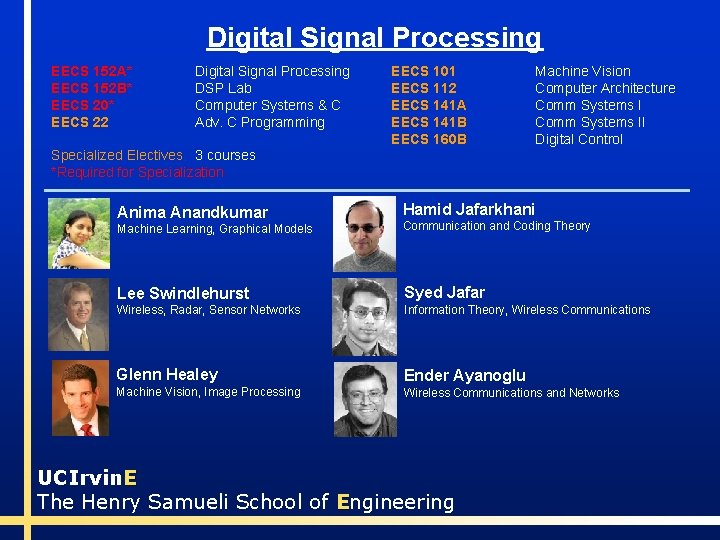
Digital Signal Processing EECS 152 A* EECS 152 B* EECS 20* EECS 22 Digital Signal Processing DSP Lab Computer Systems & C Adv. C Programming EECS 101 EECS 112 EECS 141 A EECS 141 B EECS 160 B Machine Vision Computer Architecture Comm Systems II Digital Control Specialized Electives 3 courses *Required for Specialization Anima Anandkumar Hamid Jafarkhani Machine Learning, Graphical Models Communication and Coding Theory Lee Swindlehurst Syed Jafar Wireless, Radar, Sensor Networks Information Theory, Wireless Communications Glenn Healey Ender Ayanoglu Machine Vision, Image Processing Wireless Communications and Networks UCIrvin. E The Henry Samueli School of Engineering
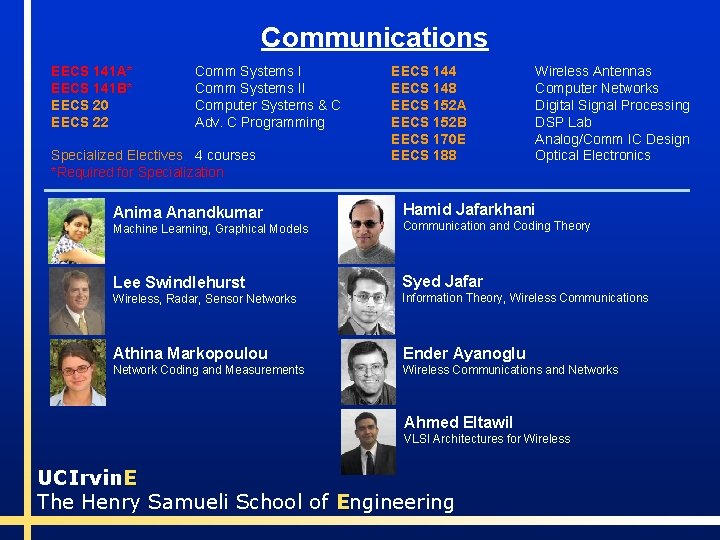
Communications EECS 141 A* EECS 141 B* EECS 20 EECS 22 Comm Systems II Computer Systems & C Adv. C Programming Specialized Electives 4 courses *Required for Specialization Anima Anandkumar EECS 144 EECS 148 EECS 152 A EECS 152 B EECS 170 E EECS 188 Wireless Antennas Computer Networks Digital Signal Processing DSP Lab Analog/Comm IC Design Optical Electronics Hamid Jafarkhani Machine Learning, Graphical Models Communication and Coding Theory Lee Swindlehurst Syed Jafar Wireless, Radar, Sensor Networks Information Theory, Wireless Communications Athina Markopoulou Ender Ayanoglu Network Coding and Measurements Wireless Communications and Networks Ahmed Eltawil VLSI Architectures for Wireless UCIrvin. E The Henry Samueli School of Engineering
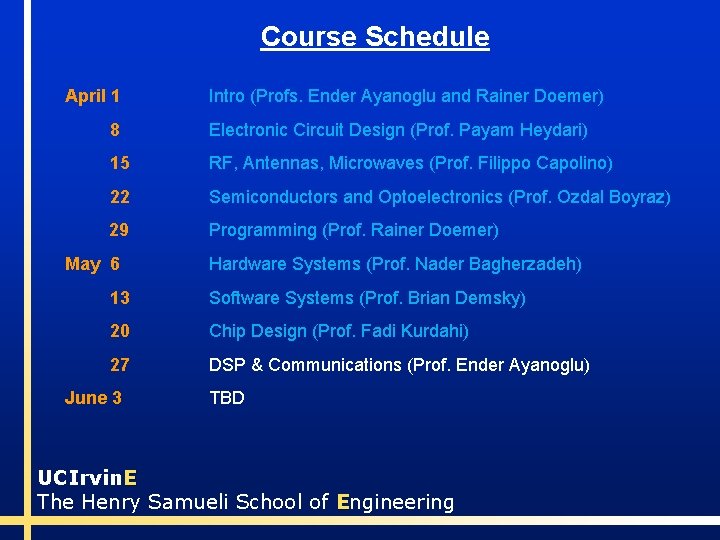
Course Schedule April 1 Intro (Profs. Ender Ayanoglu and Rainer Doemer) 8 Electronic Circuit Design (Prof. Payam Heydari) 15 RF, Antennas, Microwaves (Prof. Filippo Capolino) 22 Semiconductors and Optoelectronics (Prof. Ozdal Boyraz) 29 Programming (Prof. Rainer Doemer) May 6 Hardware Systems (Prof. Nader Bagherzadeh) 13 Software Systems (Prof. Brian Demsky) 20 Chip Design (Prof. Fadi Kurdahi) 27 DSP & Communications (Prof. Ender Ayanoglu) June 3 TBD UCIrvin. E The Henry Samueli School of Engineering
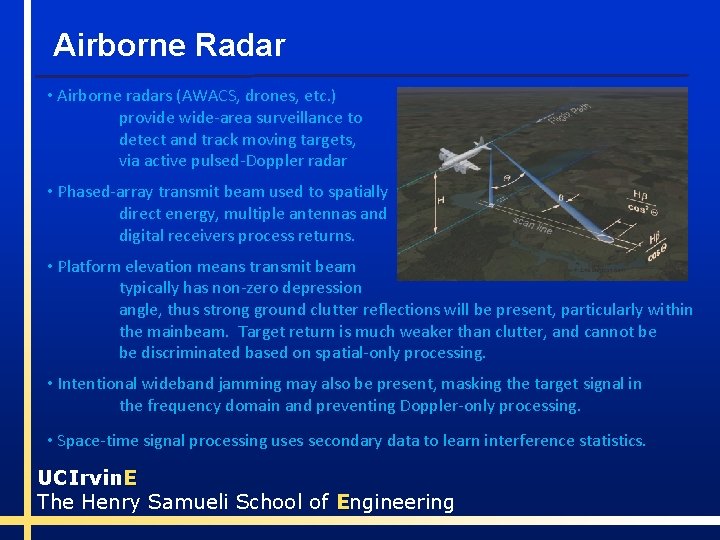
Airborne Radar • Airborne radars (AWACS, drones, etc. ) provide wide-area surveillance to detect and track moving targets, via active pulsed-Doppler radar • Phased-array transmit beam used to spatially direct energy, multiple antennas and digital receivers process returns. • Platform elevation means transmit beam typically has non-zero depression angle, thus strong ground clutter reflections will be present, particularly within the mainbeam. Target return is much weaker than clutter, and cannot be be discriminated based on spatial-only processing. • Intentional wideband jamming may also be present, masking the target signal in the frequency domain and preventing Doppler-only processing. • Space-time signal processing uses secondary data to learn interference statistics. UCIrvin. E The Henry Samueli School of Engineering
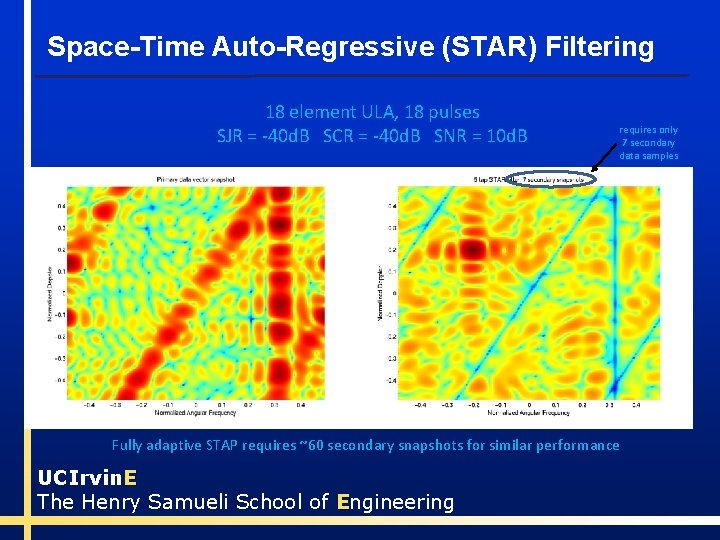
Space-Time Auto-Regressive (STAR) Filtering 18 element ULA, 18 pulses SJR = -40 d. B SCR = -40 d. B SNR = 10 d. B requires only 7 secondary data samples Fully adaptive STAP requires ~60 secondary snapshots for similar performance UCIrvin. E The Henry Samueli School of Engineering
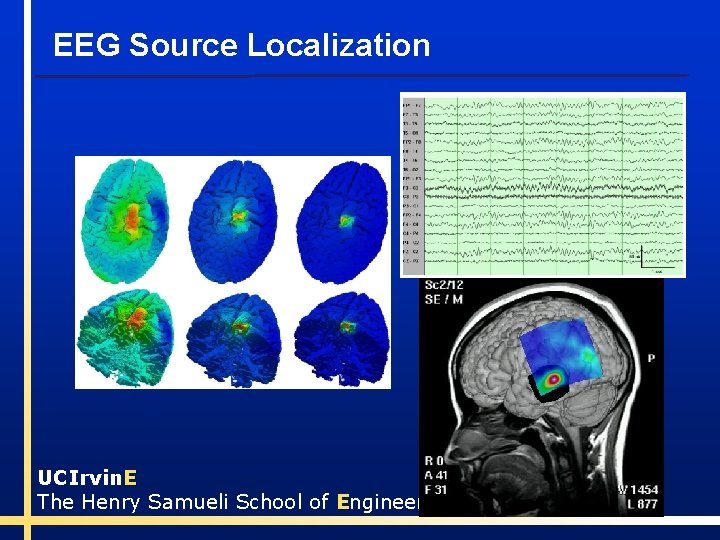
EEG Source Localization UCIrvin. E The Henry Samueli School of Engineering
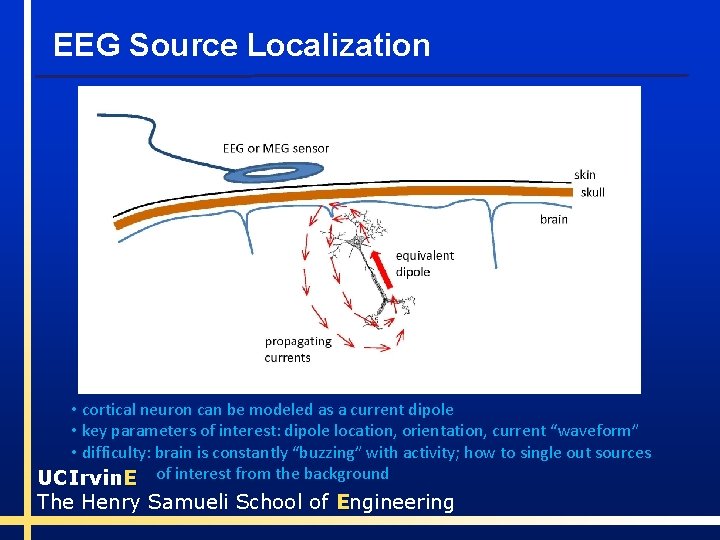
EEG Source Localization • cortical neuron can be modeled as a current dipole • key parameters of interest: dipole location, orientation, current “waveform” • difficulty: brain is constantly “buzzing” with activity; how to single out sources UCIrvin. E of interest from the background The Henry Samueli School of Engineering
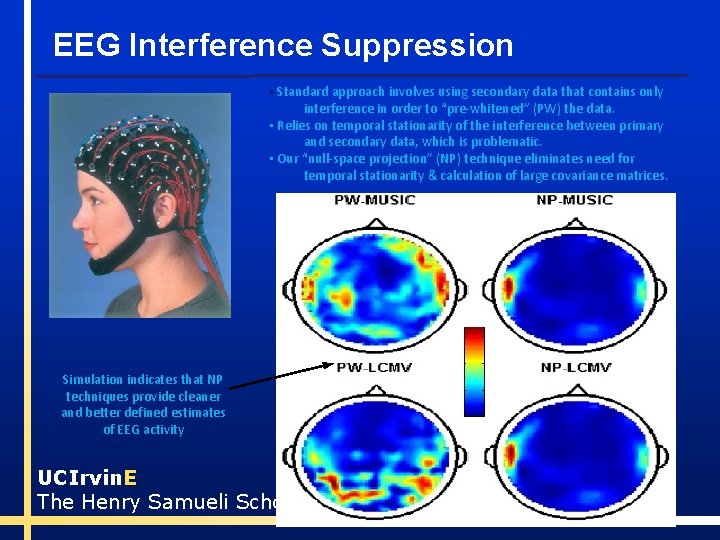
EEG Interference Suppression • Standard approach involves using secondary data that contains only interference in order to “pre-whitened” (PW) the data. • Relies on temporal stationarity of the interference between primary and secondary data, which is problematic. • Our “null-space projection” (NP) technique eliminates need for temporal stationarity & calculation of large covariance matrices. Simulation indicates that NP techniques provide cleaner and better defined estimates of EEG activity UCIrvin. E The Henry Samueli School of Engineering
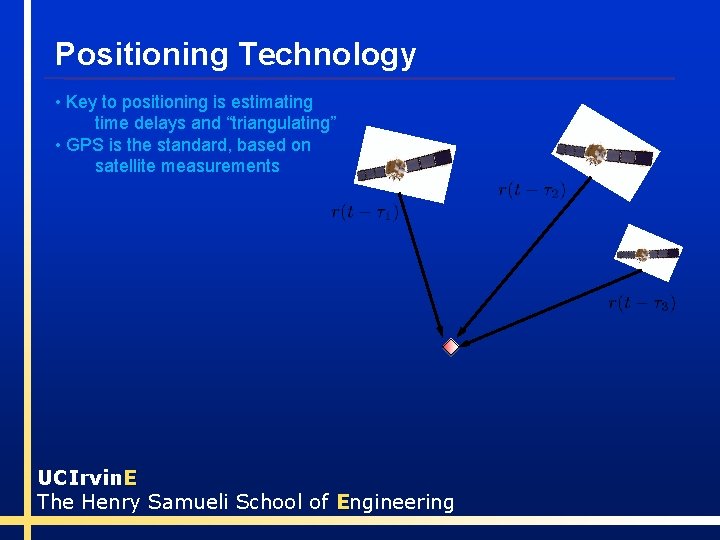
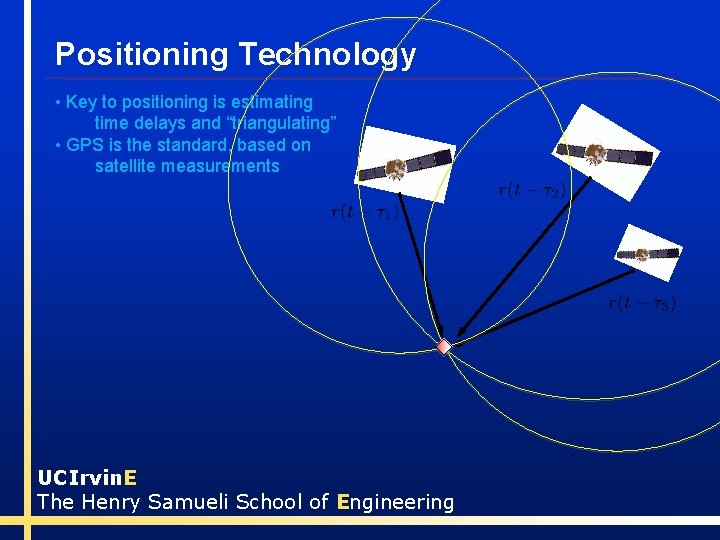
Positioning Technology • Key to positioning is estimating time delays and “triangulating” • GPS is the standard, based on satellite measurements UCIrvin. E The Henry Samueli School of Engineering
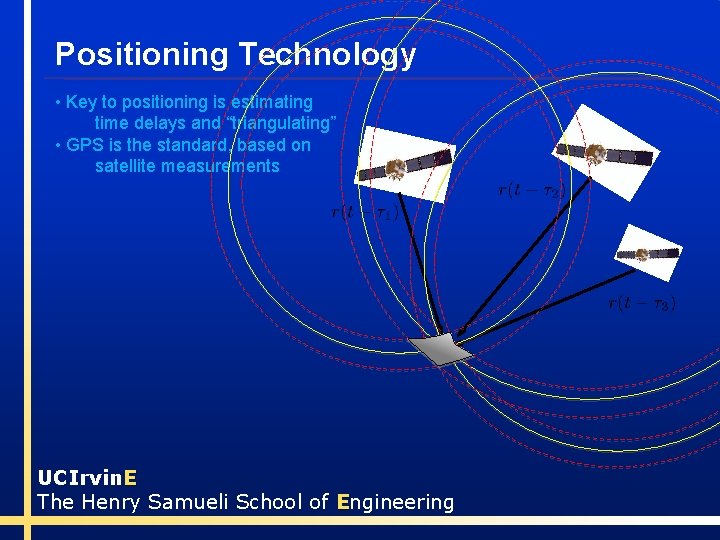
Positioning Technology • Key to positioning is estimating time delays and “triangulating” • GPS is the standard, based on satellite measurements UCIrvin. E The Henry Samueli School of Engineering
Positioning Technology • Key to positioning is estimating time delays and “triangulating” • GPS is the standard, based on satellite measurements UCIrvin. E The Henry Samueli School of Engineering
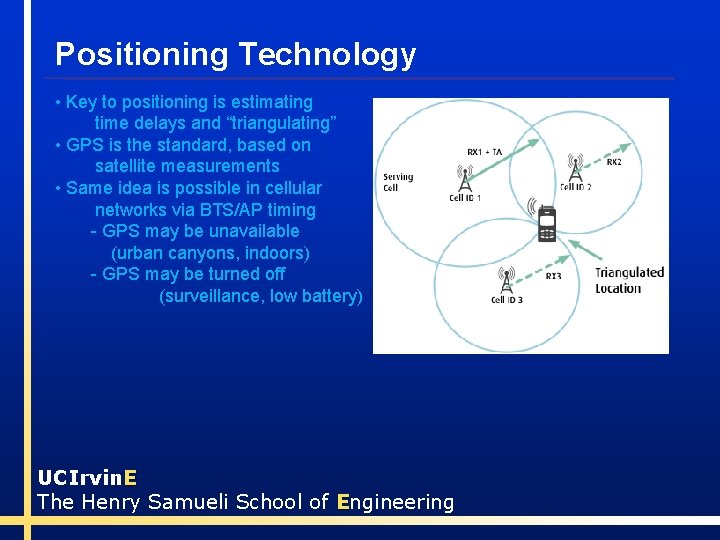
Positioning Technology • Key to positioning is estimating time delays and “triangulating” • GPS is the standard, based on satellite measurements • Same idea is possible in cellular networks via BTS/AP timing - GPS may be unavailable (urban canyons, indoors) - GPS may be turned off (surveillance, low battery) UCIrvin. E The Henry Samueli School of Engineering
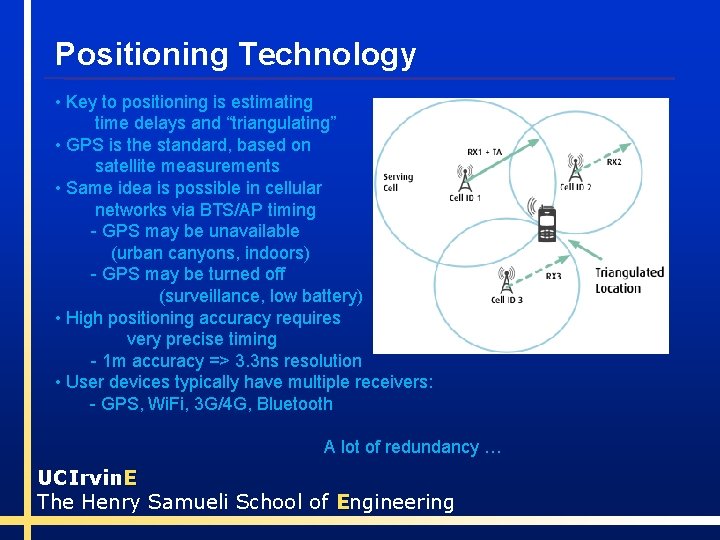
Positioning Technology • Key to positioning is estimating time delays and “triangulating” • GPS is the standard, based on satellite measurements • Same idea is possible in cellular networks via BTS/AP timing - GPS may be unavailable (urban canyons, indoors) - GPS may be turned off (surveillance, low battery) • High positioning accuracy requires very precise timing - 1 m accuracy => 3. 3 ns resolution • User devices typically have multiple receivers: - GPS, Wi. Fi, 3 G/4 G, Bluetooth A lot of redundancy … UCIrvin. E The Henry Samueli School of Engineering