
EE 445 S RealTime Digital Signal Processing Lab
EE 445 S Real-Time Digital Signal Processing Lab Spring 2014 Matched Filtering and Digital Pulse Amplitude Modulation (PAM) Slides by Prof. Brian L. Evans and Dr. Serene Banerjee Dept. of Electrical and Computer Engineering The University of Texas at Austin Lecture 14
Outline • Transmitting one bit at a time • Matched filtering • PAM system • Intersymbol interference • Communication performance Bit error probability for binary signals Symbol error probability for M-ary (multilevel) signals • Eye diagram 14 - 2
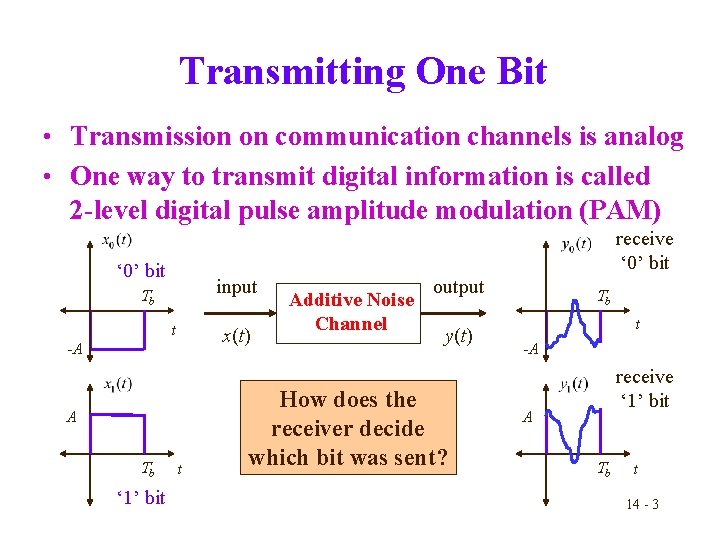
Transmitting One Bit • Transmission on communication channels is analog • One way to transmit digital information is called 2 -level digital pulse amplitude modulation (PAM) receive ‘ 0’ bit input Tb t x(t) -A A Tb ‘ 1’ bit t Additive Noise Channel output y(t) How does the receiver decide which bit was sent? Tb t -A receive ‘ 1’ bit A Tb t 14 - 3
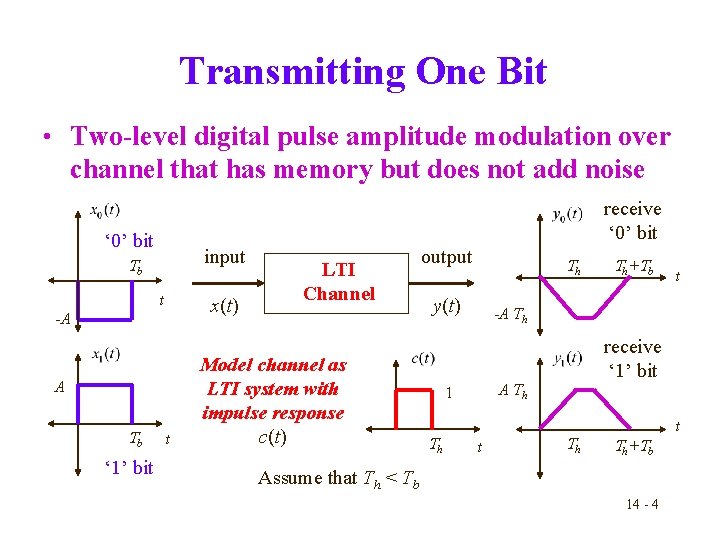
Transmitting One Bit • Two-level digital pulse amplitude modulation over channel that has memory but does not add noise receive ‘ 0’ bit input Tb t x(t) -A A Tb ‘ 1’ bit t LTI Channel Model channel as LTI system with impulse response c(t) output Th y(t) t -A Th receive ‘ 1’ bit A Th 1 Th Th+Tb t Th Th+Tb Assume that Th < Tb 14 - 4 t
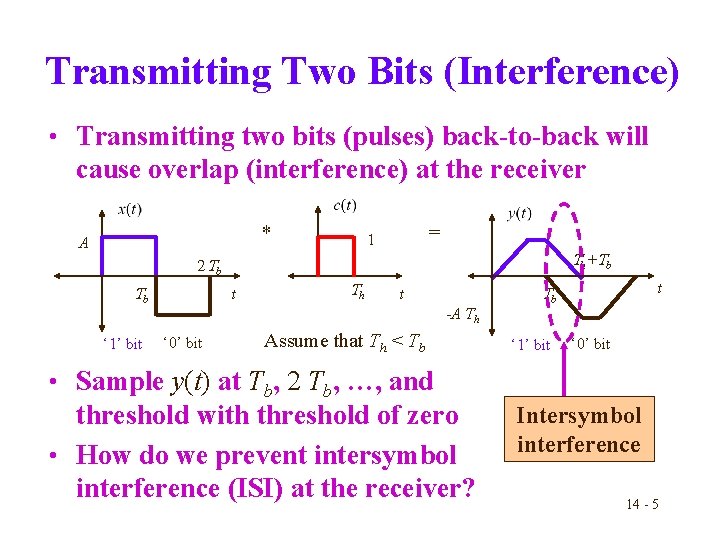
Transmitting Two Bits (Interference) • Transmitting two bits (pulses) back-to-back will cause overlap (interference) at the receiver * A = 1 Th+Tb 2 Tb Tb ‘ 1’ bit t Th t -A Th ‘ 0’ bit Assume that Th < Tb t Tb ‘ 1’ bit ‘ 0’ bit • Sample y(t) at Tb, 2 Tb, …, and threshold with threshold of zero • How do we prevent intersymbol interference (ISI) at the receiver? Intersymbol interference 14 - 5
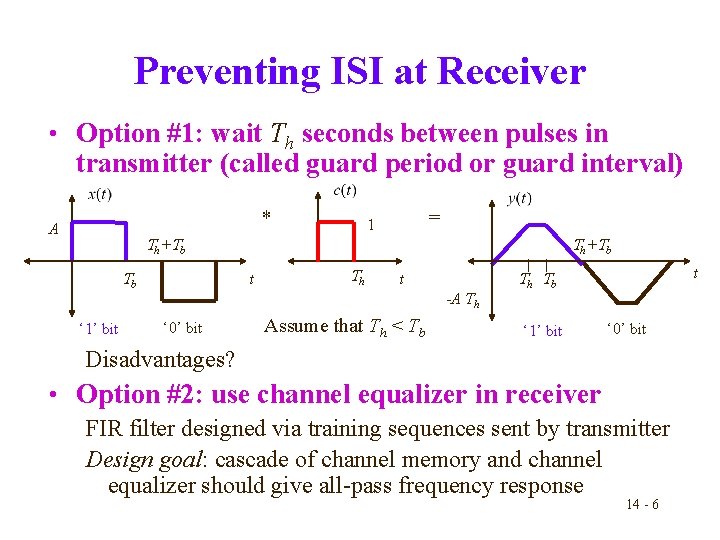
Preventing ISI at Receiver • Option #1: wait Th seconds between pulses in transmitter (called guard period or guard interval) * A = 1 Th+Tb Tb ‘ 1’ bit Th+Tb t Th t -A Th ‘ 0’ bit Assume that Th < Tb t Th Tb ‘ 1’ bit ‘ 0’ bit Disadvantages? • Option #2: use channel equalizer in receiver FIR filter designed via training sequences sent by transmitter Design goal: cascade of channel memory and channel equalizer should give all-pass frequency response 14 - 6
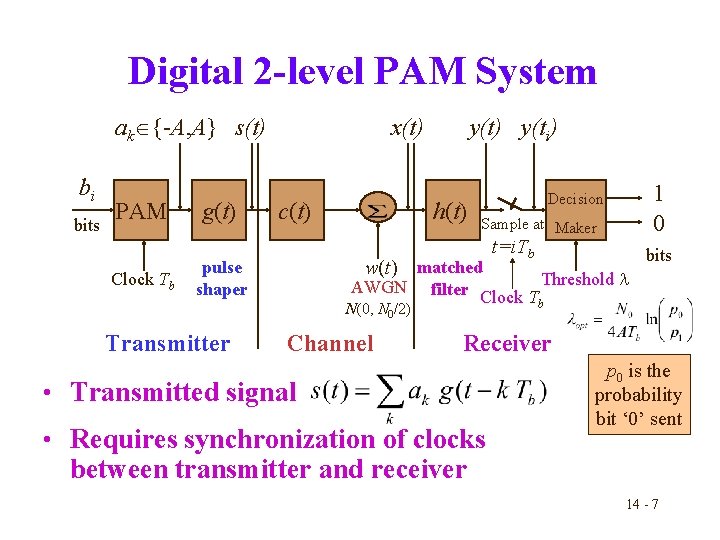
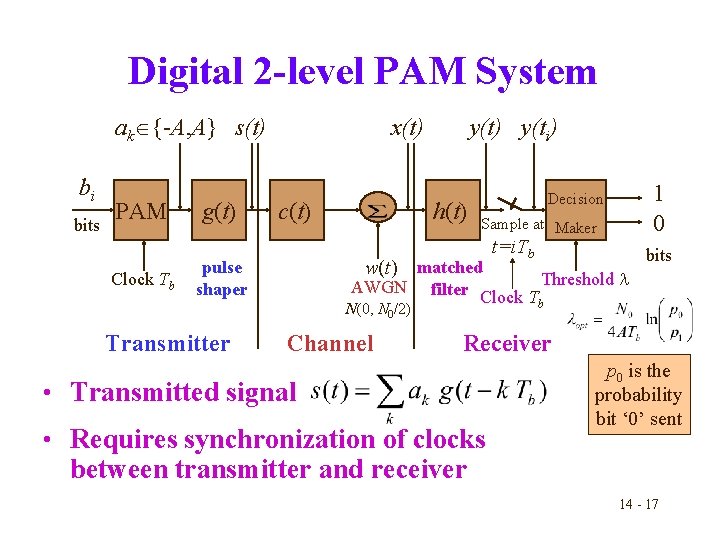
Digital 2 -level PAM System ak {-A, A} s(t) bi bits PAM Clock Tb g(t) x(t) c(t) h(t) AWGN N(0, N 0/2) Channel 1 0 Decision Sample at Maker w(t) matched pulse shaper Transmitter y(t) y(ti) t=i. Tb bits Threshold l filter Clock T b Receiver • Transmitted signal • Requires synchronization of clocks p 0 is the probability bit ‘ 0’ sent between transmitter and receiver 14 - 7

Matched Filter • Detection of pulse in presence of additive noise Receiver knows what pulse shape it is looking for Channel memory ignored (assumed compensated by other means, e. g. channel equalizer in receiver) g(t) Pulse signal x(t) h(t) Matched filter w(t) Additive white Gaussian noise (AWGN) with zero mean and variance N 0 /2 y(T) y(t) t=T T is the symbol period 14 - 8

Matched Filter Derivation • Design of matched filter Maximize signal power i. e. power of Minimize noise i. e. power of at t = T • Combine design criteria T is the symbol period g(t) Pulse signal x(t) w(t) h(t) Matched filter y(T) y(t) t=T 14 - 9

Power Spectra • Deterministic signal x(t) • Autocorrelation of x(t) w/ Fourier transform X(f) Power spectrum is square of absolute value of magnitude response (phase is ignored) Maximum value (when it exists) is at Rx(0) Rx(t) is even symmetric, i. e. Rx(t) = Rx(-t) x(t) Multiplication in Fourier domain is convolution in time domain Conjugation in Fourier domain is reversal & conjugation in time 1 0 Rx(t) -Ts Ts t 14 - 10
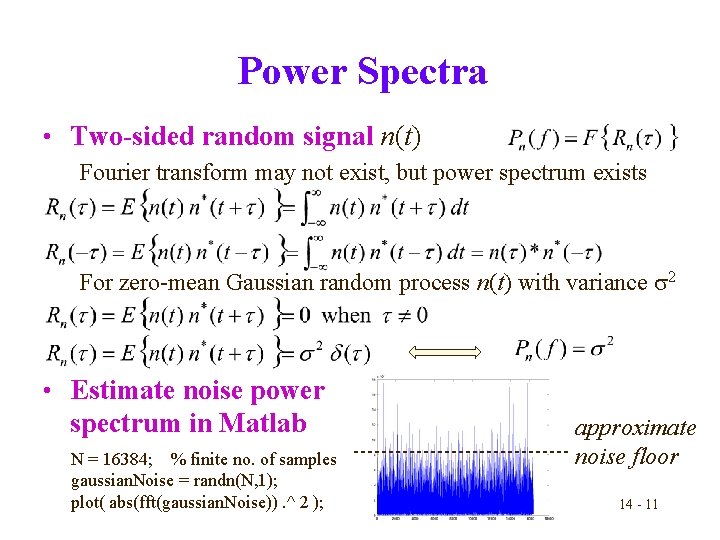
Power Spectra • Two-sided random signal n(t) Fourier transform may not exist, but power spectrum exists For zero-mean Gaussian random process n(t) with variance 2 • Estimate noise power spectrum in Matlab N = 16384; % finite no. of samples gaussian. Noise = randn(N, 1); plot( abs(fft(gaussian. Noise)). ^ 2 ); approximate noise floor 14 - 11

Matched Filter Derivation g(t) Pulse signal x(t) h(t) y(T) y(t) Noise power spectrum SW(f) t=T w(t) Matched filter f • Noise AWGN Matched filter • Signal T is the symbol period 14 - 12

Matched Filter Derivation • Find h(t) that maximizes pulse peak SNR h a • Schwartz’s inequality b For vectors: For functions: upper bound reached iff 14 - 13
Matched Filter Derivation T is the symbol period 14 - 14
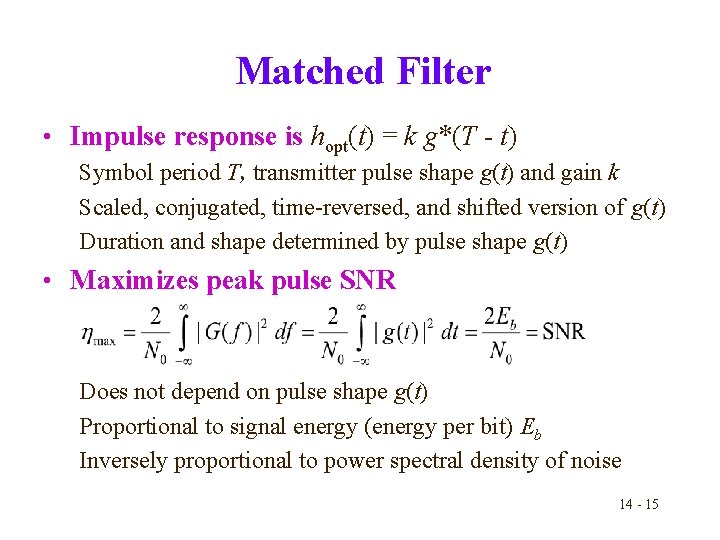
Matched Filter • Impulse response is hopt(t) = k g*(T - t) Symbol period T, transmitter pulse shape g(t) and gain k Scaled, conjugated, time-reversed, and shifted version of g(t) Duration and shape determined by pulse shape g(t) • Maximizes peak pulse SNR Does not depend on pulse shape g(t) Proportional to signal energy (energy per bit) Eb Inversely proportional to power spectral density of noise 14 - 15
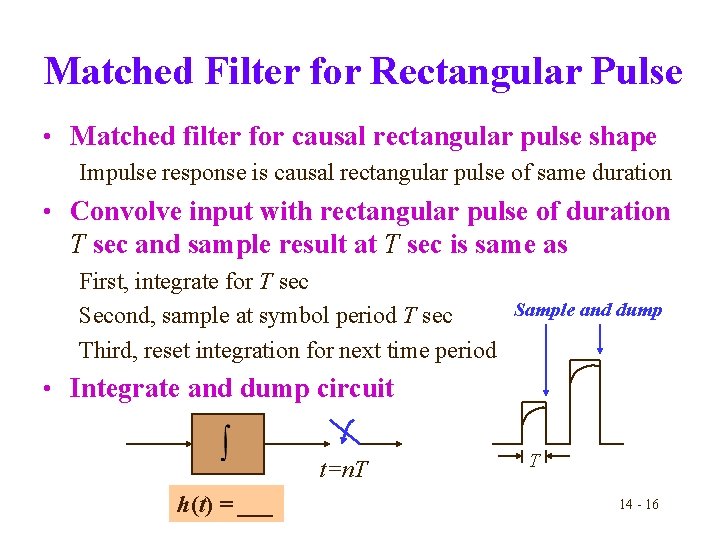
Matched Filter for Rectangular Pulse • Matched filter for causal rectangular pulse shape Impulse response is causal rectangular pulse of same duration • Convolve input with rectangular pulse of duration T sec and sample result at T sec is same as First, integrate for T sec Sample and dump Second, sample at symbol period T sec Third, reset integration for next time period • Integrate and dump circuit t=n. T h(t) = ___ T 14 - 16
Digital 2 -level PAM System ak {-A, A} s(t) bi bits PAM Clock Tb g(t) x(t) c(t) h(t) AWGN N(0, N 0/2) Channel 1 0 Decision Sample at Maker w(t) matched pulse shaper Transmitter y(t) y(ti) t=i. Tb bits Threshold l filter Clock T b Receiver • Transmitted signal • Requires synchronization of clocks p 0 is the probability bit ‘ 0’ sent between transmitter and receiver 14 - 17
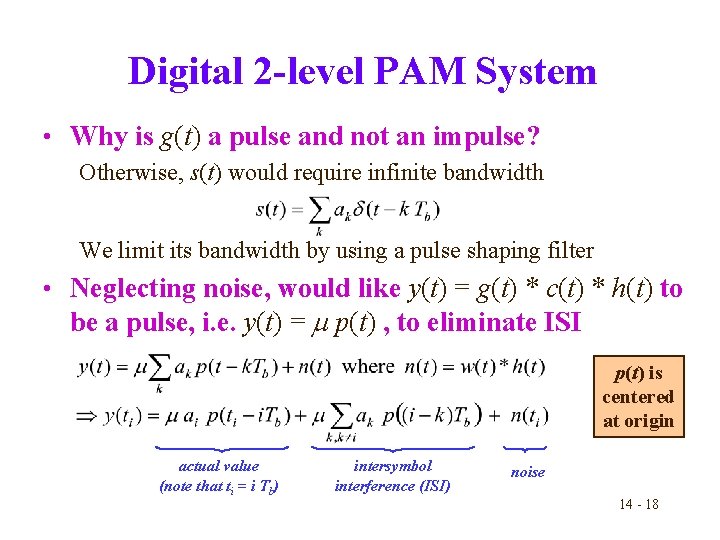
Digital 2 -level PAM System • Why is g(t) a pulse and not an impulse? Otherwise, s(t) would require infinite bandwidth We limit its bandwidth by using a pulse shaping filter • Neglecting noise, would like y(t) = g(t) * c(t) * h(t) to be a pulse, i. e. y(t) = m p(t) , to eliminate ISI p(t) is centered at origin actual value (note that ti = i Tb) intersymbol interference (ISI) noise 14 - 18
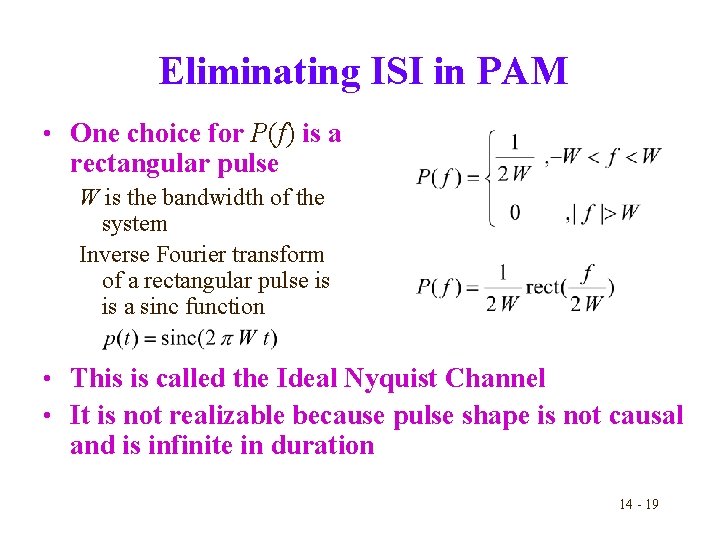
Eliminating ISI in PAM • One choice for P(f) is a rectangular pulse W is the bandwidth of the system Inverse Fourier transform of a rectangular pulse is is a sinc function • This is called the Ideal Nyquist Channel • It is not realizable because pulse shape is not causal and is infinite in duration 14 - 19

Eliminating ISI in PAM • Another choice for P(f) is a raised cosine spectrum • Roll-off factor gives bandwidth in excess of bandwidth W for ideal Nyquist channel • Raised cosine pulse has zero ISI when Nyquist channel dampening adjusted by sampled correctly idealimpulse response rolloff factor a • Let g(t) and h(t) be square root raised cosine pulses 14 - 20
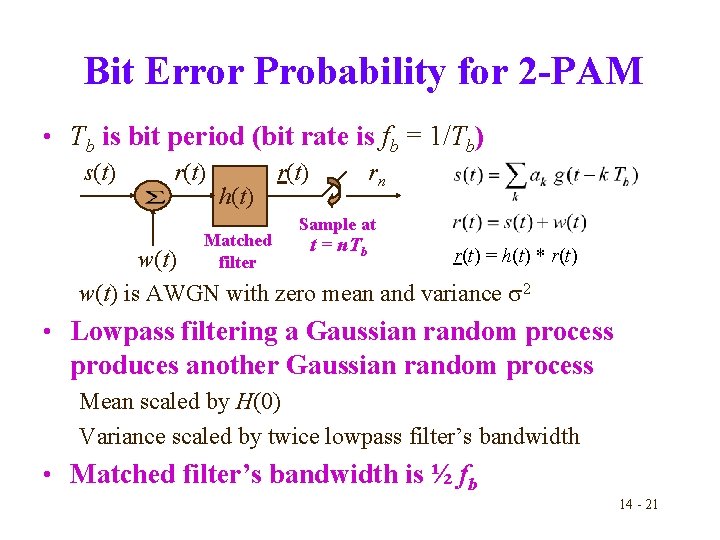
Bit Error Probability for 2 -PAM • Tb is bit period (bit rate is fb = 1/Tb) s(t) r(t) h(t) Matched filter r(t) rn Sample at t = n. Tb r(t) = h(t) * r(t) w(t) is AWGN with zero mean and variance 2 • Lowpass filtering a Gaussian random process produces another Gaussian random process Mean scaled by H(0) Variance scaled by twice lowpass filter’s bandwidth • Matched filter’s bandwidth is ½ fb 14 - 21
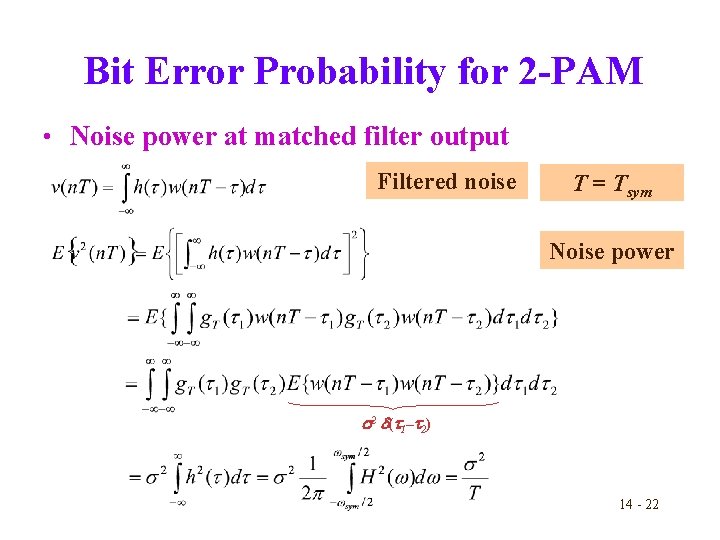
Bit Error Probability for 2 -PAM • Noise power at matched filter output Filtered noise T = Tsym Noise power s 2 d(t 1–t 2) 14 - 22
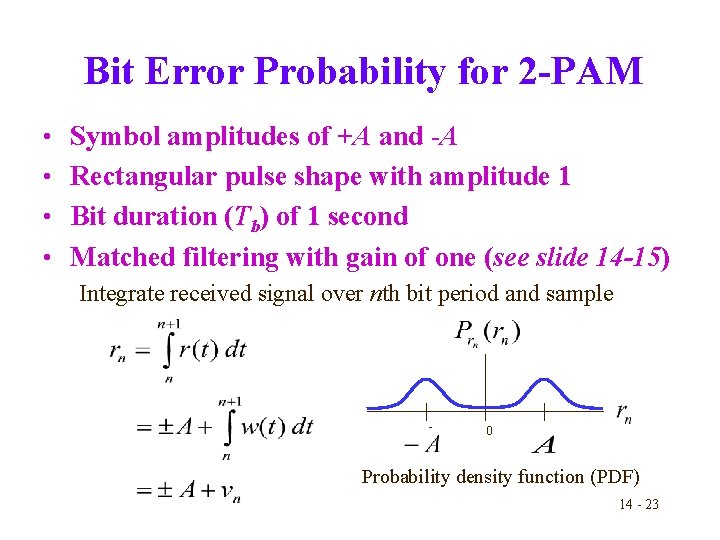
Bit Error Probability for 2 -PAM • Symbol amplitudes of +A and -A • Rectangular pulse shape with amplitude 1 • Bit duration (Tb) of 1 second • Matched filtering with gain of one (see slide 14 -15) Integrate received signal over nth bit period and sample - 0 Probability density function (PDF) 14 - 23
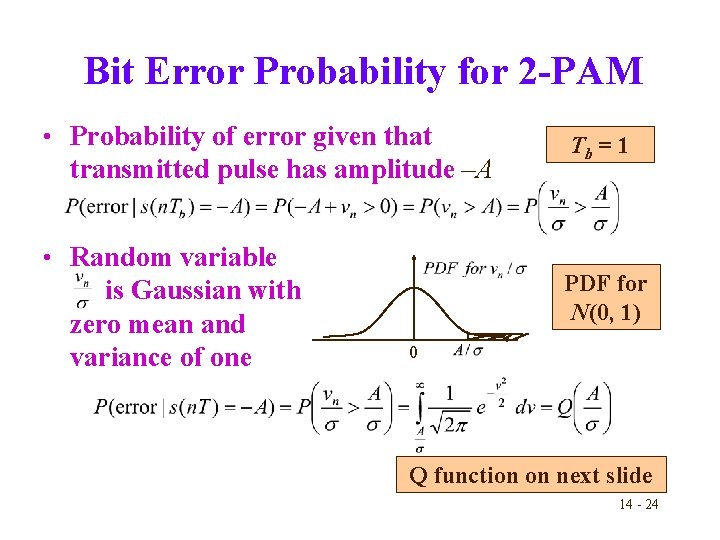
Bit Error Probability for 2 -PAM • Probability of error given that transmitted pulse has amplitude –A • Random variable is Gaussian with zero mean and variance of one Tb = 1 PDF for N(0, 1) 0 Q function on next slide 14 - 24
![Q Function • Q function • Complementary error function erfc • Relationship Erfc[x] in](http://slidetodoc.com/presentation_image/122c859a9217263bd90df688e48a59cc/image-25.jpg "Q Function • Q function • Complementary error function erfc • Relationship Erfc[x] in")
Q Function • Q function • Complementary error function erfc • Relationship Erfc[x] in Mathematica erfc(x) in Matlab 14 - 25
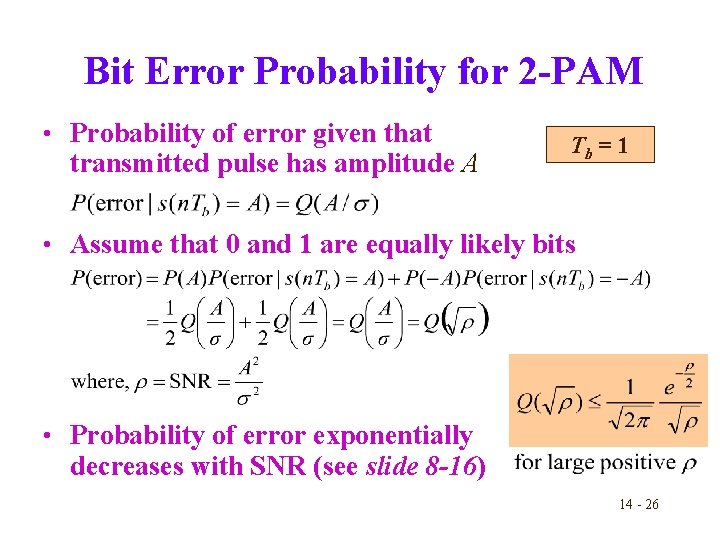
Bit Error Probability for 2 -PAM • Probability of error given that transmitted pulse has amplitude A Tb = 1 • Assume that 0 and 1 are equally likely bits • Probability of error exponentially decreases with SNR (see slide 8 -16) 14 - 26
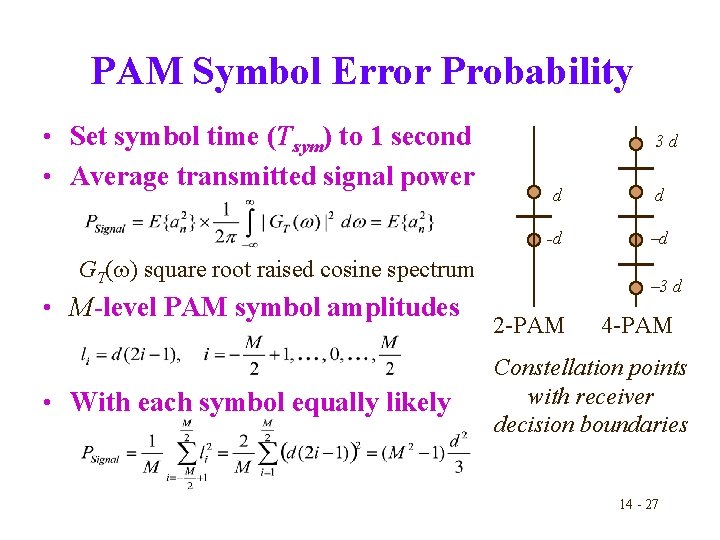
PAM Symbol Error Probability • Set symbol time (Tsym) to 1 second • Average transmitted signal power 3 d d d -d d GT(w) square root raised cosine spectrum • M-level PAM symbol amplitudes • With each symbol equally likely 3 d 2 -PAM 4 -PAM Constellation points with receiver decision boundaries 14 - 27
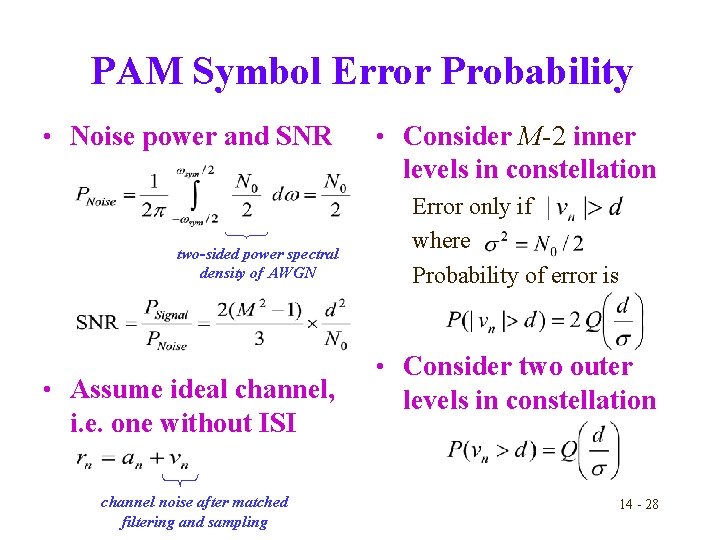
PAM Symbol Error Probability • Noise power and SNR • Consider M-2 inner levels in constellation two-sided power spectral density of AWGN • Assume ideal channel, i. e. one without ISI channel noise after matched filtering and sampling Error only if where Probability of error is • Consider two outer levels in constellation 14 - 28
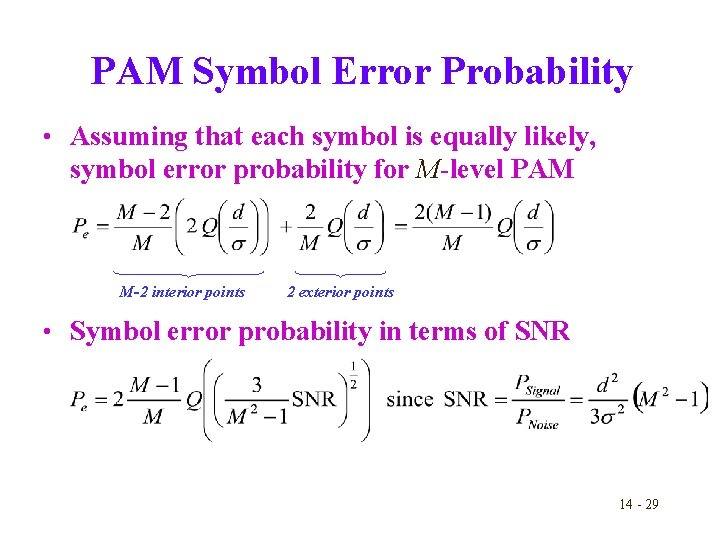
PAM Symbol Error Probability • Assuming that each symbol is equally likely, symbol error probability for M-level PAM M-2 interior points 2 exterior points • Symbol error probability in terms of SNR 14 - 29
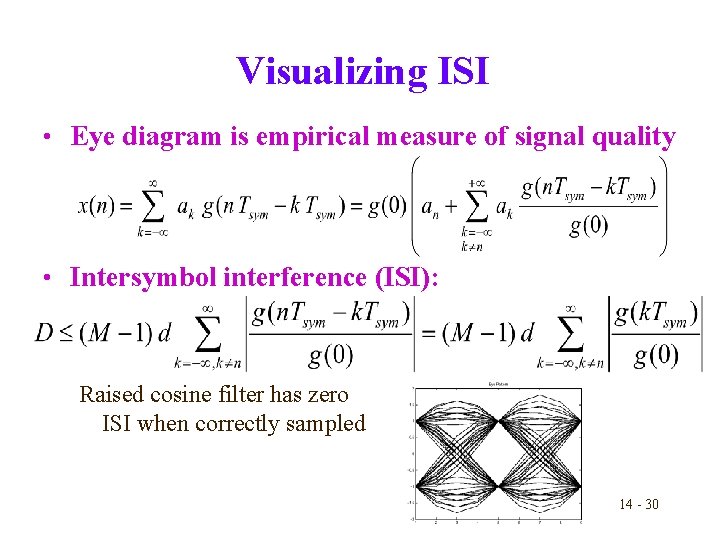
Visualizing ISI • Eye diagram is empirical measure of signal quality • Intersymbol interference (ISI): Raised cosine filter has zero ISI when correctly sampled 14 - 30
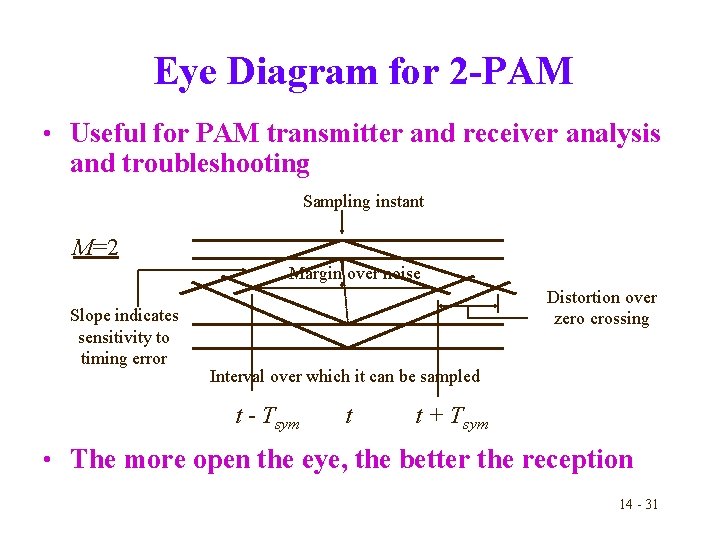
Eye Diagram for 2 -PAM • Useful for PAM transmitter and receiver analysis and troubleshooting Sampling instant M=2 Margin over noise Slope indicates sensitivity to timing error Distortion over zero crossing Interval over which it can be sampled t - Tsym t t + Tsym • The more open the eye, the better the reception 14 - 31
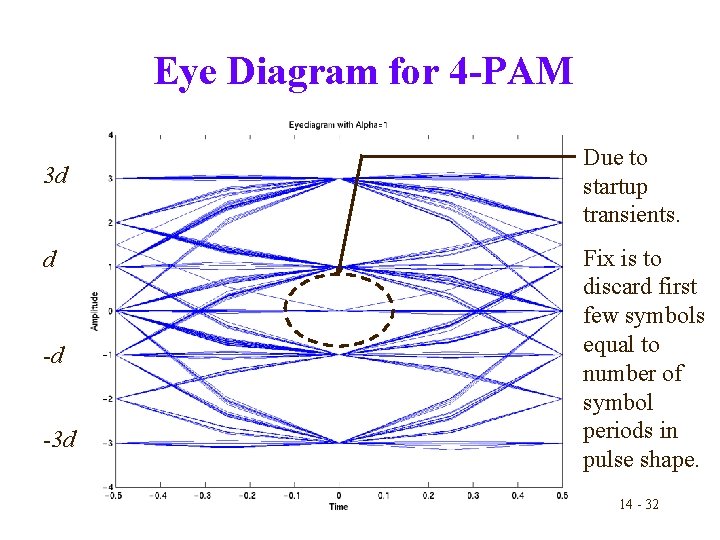
Eye Diagram for 4 -PAM 3 d d -d -3 d Due to startup transients. Fix is to discard first few symbols equal to number of symbol periods in pulse shape. 14 - 32
- Slides: 32