
EE 413 Communication Electronics Capstone Design Project Motion
- Slides: 28
EE 413 Communication Electronics Capstone Design Project (Motion Detector Alarm Dialer) Instructor Dr. Pao Lo Liu Group Members Chee Fai NG (3032 -0373) Jia Quan Cheok (3032 -6421) EE Department University at Buffalo
Project Title: Automatic Dial Alarm System Objectives: § To design and build application circuits using microcontroller. § To understand how a dial alarm system work. § To build a motion detector and understand how it work. § To learn and understand PIC language which use to program the microcontroller.
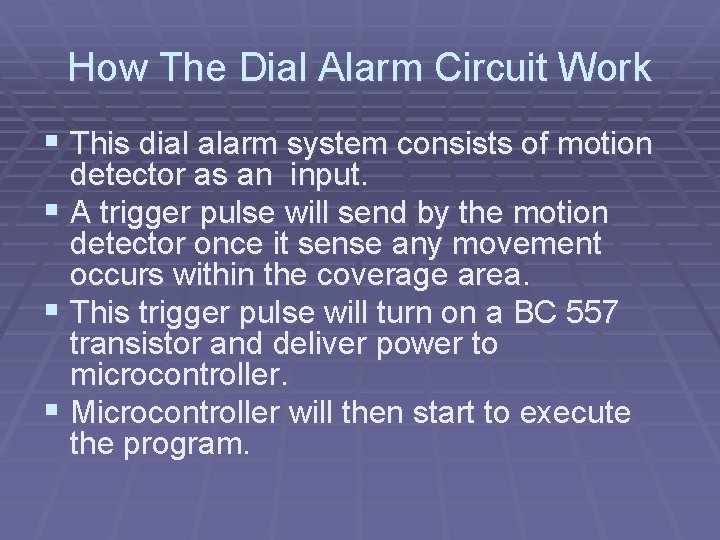
How The Dial Alarm Circuit Work § This dial alarm system consists of motion detector as an input. § A trigger pulse will send by the motion detector once it sense any movement occurs within the coverage area. § This trigger pulse will turn on a BC 557 transistor and deliver power to microcontroller. § Microcontroller will then start to execute the program.
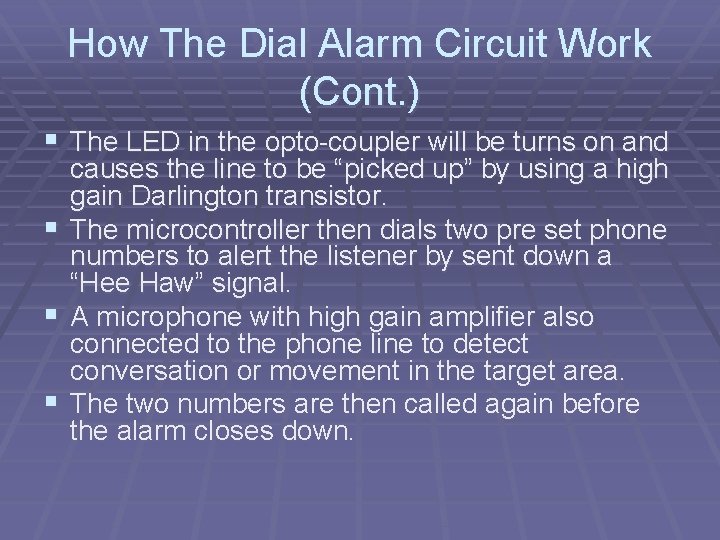
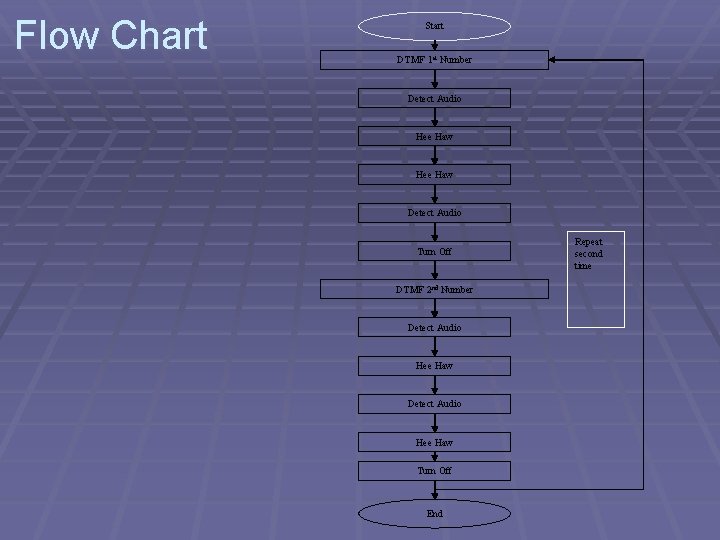
How The Dial Alarm Circuit Work (Cont. ) § The LED in the opto-coupler will be turns on and causes the line to be “picked up” by using a high gain Darlington transistor. § The microcontroller then dials two pre set phone numbers to alert the listener by sent down a “Hee Haw” signal. § A microphone with high gain amplifier also connected to the phone line to detect conversation or movement in the target area. § The two numbers are then called again before the alarm closes down.
Dial Alarm Circuit
Dial Alarm Circuit
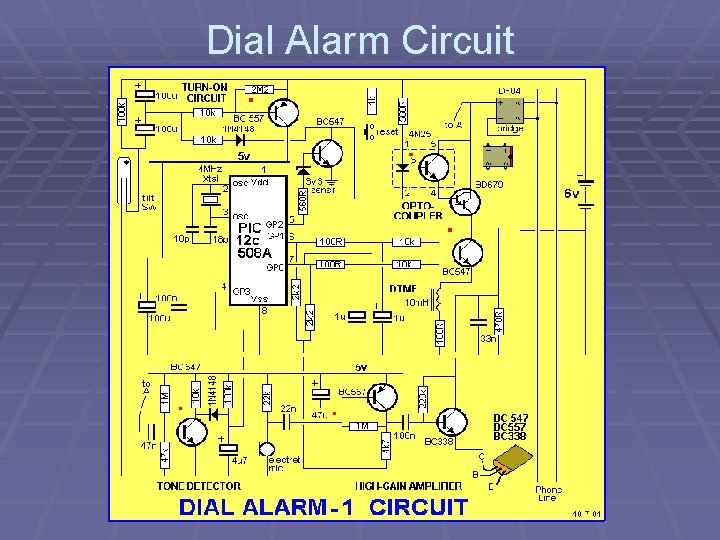
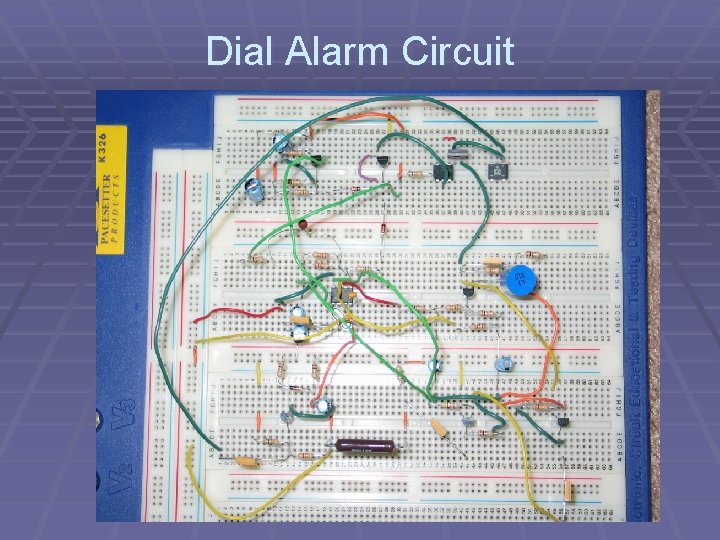
Dial Alarm Circuit (Cont. ) § Turn on circuit § Tone detector § DTMF wave shaping circuit § High gain audio amplifier § Opto-coupler § Microcontroller
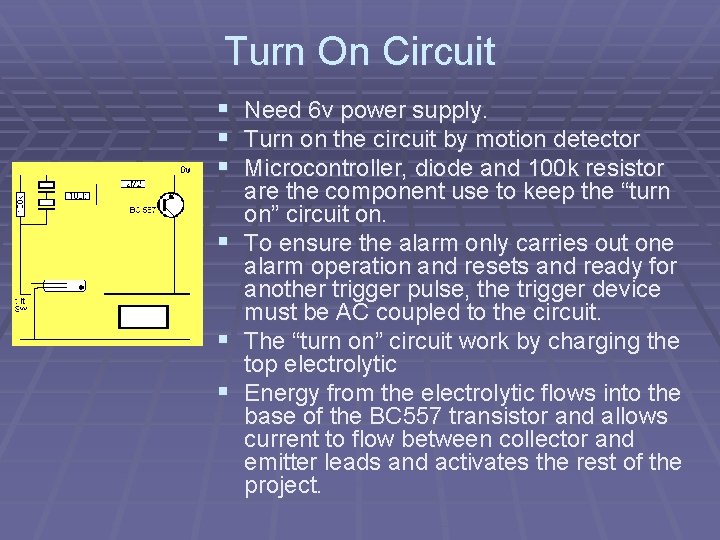
Turn On Circuit § § § Need 6 v power supply. Turn on the circuit by motion detector Microcontroller, diode and 100 k resistor are the component use to keep the “turn on” circuit on. § To ensure the alarm only carries out one alarm operation and resets and ready for another trigger pulse, the trigger device must be AC coupled to the circuit. § The “turn on” circuit work by charging the top electrolytic § Energy from the electrolytic flows into the base of the BC 557 transistor and allows current to flow between collector and emitter leads and activates the rest of the project.
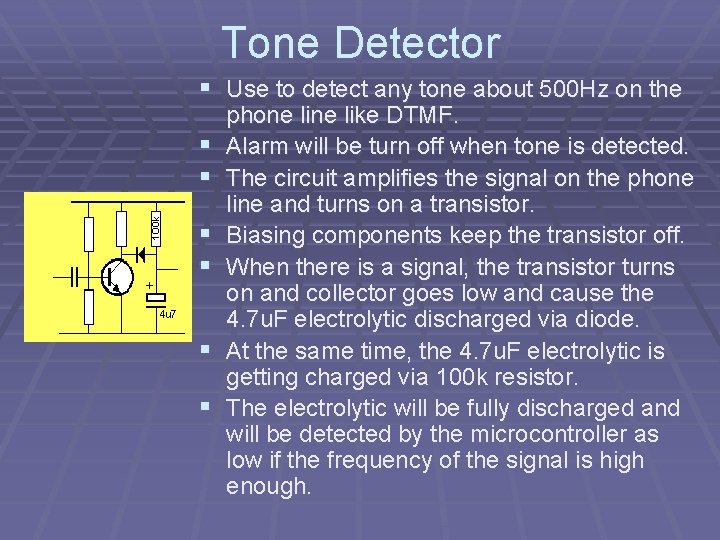
Tone Detector § Use to detect any tone about 500 Hz on the § § § phone like DTMF. Alarm will be turn off when tone is detected. The circuit amplifies the signal on the phone line and turns on a transistor. Biasing components keep the transistor off. When there is a signal, the transistor turns on and collector goes low and cause the 4. 7 u. F electrolytic discharged via diode. At the same time, the 4. 7 u. F electrolytic is getting charged via 100 k resistor. The electrolytic will be fully discharged and will be detected by the microcontroller as low if the frequency of the signal is high enough.
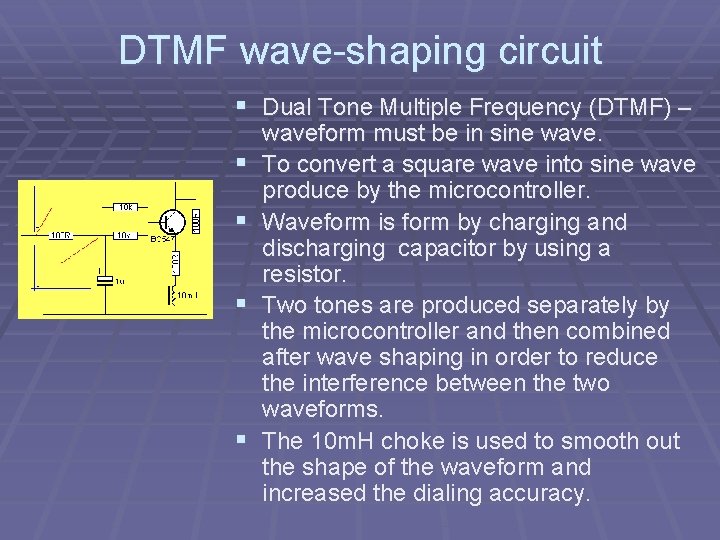
DTMF wave-shaping circuit § Dual Tone Multiple Frequency (DTMF) – § § waveform must be in sine wave. To convert a square wave into sine wave produce by the microcontroller. Waveform is form by charging and discharging capacitor by using a resistor. Two tones are produced separately by the microcontroller and then combined after wave shaping in order to reduce the interference between the two waveforms. The 10 m. H choke is used to smooth out the shape of the waveform and increased the dialing accuracy.
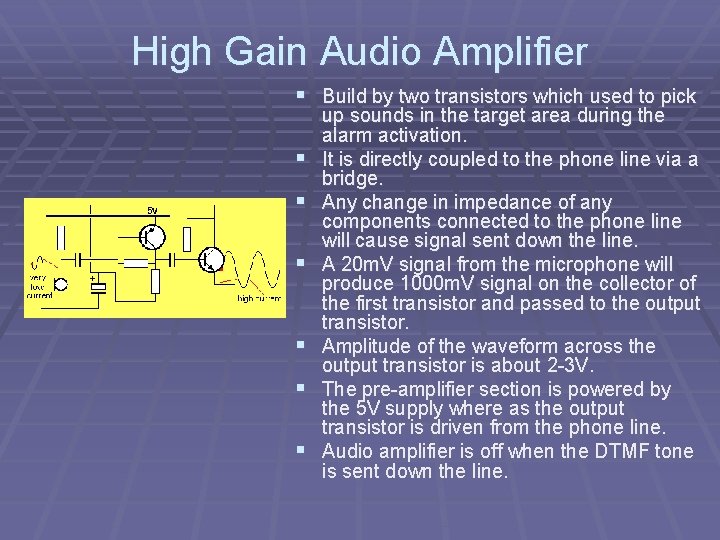
High Gain Audio Amplifier § Build by two transistors which used to pick § § § up sounds in the target area during the alarm activation. It is directly coupled to the phone line via a bridge. Any change in impedance of any components connected to the phone line will cause signal sent down the line. A 20 m. V signal from the microphone will produce 1000 m. V signal on the collector of the first transistor and passed to the output transistor. Amplitude of the waveform across the output transistor is about 2 -3 V. The pre-amplifier section is powered by the 5 V supply where as the output transistor is driven from the phone line. Audio amplifier is off when the DTMF tone is sent down the line.
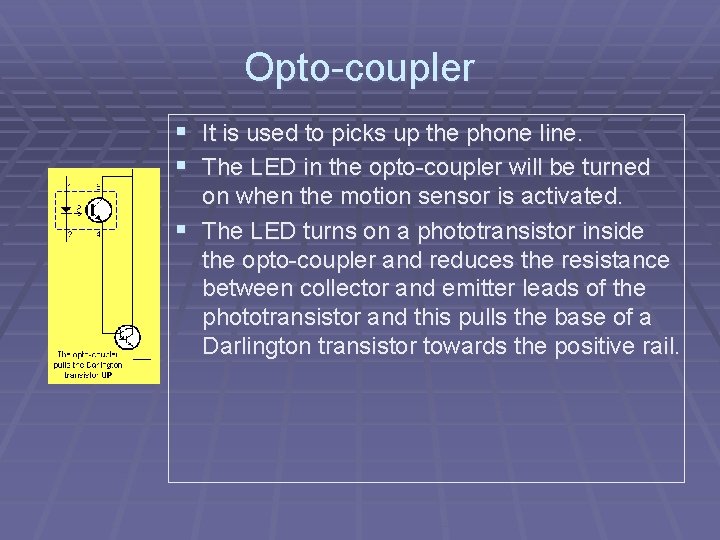
Opto-coupler § It is used to picks up the phone line. § The LED in the opto-coupler will be turned on when the motion sensor is activated. § The LED turns on a phototransistor inside the opto-coupler and reduces the resistance between collector and emitter leads of the phototransistor and this pulls the base of a Darlington transistor towards the positive rail.
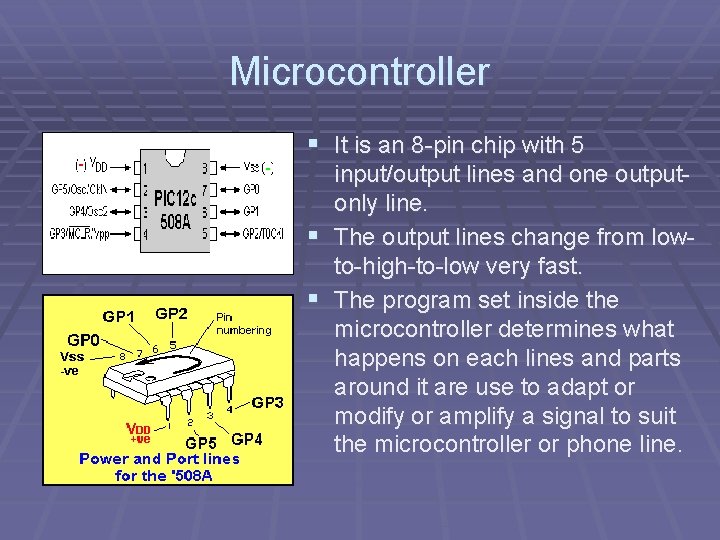
Microcontroller § It is an 8 -pin chip with 5 input/output lines and one outputonly line. § The output lines change from lowto-high-to-low very fast. § The program set inside the microcontroller determines what happens on each lines and parts around it are use to adapt or modify or amplify a signal to suit the microcontroller or phone line.
Flow Chart Start DTMF 1 st Number Detect Audio Hee Haw Detect Audio Turn Off DTMF 2 nd Number Detect Audio Hee Haw Turn Off End Repeat second time
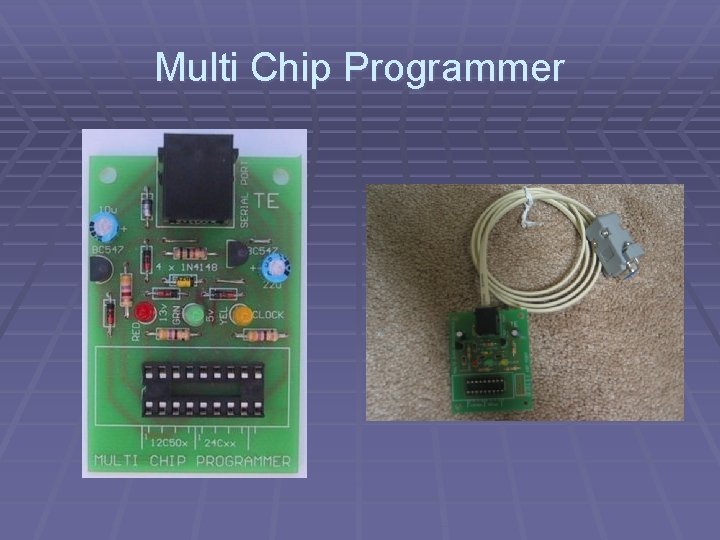
Multi Chip Programmer
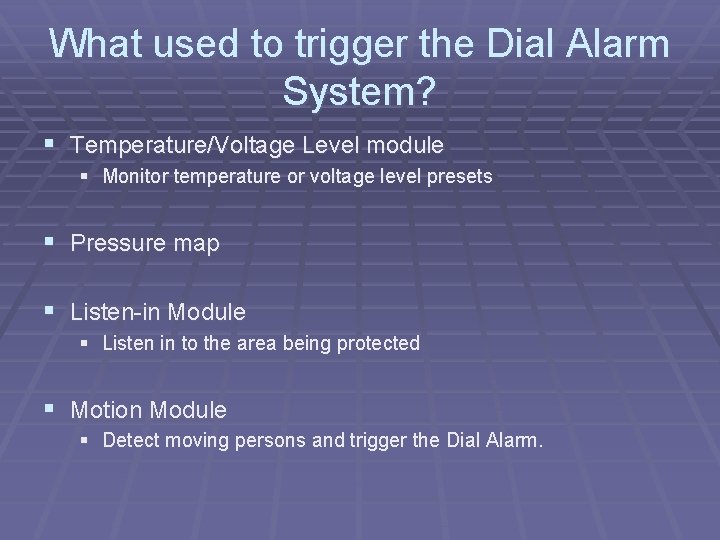
What used to trigger the Dial Alarm System? § Temperature/Voltage Level module § Monitor temperature or voltage level presets § Pressure map § Listen-in Module § Listen in to the area being protected § Motion Module § Detect moving persons and trigger the Dial Alarm.
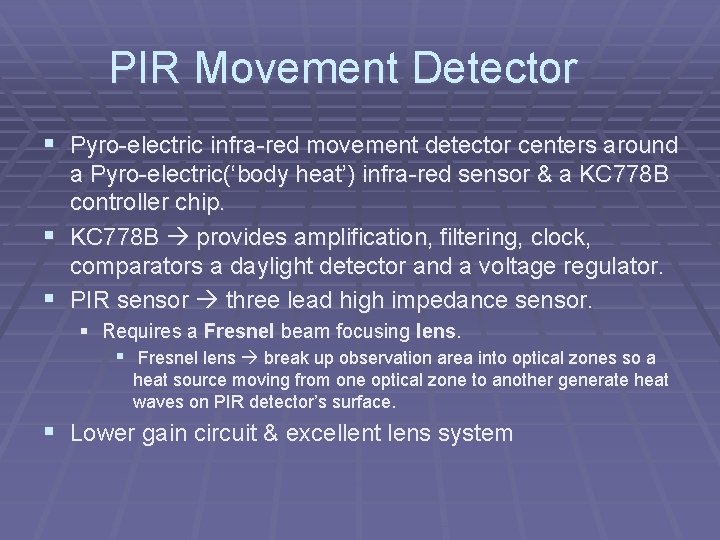
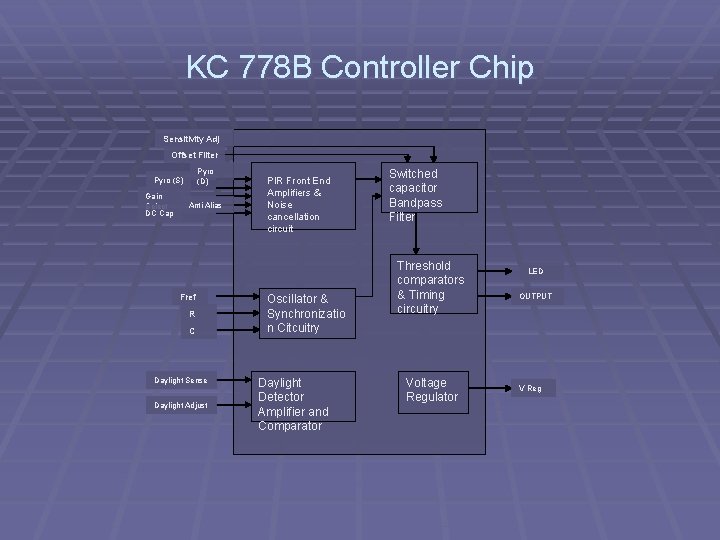
PIR Movement Detector § Pyro-electric infra-red movement detector centers around a Pyro-electric(‘body heat’) infra-red sensor & a KC 778 B controller chip. § KC 778 B provides amplification, filtering, clock, comparators a daylight detector and a voltage regulator. § PIR sensor three lead high impedance sensor. § Requires a Fresnel beam focusing lens. § Fresnel lens break up observation area into optical zones so a heat source moving from one optical zone to another generate heat waves on PIR detector’s surface. § Lower gain circuit & excellent lens system
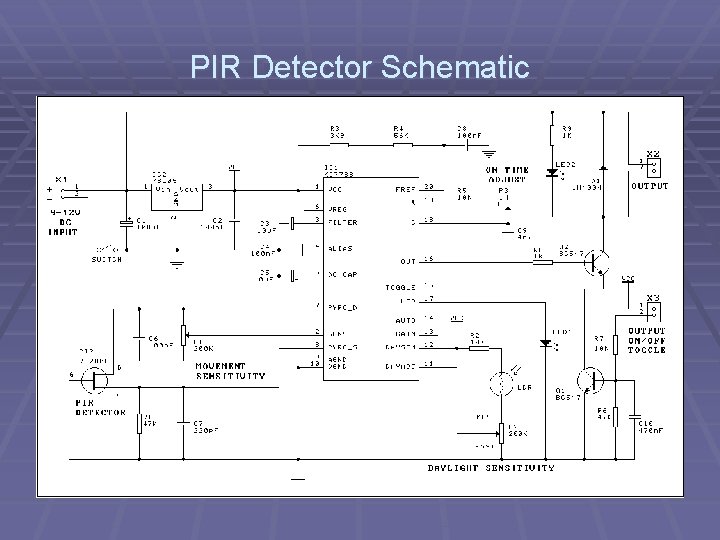
PIR Detector Schematic
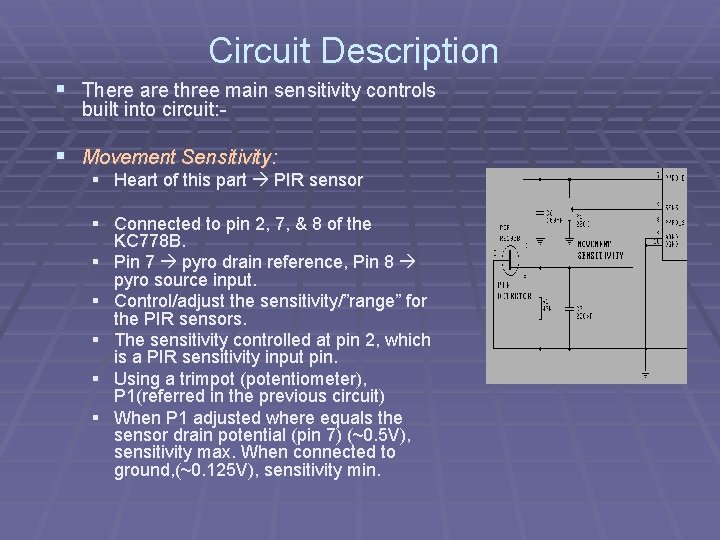
Circuit Description § There are three main sensitivity controls built into circuit: - § Movement Sensitivity: § Heart of this part PIR sensor § Connected to pin 2, 7, & 8 of the KC 778 B. § Pin 7 pyro drain reference, Pin 8 pyro source input. § Control/adjust the sensitivity/”range” for the PIR sensors. § The sensitivity controlled at pin 2, which is a PIR sensitivity input pin. § Using a trimpot (potentiometer), P 1(referred in the previous circuit) § When P 1 adjusted where equals the sensor drain potential (pin 7) (~0. 5 V), sensitivity max. When connected to ground, (~0. 125 V), sensitivity min.
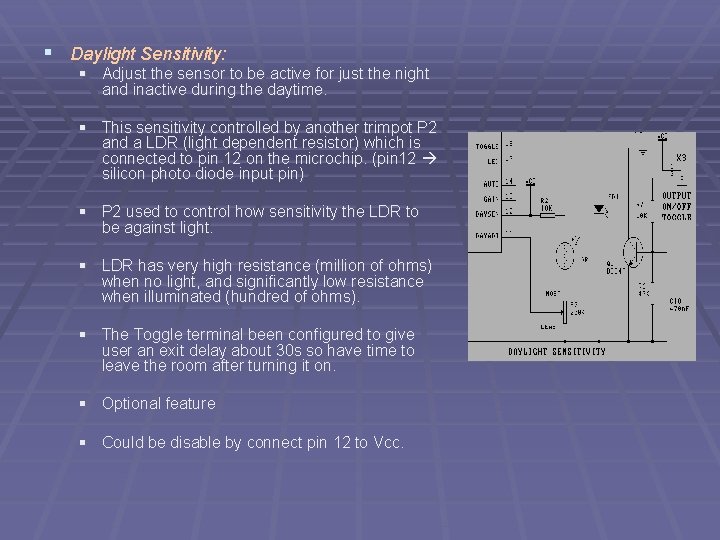
§ Daylight Sensitivity: § Adjust the sensor to be active for just the night and inactive during the daytime. § This sensitivity controlled by another trimpot P 2 and a LDR (light dependent resistor) which is connected to pin 12 on the microchip. (pin 12 silicon photo diode input pin) § P 2 used to control how sensitivity the LDR to be against light. § LDR has very high resistance (million of ohms) when no light, and significantly low resistance when illuminated (hundred of ohms). § The Toggle terminal been configured to give user an exit delay about 30 s so have time to leave the room after turning it on. § Optional feature § Could be disable by connect pin 12 to Vcc.
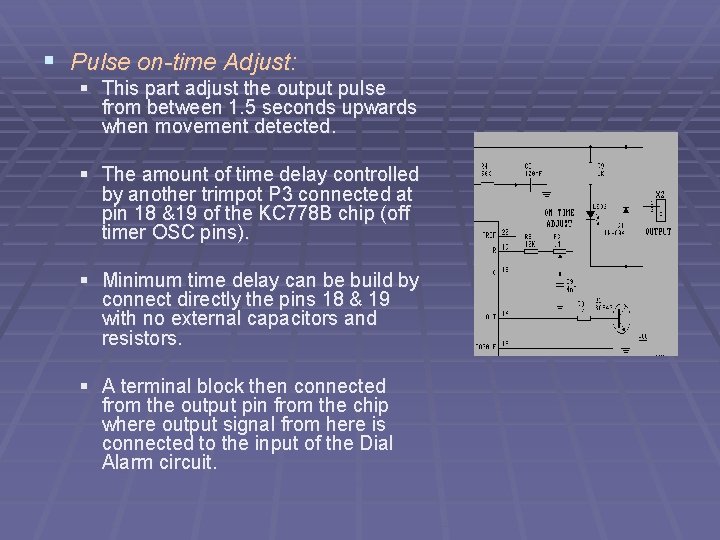
§ Pulse on-time Adjust: § This part adjust the output pulse from between 1. 5 seconds upwards when movement detected. § The amount of time delay controlled by another trimpot P 3 connected at pin 18 &19 of the KC 778 B chip (off timer OSC pins). § Minimum time delay can be build by connect directly the pins 18 & 19 with no external capacitors and resistors. § A terminal block then connected from the output pin from the chip where output signal from here is connected to the input of the Dial Alarm circuit.
KC 778 B Controller Chip Sensitivity Adj Offset Filter Pyro (D) Pyro (S) Gain Select DC Cap Anti Alias Fref R C Daylight Sense Daylight Adjust PIR Front End Amplifiers & Noise cancellation circuit Oscillator & Synchronizatio n Citcuitry Daylight Detector Amplifier and Comparator Switched capacitor Bandpass Filter Threshold comparators & Timing circuitry Voltage Regulator LED OUTPUT V Reg
KC 778 B Controller Chip (Cont’d) § The heart of the whole circuit as the motion detection IC. § Optimum with the electrical signals from the PIR sensors which have very low frequency (0. 1 to 10 Hz) and bandwidth. § Operating voltage is 4 – 15 V. § With the 78 L 05 voltage regulator we connected in pin 1(Vcc), the input voltage should be around 9 – 12 V.
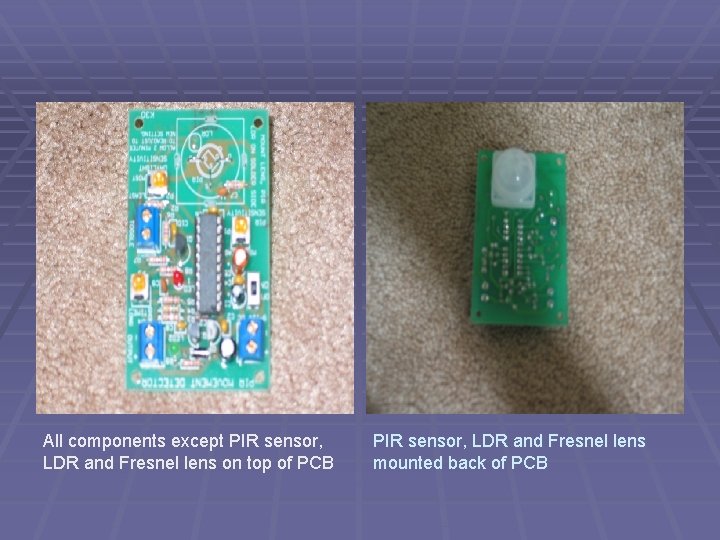
PIR Movement Detector (building and testing) § When building up the system, we used ~2. 5” by 3. 5” PC § § Board. Be aware of the right polarity of capacitors, transistor, LEDs and the PIR sensors. Components especially the controller chip and PIR sensor could damaged easily it placed incorrectly. The PIR sensor, LDR and Fresnel lens are mounted on the copper side of PCB (opposite side of all components) So, the system be easily placed (e. g. in a box) with the lens poking out with the electronics on top of the PCB for easy access.
All components except PIR sensor, LDR and Fresnel lens on top of PCB PIR sensor, LDR and Fresnel lens mounted back of PCB
§ After building the whole circuit, we tested it in the § § § electronics lab. We applied a 9 V transistor battery to Vcc pin of the chip. Connect a voltmeter to the Output pin. When power applied, waited about 30 seconds and wave hand in front of PIR sensor. The LED indicator light, and the Voltmeter from the output jump from zero volts to 9 volts in the screen. When no movement detected, the LED light off and the voltmeter value back to zero.
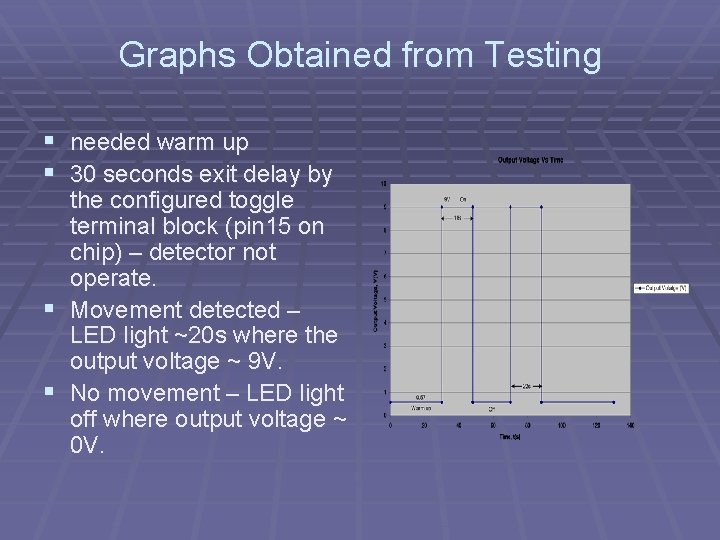
Graphs Obtained from Testing § needed warm up § 30 seconds exit delay by the configured toggle terminal block (pin 15 on chip) – detector not operate. § Movement detected – LED light ~20 s where the output voltage ~ 9 V. § No movement – LED light off where output voltage ~ 0 V.
§ Finally the PIR movement detector ready to be cascade to the Dial Alarm circuit! § Became a Motion Detector Alarm Dialer! Question? ? ?