
EE 4006 B FINAL YEAR PROJECT PRESENTATION HEALTH
EE 4006 B FINAL YEAR PROJECT PRESENTATION “HEALTH OF WHEEL” BACHELOR OF ENGINEERING (HONOURS) IN TRANSPORTATION SYSTEMS ENGINEERING WONG YAT FUNG 14102368 D SUPERVISOR: PROF. LEE KANG KUEN
INTRODUCTION Smart City Ø Understand the condition of the train’s component immediately Ø ↓Unnecessary maintenance activity Railway Wheel Ø Main component in the railway system Ø Conditional level of the railway wheel < Required value Ø Worker could determine the maintenance work
OBJECTIVES 1 • To study different types of monitoring system for the railway wheel 2 • To compare the monitoring systems for the railway wheel 3 • To improve the current monitoring system for the railway wheel

COMMONLY DEFECTS OF RAILWAY WHEEL Wheel Profile Defect • Out of roundness Wheel Tread Defect • Skidded wheel • Crack Wheel Flange Defect • Thickness • Radius • Depth
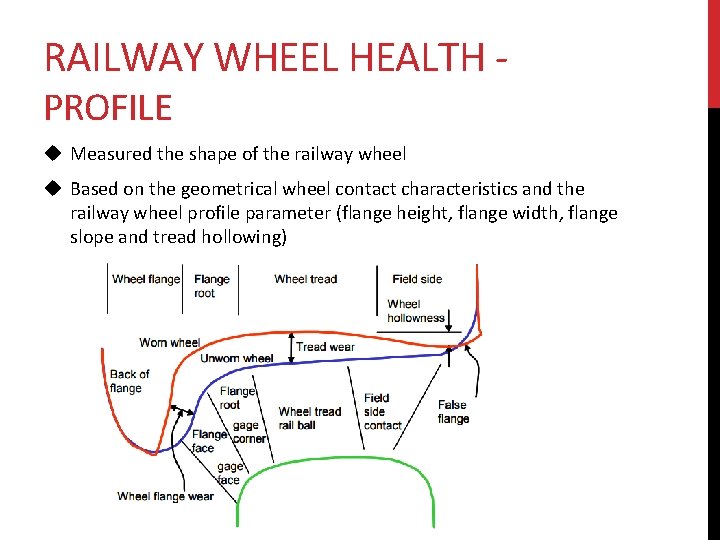
RAILWAY WHEEL HEALTH PROFILE u Measured the shape of the railway wheel u Based on the geometrical wheel contact characteristics and the railway wheel profile parameter (flange height, flange width, flange slope and tread hollowing)
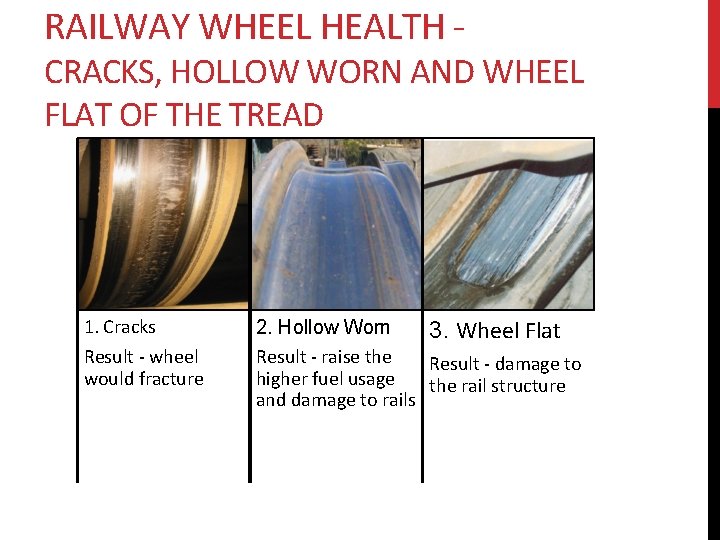
RAILWAY WHEEL HEALTH - CRACKS, HOLLOW WORN AND WHEEL FLAT OF THE TREAD 1. Cracks Result - wheel would fracture 2. Hollow Worn 3. Wheel Flat Result - raise the Result - damage to higher fuel usage the rail structure and damage to rails
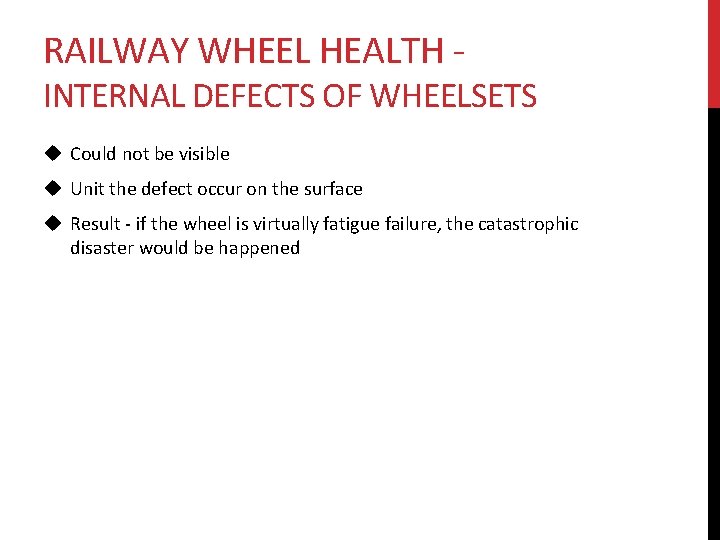
RAILWAY WHEEL HEALTH - INTERNAL DEFECTS OF WHEELSETS u Could not be visible u Unit the defect occur on the surface u Result - if the wheel is virtually fatigue failure, the catastrophic disaster would be happened
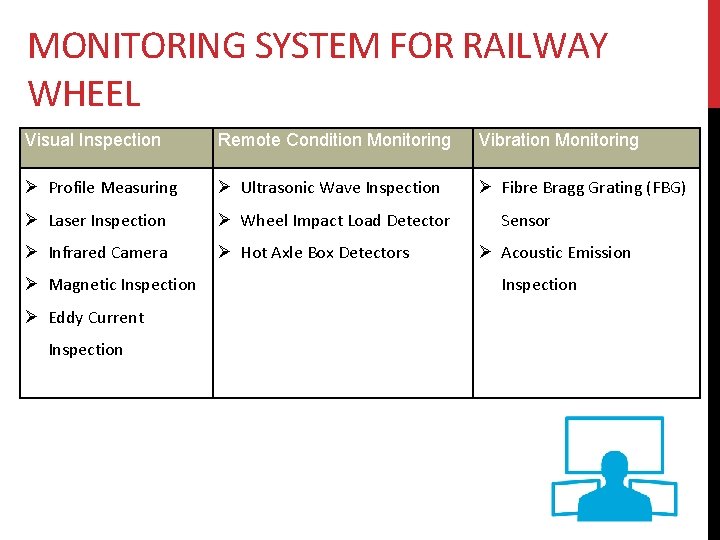
MONITORING SYSTEM FOR RAILWAY WHEEL Visual Inspection Remote Condition Monitoring Vibration Monitoring Ø Profile Measuring Ø Ultrasonic Wave Inspection Ø Fibre Bragg Grating (FBG) Ø Laser Inspection Ø Wheel Impact Load Detector Ø Infrared Camera Ø Hot Axle Box Detectors Ø Magnetic Inspection Ø Eddy Current Inspection Sensor Ø Acoustic Emission Inspection
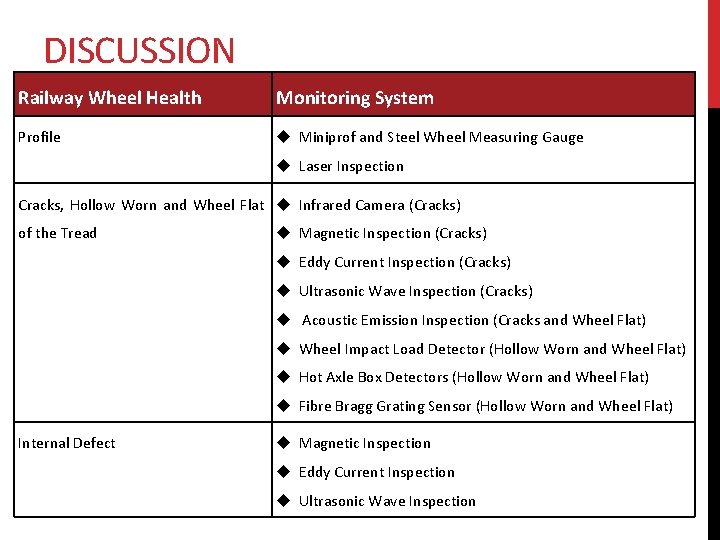
DISCUSSION Railway Wheel Health Monitoring System Profile u Miniprof and Steel Wheel Measuring Gauge u Laser Inspection Cracks, Hollow Worn and Wheel Flat u Infrared Camera (Cracks) of the Tread u Magnetic Inspection (Cracks) u Eddy Current Inspection (Cracks) u Ultrasonic Wave Inspection (Cracks) u Acoustic Emission Inspection (Cracks and Wheel Flat) u Wheel Impact Load Detector (Hollow Worn and Wheel Flat) u Hot Axle Box Detectors (Hollow Worn and Wheel Flat) u Fibre Bragg Grating Sensor (Hollow Worn and Wheel Flat) Internal Defect u Magnetic Inspection u Eddy Current Inspection u Ultrasonic Wave Inspection
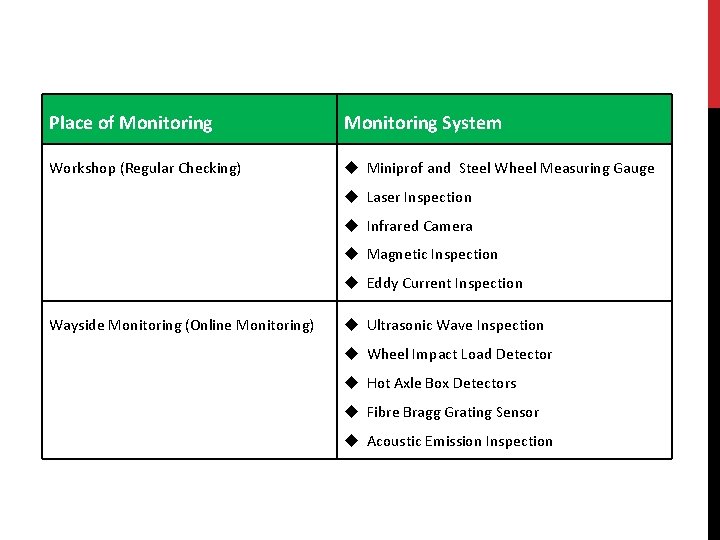
Place of Monitoring System Workshop (Regular Checking) u Miniprof and Steel Wheel Measuring Gauge u Laser Inspection u Infrared Camera u Magnetic Inspection u Eddy Current Inspection Wayside Monitoring (Online Monitoring) u Ultrasonic Wave Inspection u Wheel Impact Load Detector u Hot Axle Box Detectors u Fibre Bragg Grating Sensor u Acoustic Emission Inspection
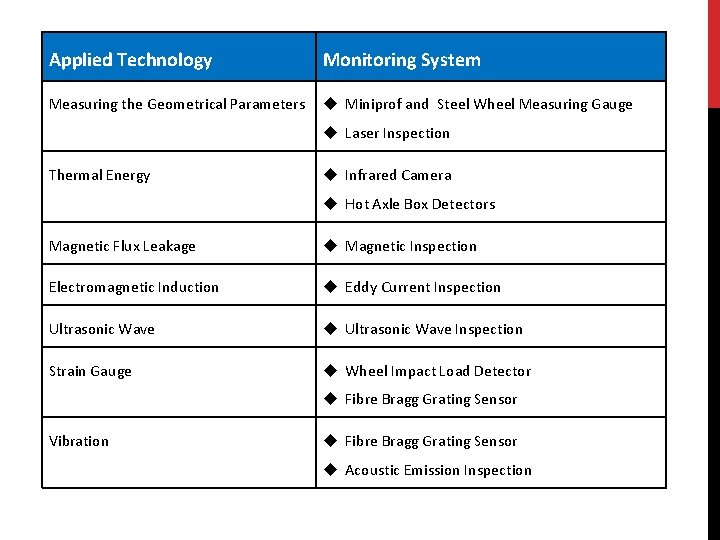
Applied Technology Monitoring System Measuring the Geometrical Parameters u Miniprof and Steel Wheel Measuring Gauge u Laser Inspection Thermal Energy u Infrared Camera u Hot Axle Box Detectors Magnetic Flux Leakage u Magnetic Inspection Electromagnetic Induction u Eddy Current Inspection Ultrasonic Wave u Ultrasonic Wave Inspection Strain Gauge u Wheel Impact Load Detector u Fibre Bragg Grating Sensor Vibration u Fibre Bragg Grating Sensor u Acoustic Emission Inspection
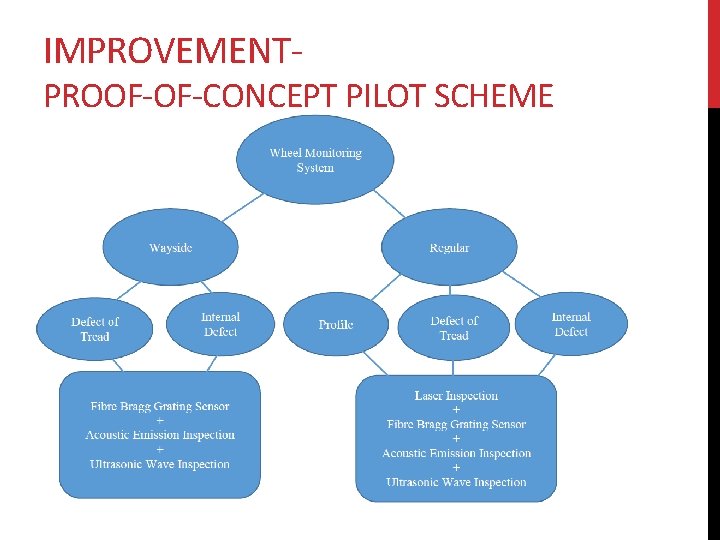
IMPROVEMENT- PROOF-OF-CONCEPT PILOT SCHEME
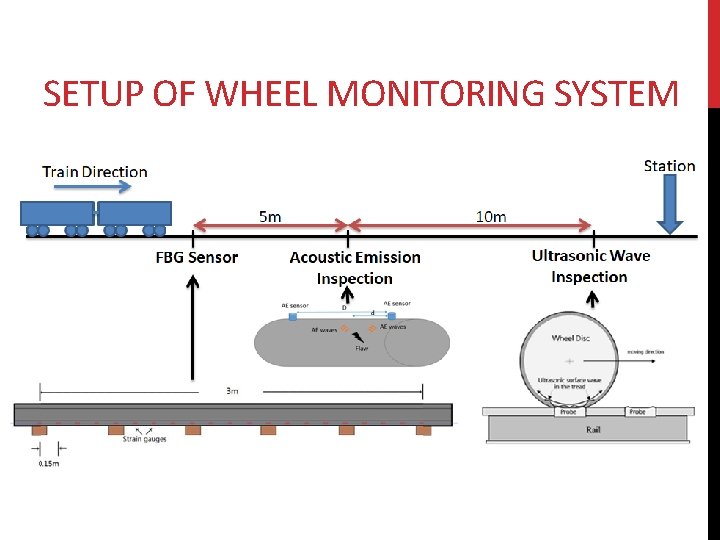
SETUP OF WHEEL MONITORING SYSTEM
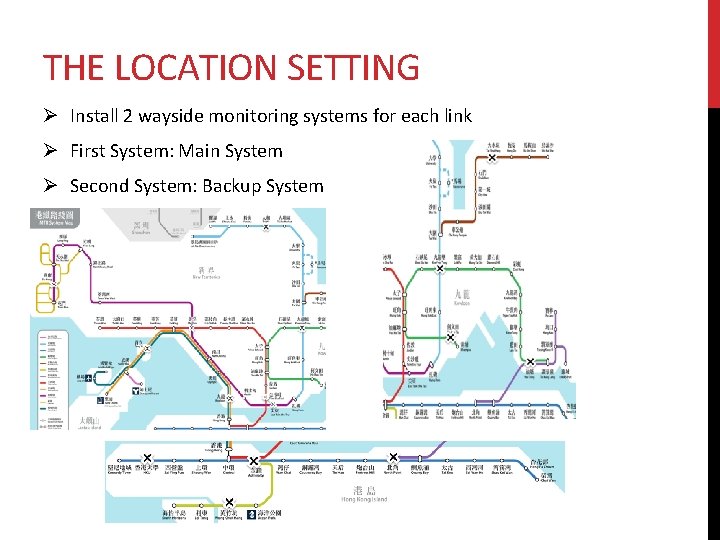
THE LOCATION SETTING Ø Install 2 wayside monitoring systems for each link Ø First System: Main System Ø Second System: Backup System
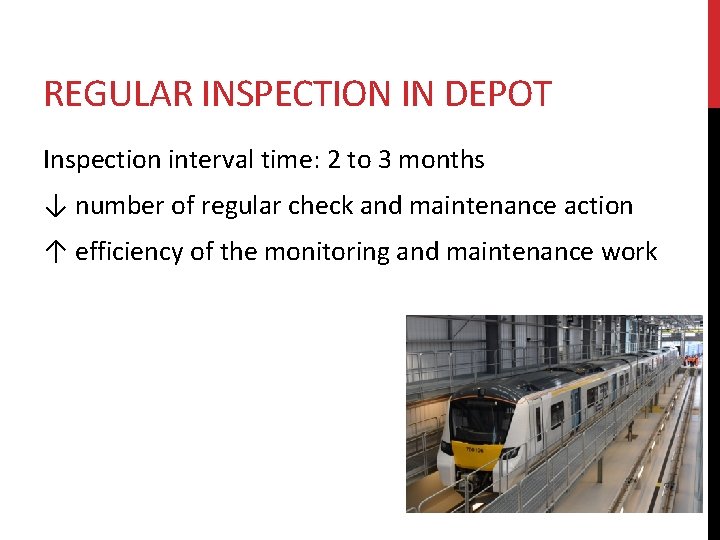
REGULAR INSPECTION IN DEPOT Inspection interval time: 2 to 3 months ↓ number of regular check and maintenance action ↑ efficiency of the monitoring and maintenance work
EVALUATION OF MTR The review report of the MTR rolling stock maintenance expert is as follows: “After reviewing the improvement measures proposed by YF Wong as specified in Chapter 7 and the monitoring systems proposed for future lines as specified in Chapter 8 of the final year project report my comments are as follows: 1. The proposed improvement measures proposed in Chapter 7 will be able to address the issues identified by the final year project but the extent of improvements need further validation through a pilot scheme to be put on a trial basis; and 2. The proposed locations of sensor installation proposed in Chapter 8 for the future new lines of Hong Kong are sensible. Exact locations can only be confirmed after the final alignment of each of the new lines has been designed and confirmed. “. Ø This pilot scheme has high feasibility to try in the future.
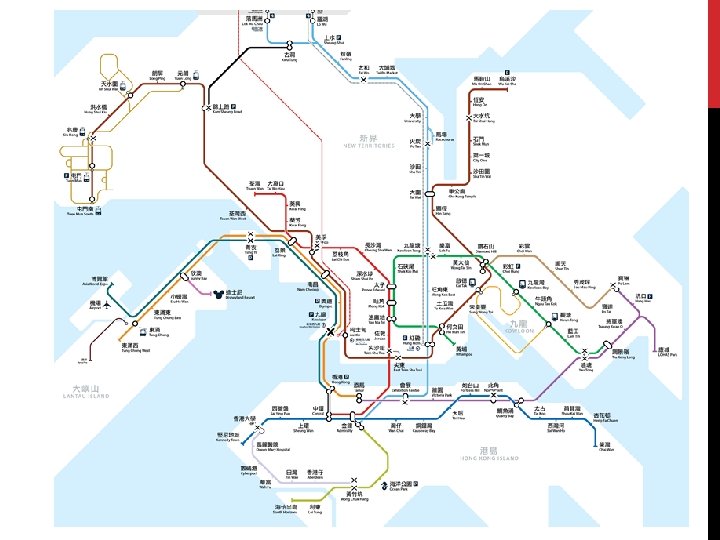
FUTURE DEVELOP 1. The Hong Kong Section of the Express Rail Link 2. Shatin to Central Link 3. South Island Line (West) 4. Northern Link 5. Tuen Mun South Extension 6. Tung Chung West Extension 7. East Kowloon Line 8. North Island Line
CONCLUSION Ø Railway wheel: important asset railway system Ø Smart railway wheel monitoring system: Necessary Ø Commonly defects of railway wheel Ø Health of the railway wheel Ø Different type of railway wheel monitoring systems Ø Improvement Ø Wayside Monitoring System Ø Regular Inspection Ø Future development
- Slides: 19