
EE 359 Wireless Communications Professor Andrea Goldsmith NextGen
- Slides: 48
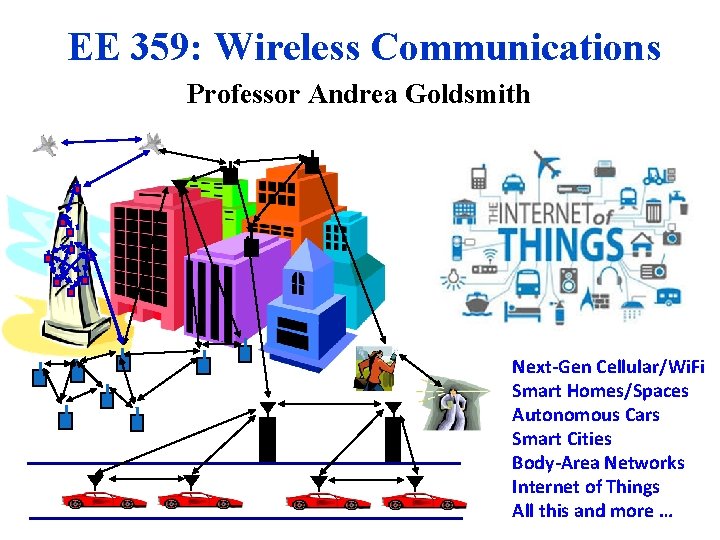
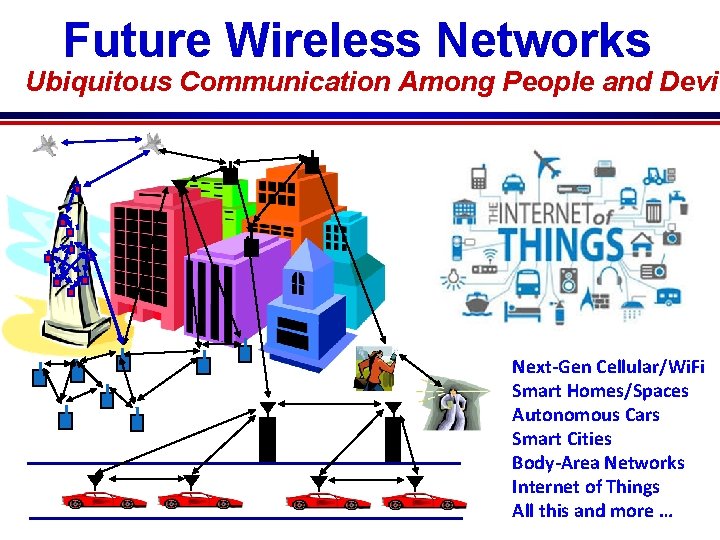
EE 359: Wireless Communications Professor Andrea Goldsmith Next-Gen Cellular/Wi. Fi Smart Homes/Spaces Autonomous Cars Smart Cities Body-Area Networks Internet of Things All this and more …
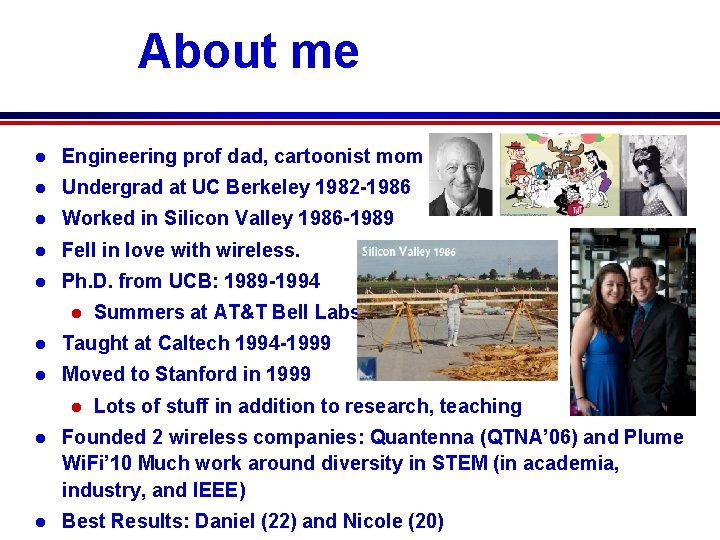
About me l Engineering prof dad, cartoonist mom l Undergrad at UC Berkeley 1982 -1986 l Worked in Silicon Valley 1986 -1989 l Fell in love with wireless. l Ph. D. from UCB: 1989 -1994 l Summers at AT&T Bell Labs l Taught at Caltech 1994 -1999 l Moved to Stanford in 1999 l Lots of stuff in addition to research, teaching l Founded 2 wireless companies: Quantenna (QTNA’ 06) and Plume Wi. Fi’ 10 Much work around diversity in STEM (in academia, industry, and IEEE) l Best Results: Daniel (22) and Nicole (20)
Outline l Course Basics l Course Syllabus l Wireless History l The Wireless Vision l Technical Challenges l Current/Next-Gen Wireless Systems l Spectrum Regulation and Standards l Emerging Wireless Systems (Optional
Course Information People * l Instructor: Andrea Goldsmith, Pack 371, andrea@ee, OHs: TTh immediately after class and by appt. l TA: Tom Dean (trdean@stanford. edu) Discussion section: Wed 4 -5 pm (hopefully taped) l OHs: Wed 5 -6 pm, Th 4 -5 pm, Fri 11 -12 pm (tentative). Emails received during OHs will be responded to during or just after. Email questions are ideally via Piazza. l Piazza: https: //piazza. com/stanford/win 2020/ee 359/home. All are registered, will use to poll on OH/discussion times l l Class Administrator: Dash Corbett, email: *See web or handout for more details
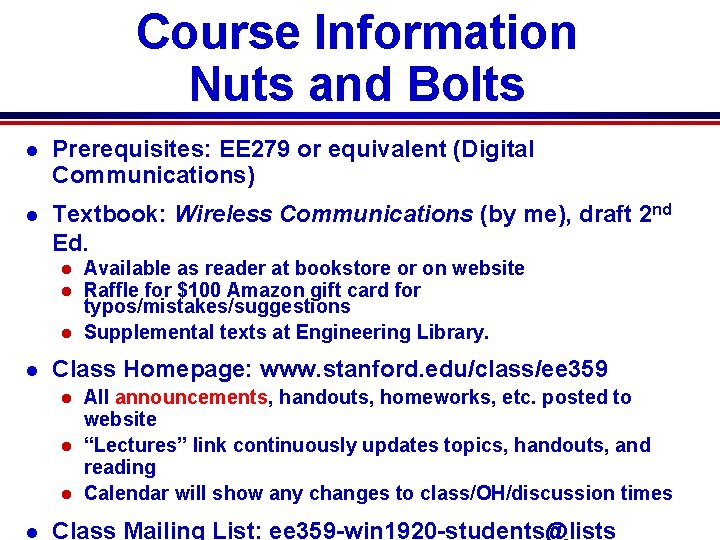
Course Information Nuts and Bolts l Prerequisites: EE 279 or equivalent (Digital Communications) l Textbook: Wireless Communications (by me), draft 2 nd Ed. Available as reader at bookstore or on website Raffle for $100 Amazon gift card for typos/mistakes/suggestions l Supplemental texts at Engineering Library. l l l Class Homepage: www. stanford. edu/class/ee 359 All announcements, handouts, homeworks, etc. posted to website l “Lectures” link continuously updates topics, handouts, and reading l Calendar will show any changes to class/OH/discussion times l l Class Mailing List: ee 359 -win 1920 -students@lists
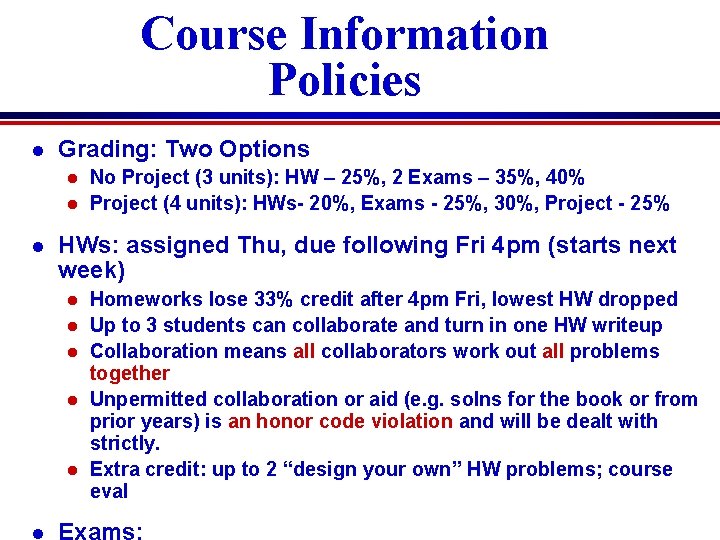
Course Information Policies l Grading: Two Options No Project (3 units): HW – 25%, 2 Exams – 35%, 40% l Project (4 units): HWs- 20%, Exams - 25%, 30%, Project - 25% l l HWs: assigned Thu, due following Fri 4 pm (starts next week) l l l Homeworks lose 33% credit after 4 pm Fri, lowest HW dropped Up to 3 students can collaborate and turn in one HW writeup Collaboration means all collaborators work out all problems together Unpermitted collaboration or aid (e. g. solns for the book or from prior years) is an honor code violation and will be dealt with strictly. Extra credit: up to 2 “design your own” HW problems; course eval
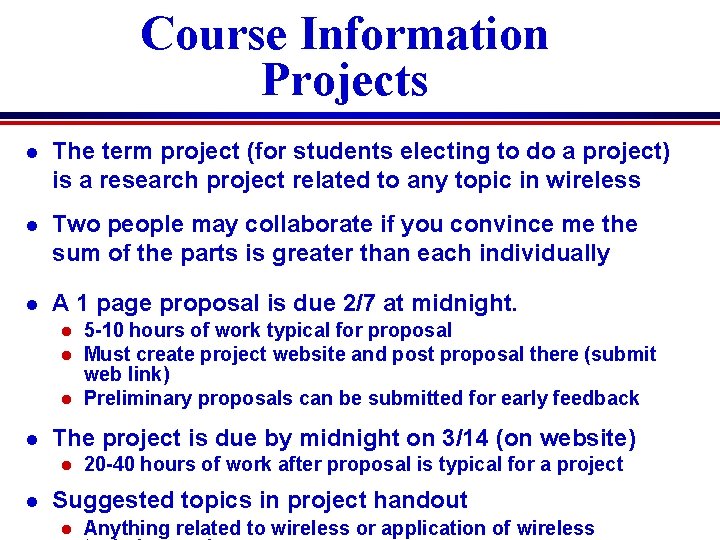
Course Information Projects l The term project (for students electing to do a project) is a research project related to any topic in wireless l Two people may collaborate if you convince me the sum of the parts is greater than each individually l A 1 page proposal is due 2/7 at midnight. 5 -10 hours of work typical for proposal Must create project website and post proposal there (submit web link) l Preliminary proposals can be submitted for early feedback l l l The project is due by midnight on 3/14 (on website) l l 20 -40 hours of work after proposal is typical for a project Suggested topics in project handout l Anything related to wireless or application of wireless
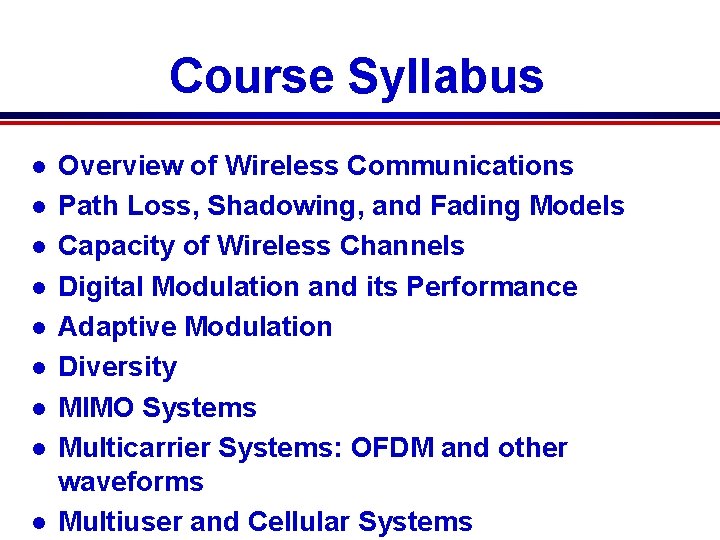
Course Syllabus l l l l l Overview of Wireless Communications Path Loss, Shadowing, and Fading Models Capacity of Wireless Channels Digital Modulation and its Performance Adaptive Modulation Diversity MIMO Systems Multicarrier Systems: OFDM and other waveforms Multiuser and Cellular Systems
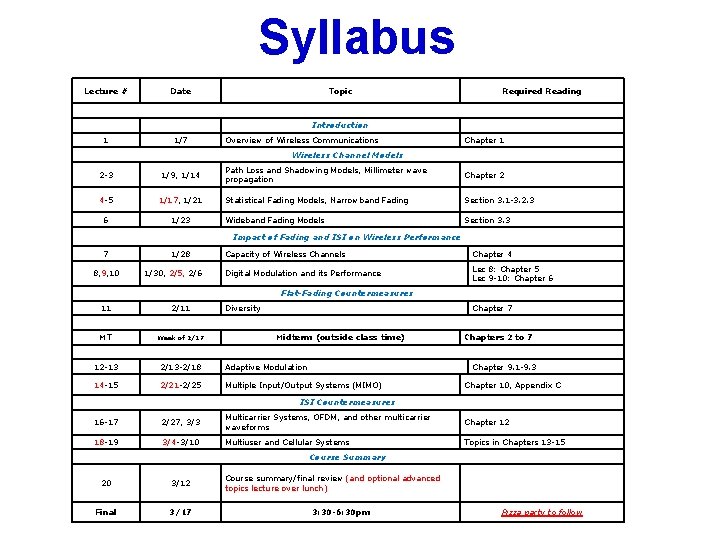
Syllabus Lecture # Date 1 1/7 Topic Required Reading Introduction Overview of Wireless Communications Chapter 1 Wireless Channel Models 2 -3 1/9, 1/14 4 -5 1/17, 1/21 6 1/23 Path Loss and Shadowing Models, Millimeter wave propagation Chapter 2 Statistical Fading Models, Narrowband Fading Section 3. 1 -3. 2. 3 Wideband Fading Models Section 3. 3 Impact of Fading and ISI on Wireless Performance 7 8, 9, 10 1/28 1/30, 2/5, 2/6 Capacity of Wireless Channels Chapter 4 Digital Modulation and its Performance Lec 8: Chapter 5 Lec 9 -10: Chapter 6 Flat-Fading Countermeasures 11 2/11 Diversity Chapter 7 MT Week of 2/17 12 -13 2/13 -2/18 Adaptive Modulation 14 -15 2/21 -2/25 Multiple Input/Output Systems (MIMO) Midterm (outside class time) Chapters 2 to 7 Chapter 9. 1 -9. 3 Chapter 10, Appendix C ISI Countermeasures 16 -17 2/27, 3/3 Multicarrier Systems, OFDM, and other multicarrier waveforms Chapter 12 18 -19 3/4 -3/10 Multiuser and Cellular Systems Topics in Chapters 13 -15 Course Summary 20 3/12 Final 3/17 Course summary/final review (and optional advanced topics lecture over lunch) 3: 30 -6: 30 pm Pizza party to follow
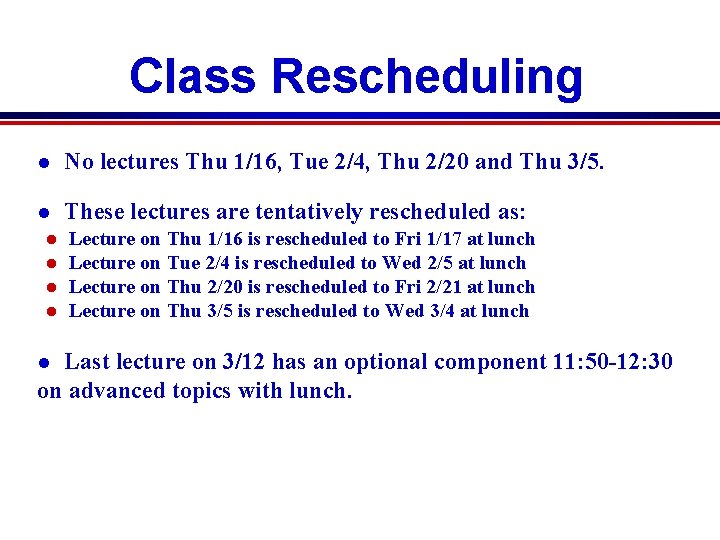
Class Rescheduling l No lectures Thu 1/16, Tue 2/4, Thu 2/20 and Thu 3/5. l These lectures are tentatively rescheduled as: l l Lecture on Thu 1/16 is rescheduled to Fri 1/17 at lunch Lecture on Tue 2/4 is rescheduled to Wed 2/5 at lunch Lecture on Thu 2/20 is rescheduled to Fri 2/21 at lunch Lecture on Thu 3/5 is rescheduled to Wed 3/4 at lunch Last lecture on 3/12 has an optional component 11: 50 -12: 30 on advanced topics with lunch. l
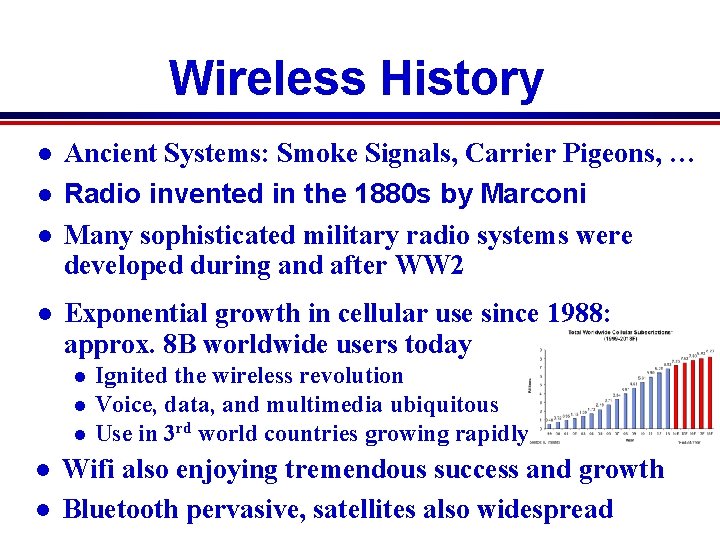
Wireless History l l Ancient Systems: Smoke Signals, Carrier Pigeons, … Radio invented in the 1880 s by Marconi Many sophisticated military radio systems were developed during and after WW 2 Exponential growth in cellular use since 1988: approx. 8 B worldwide users today l l l Ignited the wireless revolution Voice, data, and multimedia ubiquitous Use in 3 rd world countries growing rapidly Wifi also enjoying tremendous success and growth Bluetooth pervasive, satellites also widespread
Future Wireless Networks Ubiquitous Communication Among People and Devic Next-Gen Cellular/Wi. Fi Smart Homes/Spaces Autonomous Cars Smart Cities Body-Area Networks Internet of Things All this and more …
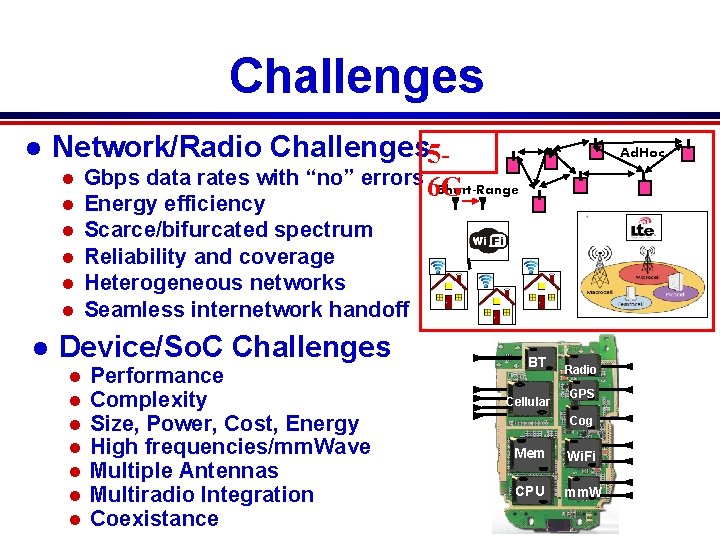
Challenges l Network/Radio Challenges 5 l l l l Gbps data rates with “no” errors Short-Range 6 G Energy efficiency Scarce/bifurcated spectrum Reliability and coverage Heterogeneous networks Seamless internetwork handoff Device/So. C Challenges l l l l Ad. Hoc Performance Complexity Size, Power, Cost, Energy High frequencies/mm. Wave Multiple Antennas Multiradio Integration Coexistance BT Cellular Radio GPS Cog Mem Wi. Fi CPU mm. W
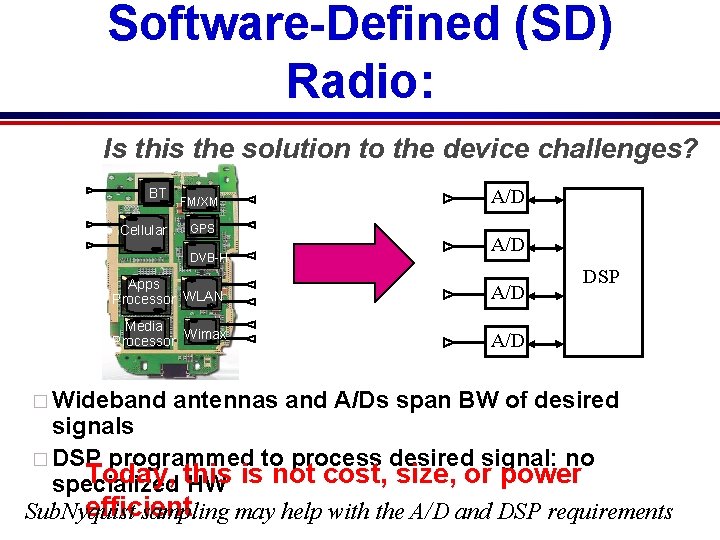
Software-Defined (SD) Radio: Is this the solution to the device challenges? BT Cellular FM/XM GPS DVB-H A/D Apps Processor WLAN A/D Media Processor Wimax A/D � Wideband DSP antennas and A/Ds span BW of desired signals � DSP programmed to process desired signal: no Today, this specialized HW is not cost, size, or power efficient Sub. Nyquist sampling may help with the A/D and DSP requirements
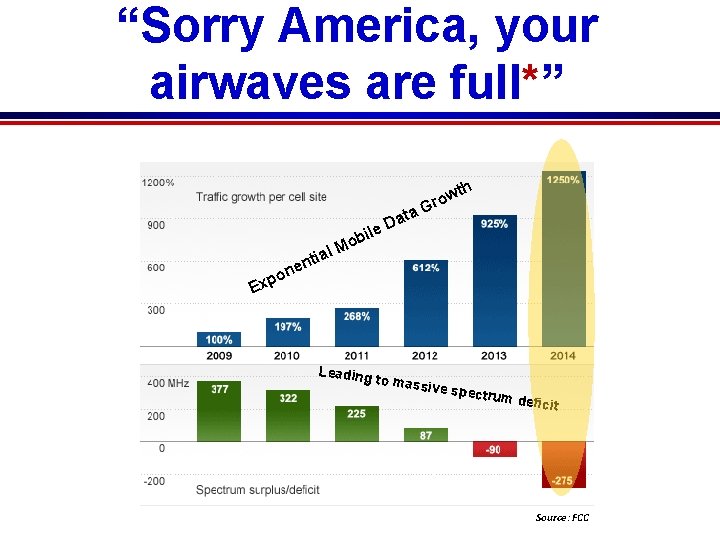
“Sorry America, your airwaves are full*” ta a le D al ti n e n xpo th w o Gr bi o M E Leading to mass ive spec trum de ficit Source: FCC
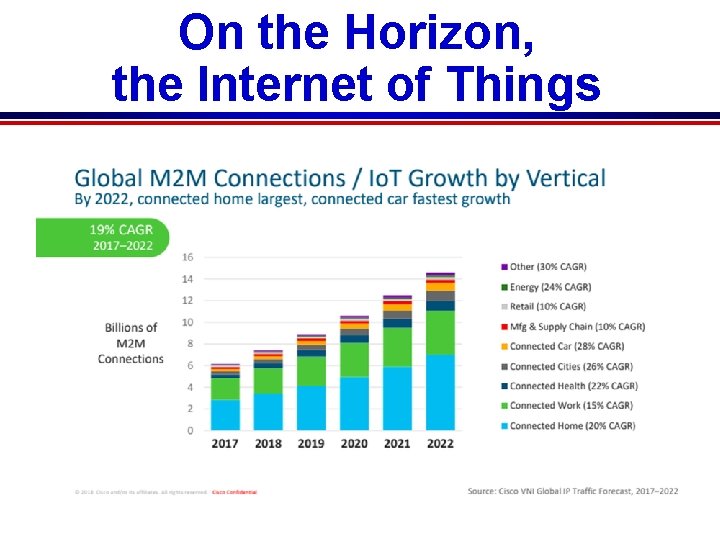
On the Horizon, the Internet of Things
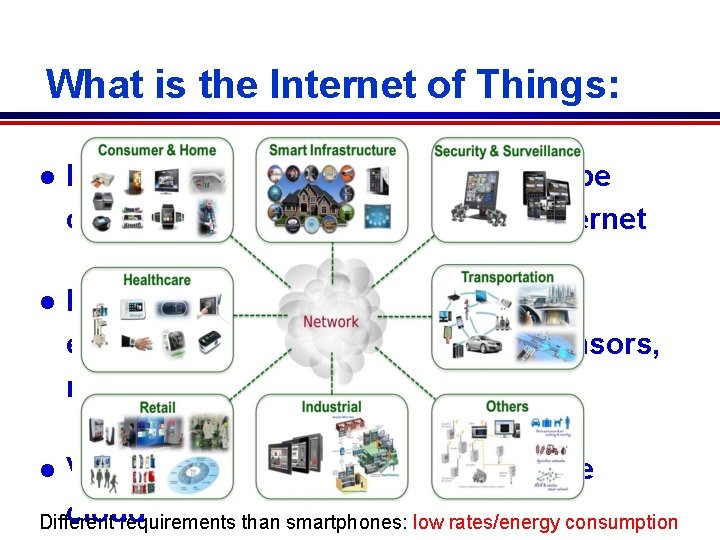
What is the Internet of Things: l Enabling every electronic device to be connected to each other and the Internet l Includes smartphones, consumer electronics, cars, lights, clothes, sensors, medical devices, … Value in Io. T is data processing in the cloud Different requirements than smartphones: low rates/energy consumption l
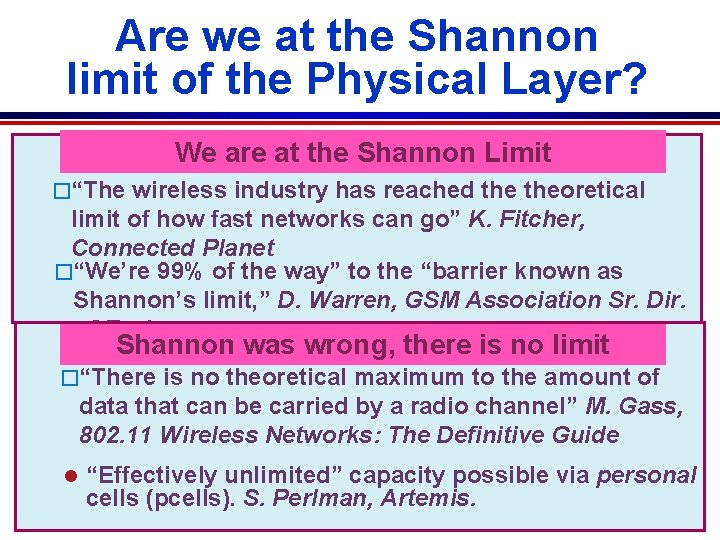
Are we at the Shannon limit of the Physical Layer? We are at the Shannon Limit �“The wireless industry has reached theoretical limit of how fast networks can go” K. Fitcher, Connected Planet �“We’re 99% of the way” to the “barrier known as Shannon’s limit, ” D. Warren, GSM Association Sr. Dir. of Tech. Shannon was wrong, there is no limit �“There is no theoretical maximum to the amount of data that can be carried by a radio channel” M. Gass, 802. 11 Wireless Networks: The Definitive Guide l “Effectively unlimited” capacity possible via personal cells (pcells). S. Perlman, Artemis.
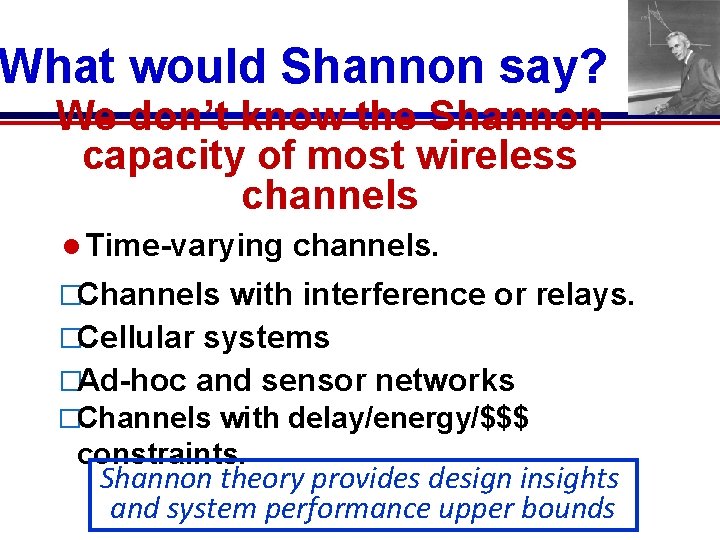
What would Shannon say? We don’t know the Shannon capacity of most wireless channels l Time-varying channels. �Channels with interference or relays. �Cellular systems �Ad-hoc and sensor networks �Channels with delay/energy/$$$ constraints. Shannon theory provides design insights and system performance upper bounds
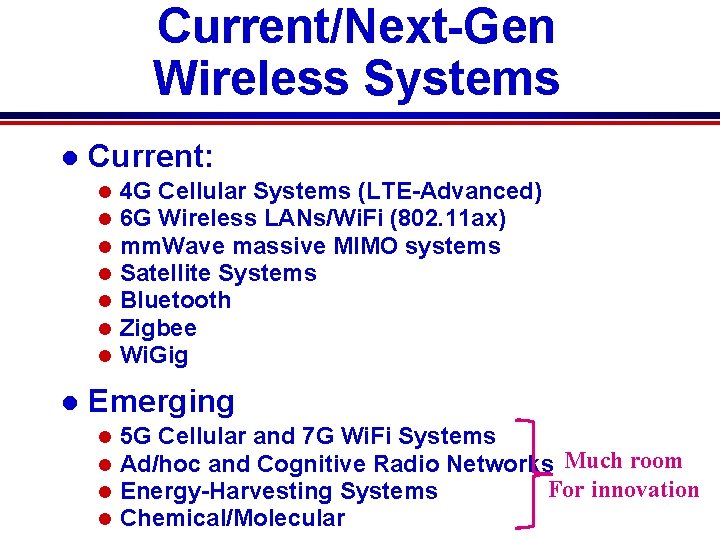
Current/Next-Gen Wireless Systems l Current: l l l l 4 G Cellular Systems (LTE-Advanced) 6 G Wireless LANs/Wi. Fi (802. 11 ax) mm. Wave massive MIMO systems Satellite Systems Bluetooth Zigbee Wi. Gig Emerging l l 5 G Cellular and 7 G Wi. Fi Systems Ad/hoc and Cognitive Radio Networks Much room For innovation Energy-Harvesting Systems Chemical/Molecular
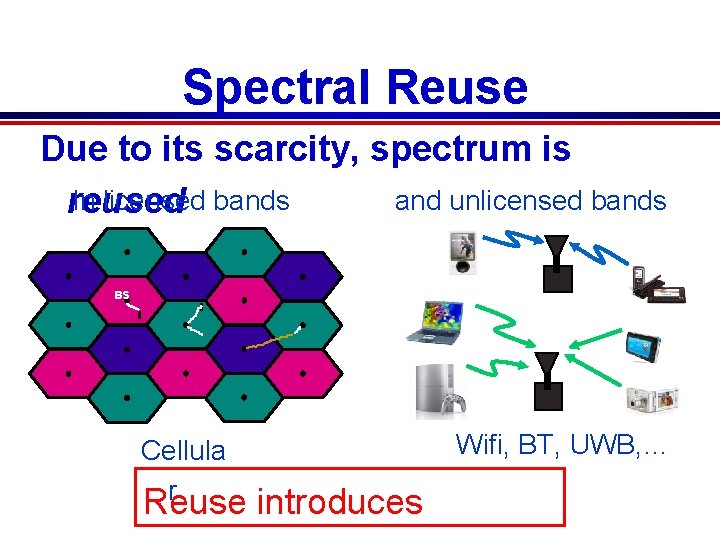
Spectral Reuse Due to its scarcity, spectrum is In licensed bands and unlicensed bands reused BS Cellula r Reuse introduces Wifi, BT, UWB, …
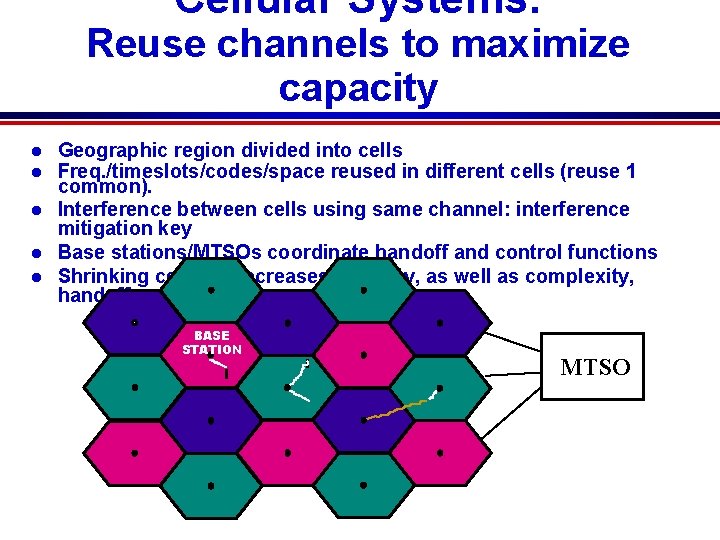
Cellular Systems: Reuse channels to maximize capacity l l l Geographic region divided into cells Freq. /timeslots/codes/space reused in different cells (reuse 1 common). Interference between cells using same channel: interference mitigation key Base stations/MTSOs coordinate handoff and control functions Shrinking cell size increases capacity, as well as complexity, handoff, … BASE STATION MTSO
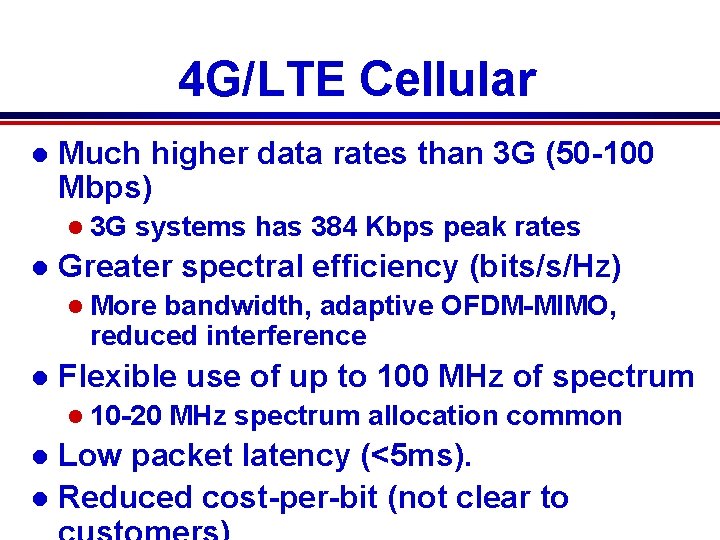
4 G/LTE Cellular l Much higher data rates than 3 G (50 -100 Mbps) l 3 G l systems has 384 Kbps peak rates Greater spectral efficiency (bits/s/Hz) l More bandwidth, adaptive OFDM-MIMO, reduced interference l Flexible use of up to 100 MHz of spectrum l 10 -20 MHz spectrum allocation common Low packet latency (<5 ms). l Reduced cost-per-bit (not clear to l
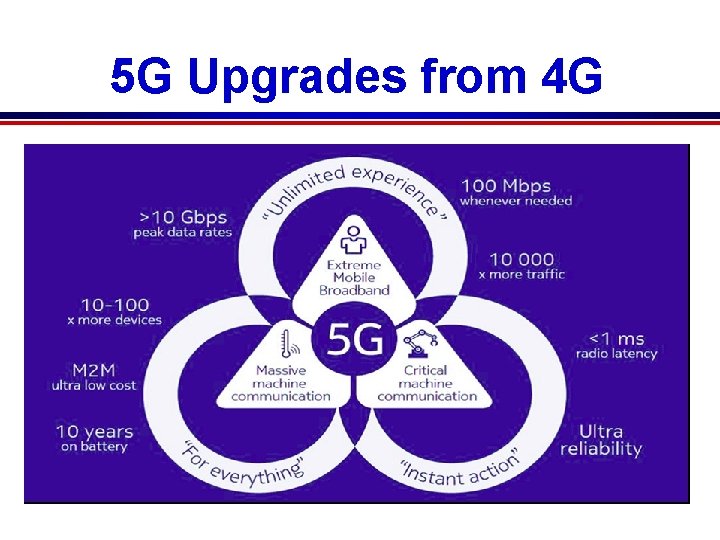
5 G Upgrades from 4 G
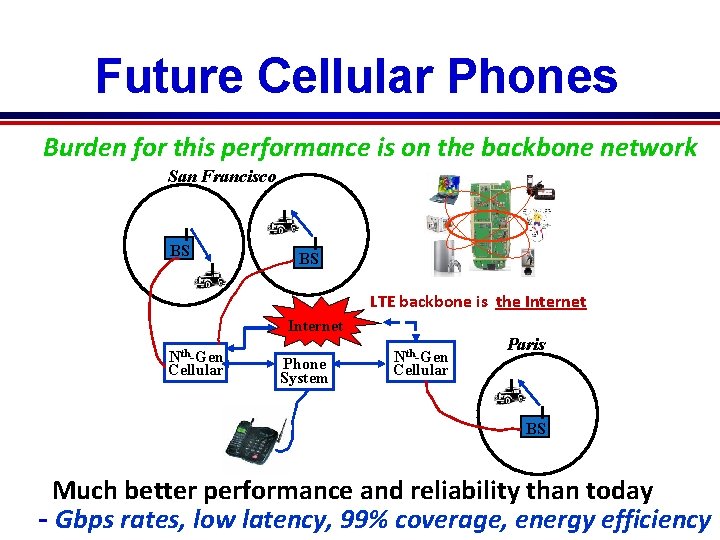
Future Cellular Phones Burden for this performance is on the backbone network Everything wireless in one device San Francisco BS BS LTE backbone is the Internet Nth-Gen Cellular Phone System Nth-Gen Cellular Paris BS Much better performance and reliability than today - Gbps rates, low latency, 99% coverage, energy efficiency
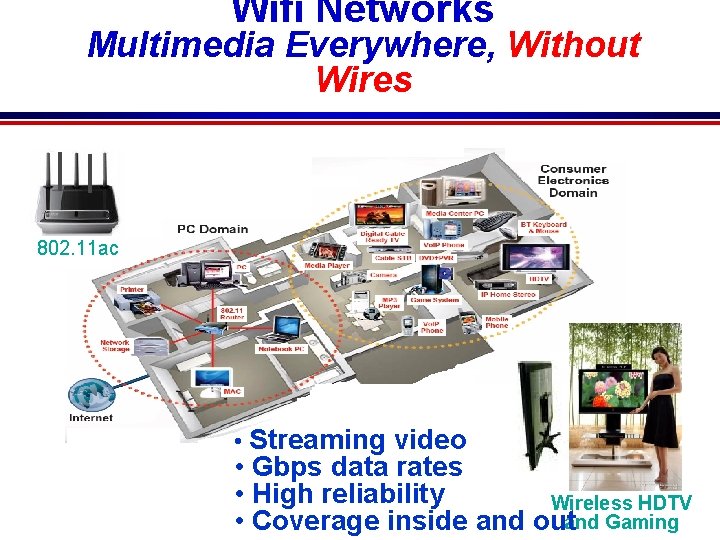
Wifi Networks Multimedia Everywhere, Without Wires 802. 11 ac • Streaming video • Gbps data rates • High reliability Wireless HDTV • Coverage inside and outand Gaming
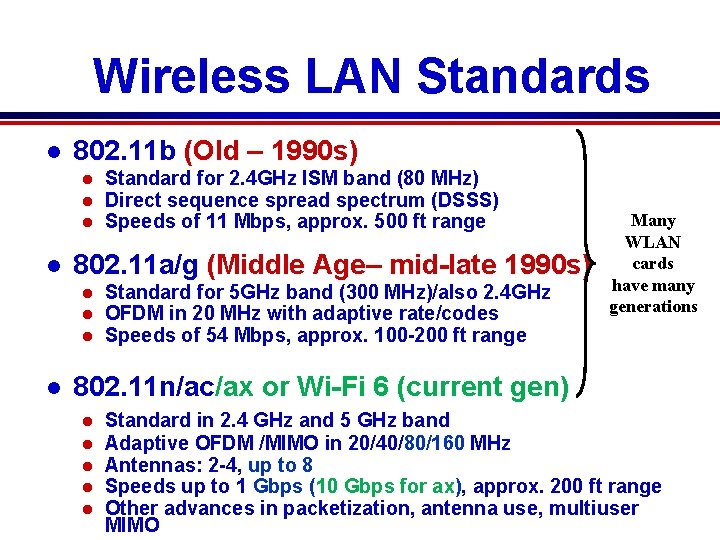
Wireless LAN Standards l 802. 11 b (Old – 1990 s) l l 802. 11 a/g (Middle Age– mid-late 1990 s) l l Standard for 2. 4 GHz ISM band (80 MHz) Direct sequence spread spectrum (DSSS) Speeds of 11 Mbps, approx. 500 ft range Standard for 5 GHz band (300 MHz)/also 2. 4 GHz OFDM in 20 MHz with adaptive rate/codes Speeds of 54 Mbps, approx. 100 -200 ft range Many WLAN cards have many generations 802. 11 n/ac/ax or Wi-Fi 6 (current gen) l l l Standard in 2. 4 GHz and 5 GHz band Adaptive OFDM /MIMO in 20/40/80/160 MHz Antennas: 2 -4, up to 8 Speeds up to 1 Gbps (10 Gbps for ax), approx. 200 ft range Other advances in packetization, antenna use, multiuser MIMO
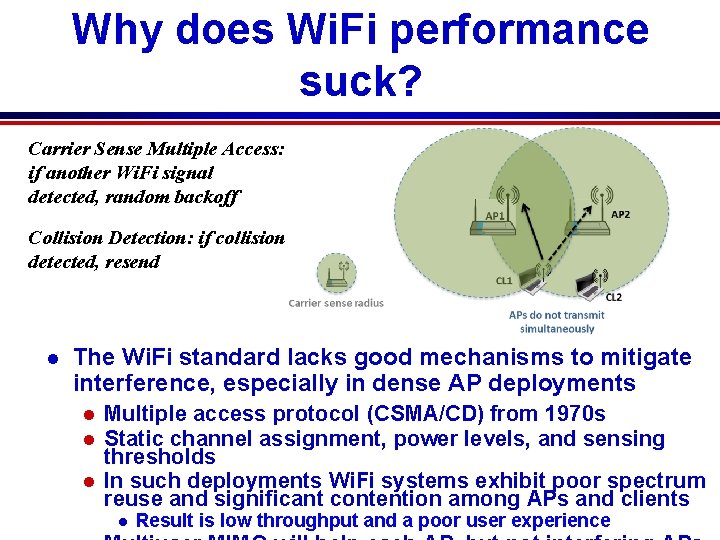
Why does Wi. Fi performance suck? Carrier Sense Multiple Access: if another Wi. Fi signal detected, random backoff Collision Detection: if collision detected, resend l The Wi. Fi standard lacks good mechanisms to mitigate interference, especially in dense AP deployments Multiple access protocol (CSMA/CD) from 1970 s Static channel assignment, power levels, and sensing thresholds l In such deployments Wi. Fi systems exhibit poor spectrum reuse and significant contention among APs and clients l l l Result is low throughput and a poor user experience
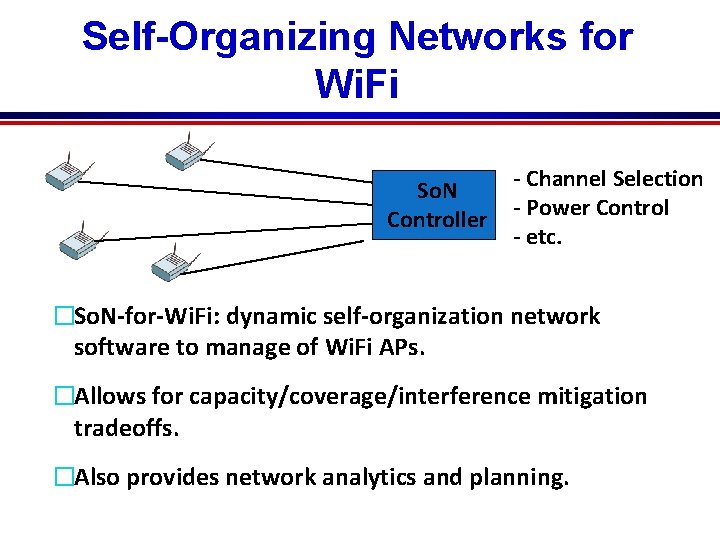
Self-Organizing Networks for Wi. Fi So. N Controller - Channel Selection - Power Control - etc. �So. N-for-Wi. Fi: dynamic self-organization network software to manage of Wi. Fi APs. �Allows for capacity/coverage/interference mitigation tradeoffs. �Also provides network analytics and planning.
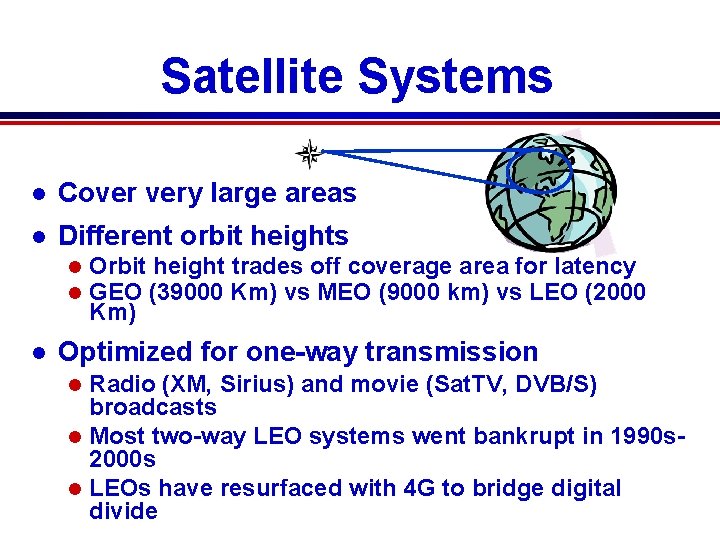
Satellite Systems l Cover very large areas l Different orbit heights l l l Orbit height trades off coverage area for latency GEO (39000 Km) vs MEO (9000 km) vs LEO (2000 Km) Optimized for one-way transmission Radio (XM, Sirius) and movie (Sat. TV, DVB/S) broadcasts l Most two-way LEO systems went bankrupt in 1990 s 2000 s l LEOs have resurfaced with 4 G to bridge digital divide l
Bluetooth l Cable replacement RF technology (low cost) l Short range (10 m, extendable to 100 m) l 2. 4 GHz band (crowded) l 1 Data (700 Kbps) and 3 voice channels, up to 3 Mbps l Widely supported by telecommunications, PC, and 8 C 32810. 61 -Cimini-7/98
IEEE 802. 15. 4/Zig. Bee Radios l Low-rate low-power low-cost secure radio l l l l Complementary to Wi. Fi and Bluetooth Frequency bands: 784, 868, 915 MHz, 2. 4 GHz Data rates: 20 Kbps, 40 Kbps, 250 Kbps Range: 10 -100 m line-of-sight Support for large mesh networking or star clusters Support for low latency devices CSMA-CA channel access
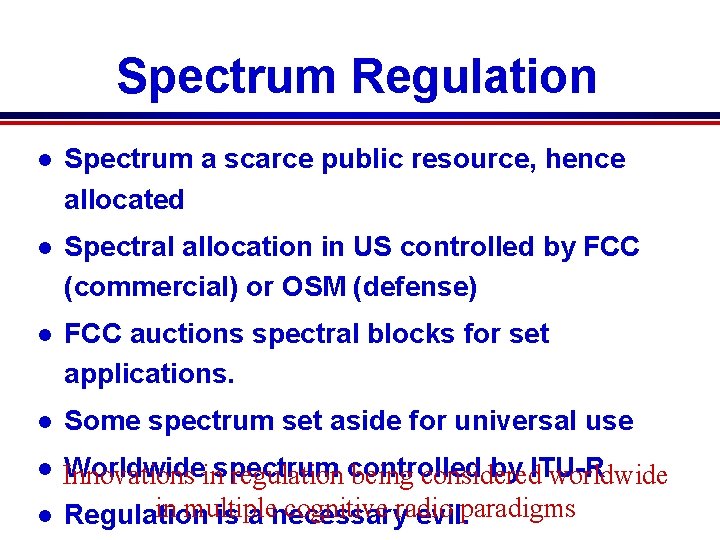
Spectrum Regulation l Spectrum a scarce public resource, hence allocated l Spectral allocation in US controlled by FCC (commercial) or OSM (defense) l FCC auctions spectral blocks for set applications. l Some spectrum set aside for universal use l Worldwideinspectrum by ITU-R Innovations regulation controlled being considered worldwide in multiple cognitive radio Regulation is a necessary evil. paradigms l
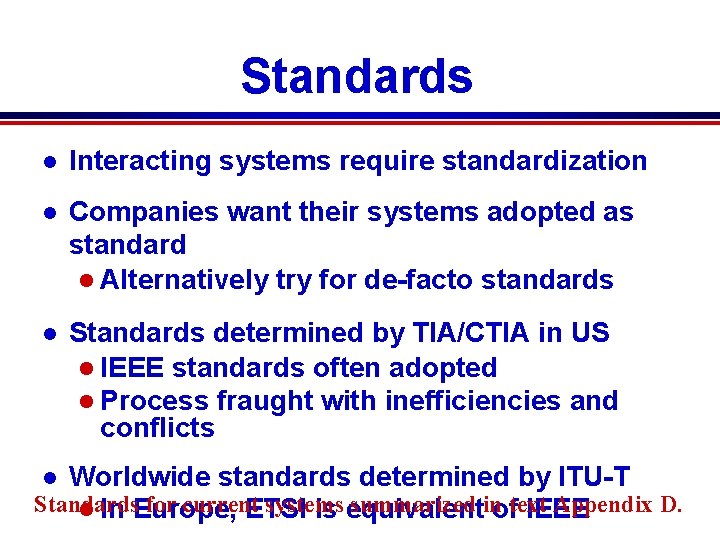
Standards l Interacting systems require standardization l Companies want their systems adopted as standard l Alternatively try for de-facto standards l Standards determined by TIA/CTIA in US l IEEE standards often adopted l Process fraught with inefficiencies and conflicts Worldwide standards determined by ITU-T Standards for current systems summarized inoftext Appendix D. l In Europe, ETSI is equivalent IEEE l
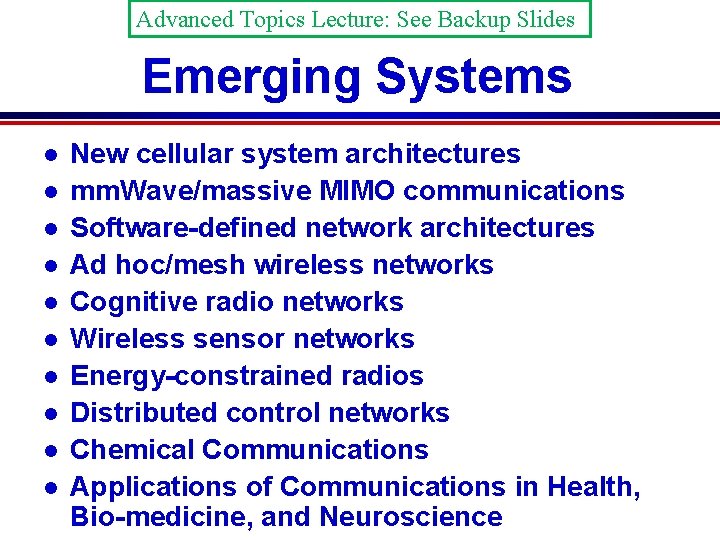
Advanced Topics Lecture: See Backup Slides Emerging Systems l l l l l New cellular system architectures mm. Wave/massive MIMO communications Software-defined network architectures Ad hoc/mesh wireless networks Cognitive radio networks Wireless sensor networks Energy-constrained radios Distributed control networks Chemical Communications Applications of Communications in Health, Bio-medicine, and Neuroscience
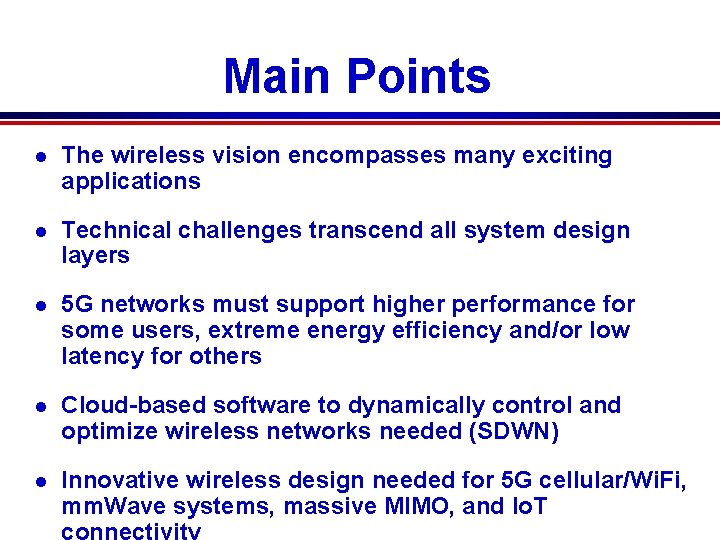
Main Points l The wireless vision encompasses many exciting applications l Technical challenges transcend all system design layers l 5 G networks must support higher performance for some users, extreme energy efficiency and/or low latency for others l Cloud-based software to dynamically control and optimize wireless networks needed (SDWN) l Innovative wireless design needed for 5 G cellular/Wi. Fi, mm. Wave systems, massive MIMO, and Io. T connectivity
Backup Slides: Emerging Systems
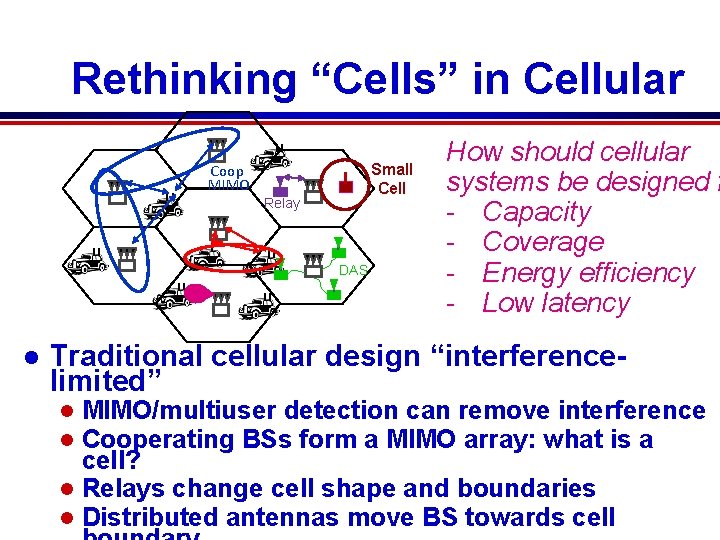
Rethinking “Cells” in Cellular Coop MIMO Small Cell Relay DAS l How should cellular systems be designed f - Capacity - Coverage - Energy efficiency - Low latency Traditional cellular design “interferencelimited” MIMO/multiuser detection can remove interference Cooperating BSs form a MIMO array: what is a cell? l Relays change cell shape and boundaries l Distributed antennas move BS towards cell l l
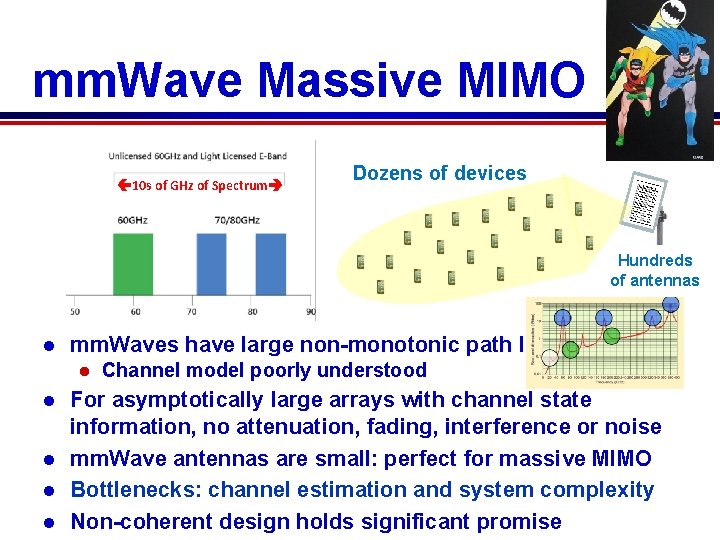
mm. Wave Massive MIMO 10 s of GHz of Spectrum Dozens of devices Hundreds of antennas l mm. Waves have large non-monotonic path loss l l l Channel model poorly understood For asymptotically large arrays with channel state information, no attenuation, fading, interference or noise mm. Wave antennas are small: perfect for massive MIMO Bottlenecks: channel estimation and system complexity Non-coherent design holds significant promise
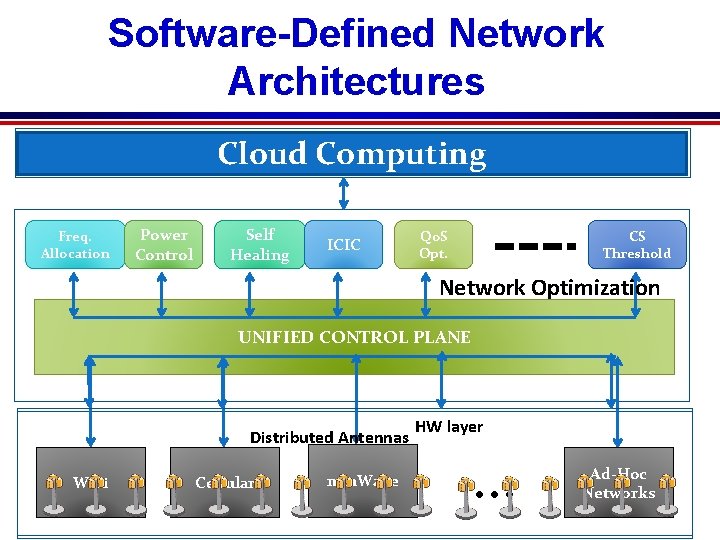
Software-Defined Network Architectures Video Freq. Allocation App layer M 2 M Cloud Computing Vehicular Networks Security Power Control Self Healing ICIC Qo. S Opt. Health CS Threshold Network Optimization UNIFIED CONTROL PLANE Distributed Antennas Wi. Fi Cellular mm. Wave HW layer … Ad-Hoc Networks
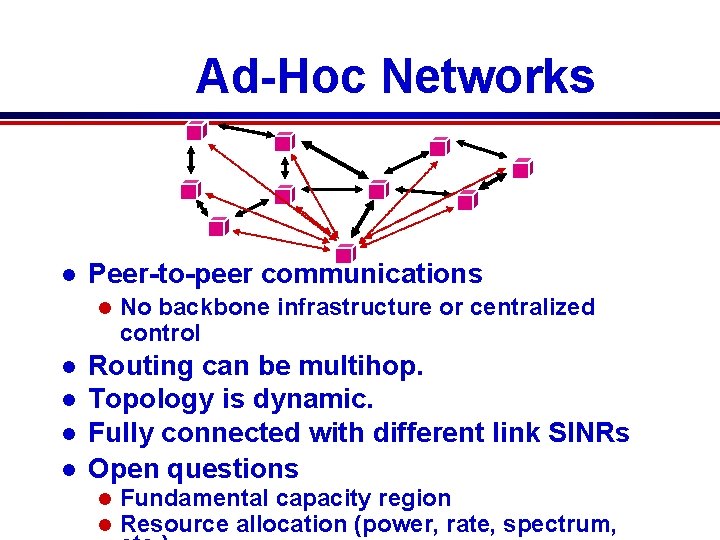
Ad-Hoc Networks l Peer-to-peer communications l l l No backbone infrastructure or centralized control Routing can be multihop. Topology is dynamic. Fully connected with different link SINRs Open questions l l Fundamental capacity region Resource allocation (power, rate, spectrum,
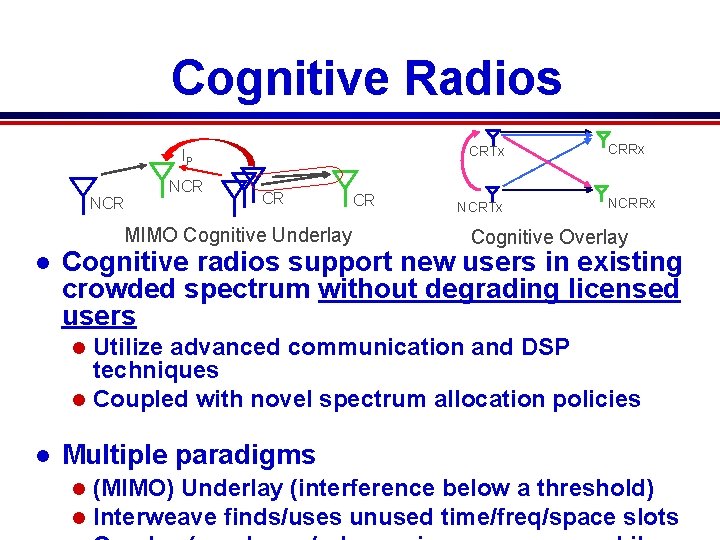
Cognitive Radios CRTx IP NCR CR MIMO Cognitive Underlay l CR NCRTx CRRx NCRRx Cognitive Overlay Cognitive radios support new users in existing crowded spectrum without degrading licensed users Utilize advanced communication and DSP techniques l Coupled with novel spectrum allocation policies l l Multiple paradigms l l (MIMO) Underlay (interference below a threshold) Interweave finds/uses unused time/freq/space slots
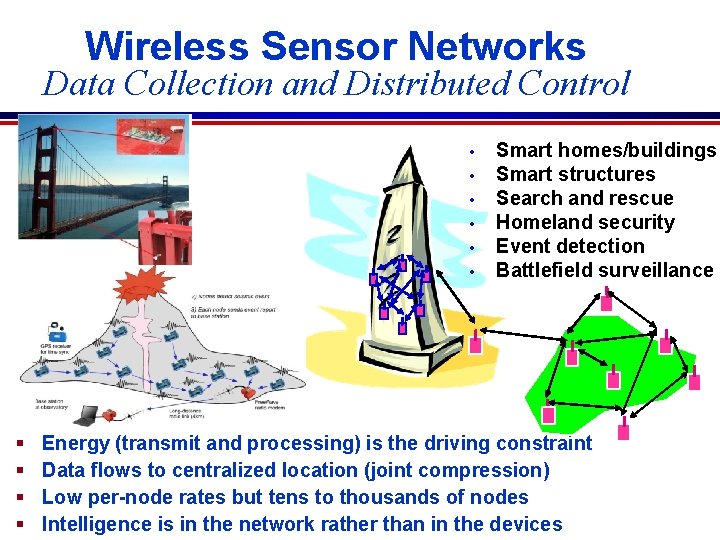
Wireless Sensor Networks Data Collection and Distributed Control • • • § § Smart homes/buildings Smart structures Search and rescue Homeland security Event detection Battlefield surveillance Energy (transmit and processing) is the driving constraint Data flows to centralized location (joint compression) Low per-node rates but tens to thousands of nodes Intelligence is in the network rather than in the devices
Energy-Constrained Radios l Transmit energy minimized by sending bits slowly l l Leads to increased circuit energy consumption Short-range networks must consider both transmit and processing/circuit energy. l l l Sophisticated encoding/decoding not always energy -efficient. MIMO techniques not necessarily energy-efficient Long transmission times not necessarily optimal Multihop routing not necessarily optimal Sub-Nyquist sampling can decrease energy and is sometimes optimal!
Where should energy come from? • Batteries and traditional charging mechanisms • • Wireless-power transfer • • Well-understood devices and systems Poorly understood, especially at large distances and with high efficiency Communication with Energy Harvesting Radios • • Intermittent and random energy arrivals Communication becomes energy-dependent
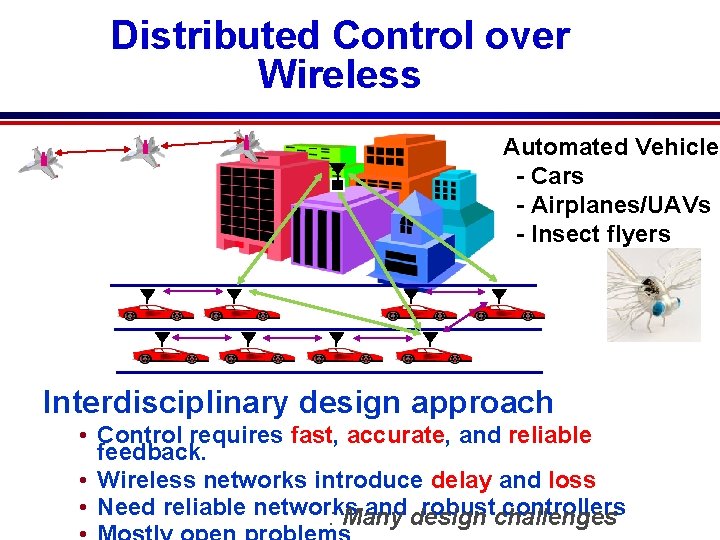
Distributed Control over Wireless Automated Vehicles - Cars - Airplanes/UAVs - Insect flyers Interdisciplinary design approach • Control requires fast, accurate, and reliable feedback. • Wireless networks introduce delay and loss • Need reliable networks and design robustchallenges controllers : Many
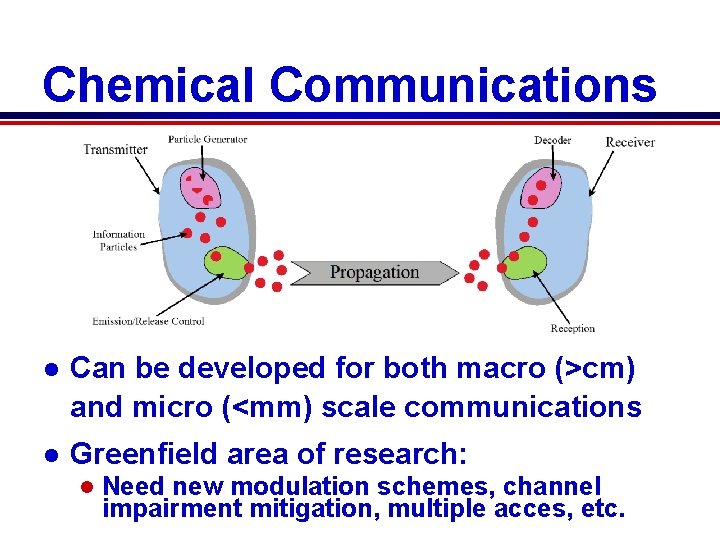
Chemical Communications l Can be developed for both macro (>cm) and micro (<mm) scale communications l Greenfield area of research: l Need new modulation schemes, channel impairment mitigation, multiple acces, etc.
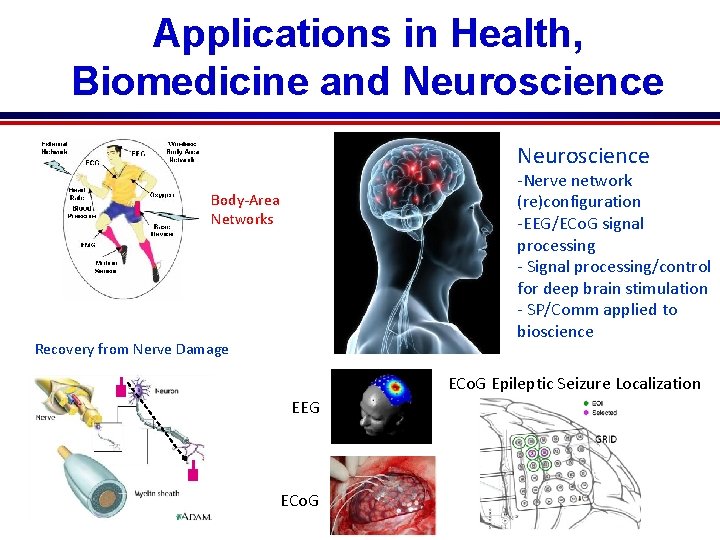
Applications in Health, Biomedicine and Neuroscience -Nerve network (re)configuration -EEG/ECo. G signal processing - Signal processing/control for deep brain stimulation - SP/Comm applied to bioscience Body-Area Networks Recovery from Nerve Damage ECo. G Epileptic Seizure Localization EEG ECo. G