
EDWIN MUIR Aspects of the Scottish Renaissance I






- Slides: 32
EDWIN MUIR Aspects of the Scottish Renaissance I
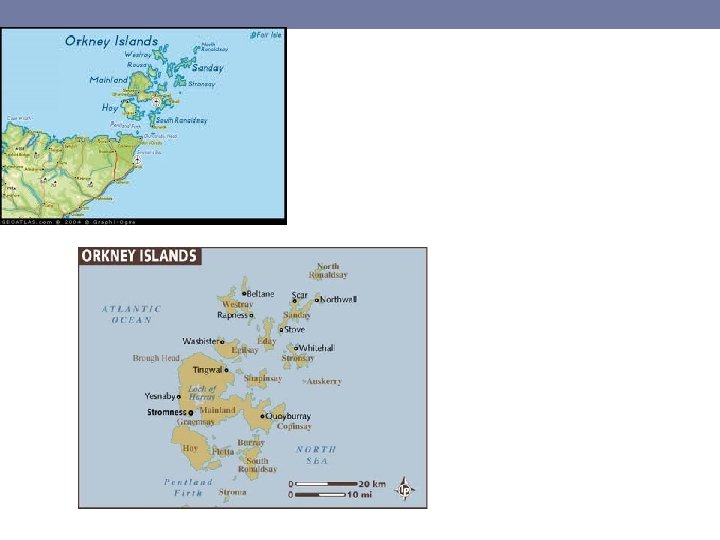
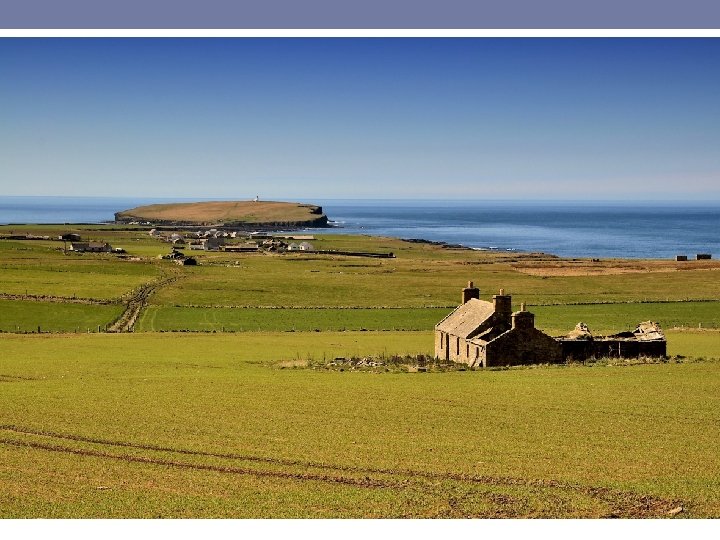
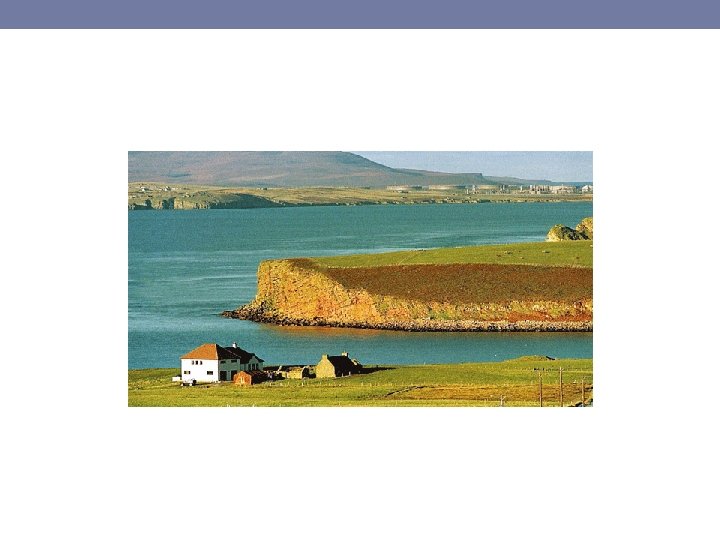
THE ORKNEY ISLANDS
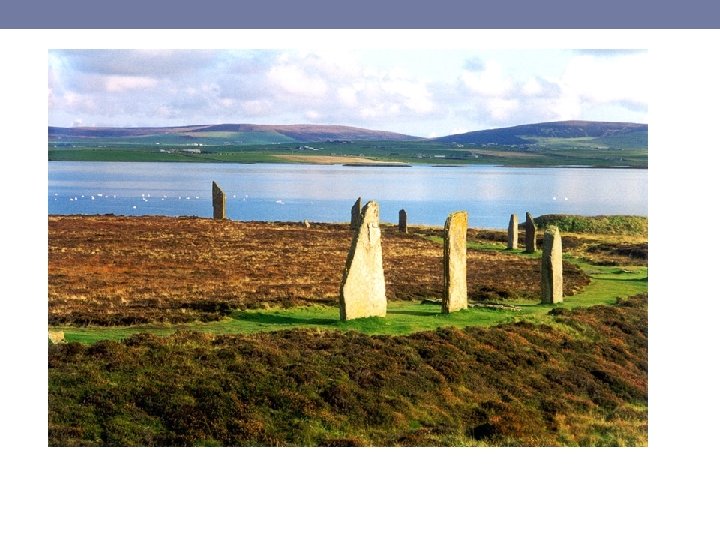
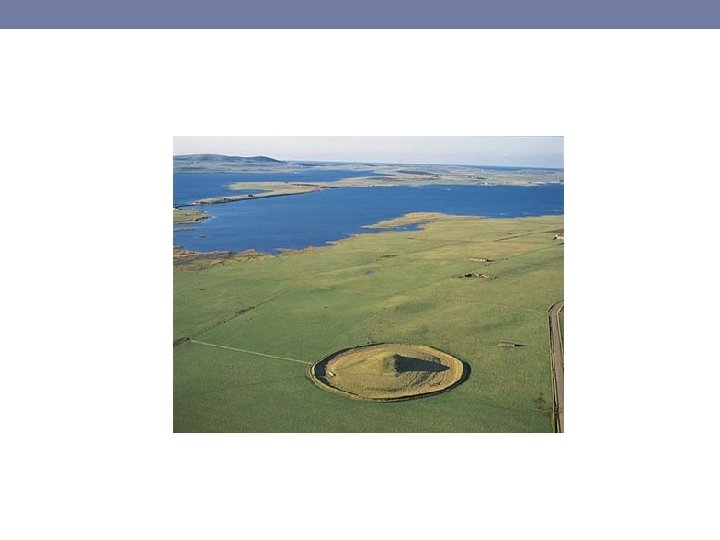
• Scandinavian identity & past • Part of Sc from 15 th c only • „Sc” vs the „mainland” • 70 islands, most uninhabited • Fishing & farming • Isolated, pre-industrial communities, rich folklore • Prehistoric past: neolithic burial places, World Heritage • Mild / cold climate: windy, stormy, harsh weather, long winter nights
LIFE OF EDWIN MUIR
• Born on the Orkney mainland, 1887, childhood spent in ~ • Leaves Orkney w/ his family at 14, settles in Glasgow, works in a glue factory • Parents die, is involved in socialism • Marries novelist Willa Anderson, 1919, settles in London, works as journalist • 1921 -24: Germany, Czechoslovakia, Italy, Austria • 1927: Sussex, 1935: St Andrews • Member of PEN • 1942: works for BC, 1946: Director of the Prague office • 1949: Rome, 1950: Warden of Newbattle Abbey College (Edinburgh), meets GM Brown & Tom Scott as students • 1955: Norton Professor of English at Harvard • 1956: returns to Cambridge, dies in 1959
WORKS OF EDWIN MUIR
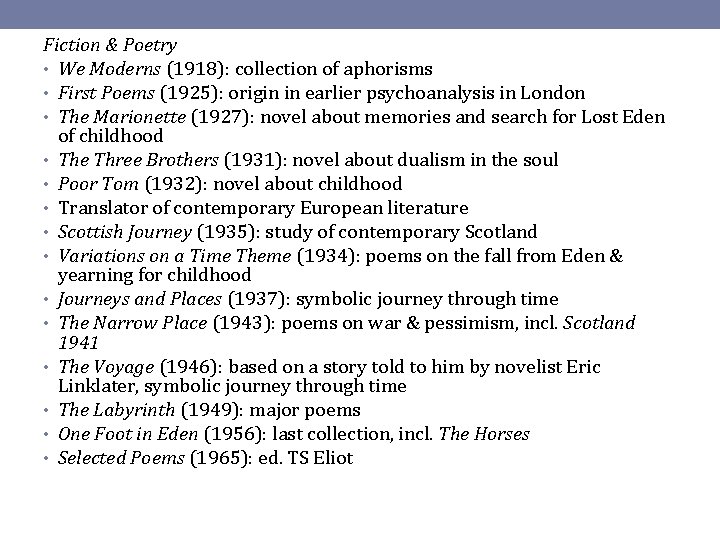
Fiction & Poetry • We Moderns (1918): collection of aphorisms • First Poems (1925): origin in earlier psychoanalysis in London • The Marionette (1927): novel about memories and search for Lost Eden of childhood • The Three Brothers (1931): novel about dualism in the soul • Poor Tom (1932): novel about childhood • Translator of contemporary European literature • Scottish Journey (1935): study of contemporary Scotland • Variations on a Time Theme (1934): poems on the fall from Eden & yearning for childhood • Journeys and Places (1937): symbolic journey through time • The Narrow Place (1943): poems on war & pessimism, incl. Scotland 1941 • The Voyage (1946): based on a story told to him by novelist Eric Linklater, symbolic journey through time • The Labyrinth (1949): major poems • One Foot in Eden (1956): last collection, incl. The Horses • Selected Poems (1965): ed. TS Eliot
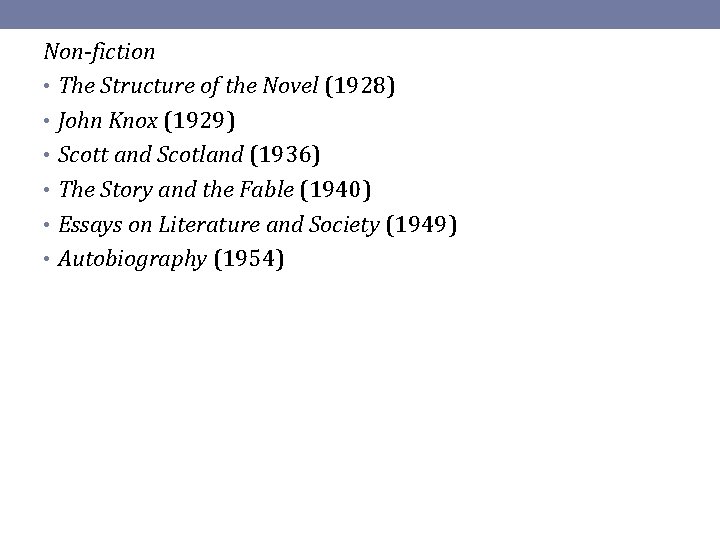
Non-fiction • The Structure of the Novel (1928) • John Knox (1929) • Scott and Scotland (1936) • The Story and the Fable (1940) • Essays on Literature and Society (1949) • Autobiography (1954)
WAS THERE A SCOTTISH LITERATURE? (1919) TS Eliot
SCOTT AND SCOTLAND (1936)
• EM’s conclusions grow out of his survey of the cultural & • • • economic situation of Sc as recorded in SJ: narrative of social & economic decline in the Depression + loss of national identity As an Orcadian: ambivalent rleationship w/ Sc: „second country”; European experience adds fresh perspectives to the contemp. Sc. Cultural scene Sense of dislocation from Scots + English > overestimating the significance of language in the literary revival SS: the loss of language is the critical apsect of Sc’s struggle to regain its cultural autonomy As a consequence of the decline of the Scots language following the U of C & P, Sc writers should adopt the E language to revive Sc lit. Sc writers „feel in one language & think in another” ~ TS Eliot’s „dissociation of sensibility”; EM admired TSE’s criticism Conclusion: „a Sc writer who wishes to achieve some approximation to completeness has no choice except to absorb the E tradition < organic view of E lit hist vs fragmentary, discontinuous, spasmodic evolution of Sc lit. CONT/
• But if a Sc writer „roots himself deliberately in Sc, he will find there…neither an organic community to round off his conceptions, nor a major literary tradition to support him, nor even a faith among the people themselves that a Sc lit is possible or desirable, nor any opportunity…of making a livelyhood by his work” (15) • Loss of national sovereignty > loss of national identity. Nut: adoption of E lang does not need to imply the adoption of E trad & identity (cf Ireland). • Unlike EM, Neil M Gunn thinks the resolution of the identity crisis could come only through Sc taking responsibility for its own affairs + a nationa’s culture consists of more than language
THE LITERARY QUARREL BETWEEN MUIR & MACDIARMID
• Scottish criticism in the inter-war period is dominated by HM & EM • 1920 s: beginning & development of Scottish Literary Renaissance • Main problem: language question • EM renounces Scots as viable literary medium in SS, followed by HM’s counter-attacks • 1920 s: EM & HM are close friends, writing for the magazine New Age. EM writes for Scottish Chapbook, ed. by HM. • 1930 s: the Muirs live in Montrose, he writes poems in Scots, encourages HM to write in Scots. • BUT: EM is NOT a nationalist & is temperamentally diffr. from HM, who’s spiky & aggressive; he’s gentle & meditative. CONT/
• When EM publishes SS, HM takes it as a betrayal. EM becomes a Judas figure & HM publicly attacks him. • Both are obsessed w/ how to achieve a modern Sc lit & both dislike modern industrial Sc, but this enmity defines their future relationship, though by this time (1930) HM too writes in E. Still, HM won’t allow a statement like that to be made. • A crucial argument that flows through the 20 th c in Sc • Should I write in Sc or E? • Is it more Scottish to write in Sc? • Problems of standardisation, readership, expectations, nationality… • HM’s response to EM: Golden Treasury of Sc Poetry (1940): presents Sc verse in 3 languages. • From 1990 s on: most verse anthologies are multilingual, implicitely saying that EM was wrong. BUT: still, E is tha major language (w/ a Sc intonation / accent…)
SCOTLAND, 1941 Fall and redemption in Scottish history
• Interpretation of history: • Orkney is pre-industrial society • Close-knit community • Past recorded in collective memory • Popular culture = oral poetry • Glasgow / Sc • Alienated, urban society • Economic competition destroys social bonds CONT/
Scotland 1941 • A link in the argument • Irreparably negative view of Reformation: iconoclasm, robbed Sc of the arts • Ideal Sc belongs to the past & cannot be retrieved • Edenic simplicity is gone • Archaic diction • „Sham bards…” • A war poem: written after the Blitz
CHILDHOOD AND ONE FOOT IN EDEN Fall and redemption in private history
• Considers himself an Orcadian rather than Sc • Idealises & mythologises place of childhood • Narrative model: Christian story of fall & redemption • Orkney: place of happiness = Eden • Move to Glasgow: fall from Eden, within 5 years, both his parents & 2 of his brothers die, could not adapt to urban life & economic competition • Marriage, psychoanalysis, continental travels: stages in journey of self-discovery which culminates in the discovery of faith CONT/
Childhood • About Orkney, passing into a wonderland, mystical silence One Foot in Eden • The other foot is either dnagling in space or is firm in Glasgow, London, Prague 24 Jesus told them another parable: “The kingdom of heaven is like a man who sowed good seed in his field. 25 But while everyone was sleeping, his enemy came and sowed weeds among the wheat, and went away. 26 When the wheat sprouted and formed heads, then the weeds also appeared. 27 “The owner’s servants came to him and said, ‘Sir, didn’t you sow good seed in your field? Where then did the weeds come from? ’ 28 “‘An enemy did this, ’ he replied. “The servants asked him, ‘Do you want us to go and pull them up? ’ 29 “‘No, ’ he answered, ‘because while you are pulling the weeds, you may uproot the wheat with them. 30 Let both grow together until the harvest. At that time I will tell the harvesters: First collect the weeds and tie them in bundles to be burned; then gather the wheat and bring it into my barn. ’” (Matthew 13: 24 -30)
THE HORSES A Cold War poem or a poem of the Apocalypse
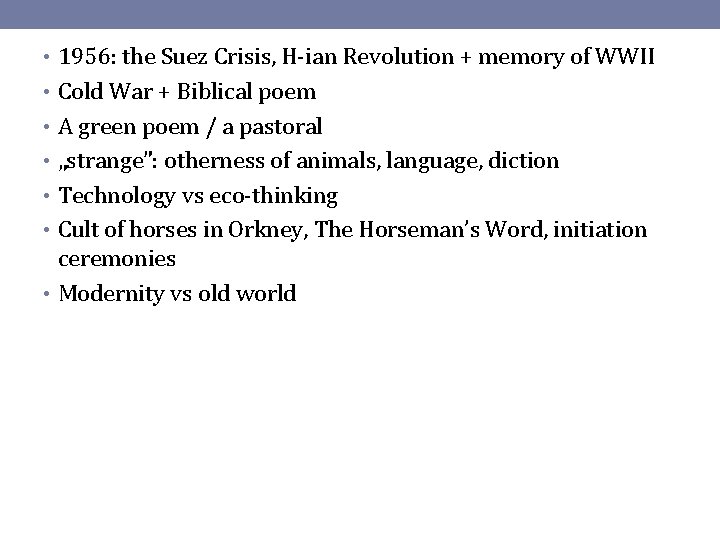
• 1956: the Suez Crisis, H-ian Revolution + memory of WWII • Cold War + Biblical poem • A green poem / a pastoral • „strange”: otherness of animals, language, diction • Technology vs eco-thinking • Cult of horses in Orkney, The Horseman’s Word, initiation ceremonies • Modernity vs old world
CONCLUSION
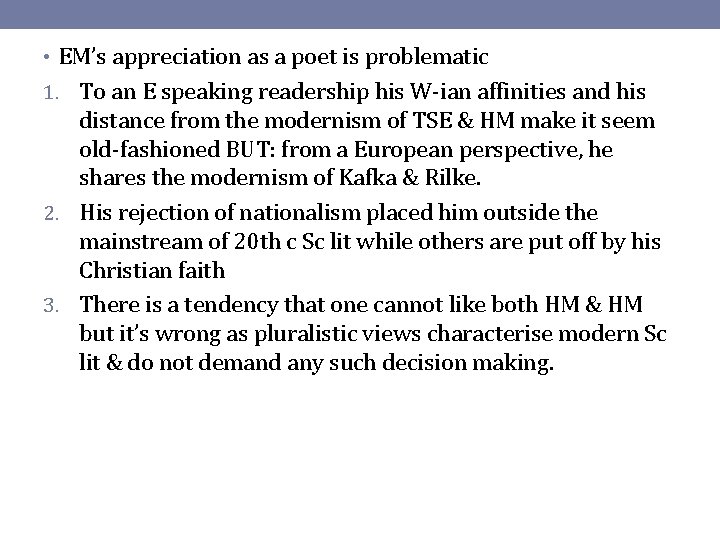
• EM’s appreciation as a poet is problematic 1. To an E speaking readership his W-ian affinities and his distance from the modernism of TSE & HM make it seem old-fashioned BUT: from a European perspective, he shares the modernism of Kafka & Rilke. 2. His rejection of nationalism placed him outside the mainstream of 20 th c Sc lit while others are put off by his Christian faith 3. There is a tendency that one cannot like both HM & HM but it’s wrong as pluralistic views characterise modern Sc lit & do not demand any such decision making.