
Edward T Halls cultural factors Context l Time
- Slides: 10
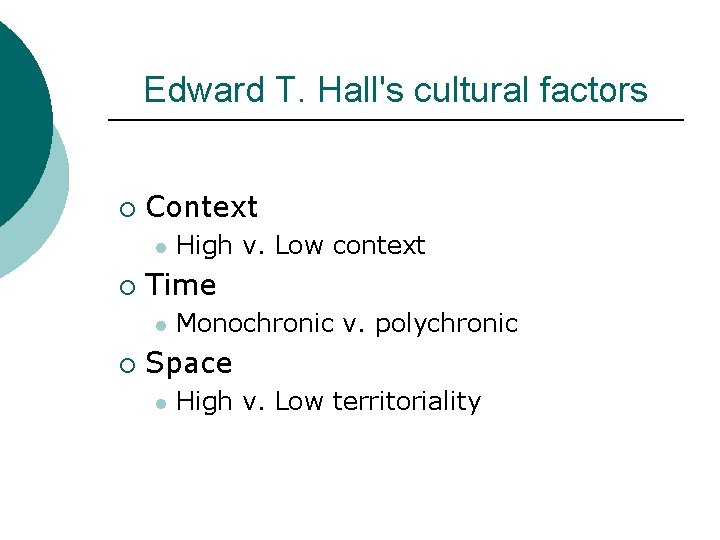
Edward T. Hall's cultural factors ¡ Context l ¡ Time l ¡ High v. Low context Monochronic v. polychronic Space l High v. Low territoriality
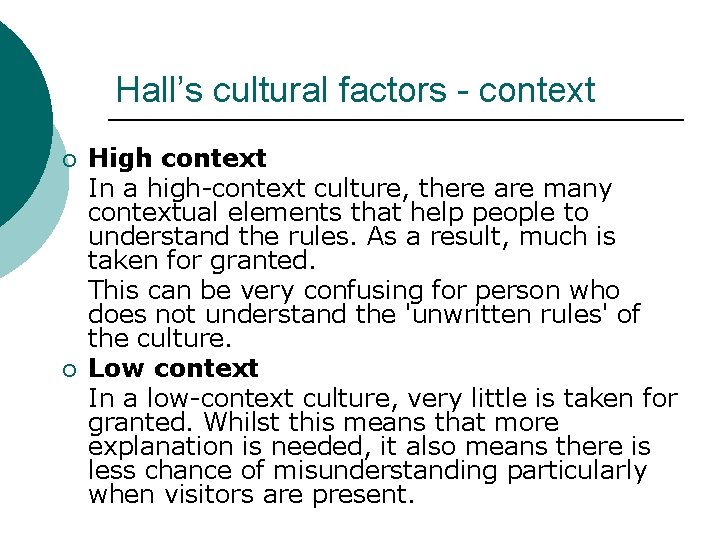
Hall’s cultural factors - context ¡ ¡ High context In a high-context culture, there are many contextual elements that help people to understand the rules. As a result, much is taken for granted. This can be very confusing for person who does not understand the 'unwritten rules' of the culture. Low context In a low-context culture, very little is taken for granted. Whilst this means that more explanation is needed, it also means there is less chance of misunderstanding particularly when visitors are present.
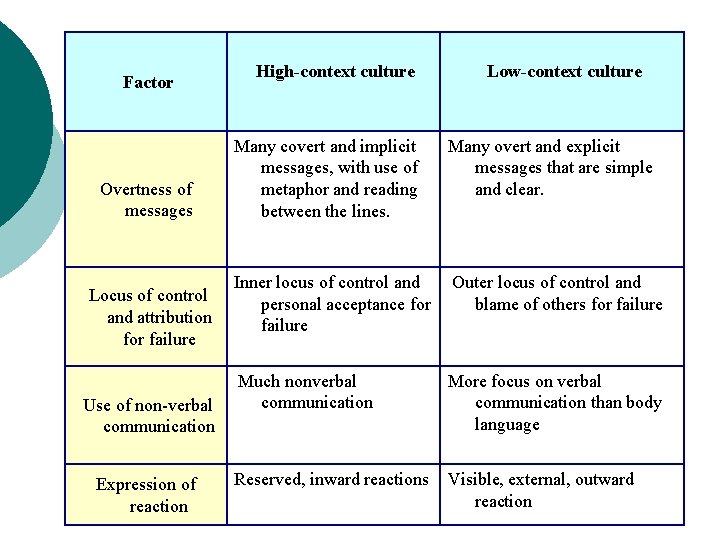
Factor Overtness of messages Locus of control and attribution for failure Use of non-verbal communication Expression of reaction High-context culture Low-context culture Many covert and implicit messages, with use of metaphor and reading between the lines. Many overt and explicit messages that are simple and clear. Inner locus of control and personal acceptance for failure Outer locus of control and blame of others for failure Much nonverbal communication More focus on verbal communication than body language Reserved, inward reactions Visible, external, outward reaction
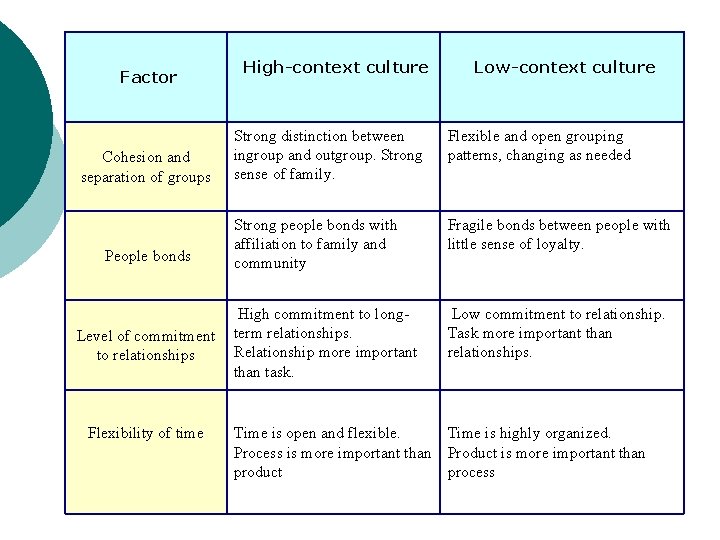
Factor Cohesion and separation of groups People bonds Level of commitment to relationships Flexibility of time High-context culture Low-context culture Strong distinction between ingroup and outgroup. Strong sense of family. Flexible and open grouping patterns, changing as needed Strong people bonds with affiliation to family and community Fragile bonds between people with little sense of loyalty. High commitment to longterm relationships. Relationship more important than task. Low commitment to relationship. Task more important than relationships. Time is open and flexible. Time is highly organized. Process is more important than Product is more important than product process
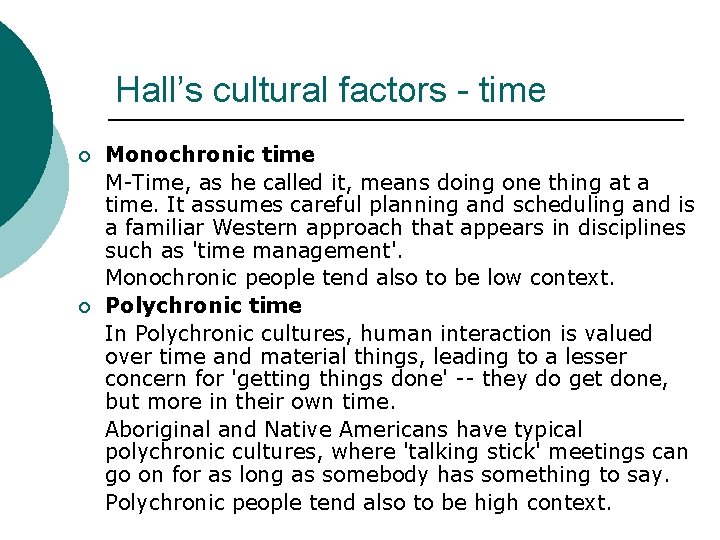
Hall’s cultural factors - time ¡ ¡ Monochronic time M-Time, as he called it, means doing one thing at a time. It assumes careful planning and scheduling and is a familiar Western approach that appears in disciplines such as 'time management'. Monochronic people tend also to be low context. Polychronic time In Polychronic cultures, human interaction is valued over time and material things, leading to a lesser concern for 'getting things done' -- they do get done, but more in their own time. Aboriginal and Native Americans have typical polychronic cultures, where 'talking stick' meetings can go on for as long as somebody has something to say. Polychronic people tend also to be high context.
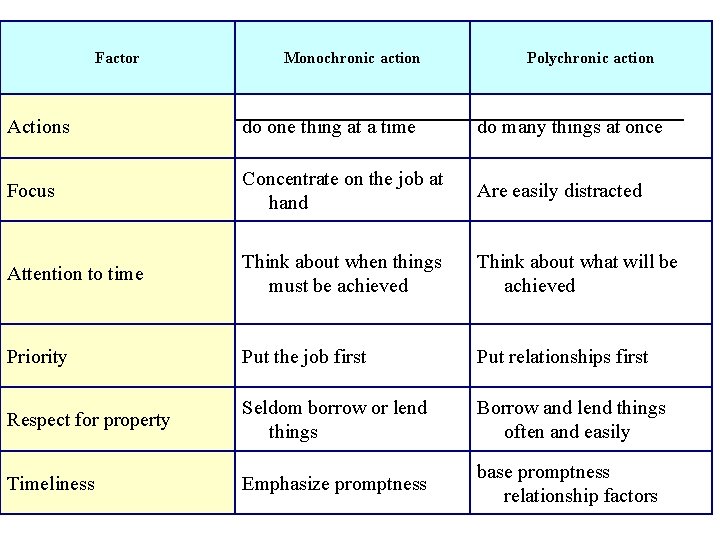
Factor Monochronic action Polychronic action Actions do one thing at a time do many things at once Focus Concentrate on the job at hand Are easily distracted Attention to time Think about when things must be achieved Think about what will be achieved Priority Put the job first Put relationships first Respect for property Seldom borrow or lend things Borrow and lend things often and easily Timeliness Emphasize promptness base promptness relationship factors
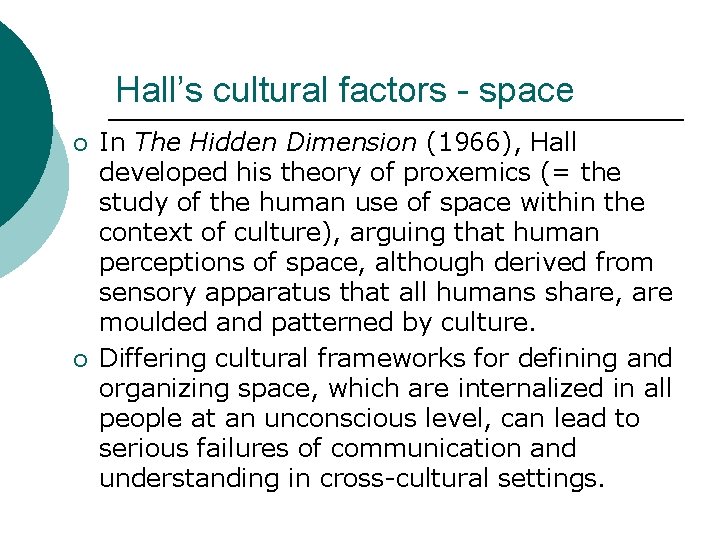
Hall’s cultural factors - space ¡ ¡ In The Hidden Dimension (1966), Hall developed his theory of proxemics (= the study of the human use of space within the context of culture), arguing that human perceptions of space, although derived from sensory apparatus that all humans share, are moulded and patterned by culture. Differing cultural frameworks for defining and organizing space, which are internalized in all people at an unconscious level, can lead to serious failures of communication and understanding in cross-cultural settings.
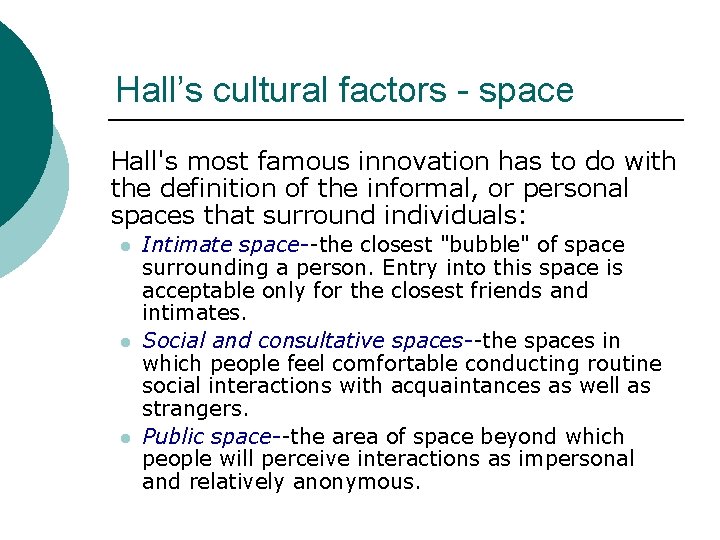
Hall’s cultural factors - space Hall's most famous innovation has to do with the definition of the informal, or personal spaces that surround individuals: l l l Intimate space--the closest "bubble" of space surrounding a person. Entry into this space is acceptable only for the closest friends and intimates. Social and consultative spaces--the spaces in which people feel comfortable conducting routine social interactions with acquaintances as well as strangers. Public space--the area of space beyond which people will perceive interactions as impersonal and relatively anonymous.
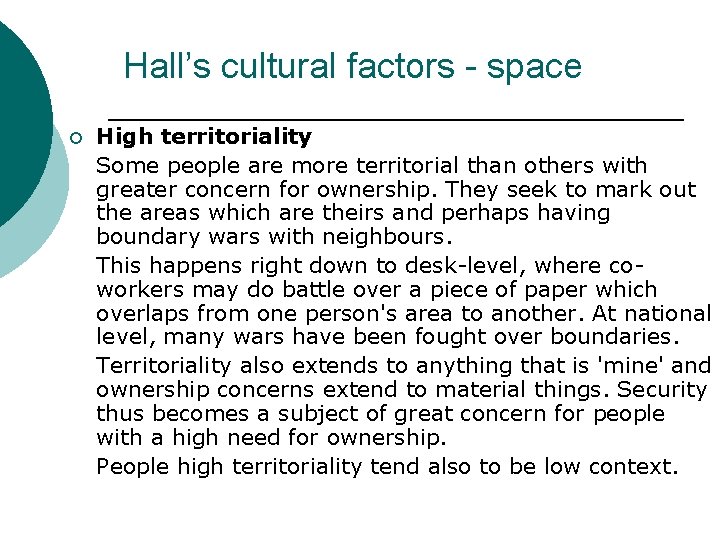
Hall’s cultural factors - space ¡ High territoriality Some people are more territorial than others with greater concern for ownership. They seek to mark out the areas which are theirs and perhaps having boundary wars with neighbours. This happens right down to desk-level, where coworkers may do battle over a piece of paper which overlaps from one person's area to another. At national level, many wars have been fought over boundaries. Territoriality also extends to anything that is 'mine' and ownership concerns extend to material things. Security thus becomes a subject of great concern for people with a high need for ownership. People high territoriality tend also to be low context.
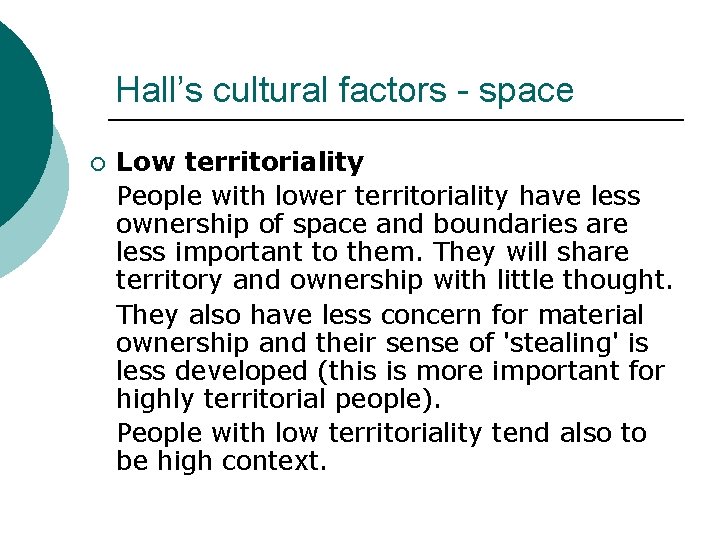
Hall’s cultural factors - space ¡ Low territoriality People with lower territoriality have less ownership of space and boundaries are less important to them. They will share territory and ownership with little thought. They also have less concern for material ownership and their sense of 'stealing' is less developed (this is more important for highly territorial people). People with low territoriality tend also to be high context.