
Edward Brorein Applications Specialist New Tools for Optimizing

Edward Brorein Applications Specialist New Tools for Optimizing Operating Time of Mobile Wireless Devices Copyright © 2002 Agilent Technologies
Challenges for the R&D Engineer • “I need to maximize the run time of my mobile wireless device” • For example … • Optimize power versus data rate by trying combinations of packet size, number of channels, or other operational parameters • Optimize power efficiency of digital baseband operation • Find and understand power-related anomalies that cause reduction in battery life • The solution is Battery Drain Analysis Copyright © 2002 Agilent Technologies 2
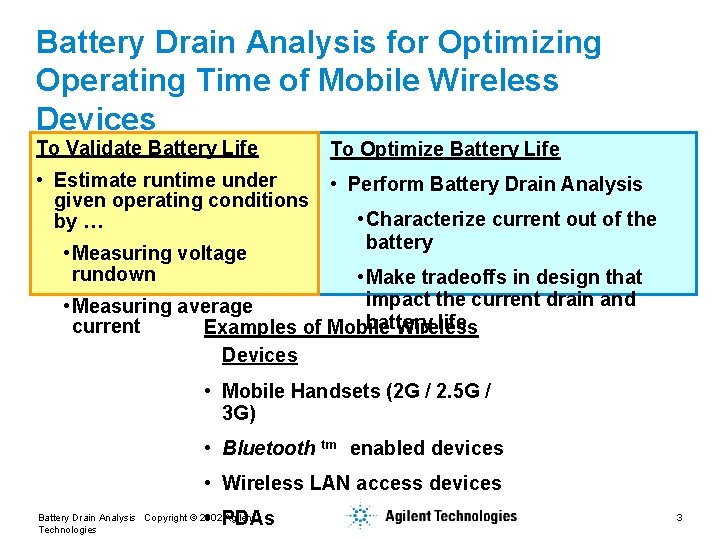
Battery Drain Analysis for Optimizing Operating Time of Mobile Wireless Devices To Validate Battery Life To Optimize Battery Life • Estimate runtime under given operating conditions by … • Perform Battery Drain Analysis • Measuring voltage rundown • Characterize current out of the battery • Make tradeoffs in design that impact the current drain and • Measuring average battery life current Examples of Mobile Wireless Devices • Mobile Handsets (2 G / 2. 5 G / 3 G) • Bluetooth tm enabled devices • Wireless LAN access devices • PDAs Battery Drain Analysis Copyright © 2002 Agilent Technologies 3
Battery Drain Analysis for Optimizing Operating Time of Mobile Wireless Devices Today’s Objectives • Review traditional methods for validating battery life • Discuss why traditional methods are inadequate for Battery Drain Analysis • Show Battery Drain Analysis is effective for characterization and optimization of battery operating time • Highlight aspects of Battery Drain Analysis that drive the need for specialized capabilities for sourcing and measurement Battery Drain Analysis Copyright © 2002 Agilent Technologies 4
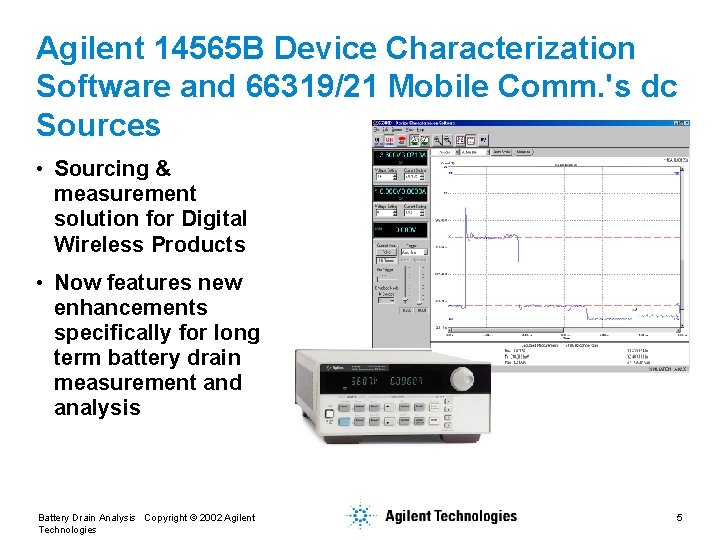
Agilent 14565 B Device Characterization Software and 66319/21 Mobile Comm. 's dc Sources • Sourcing & measurement solution for Digital Wireless Products • Now features new enhancements specifically for long term battery drain measurement and analysis Battery Drain Analysis Copyright © 2002 Agilent Technologies 5
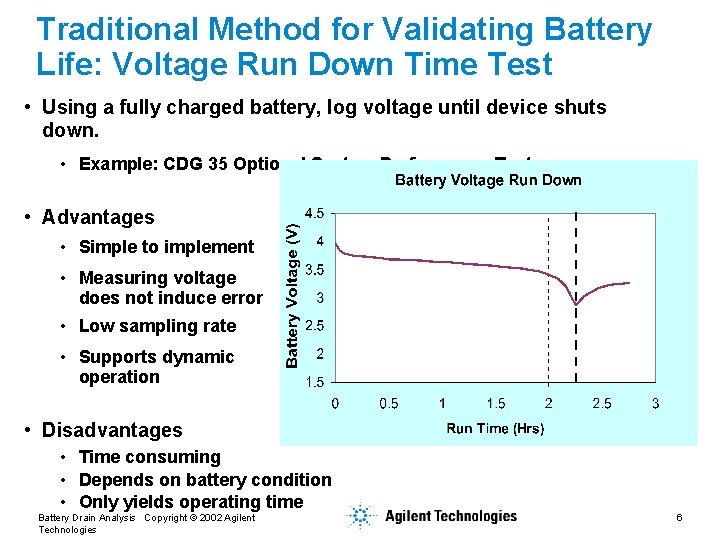
Traditional Method for Validating Battery Life: Voltage Run Down Time Test • Using a fully charged battery, log voltage until device shuts down. • Example: CDG 35 Optional System Performance Tests • Advantages • Simple to implement • Measuring voltage does not induce error • Low sampling rate • Supports dynamic operation • Disadvantages • Time consuming • Depends on battery condition • Only yields operating time Battery Drain Analysis Copyright © 2002 Agilent Technologies 6
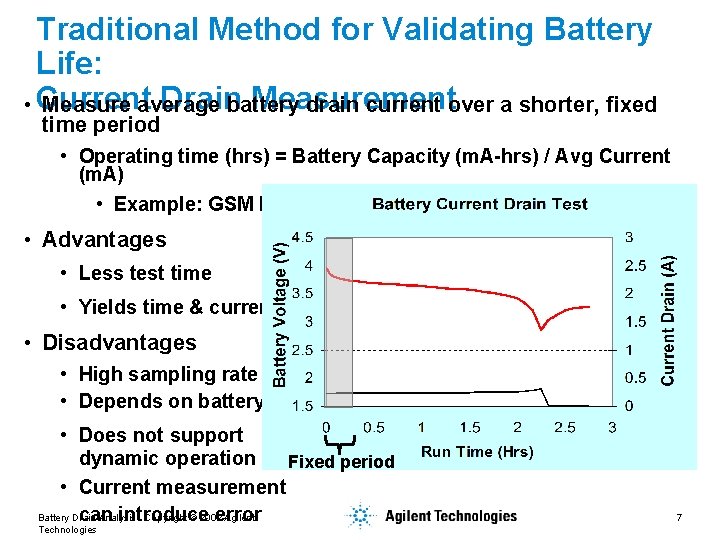
Traditional Method for Validating Battery Life: Drainbattery Measurement • Current Measure average drain current over a shorter, fixed time period • Operating time (hrs) = Battery Capacity (m. A-hrs) / Avg Current (m. A) • Example: GSM Mo. U Association PRD: TW. 09 Test Procedure • Advantages • Less test time • Yields time & current • Disadvantages • High sampling rate • Depends on battery • Does not support dynamic operation Fixed period • Current measurement can introduce error Battery Drain Analysis Copyright © 2002 Agilent Technologies 7
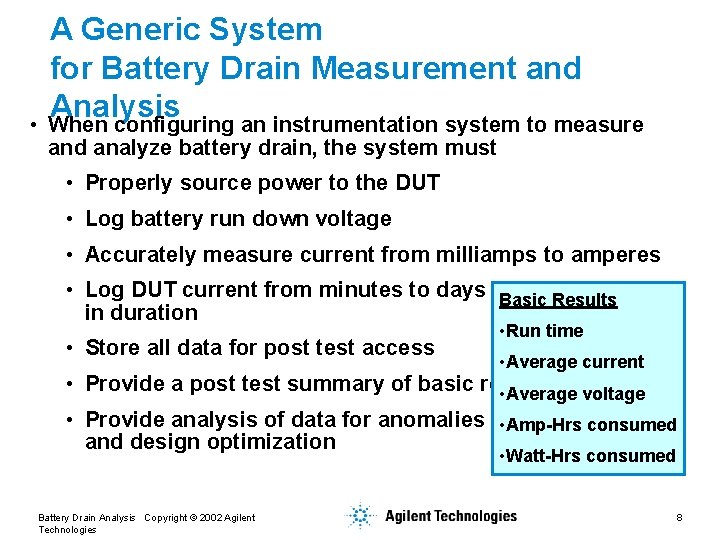
• A Generic System for Battery Drain Measurement and Analysis When configuring an instrumentation system to measure and analyze battery drain, the system must • Properly source power to the DUT • Log battery run down voltage • Accurately measure current from milliamps to amperes • Log DUT current from minutes to days in duration • Store all data for post test access Basic Results • Run time • Average current • Provide a post test summary of basic results • Average voltage • Provide analysis of data for anomalies • Amp-Hrs consumed and design optimization • Watt-Hrs consumed Battery Drain Analysis Copyright © 2002 Agilent Technologies 8
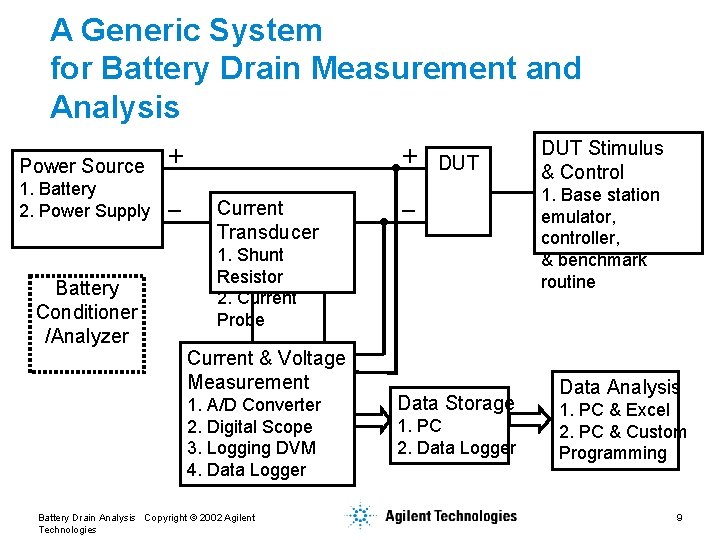
A Generic System for Battery Drain Measurement and Analysis Power Source + 1. Battery 2. Power Supply _ Battery Conditioner /Analyzer Current Transducer + DUT Stimulus & Control _ 1. Base station emulator, controller, & benchmark routine 1. Shunt Resistor 2. Current Probe Current & Voltage Measurement 1. A/D Converter 2. Digital Scope 3. Logging DVM 4. Data Logger Battery Drain Analysis Copyright © 2002 Agilent Technologies Data Storage 1. PC 2. Data Logger Data Analysis 1. PC & Excel 2. PC & Custom Programming 9
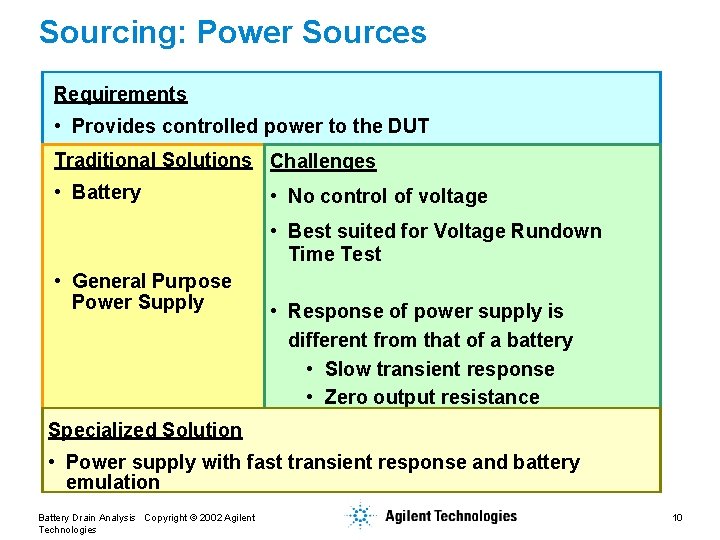
Sourcing: Power Sources Requirements • Provides controlled power to the DUT Traditional Solutions Challenges • Battery • No control of voltage • Best suited for Voltage Rundown Time Test • General Purpose Power Supply • Response of power supply is different from that of a battery • Slow transient response • Zero output resistance Specialized Solution • Power supply with fast transient response and battery emulation Battery Drain Analysis Copyright © 2002 Agilent Technologies 10
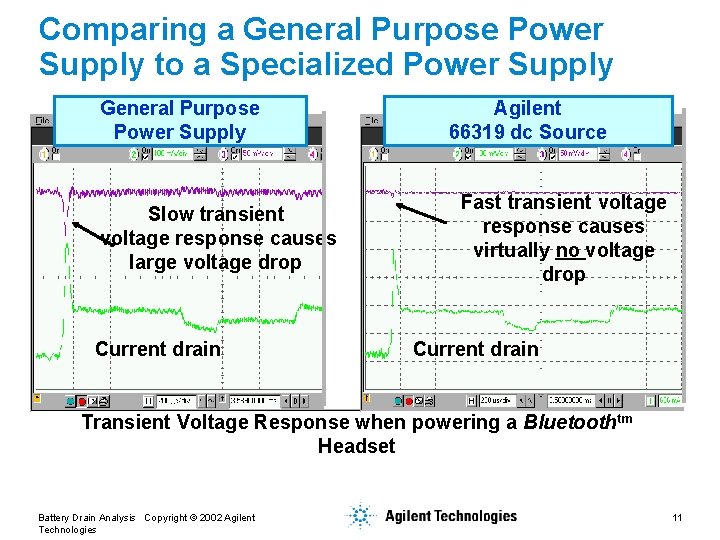
Comparing a General Purpose Power Supply to a Specialized Power Supply General Purpose Power Supply Slow transient voltage response causes large voltage drop Current drain Agilent 66319 dc Source Fast transient voltage response causes virtually no voltage drop Current drain Transient Voltage Response when powering a Bluetoothtm Headset Battery Drain Analysis Copyright © 2002 Agilent Technologies 11
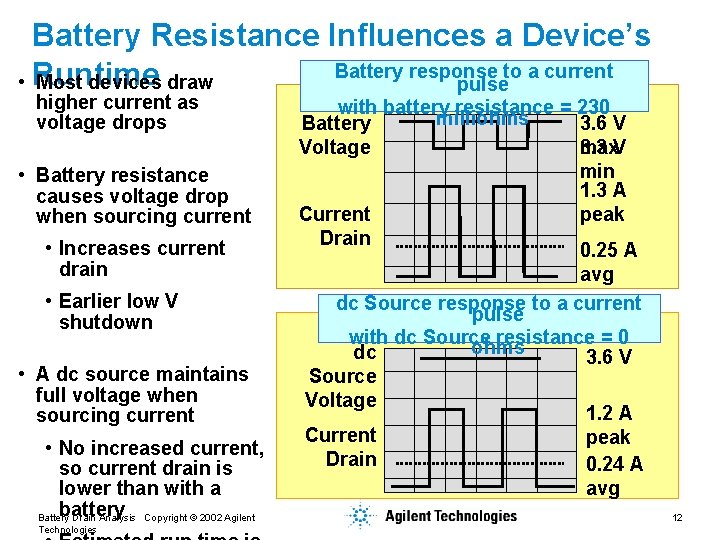
Battery Resistance Influences a Device’s Battery response to a current • Runtime Most devices draw pulse higher current as voltage drops • Battery resistance causes voltage drop when sourcing current • Increases current drain • Earlier low V shutdown • A dc source maintains full voltage when sourcing current • No increased current, so current drain is lower than with a battery Battery Drain Analysis Copyright © 2002 Agilent Technologies with battery resistance = 230 milliohms Battery 3. 6 V Voltage max. V 3. 3 min 1. 3 A Current peak Drain 0. 25 A avg dc Source response to a current pulse with dc Source resistance = 0 ohms dc 3. 6 V Source Voltage 1. 2 A Current peak Drain 0. 24 A avg 12
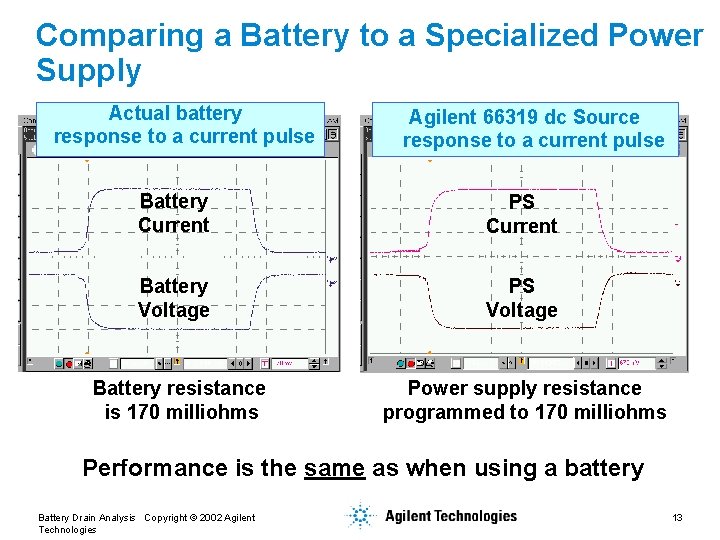
Comparing a Battery to a Specialized Power Supply Actual battery response to a current pulse Agilent 66319 dc Source response to a current pulse Battery Current PS Current Battery Voltage PS Voltage Battery resistance is 170 milliohms Power supply resistance programmed to 170 milliohms Performance is the same as when using a battery Battery Drain Analysis Copyright © 2002 Agilent Technologies 13
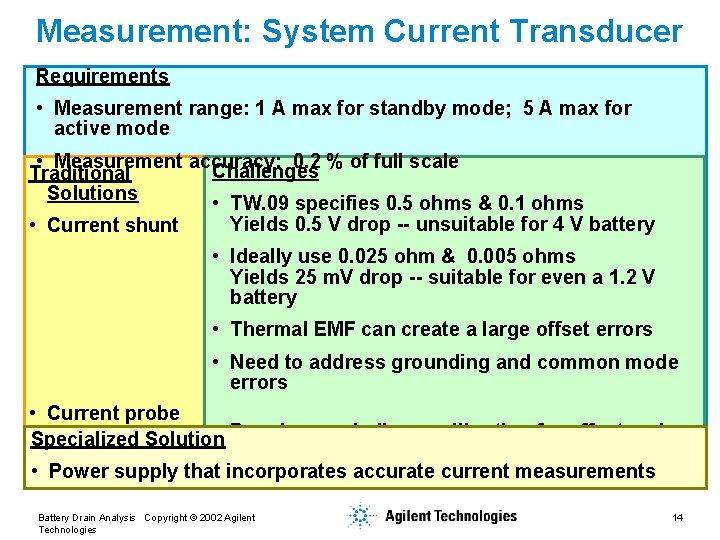
Measurement: System Current Transducer Requirements • Measurement range: 1 A max for standby mode; 5 A max for active mode • Measurement accuracy: 0. 2 % of full scale Challenges Traditional Solutions • TW. 09 specifies 0. 5 ohms & 0. 1 ohms Yields 0. 5 V drop -- unsuitable for 4 V battery • Current shunt • Ideally use 0. 025 ohm & 0. 005 ohms Yields 25 m. V drop -- suitable for even a 1. 2 V battery • Thermal EMF can create a large offset errors • Need to address grounding and common mode errors • Current probe • Requires periodic re-calibration for offset and Specialized Solution drift Creates difficulties when running long tests • Power supply that incorporates accurate current measurements Battery Drain Analysis Copyright © 2002 Agilent Technologies 14
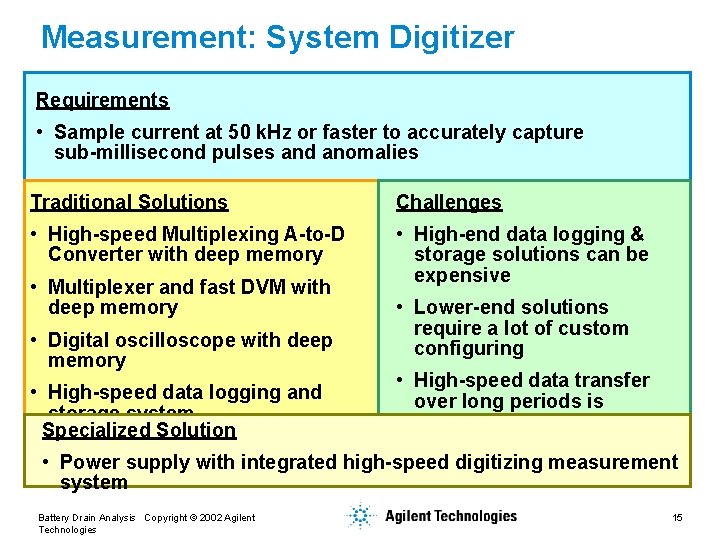
Measurement: System Digitizer Requirements • Sample current at 50 k. Hz or faster to accurately capture sub-millisecond pulses and anomalies Traditional Solutions Challenges • High-speed Multiplexing A-to-D Converter with deep memory • High-end data logging & storage solutions can be expensive • Multiplexer and fast DVM with deep memory • Digital oscilloscope with deep memory • High-speed data logging and storage system Specialized Solution • Lower-end solutions require a lot of custom configuring • High-speed data transfer over long periods is challenging • Power supply with integrated high-speed digitizing measurement system Battery Drain Analysis Copyright © 2002 Agilent Technologies 15
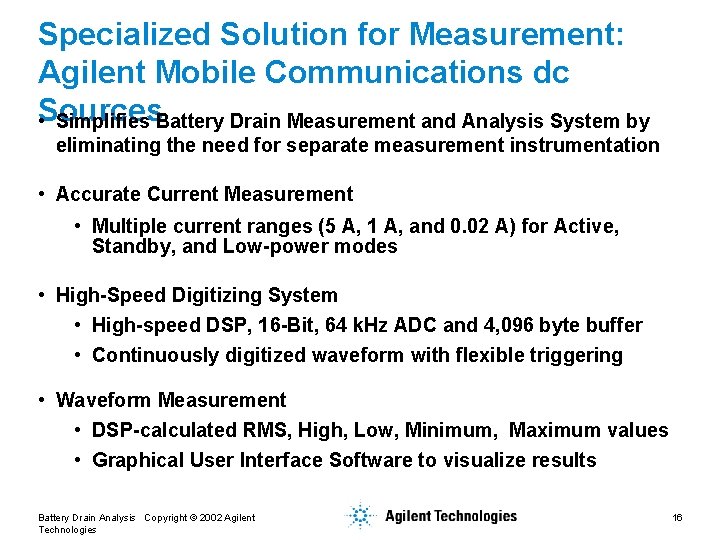
Specialized Solution for Measurement: Agilent Mobile Communications dc Sources • Simplifies Battery Drain Measurement and Analysis System by eliminating the need for separate measurement instrumentation • Accurate Current Measurement • Multiple current ranges (5 A, 1 A, and 0. 02 A) for Active, Standby, and Low-power modes • High-Speed Digitizing System • High-speed DSP, 16 -Bit, 64 k. Hz ADC and 4, 096 byte buffer • Continuously digitized waveform with flexible triggering • Waveform Measurement • DSP-calculated RMS, High, Low, Minimum, Maximum values • Graphical User Interface Software to visualize results Battery Drain Analysis Copyright © 2002 Agilent Technologies 16
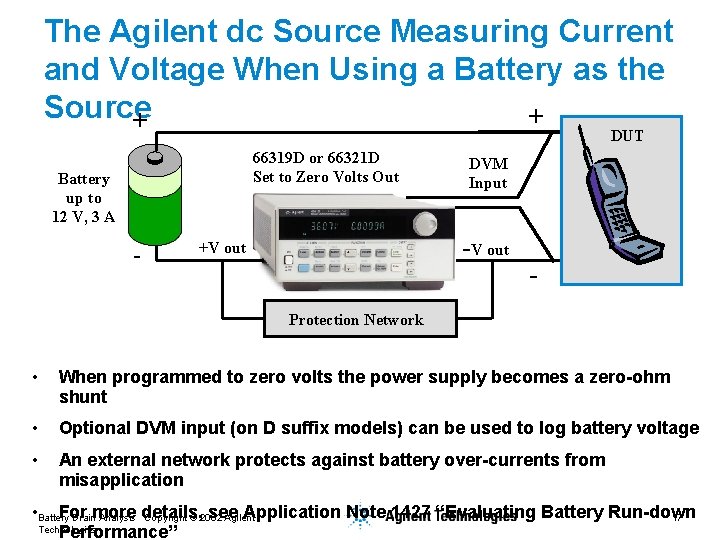
The Agilent dc Source Measuring Current and Voltage When Using a Battery as the Source + + DUT 66319 D or 66321 D Set to Zero Volts Out Battery up to 12 V, 3 A - DVM Input -V out +V out - Protection Network • When programmed to zero volts the power supply becomes a zero-ohm shunt • Optional DVM input (on D suffix models) can be used to log battery voltage • An external network protects against battery over-currents from misapplication • Battery For see Application Note 1427 “Evaluating Battery Run-down 17 Drainmore Analysis details, Copyright © 2002 Agilent Technologies Performance”
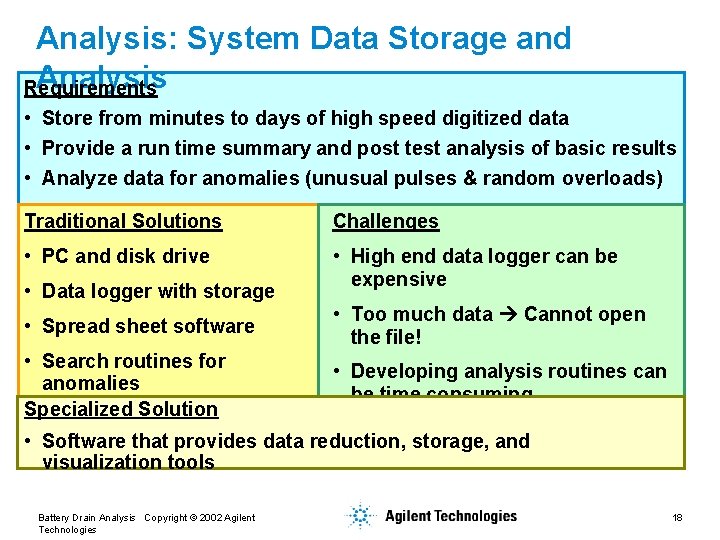
Analysis: System Data Storage and Analysis Requirements • Store from minutes to days of high speed digitized data • Provide a run time summary and post test analysis of basic results • Analyze data for anomalies (unusual pulses & random overloads) Traditional Solutions Challenges • PC and disk drive • High end data logger can be expensive • Data logger with storage • Spread sheet software • Too much data Cannot open the file! • Search routines for anomalies Specialized Solution • Developing analysis routines can be time consuming • Software that provides data reduction, storage, and visualization tools Battery Drain Analysis Copyright © 2002 Agilent Technologies 18
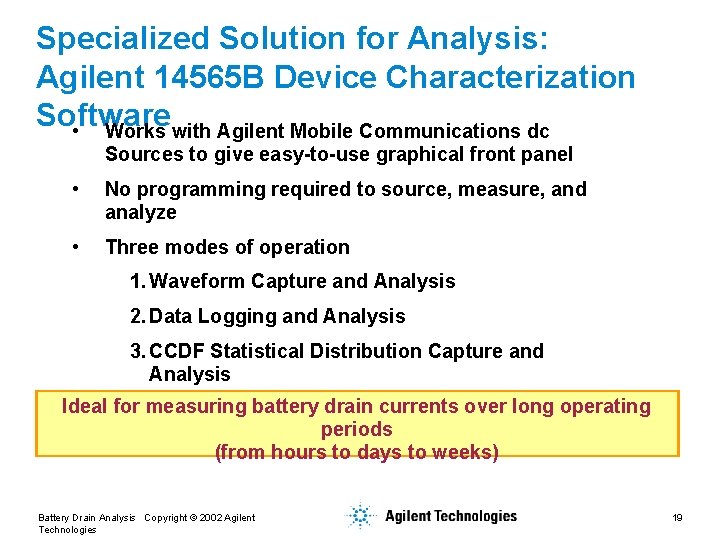
Specialized Solution for Analysis: Agilent 14565 B Device Characterization Software • Works with Agilent Mobile Communications dc Sources to give easy-to-use graphical front panel • No programming required to source, measure, and analyze • Three modes of operation 1. Waveform Capture and Analysis 2. Data Logging and Analysis 3. CCDF Statistical Distribution Capture and Analysis Ideal for measuring battery drain currents over long operating periods (from hours to days to weeks) Battery Drain Analysis Copyright © 2002 Agilent Technologies 19
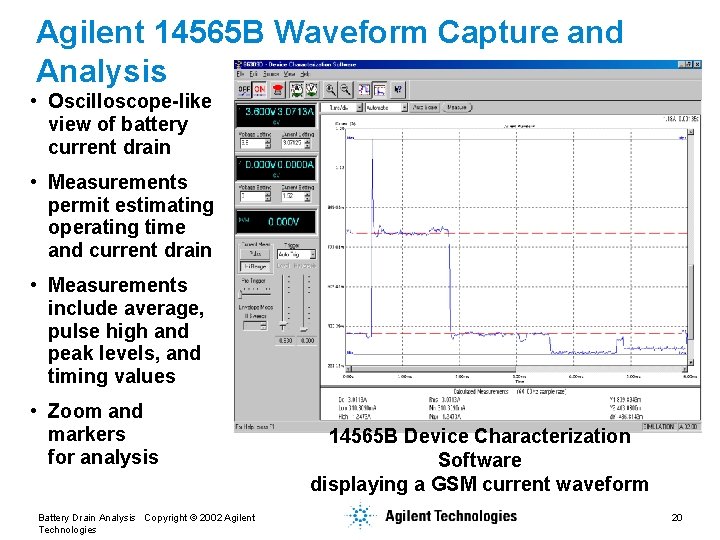
Agilent 14565 B Waveform Capture and Analysis • Oscilloscope-like view of battery current drain • Measurements permit estimating operating time and current drain • Measurements include average, pulse high and peak levels, and timing values • Zoom and markers for analysis Battery Drain Analysis Copyright © 2002 Agilent Technologies 14565 B Device Characterization Software displaying a GSM current waveform 20
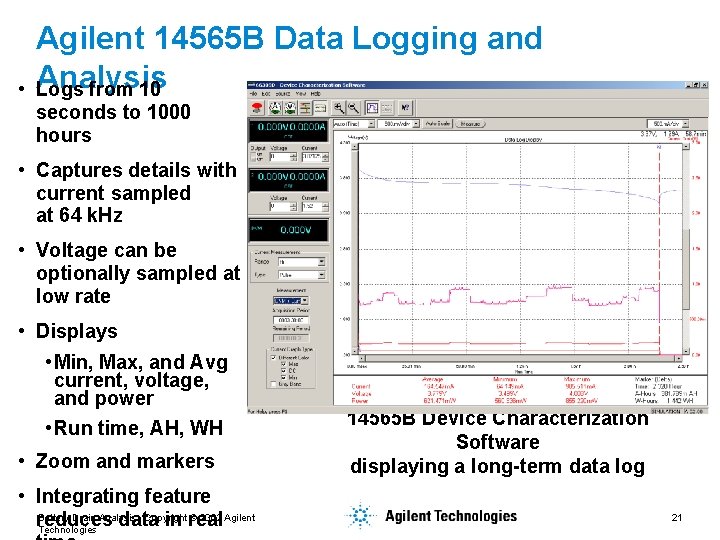
• Agilent 14565 B Data Logging and Analysis Logs from 10 seconds to 1000 hours • Captures details with current sampled at 64 k. Hz • Voltage can be optionally sampled at low rate • Displays • Min, Max, and Avg current, voltage, and power • Run time, AH, WH • Zoom and markers • Integrating feature Battery Drain Analysis Copyright © 2002 Agilent reduces data in real Technologies 14565 B Device Characterization Software displaying a long-term data log 21
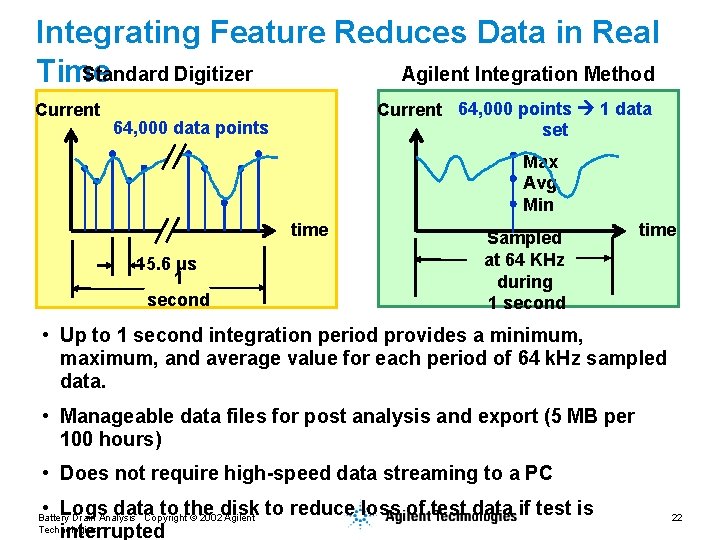
Integrating Feature Reduces Data in Real Standard Digitizer Agilent Integration Method Time Current 64, 000 points 1 data set 64, 000 data points Max Avg Min time 15. 6 μs 1 second Sampled at 64 KHz during 1 second time • Up to 1 second integration period provides a minimum, maximum, and average value for each period of 64 k. Hz sampled data. • Manageable data files for post analysis and export (5 MB per 100 hours) • Does not require high-speed data streaming to a PC • Logs data to the disk to reduce loss of test data if test is interrupted Battery Drain Analysis Copyright © 2002 Agilent Technologies 22
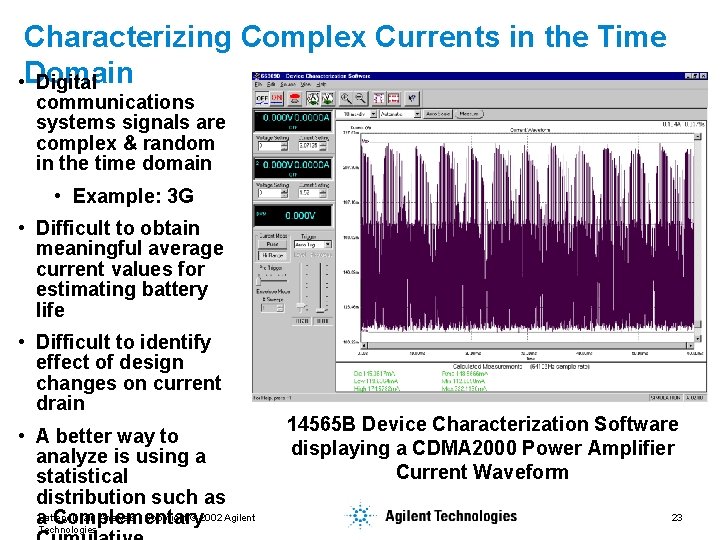
Characterizing Complex Currents in the Time • Domain Digital communications systems signals are complex & random in the time domain • Example: 3 G • Difficult to obtain meaningful average current values for estimating battery life • Difficult to identify effect of design changes on current drain • A better way to analyze is using a statistical distribution such as Drain Analysis Copyright © 2002 Agilent a. Battery Complementary Technologies 14565 B Device Characterization Software displaying a CDMA 2000 Power Amplifier Current Waveform 23
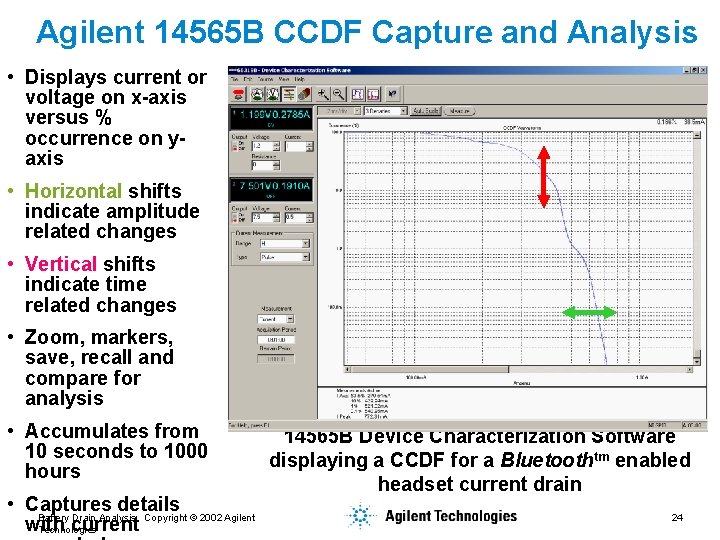
Agilent 14565 B CCDF Capture and Analysis • Displays current or voltage on x-axis versus % occurrence on yaxis • Horizontal shifts indicate amplitude related changes • Vertical shifts indicate time related changes • Zoom, markers, save, recall and compare for analysis • Accumulates from 10 seconds to 1000 hours • Captures details Battery Drain Analysis Copyright © 2002 Agilent with current Technologies 14565 B Device Characterization Software displaying a CCDF for a Bluetoothtm enabled headset current drain 24
Summary: Benefits of Battery Drain Analysis • Allows you analyze and optimize designs for maximum battery runtime • For example, provides a means to … • Quantify changes in operational parameters (examples: packet size, number of channels) to optimize power versus data rate • Quantify changes in digital baseband operation to optimize power efficiency • Capture and analyze the effects of random anomalies such as unusually high or long pulses; random overloads • Determine dynamic power requirements of battery Battery Drain Analysis Copyright © 2002 Agilent and power management circuit Technologies 25
Summary: Agilent’s Solution for Battery Drain Analysis • Agilent Model 66319 B, 66319 D, 66321 B, or 66321 D dc Sources and 14565 B Device Characterization Software with Battery Drain Analysis • Power source that simulates a battery • Integrated, high-accuracy measurement • 14565 B software is a specialized solution for Battery Drain Analysis • Continuous long-term measurement with intelligent data processing and reduction • Visualization tools to help you identify anomalies and optimize your designs • For further information http: //www. agilent. com/find/batterydrainanalyzer Battery Drain Analysis Copyright © 2002 Agilent Technologies 26
- Slides: 26