
Eduqas GCSE Geography A Examination feedback Summer 2018
Eduqas GCSE Geography A Examination feedback Summer 2018
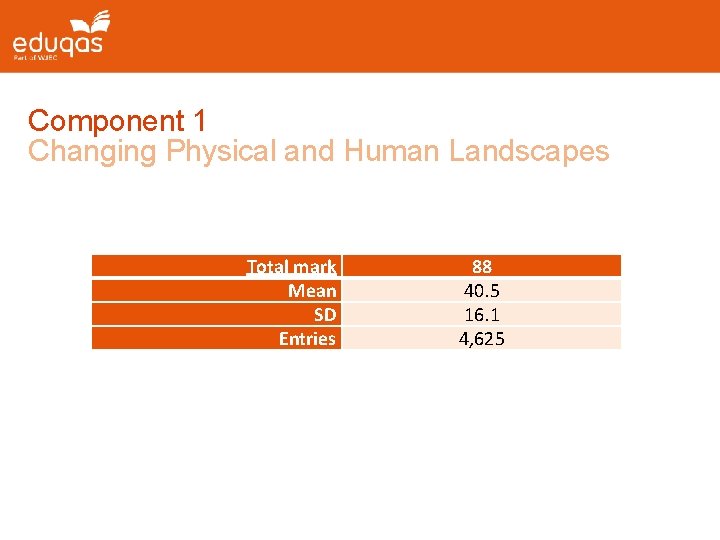
Component 1 Changing Physical and Human Landscapes Total mark Mean SD Entries 88 40. 5 16. 1 4, 625
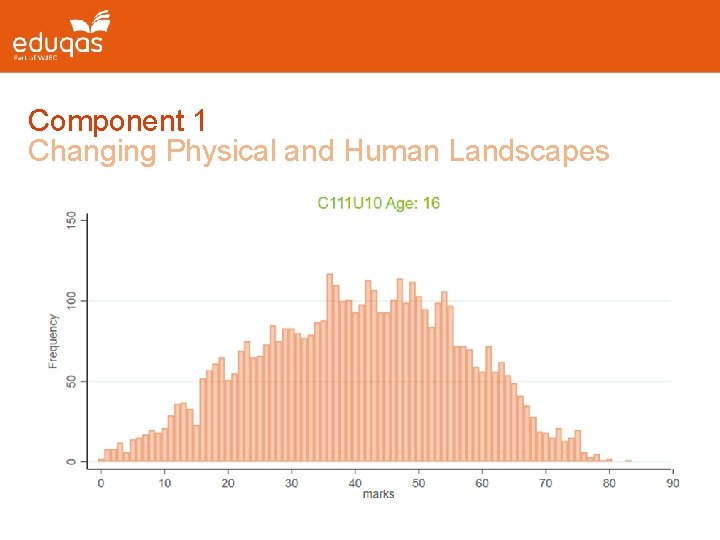
Component 1 Changing Physical and Human Landscapes
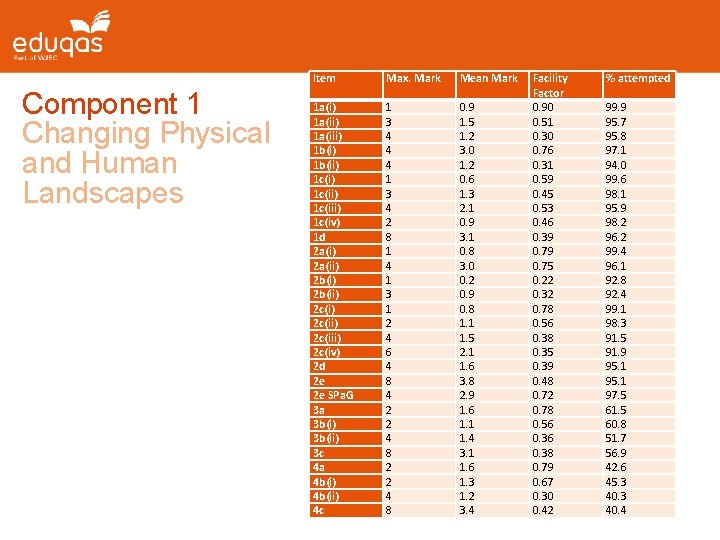
Component 1 Changing Physical and Human Landscapes Item Max. Mark Mean Mark 1 a(i) 1 a(iii) 1 b(ii) 1 c(ii) 1 c(iv) 1 d 2 a(i) 2 a(ii) 2 b(ii) 2 c(ii) 2 c(iv) 2 d 2 e 2 e SPa. G 3 a 3 b(i) 3 b(ii) 3 c 4 a 4 b(i) 4 b(ii) 4 c 1 3 4 4 4 1 3 4 2 8 1 4 1 3 1 2 4 6 4 8 4 2 2 4 8 0. 9 1. 5 1. 2 3. 0 1. 2 0. 6 1. 3 2. 1 0. 9 3. 1 0. 8 3. 0 0. 2 0. 9 0. 8 1. 1 1. 5 2. 1 1. 6 3. 8 2. 9 1. 6 1. 1 1. 4 3. 1 1. 6 1. 3 1. 2 3. 4 Facility Factor 0. 90 0. 51 0. 30 0. 76 0. 31 0. 59 0. 45 0. 53 0. 46 0. 39 0. 75 0. 22 0. 32 0. 78 0. 56 0. 38 0. 35 0. 39 0. 48 0. 72 0. 78 0. 56 0. 38 0. 79 0. 67 0. 30 0. 42 % attempted 99. 9 95. 7 95. 8 97. 1 94. 0 99. 6 98. 1 95. 9 98. 2 96. 2 99. 4 96. 1 92. 8 92. 4 99. 1 98. 3 91. 5 91. 9 95. 1 97. 5 61. 5 60. 8 51. 7 56. 9 42. 6 45. 3 40. 4
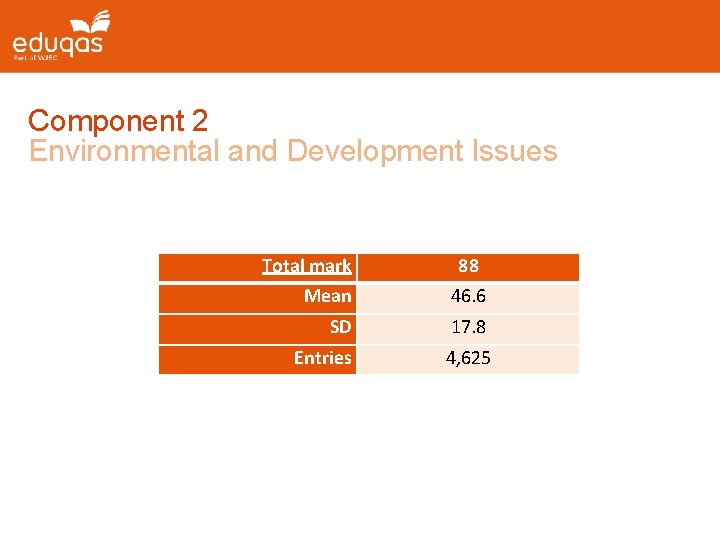
Component 2 Environmental and Development Issues Total mark 88 Mean 46. 6 SD 17. 8 Entries 4, 625
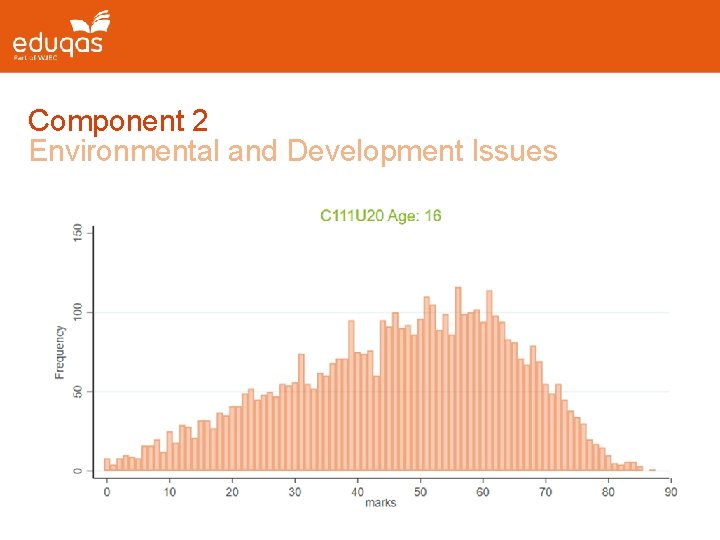
Component 2 Environmental and Development Issues Subheading
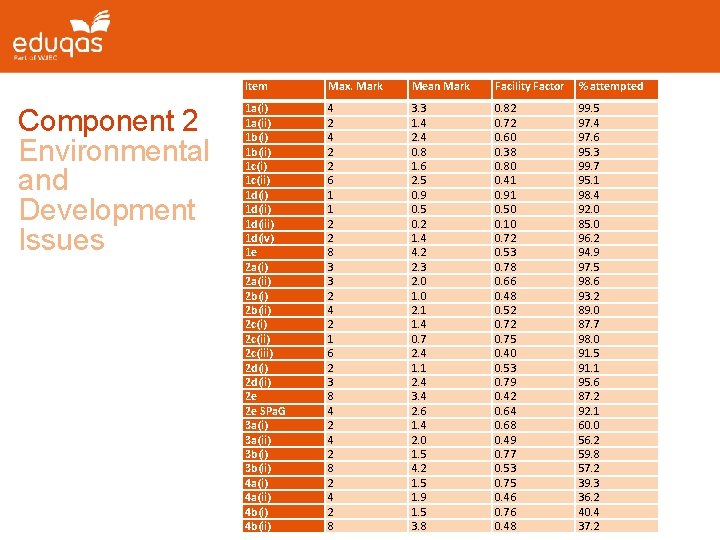
Component 2 Environmental and Development Issues Item Max. Mark Mean Mark Facility Factor % attempted 1 a(i) 1 a(ii) 1 b(ii) 1 c(ii) 1 d(ii) 1 d(iv) 1 e 2 a(i) 2 a(ii) 2 b(ii) 2 c(ii) 2 c(iii) 2 d(ii) 2 e 2 e SPa. G 3 a(i) 3 a(ii) 3 b(ii) 4 a(ii) 4 b(ii) 4 2 2 6 1 1 2 2 8 3 3 2 4 2 1 6 2 3 8 4 2 8 2 4 2 8 3. 3 1. 4 2. 4 0. 8 1. 6 2. 5 0. 9 0. 5 0. 2 1. 4 4. 2 2. 3 2. 0 1. 0 2. 1 1. 4 0. 7 2. 4 1. 1 2. 4 3. 4 2. 6 1. 4 2. 0 1. 5 4. 2 1. 5 1. 9 1. 5 3. 8 0. 82 0. 72 0. 60 0. 38 0. 80 0. 41 0. 91 0. 50 0. 10 0. 72 0. 53 0. 78 0. 66 0. 48 0. 52 0. 75 0. 40 0. 53 0. 79 0. 42 0. 64 0. 68 0. 49 0. 77 0. 53 0. 75 0. 46 0. 76 0. 48 99. 5 97. 4 97. 6 95. 3 99. 7 95. 1 98. 4 92. 0 85. 0 96. 2 94. 9 97. 5 98. 6 93. 2 89. 0 87. 7 98. 0 91. 5 91. 1 95. 6 87. 2 92. 1 60. 0 56. 2 59. 8 57. 2 39. 3 36. 2 40. 4 37. 2
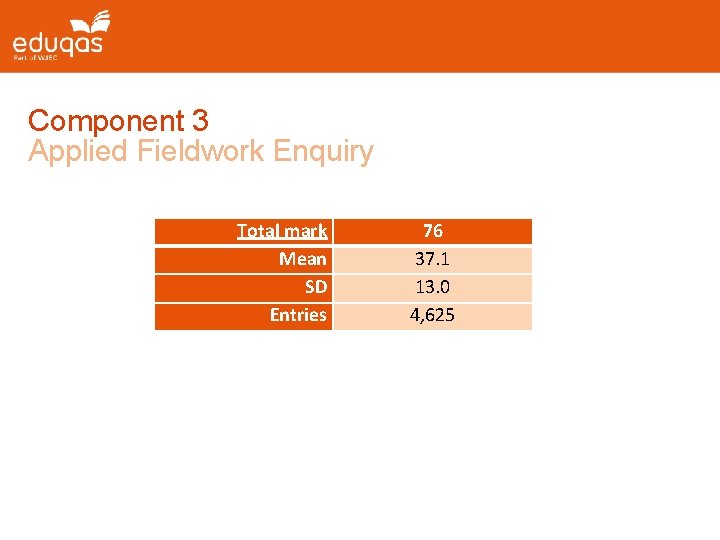
Component 3 Applied Fieldwork Enquiry Total mark Mean SD Entries 76 37. 1 13. 0 4, 625
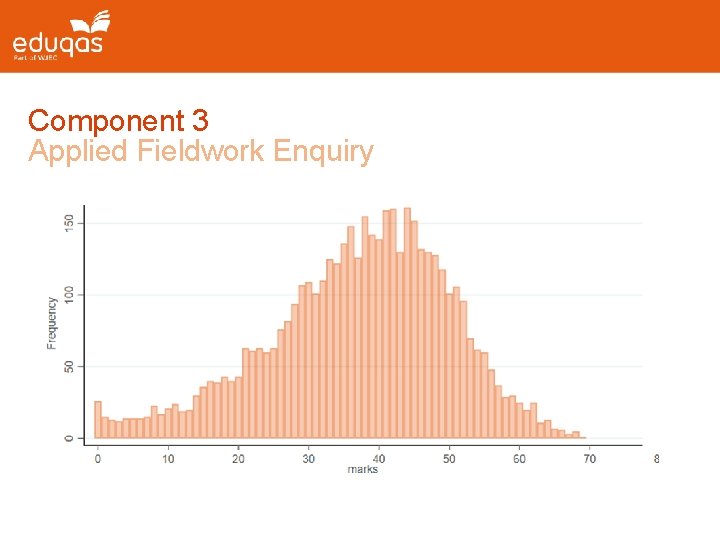
Component 3 Applied Fieldwork Enquiry Subheading
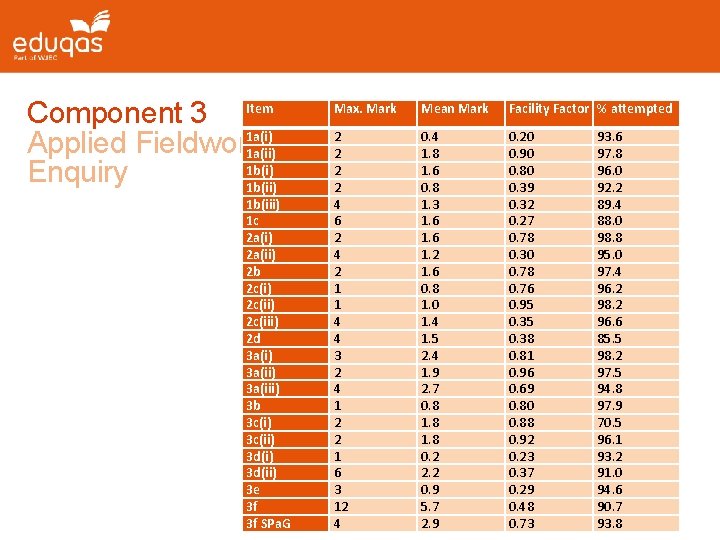
Component 3 Item 1 a(i) Applied Fieldwork 1 a(ii) 1 b(i) Enquiry 1 b(ii) 1 b(iii) 1 c 2 a(i) 2 a(ii) 2 b 2 c(i) 2 c(iii) 2 d 3 a(i) 3 a(iii) 3 b 3 c(i) 3 c(ii) 3 d(ii) 3 e 3 f 3 f SPa. G Max. Mark Mean Mark Facility Factor % attempted 2 2 4 6 2 4 2 1 1 4 4 3 2 4 1 2 2 1 6 3 12 4 0. 4 1. 8 1. 6 0. 8 1. 3 1. 6 1. 2 1. 6 0. 8 1. 0 1. 4 1. 5 2. 4 1. 9 2. 7 0. 8 1. 8 0. 2 2. 2 0. 9 5. 7 2. 9 0. 20 0. 90 0. 80 0. 39 0. 32 0. 27 0. 78 0. 30 0. 78 0. 76 0. 95 0. 38 0. 81 0. 96 0. 69 0. 80 0. 88 0. 92 0. 23 0. 37 0. 29 0. 48 0. 73 93. 6 97. 8 96. 0 92. 2 89. 4 88. 0 98. 8 95. 0 97. 4 96. 2 98. 2 96. 6 85. 5 98. 2 97. 5 94. 8 97. 9 70. 5 96. 1 93. 2 91. 0 94. 6 90. 7 93. 8
Examiner’s report on Eduqas A Components 1 and 2
Aims of today’s presentation 1. What went well / what caused concern? 2. How were the questions marked? 3. What do students need to do to improve?
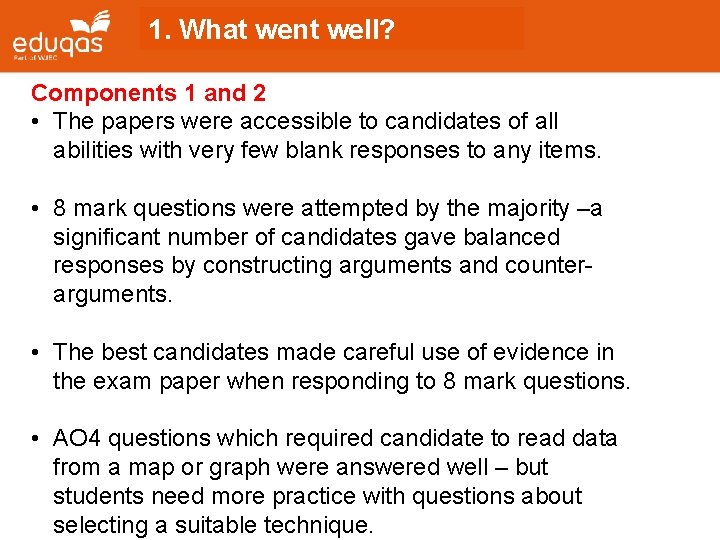
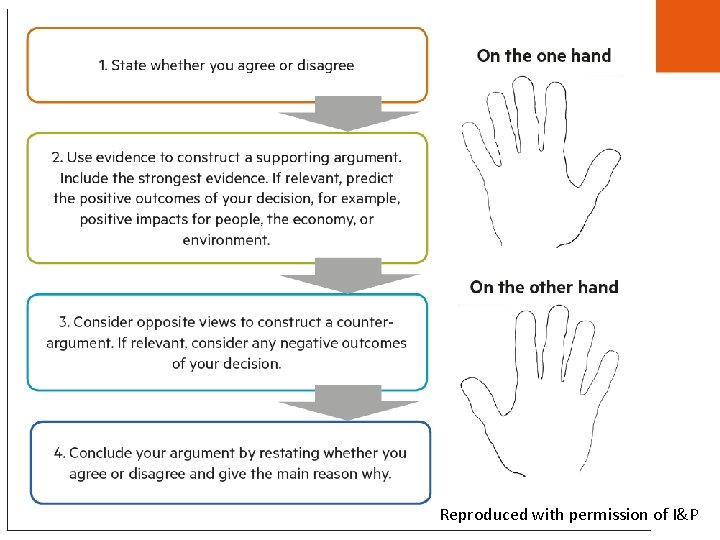
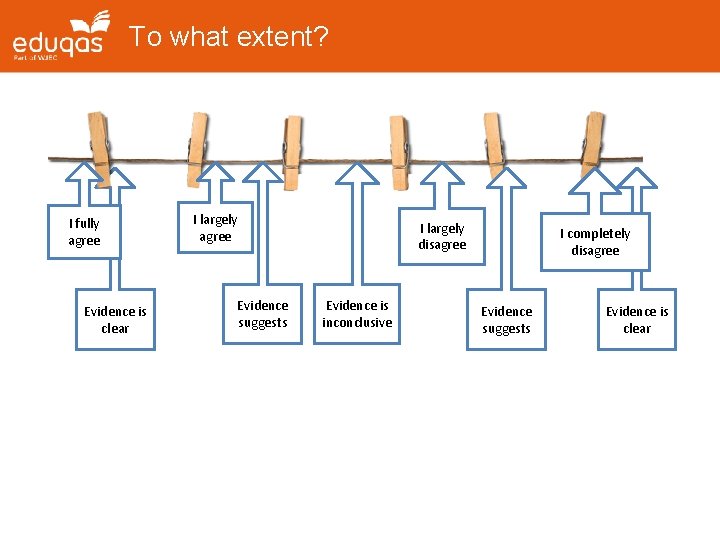
1. What went well? Components 1 and 2 • The papers were accessible to candidates of all abilities with very few blank responses to any items. • 8 mark questions were attempted by the majority –a significant number of candidates gave balanced responses by constructing arguments and counterarguments. • The best candidates made careful use of evidence in the exam paper when responding to 8 mark questions. • AO 4 questions which required candidate to read data from a map or graph were answered well – but students need more practice with questions about selecting a suitable technique.
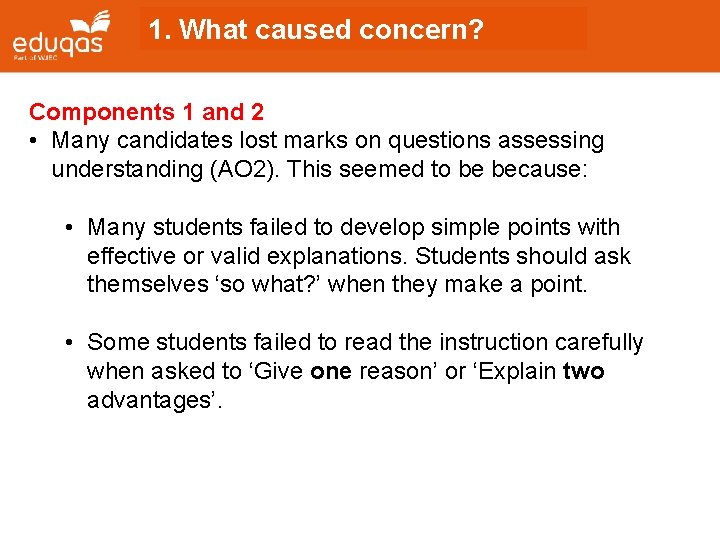
1. What caused concern? Components 1 and 2 • Many candidates lost marks on questions assessing understanding (AO 2). This seemed to be because: • Many students failed to develop simple points with effective or valid explanations. Students should ask themselves ‘so what? ’ when they make a point. • Some students failed to read the instruction carefully when asked to ‘Give one reason’ or ‘Explain two advantages’.
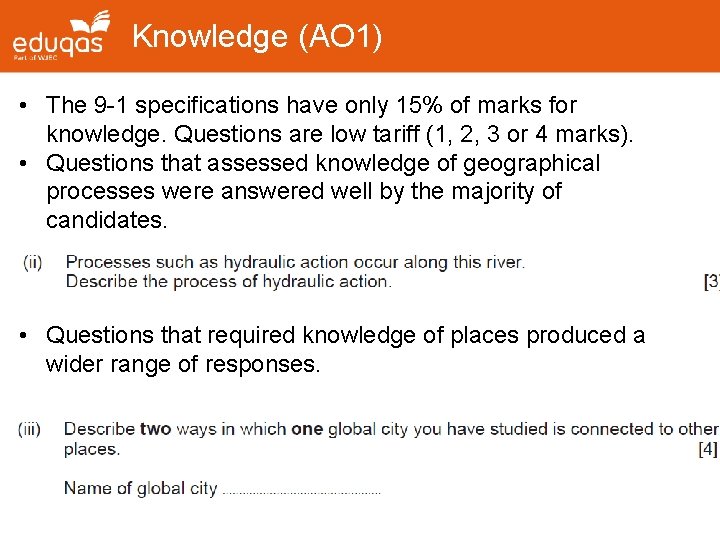
Knowledge (AO 1) • The 9 -1 specifications have only 15% of marks for knowledge. Questions are low tariff (1, 2, 3 or 4 marks). • Questions that assessed knowledge of geographical processes were answered well by the majority of candidates. • Questions that required knowledge of places produced a wider range of responses.
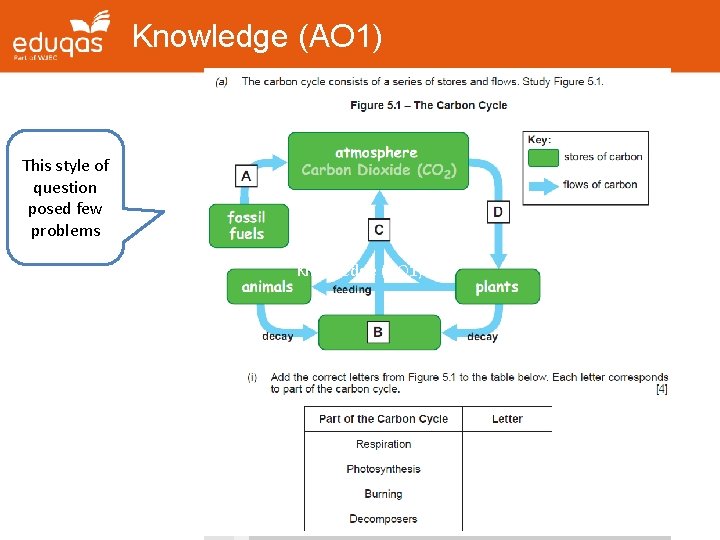
Knowledge (AO 1) This style of question posed few problems Knowledge (AO 1)
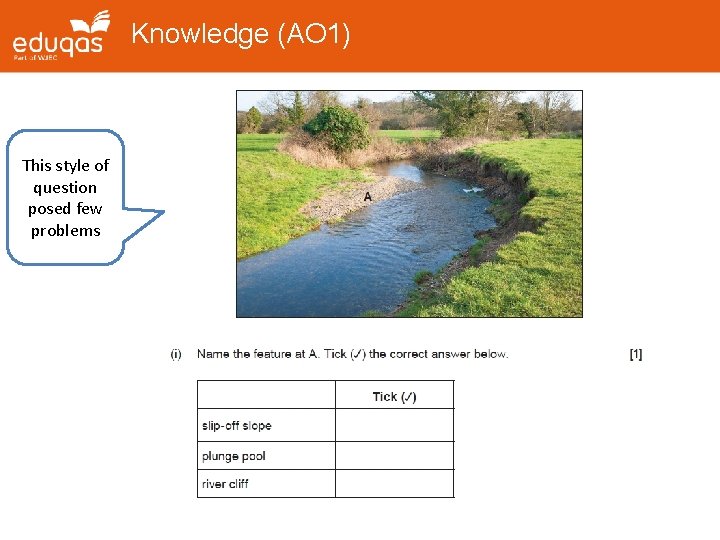
Knowledge (AO 1) This style of question posed few problems
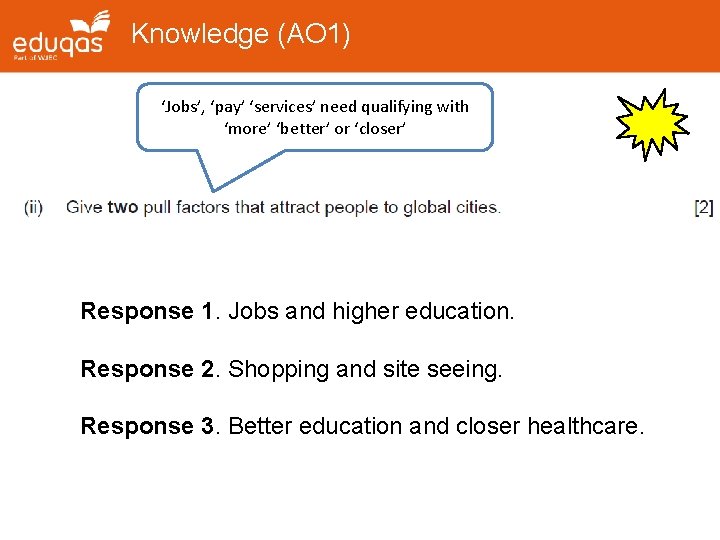
Knowledge (AO 1) ‘Jobs’, ‘pay’ ‘services’ need qualifying with ‘more’ ‘better’ or ‘closer’ Response 1. Jobs and higher education. Response 2. Shopping and site seeing. Response 3. Better education and closer healthcare.
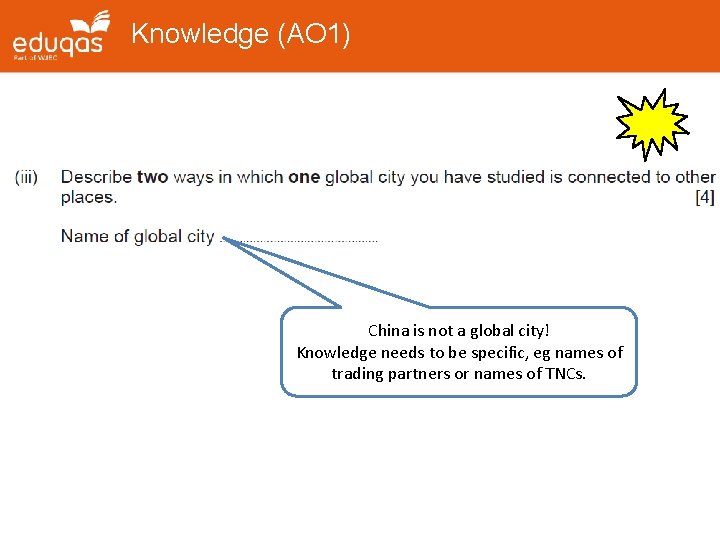
Knowledge (AO 1) China is not a global city! Knowledge needs to be specific, eg names of trading partners or names of TNCs.
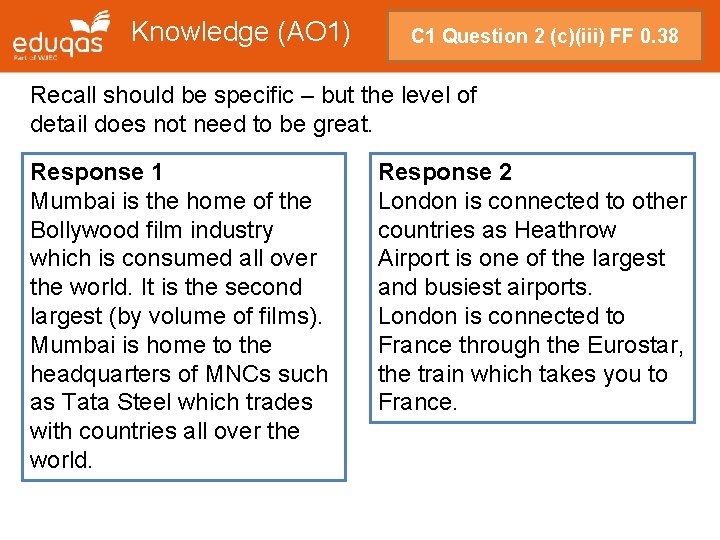
Knowledge (AO 1) C 1 Question 2 (c)(iii) FF 0. 38 Recall should be specific – but the level of detail does not need to be great. Response 1 Mumbai is the home of the Bollywood film industry which is consumed all over the world. It is the second largest (by volume of films). Mumbai is home to the headquarters of MNCs such as Tata Steel which trades with countries all over the world. Response 2 London is connected to other countries as Heathrow Airport is one of the largest and busiest airports. London is connected to France through the Eurostar, the train which takes you to France.
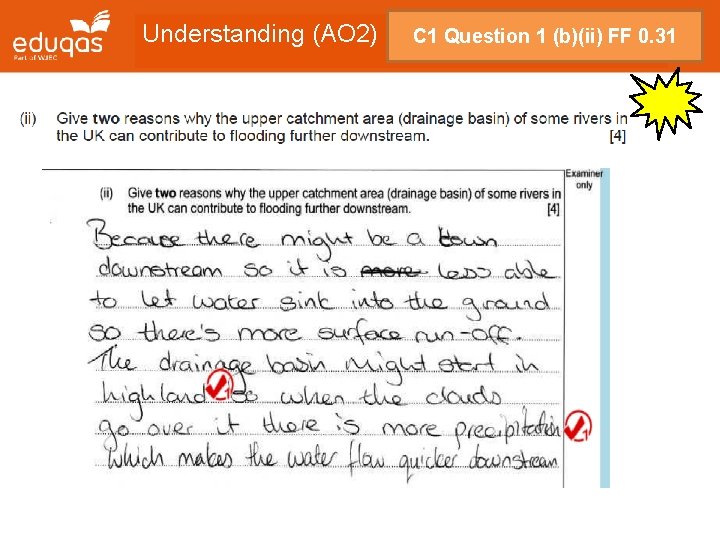
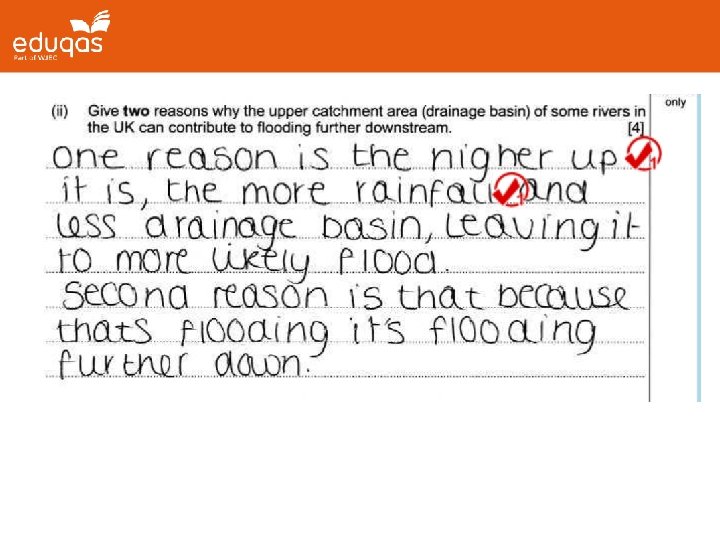
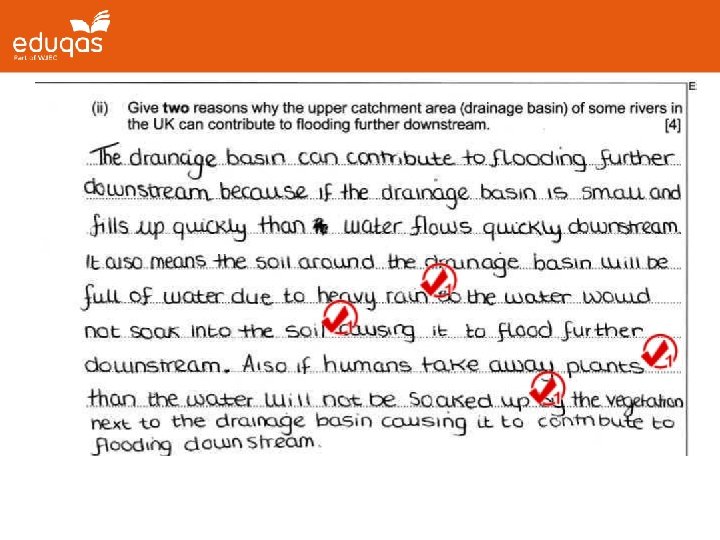
Understanding (AO 2) C 1 Question 1 (b)(ii) FF 0. 31
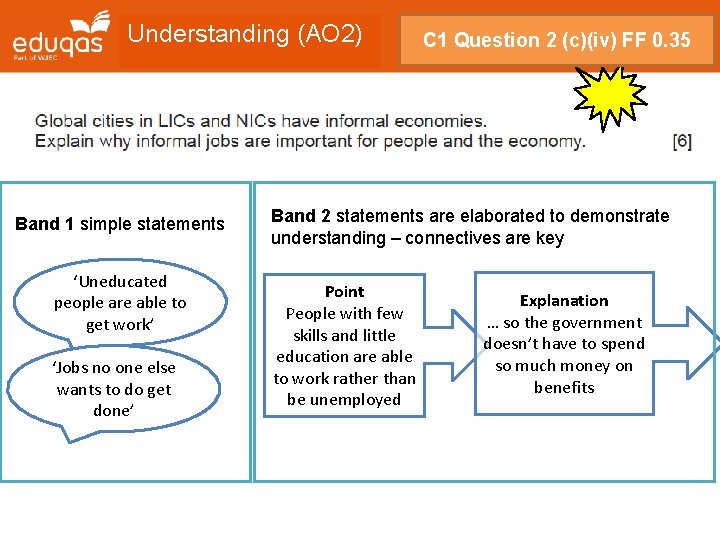
Understanding (AO 2) Band 1 simple statements ‘Uneducated people are able to get work’ ‘Jobs no one else wants to do get done’ C 1 Question 2 (c)(iv) FF 0. 35 Band 2 statements are elaborated to demonstrate understanding – connectives are key Point People with few skills and little education are able to work rather than be unemployed Explanation … so the government doesn’t have to spend so much money on benefits
Understanding – not recall Informal jobs allow people without qualifications to get a job and earn money. This allows them to pay for basic necessities, such as food, water, healthcare and shelter. Informal workers do not pay tax. Nevertheless, they still contribute to the wider economy by spending money in shops and in services where tax is paid. Their spending benefits local shops and businesses and contributes to a multiplier effect in the economy. Some informal workers are ragpickers. Ragpicking benefits people by reducing litter from their neighbourhood and it benefits the economy because it provides businesses with raw materials such as metals, fabric and plastics that can be manufactured into new goods.
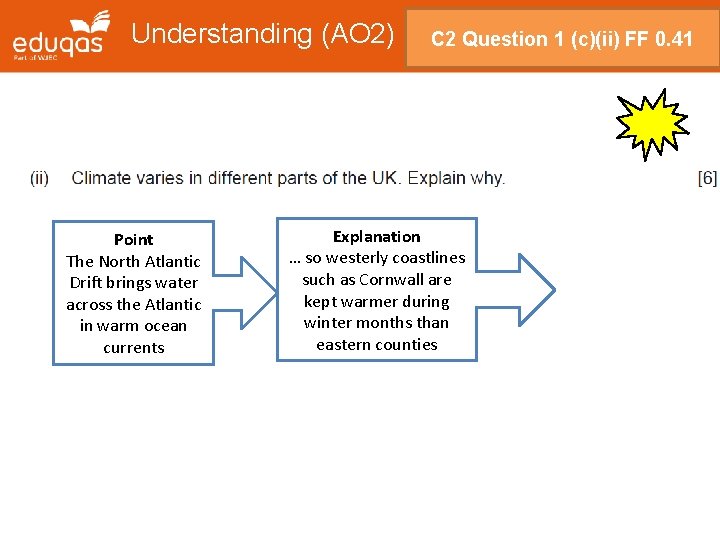
Understanding (AO 2) Point The North Atlantic Drift brings water across the Atlantic in warm ocean currents C 2 Question 1 (c)(ii) FF 0. 41 Explanation … so westerly coastlines such as Cornwall are kept warmer during winter months than eastern counties
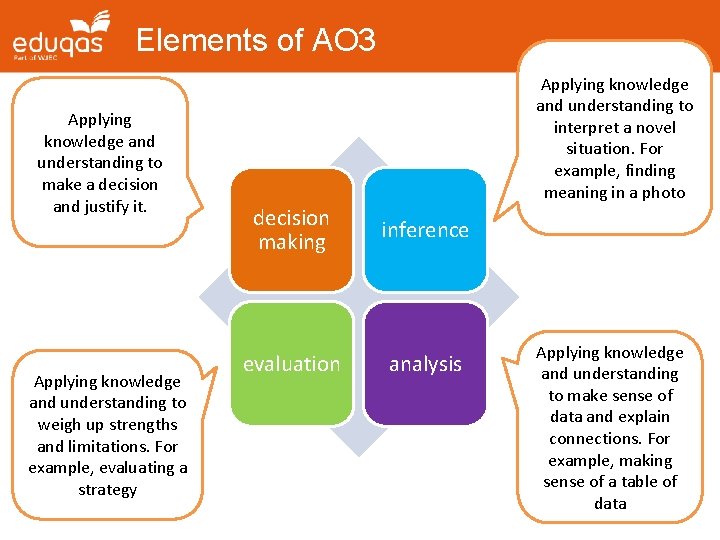
Elements of AO 3 Applying knowledge and understanding to make a decision and justify it. Applying knowledge and understanding to weigh up strengths and limitations. For example, evaluating a strategy Applying knowledge and understanding to interpret a novel situation. For example, finding meaning in a photo decision making inference evaluation analysis Applying knowledge and understanding to make sense of data and explain connections. For example, making sense of a table of data
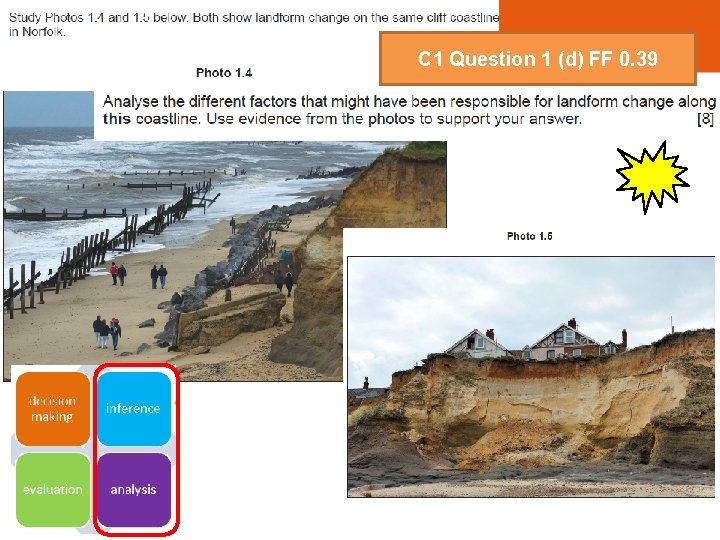
C 1 Question 1 (d) FF 0. 39
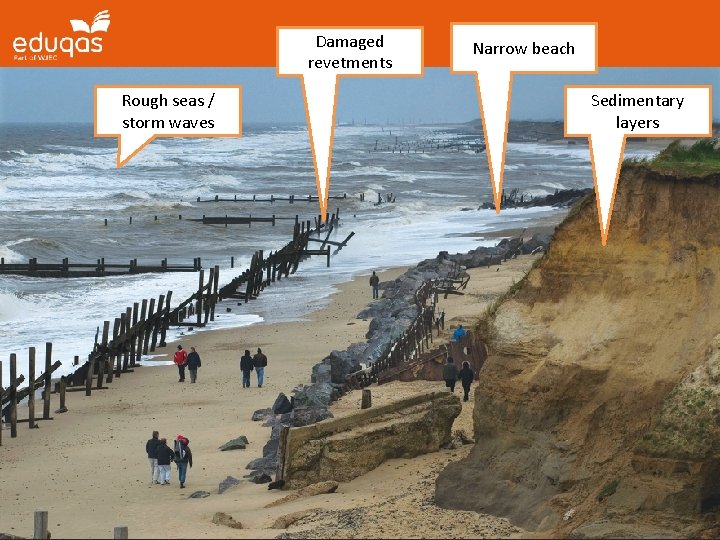
Damaged revetments Rough seas / storm waves Narrow beach Sedimentary layers
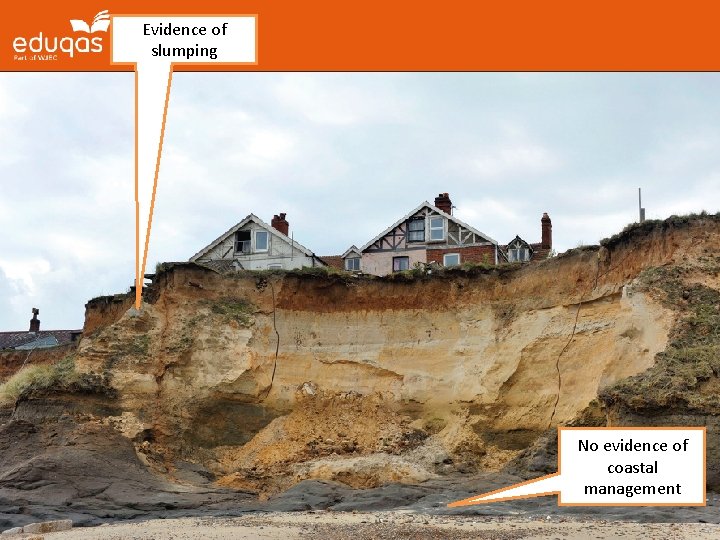
Evidence of slumping No evidence of coastal management
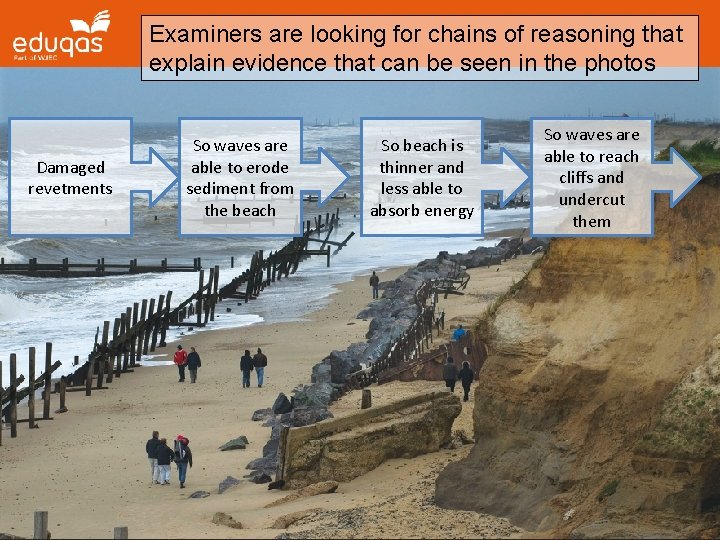
Examiners are looking for chains of reasoning that explain evidence that can be seen in the photos Damaged revetments So waves are able to erode sediment from the beach So beach is thinner and less able to absorb energy So waves are able to reach cliffs and undercut them
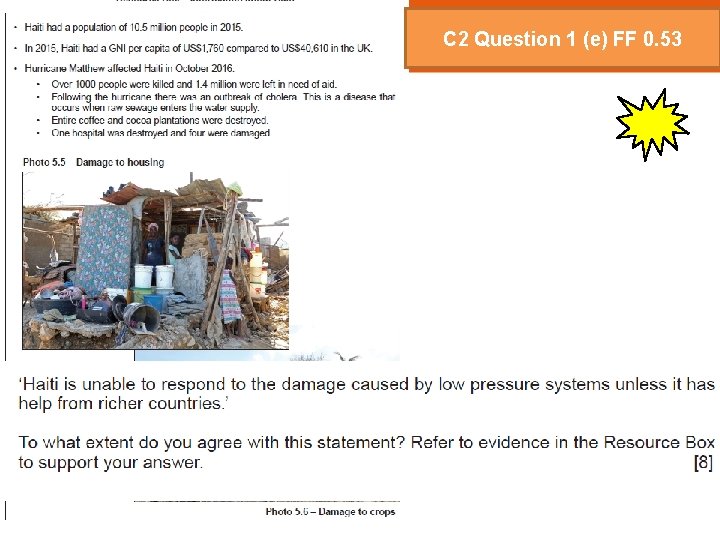
C 2 Question 1 (e) FF 0. 53
Reproduced with permission of I&P
To what extent? I fully agree Evidence is clear I largely agree Evidence suggests I largely disagree Evidence is inconclusive I completely disagree Evidence suggests Evidence is clear
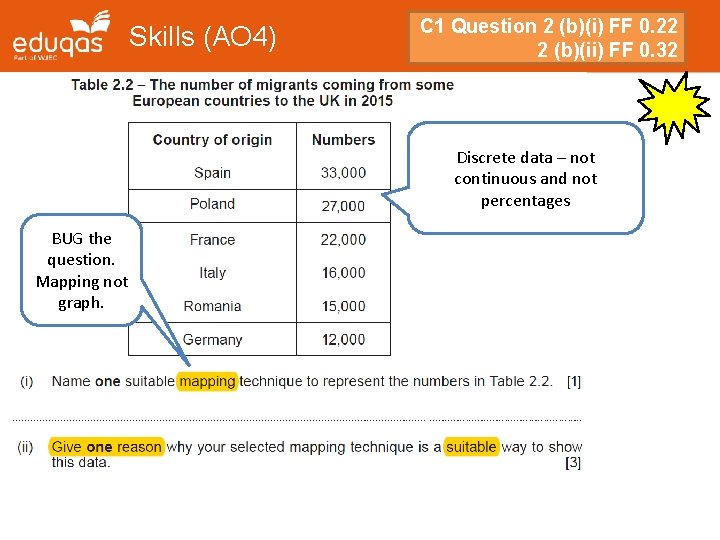
Skills (AO 4) C 1 Question 2 (b)(i) FF 0. 22 2 (b)(ii) FF 0. 32 Discrete data – not continuous and not percentages BUG the question. Mapping not graph.
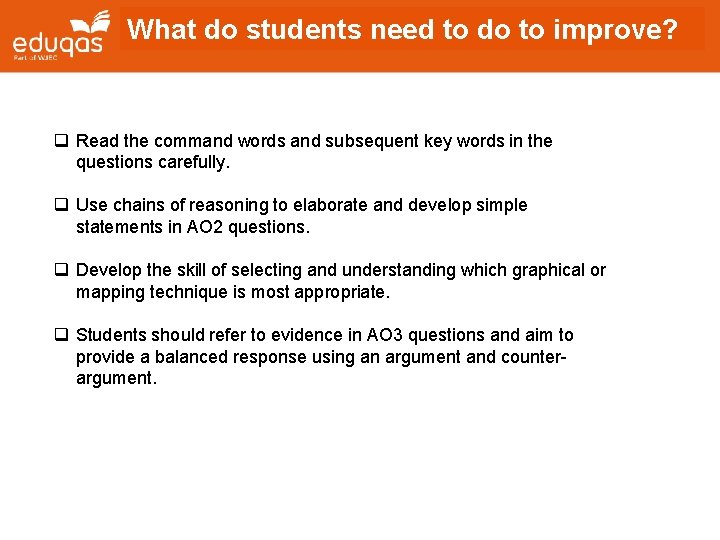
What do students need to do to improve? q Read the command words and subsequent key words in the questions carefully. q Use chains of reasoning to elaborate and develop simple statements in AO 2 questions. q Develop the skill of selecting and understanding which graphical or mapping technique is most appropriate. q Students should refer to evidence in AO 3 questions and aim to provide a balanced response using an argument and counterargument.

Any Questions? Contact our specialist Subject Officers and administrative team for your subject with any queries. GCSEGeography. A@eduqas. co. uk @eduqas. co. uk
- Slides: 37