
EDUQAS A Level Film Studies New Spec 201718
![EDUQAS A Level Film Studies [New Spec 2017/18] Component 1: Varieties of film and](https://slidetodoc.com/presentation_image/5360d5cbe77cb2bb6db40cdb8a7bcc7c/image-1.jpg "EDUQAS A Level Film Studies [New Spec 2017/18] Component 1: Varieties of film and")
- Slides: 17
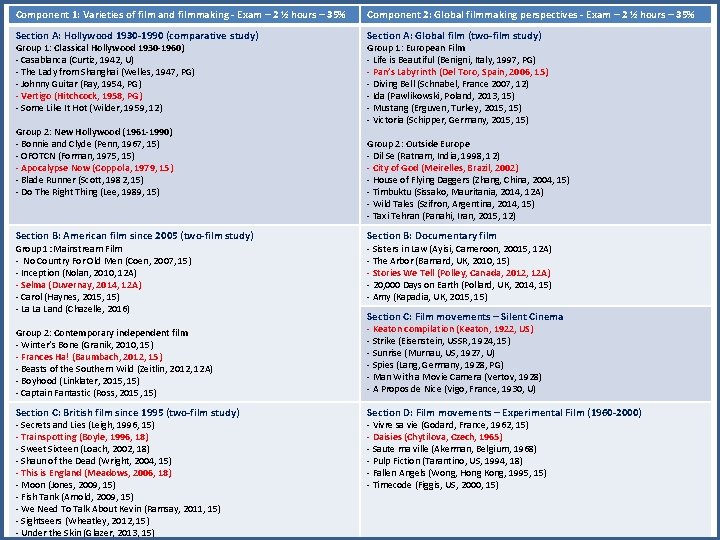
EDUQAS A Level Film Studies [New Spec 2017/18] Component 1: Varieties of film and filmmaking Exam – 2 ½ hours (35%) Section A: Hollywood 1930 -1990 (comparative study) Section B: American film since 2005 (two-film study) Section C: British film since 1995 (two-film study) Component 2: Global filmmaking perspectives Exam – 2 ½ hours (35%) Section A: Global film (two-film study) Section B: Documentary film Section C: Film movements – Silent Cinema Section D: Film movements – Experimental (1960 -2000) Component 3: Production Non-Exam Assessment (30%) 4 -5 minute short film and 1600 word evaluation
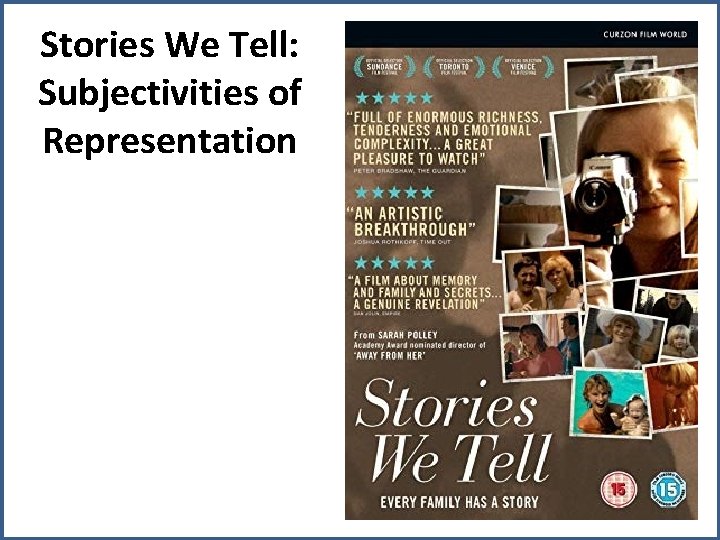
Stories We Tell: Subjectivities of Representation
Component 1: Varieties of film and filmmaking - Exam – 2 ½ hours – 35% Component 2: Global filmmaking perspectives - Exam – 2 ½ hours – 35% Section A: Hollywood 1930 -1990 (comparative study) Section A: Global film (two-film study) Group 1: Classical Hollywood 1930 -1960) - Casablanca (Curtiz, 1942, U) - The Lady from Shanghai (Welles, 1947, PG) - Johnny Guitar (Ray, 1954, PG) - Vertigo (Hitchcock, 1958, PG) - Some Like It Hot (Wilder, 1959, 12) Group 2: New Hollywood (1961 -1990) - Bonnie and Clyde (Penn, 1967, 15) - OFOTCN (Forman, 1975, 15) - Apocalypse Now (Coppola, 1979, 15) - Blade Runner (Scott, 1982, 15) - Do The Right Thing (Lee, 1989, 15) Section B: American film since 2005 (two-film study) Group 1: Mainstream Film - No Country For Old Men (Coen, 2007, 15) - Inception (Nolan, 2010, 12 A) - Selma (Duvernay, 2014, 12 A) - Carol (Haynes, 2015, 15) - La La Land (Chazelle, 2016) Group 1: European Film - Life is Beautiful (Benigni, Italy, 1997, PG) - Pan’s Labyrinth (Del Toro, Spain, 2006, 15) - Diving Bell (Schnabel, France 2007, 12) - Ida (Pawlikowski, Poland, 2013, 15) - Mustang (Erguven, Turkey, 2015, 15) - Victoria (Schipper, Germany, 2015, 15) Group 2: Outside Europe - Dil Se (Ratnam, India, 1998, 12) - City of God (Meirelles, Brazil, 2002) - House of Flying Daggers (Zhang, China, 2004, 15) - Timbuktu (Sissako, Mauritania, 2014, 12 A) - Wild Tales (Szifron, Argentina, 2014, 15) - Taxi Tehran (Panahi, Iran, 2015, 12) Section B: Documentary film - Sisters in Law (Ayisi, Cameroon, 20015, 12 A) - The Arbor (Barnard, UK, 2010, 15) - Stories We Tell (Polley, Canada, 2012, 12 A) - 20, 000 Days on Earth (Pollard, UK, 2014, 15) - Amy (Kapadia, UK, 2015, 15) Section C: Film movements – Silent Cinema Group 2: Contemporary independent film - Winter’s Bone (Granik, 2010, 15) - Frances Ha! (Baumbach, 2012, 15) - Beasts of the Southern Wild (Zeitlin, 2012, 12 A) - Boyhood (Linklater, 2015, 15) - Captain Fantastic (Ross, 2015, 15) - Keaton compilation (Keaton, 1922, US) - Strike (Eisenstein, USSR, 1924, 15) - Sunrise (Murnau, US, 1927, U) - Spies (Lang, Germany, 1928, PG) - Man With a Movie Camera (Vertov, 1928) - A Propos de Nice (Vigo, France, 1930, U) Section C: British film since 1995 (two-film study) Section D: Film movements – Experimental Film (1960 -2000) - Secrets and Lies (Leigh, 1996, 15) - Trainspotting (Boyle, 1996, 18) - Sweet Sixteen (Loach, 2002, 18) - Shaun of the Dead (Wright, 2004, 15) - This is England (Meadows, 2006, 18) - Moon (Jones, 2009, 15) - Fish Tank (Arnold, 2009, 15) - We Need To Talk About Kevin (Ramsay, 2011, 15) - Sightseers (Wheatley, 2012, 15) - Under the Skin (Glazer, 2013, 15) - Vivre sa vie (Godard, France, 1962, 15) - Daisies (Chytilova, Czech, 1965) - Saute ma ville (Akerman, Belgium, 1968) - Pulp Fiction (Tarantino, US, 1994, 18) - Fallen Angels (Wong, Hong Kong, 1995, 15) - Timecode (Figgis, US, 2000, 15)
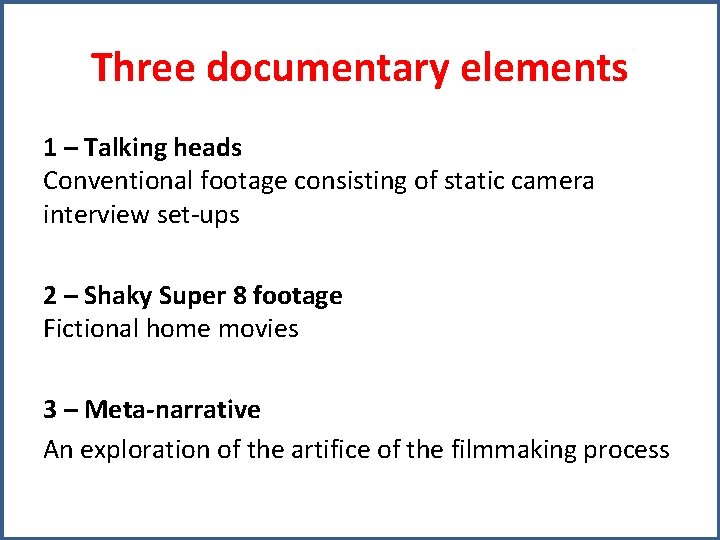
Three documentary elements 1 – Talking heads Conventional footage consisting of static camera interview set-ups 2 – Shaky Super 8 footage Fictional home movies 3 – Meta-narrative An exploration of the artifice of the filmmaking process
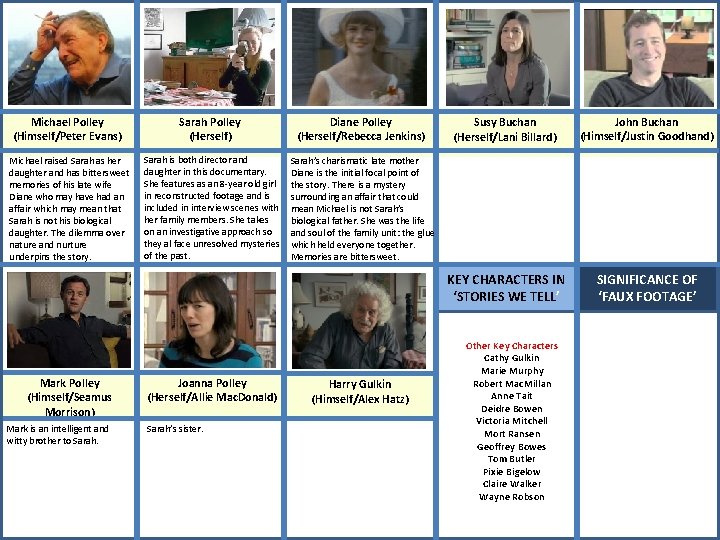
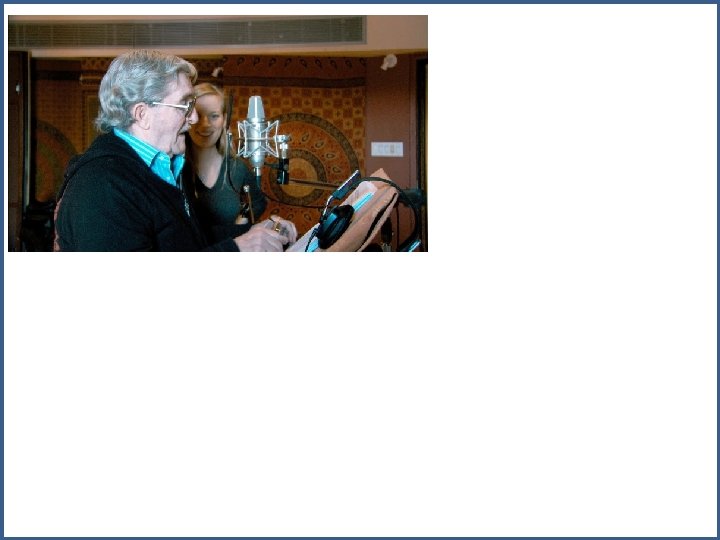
Michael Polley (Himself/Peter Evans) Sarah Polley (Herself) Diane Polley (Herself/Rebecca Jenkins) Michael raised Sarah as her daughter and has bittersweet memories of his late wife Diane who may have had an affair which may mean that Sarah is not his biological daughter. The dilemma over nature and nurture underpins the story. Sarah is both director and daughter in this documentary. She features as an 8 -year old girl in reconstructed footage and is included in interview scenes with her family members. She takes on an investigative approach so they al face unresolved mysteries of the past. Sarah’s charismatic late mother Diane is the initial focal point of the story. There is a mystery surrounding an affair that could mean Michael is not Sarah’s biological father. She was the life and soul of the family unit: the glue which held everyone together. Memories are bittersweet. Mark Polley (Himself/Seamus Morrison) Mark is an intelligent and witty brother to Sarah. Joanna Polley (Herself/Allie Mac. Donald) Sarah’s sister. Harry Gulkin (Himself/Alex Hatz) Susy Buchan (Herself/Lani Billard) John Buchan (Himself/Justin Goodhand) KEY CHARACTERS IN ‘STORIES WE TELL’ SIGNIFICANCE OF ‘FAUX FOOTAGE’ Other Key Characters Cathy Gulkin Marie Murphy Robert Mac. Millan Anne Tait Deidre Bowen Victoria Mitchell Mort Ransen Geoffrey Bowes Tom Butler Pixie Bigelow Claire Walker Wayne Robson
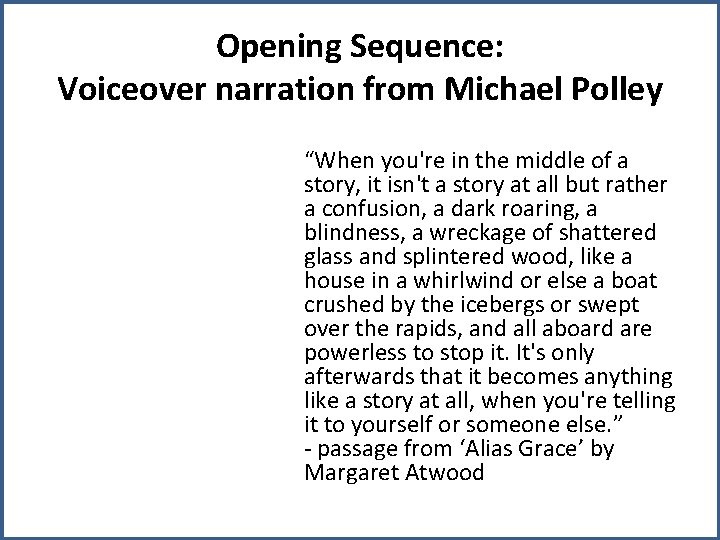
Opening Sequence: Voiceover narration from Michael Polley “When you're in the middle of a story, it isn't a story at all but rather a confusion, a dark roaring, a blindness, a wreckage of shattered glass and splintered wood, like a house in a whirlwind or else a boat crushed by the icebergs or swept over the rapids, and all aboard are powerless to stop it. It's only afterwards that it becomes anything like a story at all, when you're telling it to yourself or someone else. ” - passage from ‘Alias Grace’ by Margaret Atwood
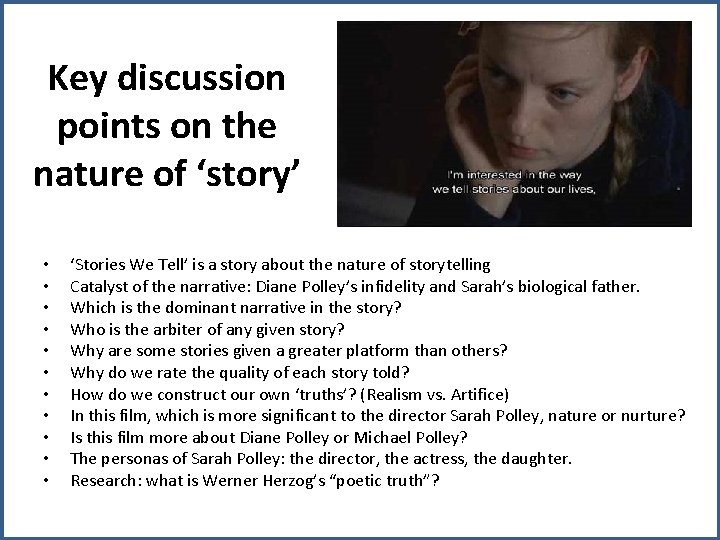
Key discussion points on the nature of ‘story’ • • • ‘Stories We Tell’ is a story about the nature of storytelling Catalyst of the narrative: Diane Polley’s infidelity and Sarah’s biological father. Which is the dominant narrative in the story? Who is the arbiter of any given story? Why are some stories given a greater platform than others? Why do we rate the quality of each story told? How do we construct our own ‘truths’? (Realism vs. Artifice) In this film, which is more significant to the director Sarah Polley, nature or nurture? Is this film more about Diane Polley or Michael Polley? The personas of Sarah Polley: the director, the actress, the daughter. Research: what is Werner Herzog’s “poetic truth”?
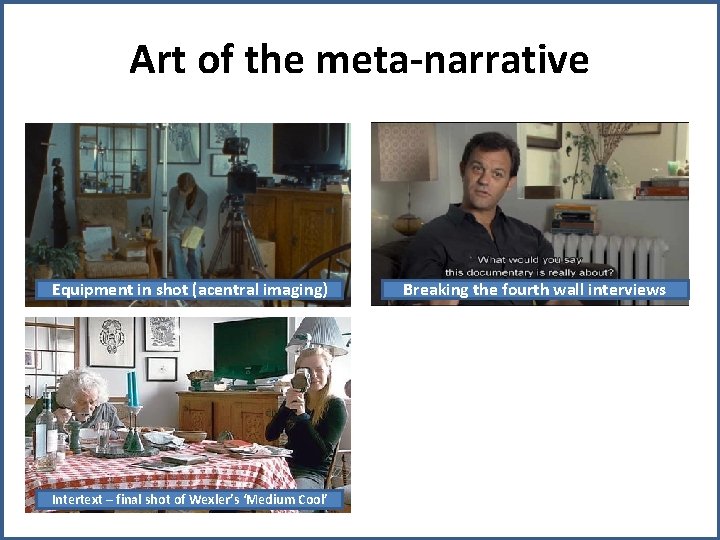
Art of the meta-narrative Equipment in shot (acentral imaging) Intertext – final shot of Wexler’s ‘Medium Cool’ Breaking the fourth wall interviews
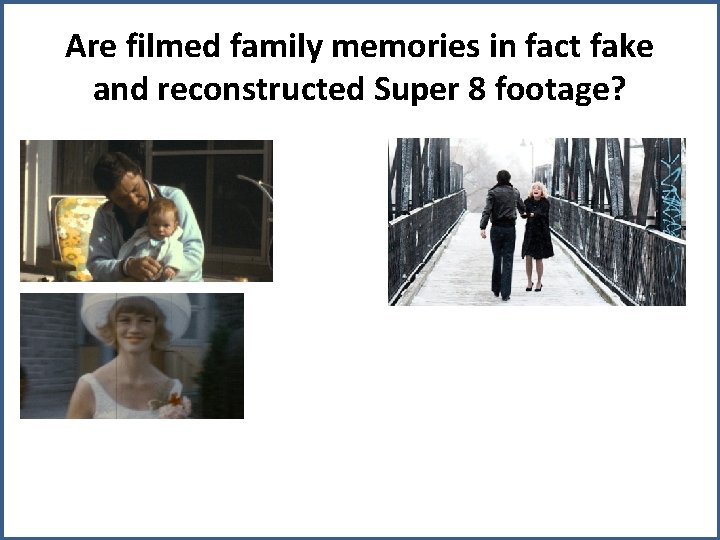
Are filmed family memories in fact fake and reconstructed Super 8 footage?
Emerging female directors • Female authorship: Longinotto able to speak nearby her subjects rather than about them (respect for subjects, providing a voice, creating intimacy, exploring ideas of truthpoetic, subjective)
Reliable or unreliable narration?
Formalist analysis • The unnatural right-to-left pan revealing • Faux footage – the credits reveal actors playing the roles of the Polley family, home movie style is voyeuristic (invasive close-ups are not typical of home videos),
Contentions • Are personal documentaries too selfindulgent?
Documentary Theory • John Grierson
Documentary Conventions
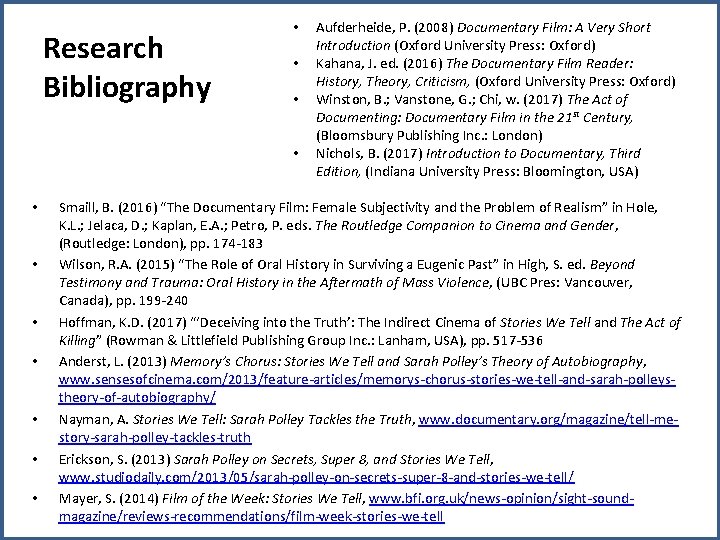
Research Bibliography • • • Aufderheide, P. (2008) Documentary Film: A Very Short Introduction (Oxford University Press: Oxford) Kahana, J. ed. (2016) The Documentary Film Reader: History, Theory, Criticism, (Oxford University Press: Oxford) Winston, B. ; Vanstone, G. ; Chi, w. (2017) The Act of Documenting: Documentary Film in the 21 st Century, (Bloomsbury Publishing Inc. : London) Nichols, B. (2017) Introduction to Documentary, Third Edition, (Indiana University Press: Bloomington, USA) Smaill, B. (2016) “The Documentary Film: Female Subjectivity and the Problem of Realism” in Hole, K. L. ; Jelaca, D. ; Kaplan, E. A. ; Petro, P. eds. The Routledge Companion to Cinema and Gender, (Routledge: London), pp. 174 -183 Wilson, R. A. (2015) “The Role of Oral History in Surviving a Eugenic Past” in High, S. ed. Beyond Testimony and Trauma: Oral History in the Aftermath of Mass Violence, (UBC Pres: Vancouver, Canada), pp. 199 -240 Hoffman, K. D. (2017) “‘Deceiving into the Truth’: The Indirect Cinema of Stories We Tell and The Act of Killing” (Rowman & Littlefield Publishing Group Inc. : Lanham, USA), pp. 517 -536 Anderst, L. (2013) Memory’s Chorus: Stories We Tell and Sarah Polley’s Theory of Autobiography, www. sensesofcinema. com/2013/feature-articles/memorys-chorus-stories-we-tell-and-sarah-polleystheory-of-autobiography/ Nayman, A. Stories We Tell: Sarah Polley Tackles the Truth, www. documentary. org/magazine/tell-mestory-sarah-polley-tackles-truth Erickson, S. (2013) Sarah Polley on Secrets, Super 8, and Stories We Tell, www. studiodaily. com/2013/05/sarah-polley-on-secrets-super-8 -and-stories-we-tell/ Mayer, S. (2014) Film of the Week: Stories We Tell, www. bfi. org. uk/news-opinion/sight-soundmagazine/reviews-recommendations/film-week-stories-we-tell