
EDUGAMES Behaviorism Repetition of actionsthinking leads to learning

EDUGAMES
Behaviorism Repetition of actions/thinking leads to learning. Reinforcement of actions/thinking through the use of incentives leads to learning. Knowledge exists to be followed. What are some elements in games that are behaviorist? What are some elements in school that are behaviorist?
Constructivism Interactions with others, contexts, and situations lead to learning. Individualized, practical experiences lead to learning. Knowledge is created and then reflected upon. What are some elements in games that are constructivist? What are some elements in school that are constructivist?
Problems and Issues Behaviorist—how do we create something new if all we know is what is reinforced? � Does Grand Theft Auto teach you to be a criminal? Does MS Flight Simulator teach you to be a pilot? � Does completing 20 of the same algebra problems teach you to make a robot? Constructivism—how do we communicate something we figured out ourselves? � Does playing Grand Theft Auto make you better at Gears of War? Does it make you better at multitasking and project management?
Thinking Exercise Behaviorist—how do we create something new if all we know is what is reinforced? How could we use Grand Theft Auto to teach people how to be a criminal? � How could we use MS Flight Simulator to teach people how to be a pilot? � How could we teach algebra other than through problem replication? � Constructivism—how do we communicate something we figured out ourselves? How could we use a game to teach people how to be better at multitasking or project management? � How do we teach 10, 50, 100 “individuals”? �
Your turn Go to the course website and select an edugame (Menu > Games > Edugames). Play it for 5 -10 minutes � Describe the game and what it is teaching � Is it behaviorist or constructivist � Is it effective? � What would you do/revise in the game to make it a better teaching/learning tool?
Reacting To The Past (RTTP)
What are they? They are role-playing games designed to get students to engage with history, literature, or science by assuming a role, and making a decision that can better help them understand how/why something happened. “Reacting To…” games were originally developed by Mark Carnes at Barnard College. They have been extensively researched and found to be more effective in retention and comprehension than lectures (Minds on Fire).
What are the components? Real situation with the possibility of an alternate outcome A balance of chance and choice. Debate, either written or spoken, are central Elements of secrecy, ulterior motives, and struggles with human nature
How to Build one? Begin with a real setting or situation � An important historical event that required a significant choice � a recent (although past) debate or choice Write a narrative “setting” that places everybody at the scene of the choice. Define roles that the students inhabit. Give them motives and back stories. Define their initial choices, but allow space for them to change their minds. Determine a win-state or victory condition Create an element of chance through having certain events or outcomes be determined by a die roll.
Required Elements Pedagogical objective Supplies Role distribution and descriptions The “core” game mechanic � In Disease Strain, it was a group act (quarantine) based on analysis and debate. � In Bomb the Church, it was debate about art v. life Description of chance possibilities (e. g. , die roll results in X) Victory condition
Above and Beyond Images, multimodal elements. Primary text references that would help students make better choices. Rich roles that reveal the foibles of human nature. Difficult choice conditions.
Published Athens in 403 B. C. “Threshold of Democracy” Charles Darwin, 1861 -64 “The Rise of Naturalism” Confucianism, 1587 “Crisis of the Wanli Emperor” Defining a Nation: India on the Eve of Independence, 1945 Greenwich Village, 1913 “Suffrage and Labor” Henry VIII “Reformation” Revolution in France, 1791 Revolution in NYC, 1775 -76 The Council of Nicaea “Orthodoxy and Heresy, 325 AD” The Trial of Anne Hutchinson The Trial of Galileo Marlowe and Shakespeare “Stages of Power”
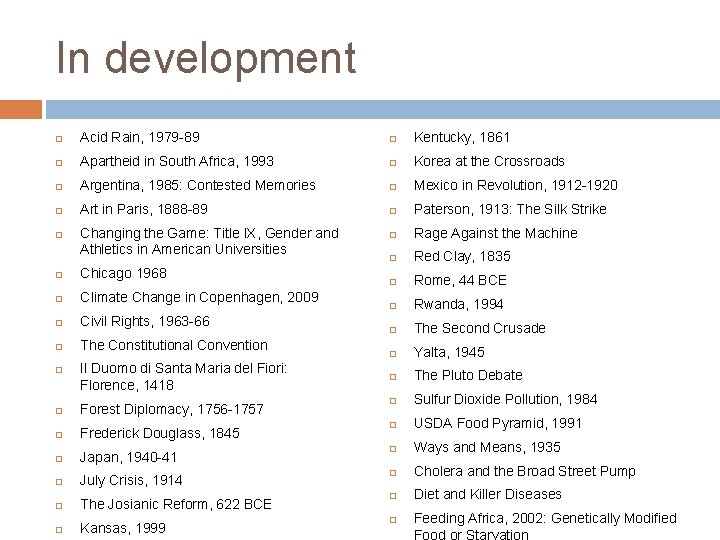
In development Acid Rain, 1979 -89 Kentucky, 1861 Apartheid in South Africa, 1993 Korea at the Crossroads Argentina, 1985: Contested Memories Mexico in Revolution, 1912 -1920 Art in Paris, 1888 -89 Paterson, 1913: The Silk Strike Rage Against the Machine Red Clay, 1835 Rome, 44 BCE Rwanda, 1994 The Second Crusade Yalta, 1945 The Pluto Debate Sulfur Dioxide Pollution, 1984 USDA Food Pyramid, 1991 Ways and Means, 1935 Cholera and the Broad Street Pump Diet and Killer Diseases Changing the Game: Title IX, Gender and Athletics in American Universities Chicago 1968 Climate Change in Copenhagen, 2009 Civil Rights, 1963 -66 The Constitutional Convention Il Duomo di Santa Maria del Fiori: Florence, 1418 Forest Diplomacy, 1756 -1757 Frederick Douglass, 1845 Japan, 1940 -41 July Crisis, 1914 The Josianic Reform, 622 BCE Kansas, 1999 Feeding Africa, 2002: Genetically Modified Food or Starvation
- Slides: 14