
Educator Evaluation The Model Process for Principal Evaluation

- Slides: 32
Educator Evaluation: The Model Process for Principal Evaluation July 26, 2012 Massachusetts Secondary School Administrators’ Association Summer Institute
Agenda Overview of 5 -Step Evaluation Cycle o Strategies for leveraging your evaluation for school improvement and professional growth Resources o What’s available o What’s coming Lessons from an Early Adopter District 2 Massachusetts Department of Elementary and Secondary Education
Intended Outcomes Understand the 5 -Step Cycle of Continuous Improvement that is the foundation of the new system o How it applies to you as an educator o How to marshal it for your own professional growth o How to leverage it for improvement in your school Know the key components of the model system for evaluating principals Know how to access resources that will help you 3 lead effective implementation efforts back in your school and district Massachusetts Department of Elementary and Secondary Education
Overview of 5 -Step Evaluation Cycle Massachusetts Model System for Educator Evaluation Part V: Implementation Guide for Principal Evaluation Massachusetts Department of Elementary and Secondary Education 4
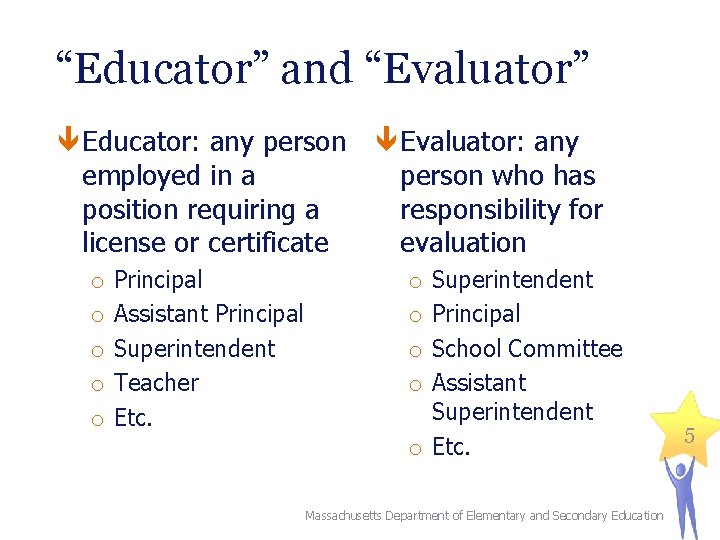
“Educator” and “Evaluator” Educator: any person Evaluator: any employed in a person who has position requiring a responsibility for license or certificate evaluation o o o Principal Assistant Principal Superintendent Teacher Etc. Superintendent Principal School Committee Assistant Superintendent o Etc. o o Massachusetts Department of Elementary and Secondary Education 5
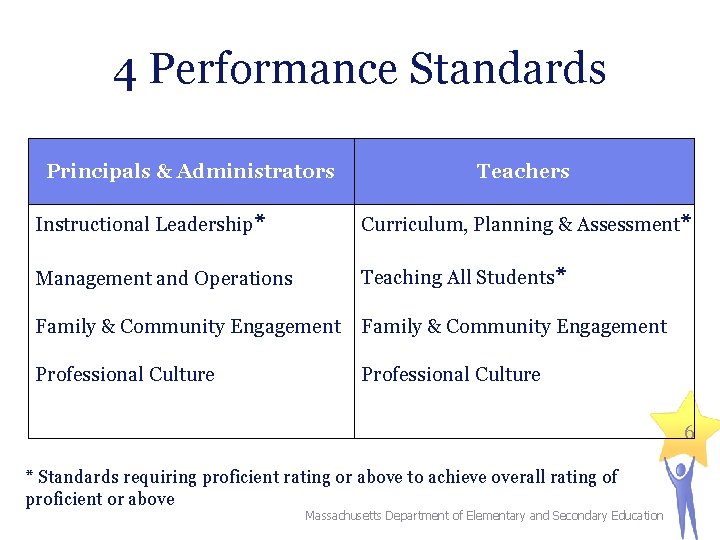
4 Performance Standards Principals & Administrators Teachers Instructional Leadership* Curriculum, Planning & Assessment* Management and Operations Teaching All Students* Family & Community Engagement Professional Culture 6 * Standards requiring proficient rating or above to achieve overall rating of proficient or above Massachusetts Department of Elementary and Secondary Education
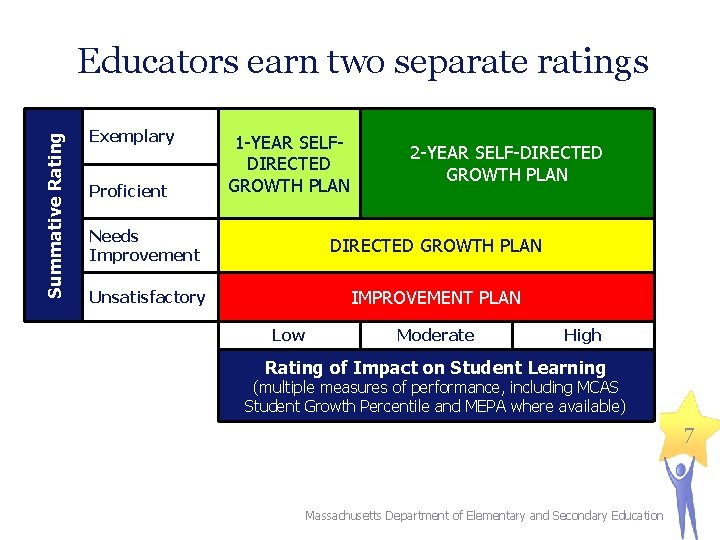
Summative Rating Educators earn two separate ratings Exemplary Proficient 1 -YEAR SELFDIRECTED GROWTH PLAN 2 -YEAR SELF-DIRECTED GROWTH PLAN Needs Improvement DIRECTED GROWTH PLAN Unsatisfactory IMPROVEMENT PLAN Low Moderate High Rating of Impact on Student Learning (multiple measures of performance, including MCAS Student Growth Percentile and MEPA where available) 7 Massachusetts Department of Elementary and Secondary Education
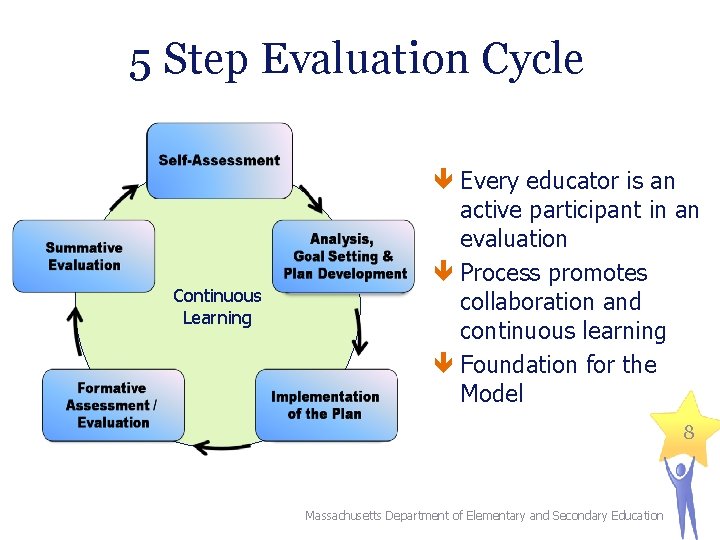
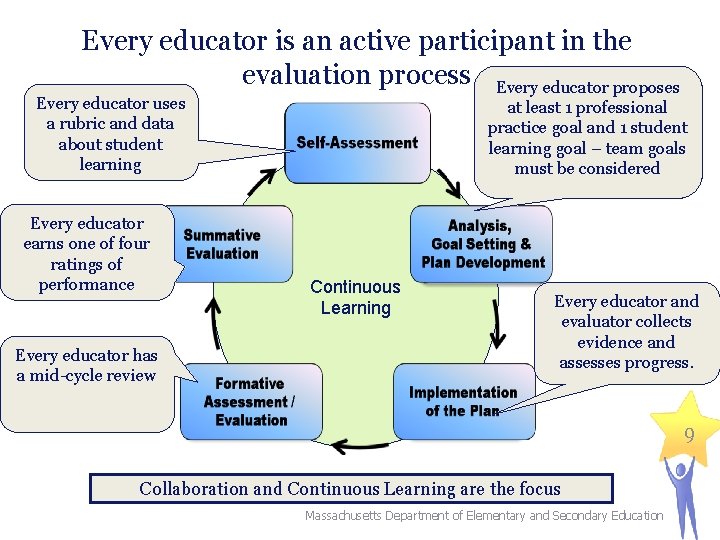
5 Step Evaluation Cycle Continuous Learning Every educator is an active participant in an evaluation Process promotes collaboration and continuous learning Foundation for the Model 8 Massachusetts Department of Elementary and Secondary Education
Every educator is an active participant in the evaluation process Every educator proposes Every educator uses a rubric and data about student learning Every educator earns one of four ratings of performance Every educator has a mid-cycle review at least 1 professional practice goal and 1 student learning goal – team goals must be considered Continuous Learning Every educator and evaluator collects evidence and assesses progress. 9 Collaboration and Continuous Learning are the focus Massachusetts Department of Elementary and Secondary Education
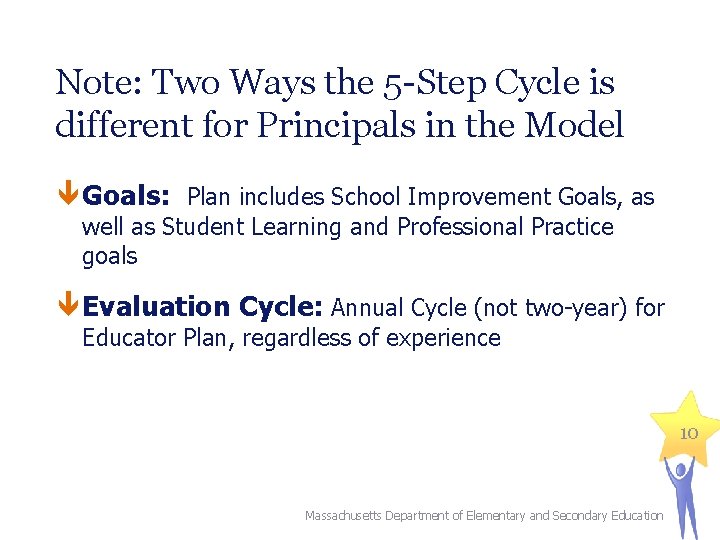
Note: Two Ways the 5 -Step Cycle is different for Principals in the Model Goals: Plan includes School Improvement Goals, as well as Student Learning and Professional Practice goals Evaluation Cycle: Annual Cycle (not two-year) for Educator Plan, regardless of experience 10 Massachusetts Department of Elementary and Secondary Education
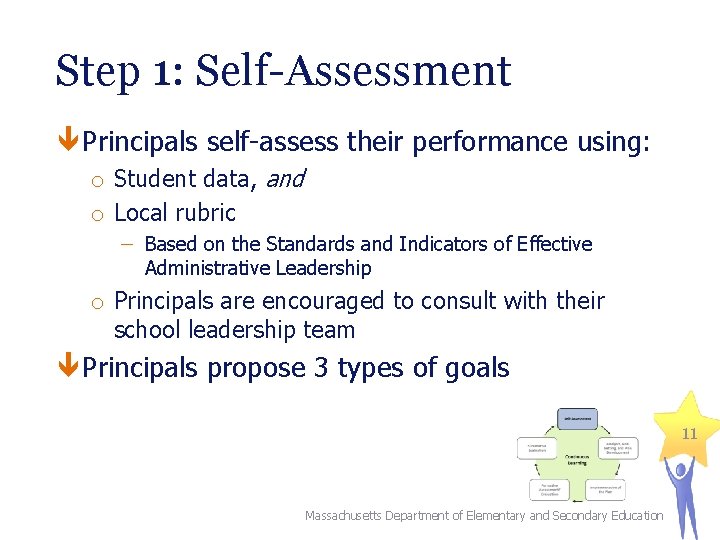
Step 1: Self-Assessment Principals self-assess their performance using: o Student data, and o Local rubric Based on the Standards and Indicators of Effective Administrative Leadership o Principals are encouraged to consult with their school leadership team Principals propose 3 types of goals 11 Massachusetts Department of Elementary and Secondary Education
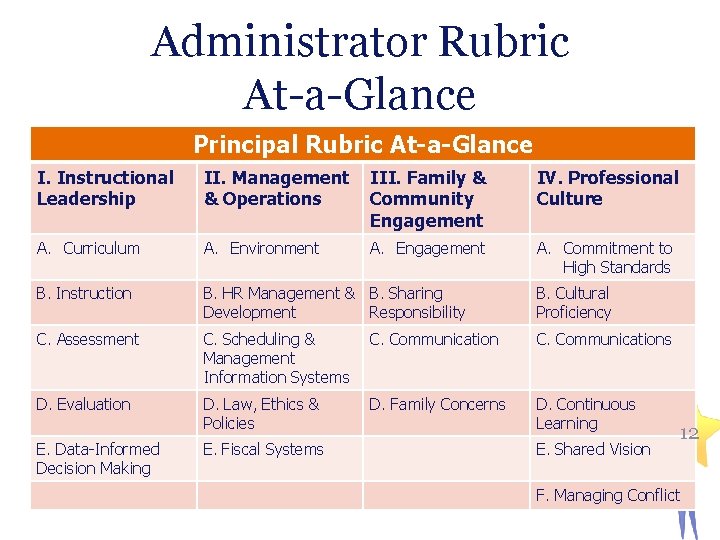
Administrator Rubric At-a-Glance Principal Rubric At-a-Glance I. Instructional Leadership II. Management & Operations III. Family & Community Engagement IV. Professional Culture A. Curriculum A. Environment A. Engagement A. Commitment to High Standards B. Instruction B. HR Management & B. Sharing Development Responsibility B. Cultural Proficiency C. Assessment C. Scheduling & Management Information Systems C. Communications D. Evaluation D. Law, Ethics & Policies D. Family Concerns D. Continuous Learning E. Data-Informed Decision Making E. Fiscal Systems E. Shared Vision 12 F. Managing Conflict
Individual Reflection Jot down one or two key priorities you want to focus on next year in your school to improve instruction and student learning 13 Massachusetts Department of Elementary and Secondary Education
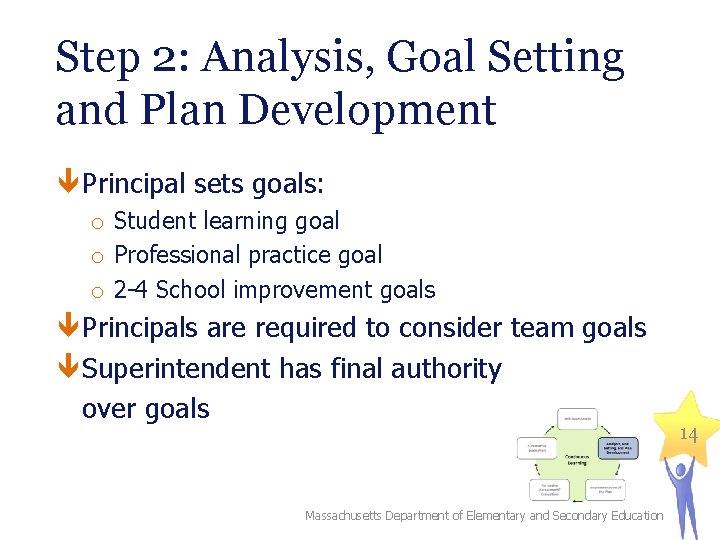
Step 2: Analysis, Goal Setting and Plan Development Principal sets goals: o Student learning goal o Professional practice goal o 2 -4 School improvement goals Principals are required to consider team goals Superintendent has final authority over goals Massachusetts Department of Elementary and Secondary Education 14
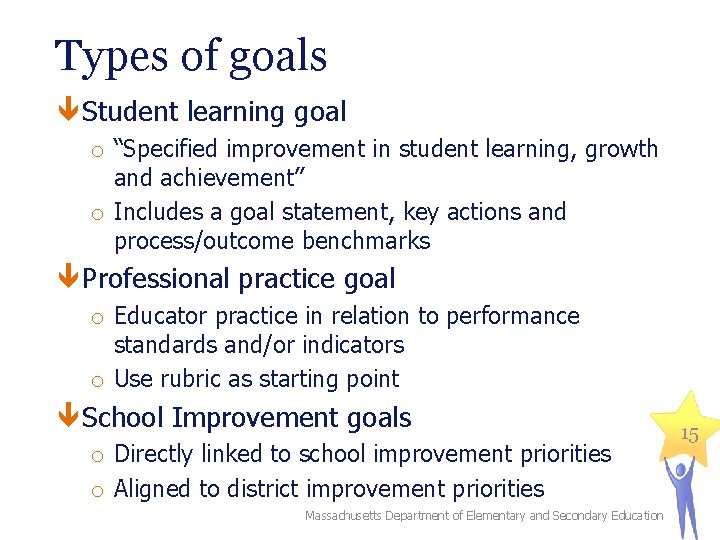
Types of goals Student learning goal o “Specified improvement in student learning, growth and achievement” o Includes a goal statement, key actions and process/outcome benchmarks Professional practice goal o Educator practice in relation to performance standards and/or indicators o Use rubric as starting point School Improvement goals o Directly linked to school improvement priorities o Aligned to district improvement priorities Massachusetts Department of Elementary and Secondary Education 15
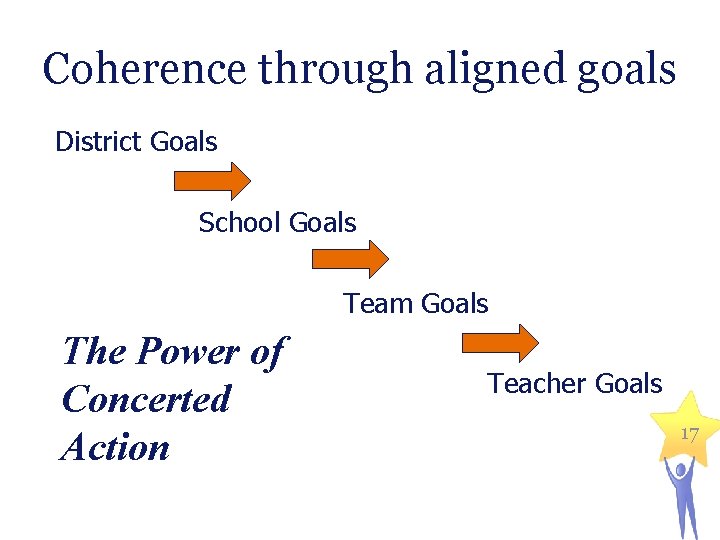
Coherence through aligned goals District Goals School Goals Team Goals The Power of Concerted Action Teacher Goals 17
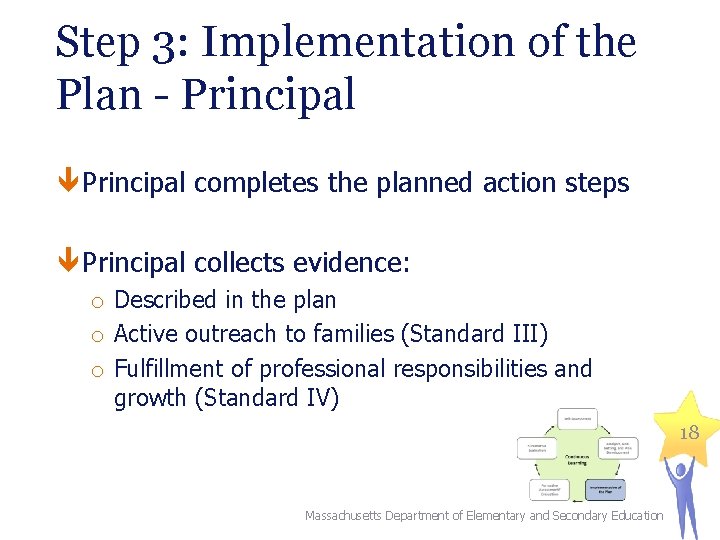
Step 3: Implementation of the Plan - Principal completes the planned action steps Principal collects evidence: o Described in the plan o Active outreach to families (Standard III) o Fulfillment of professional responsibilities and growth (Standard IV) 18 Massachusetts Department of Elementary and Secondary Education
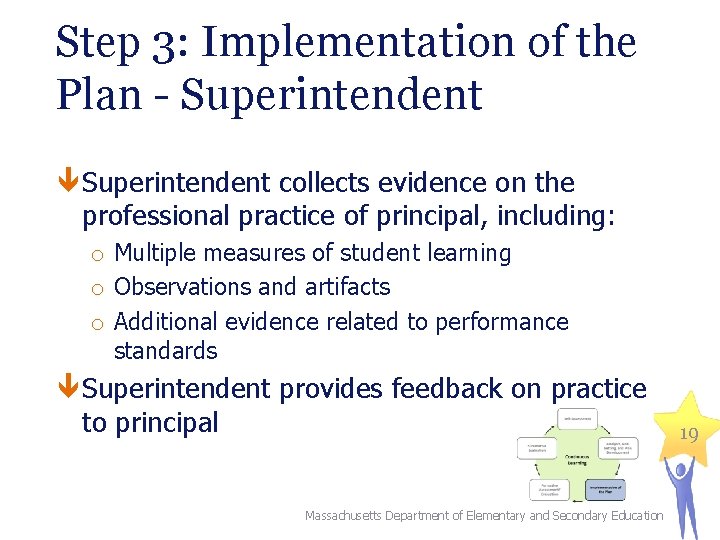
Step 3: Implementation of the Plan - Superintendent collects evidence on the professional practice of principal, including: o Multiple measures of student learning o Observations and artifacts o Additional evidence related to performance standards Superintendent provides feedback on practice to principal Massachusetts Department of Elementary and Secondary Education 19
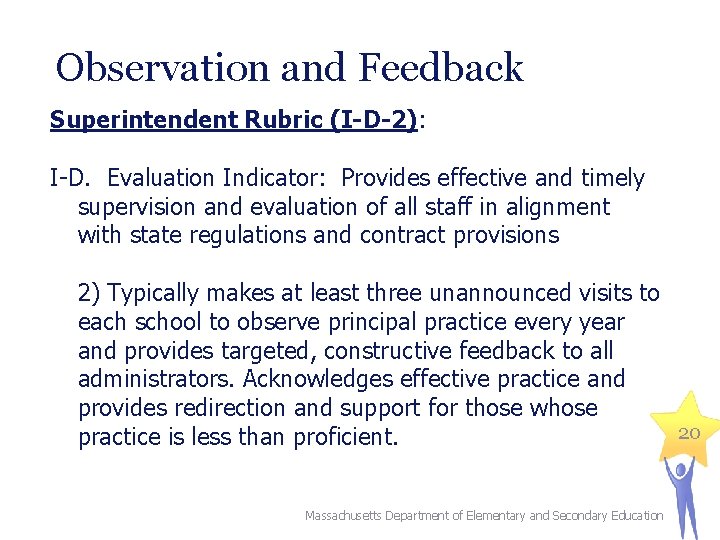
Observation and Feedback Superintendent Rubric (I-D-2): I-D. Evaluation Indicator: Provides effective and timely supervision and evaluation of all staff in alignment with state regulations and contract provisions 2) Typically makes at least three unannounced visits to each school to observe principal practice every year and provides targeted, constructive feedback to all administrators. Acknowledges effective practice and provides redirection and support for those whose 20 practice is less than proficient. Massachusetts Department of Elementary and Secondary Education
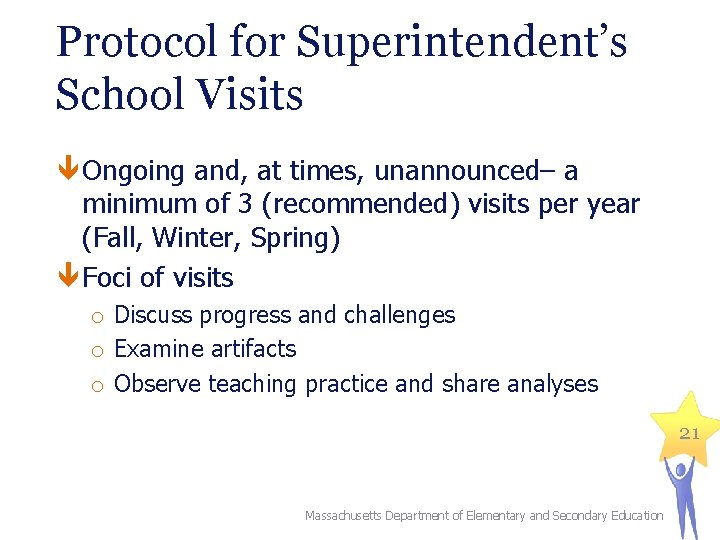
Protocol for Superintendent’s School Visits Ongoing and, at times, unannounced– a minimum of 3 (recommended) visits per year (Fall, Winter, Spring) Foci of visits o Discuss progress and challenges o Examine artifacts o Observe teaching practice and share analyses 21 Massachusetts Department of Elementary and Secondary Education
Strategy: Align process to goals What is the opportunity with Superintendent’s visits? o Discuss progress and challenges Related to goals o Examine relevant artifacts (quality not quantity) Aligned to priority areas Ex: Interim assessment results, meeting plans, etc. o Observe classrooms and other practices; share analyses Meetings: leadership team, faculty, parent, department Transitions Massachusetts Department of Elementary and Secondary Education 22
Step 4: Formative Assessment/ Evaluation Principal prepares a progress report Review evidence and assess progress on principal’s goals Superintendent completes the Mid-Cycle formative assessment o Provides feedback to the principal to help him or her improve professional practice 23 Massachusetts Department of Elementary and Secondary Education
Step 5: Summative Evaluation Principal submits collected data to Superintendent determines an overall summative rating of performance based on: o The principal’s performance against the four performance Standards (educators receive a rating for each Standard), and o Evidence of the attainment of goals Massachusetts Department of Elementary and Secondary Education 24
Step 5: Summative Evaluation, cont. Superintendent provides feedback to the educator to help him or her improve professional practice Principal uses summative evaluation to inform self-assessment o Continuous Improvement process 25 Massachusetts Department of Elementary and Secondary Education
Proficient vs. Exemplary “Proficient is the expected, rigorous level of performance for educators. It is the demanding but attainable level of performance for most educators. ” “Exemplary performance significantly exceeds Proficient and could serve as a model for leaders district-wide or even statewide. Few educators—principals included—are expected to demonstrate Exemplary performance on more than a small number of Indicators or Standards. ” Part III: Guide to Rubrics Page 9 Massachusetts Department of Elementary and Secondary Education 26
Next Steps – Suggestions for Principals Review “SMART” Goal Setting and assess how “SMART” your current school improvement goals are Read the Implementation Guide for Principal Evaluation (Part V of the Model System) and the Administrator rubric Locate your school improvement focus areas in the Administrator and Teacher rubric 27 Massachusetts Department of Elementary and Secondary Education
Resources Massachusetts Model System for Educator Evaluation 28 Massachusetts Department of Elementary and Secondary Education
Implementation Guide for Principal Evaluation Content Overview The Model Evaluation Process for Principals Guidance for Conducting the Evaluation Process Cycle of Continuous Improvement Select Appendices: Administrator Standards and Indicators, Evaluation Report Forms, Roles and Responsibilities, SMART Goals, Samples 29 Massachusetts Department of Elementary and Secondary Education
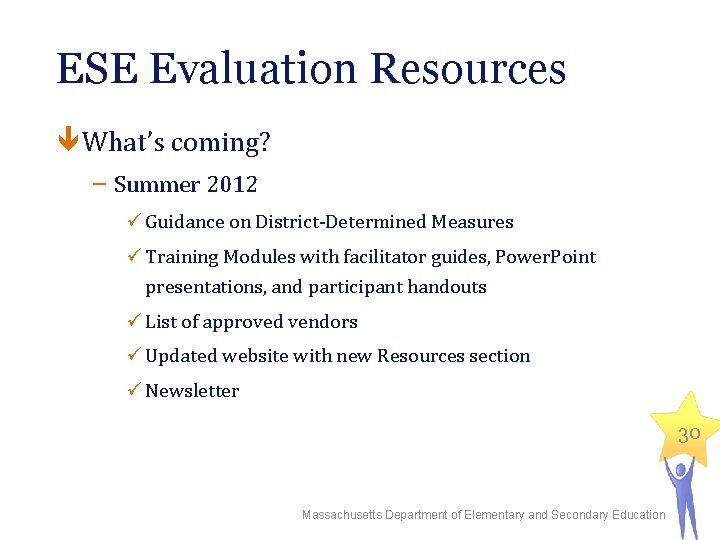
ESE Evaluation Resources What’s coming? − Summer 2012 ü Guidance on District-Determined Measures ü Training Modules with facilitator guides, Power. Point presentations, and participant handouts ü List of approved vendors ü Updated website with new Resources section ü Newsletter 30 Massachusetts Department of Elementary and Secondary Education
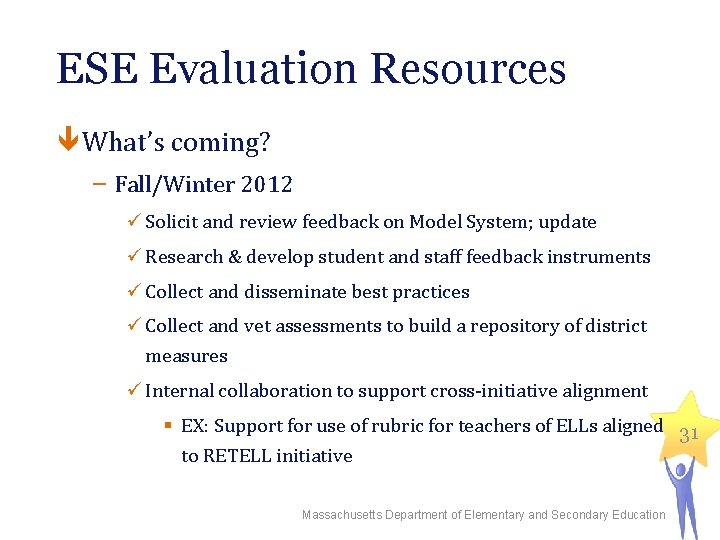
ESE Evaluation Resources What’s coming? − Fall/Winter 2012 ü Solicit and review feedback on Model System; update ü Research & develop student and staff feedback instruments ü Collect and disseminate best practices ü Collect and vet assessments to build a repository of district measures ü Internal collaboration to support cross-initiative alignment § EX: Support for use of rubric for teachers of ELLs aligned 31 to RETELL initiative Massachusetts Department of Elementary and Secondary Education
For More Information and Resources: Visit the ESE educator evaluation website: www. doe. mass. edu/edeval Contact ESE with questions and suggestions: Educator. Evaluation@doe. mass. edu Presenters: Claudia Bach – cbach@doe. mass. edu Preeya Pandya – ppandya@doe. mass. edu Massachusetts Department of Elementary and Secondary Education 32
Lessons from an Early Adopter District Patricia Puglisi Assistant Principal Reading Memorial High School Massachusetts Department of Elementary and Secondary Education 33