
Educator Ethics Iowa Board of Educational Examiners Why
Educator Ethics Iowa Board of Educational Examiners
Why Ethics? • Educators today face increasing and more complicated ethical dilemmas • Educators often think that it “won’t happen to them” • Ethical standards protect students and the profession • Transparent conversations help us to hold each other accountable • New national standards – Model Code of Ethics for Educators
Outcomes • Discover the difference between morals and ethics • Explore the national standards – Model Code of Ethics for Educators • Review the Iowa Code of Professional Conduct and Ethics • Analyze new dilemmas concerning educators, students, and technology
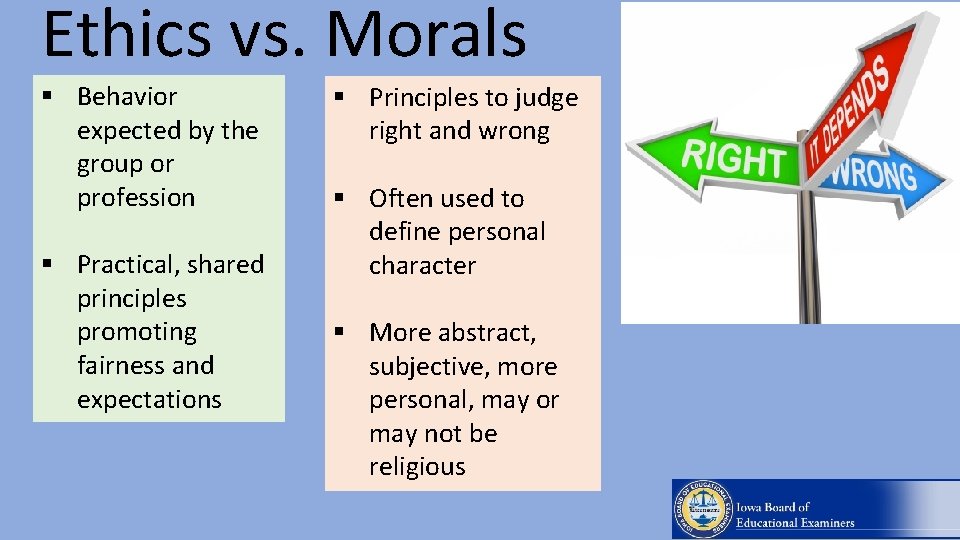
Ethics vs. Morals § Behavior expected by the group or profession § Practical, shared principles promoting fairness and expectations § Principles to judge right and wrong § Often used to define personal character § More abstract, subjective, more personal, may or may not be religious
A teacher decides not to drink a beer when he sees a student enter the same restaurant. A principal changes an old letter of recommendation to show current dates. A coach posts pictures of herself online wearing only a bikini while on a beach vacation. A teacher presents only the religious interpretation of creationism in science class. A teacher calls in sick to extend her vacation.
Is it possible that high moral standards sometimes make educators more vulnerable to ethics violations or professional risk?

Model Code of Ethics for Educators Codes of ethics are commonly agreed upon standards that inform the course of action related to ethical practice. They set a higher threshold than codes of conduct, help guide discussions of ethical dilemmas, and establish a framework for ethical decision-making. The MCEE was created in 2015 through NASDTEC collaboratively with professional education organizations. • • • promote student safety and welfare, guide educator decision-making, foster public confidence in the profession
Model Code of Ethics for Educators Responsibility to the Profession Responsibility for Professional Competence Responsibility to Students Responsibility to Parents/Guardians, Colleagues, the Community and Employers • Responsible and Ethical Use of Technology • •
Model Code of Ethics for Educators Principle I: Responsibility to the Profession The professional educator is aware that trust in the profession depends upon a level of professional conduct and responsibility that may be higher than required by law. This entails holding one and other educators to the same ethical standards.
Model Code of Ethics for Educators Principle I: Responsibility to the Profession A. The professional educator demonstrates responsibility to oneself as an ethical professional B. The professional educator fulfills the obligation to address and attempt to resolve ethical issues C. The professional educator promotes and advances the profession within and beyond the school community
Model Code of Ethics for Educators Principle II: Responsibility for Professional Competence The professional educator is committed to the highest levels of professional and ethical practice, including demonstration of the knowledge, skills and dispositions required for professional competence.

Model Code of Ethics for Educators Principle II: Responsibility for Professional Competence A. The professional educator demonstrates commitment to high standards of practice B. The professional educator demonstrates responsible use of data, materials, research and assessment C. The professional educator acts in the best interest of all students
Model Code of Ethics for Educators Principle III: Responsibility to Students The professional educator has a primary obligation to treat students with dignity and respect. The professional educator promotes the health, safety and well being of students by establishing and maintaining appropriate verbal, physical, emotional and social boundaries.
Model Code of Ethics for Educators Principle III: Responsibility to Students A. The professional educator respects the rights and dignity of students B. The professional educator demonstrates an ethic of care C. The professional educator maintains student trust and confidentiality when interacting with students in a developmentally appropriate manner and within appropriate limits
Model Code of Ethics for Educators Principle IV: Responsibility to the School Community The professional educator promotes positive relationships and effective interactions, with members of the school community, while maintaining professional boundaries.

Model Code of Ethics for Educators Principle IV: Responsibility to the School Community A. The professional educator promotes effective and appropriate relationships with parents/guardians B. The professional educator promotes effective and appropriate relationships with colleagues C. The professional educator promotes effective and appropriate relationships with the community and other stakeholders D. The professional educator promotes effective and appropriate relationships with employers E. The professional educator understands the problematic nature of multiple relationships
Model Code of Ethics for Educators Principle V: Responsible and Ethical Use of Technology The professional educator considers the impact of consuming, creating, distributing and communicating information through all technologies. The ethical educator is vigilant to ensure appropriate boundaries of time, place and role are maintained when using electronic communication.
Model Code of Ethics for Educators Principle V: Responsible and Ethical Use of Technology A. The professional educator uses technology in a responsible manner B. The professional educator ensures students’ safety and well-being when using technology C. The professional educator maintains confidentiality in the use of technology D. The professional educator promotes the appropriate use of technology in educational settings
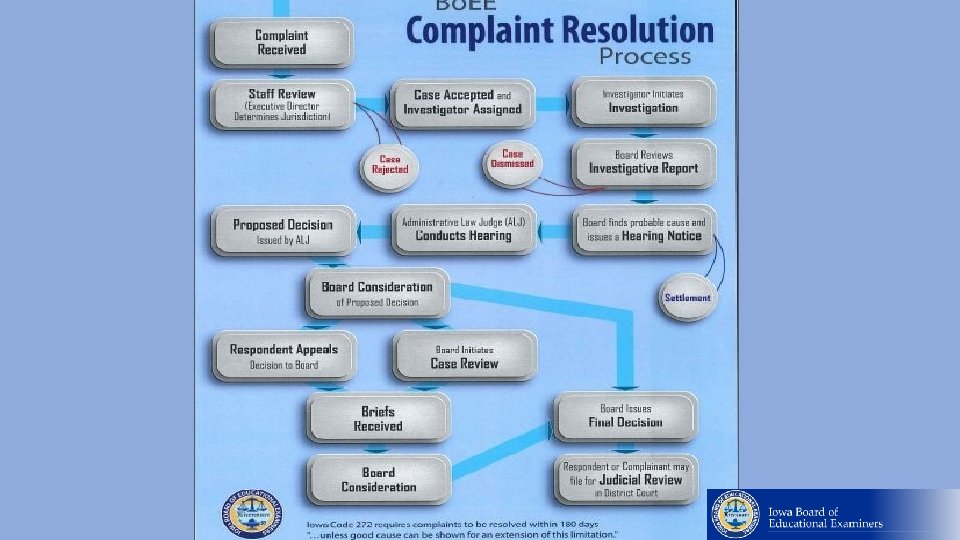
Iowa Code of Professional Conduct and Ethics violations may be reported to the Bo. EE by: A. A parent of a child directly involved B. Department of Education, Bo. EE, Department of Transportation, Department of Revenue C. Anyone holding a Bo. EE license (teachers, administrators, coaches, etc. ) D. School Board
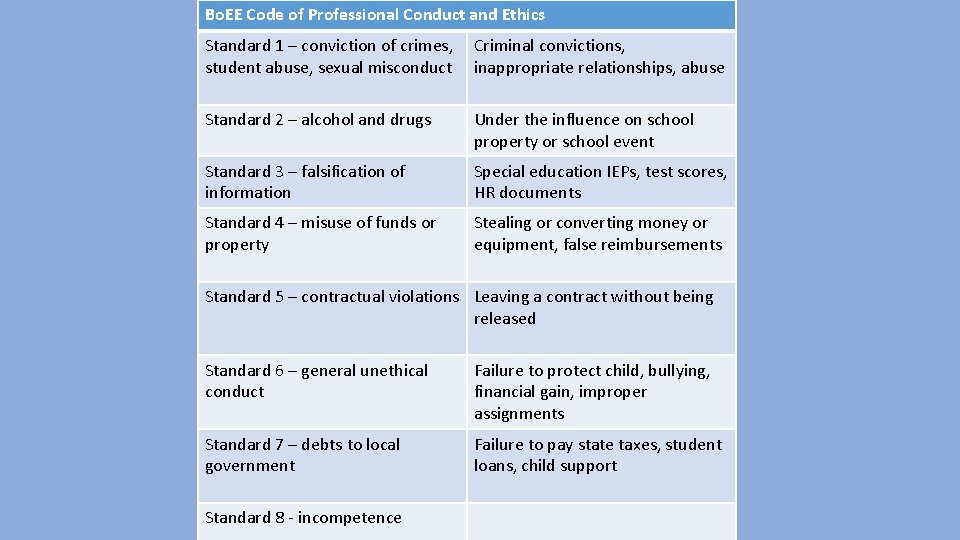
Bo. EE Code of Professional Conduct and Ethics Standard 1 – conviction of crimes, Criminal convictions, student abuse, sexual misconduct inappropriate relationships, abuse Standard 2 – alcohol and drugs Under the influence on school property or school event Standard 3 – falsification of information Special education IEPs, test scores, HR documents Standard 4 – misuse of funds or property Stealing or converting money or equipment, false reimbursements Standard 5 – contractual violations Leaving a contract without being released Standard 6 – general unethical conduct Failure to protect child, bullying, financial gain, improper assignments Standard 7 – debts to local government Failure to pay state taxes, student loans, child support Standard 8 - incompetence
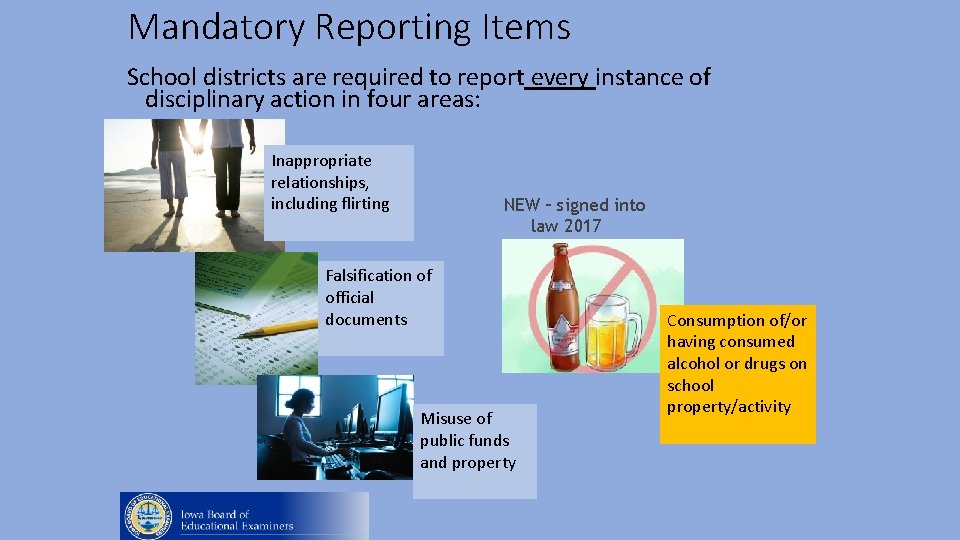
Mandatory Reporting Items School districts are required to report every instance of disciplinary action in four areas: Inappropriate relationships, including flirting NEW – signed into law 2017 Falsification of official documents Misuse of public funds and property Consumption of/or having consumed alcohol or drugs on school property/activity
The following situations increase risk for educators, especially when they fall outside the norm: TIME LOCATION ROLE/RESPONSIBILITY
For each of the next scenarios, consider the following questions: What are the main issues? What are the possible ethics (MCEE or Bo. EE) or school/district violations? What are the possible negative consequences? What are the responses/actions, or proactive measures that should be considered?
MCEE Principle 1 – Responsibility to the Profession Scenario 1: Online Discovery Mr. Y is a first year high school teacher. He received a friend request from his mentor, Mr. Z on Facebook. Mr. Z has been teaching for over 30 years and is a respected member of the faculty. Mr. Y noticed that the mentor’s page is full of derogatory and vulgar comments about women. Mr. Y did not say anything to his mentor or to the principal, especially since there are other teachers who are also “friends” with Mr. Z on Facebook, and they seem to appreciate his sense of humor.
MCEE Principle 2 – Responsibility for Professional Competence Scenario 2: Unlicensed Coach Mr. C was hired in the spring to be the fall football coach. He was told by the principal to make sure he obtained his coaching authorization prior to the start of the season. He completed the required coaching class, but he forgot to apply for the coaching Optional follow-up scenario: authorization. After practices began, he told the principal it was all Optional follow-up scenario: In April, a principal hires a new teacher to start in taken care of, and the principal trusted that the coach was being A principal reassigns a teacher outside of her August. When school begins, the principal finds out honest. endorsement areas. He doesn’t report this on the that the new teacher has not yet passed the fall Department of Education BEDS report, because required Praxis tests, and consequently does not he doesn’t want her to have to pay for classes or yet hold an Iowa teaching license. The principal fills get a conditional license since it may be temporary. the position with a substitute teacher to serve What are some possible issues and solutions? alongside the unlicensed teacher to start the year. What are some possible issues and solutions?
MCEE Principle 2 – Responsibility for Professional Competence Scenario 3: Special Education Reporting Mr. S is a middle school special education teacher with two years of experience. He didn’t plan on teaching special education, and doesn’t necessary love doing it, but he Optional follow-up scenario: decided to give it a try to get his “foot in the door”. He is teaching on a conditional Student R has been acting out in class. His teacher license, but hasn’t had much time to devote to classes since he is also coaching. informs the parents that he thinks their son has ADHD and should be medicated. The teacher also Recently, someone at the AEA noticed a lack of data entered for Mr. S’s students, and recommends that student R’s cell phone be taken the principal was subsequently notified. In a panic, Mr. S quickly entered numbers for Optional follow-up scenario: away, and that he should be removed from all his students since he knows approximately how they would have done on the probes A special education teacher frequently leaves her sports until student R’s behavior improves in this anyway, so in his mind it is a fair representation of their progress. He also realizes that self-contained room to assist other teachers. The class. he forgot to notify parents about an IEP meeting he had last week for a student, so he students are left with the paraprofessional. What changes the report to show that they were in attendance. are some possible issues and solutions?
MCEE Principle 3 – Responsibility to Students Scenario 4: Graduation Party Mrs. G is a high school teacher who enjoys attending graduation parties for her departing senior students. During one of the parties, Mrs. G notices that there are many high school students present who are consuming alcohol. Mrs. G also notices that the parents of the students are joking that they would rather have the students drink in front of them where they can monitor it instead of hiding it. Mrs. G decides not to say anything since the parents are clearly in favor of the drinking behavior.
MCEE Principle 3 – Responsibility to Students Scenario 5: Ride Home Mrs. R is a very successful coach who often gives rides to students in her own car. She drives them home after school, after practice, or after games, which can be very late at night or on weekends. She enjoys spending extra time with the students to get to know them better. She feels that this is helping students to participate who may not otherwise be able. She is concerned about students who have to walk home in the dark or when it is very cold. Optional follow-up scenario: Due to budget cuts, district transportation to events is limited. When events occur less than 20 miles away, the district decides to have students transport themselves. What are some possible issues and solutions?
MCEE Principle 3 – Responsibility to Students Scenario 6: Boys Will Be Boys Mrs. J is a middle school teacher with 25 years of experience. A 6 th grade female student approached her complaining that a group of boys were snapping her bra closure on her back every day and that they would try to Optional follow-up scenario: purposefully bump into her in the hallway, often grabbing her chest A high school teacher sees conversations online which indicate that one of her students is the victim claiming it was “just an accident”. Mrs. J told her not to worry, that the boys Optional follow-up scenario: of cyberbullying. The student is quiet and probably like her, and if she simply ignores them, they will stop. Mrs. J also A middle school principal sends home a letter reminding parents withdrawn at school. The teacher decides not to and students about the school’s dress code policy, and that they suggested to the female student that she should wear a large sweatshirt talk to the student about it, since it happened are also banning girls’ leggings and yoga pants because they are over her clothes every day to see if that would help the boys ignore her. online at night and not during school hours. What too distracting for the boys. What are some possible issues and solutions?
MCEE Principle 3 – Responsibility to Students Scenario 7: Marker Joke Mr. M is a 15 -year veteran middle school teacher known for his humor and sarcasm. When students fall asleep in his class, he writes “ZZZZZ” in permanent marker on their arms and hands. The other students in the class watch and laugh along with Mr. M when this occurs. Mr. M believes that he is sending an effective message since students never fall asleep twice. The other teachers and administrators dismiss the behavior because it’s just “Mr. Optional follow-up scenario: M”. A coach uses running laps as punishment for student behavior. What are some possible issues and solutions?
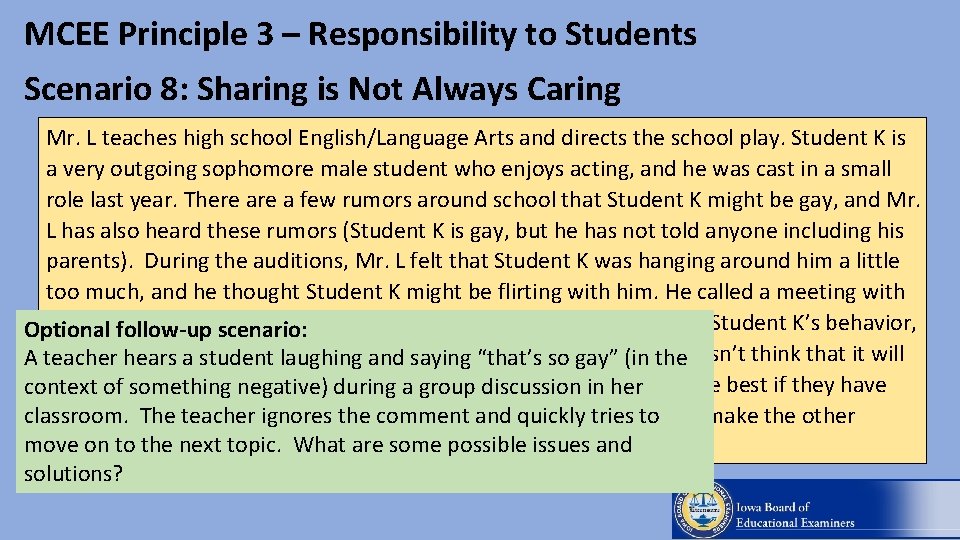
MCEE Principle 3 – Responsibility to Students Scenario 8: Sharing is Not Always Caring Mr. L teaches high school English/Language Arts and directs the school play. Student K is a very outgoing sophomore male student who enjoys acting, and he was cast in a small role last year. There a few rumors around school that Student K might be gay, and Mr. L has also heard these rumors (Student K is gay, but he has not told anyone including his parents). During the auditions, Mr. L felt that Student K was hanging around him a little too much, and he thought Student K might be flirting with him. He called a meeting with Student K, his parents, and the principal. Mr. L told the group about Student K’s behavior, Optional follow-up scenario: that he knows Student K is gay, and under the circumstances he doesn’t think that it will A teacher hears a student laughing and saying “that’s so gay” (in the be appropriate to cast him in the play this year. Mr. L thinks it will be best if they have context of something negative) during a group discussion in her some space and boundaries from each other, and that it might also make the other classroom. The teacher ignores the comment and quickly tries to move on to the next topic. What are some possible issues and students uncomfortable to have to be around Student K in the play. solutions?
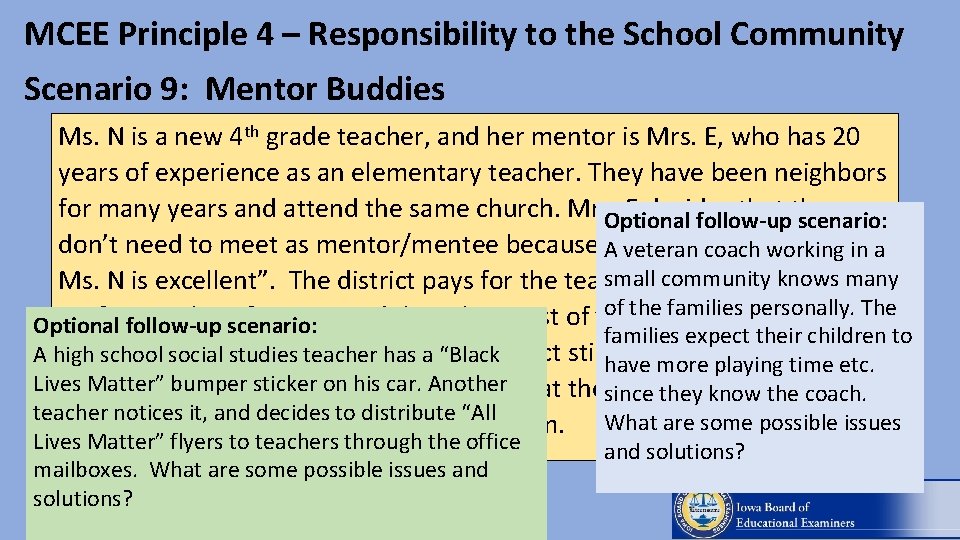
MCEE Principle 4 – Responsibility to the School Community Scenario 9: Mentor Buddies Ms. N is a new 4 th grade teacher, and her mentor is Mrs. E, who has 20 years of experience as an elementary teacher. They have been neighbors for many years and attend the same church. Mrs. E decides that they Optional follow-up scenario: don’t need to meet as mentor/mentee because “she already knows that A veteran coach working in a small community knows many Ms. N is excellent”. The district pays for the teachers to attend a of the families personally. The professional conference, and they skip most of the sessions to go Optional follow-up scenario: families expect their children to sightseeing. The mentor receives the district stipend for the work, and A high school social studies teacher has a “Black have more playing time etc. Lives Matter” bumper sticker on his car. Another later the principal signs a form verifying that the new teacher has since they know the coach. teacher notices it, and decides to distribute “All completed the required mentoring program. What are some possible issues Lives Matter” flyers to teachers through the office mailboxes. What are some possible issues and solutions?
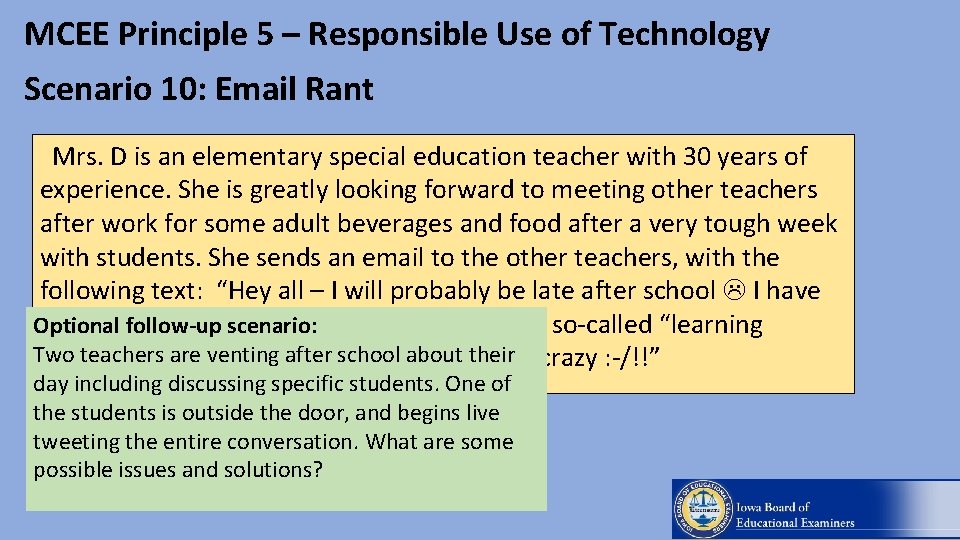
MCEE Principle 5 – Responsible Use of Technology Scenario 10: Email Rant Mrs. D is an elementary special education teacher with 30 years of experience. She is greatly looking forward to meeting other teachers after work for some adult beverages and food after a very tough week with students. She sends an email to the other teachers, with the following text: “Hey all – I will probably be late after school I have an IEP meeting for John Jones because of his so-called “learning Optional follow-up scenario: Two teachers are venting after school about their disability” (cough), and his mother is totally crazy : -/!!” day including discussing specific students. One of the students is outside the door, and begins live tweeting the entire conversation. What are some possible issues and solutions?
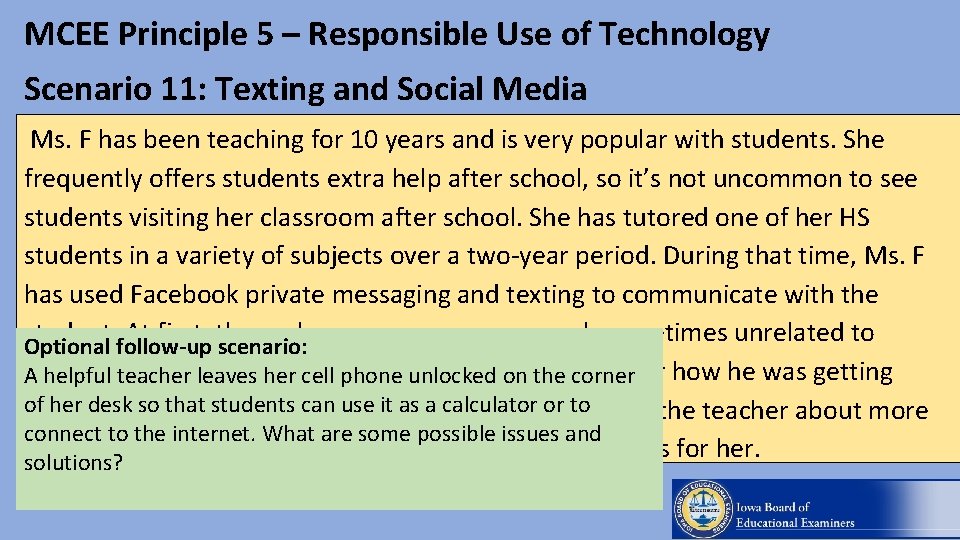
MCEE Principle 5 – Responsible Use of Technology Scenario 11: Texting and Social Media Ms. F has been teaching for 10 years and is very popular with students. She frequently offers students extra help after school, so it’s not uncommon to see students visiting her classroom after school. She has tutored one of her HS students in a variety of subjects over a two-year period. During that time, Ms. F has used Facebook private messaging and texting to communicate with the student. At first, the exchanges were very general; sometimes unrelated to Optional follow-up scenario: school work (e. g. , asking the student about his family, or how he was getting A helpful teacher leaves her cell phone unlocked on the corner of her desk so that students can use it as a calculator or to along with friends). Recently, the student began to text the teacher about more connect to the internet. What are some possible issues and personal feelings, including romantic feelings that he has for her. solutions?
MCEE Principle 5 – Responsible Use of Technology Scenario 12: Summer Painting Mr. D, a 4 th grade teacher, has a house painting business on the side to generate extra income in the summer. He often uses his school computer to update his website and to generate invoices. He is careful to only do this during before and after school hours and during the Optional follow-up scenario: summer. The district athletic director (who happens to be close friends A district is getting rid of some older laptops. A teacher is in charge with Mr. D) hires Mr. D’s painting company to paint all of the athletic of donating them to a local charity. He decides to keep one of the buildings in the district this coming summer. Mr. D uses the industrial laptops because it is better than what his son has at home, and the technology room to store his equipment and uses the tools in the room district has already removed them from the inventory anyway. What are some possible issues and solutions? to help with painting prep.
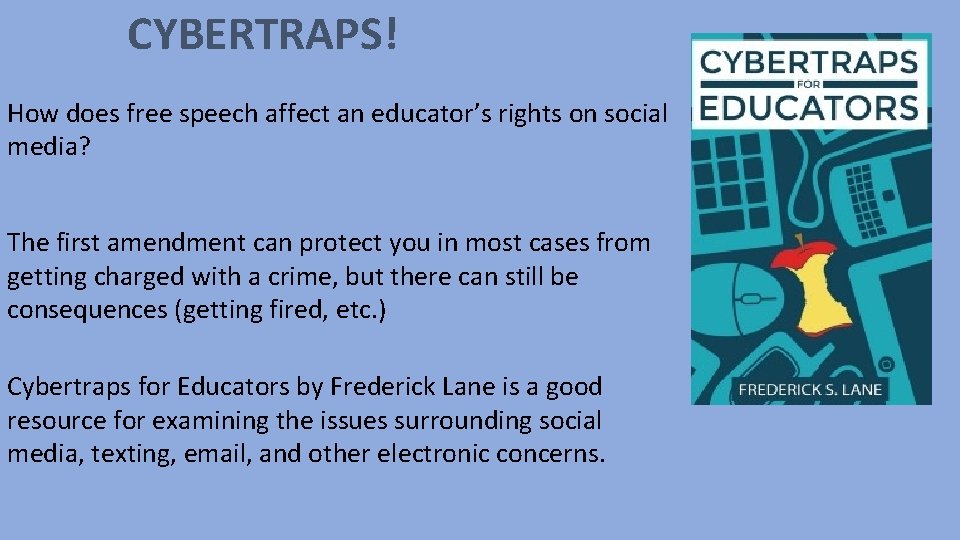
CYBERTRAPS! How does free speech affect an educator’s rights on social media? The first amendment can protect you in most cases from getting charged with a crime, but there can still be consequences (getting fired, etc. ) Cybertraps for Educators by Frederick Lane is a good resource for examining the issues surrounding social media, texting, email, and other electronic concerns.
Other Social Media Examples (educators were fired for these posts): “I guess that’s what happens when you flunk out of school and have no education…I’m almost to the point of wanting them all segregated on one side of town so they can hurt each other and leave the innocent people alone. ” ----------------------------------------- “I don’t know him, but I hate him #pothead #STEM #wannabecool #dorkywhiteboy” ----------------------------------------A teacher was fired from a Christian school. The school did not tell him specifically what was posted on social media to get him fired, but he was led to believe it was a picture of himself and his wife holding a bottle of alcohol.
Other Social Media Examples (educators were fired - continued): “an impressive turnout. Lots of pink hats & stuff. Then they all went home to make dinner. Well done, ladies!” The tweet included a photo of the women’s march, along with a 1952 advertising stock photo of a smiling woman wearing a dress and apron while she stirs a bowl in a kitchen. ------------------------------------------When the student asked @FCPSMaryland over Twitter on Jan. 5 for school to be closed “tammarow, ” Katie Nash, 33, replied, “but then how would you learn how to spell ‘tomorrow’? : )” ------------------------------------------The teacher had disparaged students as “rude, disengaged, lazy whiners, ” “frightfully dim, ” “utterly loathsome, ” “The Queen of Drama” and “A. I. R. H. E. A. D. ” in her blog, which was meant for a few friends but shared on Facebook by a student who found it.
Other Social Media Examples (educators were fired - continued): "The funny thing about immigrants staying home is the rest of us who pay for them are at work like we've always been. Looks like less mouths to feed today. Have fun while you still can. So glad to hear about massive deportation. Let's make America great again. Thanks Donald Trump!!" ------------------------------------------“Field day with my little [expletives] that I somehow still love. ” A student wearing a traditional Mexican hat or sombrero- is captioned: “This is an African American Mexican. ” ------------------------------------------“The only good Trump supporter is a dead Trump supporter”
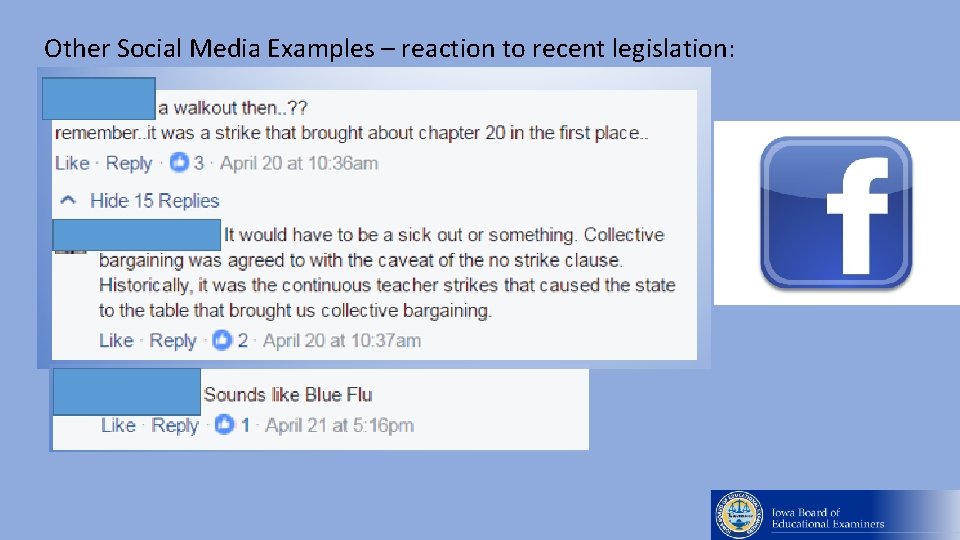
Other Social Media Examples – reaction to recent legislation:
Recommendations: • Foster an environment that encourages open and collaborative discussions around ethics. Continue to facilitate conversations on a regular basis. • Review district and state policies and guidance around hiring, state reports, transportation, technology, and other commonly reported areas • Emphasize that caring and connecting with students is still important, but that educators also have the responsibility to do so within professional boundaries. • Encourage transparency, which is usually the key to solving many ethical dilemmas.
Resources and Acknowledgements National Association of State Directors of Teacher Education and Certification (www. nasdtec. net) Model Code of Ethics for Educators (2015) Iowa Board of Educational Examiners (www. boee. iowa. gov) Code of Professional Conduct and Ethics Board Decisions Lane, Frederick. (2015) Cybertraps for Educators. Frederick Lane (selfpublished). www. fredericklane. com – Cypertraps Blog Connecticut Code of Professional Responsibility for Educators (and sample scenarios) http: //www. ctteam. org/
- Slides: 43