
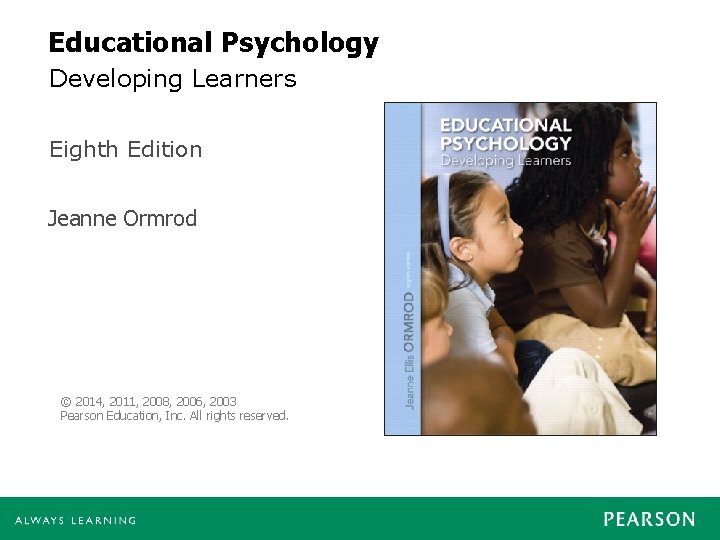
Educational Psychology Developing Learners Eighth Edition Jeanne Ormrod

- Slides: 30
Educational Psychology Developing Learners Eighth Edition Jeanne Ormrod © 2014, 2011, 2008, 2006, 2003 Pearson Education, Inc. All rights reserved.
Chapter 11 Motivation and Affect Ormrod Educational Psychology: Developing Learners , 8 e © 2014 Pearson Education, Inc. All rights reserved. 11 -1
The Nature of Motivation Ormrod Educational Psychology: Developing Learners , 8 e © 2014 Pearson Education, Inc. All rights reserved. 11 -2
Motivation n n Directs behavior toward particular goals Leads to increased effort and energy Increases initiation of, and persistence in, activities Enhances cognitive processing Determines what consequences are reinforcing and punishing Ormrod Educational Psychology: Developing Learners , 8 e © 2014 Pearson Education, Inc. All rights reserved. 11 -3
General Principles n n n All children and adolescents are motivated in one way or another. Motivation to do well in school is grounded in a variety of cognitive and sociocultural factors that evolve over time. Classroom conditions play a major role in students’ motivation to learn and achieve n situated motivation Ormrod Educational Psychology: Developing Learners , 8 e © 2014 Pearson Education, Inc. All rights reserved. 11 -4
Motivation n Extrinsic motivators n n factors external to the individual factors unrelated to the task n n good grades, money, recognition Intrinsic motivators n n factors within the individual factors inherent in the task n pleasure, developing a valued skill, ethically and morally the right thing to do Ormrod Educational Psychology: Developing Learners , 8 e © 2014 Pearson Education, Inc. All rights reserved. 11 -5
Basic Human Needs Ormrod Educational Psychology: Developing Learners , 8 e © 2014 Pearson Education, Inc. All rights reserved. 11 -6
Basic Human Needs n Arousal n n Competence and Self-Worth n n ability to deal effectively with environment Self-Determination n n basic need for stimulation sense of autonomy Relatedness n need to feel socially connected, to secure others’ love and respect Ormrod Educational Psychology: Developing Learners , 8 e © 2014 Pearson Education, Inc. All rights reserved. 11 -7
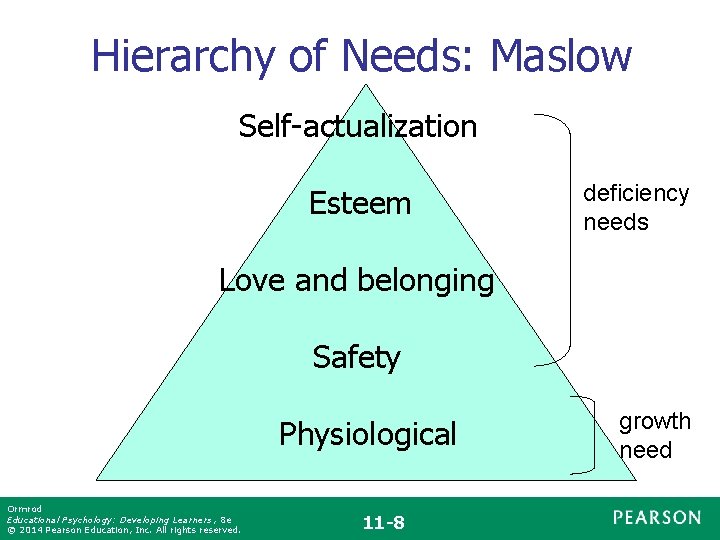
Hierarchy of Needs: Maslow Self-actualization Esteem deficiency needs Love and belonging Safety Physiological Ormrod Educational Psychology: Developing Learners , 8 e © 2014 Pearson Education, Inc. All rights reserved. 11 -8 growth need
Cognitive Factors in Motivation Ormrod Educational Psychology: Developing Learners , 8 e © 2014 Pearson Education, Inc. All rights reserved. 11 -9
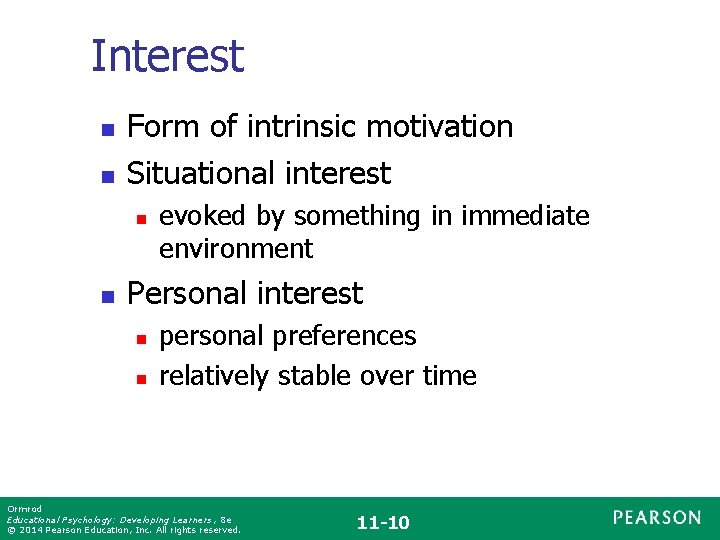
Interest n n Form of intrinsic motivation Situational interest n n evoked by something in immediate environment Personal interest n n personal preferences relatively stable over time Ormrod Educational Psychology: Developing Learners , 8 e © 2014 Pearson Education, Inc. All rights reserved. 11 -10
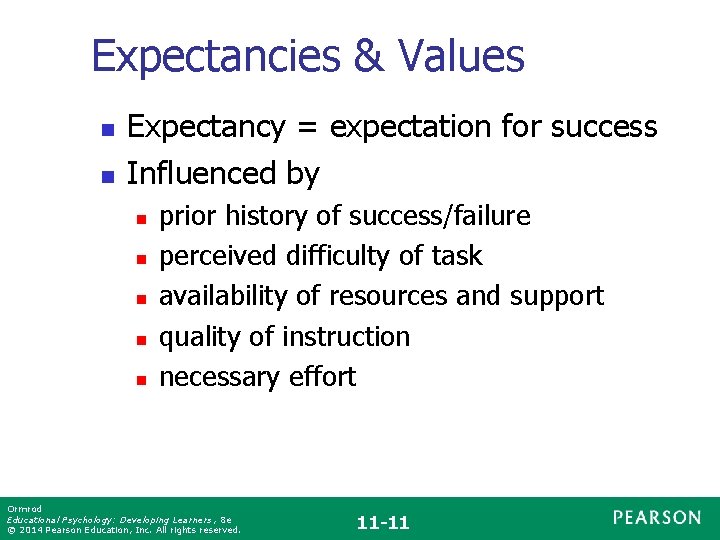
Expectancies & Values n n Expectancy = expectation for success Influenced by n n n prior history of success/failure perceived difficulty of task availability of resources and support quality of instruction necessary effort Ormrod Educational Psychology: Developing Learners , 8 e © 2014 Pearson Education, Inc. All rights reserved. 11 -11
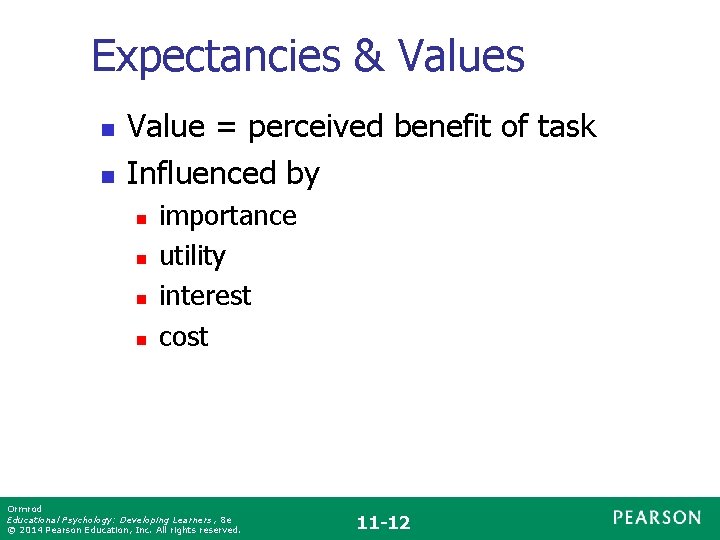
Expectancies & Values n n Value = perceived benefit of task Influenced by n n importance utility interest cost Ormrod Educational Psychology: Developing Learners , 8 e © 2014 Pearson Education, Inc. All rights reserved. 11 -12
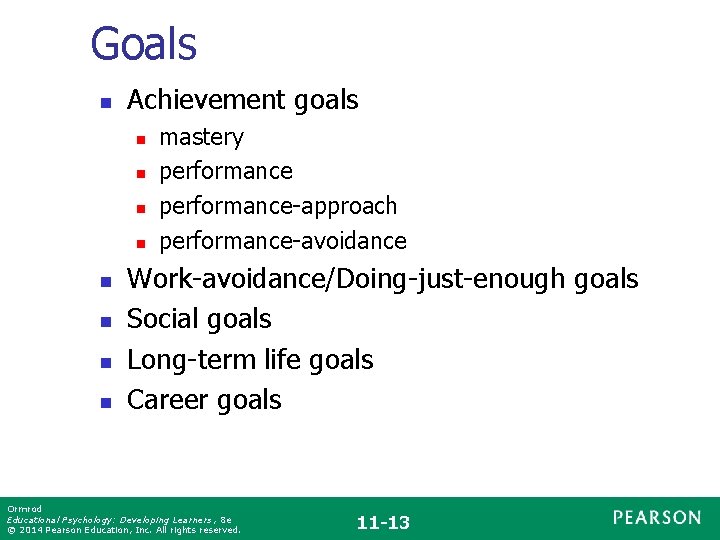
Goals n Achievement goals n n n n mastery performance-approach performance-avoidance Work-avoidance/Doing-just-enough goals Social goals Long-term life goals Career goals Ormrod Educational Psychology: Developing Learners , 8 e © 2014 Pearson Education, Inc. All rights reserved. 11 -13
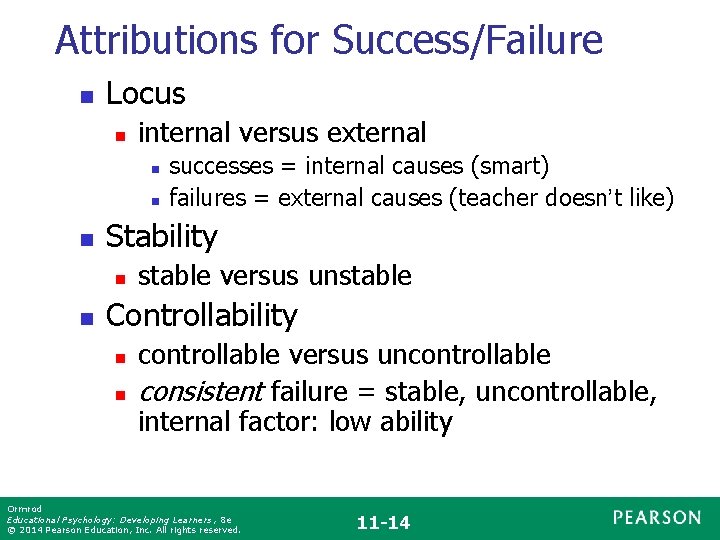
Attributions for Success/Failure n Locus n internal versus external n n n Stability n n successes = internal causes (smart) failures = external causes (teacher doesn’t like) stable versus unstable Controllability n n controllable versus uncontrollable consistent failure = stable, uncontrollable, internal factor: low ability Ormrod Educational Psychology: Developing Learners , 8 e © 2014 Pearson Education, Inc. All rights reserved. 11 -14
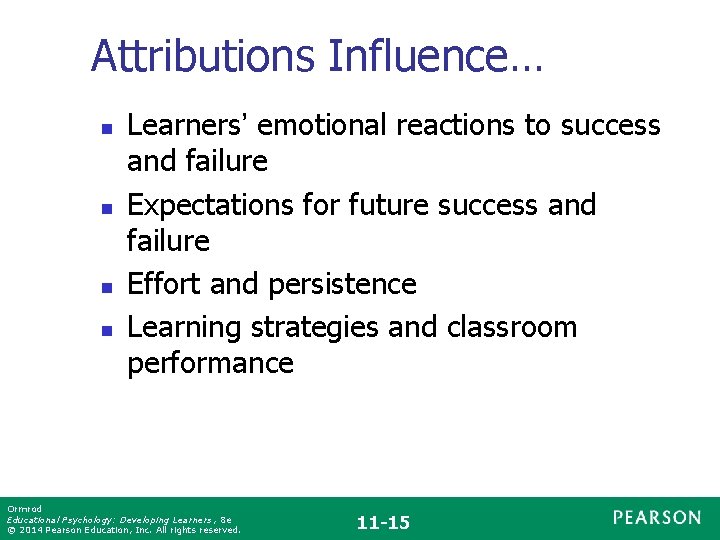
Attributions Influence… n n Learners’ emotional reactions to success and failure Expectations for future success and failure Effort and persistence Learning strategies and classroom performance Ormrod Educational Psychology: Developing Learners , 8 e © 2014 Pearson Education, Inc. All rights reserved. 11 -15
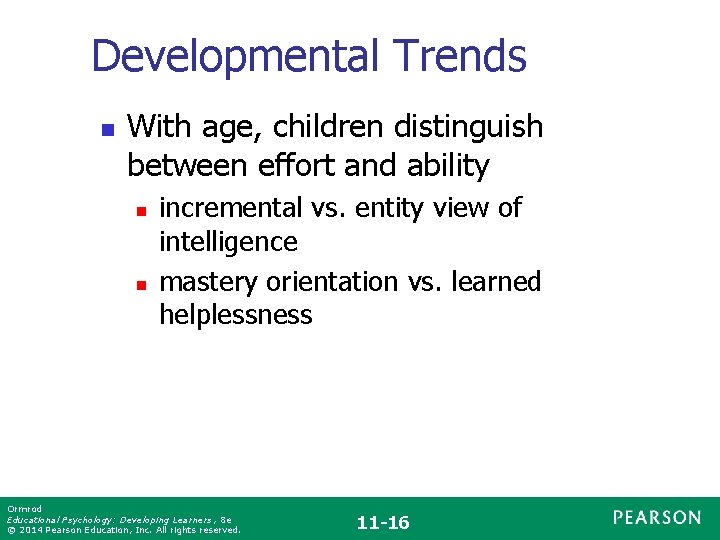
Developmental Trends n With age, children distinguish between effort and ability n n incremental vs. entity view of intelligence mastery orientation vs. learned helplessness Ormrod Educational Psychology: Developing Learners , 8 e © 2014 Pearson Education, Inc. All rights reserved. 11 -16
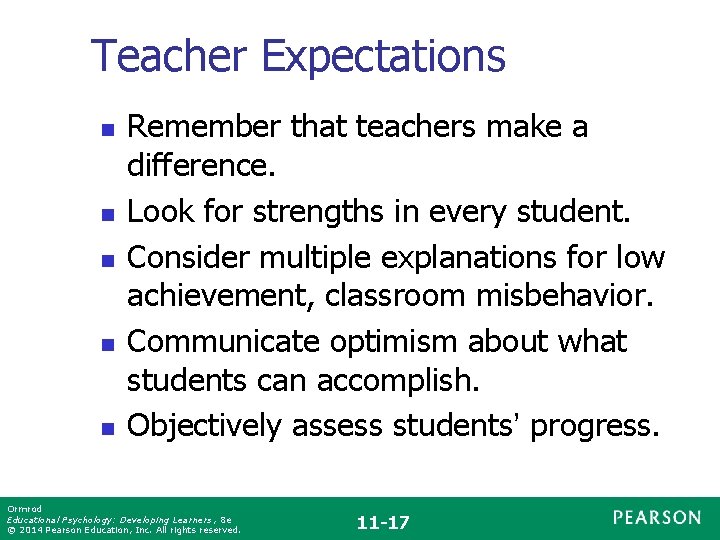
Teacher Expectations n n n Remember that teachers make a difference. Look for strengths in every student. Consider multiple explanations for low achievement, classroom misbehavior. Communicate optimism about what students can accomplish. Objectively assess students’ progress. Ormrod Educational Psychology: Developing Learners , 8 e © 2014 Pearson Education, Inc. All rights reserved. 11 -17
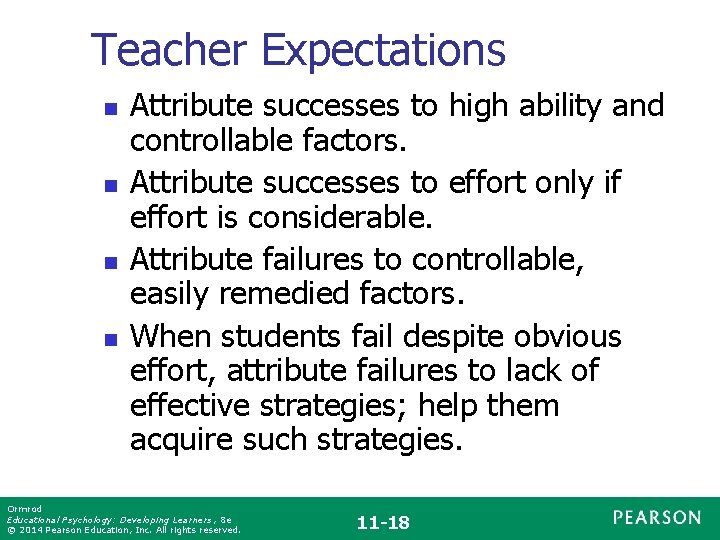
Teacher Expectations n n Attribute successes to high ability and controllable factors. Attribute successes to effort only if effort is considerable. Attribute failures to controllable, easily remedied factors. When students fail despite obvious effort, attribute failures to lack of effective strategies; help them acquire such strategies. Ormrod Educational Psychology: Developing Learners , 8 e © 2014 Pearson Education, Inc. All rights reserved. 11 -18
Affect and Its Effects Ormrod Educational Psychology: Developing Learners , 8 e © 2014 Pearson Education, Inc. All rights reserved. 11 -19
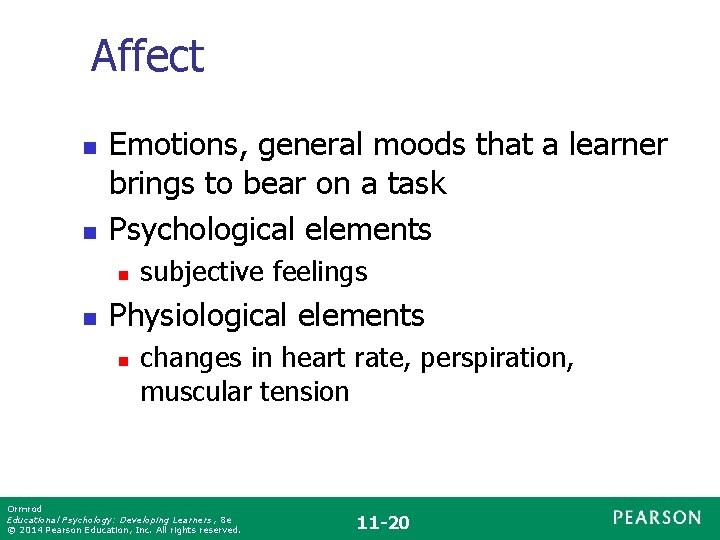
Affect n n Emotions, general moods that a learner brings to bear on a task Psychological elements n n subjective feelings Physiological elements n changes in heart rate, perspiration, muscular tension Ormrod Educational Psychology: Developing Learners , 8 e © 2014 Pearson Education, Inc. All rights reserved. 11 -20
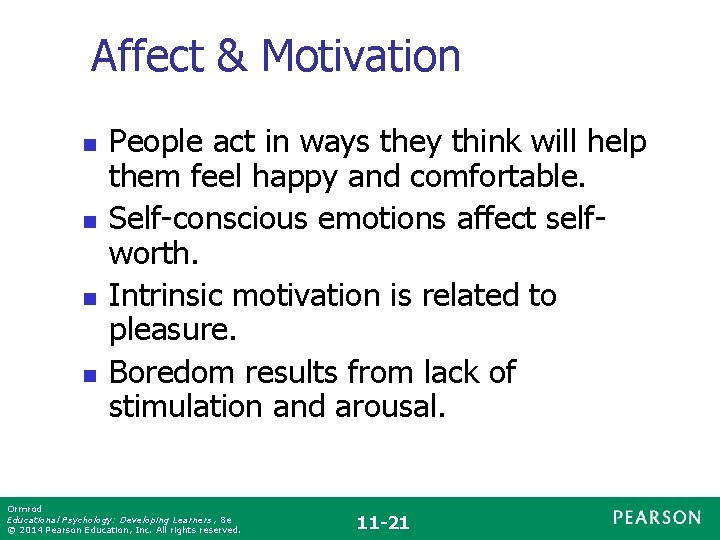
Affect & Motivation n n People act in ways they think will help them feel happy and comfortable. Self-conscious emotions affect selfworth. Intrinsic motivation is related to pleasure. Boredom results from lack of stimulation and arousal. Ormrod Educational Psychology: Developing Learners , 8 e © 2014 Pearson Education, Inc. All rights reserved. 11 -21
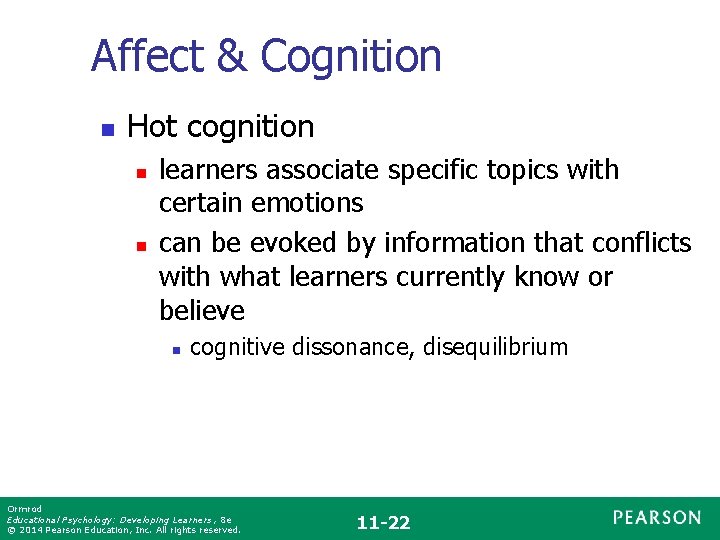
Affect & Cognition n Hot cognition n n learners associate specific topics with certain emotions can be evoked by information that conflicts with what learners currently know or believe n cognitive dissonance, disequilibrium Ormrod Educational Psychology: Developing Learners , 8 e © 2014 Pearson Education, Inc. All rights reserved. 11 -22
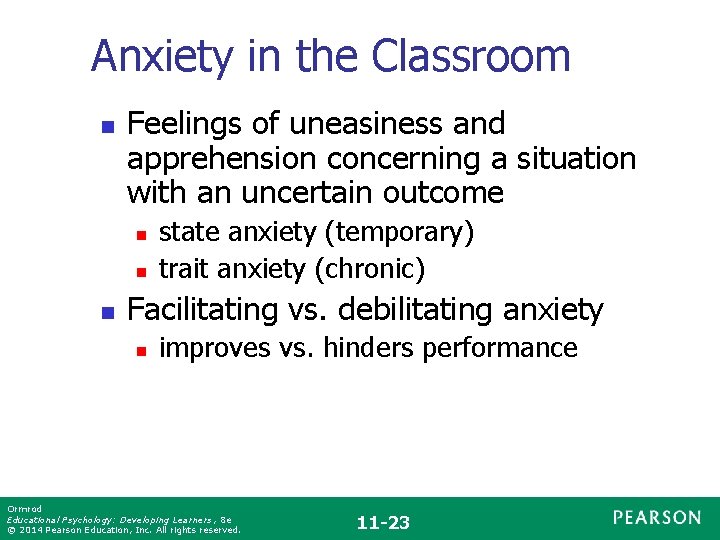
Anxiety in the Classroom n Feelings of uneasiness and apprehension concerning a situation with an uncertain outcome n n n state anxiety (temporary) trait anxiety (chronic) Facilitating vs. debilitating anxiety n improves vs. hinders performance Ormrod Educational Psychology: Developing Learners , 8 e © 2014 Pearson Education, Inc. All rights reserved. 11 -23
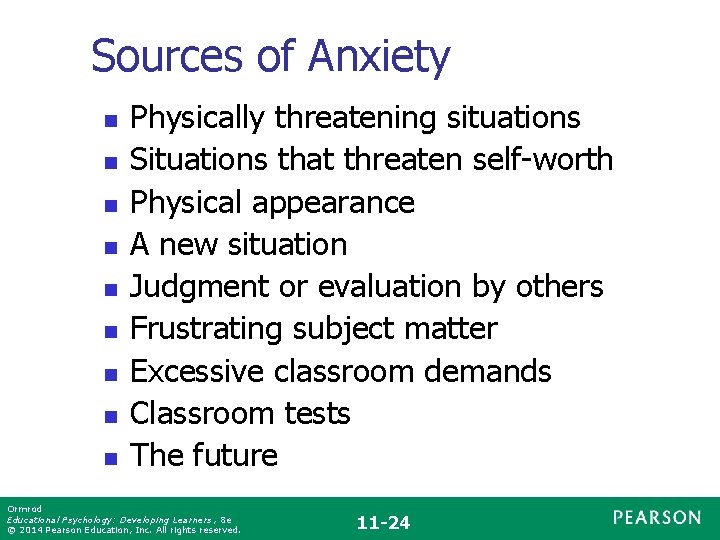
Sources of Anxiety n n n n n Physically threatening situations Situations that threaten self-worth Physical appearance A new situation Judgment or evaluation by others Frustrating subject matter Excessive classroom demands Classroom tests The future Ormrod Educational Psychology: Developing Learners , 8 e © 2014 Pearson Education, Inc. All rights reserved. 11 -24
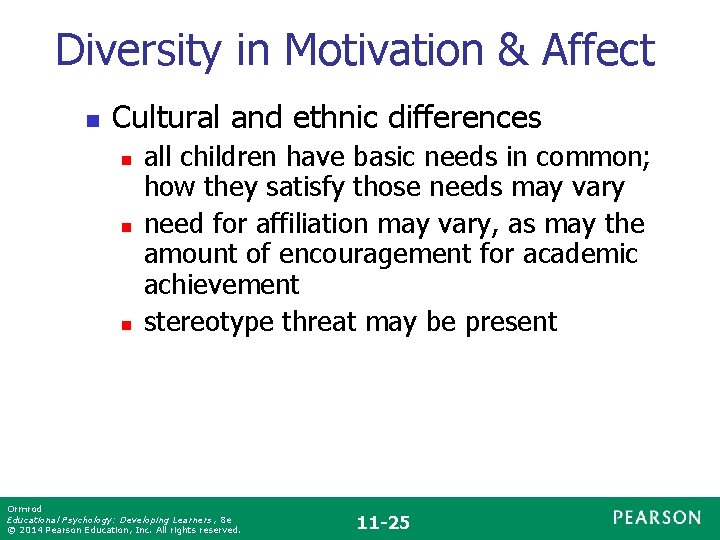
Diversity in Motivation & Affect n Cultural and ethnic differences n n n all children have basic needs in common; how they satisfy those needs may vary need for affiliation may vary, as may the amount of encouragement for academic achievement stereotype threat may be present Ormrod Educational Psychology: Developing Learners , 8 e © 2014 Pearson Education, Inc. All rights reserved. 11 -25
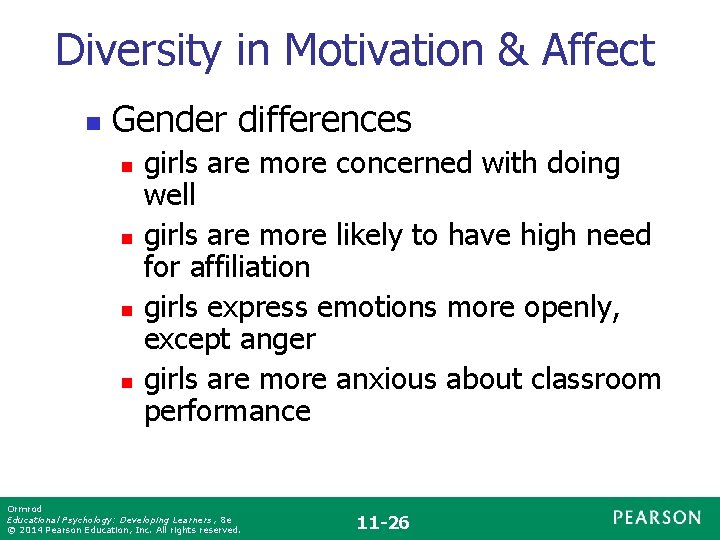
Diversity in Motivation & Affect n Gender differences n n girls are more concerned with doing well girls are more likely to have high need for affiliation girls express emotions more openly, except anger girls are more anxious about classroom performance Ormrod Educational Psychology: Developing Learners , 8 e © 2014 Pearson Education, Inc. All rights reserved. 11 -26
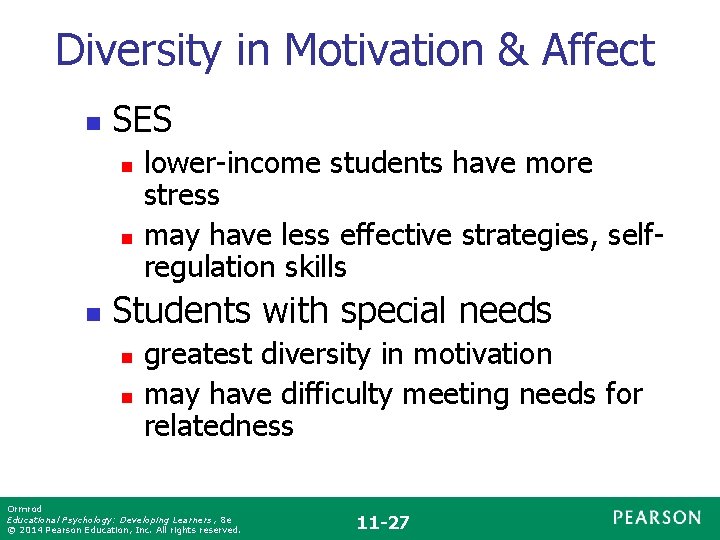
Diversity in Motivation & Affect n SES n n n lower-income students have more stress may have less effective strategies, selfregulation skills Students with special needs n n greatest diversity in motivation may have difficulty meeting needs for relatedness Ormrod Educational Psychology: Developing Learners , 8 e © 2014 Pearson Education, Inc. All rights reserved. 11 -27
The Big Picture Ormrod Educational Psychology: Developing Learners , 8 e © 2014 Pearson Education, Inc. All rights reserved. 11 -28
The Big Picture n n Motivation energizes, directs, and sustains behavior. Several basic needs seem to drive much of human behavior. Many forms of motivation have both cognitive and sociocultural elements. The emotions and general moods that learners bring to bear on a task—collectively known as affect—are closely intertwined with motivation. Ormrod Educational Psychology: Developing Learners , 8 e © 2014 Pearson Education, Inc. All rights reserved. 11 -29